Plan the reconstruction before entering theatre
- Templating is not just implant sizing; it is the plan for hip centre, leg length, offset, fixation, exposure and backup equipment.
- A poorly positioned or uncalibrated radiograph can make an accurate-looking template wrong.
- The acetabular plan sets hip centre, cup size, medialisation, inclination, version and bone coverage.
- The femoral plan sets stem size, fixation, neck cut, offset, version, leg length and need for special stems or osteotomy.
- The final implant decision is made intraoperatively after exposure, bone assessment, trial reduction, stability and leg-length checks.
- “Check the radiograph before templating: AP pelvis quality, rotation, calibration marker, lateral view and full femur when needed.
- “Templating the contralateral hip is helpful only if the opposite hip is normal and not itself dysplastic, arthritic or deformed.
- “Lengthening the leg without restoring offset and stability is not a good plan.
- “In complex anatomy, plan the backup before incision: smaller/larger stems, cemented option, modular stem, augments, cables, plates or dual mobility.
- “Spinopelvic stiffness changes functional cup position; a safe plan includes standing and sitting assessment when instability risk is high.
THA Templating and Preoperative Planning
Overview and Epidemiology
Preoperative planning for total hip arthroplasty is the process of deciding how the arthritic or fractured hip will be reconstructed before surgery. Templating is one part of that process: it estimates component size and position. The wider plan also covers exposure, fixation, leg length, offset, centre of rotation, stability risk, blood loss, implant inventory and bailout options.
Every hip needs a plan. A routine osteoarthritic hip still needs an AP pelvis, a lateral view and a clear plan for cup and stem sizing. A complex hip needs more. Dysplasia, protrusio, post-traumatic deformity, previous osteotomy, retained metalwork, childhood hip disease, fracture of the femoral neck, obesity, osteoporosis and spinal stiffness can all make a standard template misleading.
What templating does well. It clarifies the intended hip centre, the component size range, the neck cut, the offset option, the leg-length goal and the equipment list. It also makes the surgeon think the case through before the incision.
A template that predicts a stem or cup size is useful, but it is not the operation. It cannot assess real bone quality, guarantee press-fit, replace safe exposure, correct a bad radiograph, or remove the need for trial reduction and intraoperative judgement. The surgeon must still judge bone quality, press-fit, version, offset, leg length, stability and soft-tissue tension in theatre.
Planning is broader than component size
- Preoperative planning in primary THA is a structured reconstruction exercise.
- The plan includes restoration of anatomy, implant selection and anticipation of technical problems.
- The template helps the operation only when the image and assumptions are correct.
Pathophysiology and Mechanisms
Planning is biomechanical reconstruction. The native hip transmits load through a centre of rotation, a femoral offset, an abductor lever arm and a leg-length relationship, and THA changes these variables. If the reconstruction shortens offset, the abductors work at a disadvantage and the hip may feel weak or unstable. If length is overcorrected, the patient may have nerve stretch, pain or dissatisfaction.
Cup and stem errors. If the cup is placed too high or too lateral, hip mechanics and wear may suffer. If the femoral stem is undersized or malaligned, fixation may fail.
What the plan must set. These are the most important planning variables:
- Hip centre: restore or deliberately reconstruct the centre of rotation
- Cup position: size, medialisation, inclination, version, coverage and screw plan if needed
- Femoral fixation: cemented, cementless, hybrid, modular, long stem or special implant
- Neck cut: level and orientation that allow the planned stem and length restoration
- Offset: femoral and global offset, abductor tension and impingement-free motion
- Leg length: planned correction balanced against nerve and soft-tissue safety
- Version and stability: combined anteversion, impingement, spinopelvic mechanics and head/liner choice
Lengthening alone can make a hip tight without restoring abductor mechanics. Offset restoration improves abductor tension and stability, but excessive offset can increase soft-tissue tension and trochanteric pain. The plan must balance both.
Classification
For templating, classification should make the case easier to plan. The most useful one is a practical complexity assessment rather than a single named system: a standard primary, a complex primary, or a hip at high stability risk.
- Planning implication
- Contralateral hip may help estimate anatomy if normal.
- Typical action
- 2D digital template from calibrated AP pelvis and lateral hip.
- Planning implication
- Routine cemented or cementless fixation according to age and bone quality.
- Typical action
- Prepare expected size plus adjacent sizes.
- Planning implication
- Aim to restore anatomy and stability.
- Typical action
- Confirm intraoperatively with trials and landmarks.
Clinical Presentation and Assessment
Clinical assessment before templating is an operative planning assessment as well as the diagnosis of arthritis.
History. Ask about pain, walking distance, walking aids, instability symptoms, previous hip surgery, childhood hip disease, fracture history, spine disease, neurological disease, infection risk, anticoagulation, metal allergy history and the patient's priorities. Clarify any perceived leg-length inequality and shoe raises, and whether the patient would prefer equal length, stability or nerve safety if a trade-off is unavoidable.
Examination. Examine gait, the Trendelenburg sign, fixed flexion deformity, abduction contracture, true and apparent leg length, pelvic obliquity, lumbar stiffness, rotational profile, hip range of motion, abductor power, knee and foot deformity, and the neurovascular baseline. The examination helps explain why the radiographic plan may not match the functional limb length.
Pelvic obliquity. When it is fixed, apparent leg length may not equal bony leg length. Plan a standing assessment and counsel carefully.
Neurological symptoms. Baseline documentation is essential, and nerve stretch risk may limit lengthening. Document the preoperative status and avoid excessive lengthening.
Lumbar stiffness, abductor weakness and a previous femoral osteotomy also change the template; the planning response to each is set out in the Classification tables.
Imaging and Investigations
Radiograph quality determines template quality. If the image is not fit for planning, the safest decision is to repeat or extend imaging; a bad radiograph should be repeated rather than templated confidently.
The standard set. Each view, with what it shows or when it is needed:
- AP pelvis: centred, showing both hips, not a cropped hip alone. Teardrops, obturator foramina, lesser trochanters and proximal femora should be visible; check the obturator foramina, coccyx and lesser trochanters for malrotation.
- Cross-table lateral or lateral hip: femoral morphology, version clues, osteophytes and anterior/posterior deformity.
- Calibration marker: correctly placed at the level of the greater trochanter or hip where possible; poor marker position reduces accuracy.
- Full-length femur: previous fracture, osteotomy, deformity, retained implants, long stem planning or suspected canal abnormality.
- Standing and sitting lateral pelvis/spine: spinal stiffness, lumbar fusion, sagittal imbalance or high dislocation-risk planning.
Beyond plain films. Judet views, CT or EOS are used when routine views do not answer the question. CT or EOS is useful when two-dimensional templating cannot answer it: severe dysplasia, protrusio, post-traumatic deformity, previous osteotomy, rotational deformity, retained metalwork, custom implant planning or unclear acetabular bone stock. Three-dimensional planning can improve anatomical understanding and size prediction in complex cases, but it does not remove the need for intraoperative judgement.
Radiographic magnification and marker placement matter
- A PHANTOM study, not a patient study: a 25 mm external calibration marker was imaged at eight object-to-image distances, three source-to-image distances and several imaging conditions, and measured by three radiographers
- The magnification factor ranged from 1.16 to 1.40 depending on geometry alone - a 21 per cent spread produced purely by how the film was taken, which is more than a whole implant size
- The extremes are instructive: the smallest magnification came from an 8 cm object-to-image distance at 120 cm with the marker in the central ray and the detector in the table bucky; the largest from a 15 cm object-to-image distance at 100 cm with the detector under an emergency department trolley
- The authors' practical recommendation is specific: place the external calibration marker MEDIALLY, between the patient's internally rotated legs, at the level of the greater trochanter
Calibration systems and projection error
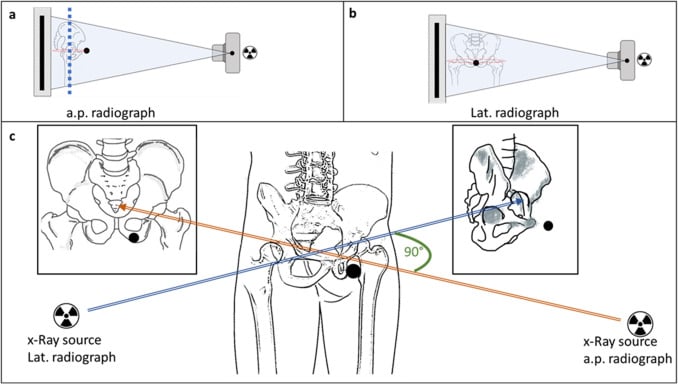
The single marker. Magnification error changes component sizing. A spherical marker of known diameter provides a scale for magnification correction, but a marker displaced anteriorly or posteriorly from the hip plane no longer shares the femoral magnification factor.
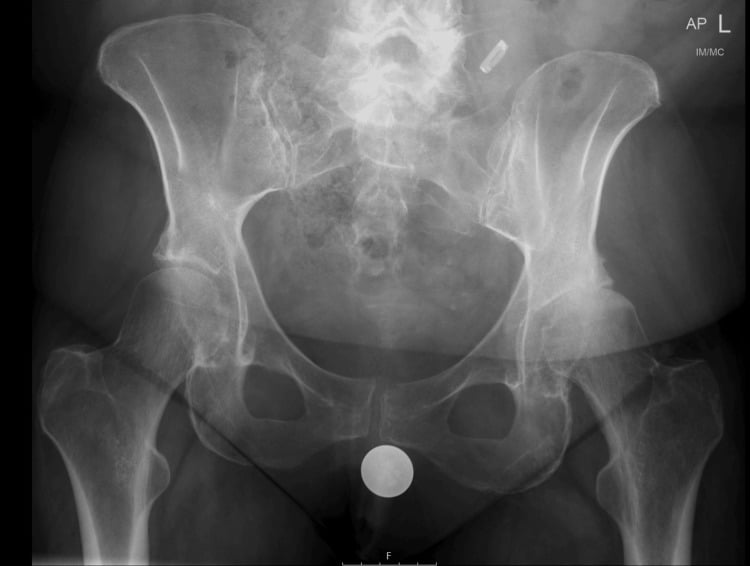
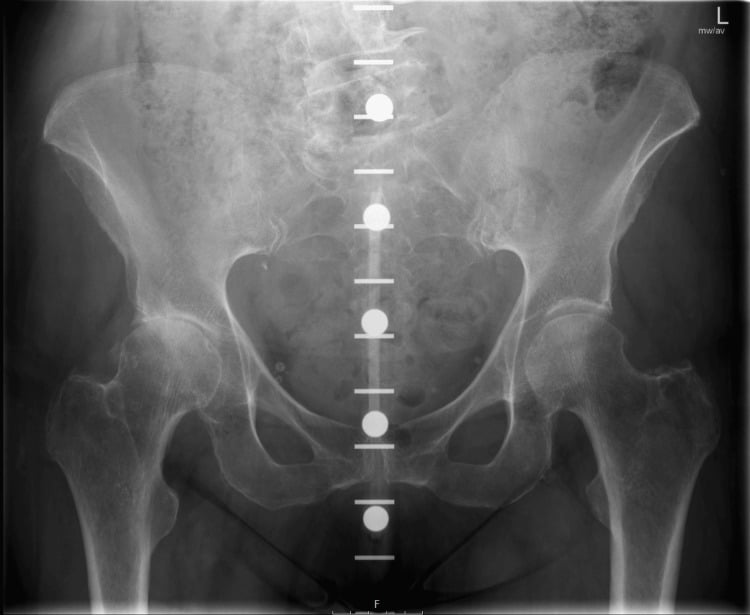
The KingMark system. It combines a radiopaque ruler over the pelvis with a mobile sphere between the thighs. Two reference planes reduce dependence on estimating the depth of a single marker.
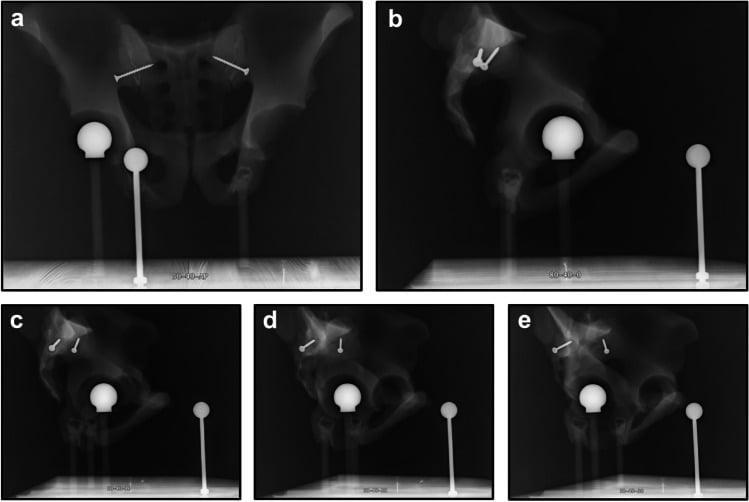
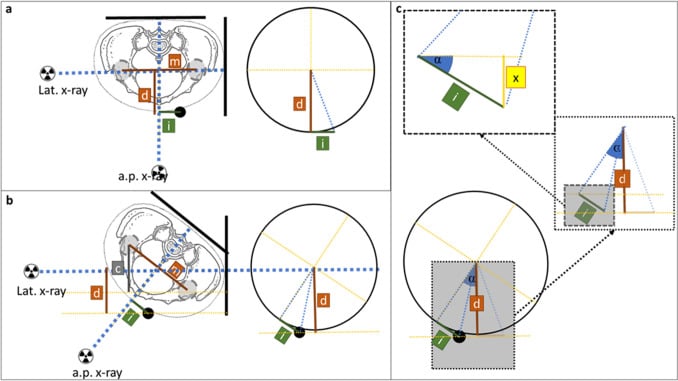
Rotation and projection. Marker presence alone does not guarantee reliable calibration. Pelvic rotation and lateral marker offset alter the measured marker-to-hip distances in AP and lateral views; the error is geometric, not a failure of the templating software. Orthogonal AP and lateral beams allow the marker's three-dimensional relationship to the hip centre to be reconstructed, whereas non-orthogonal projections make inferred marker depth and magnification unreliable.
Management
Management here is the planning process itself: the decisions made before the incision that determine whether the operation is straightforward. The plan has three parts: the acetabular plan, the femoral plan, and the backup for when the hip does not behave as templated.
Plan the cup before the stem. The hip centre affects length, offset, abductor mechanics and cup coverage. Identify the teardrop, native acetabular floor, superolateral acetabular margin and intended hip centre, then choose a cup size that gives stable bone contact without excessive medialisation, over-reaming or loss of bone stock.
- Decision
- Restore native centre or deliberately plan a safe alternative.
- Key risk
- High or lateral centre can impair mechanics.
- Decision
- Estimate size and adjacent sizes.
- Key risk
- Oversizing can fracture or remove bone; undersizing can be unstable.
- Decision
- Use controlled medialisation to improve coverage when appropriate.
- Key risk
- Protrusio or thin medial wall needs protection.
- Decision
- Plan safe orientation adjusted for anatomy and spinopelvic risk.
- Key risk
- Malposition increases instability, edge loading and wear.
- Decision
- Plan screws, graft, augments, cage or custom options when needed.
- Key risk
- Unrecognised deficiency leads to poor fixation.
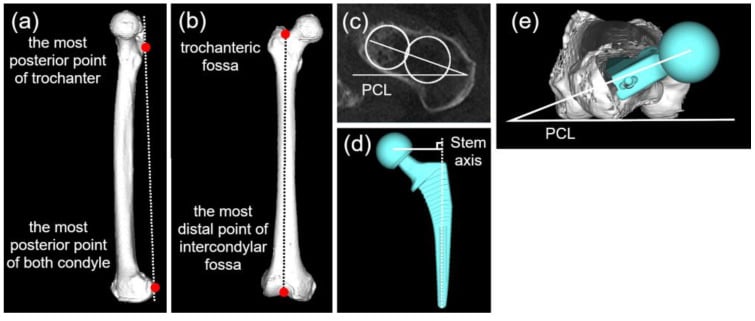
Two numbers anchor cup positioning. The Lewinnek "safe zone" (radiographic) is cup inclination 40 plus or minus 10 degrees and anteversion 15 plus or minus 10 degrees; dislocations cluster outside it, though it is necessary rather than sufficient (many dislocations occur with cups inside it, the basis of the functional-target debate). The second concept is combined anteversion = cup anteversion + femoral stem anteversion, targeted at roughly 25 to 50 degrees (around 37 degrees); Widmer's rule formalises this as cup anteversion + 0.7 times stem anteversion of about 37 degrees, the principle being that cup and stem version must be planned together for impingement-free, stable motion. In the stiff or fused spine the functional cup target shifts (less pelvic-tilt change standing-to-sitting), so a standing and sitting assessment, not the static Lewinnek box alone, should set the goal.
Surgical Technique
Templating technique should be systematic and repeatable.
- Confirm patient, side and image quality.
- Calibrate magnification using a marker at hip level when available.
- Draw or recognise pelvic reference lines and check rotation.
- Template the acetabulum: hip centre, cup size, medialisation, inclination, coverage and screw plan.
- Template the femur: neck cut, stem size, fixation, offset option, version and canal fit.
- Compare planned reconstruction with the contralateral side only if the opposite hip is reliable.
- Estimate leg-length correction and offset restoration.
- Record the expected sizes and adjacent sizes.
- List implants, instruments and backup equipment.
- Reassess the plan intraoperatively after exposure, trialling and stability testing.
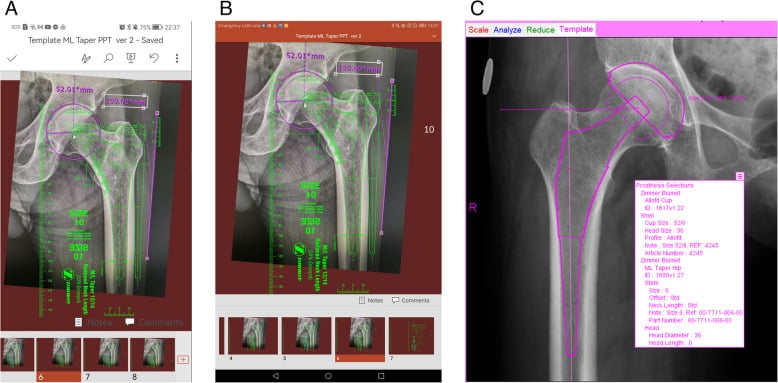
The overlay. A calibrated AP pelvis is translated into component decisions by scaling and rotating cup and stem outlines against bone. The overlay should restore hip centre, length and offset while adjacent implant sizes remain available.
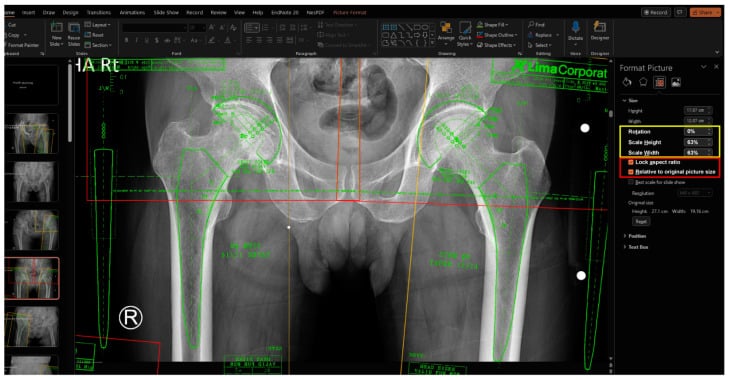
The device. Smartphone, tablet and conventional software perform the same operative task: calibrate, scale, rotate and seat the stem outline in the canal, then record size, neck length and offset. The device does not replace anatomical checks.
Complex Planning
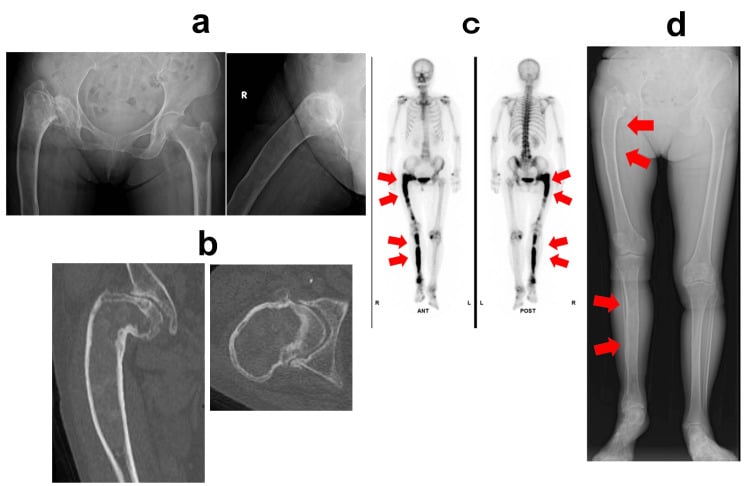
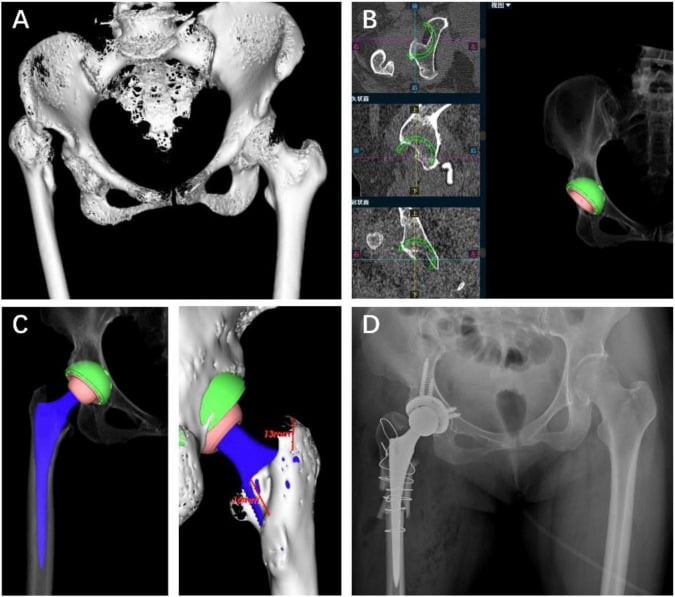
Complex primary THA should be recognised before the day of surgery; the patterns, and the imaging and implants each adds, are tabulated under Classification. Hip centre, acetabular deficiency, femoral canal shape, version, shortening, offset and backup implants all need to be considered before theatre. The cases below show how CT, three-dimensional models and digital component simulation change the plan in dysplasia and severe femoral deformity.
When plain films are not enough. In a severely deformed femur, plain AP templating alone cannot safely select fixation or stem geometry.
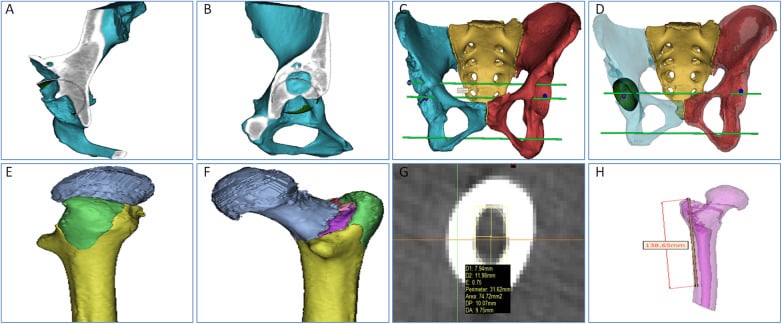
Three-dimensional planning in dysplasia. When deformity makes two-dimensional outlines inadequate, multiplanar CT and a three-dimensional model quantify true-acetabular bone stock, transfer the contralateral hip centre, size and position the cup, and simulate femoral reconstruction.
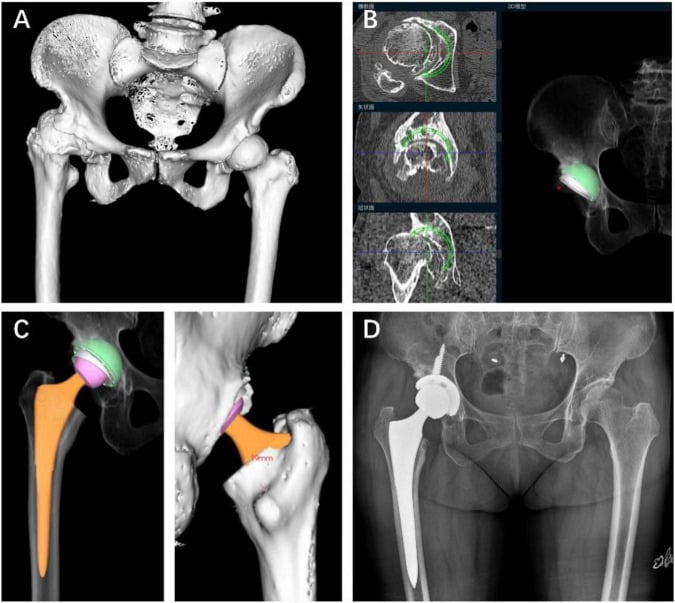
Sizing each component, then the construct. In Crowe II dysplasia, the CT reconstruction permits separate cup and stem sizing before their combined reconstruction is checked on the postoperative radiograph; coverage, hip centre, canal fit and offset are planned together. The plan can also show that the stem will not fit. In a Crowe IV post-septic hip the planned stem exceeds the available femoral bony envelope, and recognising that mismatch before theatre triggers alternative stem geometry, osteotomy and fracture-control options.
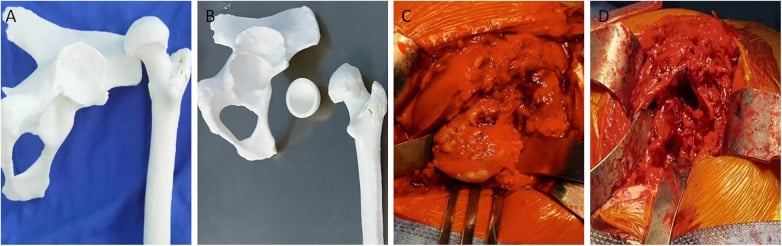
Rehearsing the operation. Patient-specific models define the true and pseudo-acetabula and the planned reconstruction before exposure. A useful plan predicts what the surgeon will encounter.
Complications
Templating errors are not theoretical: they appear as operative and postoperative complications.
- Planning failure
- Clinical and radiographic length were not reconciled.
- Prevention
- Assess pelvic obliquity, true/apparent length and planned correction.
- Planning failure
- Offset was reduced or trochanteric mechanics were ignored.
- Prevention
- Template femoral and global offset and trial abductor tension.
- Planning failure
- Spinopelvic stiffness, component position or soft-tissue tension was not planned.
- Prevention
- Assess stability risk and plan cup orientation, head/liner and offset.
- Planning failure
- Stem was oversized or bone quality underestimated.
- Prevention
- Prepare adjacent sizes, cables and cemented option.
- Planning failure
- Acetabular deficiency or protrusio was missed.
- Prevention
- Plan bone stock, medial wall, screw fixation, graft or augment.
- Planning failure
- Inventory was not matched to the plan.
- Prevention
- Record expected and backup sizes before theatre.
Clinical Pitfalls
- Why it fails
- Cup position, length and offset estimates are distorted.
- Safer approach
- Repeat imaging or interpret with caution.
- Why it fails
- Magnification can make the planned implant size wrong.
- Safer approach
- Use marker, known implant, or prepare adjacent sizes.
- Why it fails
- Anterior bowing, femoral shape and deformity can be missed.
- Safer approach
- Always review lateral and full femur when indicated.
- Why it fails
- The other hip may also be dysplastic, arthritic or deformed.
- Safer approach
- Use it only if it is genuinely normal.
Why It Matters
What poor planning costs. Poor planning causes predictable problems: the wrong components available, a poor exposure strategy, inadequate restoration of leg length or offset, a malpositioned hip centre, an unstable trial reduction, intraoperative fracture, unplanned conversion to cement, metalwork that cannot be removed, or a rushed decision to use an implant that is not ideal.
What good planning buys. It improves theatre efficiency and reduces avoidable surprises. It also improves consent, because the surgeon can explain why the hip is routine or complex, what reconstruction is intended and what alternatives may be needed if the anatomy is different from the radiograph.
Guidelines, Registries and Global Practice
THA is one of the most studied operations in orthopaedics, with more than one million primaries performed worldwide each year and registries tracking implant survival across millions of cases. Planning principles are globally consistent, but imaging access and implant availability vary widely.
Global epidemiology
- Hip osteoarthritis is the dominant indication in high-income settings; in many lower- and middle-income regions, sequelae of childhood hip disease, dysplasia, post-traumatic deformity and avascular necrosis make a larger share of the templating workload, raising the proportion of complex primaries.
- Demand is rising with ageing populations; THA volumes are projected to increase substantially over the coming decades across most registry nations.
Society guidance, side by side
- Emphasis relevant to templating
- Evidence-based management of hip osteoarthritis and shared decision-making before arthroplasty.
- Practical takeaway
- Plan documented reconstruction goals and consent before listing.
- Emphasis relevant to templating
- Standardised pathways, calibrated digital templating and implants with strong registry survivorship (ODEP ratings).
- Practical takeaway
- Choose implants with proven survival and template on quality images.
- Emphasis relevant to templating
- Restoration of hip biomechanics: centre of rotation, offset and leg length.
- Practical takeaway
- Plan biomechanics, not just implant size.
- Emphasis relevant to templating
- Spinopelvic assessment and functional cup orientation in at-risk patients.
- Practical takeaway
- Add standing and sitting imaging when instability risk is high.
Registry signals that inform planning
- Large arthroplasty registries (NJR for England, Wales, Northern Ireland and the Isle of Man; AOANJRR Australia; AJRR US; the Swedish and Norwegian registries; NZJR) track revision and implant survival by fixation, bearing and head size.
- Registry-level findings that shape the plan: larger femoral heads and dual-mobility constructs reduce dislocation-related revision; cemented fixation lowers periprosthetic fracture risk in older patients with poor bone; and implant choice should favour constructs with documented long-term survivorship rather than novel designs without registry data.
High- versus limited-resource practice
- Well-resourced setting
- Calibrated digital radiographs, CT or EOS for complex cases, commercial software.
- Limited-resource setting
- Plain film with acetate overlays or a known-diameter marker; PACS plus tablet templating shown to match commercial software.
- Well-resourced setting
- Full range plus backup stems, augments, dual mobility and revision options on the shelf.
- Limited-resource setting
- Restricted range; plan around available sizes and prepare cemented fallback.
- Well-resourced setting
- 3D planning, custom or modular implants, navigation.
- Limited-resource setting
- Greater reliance on careful 2D planning, contralateral comparison and intraoperative judgement.
When asked to justify an implant, a strong answer anchors to registry survivorship and biomechanical restoration rather than personal preference. Choosing a construct with proven long-term survival and planning offset, leg length and stability is more defensible than chasing a novel design.
Areas of Uncertainty and Controversy
Templating is mature but several questions remain genuinely debated, and examiners reward a candidate who can state both sides.
- Argument for
- Randomised data show far higher exact size and offset prediction than 2D.
- Argument against / nuance
- Added radiation, cost and time; most primary hips are reconstructed accurately with good 2D radiographs plus intraoperative trialling.
- Argument for
- Magnification varies widely with habitus and geometry, so markers reduce sizing error.
- Argument against / nuance
- Marker malposition can introduce its own error; some series show little size difference with versus without a marker (KingMark data).
- Argument for
- Reduces dislocation in spinopelvic-imbalance and high-risk patients.
- Argument against / nuance
- Concerns over intraprosthetic dislocation, cost and lack of very long-term registry data in younger patients.
- Argument for
- Spinopelvic imbalance moves the functional safe zone; static Lewinnek targets miss it.
- Argument against / nuance
- No single validated functional target; over-correction can create new impingement.
- Argument for
- Speeds planning and may standardise output.
- Argument against / nuance
- Still requires verification against the actual radiograph and intraoperative judgement; not a replacement for the surgeon.
MCQ Practice Points
Q: What are the Lewinnek safe-zone values, and what is the caveat an examiner is listening for? A: Cup inclination 40 plus or minus 10 degrees and anteversion 15 plus or minus 10 degrees - the most-tested pair in hip templating. The caveat earns the mark: dislocations cluster outside the zone but a large share occur inside it, so the zone is necessary but not sufficient. That is precisely why the functional-target debate exists, and why spinopelvic assessment is added in high-risk patients.
Q: Why is combined anteversion planned rather than cup anteversion alone? A: Because impingement is a property of the construct, not of either component. Target combined anteversion of roughly 25 to 50 degrees, and Widmer's rule expresses the relationship as cup anteversion plus 0.7 times stem anteversion, approximately 37 degrees. Cup and stem version are therefore planned together, and one can be used to compensate for the other.
Q: How accurate is 2D digital templating, and what does that imply for theatre? A: Within one size is the honest ceiling. Holzer's 632-patient series predicted the exact size in only 42 per cent of femoral and 37 per cent of acetabular components, but was within one size in 87 and 78 per cent. The implication is operational rather than intellectual: the plan is the expected size plus the adjacent sizes made available, and femoral accuracy in particular falls with an inexperienced planner and a higher BMI.
Q: Does biplanar or 3D imaging template better than plain radiographs? A: For SIZE, yes. EOS predicted the exact cup and stem size in 71 and 66 per cent of 43 hips and within one size in 98 per cent, significantly better than conventional radiographs, and with a lower radiation dose. CT-based 3D planning predicted both component sizes exactly in 96 per cent against 16 per cent for 2D. But note the limit: EOS did not significantly improve femoral offset prediction (83 against 80 per cent, p = 0.341). Access, not accuracy, is the practical constraint.
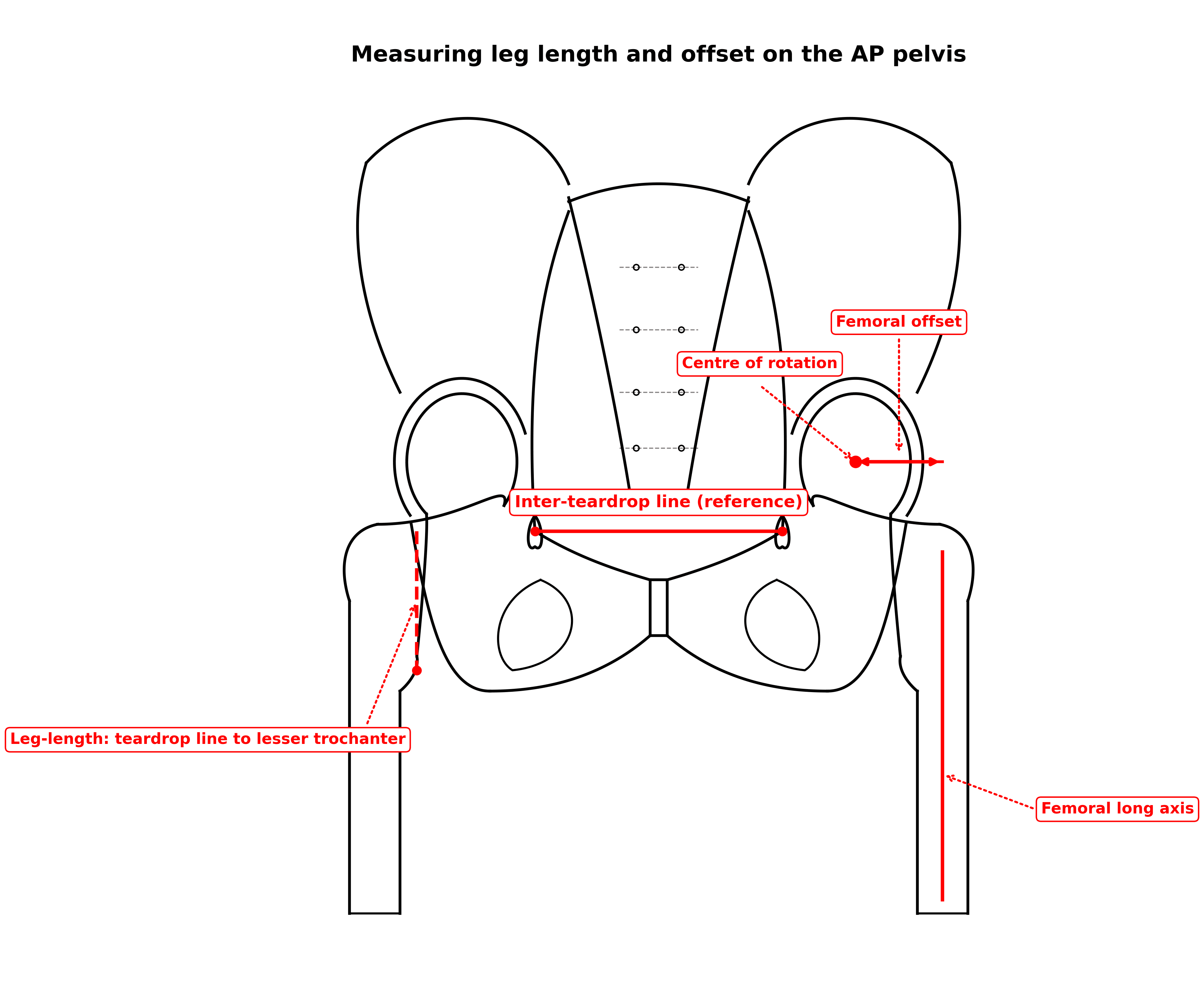
Q: How is leg-length discrepancy actually measured on an AP pelvis, and how is offset defined? A: Examiners want the method, not the concept. Draw a horizontal reference line - the inter-teardrop line - then measure the perpendicular distance to the same landmark, usually the lesser trochanter, on each side; the side-to-side difference is the bony discrepancy. Global offset is femoral plus acetabular offset, femoral offset being the perpendicular distance from the femoral axis to the centre of rotation. Plan the two together, because neck cut and stem choice trade leg length against offset.
Q: The stem shows a rotated, uncalibrated pelvis with no usable contralateral hip. What is the answer? A: That the image must be adequate before any size estimate is trusted. Templating questions are usually radiograph problems rather than knowledge problems. Magnification is not a constant: a phantom study varied it from 1.16 to 1.40 through radiographic geometry alone, a 21 per cent spread that exceeds one implant size, and the calibration marker should sit medially, between internally rotated legs, at the level of the greater trochanter. An uncalibrated film makes the template approximate, and a template is a plan rather than a promise.
References
- 1Della Valle AG, Padgett DE, Salvati EA. "Preoperative planning for primary total hip arthroplasty.". Journal of the American Academy of Orthopaedic Surgeons. 2005PubMed
- 2Alnahhal A, Aslam-Pervez N, Sheikh HQ. "Templating Hip Arthroplasty.". Open Access Macedonian Journal of Medical Sciences. 2019PubMed
- 3Colombi A, Schena D, Castelli CC. "Total hip arthroplasty planning.". EFORT Open Reviews. 2019PubMed
- 4Holliday M, Steward A. "Pre-operative templating for total hip arthroplasty: How does radiographic technique and calibration marker placement affect image magnification?". Journal of Medical Radiation Sciences. 2021PubMed
- 5Whiddon DR, Bono JV. "Digital templating in total hip arthroplasty.". Instructional Course Lectures. 2008PubMed
- 6Sariali E, et al.. "Accuracy of the preoperative planning for cementless total hip arthroplasty. A randomised comparison between three-dimensional computerised planning and conventional templating.". Orthopaedics and Traumatology: Surgery and Research. 2012PubMed
- 7Holzer LA, et al.. "The accuracy of digital templating in uncemented total hip arthroplasty.". Archives of Orthopaedic and Trauma Surgery. 2019PubMed
- 8Pongkunakorn A, et al.. "Digital Templating of THA Using PACS and an iPhone or iPad is as Accurate as Commercial Digital Templating Software.". Clinical Orthopaedics and Related Research. 2023PubMed
- 9Girgis SF, et al.. "The Accuracy of Digital Preoperative Templating in Primary Total Hip Replacements.". Cureus. 2023PubMed
- 10Buller LT, et al.. "EOS Imaging is Accurate and Reproducible for Preoperative Total Hip Arthroplasty Templating.". Journal of Arthroplasty. 2021PubMed
Summary
THA templating is a structured reconstruction plan. Start with adequate calibrated imaging, define the clinical goal, then plan the acetabulum, femur, leg length, offset, stability and backup implants. The plan should be specific enough to prepare theatre and consent the patient, but flexible enough to change when the bone, trials or stability assessment prove that the template is wrong.
Clinical Scenarios
Practise clinical reasoning and management decisions out loud
“A 68-year-old has end-stage hip osteoarthritis and is listed for primary THA. The AP pelvis has a calibration marker, but the pelvis is rotated and the lateral hip is poor. How do you proceed with templating?”
“A patient with severe dysplastic hip arthritis is planned for THA. The femur is narrow and anteverted, the acetabulum is deficient and the leg is short. What changes in your preoperative plan?”
“A 72-year-old with a previous L3 to S1 lumbar fusion is listed for primary THA for osteoarthritis. The referring team asks whether anything changes in your planning. What is your approach to templating and component selection?”
Core Principle
- Templating is a reconstruction plan, not just implant sizing.
- Bad radiographs produce bad plans.
- The intraoperative trial must confirm or change the preoperative plan.
Image Set
- AP pelvis, lateral hip and calibration marker are standard.
- Full femur is needed for deformity, previous osteotomy, retained implants or long stems.
- Standing and sitting spine-pelvis views are useful for high instability-risk patients.
Acetabulum
- Plan hip centre, cup size, medialisation, inclination, version and coverage.
- Check protrusio, dysplasia and bone deficiency before theatre.
- Prepare screws, graft, augments or revision shells when indicated.
Femur
- Plan fixation, stem size, neck cut, offset, version and canal fit.
- Prepare adjacent sizes and backup fixation.
- Cemented, modular, long or narrow stems may be needed in complex anatomy.
Biomechanics
- Restore leg length and offset together.
- Account for pelvic obliquity and spine stiffness.
- Trial stability and impingement before accepting final implants.
Pitfalls
- No calibration marker, rotated pelvis and poor lateral view.
- Blindly copying the opposite hip.
- No backup sizes or stability strategy.
- Ignoring spinopelvic mechanics in high-risk patients.
Evidence Summary
The literature supports templating as a useful planning tool, but not as a perfect size predictor. Digital templating commonly predicts implant size within one size in many series, with accuracy affected by radiograph quality, calibration, body habitus, implant system, surgeon experience and abnormal anatomy. Three-dimensional planning may improve anatomical understanding and size prediction in complex cases, but routine primary THA still depends on good radiographs and intraoperative judgement.
Templating Hip Arthroplasty
- A systematic review comparing acetate overlay against digital methods, including single-marker and double-marker calibration
- Its stated conclusion is that preoperative templating produces 'an enormous increase in the accuracy' of THA and that, among the methods compared, the KING MARK is the most reliable
- NOTE ON VERIFICATION: the PubMed abstract for this review contains BACKGROUND, AIMS, METHODS and CONCLUSION but NO RESULTS SECTION - no number of included studies, no pooled estimate and no effect size. The conclusion cannot be checked against any reported data here
Digital templating accuracy and its limits
- Exact size prediction was achieved in only 42% of femoral and 37% of acetabular components, but 87% of femoral and 78% of acetabular components were accurate within one size.
- Femoral templating was significantly more reliable when performed by a senior surgeon than a resident.
- BMI affected the FEMORAL side only, and the detail matters: planning was significantly more inaccurate in OVERWEIGHT patients than in normal-weight patients, whereas the differences seen in OBESE patients were NOT statistically significant. Acetabular accuracy was unaffected by BMI or by experience
- Prosthesis design and patient sex had no influence on size prediction