Saddle Joint Degeneration | Beak Ligament Failure | Grind Test | Eaton-Littler Staging
- Saddle joint anatomy - unique biaxial motion allows opposition and circumduction
- Anterior oblique (beak) ligament is primary stabiliser - failure leads to subluxation
- Grind test is pathognomonic - axial compression with rotation reproduces pain
- Eaton-Littler staging guides treatment - Stage I-II conservative, III-IV surgical
- Trapeziectomy with LRTI is gold standard - 90%+ satisfaction, preserves motion
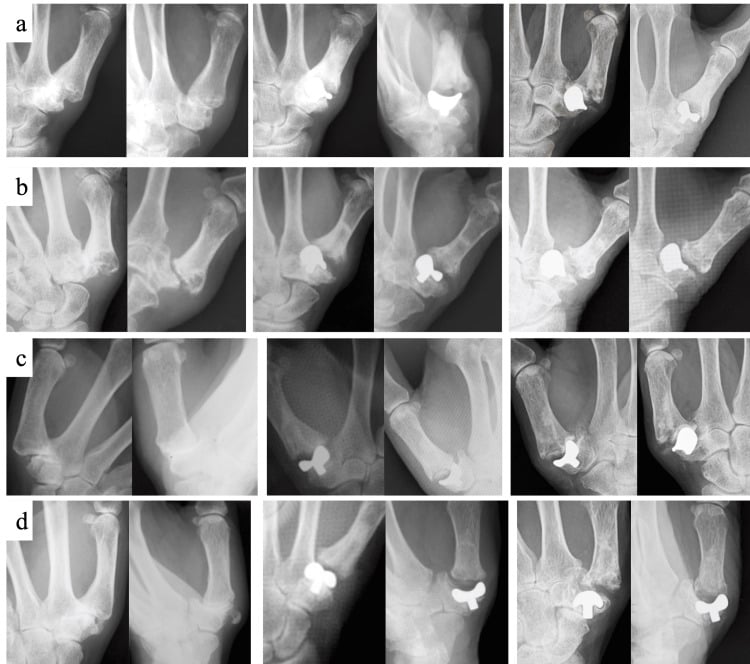
- CMC arthroplasty emerging option - preserves height but higher complication rate
- “CMC arthritis is the most common site of hand osteoarthritis
- “Anterior oblique ligament (beak ligament) is the key primary restraint
- “Grind test positive = pain with axial load and rotation of thumb metacarpal
- “Stage IV includes scaphotrapezial-trapezoid (STT) joint involvement
- “Attribution: the original 1973 Eaton-Littler paper described the early staging and volar ligament reconstruction; the four-stage system incorporating pan-trapezial disease as Stage IV is the 1987 Eaton-Glickel modification
- “LRTI = Ligament Reconstruction and Tendon Interposition
- “FCR is most commonly used donor tendon for LRTI
Overview and Epidemiology
Thumb carpometacarpal (CMC) arthritis, also called trapeziometacarpal osteoarthritis or basilar joint arthritis, is osteoarthritis of the articulation between the first metacarpal and the trapezium. It is the most common site of osteoarthritis in the hand.
Who. Prevalence rises with age, and the disease affects up to 33% of postmenopausal women, with a female-to-male ratio of approximately 15:1. It is bilateral in 40-70% of cases. The most common symptomatic presentation is Stage II-III disease.
Risk factors. Several are recognised:
- Female sex (hormonal factors, ligamentous laxity)
- Age over 50 years
- Previous trauma or fracture
- Repetitive pinch activities (occupational)
- Joint laxity or hypermobility
- Genetic predisposition
Anatomy and Pathophysiology
The joint. The trapezium, a bone of the distal carpal row, and the base of the first metacarpal carry reciprocally curved saddle surfaces, each concave in one plane and convex in the other. This saddle (sellar) joint is biaxial, with two degrees of freedom, flexion-extension and abduction-adduction, and it permits opposition and circumduction. Opposition is a combination of abduction, flexion and pronation, the pronation component coming from muscle action.
The load. The shape that grants the wide, opposable arc of thumb motion also makes the joint intrinsically unstable, so it depends on ligaments to resist the shear generated by pinch. Contact stresses during pinch reach up to 120 kg/cm² (12 MPa), concentrated on a small articular surface of 1-2 cm², and it is the ligamentous restraints that prevent subluxation under these loads. High stress on a small surface is what predisposes the joint to cartilage degeneration.
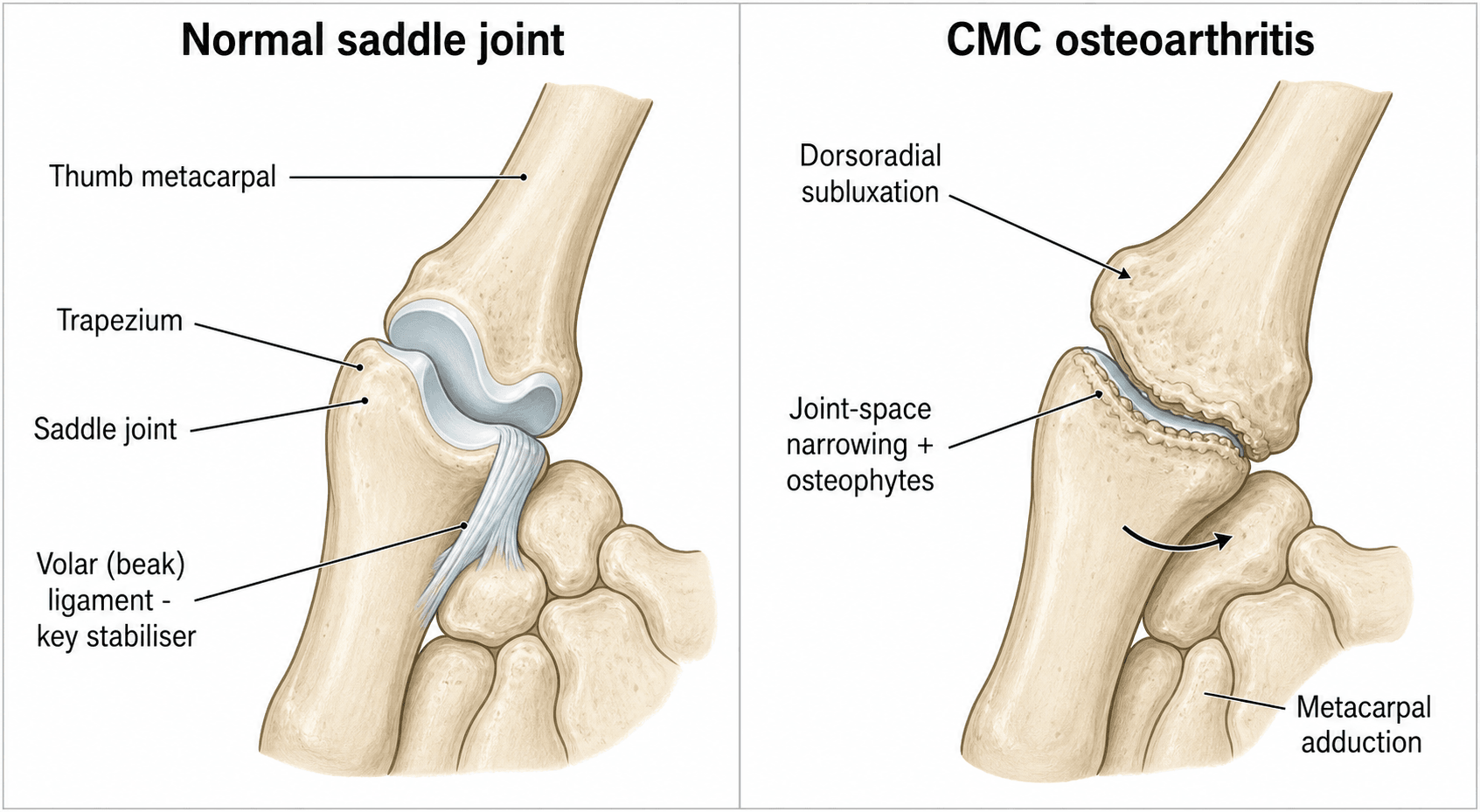
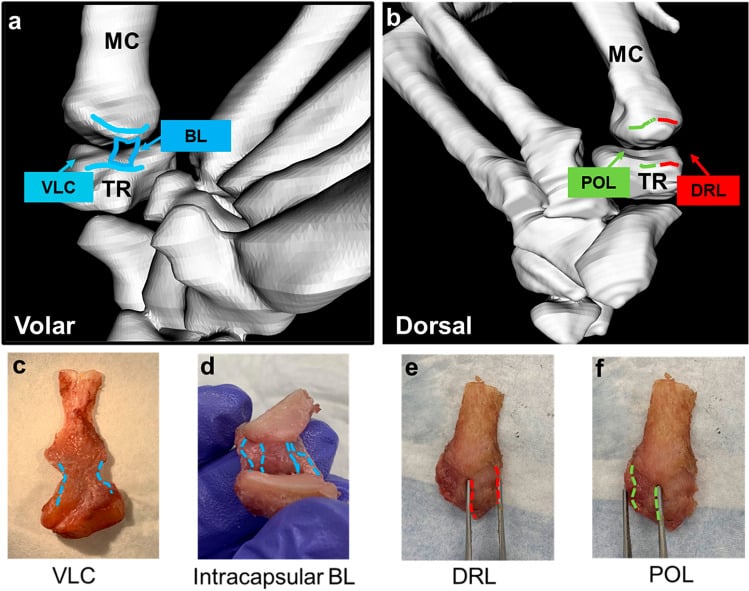
The ligaments. Sixteen ligaments have been described around the joint. The key structures:
- Location
- Volar-ulnar, beak-shaped
- Function
- Primary restraint to dorsoradial subluxation
- Clinical Significance
- Failure is initiating event in arthritis
- Location
- Dorsal-radial
- Function
- Secondary restraint
- Clinical Significance
- Contributes to stability in extension
- Location
- Between MC1 and MC2
- Function
- Prevents dorsal subluxation
- Clinical Significance
- May be used for reconstruction
- Location
- Dorsal aspect
- Function
- Restraint in flexion
- Clinical Significance
- Less critical than AOL
Which ligament fails. The anterior oblique ligament is the primary restraint to dorsoradial subluxation, and its attenuation is the initial pathological event.
The anterior oblique ligament (AOL) is also called the beak ligament because of its shape. It originates from the volar-ulnar tubercle of the trapezium and inserts on the volar-ulnar aspect of the metacarpal base. It is the primary restraint and its attenuation is the initial pathologic event. Think of it as the ACL of the thumb CMC joint.
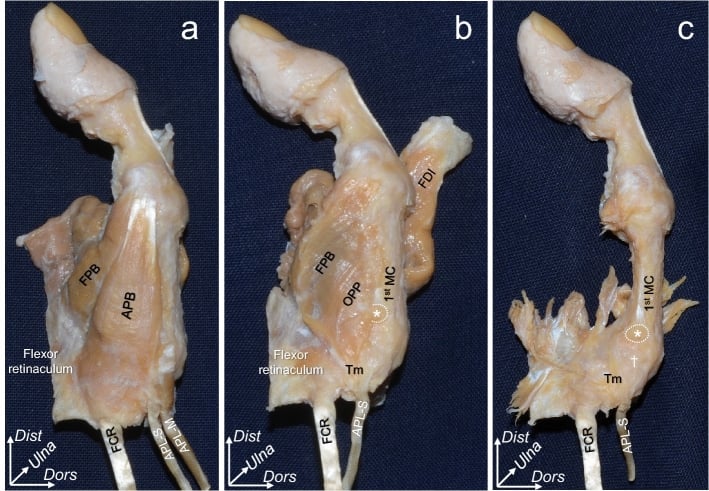
Muscle and capsule. The thenar muscles are part of the joint restraint: abductor pollicis brevis, opponens and flexor pollicis brevis blend with the radial capsule. Their deforming pull explains the metacarpal adduction that follows once the passive restraints are gone. In the capsule, the dorsal and radial portion is substantial while the volar structures are thinner and more variable, and that distribution of capsular thickness is the anatomical basis for the direction in which the metacarpal subluxes.
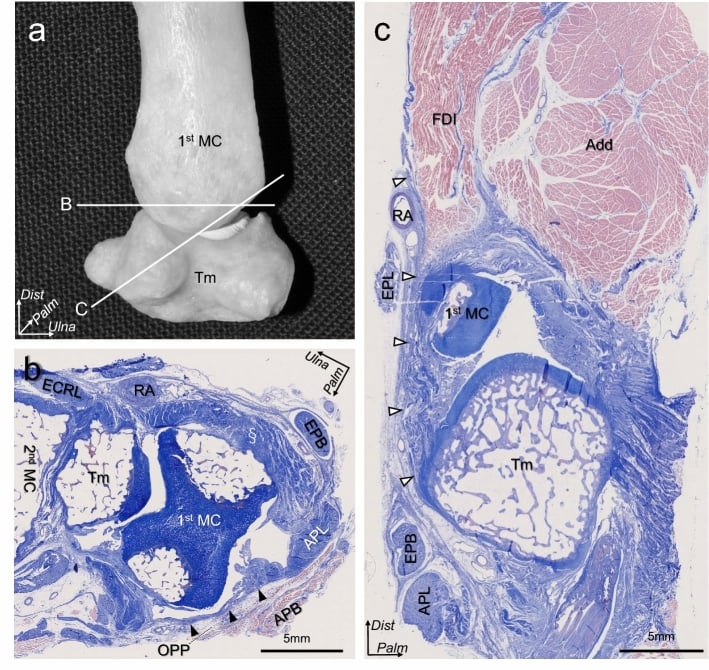
The cascade. The disease runs from ligament to cartilage to deformity. Once the ligament attenuates, the metacarpal base slides dorsoradially off the trapezium, and the eccentric loading that results destroys the cartilage.
Anterior oblique ligament stretches or partially tears, often from repetitive microtrauma or hormonal-related laxity. Joint kinematics become abnormal with subluxation during pinch.
Dorsoradial subluxation of the metacarpal base occurs with pinch. Altered contact areas and increased peak stresses damage articular cartilage.
Progressive cartilage loss with fibrillation, fissuring, and full-thickness defects. Subchondral bone exposure and sclerosis. Osteophyte formation at joint margins.
Severe joint space loss, large osteophytes, cyst formation. Adduction contracture develops. In Eaton-Littler Stage IV, pantrapezial arthritis with STT joint involvement.
The deformity. The unstable metacarpal collapses into adduction, which is why advanced disease often drives a compensatory hyperextension of the metacarpophalangeal joint. The secondary deformities:
- Adduction contracture, narrowing the first web space
- Dorsoradial subluxation of the metacarpal base, a prominent "shoulder" at the base
- MCP hyperextension, compensating for the adduction (the swan-neck of the thumb)
- Z-deformity, the zig-zag of adduction at the CMC, hyperextension at the MCP and flexion at the IP joint
The hyperextended MCP and the contracted first web are both surgical decisions, taken in their own sections below.
Classification Systems
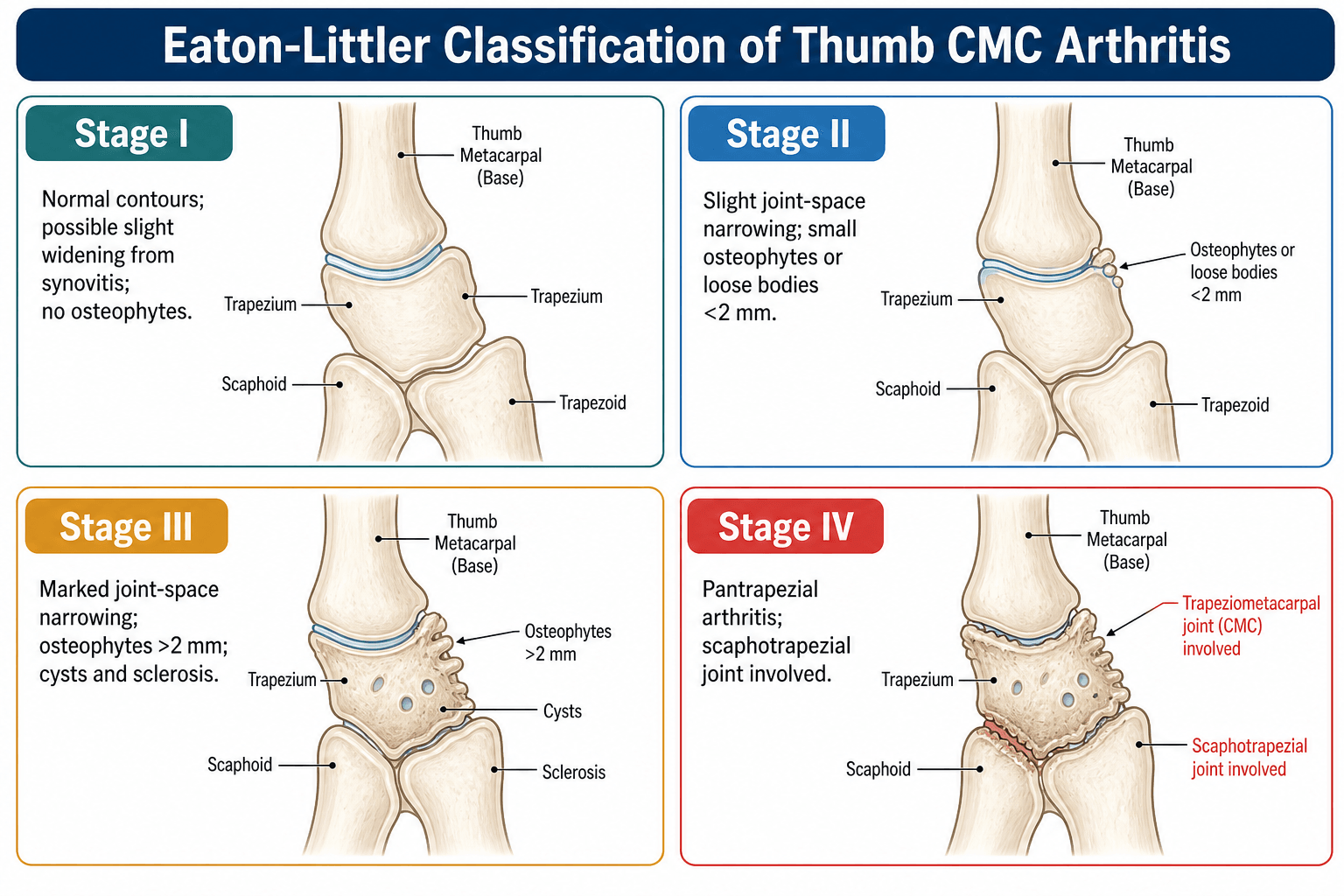
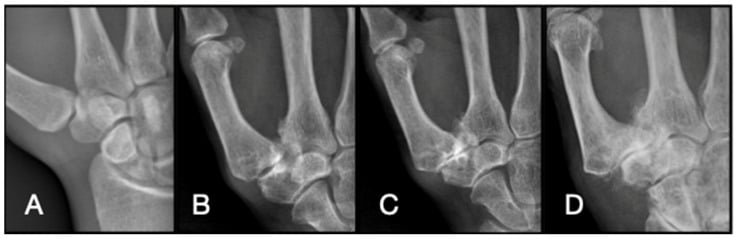
The Eaton-Littler classification (modified Eaton classification) is the standard staging system for thumb CMC arthritis. It is based on radiographic findings, and it guides treatment decisions.
- Radiographic Findings
- Normal joint space or slight widening; no osteophytes; possible joint effusion (synovitis); subluxation may be present on stress views
- Clinical Picture
- Pain with activities; tenderness over the CMC joint; grind test positive; pinch strength maintained
- Radiographic Findings
- Joint space narrowing (less than normal but still present); small osteophytes or bone debris under 2mm; possible sclerosis; subluxation may be apparent
- Clinical Picture
- Pain with pinch and grasp; thenar pain and tenderness; reduced pinch strength (20-30% loss); positive grind test; some limitation of thumb motion
- Radiographic Findings
- Severe narrowing or complete loss of joint space; large osteophytes over 2mm; subchondral sclerosis and cysts; dorsoradial subluxation; STT joint normal (the key differentiator from Stage IV)
- Clinical Picture
- Significant pain with activities and at rest; thenar atrophy; marked pinch weakness (50%+ loss); adduction contracture; positive grind test; palpable osteophytes; squaring of the thumb base
- Radiographic Findings
- All Stage III findings at the CMC joint plus scaphotrapezial-trapezoid (STT) arthritis: STT joint space narrowing and osteophytes at multiple trapezial articulations
- Clinical Picture
- As Stage III but more extensive pain; pain over the STT joint (radial side of wrist); tenderness over the scaphoid tuberosity; more severe functional limitation; potential radiocarpal arthritis symptoms
Where patients present. Stage I is relatively uncommon, as patients often present later. Stage II is the transition zone between conservative and surgical treatment, and Stage III is the most common presentation requiring surgery.
The defining feature of Stage IV is involvement of the STT joint (scaphotrapezial-trapezoid articulation). This is pantrapezial arthritis. Treatment requires addressing the STT joint, either with trapeziectomy (which removes the trapezium articulating with scaphoid) or with combined procedures like STT fusion.
Clinical Presentation and Examination
History. The complaint is pain at the base of the thumb and difficulty with pinch. The pain is worse with pinching, opening jars, turning keys and writing, and its onset is often gradual, over months to years. Grip strength falls and activities of daily living become difficult.
What shapes the plan. Ask what has been tried already (splinting, NSAIDs, injections), which hand is dominant, since that affects functional expectations, and whether the work is heavy manual labour or sedentary.
Look. The thumb base is squared by the prominence of dorsoradial subluxation and osteophytes. Look for thenar atrophy in advanced cases, an adduction contracture reducing the first web space, the compensatory MCP hyperextension of the Z-deformity, and skin changes overlying the joint.
Feel. Tenderness lies directly over the CMC joint, volar and dorsal. Palpate for osteophytes as bony prominences at the base, crepitus with joint motion, and the soft-tissue fullness of synovitis.
Move. Measure opposition, thumb tip to the base of the small finger (the Kapandji score), and abduction as the width of the first web space. Radial and palmar abduction are often reduced, and extension may show compensatory MCP hyperextension.
- Technique
- Axial compression of thumb metacarpal with rotation
- Positive Finding
- Pain and/or crepitus reproduced
- Sensitivity
- Very high (pathognomonic)
- Technique
- Stabilise trapezium, translate metacarpal dorsally and volarly
- Positive Finding
- Pain, crepitus, or excessive translation
- Sensitivity
- High for instability
- Technique
- Radial deviation of wrist with compression
- Positive Finding
- Pain over STT joint (Stage IV)
- Sensitivity
- Moderate for STT involvement
- Technique
- Key pinch (lateral) and tip pinch measured
- Positive Finding
- Reduced compared to contralateral (greater than 30%)
- Sensitivity
- Functional assessment
The grind test is the most specific examination finding for CMC arthritis. Hold the thumb metacarpal, apply axial compression (pushing the base toward the trapezium), and rotate the metacarpal. Pain and crepitus are pathognomonic. The test reproduces the high contact stresses that occur during pinch.
- Pain Location
- Volar/dorsal base of thumb
- Key Test / Sign
- Grind test positive; squaring of base
- Discriminating Feature
- Pain reproduced by axial load + rotation; narrowing on Robert view
- Pain Location
- Radial styloid (1st extensor compartment)
- Key Test / Sign
- Finkelstein / Eichhoff positive
- Discriminating Feature
- Tenderness 1-2cm proximal to CMC joint; grind test negative
- Pain Location
- Distal scaphoid / radial wrist
- Key Test / Sign
- STT tenderness; STT narrowing on imaging
- Discriminating Feature
- Defines Eaton-Littler stage IV when combined with CMC disease
- Pain Location
- Anatomical snuffbox
- Key Test / Sign
- Snuffbox tenderness; scaphoid views
- Discriminating Feature
- Trauma history; proximal to CMC joint
- Pain Location
- Volar wrist over FCR tendon
- Key Test / Sign
- Pain on resisted wrist flexion
- Discriminating Feature
- Linear tenderness along tendon, not over joint
- Pain Location
- Volar wrist / radial 3.5 digits
- Key Test / Sign
- Tinel/Phalen, nerve conduction studies
- Discriminating Feature
- Paraesthesia and night symptoms; may coexist with CMC OA
Two further mimics are worth knowing. First dorsal compartment arthritis is rare and worth considering if de Quervain symptoms persist, and a trigger thumb locks and catches at the IP or MCP joint rather than hurting at the joint line.
Investigations and Imaging
Radiographs. The standard series for CMC arthritis:
- PA view of the hand - joint space narrowing, osteophytes and the subluxation pattern
- Lateral view of the hand - dorsal subluxation and osteophyte size
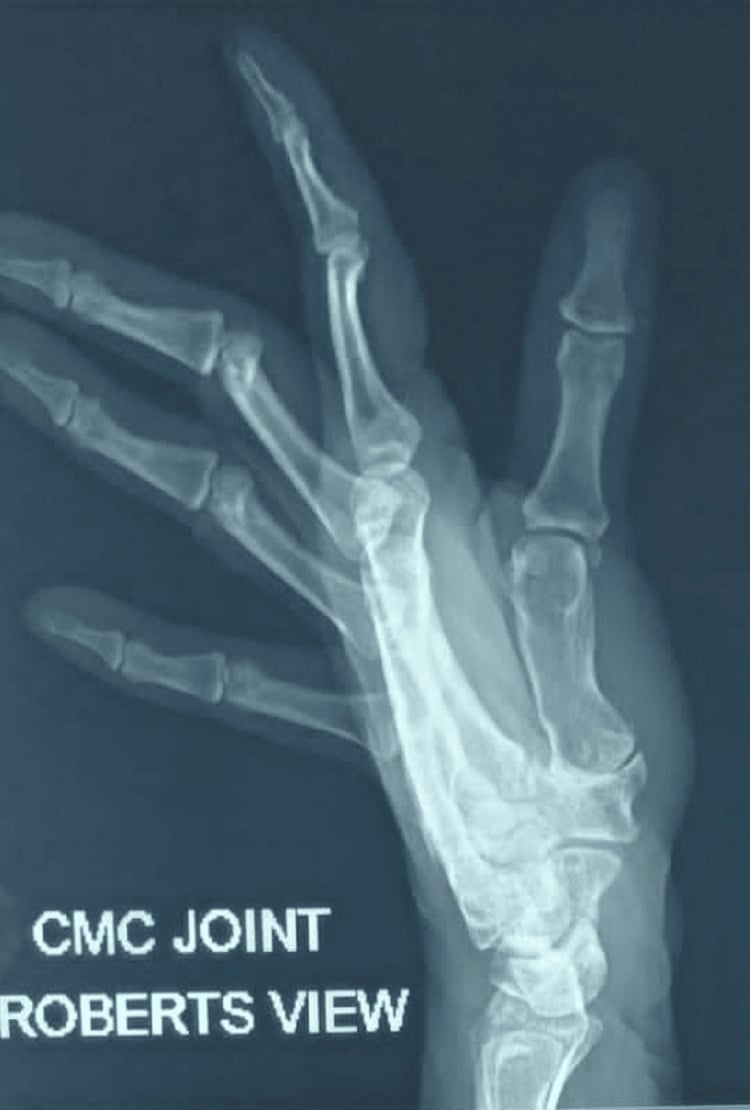
- Robert view (Bett view, stress AP) - a true AP of the CMC joint, the best view for joint space narrowing and subluxation, and the most useful for staging
- Eaton stress view - taken during resisted tip pinch to demonstrate dynamic subluxation, useful in early (Stage I-II) disease
The Robert view is the most important radiograph for CMC arthritis. With the forearm fully pronated and the thumb extended and opposed, its dorsum flat on the cassette, it profiles the whole trapeziometacarpal articulation without the metacarpal overlapping it. A standard hand PA consistently understages this joint.
What the films decide. Together, PA, oblique and lateral films show the joint space, the position of the osteophytes and the degree of dorsal subluxation, which is what determines whether a simple trapeziectomy will suffice.
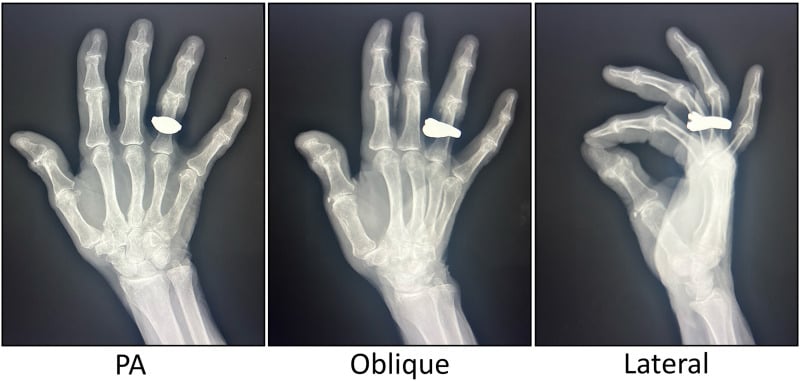
Both thumbs. Because the disease is so often bilateral, assess and film both thumbs. The asymptomatic side often shows the same radiographic stage, and that informs the conversation about future surgery.
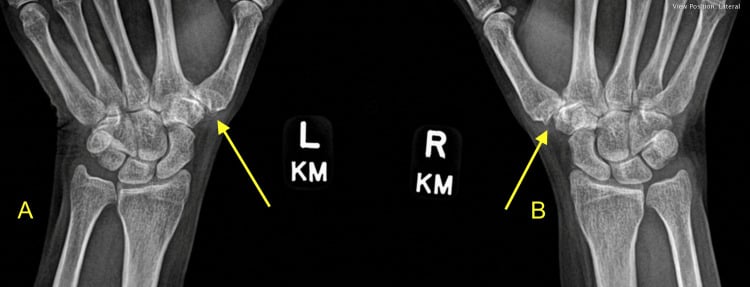
MRI is not routinely required for diagnosis. It may be useful to assess the integrity of the AOL, the severity of synovitis, the articular cartilage, occult fractures, and the STT joint when the radiograph is equivocal.
CT is rarely indicated. It may help in planning an arthrodesis, in assessing complex deformity, and after failed prior surgery.
Ultrasound can assess synovitis and guide injections, but its role is limited compared with radiographs.
Injection. A diagnostic injection of local anaesthetic into the CMC joint confirms the joint as the source when it relieves the pain, and distinguishes it from de Quervain tenosynovitis or STT arthritis. A therapeutic corticosteroid injection may give temporary relief for weeks to months, and it helps select appropriate surgical candidates.
Management Approach
The decision. Management is led by symptoms and demand more than by the radiographic stage. Early disease with tolerable symptoms is treated non-operatively first, and surgery is for symptoms that persist despite that trial or for advanced disease.
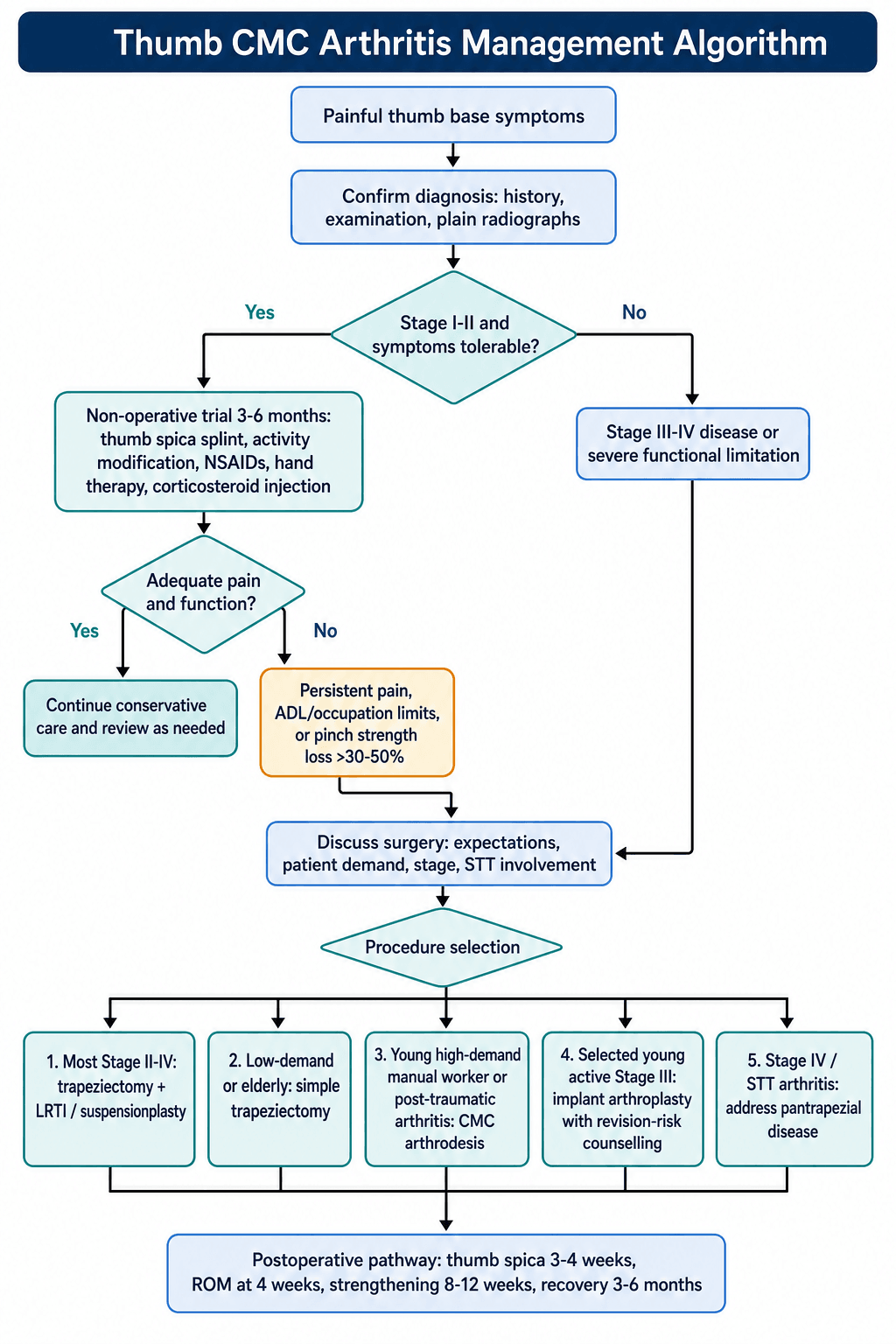
Non-operative treatment. Stage I-II disease starts with a trial of 3-6 months:
- Thumb spica splinting (removable, worn during activities and at night)
- Activity modification (avoid repetitive pinch)
- NSAIDs, oral or topical
- Hand therapy (strengthening, range of motion, adaptive equipment)
- Corticosteroid injection, up to 3 attempts
40-60% of patients achieve adequate symptom control, with better outcomes in Stage I-II disease.
When to operate. Consider surgery for:
- Failure of conservative management for 3-6 months
- Persistent pain affecting function
- Significant functional limitation (activities of daily living, occupation)
- Pinch strength loss greater than 30-50%
- Patient motivation for surgical intervention
- Stage III-IV disease (earlier surgical consideration)
These indications apply to properly selected patients with realistic expectations.
Choosing the operation. The choice depends on patient factors, stage, surgeon preference and evidence. The options by stage:
- First-Line Treatment
- Thumb spica splinting, NSAIDs, activity modification, corticosteroid injection (diagnostic and therapeutic)
- Surgical Options
- Arthroscopic synovectomy (rarely indicated)
- First-Line Treatment
- Conservative trial of 3-6 months: splinting in a functional position, NSAIDs, activity modification, corticosteroid injection
- Surgical Options
- If conservative treatment fails: trapeziectomy with LRTI, ligament reconstruction alone (volar ligament reconstruction), arthroscopy with debridement (limited role)
- First-Line Treatment
- Primarily surgical; surgery if conservative treatment fails
- Surgical Options
- Trapeziectomy with LRTI (gold standard), simple trapeziectomy, CMC arthroplasty (hemiarthroplasty or total joint), arthrodesis (young labourers), haematoma distraction arthroplasty (Burton procedure)
- First-Line Treatment
- Surgery addressing all involved joints
- Surgical Options
- Trapeziectomy with LRTI (most common), combined trapeziectomy and STT fusion, extended trapeziectomy, complete arthrodesis, four-corner fusion (if severe wrist arthritis), total wrist arthrodesis (salvage)
What the evidence says. Trapeziectomy with LRTI is taught as the gold standard. The studies in the evidence section qualify that. The Cochrane review found no procedure superior to another for pain or function, and Vermeulen's systematic review found no evidence that LRTI beats simpler trapeziectomy while it carried a higher complication rate, which leaves simple trapeziectomy a defensible default as well. LRTI is the standard operation; it has not been shown to be the better one.
Surgical Techniques
Who. Stage II-IV disease with failed conservative treatment. It is the primary surgical option for most patients and the standard procedure with the best long-term evidence.
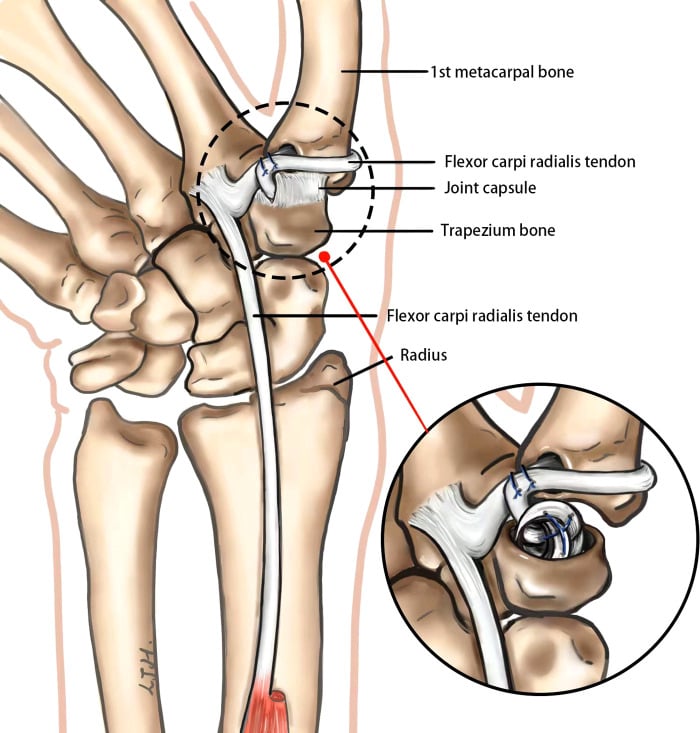
The operation. LRTI is Ligament Reconstruction and Tendon Interposition, after Burton and Pellegrini, with variations. The trapezium is removed completely, a tendon slip suspends the first metacarpal (the suspensionplasty), and the remaining tendon fills the trapezial space as a spacer. Flexor carpi radialis is the most commonly used donor.
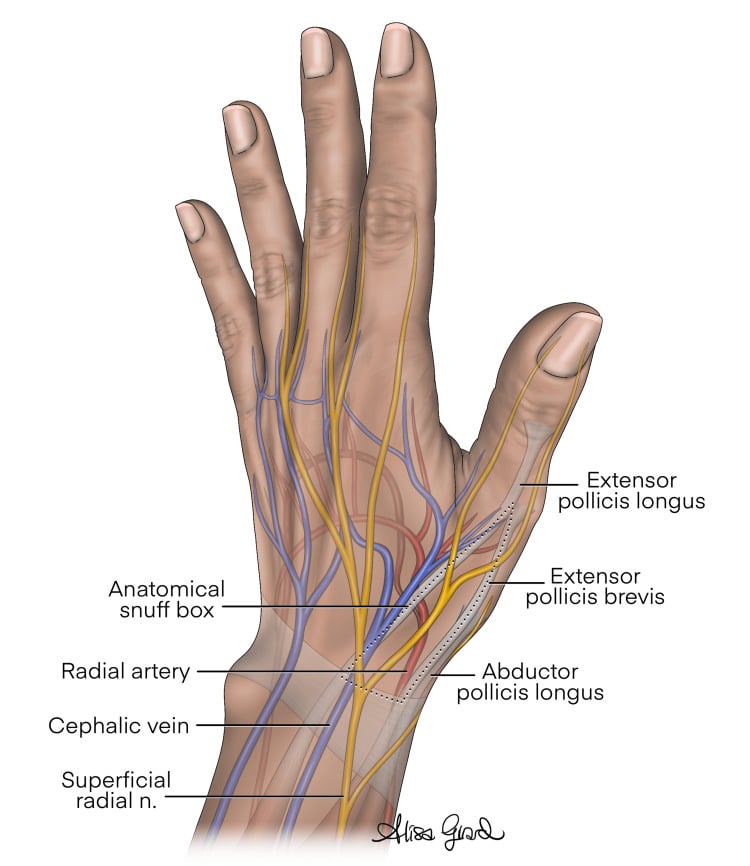
- Approach. Dorsal or volar, volar being more common, through a Wagner incision longitudinally over the thenar eminence or a Brunner incision. Identify and protect the radial sensory nerve branches and the palmar cutaneous branch of the median nerve.
- Trapeziectomy. Identify the CMC joint and trapezium and dissect circumferentially around the trapezium, protecting FCR (volar approach) or ECRB (dorsal approach). Remove the trapezium completely, ensure no fragments remain, and inspect the STT joint (Stage IV).
- Tendon harvest. Harvest half the width of FCR (most common) or the entire APL. For FCR, make a distal window and retrieve the tendon with a stripper, leaving the proximal attachment intact; 10-12 cm is typically adequate, long enough for weaving.
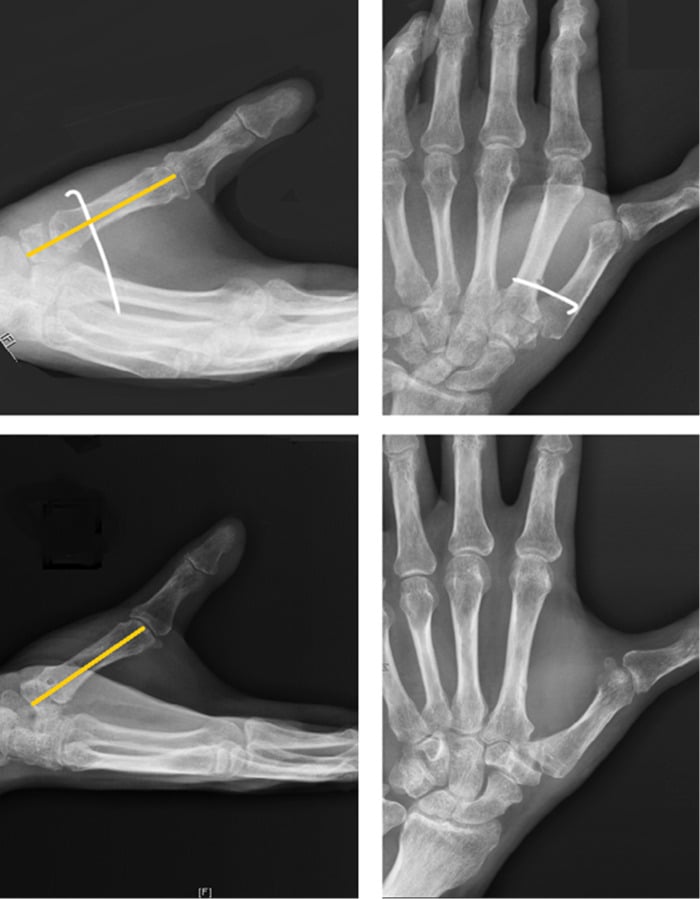
- Ligament reconstruction. Drill a hole in the metacarpal base (dorsal-radial to volar-ulnar), with a second hole in the index metacarpal base or passage through the FCR tunnel. Thread the tendon through the metacarpal hole and create a sling or anchor that suspends the first metacarpal, preventing proximal migration and subsidence.
- Tendon interposition. Roll the remaining tendon into a ball or figure-of-eight, place it in the trapezial space as a spacer, and suture it to the capsule to prevent migration. It maintains the space and prevents subsidence.
- Closure. Repair the capsule, close the skin, and apply a thumb spica splint with the IP joint free.
Technical points. Complete removal of the trapezium is essential, because retained trapezium causes pain. Take only half the width of FCR so that wrist flexion is preserved, FCU compensating for the half harvested. Tension the suspension adequately but not too tight. The interposed tendon prevents bone-on-bone contact, and the construct maintains thumb height and strength.
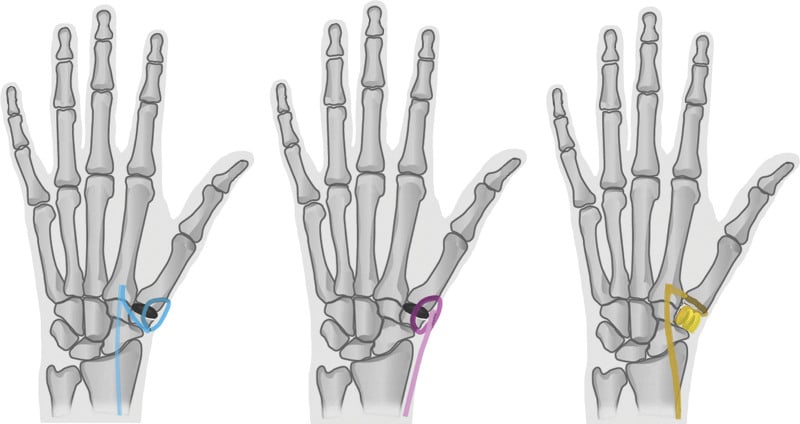
Why the sequence matters. Each surgical step changes thumb mechanics: dividing the volar plate, excising the trapezium, then reconstructing by the Weilby technique and adding an extensor pollicis brevis tenodesis. Understanding the sequence explains why partial procedures leave residual instability.
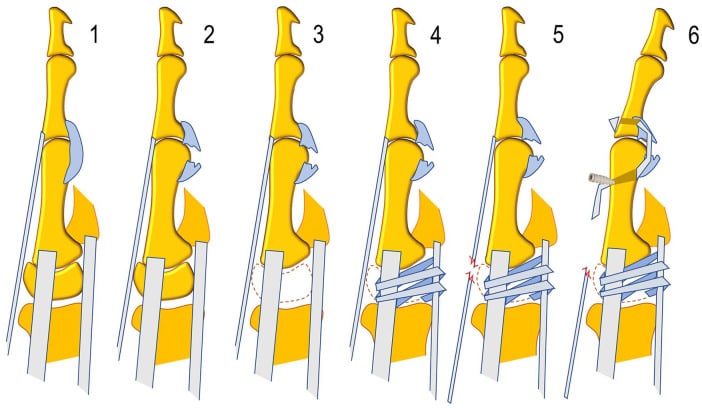
Managing the Hyperextended MCP Joint
The Z (collapse) deformity described earlier, CMC adduction with compensatory MCP hyperextension (the thumb "swan-neck"), has a surgical corollary that is repeatedly examined. A significantly hyperextending thumb MCP must be addressed at the same sitting as the CMC procedure.
Why. Left uncorrected, the deforming force persists, and the trapeziectomy or reconstruction is more likely to fail with recurrent adduction and weak pinch. Assess the MCP passively at surgery and choose by the magnitude and correctability of the hyperextension.
- Problem
- Minor; does not drive recurrence
- Option at the Same Sitting
- Usually no specific MCP procedure needed
- Problem
- Contributes to collapse and weak pinch
- Option at the Same Sitting
- Temporary MCP pinning in about 20-30 degrees of flexion for around 4 weeks, with or without volar capsulodesis
- Problem
- Perpetuates the Z-deformity and threatens the reconstruction
- Option at the Same Sitting
- Volar plate capsulodesis, sesamoid arthrodesis, or EPB-to-metacarpal transfer
- Problem
- Cannot be corrected by soft tissue alone
- Option at the Same Sitting
- MCP arthrodesis in slight (about 15-20 degrees) flexion
The Adducted Thumb and First Web Space Contracture
The adduction contracture and first-web narrowing listed among the secondary deformities are also a surgical decision point. Advanced disease pulls the first metacarpal into adduction, narrowing the first web and limiting grasp and opposition.
Why. Removing the trapezium does not open a contracted web on its own, so a fixed contracture that is not released limits the abduction and opposition surgery can restore and blunts its functional benefit. Assess the web pre-operatively and grade the release by severity.
- Finding
- Web narrowed but passively correctable
- Release at the Time of Surgery
- Therapy and stretching; trapeziectomy alone usually restores the web as the metacarpal falls back
- Finding
- Tight adductor pollicis and deep fascia
- Release at the Time of Surgery
- Adductor pollicis recession/release from its third-metacarpal origin, with or without first dorsal interosseous release
- Finding
- Contracted web skin limiting abduction
- Release at the Time of Surgery
- Web deepening with a four-flap (or Z-) plasty, or a local rotation flap
Complications of Surgical Treatment
Early complications are those in the first 6 weeks.
- Incidence
- 5-10%
- Management
- Observation (most resolve), neuroma excision if persistent
- Prevention
- Careful dissection, protect nerve branches
- Incidence
- 1-2%
- Management
- Antibiotics, wound care, possible debridement
- Prevention
- Perioperative antibiotics, sterile technique
- Incidence
- 2-3%
- Management
- Compression, drainage if large
- Prevention
- Haemostasis, drain consideration
- Incidence
- 1-5%
- Management
- Early mobilisation, therapy, medications
- Prevention
- Early ROM, avoid prolonged immobilisation
The radial sensory nerve. It is the structure most often injured. Its branches fan across the snuffbox directly over the surgical field, and longitudinal incisions with blunt dissection and formal identification of the branches is the only reliable protection against a painful neuroma.
Postoperative Care and Rehabilitation
- Thumb spica splint or cast for 3-4 weeks, including the wrist and the thumb CMC and MCP joints, with the IP joint free for motion
- Elevate the hand to reduce swelling
- Suture removal at 2 weeks
- Splint removed at 4 weeks and gentle range of motion begun: thumb opposition, radial and palmar abduction, CMC and MCP flexion-extension
- Progress to active range of motion without resistance
- Custom splint for protection during activities
- Scar massage and desensitisation
- Progressive resistance exercises
- Pinch strengthening (putty, grippers) and grip strengthening
- Functional activities training
- Gradual return to work on light duties
- Full range of motion usually achieved by 3 months; avoid heavy lifting until 3 months
- Strengthening continues for 6 months
- Return to unrestricted activities at 3-6 months; heavy manual labour may require 6 months
- Maximal improvement at 6-12 months
What to expect. Pain is relieved in 90-95% of patients, and pinch strength recovers to 80-90% of the contralateral side. Range of motion is slightly reduced but functional, satisfaction runs at 85-95%, and 90%+ return to their activities.
Starting ROM at 4 weeks is critical to prevent stiffness and adhesions. Prolonged immobilisation beyond 4 weeks increases the risk of CRPS and poor functional outcomes. Balance protection of the reconstruction against the need for early mobilisation.
Outcomes and Prognosis
Cochrane Review: No Surgical Technique Proven Superior
- No technique superior for pain or physical function (low-quality evidence)
- Mean pain ~26mm/100 VAS after trapeziectomy alone; LRTI changed pain by only -2.8mm (95% CI -9.8 to 4.2)
- Adverse events numerically higher with LRTI (19 vs 10 per 100) but RR 1.89 with 95% CI 0.96 to 3.73 - the interval crosses 1, so this is a consistent signal of harm rather than a demonstrated one
- Physical function was equally flat: mean 31.1 points on a 0-100 scale after trapeziectomy alone, with LRTI giving a standardised mean difference of 0.1 (95% CI -0.30 to 0.32), equivalent to a 0.2-point worsening
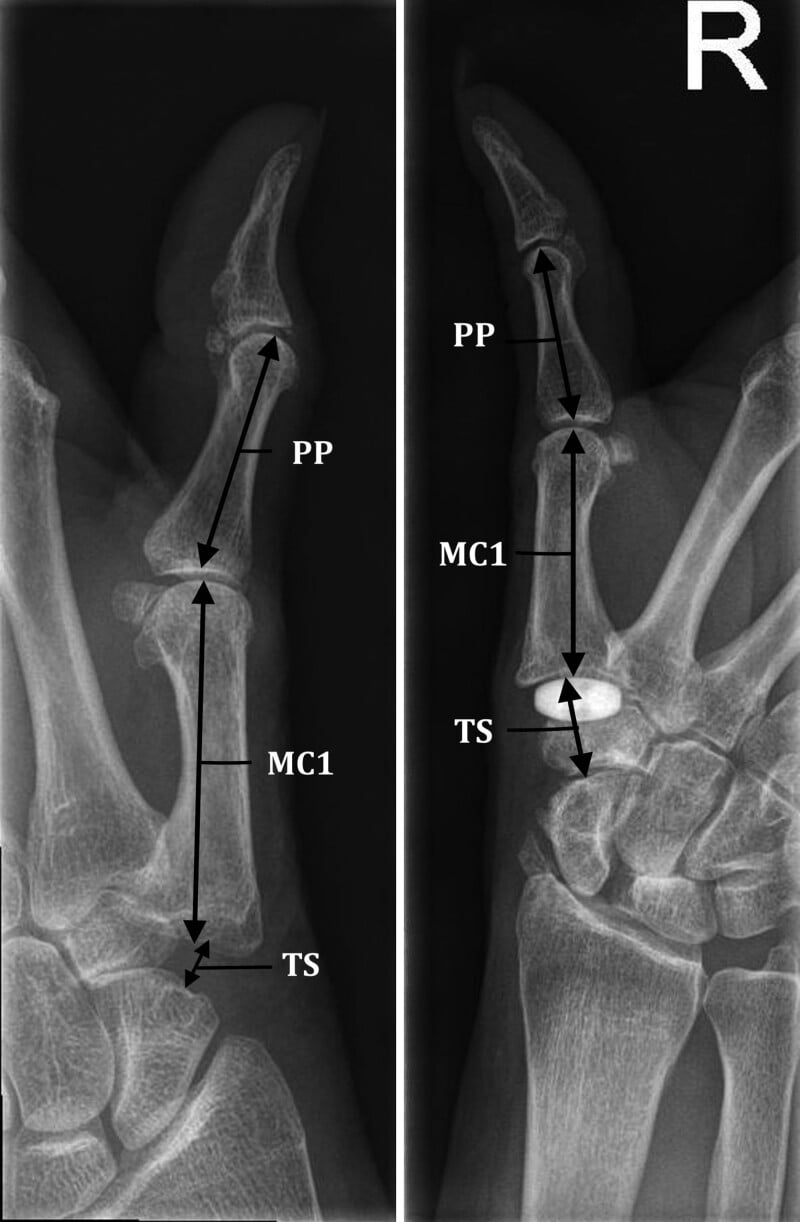
- Scapho-metacarpal distance differed by 0.1 mm (95% CI -0.81 to 0.61) - adding ligament reconstruction did not measurably preserve the space it is designed to preserve
- NONE of the included trials reported global assessment, quality of life, or revision and re-operation rates
- No trial compared surgery with SHAM. Note the distinction: trials comparing surgery with NON-OPERATIVE treatment were EXCLUDED by the review's own selection criteria, so their absence here is a design choice rather than an absence in the literature
- Most outcomes evidence remains low quality
Systematic Review: LRTI Not Superior to Simpler Procedures
- No procedure proven superior for pain or function
- Trapeziectomy with LRTI carries a higher complication rate
- Autologous interposition preferable to synthetic spacers (e.g. Artelon)
- Higher-level RCTs comparing arthrodesis and total joint replacement still needed
- Follow-up in higher-evidence trials was short (~12 months), limiting long-term conclusions
Total Joint Replacement: Faster Recovery, Costlier, Higher Complications
- Outcomes very implant-dependent; some implants withdrawn from market
- No clear superiority over trapeziectomy variants
- Higher complication rate and additional implant cost
- Best implants achieve survivorship beyond 10 years
- Worst implants show unacceptably high early failure
RCT: Touch Dual-Mobility Prosthesis vs Tendon Interposition
- Prosthesis group recovered faster, with better strength and ROM throughout follow-up
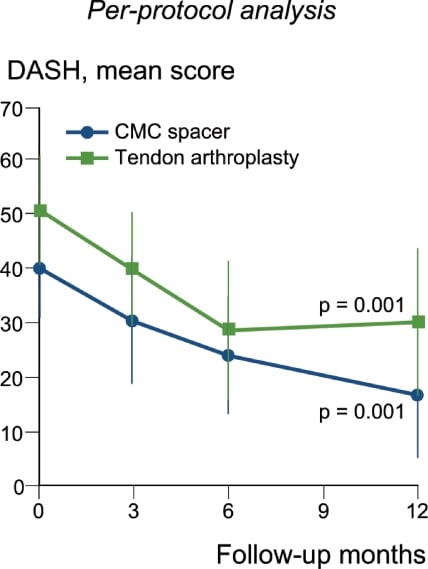
- Both techniques improved significantly versus preoperative values
- Authors suggest joint replacement be preferred, reserving interposition for prosthetic complications or STT osteoarthritis
- Group sizes: 71 patients (75 hands) had tendon interposition and 65 patients (72 hands) had total joint replacement
- TWO REPORTING GAPS MATTER FOR A TRIAL RECOMMENDING A PROSTHESIS: patients were randomised but HANDS were analysed, so bilateral cases contribute twice and the observations are not independent; and the abstract reports NO complication data at all, which is the outcome on which the systematic reviews on this page fault joint replacement
- Follow-up limited to 24 months - long-term survivorship not yet established
RCT: Arthrodesis vs LRTI — Trial Stopped for Excess Complications
- Arthrodesis complications 71% vs 29% for LRTI (p=0.016) — trial halted early
- PRWHE and DASH similar between groups at 12 months
- More LRTI patients would repeat their surgery (86% vs 53%, p=0.025)
- The excess complications translated into reoperation: two of seventeen arthrodesis patients required revision surgery
- Single-blind design; 43 patients were enrolled before termination
- Authors do NOT recommend routine plate-and-screw arthrodesis in this group
- Nonunion reported in the literature averages 8-21% after CMC arthrodesis
Intra-Articular Injection: Steroid Fast, Hyaluronate Durable
- Corticosteroid: maximal relief at 2-3 weeks (faster onset)
- Hyaluronate: better pain and pinch power at 26 weeks (more durable)
- Pain improvement reported by 79-88% of patients at 6 months
- Both agents well tolerated with no causally-linked adverse events
- Injection is symptomatic, not disease-modifying
Ligament Anatomy: 16 Ligaments, Beak (Deep AOL) and Dorsoradial Key
- 16 distinct ligaments identified around the trapezium/TMC joint
- Deep anterior oblique (beak) ligament functions as a pivot enabling thumb pronation
- Dorsoradial ligament is a substantial dynamic stabiliser
- Trapezio-second and trapezio-third metacarpal ligaments resist cantilever bending
- Modern biomechanical data implicate the dorsoradial ligament as well as the beak ligament in instability
Guidelines, Registries & Global Practice
Global epidemiology:
In the population-based Rotterdam study (n=3906, age greater than or equal to 55y), radiographic thumb-base osteoarthritis was present in 35.8% of participants, with hand osteoarthritis in at least one joint affecting 67% of women and 54.8% of men — confirming the thumb base as one of the most commonly affected sites (Dahaghin et al, Ann Rheum Dis 2004). The same cohort showed only a modest-to-weak correlation between radiographic change and pain or disability, underscoring that radiographic stage alone should not drive surgical decisions. The Eaton-Littler radiographic classification itself shows only moderate interobserver agreement and fair agreement on treatment choice (Spaans et al, J Hand Surg Am 2011), which is why management is anchored to symptoms and function rather than imaging stage alone.
Side-by-side guidance and evidence base:
- Position
- No surgical technique superior; LRTI adds complications without functional benefit
- Evidence Level
- Level I (low-quality RCT pooling)
- Position
- First-line conservative: education, exercise/hand therapy, topical/oral NSAIDs; intra-articular steroid for short-term relief; surgery only after non-operative failure
- Evidence Level
- Guideline (GRADE-based)
- Position
- Stepwise care: splint + therapy + injection, then trapeziectomy-based surgery; no single 'gold-standard' operation mandated
- Evidence Level
- Consensus / Level II
- Position
- Trapeziectomy +/- interposition mainstay; modern total joint replacement an accepted option in selected patients
- Evidence Level
- Consensus / Level II
- Position
- Dual-mobility total joint replacement gives faster recovery and better early strength/ROM vs interposition
- Evidence Level
- Level I (single-centre RCT)
Registry and implant-surveillance evidence:
Unlike hip and knee replacement, thumb CMC implants are not comprehensively captured by most national joint registries, so survivorship data rely on cohort series and systematic reviews. Huang et al (J Hand Surg Eur Vol 2015) found total-joint survivorship highly implant-dependent, with some designs surviving beyond 10 years and others withdrawn for early failure. This registry gap is a key reason guideline bodies remain cautious about routine arthroplasty and why post-market surveillance is emphasised.
Practice variation:
There is wide international variation in operative choice driven by surgeon training rather than evidence: practice in many high-income settings is dominated by trapeziectomy with or without LRTI, whereas some continental European centres (notably France) have higher uptake of total joint replacement. The Cochrane and Vermeulen reviews show this variation is not justified by superiority data.
MCQ and Exam Practice Points
-
Epidemiology:
- Most common site of osteoarthritis in the hand
- Female to male ratio 15:1
- Affects 33% of postmenopausal women
-
Anatomy:
- Saddle joint (sellar joint) with biaxial motion
- Anterior oblique ligament (beak ligament) is primary stabilizer
- 16 ligaments described around CMC joint
- Contact stress during pinch: 120 kg/cm²
-
Pathophysiology:
- Initial event is AOL attenuation or failure
- Leads to dorsoradial subluxation
- Abnormal kinematics cause cartilage degeneration
-
Clinical examination:
- Grind test is pathognomonic: axial compression with rotation
- Squaring of thumb base from subluxation and osteophytes
- Adduction contracture reduces first web space
-
Eaton-Littler classification:
- Stage I: widening, no narrowing
- Stage II: narrowing, osteophytes less than 2mm
- Stage III: severe narrowing, osteophytes greater than 2mm
- Stage IV: pantrapezial arthritis (STT joint involved)
-
Imaging:
- Robert view (Bett view) is best radiograph for staging
- True AP of CMC joint with forearm pronated
-
Treatment:
- Stage I-II: conservative first (splinting, NSAIDs, injection)
- Stage III-IV: surgery if conservative fails
- Trapeziectomy with LRTI is gold standard
- Success rate 90-95% for pain relief
-
Surgical techniques:
- LRTI: FCR most common donor tendon (half width harvested)
- Simple trapeziectomy has equivalent outcomes but higher subsidence
- Arthrodesis: best for young male manual laborers (maximal strength)
- CMC arthroplasty: higher revision rate (10-15%)
-
Complications:
- Radial sensory nerve injury: 5-10%
- Subsidence: 20-30% simple trapeziectomy, less than 10% LRTI
- Nonunion after arthrodesis: 5-10%
-
Outcomes:
- Pain relief in 90-95% with LRTI
- Pinch strength recovers to 80-90% of contralateral
- Maximal improvement at 6-12 months
- Stage III disease with failed conservative treatment → LRTI
- Young male laborer → arthrodesis
- Persistent post-operative pain → assess for STT arthritis (Stage IV)
- Stage II disease → conservative vs. surgical (shared decision)
Exam Viva Scenarios
Practise clinical reasoning and management decisions out loud
“A 62-year-old right-hand-dominant female presents with 2 years of progressive right thumb base pain. She reports difficulty opening jars, turning keys, and writing. Conservative treatment with splinting and NSAIDs for 6 months has failed. X-rays show Eaton-Littler Stage III changes. She asks about surgical options.”
“A 35-year-old male carpenter presents with left thumb base pain. He does heavy manual work requiring strong grip and pinch. Examination reveals positive grind test, reduced pinch strength 40% compared to right side. X-rays show Stage III CMC arthritis. He has tried conservative treatment for 4 months without benefit. He asks what operation will give him the strongest grip to return to his carpentry work.”
“A 58-year-old female underwent trapeziectomy with LRTI 6 months ago for Stage III CMC arthritis. She initially improved but now has persistent radial-sided wrist pain, especially with gripping. Examination shows tenderness over the scaphoid and STT joint area. Post-operative X-rays show complete trapezium removal with some subsidence but good alignment. How would you manage this?”
“A 55-year-old female office worker has Stage II CMC arthritis. She has had splinting and two corticosteroid injections over 8 months with temporary relief but pain returns. She asks if she should have surgery now or continue with injections.”
Key Anatomy
- Saddle joint (sellar) - biaxial motion: flexion/extension + abduction/adduction
- Anterior oblique ligament (AOL/beak ligament) - PRIMARY stabilizer, prevents dorsoradial subluxation
- 16 ligaments total described, AOL most important
- High contact stress: 120 kg/cm² during pinch
- Small articular surface (1-2 cm²) predisposes to arthritis
Eaton-Littler Classification
- Stage I: Normal/widened space, synovitis, stress view shows subluxation → Conservative
- Stage II: Narrowing, osteophytes less than 2mm → Conservative trial, surgery if fails
- Stage III: Severe narrowing, osteophytes greater than 2mm, CMC only → Surgery (LRTI gold standard)
- Stage IV: Stage III + STT joint arthritis (pantrapezial) → Surgery addressing all joints
Clinical Examination
- GRIND TEST: axial compression + rotation of MC = pain/crepitus (PATHOGNOMONIC)
- Squaring of thumb base (subluxation + osteophytes)
- Adduction contracture (reduced first web space)
- Thenar atrophy in advanced cases
- Pinch strength reduced (compare to contralateral)
Imaging
- Robert view (Bett view): TRUE AP of CMC joint - BEST for staging
- Eaton stress view: resisted pinch shows dynamic subluxation
- PA and lateral hand views
- Assess STT joint for Stage IV disease
Conservative Treatment
- Thumb spica splinting (activities + night)
- NSAIDs (oral or topical)
- Activity modification
- Corticosteroid injection (up to 3 attempts)
- Hand therapy (strengthening, adaptive equipment)
- Success in 40-60% of Stage I-II patients
Surgical Options
- Trapeziectomy + LRTI: GOLD STANDARD, 90-95% success, FCR tendon most common donor
- Simple trapeziectomy: equivalent outcomes, higher subsidence (20-30% vs less than 10%)
- Arthrodesis: young male laborers, MAX strength (100%+), loses motion, nonunion 5-10%
- CMC arthroplasty: emerging, higher revision (10-15%), not yet standard
- Recovery: 4 weeks splint, ROM at 4 weeks, strengthen 8-12 weeks, full recovery 6-12 months
LRTI Technique
- Complete trapeziectomy (no fragments)
- Harvest HALF of FCR tendon (or entire APL)
- Suspensionplasty: drill MC base, weave tendon, anchor to MC2 or through FCR tunnel
- Interposition: remaining tendon rolled into space as spacer
- Prevents subsidence and bone-on-bone contact
Complications
- Radial sensory nerve injury: 5-10% (paresthesia, neuroma)
- Subsidence: 20-30% simple, less than 10% LRTI (often asymptomatic)
- CRPS: 1-5% (early ROM prevents)
- Persistent pain: incomplete trapezium, STT arthritis, de Quervain
- Arthrodesis: nonunion 5-10%, MCP hyperextension/arthritis long-term
Exam Viva Answers
- Stage III failed conservative → Recommend LRTI, discuss simple trapeziectomy equivalent evidence
- Young male laborer → Arthrodesis for MAX strength, accept loss of motion
- Persistent pain post-op → DDx: STT arthritis (Stage IV), de Quervain, nerve, incomplete removal
- Stage II → Shared decision: surgery justified if failed conservative, or continue if managing
- Difference LRTI vs simple → Subsidence lower with LRTI but outcomes equivalent at 1 year
High-Yield Numbers
- 33% of postmenopausal women affected
- 15:1 female to male ratio
- 90-95% surgical success rate
- 80-90% pinch strength recovery
- 120 kg/cm² contact stress during pinch
- 4 weeks immobilization, 6-12 months full recovery
References
-
Becker SJE, Makarawung DJS, Spit SA, et al. Disability in patients with trapeziometacarpal joint arthrosis: incidental versus presenting diagnosis. J Hand Surg Am. 2014;39(10):2009-2015. doi:10.1016/j.jhsa.2014.07.009
-
Wajon A, Vinycomb T, Carr E, et al. Surgery for thumb (trapeziometacarpal joint) osteoarthritis. Cochrane Database Syst Rev. 2015;2015(2):CD004631. doi:10.1002/14651858.CD004631.pub4
-
Eaton RG, Littler JW. Ligament reconstruction for the painful thumb carpometacarpal joint. J Bone Joint Surg Am. 1973;55(8):1655-1666.
-
Bettinger PC, Linscheid RL, Berger RA, et al. An anatomic study of the stabilizing ligaments of the trapezium and trapeziometacarpal joint. J Hand Surg Am. 1999;24(4):786-798. doi:10.1053/jhsu.1999.0786
-
Pellegrini VD Jr. Osteoarthritis of the trapeziometacarpal joint: the pathophysiology of articular cartilage degeneration. I. Anatomy and pathology of the aging joint. J Hand Surg Am. 1991;16(6):967-974.
-
Vermeulen GM, Slijper H, Feitz R, et al. Surgical management of primary thumb carpometacarpal osteoarthritis: a systematic review. J Hand Surg Am. 2011;36(1):157-169. doi:10.1016/j.jhsa.2010.10.028
-
Salem H, Davis TR. Six year outcome excision of the trapezium for trapeziometacarpal joint osteoarthritis: is it improved by ligament reconstruction and temporary Kirschner wire insertion? J Hand Surg Eur Vol. 2012;37(3):211-219. doi:10.1177/1753193411414518
-
Huang K, Hollevoet N, Giddins G. Thumb carpometacarpal joint total arthroplasty: a systematic review. J Hand Surg Eur Vol. 2015;40(4):338-350. doi:10.1177/1753193414563243
-
Vitale MA, Hettinger RM, O'Connor JP, et al. Trapeziometacarpal arthroplasty. J Am Acad Orthop Surg. 2016;24(8):555-562. doi:10.5435/JAAOS-D-15-00266
-
Gottschalk MB, Carpenter E, Oakes D, et al. Thumb carpometacarpal arthrodesis for arthritis: patient-reported outcomes and satisfaction at greater than 5-year follow-up. J Hand Surg Am. 2018;43(9):815-821. doi:10.1016/j.jhsa.2018.05.012
-
Burton RI, Pellegrini VD Jr. Surgical management of basal joint arthritis of the thumb. Part II. Ligament reconstruction with tendon interposition arthroplasty. J Hand Surg Am. 1986;11(3):324-332.
-
Forestier E, Vidoni E, Corain M, et al. Radiographic progression in thumb base osteoarthritis: a follow-up study. Clin Exp Rheumatol. 2018;36(6):1059-1064.
-
Marks M, Hensler S, Wehrli M, et al. Trapeziectomy with suspension-interposition arthroplasty for thumb carpometacarpal osteoarthritis: a randomized controlled trial comparing the use of allograft versus flexor carpi radialis tendon. J Hand Surg Am. 2017;42(12):978-986. doi:10.1016/j.jhsa.2017.07.004
-
Spekreijse KR, Vermeulen GM, Kedilioglu MA, et al. The effect of a bone tunnel during ligament reconstruction for trapeziometacarpal osteoarthritis: a 5-year follow-up. J Hand Surg Am. 2013;38(4):690-696. doi:10.1016/j.jhsa.2013.01.023
-
Marks M, Audigé L, Herren DB, et al. Trapeziometacarpal joint implant arthroplasty outcomes and approach-related complications: a systematic review. J Hand Surg Eur Vol. 2014;39(9):927-938. doi:10.1177/1753193413511936
-
Gangopadhyay S, McKenna H, Burke FD, et al. Five- to 18-year follow-up for treatment of trapeziometacarpal osteoarthritis: a prospective comparison of excision, tendon interposition, and ligament reconstruction and tendon interposition. J Hand Surg Am. 2012;37(3):411-417. doi:10.1016/j.jhsa.2011.11.027
-
Davis TR, Brady O, Dias JJ. Excision of the trapezium for osteoarthritis of the trapeziometacarpal joint: a study of the benefit of ligament reconstruction or tendon interposition. J Hand Surg Am. 2004;29(6):1069-1077. doi:10.1016/j.jhsa.2004.06.017
-
Hartigan BJ, Stern PJ, Kiefhaber TR. Thumb carpometacarpal osteoarthritis: arthrodesis compared with ligament reconstruction and tendon interposition. J Bone Joint Surg Am. 2001;83(10):1470-1478.
-
Spaans AJ, van Laarhoven CM, Schuurman AH, et al. Interobserver agreement of the Eaton-Littler classification system and treatment strategy of thumb carpometacarpal joint osteoarthritis. J Hand Surg Am. 2011;36(9):1467-1470. doi:10.1016/j.jhsa.2011.06.017
-
Raven EE, Haverkamp D, Sierevelt IN, et al. Long-term results of surgical intervention for osteoarthritis of the trapeziometacarpal joint: comparison of resection arthroplasty, trapeziectomy with tendon interposition and trapezio-metacarpal arthrodesis. Int Orthop. 2007;31(4):547-554. doi:10.1007/s00264-006-0224-5