Supracondylar Femur | Tibial Plateau | Patella | Lewis and Rorabeck Classification
- Lewis & Rorabeck classification determines treatment based on displacement and prosthetic stability
- Anterior femoral notching is an implicated (though debated) supracondylar stress riser - assess on lateral radiographs
- Type III fractures require revision arthroplasty with long cemented stems, NOT simple ORIF
- Retrograde IM nailing requires open intercondylar box in femoral component for nail passage
- Bone quality and fixation are paramount - osteoporotic bone requires locked plating or cemented stems
- “In viva, examiners test ability to classify fracture AND assess prosthetic stability independently
- “Type II vs Type III distinction: Examine AP and lateral radiographs for lucency, subsidence, alignment
- “Surgical approach selection depends on implant compatibility (open box vs closed box femoral component)
- “Registry data (AOANJRR) reports increasing revision burden from periprosthetic fractures with ageing population
Overview and Epidemiology
Periprosthetic fractures around a total knee replacement are increasing with the ageing population and the higher activity levels of arthroplasty patients. They are a major source of morbidity, healthcare cost and revision burden: the Australian Orthopaedic Association National Joint Replacement Registry (AOANJRR) reports that they account for 10-15% of all TKA revisions.
Who and when. The incidence is 2.5% after primary TKA and 5-10% after revision TKA. The patients are predominantly elderly women, with a mean age of 70-75 years. Timing is bimodal: early (intraoperative or within the first 2 years) or late (more than 5 years after surgery).
Mechanism. A low-energy fall causes 80% of these fractures. High-energy trauma and spontaneous fracture account for 10% each.
Risk factors. Bone health and fall prevention are worth optimising before the index TKA in these patients:
- Female sex - 2-3 times the risk of males
- Osteoporosis - a T-score below -2.5 significantly increases fracture risk
- Rheumatoid arthritis - inflammatory arthropathy with poor bone quality
- Neurological disorders - Parkinson's disease and seizures increase the risk of falling
- Old age - over 70 years, with frailty and sarcopenia
- Warfarin and steroids - medications affecting bone quality and healing
Where. The supracondylar femur dominates:
- Supracondylar femur - 80% of all periprosthetic knee fractures
- Tibial plateau - 10-15%, often metaphyseal collapse
- Patella - 5%, typically with a cementless patella or over-resection
- Polyethylene post - rare, in posterior-stabilised designs
The cost. Only 50% of patients return to their pre-fracture mobility, and 20% need further surgery within 2 years. The average cost exceeds $50,000 AUD per case. One-year mortality is covered under Complications.
Anatomy and Biomechanics
Anterior femoral notching. Notching the anterior femoral cortex by more than 3mm during femoral component preparation has traditionally been implicated as a supracondylar stress riser, theoretically concentrating the bending moments that are highest in this region during gait. The largest clinical series (Ritter, JBJS Am 2005, 1089 knees) found no significant increase in fracture rate with notching. Present it as a plausible but unproven risk factor, avoid it where possible, and always assess the lateral radiograph when evaluating a periprosthetic fracture.
The stem tip. The other stress riser is the stem tip, and it matters most when there is a second implant above. A femur carrying both a hip and a knee replacement has a finite segment of bone between them, and a fracture there, or any construct that ends near the opposite stem, creates a new riser rather than removing one. Spanning fixation that overlaps the implants is the principle; the specific constructs and their pitfalls are in Interprosthetic Femoral Fracture.
What the implant changes. The stiff femoral component alters load distribution through the bone around it:
- Stress shielding, which reduces bone density and causes proximal femur bone loss
- Stress concentration at the tip of the femoral component and at an anterior notch
- Alignment changes, valgus alignment shifting medial-lateral forces
- Mechanism
- Bending moment, stress concentration
- Risk Factors
- Anterior notching, osteoporosis
- Treatment Complexity
- High - requires plate or revision
- Mechanism
- Subsidence, metaphyseal collapse
- Risk Factors
- Cementless stems, poor bone quality
- Treatment Complexity
- Moderate - often requires stems
- Mechanism
- Trauma, over-resection
- Risk Factors
- Cementless fixation, thin patella
- Treatment Complexity
- Low to moderate - excision vs ORIF
Classification Systems
Two questions decide the treatment of a periprosthetic femoral fracture, and each has its own classification. Lewis and Rorabeck asks whether the implant is stable, which decides fix against revise; Su asks whether there is enough distal bone to fix to. Use them together. Tibial fractures are described by Felix, and patellar fractures by Ortiguera and Berry.
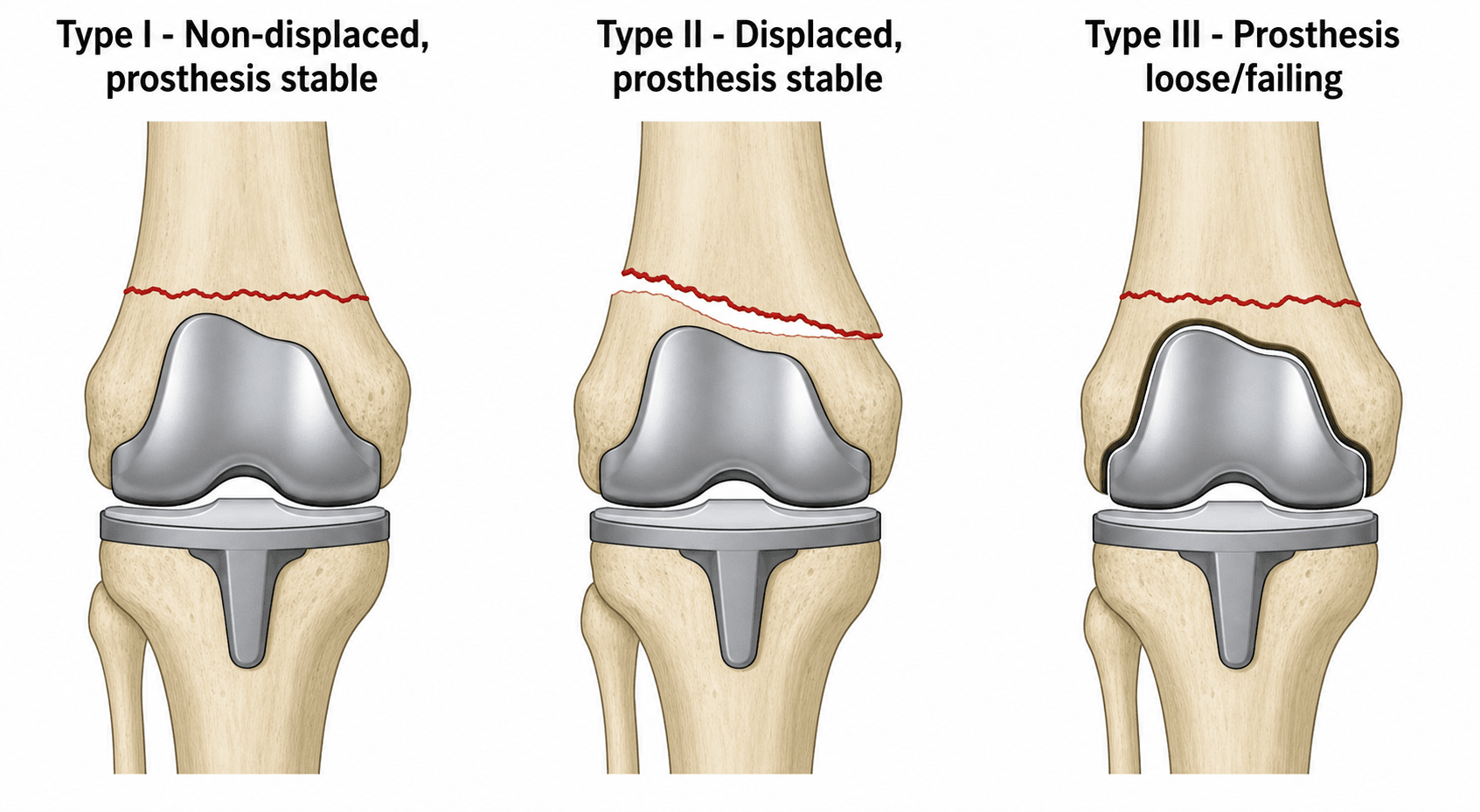
- Fracture Displacement
- Non-displaced (under 5mm shift, under 5° angulation)
- Prosthesis Stability
- Stable, well-fixed
- Treatment
- ORIF with locked plate OR conservative (elderly, low demand)
- Outcomes
- Union rate over 85%, good function
- Fracture Displacement
- Displaced (over 5mm shift OR over 5° angulation)
- Prosthesis Stability
- Stable, no lucency, no subsidence
- Treatment
- ORIF (plate or IM nail) based on implant design and bone quality
- Outcomes
- Union rate 75-85%, 15-20% require revision
- Fracture Displacement
- Any displacement
- Prosthesis Stability
- Loose (lucency, subsidence, malalignment)
- Treatment
- Revision TKA with long cemented stems (greater than 100mm beyond fracture)
- Outcomes
- Union rate 60-75%, high complication rate 30-40%
Type II or Type III. This is the decision that matters, and it is made on the radiographs before committing to ORIF. A displaced fracture around a loose prosthesis is Type III, and ORIF will fail because it leaves the loosening unaddressed.
- Stable (Types I and II) - no lucency at the bone-cement or cement-implant interface, no subsidence, alignment maintained
- Loose (Type III) - progressive radiolucent lines (over 2mm), subsidence (over 2mm component migration), malalignment (over 3° from neutral)
If in doubt, obtain contralateral TKA radiographs for comparison, or stress fluoroscopy in theatre, before committing to ORIF.
Clinical Assessment
History. The mechanism is most often a fall from standing height; trauma and spontaneous fracture account for the rest. Pain is acute, above or below the knee, with inability to bear weight and loss of ambulation, and with a patellar fracture the patient may be unable to straight leg raise. Establish:
- The index surgery - date of TKA, indication, implant type and any complications
- Medical history - osteoporosis, steroid use, rheumatoid arthritis, neurological disorders
- Red flags - neurovascular compromise, open fracture, compartment syndrome
Examination. A systematic look, feel and move, then the special tests:
- Look - deformity, swelling, ecchymosis, skin integrity, alignment
- Feel - point tenderness, crepitus, warmth (infection against acute fracture)
- Move - knee range of motion compared with the other side, extensor lag
- Special tests - straight leg raise (patellar fracture) and neurovascular examination
- The implant - warmth and an effusion suggesting loosening or infection
- Gait - inability to bear weight, an antalgic gait, a Trendelenburg gait if there is a tibial fracture
Periprosthetic joint infection (PJI) can present with acute pain, swelling and inability to weight-bear, mimicking a fracture. If infection is clinically suspected (wound drainage, fevers, elevated inflammatory markers), aspirate the joint before surgical fixation to rule out PJI. CRP over 100 mg/L or ESR over 60 mm/hr in the absence of other inflammatory conditions should raise suspicion.
- Distinguishing Features
- Trauma/fall, deformity, fracture line on radiograph
- Key Investigation
- AP and lateral full-length femur/tibia radiographs
- Pitfall if Missed
- Misclassifying stable vs loose implant alters whole plan
- Distinguishing Features
- Rest pain, effusion, warmth, raised CRP/ESR, sinus
- Key Investigation
- Joint aspiration (cell count, culture), CRP/ESR
- Pitfall if Missed
- Fixing over an undiagnosed infection guarantees failure
- Distinguishing Features
- Insidious start-up pain, progressive lucency/subsidence, no acute injury
- Key Investigation
- Serial radiographs +/- nuclear imaging
- Pitfall if Missed
- Plating a loose implant (treat as Rorabeck III)
- Distinguishing Features
- Loss of active extension, palpable gap, high-riding or low patella
- Key Investigation
- Lateral radiograph, ultrasound/MRI, straight-leg-raise test
- Pitfall if Missed
- Conservative care of a true extensor disruption
- Distinguishing Features
- Osteoporosis/steroids, no clear trauma, subtle radiograph
- Key Investigation
- MRI or CT, bone-health assessment
- Pitfall if Missed
- Repeated falls or progression to displaced fracture
- Distinguishing Features
- Mechanical symptoms, recurrent effusion, no fracture line
- Key Investigation
- Weight-bearing radiographs, examination under stress
- Pitfall if Missed
- Unnecessary fixation when isolated bearing exchange suffices
Investigations
Radiographs are the first line:
- AP and lateral knee
- AP and lateral full-length femur
- The contralateral knee for comparison
Read them for the questions the classifications ask: fracture displacement, prosthetic stability against the Type II and III criteria under Classification, an anterior femoral notch on the lateral view, and bone quality, meaning osteopenia, cortical thickness and canal diameter.
CT is for uncertainty: complex fracture patterns, assessing prosthetic fixation, and planning a revision. It delineates the fracture better (comminution, extension into the joint), shows the bone stock available for revision (metaphyseal defects, cortical thickness) and allows templating of stem length and diameter.
The infection screen. ESR, CRP and WCC, compared with baseline and 6-week post-TKA values. When the CRP threshold in the alert above is crossed, or infection is clinically suspected, aspirate:
- Synovial fluid WCC - over 3000 cells/microL is suspicious
- Polymorphonuclear percentage - over 80% is concerning
- Culture and sensitivities - hold antibiotics if possible
- Alpha-defensin - a point-of-care test with 90% sensitivity and 95% specificity for PJI
Bone quality. A DEXA scan if one has not been done recently; a T-score below -2.5 indicates severe osteoporosis. It changes the operation (see Management) and prompts medical optimisation with vitamin D, calcium, bisphosphonates or teriparatide.
Management Algorithm
The decision. Classify the fracture and judge the prosthesis separately. A loose prosthesis means revision, whatever the displacement. With a stable prosthesis, the femoral component's box design, the fracture's position relative to the component and the bone quality choose between the options. Severe osteoporosis (T-score below -2.5) often necessitates revision arthroplasty with cemented stems rather than ORIF, especially in Type II fractures.
Non-operative treatment, for selected cases. The indications are:
- Elderly, low-demand patient (limited community ambulator)
- Significant medical comorbidities (high anaesthetic risk)
- Minimal displacement (under 2mm shift, under 3° angulation)
- Good bone quality
The protocol is a hinged knee brace locked in extension for 6 weeks and touch weight-bearing with crutches for 8-12 weeks, with radiographs at 2, 6 and 12 weeks to catch displacement, progressing to full weight-bearing at 12 weeks if union is evident. The risks are loss of reduction requiring delayed ORIF in 15-20%, knee stiffness, and nonunion in 5-10% of elderly patients.
Locked lateral plating is for the younger, higher-demand patient with minimal comorbidities, or anyone whose compliance with non-weight-bearing is in doubt. A bridge-plating technique allows early range of motion and progressive weight-bearing (technique below), and function returns in 75-80%.
Which to choose. Examiners often present an 85-year-old with a Type I fracture and ask for management. The safe answer is ORIF with a locked plate in most cases, unless the patient is bedbound or a high anaesthetic risk. Reserve non-operative treatment for very select cases, with shared decision-making about the risk of loss of reduction.
- Prosthesis Status
- Stable, no lucency
- Bone Quality
- Good
- Treatment
- ORIF with locked lateral plate
- Key Pearl
- Non-operative only for selected elderly, high-risk patients
- Prosthesis Status
- Stable, well-fixed
- Bone Quality
- Good, open box
- Treatment
- Retrograde IM nail
- Key Pearl
- Check femoral component - must have open box
- Prosthesis Status
- Stable, well-fixed
- Bone Quality
- Good, closed box
- Treatment
- Lateral locked plate (LISS/NCB)
- Key Pearl
- Biological plating with indirect reduction
- Prosthesis Status
- Stable
- Bone Quality
- Osteoporotic
- Treatment
- Consider revision with stems
- Key Pearl
- ORIF has high failure rate in poor bone
- Prosthesis Status
- Loose or failing
- Bone Quality
- Any
- Treatment
- Revision TKA with long stems
- Key Pearl
- ORIF will fail - must address prosthetic loosening
Surgical Technique
Consent. Warn the patient of:
- Infection - 2-5% superficial, 1-2% deep
- Nonunion, particularly in osteoporotic bone (rates under Complications)
- Malunion - 5-10%, varus or valgus deformity
- Hardware prominence - 10-15%, which may require removal
- Peroneal nerve injury - 1-2%
- Need for revision - 15-20% within 2 years
Equipment. Have ready:
- A LISS or NCB periarticular plate of appropriate length, typically 9-13 holes
- 4.8-5.0mm locking screws, at least 8-10 of them
- Pointed reduction clamps, K-wires and Schanz pins
- A C-arm able to show the full plate length on AP and lateral views
- A revision TKA set on standby in case the prosthesis is found loose intraoperatively
Positioning. Supine on a radiolucent table (Jackson, or a standard table with a radiolucent extension), with a bump under the ipsilateral hip for neutral rotation and the contralateral leg in a well-leg holder. The C-arm comes from the contralateral side for lateral views, with the beam parallel to the floor; confirm adequate AP and lateral imaging of the entire femur before draping, and have the radiographer practise obtaining the femoral component views. Prep and free-drape the leg from hip to ankle, including the contralateral knee if templating may be needed intraoperatively, with impervious stockinette isolating the foot at the ankle.
Incision. Straight lateral, from the lateral femoral epicondyle towards the proximal lateral femur, 8-12cm depending on fracture extent and plate length, centred over the lateral intermuscular septum.
Keep incision posterior enough to allow submuscular plate passage but anterior enough to avoid sciatic nerve (greater than 2cm from posterior femoral cortex on lateral view). Use fluoroscopy to mark ideal trajectory if uncertain.
The submuscular space. Incise the fascia lata along the lateral intermuscular septum, identify vastus lateralis anterior to it, and lift the muscle off the septum to create the submuscular space. Ligate or cauterise the perforating vessels.
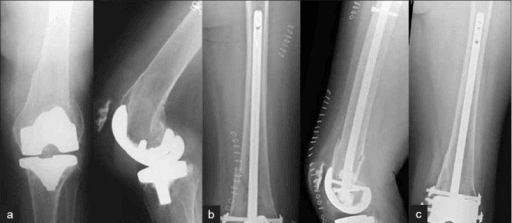
Reduction. This is bridge plating: do not open the fracture site and do not strip the periosteum. Confirm the fracture by palpating the step-off or gap, and reduce it with traction, manipulation, and K-wires or Schanz pins for provisional alignment. Accept under 5° of varus or valgus and under 5mm of translation on AP and lateral fluoroscopy.
The plate. Create an epiperiosteal tunnel deep to vastus lateralis with a McDonald clamp or the plate insertion guide, and slide the plate proximally, keeping it on the bone surface. It should sit centred on the lateral femoral cortex with its distal end 1-2cm above the femoral component, confirmed on fluoroscopy before fixation. The plate must not impinge on the femoral component, so leave a gap of at least 1cm. If the fracture is very distal (within 5cm of the component), consider revision arthroplasty instead of plating.
Screws. Fix in sequence:
- Distal locking screws first - 3-4, bicortical
- Check the reduction on fluoroscopy and adjust it before proximal fixation
- Proximal locking screws - 4-6, bicortical
- In osteoporotic bone, fill every available hole for maximal stability
Drill through the locking guide sleeve and measure with a depth gauge (both cortices plus 5mm for safety). Tighten each screw until the head seats in the plate without overtightening, and confirm on fluoroscopy that the threads engage the far cortex.
Final check. AP and lateral fluoroscopy should confirm:
- Reduction maintained
- All screws bicortical
- No screw penetrating the knee joint
- No plate impingement on the femoral component
Manually stress the fracture under fluoroscopy; it should be stable with minimal motion.
Closure. Irrigate the submuscular space with 3L of normal saline, cauterise the perforators, and consider a drain if oozing is significant (removed at 24-48 hours). Close the fascia lata with interrupted 0 Vicryl, watertight to prevent muscle herniation, then 2-0 Vicryl subcuticular to the subcutaneous layer and 3-0 Monocryl or staples to skin, with a sterile dressing and compressive wrap. A hinged knee brace locked in extension gives comfort and protection, with touch weight-bearing on a walker for 6 weeks and range-of-motion exercises from day 1 (see Postoperative Care).
Complications
Nonunion. Estimates of nonunion after ORIF in osteoporotic bone range from 15-20% to 30-40%; inadequate fixation adds to the risk, and in poor bone the construct can fail by screw pullout or plate failure. After repeated failure or recurrent infection, amputation is the salvage.
- Incidence
- 20-30% (ORIF in osteoporotic bone)
- Risk Factors
- Osteoporosis, smoking, diabetes, infection
- Prevention
- Optimise bone health pre-op, rigid fixation, avoid soft tissue stripping
- Management
- Revision ORIF with bone graft OR conversion to revision TKA with stems
- Incidence
- 10-15%
- Risk Factors
- Inadequate reduction, loss of fixation, patient non-compliance
- Prevention
- Intraoperative fluoroscopy, locked fixation, early weight-bearing restriction
- Management
- If symptomatic: Corrective osteotomy OR revision TKA if severe (over 10° deformity)
- Incidence
- 10-15% (plate), 5% (nail)
- Risk Factors
- Screw pullout in osteoporotic bone, premature weight-bearing
- Prevention
- Locked screws, fill all plate holes in poor bone, weight-bearing restrictions
- Management
- Revision ORIF with longer plate or conversion to revision TKA
- Incidence
- 3-5%
- Risk Factors
- Diabetes, immunosuppression, prior infection, haematoma
- Prevention
- Antibiotic prophylaxis, meticulous sterility, drain if needed
- Management
- Acute: Debridement and component retention OR single-stage revision. Chronic: Two-stage revision
- Incidence
- 15-20%
- Risk Factors
- Prolonged immobilisation, heterotopic ossification, infection
- Prevention
- Early ROM, CPM machine, aggressive physical therapy
- Management
- Manipulation under anaesthesia at 6-12 weeks OR open arthrolysis if severe
- Incidence
- 1-2%
- Risk Factors
- Peroneal nerve stretch, vascular injury during reduction or fixation
- Prevention
- Gentle reduction, avoid forceful manipulation, check pulses intraoperatively
- Management
- Nerve injury: Observation, AFO if foot drop. Vascular: Immediate repair by vascular surgery
- Incidence
- 30% at 1 year
- Risk Factors
- Age over 80, multiple comorbidities, low baseline function, delay to surgery
- Prevention
- Optimise medical comorbidities, early surgery (within 48 hours if possible), multidisciplinary care
- Management
- Palliative care involvement if appropriate, maximise function even if fracture healing suboptimal
Mortality. The table's one-year figure applies to elderly patients with supracondylar fractures and is comparable to neck of femur fracture. The cohorts in the evidence section report lower one-year mortality, around 10-22%, and the figure varies with case mix. Medical optimisation, early surgery and multidisciplinary orthogeriatric care are essential to improve outcomes, and in very frail patients non-operative management with pain control and palliative care may be appropriate after shared decision-making.
Postoperative Care and Rehabilitation
Rehabilitation Timeline After ORIF
A hinged knee brace locked in extension for walking, and touch weight-bearing with a walker (10-15kg maximum on the affected limb). Out of bed to a chair on day 1, with transfer training by the physiotherapist.
- DVT prophylaxis - enoxaparin 40mg SC daily or rivaroxaban 10mg daily for 6 weeks, with TED stockings and sequential compression devices
- Analgesia - multimodal (paracetamol, NSAIDs if not contraindicated, opioids as needed)
Touch weight-bearing with a walker, progressing to 25% of body weight at 4 weeks if the radiographs are stable. Passive range of motion 0-60° with the physiotherapist (brace unlocked for exercises), active-assisted range of motion, quadriceps sets and straight leg raises. No active knee flexion against resistance and no squatting. Radiographs at 2 and 6 weeks check alignment, hardware position and early healing.
Progress from 50% to full weight-bearing as tolerated, guided by callus on the radiographs, pain and stability on examination. Range of motion moves from passive to active, with a goal of 0-100° by 12 weeks, and progressive resistance exercises for the quadriceps, hamstrings and hip abductors. Radiographs at 12 weeks should show bridging callus on at least 3 of 4 cortices.
Full weight-bearing without aids once there is radiographic union, with independent walking, stairs step-over-step and a return to activities of daily living. Radiographs at 6 months make the final assessment of union, alignment and hardware integrity. Union means bridging callus on 3 of 4 cortices, pain-free weight-bearing and no tenderness at the fracture site.
Annual radiographs for hardware failure, loss of reduction and late prosthetic loosening. Low-impact activities (walking, swimming, cycling) are encouraged and high-impact sports (running, jumping) avoided. Consider hardware removal at 18-24 months if it is prominent and symptomatic, and only after confirmed radiographic union.
Why the weight-bearing is staged. Touch weight-bearing for the first 6 weeks allows soft-tissue healing and early callus formation while preventing catastrophic hardware failure. Partial weight-bearing from 6 weeks stimulates further bone healing through controlled mechanical stress (Wolff's law). Full weight-bearing at 12 weeks assumes radiographic union is progressing; if it is not, delay full weight-bearing until 16-20 weeks.
Periprosthetic fractures have slower healing than native bone fractures due to osteoporosis, age, and altered biomechanics. Average time to union is 5-7 months for ORIF cases. If no radiographic progression of healing at 4-6 months, consider bone stimulation (ultrasound or pulsed electromagnetic fields) or revision surgery with bone grafting.
Outcomes and Prognosis
- Union Rate
- 75-85% (good bone), 60-70% (osteoporotic)
- Functional Outcome
- Good to excellent in 70%, return to pre-fracture function 50%
- Revision Rate
- 15-20% require revision within 2 years
- Notes
- Best for Type II with good bone quality and closed-box implants
- Union Rate
- 80-90%
- Functional Outcome
- Good to excellent in 75-80%, faster mobilisation than plate
- Revision Rate
- 10-15% require revision
- Notes
- Requires open-box design, good for bilateral fractures
- Union Rate
- 65-80% (fracture union)
- Functional Outcome
- Fair to good in 60%, limited by age and comorbidities
- Revision Rate
- 20-25% require further revision
- Notes
- Necessary for Type III, higher complication rate but addresses prosthetic loosening
- Union Rate
- 70-80% (selected cases)
- Functional Outcome
- Fair in 50%, high rate of stiffness and functional loss
- Revision Rate
- 15-20% loss of reduction requiring delayed ORIF
- Notes
- Reserved for very elderly, high-risk patients with minimal displacement
Predictors of a poor outcome. These point to a worse result:
- Age over 80 - mortality risk and poor healing
- Severe osteoporosis (T-score below -2.5) - a high nonunion rate with ORIF
- A Type III fracture with prosthetic loosening - complex reconstruction and longer recovery
- Medical comorbidities - diabetes, renal failure, immunosuppression
- Smoking - 2-3 times the nonunion rate
- Delay to surgery over 7 days - associated with worse outcomes
The best outcomes are in Type II fractures in patients under 75 with good bone quality and a stable prosthesis, treated with ORIF within 48 hours.
Guidelines, Registries & Global Practice
Global Epidemiology
- Figure
- 13.2%
- Source
- Lützner 2024, EPRD registry (PMID 37498352)
- Figure
- 32.7%
- Source
- Lützner 2024 (PMID 37498352)
- Figure
- 22% vs 10%
- Source
- Hoellwarth 2018 (PMID 29208310)
- Figure
- 13%
- Source
- Ross 2021, BJJ (PMID 33789473)
- Figure
- 5.9 vs 6.8 months
- Source
- Wall 2023 (PMID 36442809)
- Figure
- Decreasing share in some registries
- Source
- Dyrhovden 2017, Norwegian register (PMID 28299718)
Reported one-year mortality varies widely (around 10-22%) between cohorts because case mix differs: distal-femoral-replacement series enrol older, lower-bone-stock patients. The consistent message across the German EPRD, Australian AOANJRR and UK series is that periprosthetic distal femoral fracture carries hip-fracture-level mortality and should be managed with the same orthogeriatric urgency.
Side-by-Side Guidance and Registry Evidence
- Region
- International
- Position on PDFF Management
- Classify by prosthetic stability and bone stock; locked bridge plating or retrograde nail for stable implants, revision/megaprosthesis for loose or unreconstructable distal bone
- Evidence Basis
- Expert consensus + cohort data (Level III-IV)
- Region
- UK
- Position on PDFF Management
- Treat as fragility fractures: prompt surgery allowing early weight-bearing, orthogeriatric co-management, bone-health assessment
- Evidence Basis
- Consensus standard informed by NHFD-style pathways
- Region
- UK
- Position on PDFF Management
- Multidisciplinary fragility-fracture care, falls and bone-health optimisation; no construct-specific mandate
- Evidence Basis
- Guideline (consensus + economic modelling)
- Region
- USA
- Position on PDFF Management
- No single mandated construct; surgeon-directed fixation vs distal femoral replacement guided by bone stock and patient demand
- Evidence Basis
- Evidence map / appropriate-use criteria
- Region
- Australia
- Position on PDFF Management
- Tracks periprosthetic fracture as a revision indication; registry signal favouring stemmed/cemented revision in the loosening setting
- Evidence Basis
- National registry (Level III)
- Region
- Germany
- Position on PDFF Management
- Documents high revision (19.7% at 4y) and PJI (12.8%) after distal femoral replacement for PDFF
- Evidence Basis
- National registry (PMID 37498352)
There is no high-level (RCT) guideline mandating one construct for periprosthetic distal femoral fractures. Two meta-analyses (Quinzi 2021, PMID 33743062; Wall 2023, PMID 36442809) show equivalent union, infection and reoperation rates for ORIF, retrograde nail and distal femoral replacement. Guidance is therefore principle-based: classify by implant stability and bone stock, allow early mobilisation, and co-manage medically.
Practice Variation
- Primary distal femoral replacement: more common in North America and Germany for very low or comminuted fractures in low-demand elderly patients; used more selectively in the UK/Australia given late aseptic loosening (Ross 2021)
- Retrograde nail uptake: limited by closed-box prevalence of the local implant market
- Weight-bearing protocols: increasingly liberalised internationally; meta-analysis shows no complication penalty for early weight-bearing in the elderly (Wardle 2024, PMID 38777887)
- Bone-health pathways: routine fragility/bone-health referral is embedded in UK and Australian systems, more variable elsewhere
- Assess prosthetic stability FIRST (drives ORIF vs revision)
- Confirm open- vs closed-box femoral component before planning a retrograde nail
- Bridge/biological plating and locking fixation in osteoporotic bone
- Orthogeriatric co-management and early mobilisation (hip-fracture model)
- Pre-operative infection screen (CRP/ESR, aspiration if indicated) before fixation
- Informed consent: Document discussion of treatment options (ORIF vs revision TKA), expected outcomes, complications (nonunion 20-30%, infection 3-5%, mortality 30% at 1 year in elderly), and alternative approaches
- Prosthetic stability assessment: Document radiographic criteria used to classify fracture (Type I vs II vs III), including assessment for lucency, subsidence, and alignment on AP and lateral views
- Implant compatibility: Document verification of femoral component design (open vs closed box) before planning retrograde nail - attempting to nail closed-box component is indefensible
- Medical optimization: Document pre-operative assessment of bone health (DEXA if available), medical comorbidities, and optimization of cardiopulmonary status
- Early surgery: Document rationale for timing of surgery - delay beyond 48 hours should have clear medical justification
- Postoperative complications: Document management of complications (nonunion, infection, hardware failure) and shared decision-making about revision surgery
- Anterior femoral notching during index TKA leading to subsequent fracture (claims of substandard surgical technique)
- Wrong fixation method (attempting retrograde nail through closed-box component, or ORIF in Type III fracture)
- Delayed surgery (beyond 7 days) without medical justification, associated with worse outcomes
- Failure to diagnose prosthetic loosening pre-operatively (Type III misclassified as Type II, leading to ORIF failure)
MCQ Practice Points
Q: A 78-year-old woman sustains a periprosthetic supracondylar fracture 6 years after TKA. Radiographs show 8mm of fracture displacement with the femoral component appearing well-fixed with no lucency. What Lewis & Rorabeck type is this?
A: Type II - Displaced fracture (over 5mm) with stable, well-fixed prosthesis. Type I would be non-displaced (under 5mm, under 5° angulation). Type III would have evidence of prosthetic loosening (lucency, subsidence, or malalignment). The key is assessing prosthetic stability independently from fracture displacement.
Q: What is the critical pre-operative assessment required before planning retrograde intramedullary nailing for a Type II periprosthetic supracondylar fracture?
A: Assessment of femoral component intercondylar box design on lateral radiograph. An open-box design with adequate height (over 10mm) and width (over 12mm) is REQUIRED to allow passage of a retrograde nail (typically 9-10mm diameter). Closed-box designs do NOT allow nail passage and require lateral locked plate fixation instead. Attempting to nail through a closed box will cause catastrophic implant damage.
Q: Is anterior femoral cortical notching during TKA a proven risk factor for periprosthetic supracondylar fracture?
A: It is implicated but not proven. Notching greater than 3mm has traditionally been described as a supracondylar stress riser, but the largest clinical series (Ritter et al, JBJS Am 2005, 1089 knees) found no significant increase in fracture rate. A safe exam answer acknowledges notching as a biomechanically plausible, technique-dependent factor to be avoided, while noting that high-quality evidence for a clinically meaningful effect is lacking. The dominant, well-established risk factors are osteoporosis, female sex, age and inflammatory arthropathy.
Q: An 85-year-old patient with severe medical comorbidities sustains a Type II periprosthetic supracondylar fracture. CT shows severe osteoporosis with thin cortices. What factors would make you consider revision TKA with stems instead of ORIF?
A: Severe osteoporosis (T-score below -2.5), very thin cortices (under 4mm), and poor bone quality are relative indications for revision TKA over ORIF in Type II fractures. ORIF in severe osteoporosis has nonunion rates of 30-40% and high risk of screw pullout. Revision with long cemented stems provides immediate stability and load-sharing fixation. Other factors: very distal fracture location (within 5cm of component), closed-box implant precluding nail, or patient factors suggesting ORIF will fail.
Q: What is the 1-year mortality rate for elderly patients with periprosthetic supracondylar fractures after TKA, and how does it compare to hip fractures?
A: Approximately 30% mortality at 1 year, which is comparable to neck of femur fractures in the elderly. This high mortality reflects the patient population (elderly, multiple comorbidities, osteoporosis) and the physiological stress of fracture and surgery. These fractures should be treated with the same urgency as hip fractures, with early surgery (within 48 hours if possible), multidisciplinary orthogeriatric care, and medical optimization to reduce mortality.
Q: What is the expected union rate for Type II periprosthetic fractures treated with ORIF in patients with good bone quality vs severe osteoporosis?
A: Good bone quality: 75-85% union rate. Severe osteoporosis: 60-70% union rate. The 15-25% difference reflects the impact of bone quality on fracture healing and fixation stability. In osteoporotic bone, locking screws can pull out, plates can fail, and biological healing is impaired. This is why severe osteoporosis is a relative indication for revision TKA with cemented stems rather than ORIF, especially in Type II fractures.
Exam Viva Scenarios
Practise clinical reasoning and management decisions out loud
“An 82-year-old woman presents to ED after a fall at home. She has a right TKA performed 5 years ago for osteoarthritis. Radiographs show a supracondylar femur fracture 8cm above the femoral component with 10mm of lateral translation. The femoral component appears well-fixed with no lucency. How would you assess and manage this patient?”
“You are planning surgery for the patient in Scenario 1. On reviewing the lateral radiograph more carefully, you note the femoral component has a closed-box design. The patient's bone quality appears osteoporotic with thin cortices. Walk me through your surgical plan.”
“A 74-year-old man with a TKA performed 8 years ago falls and sustains a supracondylar femur fracture. Radiographs show the fracture is displaced with 5° of valgus angulation. You also note progressive radiolucent lines around the femoral component and 3mm of component subsidence compared to prior radiographs. How would you manage this?”
Key Classification
- Lewis & Rorabeck Type I = Non-displaced (under 5mm, under 5°), stable prosthesis = ORIF or conservative
- Type II = Displaced (over 5mm OR over 5°), stable prosthesis = ORIF (plate or nail based on implant design)
- Type III = Any displacement + prosthesis loose (lucency, subsidence, malalignment) = Revision TKA with stems
- Felix tibial: Type I (plateau) = revision, Type II (adjacent to stem) = plate ± stem extension, Type III/IV = standard fixation
- Patellar: Intact extensor = conservative, disrupted extensor = surgical repair or patellectomy
Surgical Decision Algorithm
- Type II + open-box component + good bone = Retrograde IM nail (85-90% union)
- Type II + closed-box component OR osteoporotic bone = Lateral locked plate (75-85% union)
- Type III (loose prosthesis) = Revision TKA with long stems (over 100mm beyond fracture) + cerclage cables
- Severe osteoporosis in Type II = Consider revision TKA upfront (ORIF has 30-40% nonunion rate)
- Open-box verification is MANDATORY before planning retrograde nail - catastrophic if attempted with closed box
Surgical Pearls
- Lateral locked plate: Submuscular bridge plating, fill all holes in osteoporotic bone, leave 1cm gap from femoral component
- Retrograde nail: Entry point center of intercondylar notch, bury nail 5mm below articular surface, confirm clearance from polyethylene
- Revision TKA: Cemented stems preferred (immediate stability), cerclage cables for provisional fracture fixation, stem length = fracture + 100mm or 2 cortical diameters
- Anterior femoral notching over 3mm = implicated (but unproven; Ritter JBJS 2005 negative) stress riser, avoid and assess on lateral radiographs
- Weight-bearing: Touch for 6 weeks, progress to full by 12 weeks if radiographic healing evident
Risk Factors
- Female, Osteoporosis, Rheumatoid, Neurological, Old age, Warfarin/steroids
- Anterior femoral notching over 3mm = implicated but unproven stress riser (Ritter JBJS 2005 found no association) - avoid, but not a dominant risk factor
- Osteoporosis (T-score below -2.5) increases nonunion risk with ORIF to 30-40%
- Revision TKA has 5-10% periprosthetic fracture rate (vs 2.5% for primary TKA)
Complications
- Nonunion 20-30% with ORIF in osteoporotic bone, 10-15% in good bone, managed with revision ORIF or conversion to stemmed TKA
- Hardware failure 10-15% (plate) or 5% (nail), due to screw pullout in poor bone or premature weight-bearing
- Infection (PJI) 3-5%, requires debridement or two-stage revision based on chronicity
- Mortality 30% at 1 year in elderly - comparable to hip fracture, treat with same urgency
- Stiffness 15-20%, managed with early ROM, manipulation under anesthesia at 6-12 weeks if severe
Evidence Base and Key Trials
ORIF vs Retrograde Nail vs Distal Femoral Replacement (Quinzi 2021)
- Systematic review and meta-analysis of 52 studies (ORIF n=1205, retrograde IM nail n=272, distal femoral replacement n=353)
- No significant difference in major complication rates (p=0.55) or reoperation rates (p=0.20) between the three treatment strategies
- Deep infection was higher with distal femoral replacement than with internal fixation (p=0.03)
- Malunion was more common with intramedullary nail than ORIF (p=0.02)
- Periprosthetic fracture rates were higher with distal femoral replacement and IM nail than with ORIF
- READ THE FORMAL META-ANALYSIS INTERVALS BEFORE CALLING THIS EQUIVALENCE: pooled across the 14 comparative studies, the odds of major complications were 1.39 (95% CI 0.23 to 8.52) for nail versus replacement, 0.86 (0.48 to 1.53) nail versus ORIF and 0.91 (0.52 to 1.59) ORIF versus replacement - intervals that wide exclude almost nothing
- Median follow-up was only 30 months (range 6 to 96), which is short for implant-related endpoints
Retrograde Nail vs Distal Femoral Plating (Wall 2023)
- Systematic review and meta-analysis of 8 comparative studies (407 cases: 252 plating, 155 retrograde IM nailing)
- Mean time to union equivalent: 5.88 months for nail vs 6.75 months for plating (standardised mean difference 0.28, 95% CI -0.02 to 0.58)
- No significant difference in deep infection (OR 1.41, 95% CI 0.40-5.00)
- No significant difference in revision surgery (OR 0.74, 95% CI 0.39-1.41)
- Marked heterogeneity in fracture classification limited pooled functional analysis
AOANJRR Periprosthetic Fracture Revision Data
- Periprosthetic fractures account for 12% of all TKA revisions in Australia
- Incidence increasing with aging population (2.1% to 2.8% over 10 years)
- Revision for periprosthetic fracture has 20% re-revision rate at 5 years
- Cemented stems associated with lower revision rate than uncemented in fracture setting (15% vs 25%)
- Mortality at 1 year post-revision for fracture: 28% (comparable to hip fracture mortality)
Lateral Locked Plate vs Distal Femoral Arthroplasty for Low PDFFs (Ross 2021)
- Retrospective cohort of 60 unilateral low (Su type II/III) periprosthetic distal femoral fractures in patients aged 60 years or over (33 lateral locked plate ORIF, 27 distal femoral arthroplasty)
- One-year mortality 13% (8/60) across the whole cohort
- Reoperation more common after locked plating: 7/33 vs 0/27 (p=0.008); 5-year reoperation-free survival 70.8% plate vs 100% arthroplasty (p=0.006)
- Medial comminution independently predicted reoperation after plating (HR 10.7, 95% CI 1.45-79.5); anatomical reduction was protective (HR 0.11)
- MECHANICAL FAILURE DID NOT DIFFER even in the unrestricted analysis: 74.5% survival for plating against 78.2% for arthroplasty (p = 0.182), so the arthroplasty advantage is in avoiding REOPERATION rather than in the construct surviving better
- When inadequately fixed fractures were excluded there was no difference in five-year survival for either reoperation (p = 0.156) or mechanical failure (p = 0.453)
- Fractures were Su type II in 40 of 60 and type III in 20 of 60; mean follow-up 3.8 years (1.0 to 10.4)