Reversible Lysine Analogue | Reduces Blood Loss | No Signal of Thrombotic Harm, But Safety Not Formally Established | Cost-Effective
- Mechanism: Reversible competitive inhibitor of plasminogen activation, preventing fibrin degradation
- Evidence: Level I evidence in TKA, THA, trauma, spine surgery for reducing blood loss
- Safety - state this precisely, because 'no evidence of increased risk' is not 'evidence of no increased risk'. The surgical meta-analysis cited on this page found no significant effect on myocardial infarction, stroke, DVT or pulmonary embolism, but its own conclusion is that the effect on thromboembolic events remains uncertain - the confidence intervals are wide (DVT 0.53 to 1.39) because these are rare events in trials sized for transfusion. POISE-3, the largest surgical trial, found the cardiovascular composite essentially identical (14.2% vs 13.9%) yet did not establish noninferiority, because the interval crossed its prespecified margin. In practice TXA is used freely and no signal of harm has emerged in decades of use; just do not claim proof of safety that the trials do not provide
- Timing: Pre-incision IV (15-20mg/kg bolus) is the conventional default, with moderate evidence in TKA; in trauma within 3h of injury
- Cost-effectiveness: Reduces transfusion rates and hospital costs significantly
- “TXA binds reversibly to plasminogen, blocking lysine-binding sites
- “CRASH-2 established use in trauma (1g bolus, then 1g over 8h); the 3h window comes from its time-to-treatment analysis
- “No clinically significant difference between IV, topical, or combined routes in TJA
- “Contraindications: active thromboembolic disease (absolute); renal impairment (adjust dose) and seizure history (relative)
Pharmacology and Mechanism
The molecule. Tranexamic acid (TXA) is a synthetic derivative of the amino acid lysine: trans-4-(aminomethyl)cyclohexanecarboxylic acid, C8H15NO2. Its structural likeness to lysine is what allows it to bind competitively, and it acts as a competitive inhibitor of fibrinolysis.
How it works. TXA binds reversibly to the lysine-binding sites on plasminogen. Plasminogen can then no longer bind fibrin, and tissue plasminogen activator (tPA) cannot convert it to plasmin. At higher concentrations TXA also inhibits plasmin directly, preventing degradation of the fibrin clot into fibrin degradation products (FDPs).
What that achieves. Formed clot is protected from premature breakdown, so surgical haemostasis is more effective and more durable. TXA inhibits fibrinolysis, not coagulation initiation: it protects formed clot rather than promoting new clot formation.
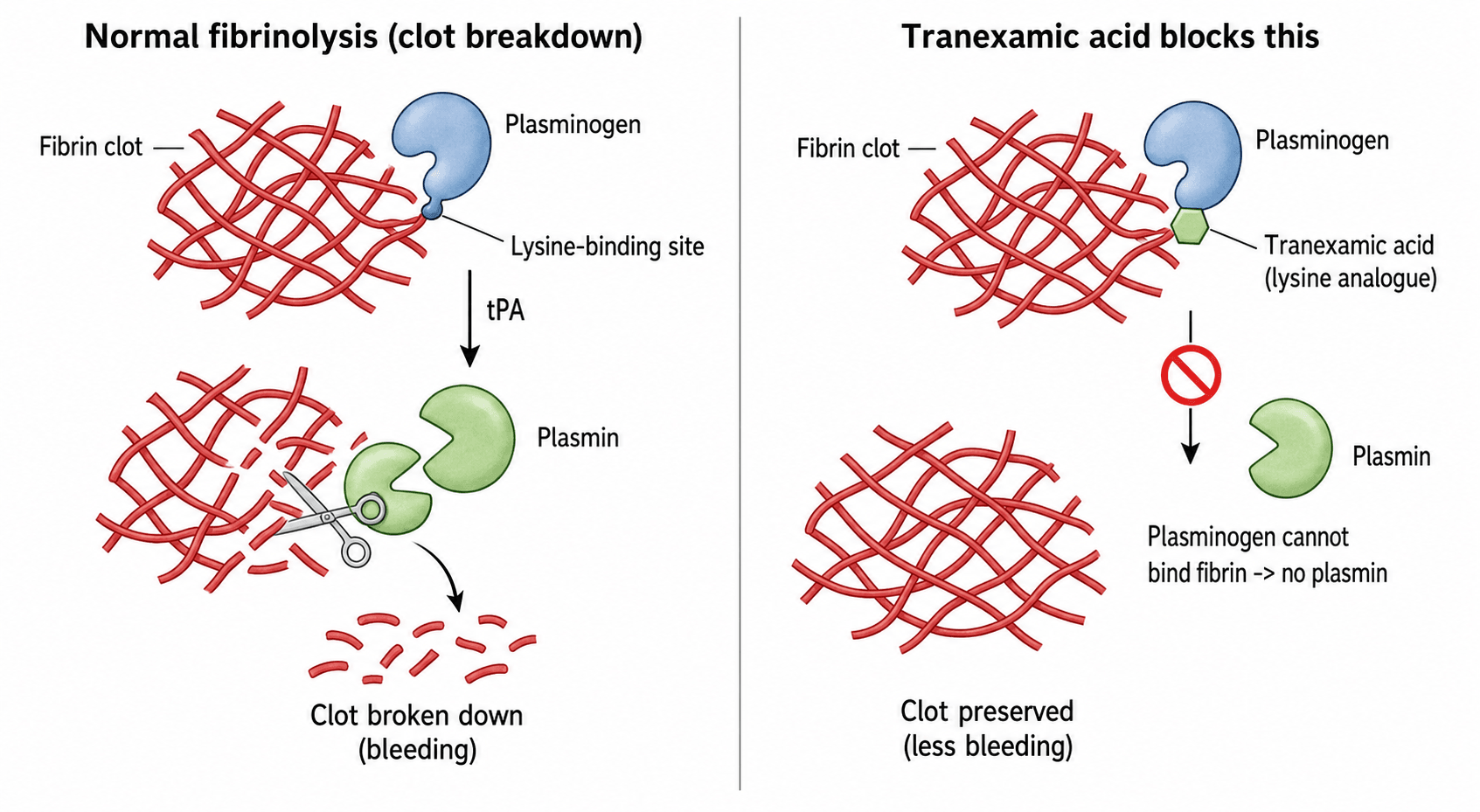
Why surgery switches fibrinolysis on. Tissue damage releases tPA, and contact with artificial surfaces, especially cardiopulmonary bypass, adds to it. This physiological response can be excessive and produce microvascular oozing, and surgical fibrinolysis peaks during and immediately after surgery. TXA counteracts it by stabilising clot at the surgical site.
Pharmacokinetics. The figures worth knowing:
- Peak plasma level immediately after an IV bolus and 1 hour after an oral dose; oral bioavailability approximately 45%
- Low protein binding (3%); distributes into the extravascular space, including joint fluid
- Half-life 2-3 hours, prolonged in renal impairment
- 90% excreted unchanged in the urine by glomerular filtration
- Antifibrinolytic effect at 10-15 micrograms/mL, lasting 3-6 hours after a single dose
Dose and effect. Low-to-moderate doses (10-25mg/kg) give an effective antifibrinolytic action without significant adverse effects, and 15-20mg/kg IV or a 1-2g flat dose provides therapeutic levels for typical orthopaedic procedures. Doses over 100mg/kg add no haemostatic benefit and raise the seizure risk (see Complications).
Other Antifibrinolytics: Aminocaproic Acid and Aprotinin
TXA is best understood against the other two antifibrinolytics. Aminocaproic acid shares its mechanism at lower potency and is the fallback; aprotinin works differently and is the cautionary tale.
- Class / Mechanism
- Lysine analogue - reversibly blocks the lysine-binding sites on plasminogen
- Relative Potency and Status
- First-line; roughly ten times more potent than aminocaproic acid; WHO Essential Medicine
- Exam Points
- The standard antifibrinolytic in orthopaedics
- Class / Mechanism
- Lysine analogue, same mechanism as TXA but lower affinity
- Relative Potency and Status
- Less potent (about one-tenth), so higher doses are needed; second-line alternative
- Exam Points
- The fallback when TXA is unavailable or not tolerated
- Class / Mechanism
- Serine protease inhibitor - directly inhibits plasmin (and kallikrein); NOT a lysine analogue
- Relative Potency and Status
- Largely withdrawn after the BART trial showed higher mortality and renal failure versus the lysine analogues; only limited reintroduction in selected cardiac surgery
- Exam Points
- Different mechanism; the safety cautionary tale
Investigations
Before giving TXA. Routine use in TKA or THA needs nothing beyond the standard preoperative workup, and routine coagulation testing is not required unless the patient is anticoagulated. The screen is mostly history, with eGFR the one value that changes the dose:
- Renal function (eGFR)
- Previous thromboembolic disease: DVT, PE, stroke, MI
- Current anticoagulant or antiplatelet therapy
- Seizure history
- Pregnancy or breastfeeding
Most orthopaedic patients are candidates.
- When Required
- Routine preoperative
- Action if Abnormal
- Optimise Hb before surgery if anaemic
- When Required
- All patients
- Action if Abnormal
- Adjust dose by eGFR (table below)
- When Required
- If on anticoagulation or liver disease
- Action if Abnormal
- May need to hold anticoagulation
- When Required
- If transfusion possible
- Action if Abnormal
- Crossmatch if high blood loss expected
Renal function and dose. Because TXA is renally excreted, impairment prolongs its half-life, to 4-8 hours, and the higher plasma levels increase the seizure risk. The dose follows the eGFR, and in a patient on dialysis it is given after dialysis.
- Dose Adjustment
- Full dose (15-20mg/kg)
- Rationale
- Normal clearance
- Dose Adjustment
- Consider reduced dose (10-15mg/kg)
- Rationale
- Moderately prolonged half-life
- Dose Adjustment
- Reduce dose by 50% (7.5-10mg/kg)
- Rationale
- Significantly prolonged half-life
- Dose Adjustment
- Avoid or single reduced dose
- Rationale
- Accumulation risk, seizure risk
Absolute. Do not give TXA with:
- Active thromboembolic disease: current DVT or PE, acute stroke, arterial thrombosis
- Subarachnoid haemorrhage (risk of cerebral vasospasm and ischaemia)
- Known hypersensitivity to TXA
- Active intravascular clotting (DIC with thrombosis)
Relative. Weigh risk against benefit (management in the special-populations table under Management):
- History of VTE, a stronger concern if within 6 months
- Known thrombophilia (Factor V Leiden, Protein C/S deficiency)
- Renal impairment (eGFR less than 30)
- Seizure disorder, or a history of intracranial haemorrhage
- Acquired disturbance of colour vision (rare retinal toxicity)
- Coronary stents or recent MI: a theoretical concern, with no evidence of harm at standard doses
Thrombophilia screening. No routine screening is recommended. Surgical meta-analyses show no clear increase in VTE with TXA at therapeutic doses, testing is expensive and rarely changes management, and a patient with known thrombophilia can still receive TXA with appropriate VTE prophylaxis. Individualised discussion is reserved for severe hereditary thrombophilia.
Monitoring. TXA needs no coagulation studies, D-dimer or fibrinogen monitoring, during or after surgery, and PT and aPTT are unaffected. Routine observations cover what little it can do:
- Frequency
- During administration
- Concern
- Rapid IV bolus can cause hypotension (rare)
- Frequency
- Continuous
- Concern
- Arrhythmia extremely rare
- Frequency
- Throughout case
- Concern
- Assess TXA efficacy
- Frequency
- Point-of-care / Day 1
- Concern
- Against restrictive transfusion thresholds (Postoperative Care)
Anything further is directed at a specific suspected adverse event:
- Investigation
- Doppler ultrasound
- Rationale
- Rule out DVT
- Investigation
- CTPA or V/Q scan
- Rationale
- Rule out PE
- Investigation
- CT head, EEG
- Rationale
- Rare complication, exclude other causes
- Investigation
- Ophthalmology review
- Rationale
- Extremely rare retinal toxicity
Management
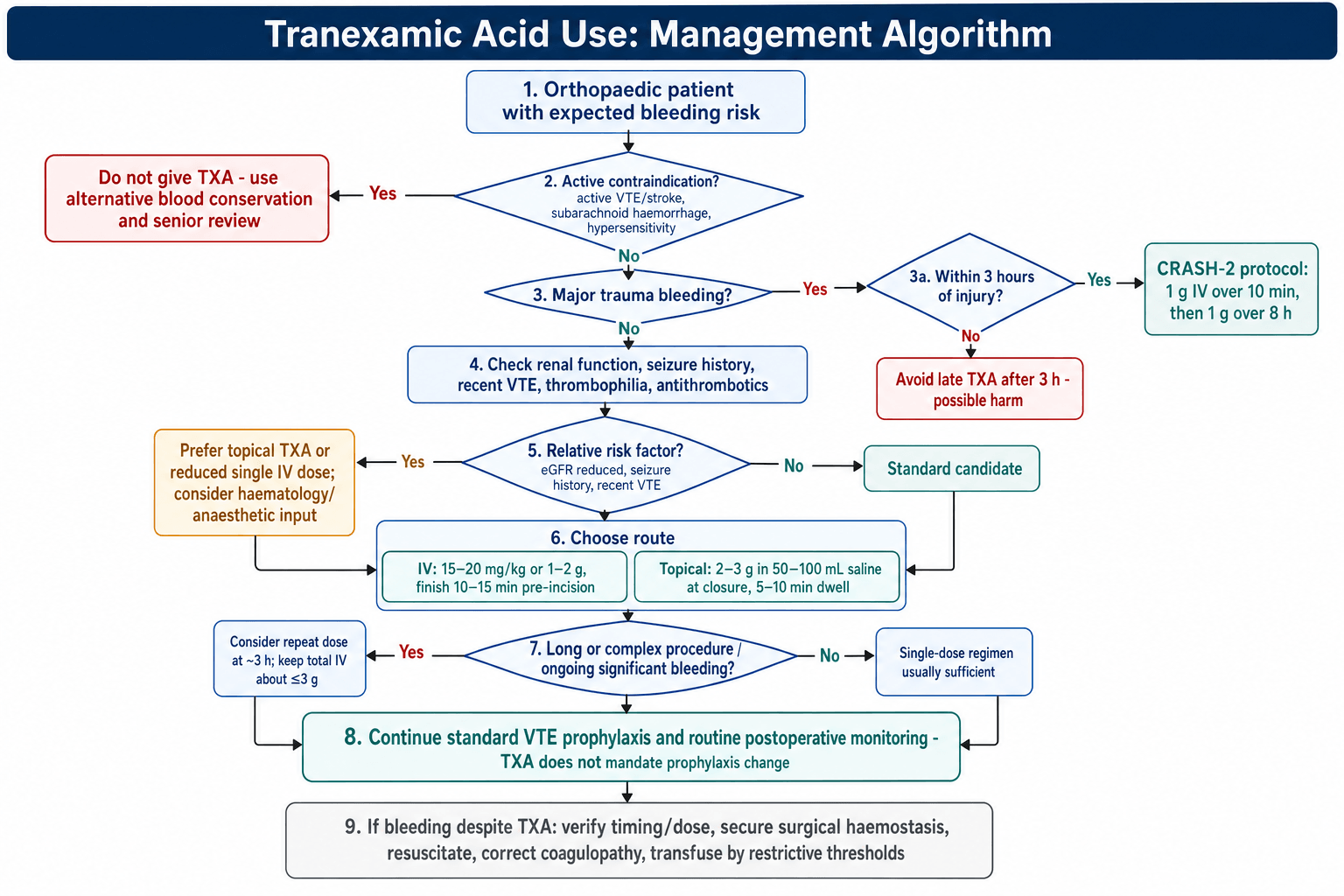
The decision. Using TXA well is mostly about who should not have it, and when. Screen for contraindications, then choose a route, time the dose, decide whether a repeat is needed, and document the plan.
- IV Dose
- 15-20mg/kg or 1-2g flat dose
- Topical Dose
- 2-3g in 50-100mL saline
- Timing
- Pre-incision +/- repeat at closure
- IV Dose
- 20mg/kg or 2g
- Topical Dose
- 3g topical
- Timing
- Pre-incision + repeat dose
- IV Dose
- Loading 10-15mg/kg, then 1-2mg/kg/h infusion
- Topical Dose
- 1-2g topical
- Timing
- Pre-incision, continue intraoperatively
- IV Dose
- 1g IV over 10 min, then 1g over 8h
- Topical Dose
- N/A
- Timing
- Within 3 hours of injury
- IV Dose
- 15mg/kg or 1g
- Topical Dose
- 1-2g topical
- Timing
- Pre-incision
What the evidence settles. The Fillingham network meta-analyses underpinning the combined AAOS/AAHKS/Hip and Knee Society/ASRA guideline found topical, IV and oral TXA all superior to placebo, with no formulation, dose, dosing frequency or timing clearly superior in either TKA or THA. Moderate evidence supported pre-incision IV administration in TKA. Pre-incision IV is therefore a reasonable default, and the confident protocols in circulation are convention rather than demonstrated optimum.
- Blood Loss Reduction
- 30-40%
- Transfusion Reduction
- Substantial
- Notes
- Standard of care, well-supported
- Blood Loss Reduction
- 35-45%
- Transfusion Reduction
- Substantial
- Notes
- Consider for long procedures; no clear advantage over single dose in NMA
- Blood Loss Reduction
- 30-40%
- Transfusion Reduction
- Substantial
- Notes
- Equivalent to IV in TJA
- Blood Loss Reduction
- 35-45%
- Transfusion Reduction
- Substantial
- Notes
- Marginal/no clear benefit over single route
- Blood Loss Reduction
- Similar to standard
- Transfusion Reduction
- Similar
- Notes
- No added benefit, increased seizure risk
Intravenous TXA gives a systemic effect that reaches every surgical site, with predictable plasma levels and the most extensive RCT data, and it is the standard approach in most institutions.
Topical TXA gives a high local concentration with minimal systemic absorption, although even topical use achieves measurable plasma levels. Xie et al. (Thrombosis Research 2017) found similar transfusion requirements with the two routes in THA and TKA, with a marginally smaller maximum haemoglobin drop with IV; there is no clinically significant difference between routes.
Choosing the route. Choose on patient factors and surgeon preference. In a standard patient either route is acceptable. Renal impairment favours topical or a reduced IV dose, a seizure history favours topical, and topical is preferred for any relative contraindication to systemic use because it reduces systemic exposure.
Combined IV and topical. IV pre-incision plus topical at closure has an attractive rationale, systemic plus high local concentration, but multiple RCTs show no significant additional benefit over a single route. It is safe and can be reserved for high-bleeding-risk cases such as revision or a complex primary.
Oral TXA, 1-2g preoperatively (for example 2g about 2 hours before surgery), is an emerging, cost-effective and less-studied alternative, with efficacy comparable to IV in TJA network meta-analysis.
Repeat dosing. Consider a repeat dose when the procedure runs over 3 hours (the half-life is 2-3 hours), with ongoing significant or unexpected blood loss, or in revision and complex reconstruction with a large surface area. Give half the initial dose, or the full dose at 3 hours, and do not exceed about 3g total IV. Routine postoperative dosing is not required; a single 1g IV dose at around 3 hours may be considered only for ongoing oozing or concern about late fibrinolysis.
Continue standard VTE prophylaxis: mechanical (IPC, TED stockings), chemical (LMWH, rivaroxaban, aspirin per protocol, extended for TKA/THA) and early mobilisation. TXA is not a substitute for prophylaxis and is not known to work against it.
Special populations. The relative contraindications, and pregnancy, translate into these plans:
- Management Strategy
- Use TXA with enhanced VTE prophylaxis
- Rationale
- Benefit outweighs risk with appropriate prophylaxis
- Management Strategy
- Individual risk-benefit, consider topical
- Rationale
- Recent VTE is relative contraindication
- Management Strategy
- Use TXA with haematology input
- Rationale
- No clear increased risk at therapeutic doses
- Management Strategy
- Use TXA, continue antiplatelets
- Rationale
- Theoretical concern; no evidence of harm at standard doses
- Management Strategy
- Use topical TXA, avoid high-dose IV
- Rationale
- Seizures associated with high plasma levels
- Management Strategy
- Avoid unless life-threatening bleeding
- Rationale
- Limited safety data
- Management Strategy
- Reduce dose (see eGFR table), prefer single dose/topical
- Rationale
- 90% renal excretion, prolonged half-life
Trauma. The regimen is the CRASH-2 protocol, 1g IV over 10 minutes, then 1g over 8 hours, given as soon as possible. CRASH-2 reduced all-cause mortality in bleeding trauma patients, with an NNT of roughly 67 to save one life, but the benefit is confined to treatment within 3 hours of injury. That window comes from the trial's time-to-treatment analysis, not from the primary report, which randomised within 8 hours.
Head injury. CRASH-3 extended the finding to traumatic brain injury, reducing head-injury-related death in mild-to-moderate TBI treated within 3 hours, with no increase in seizures or vascular occlusive events.
Give TXA within 3 hours of injury, ideally within 1 hour. Given after 3 hours it may increase mortality: in the CRASH-2 time-to-treatment analysis late treatment was associated with more deaths from bleeding. The mechanism may relate to a shift from hyperfibrinolysis to fibrinolytic shutdown, set out in the section on fibrinolytic shutdown below.
Bleeding despite TXA. Work through the causes in order:
- Verify delivery: pre-incision timing, adequate dose, and a repeat if over 3 hours have elapsed
- Surgical control: electrocautery, bone wax, topical haemostatics, direct pressure
- Resuscitation: point-of-care Hb, transfusion by restrictive thresholds, correction of hypothermia and acidosis, FFP and platelets if coagulopathic
- Pharmacological: further TXA up to about 3g total; aminocaproic acid is the alternative antifibrinolytic, aprotinin having been withdrawn
Surgical Technique
Intravenous administration. A slow infusion, finished before the knife goes in:
- Confirm there are no contraindications during the WHO checklist
- Prepare 15-20mg/kg or 1-2g in 100mL saline
- Give it as a slow IV infusion over 10 minutes; slow infusion reduces the risk of hypotension
- Complete it 10-15 minutes before skin incision
- Document dose, timing and route in the anaesthetic or operative record
TXA is compatible with most IV fluids.
Topical administration. Haemostasis first, then the soak, at the end of the procedure before closure:
- Prepare 2-3g TXA in 50-100mL normal saline
- Achieve mechanical surgical haemostasis
- Instil into the joint cavity or wound, in contact with the bleeding surfaces
- Leave a dwell time of 5-10 minutes
- If a drain is used, clamp it during the dwell, then release
An absorbable gelatin sponge can be soaked in TXA for additional local effect, the solution should not be mixed with blood products, and some surgeons atomise it for even distribution.
- Volume
- 50-100mL
- Application Method
- Intra-articular instillation
- Notes
- Can inject via capsule or drain tube
- Volume
- 50-100mL
- Application Method
- Wound irrigation, acetabulum/femoral canal
- Notes
- Less contained than knee
- Volume
- 30-50mL
- Application Method
- Intra-articular
- Notes
- Limited evidence, extrapolated from TJA
Drains. If a drain is used, instil TXA, close the wound layers and clamp the drain for the dwell period, 5-10 minutes or up to 1-2 hours in some protocols, then unclamp, allow free drainage, monitor output as usual and remove it per standard protocol, typically at 24-48 hours. Extended clamping has mixed evidence and risks haematoma if bleeding is brisk. Many surgeons now use drainless protocols, as the blood-loss reduction from TXA makes drains less necessary; otherwise drain management is not significantly altered.
Tourniquet in TKA. Tourniquet release increases bleeding, which is where TXA is particularly beneficial. Timing is pre-incision regardless of tourniquet strategy: given systemically before inflation, therapeutic plasma levels are present to control the reactive bleeding on release, whether the tourniquet is used throughout, for cementation only, or not at all.
By procedure. Points specific to each operation:
- THA: IV or topical, effective with all approaches (posterior, anterior, lateral)
- Revision arthroplasty: higher blood loss, so consider the combined IV and topical approach and a higher dose
- Spine: IV loading dose and infusion; topical is less studied but likely effective
- Trauma fixation: IV by the CRASH-2 protocol, time-critical within 3 hours of injury
Complications and Safety
Thromboembolism. No clear increase in VTE has been detected at therapeutic doses. CRASH-2 (20,211 patients) found no difference in vascular occlusive events (DVT, PE, stroke, MI) even in a high-risk trauma population without routine chemical prophylaxis. In the Ker surgical meta-analysis (129 trials, 10,488 patients) the estimates showed no clear increase, but every interval is wide:
- DVT RR 0.86 (95% CI 0.53-1.39)
- PE RR 0.61 (0.25-1.47)
- MI RR 0.68 (0.43-1.09)
- Stroke RR 1.14 (0.65-2.00)
POISE-3. In noncardiac surgery the cardiovascular composite was near-identical, 14.2% vs 13.9%, but formal noninferiority was not met, so vigilance and standard prophylaxis remain essential.
No signal of thrombotic harm has emerged, but the surgical meta-analysis calls its own thromboembolic result uncertain because these are rare events in trials sized for transfusion, and POISE-3 did not establish noninferiority. "No evidence of increased risk" is not "evidence of no increased risk". The practical resolution is that standard VTE prophylaxis always continues.
Seizures. The risk is dose-dependent and very low at orthopaedic doses.
- Risk Level
- Very low (under 0.1%)
- Notes
- Extremely rare at therapeutic doses
- Risk Level
- Increased risk
- Notes
- Cardiac surgery literature; up to several percent at very high doses
- Risk Level
- Increased (dose accumulation)
- Notes
- Reduce dose if eGFR less than 30
- Risk Level
- Caution advised
- Notes
- Consider topical route or avoid
At plasma concentrations over about 80-100 micrograms/mL TXA acts as a GABA-A receptor antagonist, lowering the seizure threshold, and orthopaedic doses rarely reach these levels. If a TXA-related seizure occurs, stop the infusion, protect the airway, give a benzodiazepine, check glucose, document it and avoid TXA in future.
Other adverse effects. Most are minor or rare, serious adverse events are rare at orthopaedic doses, and the risk rises with dose and renal impairment:
- Nausea, vomiting and diarrhoea, especially with rapid IV or oral dosing
- Hypotension with rapid IV administration
- Visual disturbance and retinal toxicity: extremely rare, reported with prolonged oral use (e.g. menorrhagia), not with short-term perioperative use
- Allergic reactions: very rare, and anaphylaxis has not been reported at standard doses
Interactions. Concurrent antiplatelets, anticoagulants and other drugs are handled as follows:
- Interaction
- No significant interaction
- Management
- Continue as per cardiac indication
- Interaction
- No evidence of harm
- Management
- Use TXA perioperatively, monitor INR
- Interaction
- Typically held perioperatively
- Management
- TXA safe once DOAC managed per protocol
- Interaction
- Theoretical thrombosis risk
- Management
- No evidence of increased risk with short-term perioperative use
- Interaction
- Increased thrombosis risk
- Management
- Caution with concurrent use
The balance sheet. What TXA does to complications:
- Reduced by TXA: transfusion requirements, wound haematoma, reoperation for bleeding
- Not increased by TXA: DVT, PE, wound infection, periprosthetic joint infection
- Uncertain or dose-dependent: seizures (only at very high doses or in renal impairment), retinal toxicity (not with short-term use)
Postoperative Care
Routine care. TXA needs no additional postoperative monitoring: standard wound observation, a routine day-1 haemoglobin and VTE prophylaxis per protocol. TXA typically reduces wound haematoma, and rehabilitation is unchanged, with early mobilisation on day 0 or day 1.
Transfusion. Standard restrictive thresholds apply: transfuse below 70 g/L for most patients, or at 70-80 g/L if symptomatic or with cardiac disease. TXA reduces transfusion need but does not eliminate it.
Ongoing bleeding. Any of these is cause for concern:
- Drain output over 500mL in the first 4 hours
- An expanding wound haematoma
- Hb drop greater than 30 g/L
- Haemodynamic instability
Managing it. Start conservatively: compression dressing and ice, reversal of excessive anticoagulation, and transfusion if indicated. By the time excessive drainage or haematoma appears the TXA effect has usually worn off, so the priority is to assess for surgical bleeding rather than routinely re-dose, although an additional 1g IV may be considered within about 6 hours of surgery.
Return to theatre is indicated for:
- Expanding haematoma compromising the wound
- Haemodynamic instability despite resuscitation
- Drain output greater than 1500mL in 6-8 hours
- Suspected arterial bleeding
Enhanced recovery. TXA is the core blood-conservation component of an ERAS pathway for joint replacement, with a transfusion rate under 5% that reduces transfusion-related morbidity. Less anaemia enables early mobilisation, an indirect benefit, and TXA contributes to reduced length of stay as part of a multimodal strategy; the VTE prophylaxis protocol does not change.
Outcomes and Cost-Effectiveness
Blood loss. TXA reduces total blood loss by 30-50% in TKA and 30-40% in THA, an absolute reduction of approximately 300-500 mL per procedure. That reduces anaemia, transfusion need and the complications of both.
Transfusion. In arthroplasty the transfusion rate falls from 15-25% without TXA to 2-5% with it, a reduction of roughly one third to two thirds. Across surgery the Ker meta-analysis found transfusion reduced by about one third (RR 0.62). Beyond arthroplasty, POISE-3 (9535 noncardiac surgery patients) reduced the composite bleeding outcome, 9.1% vs 11.7% (HR 0.76).
- Without TXA
- 800-1200 mL
- With TXA
- 500-800 mL
- Improvement
- 30-50% reduction
- Without TXA
- 1000-1500 mL
- With TXA
- 600-900 mL
- Improvement
- 30-40% reduction
- Without TXA
- 15-25%
- With TXA
- 2-5%
- Improvement
- Substantial reduction
- Without TXA
- 3-4 g/dL
- With TXA
- 2-3 g/dL
- Improvement
- About 1 g/dL less drop
- Without TXA
- 0.5-1%
- With TXA
- 0.5-1%
- Improvement
- No clear difference
- Without TXA
- 3-5%
- With TXA
- 2-4%
- Improvement
- Slight reduction
Cost. TXA is one of the most cost-effective interventions in orthopaedic surgery and is generally cost-saving, a dominant strategy that both saves money and improves outcomes. A single bolus is simple to give and effective in many settings.
- TXA costs of the order of a few units of currency per gram, roughly 10-30 per patient
- A single unit of blood costs hundreds, including testing, administration and monitoring, plus the cost of transfusion-related complications
- Transfusion falls by the order of 15-20% absolute, an NNT of roughly 5-10 to prevent one transfusion, with net savings of several hundred per patient
- Indirect benefits: shorter length of stay, fewer transfusion-related complications, less burden on the blood bank
Other settings and the long term. The evidence outside primary joint replacement, and over time:
- Spine surgery: 20-40% blood-loss reduction, most beneficial in multilevel fusions and deformity correction; no increase in epidural haematoma or neurological complications, and no effect on MEP/SSEP monitoring
- Hip fracture and periarticular trauma: reduced transfusion; give as early as possible, ideally within 3 hours
- Shoulder arthroplasty: limited but consistent evidence of blood-loss reduction; topical use is feasible
- Long term: no delayed VTE signal, no increase in implant failure or revision, no delayed wound complications
Fibrinolytic Shutdown and the Timing of TXA in Trauma
The trauma sections explain that TXA given after 3 hours may increase mortality and attribute this to a shift toward fibrinolytic shutdown. That shift is part of the trauma-induced-coagulopathy fibrinolysis spectrum, and understanding the phenotypes explains why TXA timing matters.
- What Happens
- Excessive plasmin activity rapidly breaks down clot, typically early after major injury and shock
- Implication for TXA
- TXA most beneficial - it stabilises clot and reduces death from bleeding (CRASH-2, within 3 hours)
- What Happens
- Normal, balanced clot turnover
- Implication for TXA
- TXA of limited additional benefit
- What Happens
- Suppressed fibrinolysis with impaired clot breakdown and microvascular thrombosis, often hours after injury or during shock-resuscitation
- Implication for TXA
- TXA may be unnecessary or harmful - the proposed mechanism for the late-administration harm signal
The trauma fibrinolysis response is a spectrum: early hyperfibrinolysis (where TXA helps) can give way over hours to fibrinolytic shutdown - suppressed clot breakdown with microvascular thrombosis - which is the leading explanation for why TXA given more than 3 hours after injury was associated with increased mortality in CRASH-2. Where available, viscoelastic testing (TEG or ROTEM) can identify the phenotype, but in practice the rule is simple: give TXA as early as possible (ideally within 1 hour, certainly within 3) and do not start it late.
Guidelines, Registries & Global Practice
Global epidemiology and rationale
Perioperative bleeding and allogeneic transfusion are common across orthopaedic surgery worldwide. Untreated, transfusion rates reach 15-25% in primary TKA/THA and are higher in revision, bilateral and trauma cases. TXA is on the WHO Model List of Essential Medicines, reflecting its global relevance and low cost, and is a cornerstone of patient blood management (PBM) programmes internationally.
Major society guidance (side by side)
- Setting
- Primary TJA
- Recommendation
- Strong
- Key Points
- Routine use; no route/dose/timing clearly superior
- Setting
- Elective hip/knee replacement
- Recommendation
- Recommended
- Key Points
- Cost-effective; considered standard of care
- Setting
- Trauma bleeding
- Recommendation
- Essential Medicine
- Key Points
- CRASH-2 protocol, within 3h of injury
- Setting
- Trauma and major surgery
- Recommendation
- Recommended
- Key Points
- Early administration; part of blood management
Registry and blood-management context
National joint registries (NJR-UK, AJRR-US, AOANJRR-Australia, Swedish/Norwegian registries) do not all capture TXA use directly, but transfusion rates following primary TKA/THA have fallen markedly over the past decade in regions where TXA and PBM programmes have been adopted (e.g. TKA transfusion rates declining from roughly 20% to under 10% nationally in several registries). This temporal correlation supports TXA as a key driver of reduced perioperative transfusion. No registry-level signal of increased VTE or revision has emerged.
Patient blood management (PBM) - three pillars
- Optimise erythropoiesis preoperatively - treat anaemia (iron, erythropoietin if indicated), manage anticoagulation
- Minimise perioperative blood loss - TXA as the key pharmacological intervention, cell salvage, meticulous haemostasis, hypotensive anaesthesia where safe
- Harness tolerance of anaemia - restrictive transfusion thresholds (Hb less than 70-80 g/L unless symptomatic), continued iron supplementation
High- vs limited-resource variation
- High-resource settings: TXA is often embedded in pre-printed order sets and surgical checklists for TJA and trauma, with pharmacy-driven automatic dispensing; cell salvage and restrictive transfusion are routinely available
- Limited-resource settings: TXA is especially valuable because it is cheap, stable and easy to administer, reducing dependence on a constrained donor blood supply; CRASH-2 deliberately recruited across 40 countries to establish global applicability
Barriers and strategies for adoption
Despite strong evidence, uptake varies due to knowledge gaps, outdated VTE-risk concerns and protocol inertia. Effective strategies include institutional protocols, default order sets, education for surgeons/anaesthetists/nurses, and audit-and-feedback on transfusion and TXA utilisation.
TXA is a WHO Essential Medicine and a cornerstone of patient blood management worldwide. Major society guidelines (AAOS, NICE/BOA, WHO, European trauma consensus) converge on routine use in primary TJA and early use in trauma, with no single route or dosing schedule shown to be clearly superior in arthroplasty.
MCQ Practice Points
Q: What is the mechanism of action of tranexamic acid (TXA) in reducing surgical blood loss?
A: TXA competitively inhibits plasminogen activation by binding to lysine-binding sites on plasminogen. This prevents plasmin from degrading fibrin clots (antifibrinolytic). TXA stabilizes formed clots rather than promoting new clot formation. It does NOT clearly increase thrombogenicity or VTE risk in orthopaedic surgery populations based on large trials (CRASH-2) and surgical meta-analyses.
Q: What is the recommended dosing regimen for TXA in primary total knee arthroplasty?
A: IV TXA 1-2g (or 15-20mg/kg) given before tourniquet inflation or skin incision, with an optional repeat dose at closure or 3 hours later. Topical TXA (2-3g in 50-100mL saline) applied before closure is an alternative with equivalent efficacy and lower systemic absorption. Network meta-analyses show no route, dose or timing is clearly superior. Avoid exceeding about 3g total IV.
Q: What is the expected reduction in blood loss and transfusion risk with TXA use in total joint arthroplasty?
A: TXA reduces calculated blood loss by 30-50% (approximately 300-500mL) and transfusion risk substantially (the Ker meta-analysis reported transfusion reduced by about one third overall). Hemoglobin drop is reduced by approximately 1 g/dL. Hospital length of stay may be shortened. No clear increase in DVT/PE with appropriate thromboprophylaxis.
Q: What are the absolute and relative contraindications to TXA use in orthopaedic surgery?
A: Absolute: active thromboembolic disease (acute DVT, PE, stroke), subarachnoid haemorrhage, hypersensitivity. Relative: history of VTE (requires thromboprophylaxis), renal impairment (reduce dose by 50% if eGFR 10-30, avoid if under 10), seizure disorder (TXA lowers seizure threshold at high plasma levels), coronary stents. Previous treated VTE with adequate prophylaxis is NOT an absolute contraindication.
Q: What is the evidence for TXA in trauma and noncardiac surgery beyond arthroplasty?
A: CRASH-2 (20,211 trauma patients) reduced mortality when given within 3 hours of injury, and CRASH-3 reduced head-injury death in mild-to-moderate TBI. POISE-3 (9535 noncardiac surgery patients) significantly reduced the composite bleeding outcome (HR 0.76) but did NOT formally establish cardiovascular noninferiority, so standard VTE/cardiovascular care continues. In trauma, give as early as possible and avoid administration more than 3 hours post-injury.
Exam Viva Scenarios
Practise clinical reasoning and management decisions out loud
“A 75-year-old woman with eGFR of 25 mL/min/1.73m2 is scheduled for TKA. How do you manage TXA in this patient?”
“A 65-year-old woman is scheduled for bilateral TKA under single anesthetic. How would you manage TXA dosing for this patient?”
“Describe your technique for administering tranexamic acid during total knee arthroplasty.”
“A colleague expresses concern about using TXA in patients undergoing TKA, citing thromboembolic risk. How do you address this concern?”
“You are called to the ward on the evening of surgery. Your patient who had TKA with TXA has 600mL in the drain over 4 hours and is complaining of knee pain and swelling. How do you manage this?”
“What is the evidence for using tranexamic acid in total knee arthroplasty, and should it be standard of care?”
Mechanism
- Synthetic lysine analogue - competitively inhibits plasminogen
- Binds lysine-binding sites, prevents plasmin formation
- Antifibrinolytic - stabilizes clots, does not promote formation
- Half-life 2-3h, 90% renal excretion unchanged
Evidence Base
- TKA/THA: 30-50% reduction in blood loss, substantial transfusion reduction (Level I)
- CRASH-2: 20,211 trauma patients, mortality reduced 16.0% to 14.5% (RR 0.91)
- CRASH-3: benefit in mild-moderate TBI within 3h, no increase in seizures/VTE
- POISE-3: bleeding reduced (HR 0.76) but cardiovascular noninferiority not met
- Ker BMJ meta-analysis: transfusion down ~one third, no clear VTE increase
Dosing Protocols
- TKA/THA: 15-20mg/kg or 1-2g IV bolus pre-incision
- Topical: 2-3g in 50-100mL saline, 5-10 min dwell
- Trauma (CRASH-2): 1g over 10 min, then 1g over 8h within 3h injury
- Spine: Loading 10-15mg/kg, then 1-2mg/kg/h infusion
- Renal impairment: 50% dose if eGFR 10-30, avoid if under 10
Safety Profile
- VTE risk: no clear increase at therapeutic doses (CRASH-2, Ker meta-analysis)
- Mechanism of safety: antifibrinolytic, not procoagulant
- Seizure risk: rare, dose-dependent (over 100mg/kg), risk if renal impairment
- Safe with aspirin, antiplatelet agents, and warfarin
Contraindications
- Absolute: active VTE (acute DVT/PE), subarachnoid hemorrhage, allergy
- Relative: seizure disorder (consider topical), renal impairment (dose adjust)
- Previous treated VTE: relative, ensure adequate prophylaxis
- Trauma timing: DO NOT give if over 3h post-injury (CRASH-2 harm signal)
Routes Comparison
- IV bolus: rapid, systemic, standard for most procedures
- Topical: equivalent to IV in TJA, lower systemic exposure
- IV infusion: for prolonged surgery (spine, complex revision)
- Combined IV+topical: no clear additional benefit over either alone
- Oral: 45% bioavailability, emerging evidence but less studied
Guidelines
- AAOS/AAHKS/ASRA: strong recommendation for TXA in primary TJA
- NICE/BOA: recommended for elective hip/knee replacement
- WHO: Essential Medicine for trauma bleeding (CRASH-2 protocol)
- Standard of care: routine in TJA, trauma, major spine
Cost-Effectiveness
- TXA is inexpensive per gram (a few units per dose)
- A single transfusion costs many times more, plus risks
- NNT roughly 5-10 to prevent one transfusion
- Generally cost-saving (dominant): saves money and improves outcomes
Key Exam Points
- State mechanism clearly: reversible competitive inhibition of plasminogen
- Know CRASH-2: 20,211 patients, reduced mortality, within 3h only
- Safety: no clear VTE increase; acknowledge POISE-3 noninferiority not met
- Dosing: 15-20mg/kg or 1-2g IV for TJA, CRASH-2 protocol for trauma
- Routes equivalent in TJA: IV and topical same efficacy
- Contraindications: absolute vs relative, most patients eligible
- Cost-effective: strong economic argument, should be routine
Common Viva Questions
- Q: Does TXA increase VTE risk? A: No clear increase in surgical meta-analyses
- Q: Mechanism? A: Lysine analogue, reversibly inhibits plasminogen activation
- Q: Dosing in TKA? A: 15-20mg/kg or 1-2g IV pre-incision, or 2-3g topical
- Q: CRASH-2 protocol? A: 1g over 10 min, then 1g over 8h, within 3h injury
- Q: Contraindications? A: Absolute - active VTE, SAH, allergy. Relative - seizure, renal
- Q: IV vs topical? A: Equivalent efficacy in TJA, choose based on patient factors
Evidence Base Across Orthopaedic Subspecialties
Total Knee Arthroplasty (TKA)
- Network meta-analysis and multiple RCTs demonstrate consistent 30-50% reduction in blood loss and a fall in transfusion from roughly 20% to under 5%
- No clear increase in symptomatic VTE
- Routes: IV (15-20mg/kg pre-incision), topical (2-3g in 50-100mL saline, 5-10 min dwell), combined (no clear added benefit), oral (1-2g pre-op, emerging) - none clearly superior
- Outcomes: mean blood-loss reduction 300-500mL; no difference in infection, wound complications or thrombosis
No clinically significant difference between topical and IV TXA in RCTs and network meta-analyses. Choose IV for systemic effect and convenience, or topical if the patient has a relative contraindication to systemic use (e.g. seizure disorder).
Total Hip Arthroplasty (THA)
- 30-40% blood-loss reduction across approaches (posterior, lateral, anterior); transfusion reduced from 15-25%
- Safe in cemented and uncemented techniques; effective in revision with higher doses considered
- Dosing: 1.5-2g IV bolus or 15-20mg/kg; topical 2-3g into acetabulum/femoral canal before final component insertion; consider repeat for prolonged procedures
Key Evidence Summary
CRASH-2 Trial - Trauma
- All-cause mortality reduced 16.0% to 14.5% (RR 0.91)
- Death from bleeding reduced 5.7% to 4.9% (RR 0.85)
- No increase in vascular occlusive events
- Note what this 2010 paper does NOT contain: patients were randomised within EIGHT hours, and the familiar three-hour rule comes from the separate 2011 exploratory analysis below - do not cite this paper for it
CRASH-2 Time-to-Treatment Analysis - Where the Three-Hour Rule Comes From
- Treatment within 1 hour: death from bleeding 5.3% vs 7.7%, RR 0.68 (0.57-0.82), p less than 0.0001
- Treatment at 1-3 hours: 4.8% vs 6.1%, RR 0.79 (0.64-0.97), p=0.03
- Treatment AFTER 3 hours: 4.4% vs 3.1%, RR 1.44 (1.12-1.84), p=0.004 - an apparent INCREASE in death due to bleeding
- No variation in effect by systolic blood pressure, Glasgow Coma Score or injury type
TXA Safety and Efficacy in Surgery - Ker Meta-Analysis
- Transfusion reduced by about one third (RR 0.62)
- No clear increase in DVT (RR 0.86) or PE (RR 0.61)
- No clear increase in MI (RR 0.68) or stroke (RR 1.14)
- Thromboembolic effect estimates have wide confidence intervals
Route Comparison in TKA - Fillingham Network Meta-Analysis
- 67 studies, primary TKA
- Topical, IV and oral all superior to placebo
- No formulation, dose or timing clearly superior
- Moderate evidence favours pre-incision IV
Route Comparison in THA - Fillingham Network Meta-Analysis
- 34 studies, primary THA
- All routes superior to placebo
- No route clearly superior
- Higher/repeat dosing no clear benefit
POISE-3 - TXA in Noncardiac Surgery
- 9535 noncardiac surgery patients
- Composite bleeding 9.1% vs 11.7% (HR 0.76), an absolute difference of -2.6 percentage points (95% CI -3.8 to -1.4)
- Cardiovascular composite 14.2% vs 13.9% (HR 1.02)
- Formal cardiovascular noninferiority not established
CRASH-3 - TXA in Traumatic Brain Injury
- 12,737 randomised, but the primary outcome is reported in the 9,202 (72.2%) treated WITHIN 3 HOURS - quote that denominator, not the headline one
- Head-injury death 18.5% vs 19.8% (RR 0.94, 95% CI 0.86-1.02)
- Benefit in mild-to-moderate TBI (RR 0.78, 0.64-0.95) but not severe (0.99, 0.91-1.07), with a p value for heterogeneity of 0.030 - it is that test, not the subgroup estimates alone, that licenses treating them separately
- Early treatment was more effective than later treatment in mild and moderate injury (p = 0.005) but time made no obvious difference in severe injury (p = 0.73)
- No increase in vascular occlusive events (RR 0.98, 0.74-1.28) or seizures (1.09, 0.90-1.33)
Society Guideline - TXA in Primary Total Joint Arthroplasty
- Strong recommendation for TXA in primary TJA
- No route/dose/timing clearly superior
- Concordant with NICE and WHO guidance