A1 Pulley | Stenosing Tenosynovitis | Injection | Release
- A1 Pulley: Location of stenosis at MCP level. Release A1, NOT A2.
- Thumb and Ring Finger: Most commonly affected; series disagree on which leads.
- Steroid Injection: roughly 55-70% short-term success; about a third in diabetes.
- A2 Pulley: CRITICAL - never release. Causes bowstringing if released.
- Diabetics: 10% prevalence, multiple digits, lower injection success.
- “Palpable nodule at A1 (MCP level)
- “Worse in morning (tissue oedema)
- “Diabetics: 10% prevalence, multiple fingers
- “Preserve A2 = fundamental principle
Overview and Epidemiology
Trigger finger, or stenosing tenosynovitis, is catching or locking of a digit caused by stenosis at the A1 pulley.
Who. Prevalence is 2-3% in the general population. Women are affected more often than men (6:1) and incidence peaks at 50-60 years. Middle-aged women are the classic demographic.
Which digit. The thumb and ring finger are the most often affected, then the long finger, with the index and little fingers least often. The percentages below come from the Rozental cohort of 124 digits carded in the Evidence Base. Other series place the ring finger first, so the rank order of thumb and ring is not settled, and the neatly rounded five-digit breakdowns in circulation are not traceable to any cohort.
- Frequency
- 35%
- Notes
- Different anatomy - single IP joint, A1 over the metacarpal head
- Frequency
- 31%
- Notes
- The digit most often quoted as commonest in other series
- Frequency
- 23%
- Notes
- Consistently third
- Frequency
- Remainder
- Notes
- Least often affected
Multiple digits are commonly involved, especially in diabetes.
Risk factors. Diabetes raises the prevalence to 10%; screen diabetic patients for trigger finger. The other associations:
- Rheumatoid arthritis - inflammatory tenosynovitis
- Gout - crystal-induced
- Repetitive gripping - occupational
- Carpal tunnel - an associated condition
Pathophysiology and Mechanisms
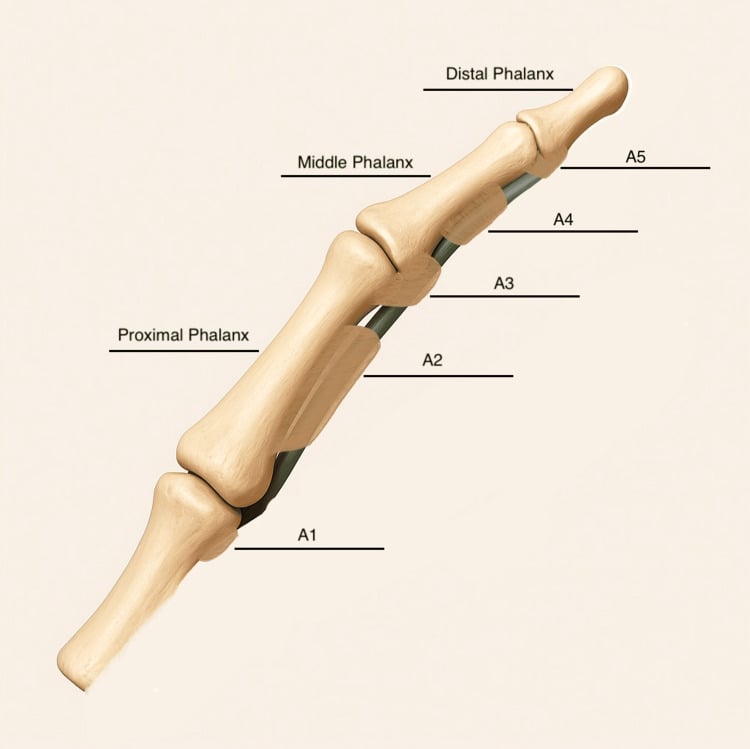
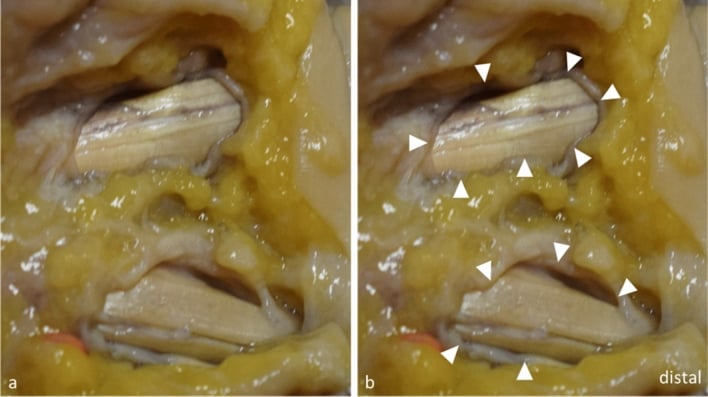
The pulleys. The flexor sheath has five annular pulleys (A1-A5) and three cruciate pulleys (C1-C3). The annular pulleys lie at these levels:
- A1 - MCP joint, where trigger finger occurs
- A2 - over the proximal phalanx
- A3 - PIP joint
- A4 - over the middle phalanx
- A5 - DIP joint
A1 is short and lies at the MCP joint; A2 is long and runs over the proximal phalanx. The junction between them is the boundary of the release.
A2 and A4 are critical for tendon function: they maintain tendon apposition and are never released. Releasing A2 causes bowstringing and loss of grip. A1, A3 and A5 are minor and can be released safely; A3 and A5 contribute less to bowstring prevention.
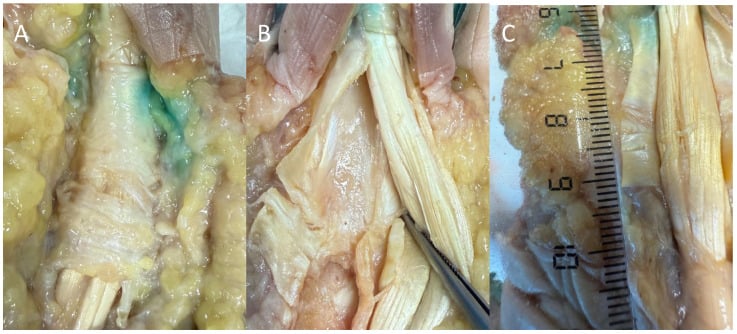
The lesion. Repetitive friction thickens the tendon sheath at A1, and a nodule forms in the flexor tendon (FDS or FDP). The nodule catches at the narrowed pulley, producing catching, triggering or locking.
Classification Systems
Green's grading runs from pain with only a history of catching, through demonstrable catching and locking that needs passive extension, to a digit that cannot be passively extended. Higher grades are progressively more likely to need surgery.
- Description
- Pain, palpable nodule
- Clinical Features
- History of catching, no demonstrable catching
- Treatment
- Splinting, activity modification
- Description
- Catching
- Clinical Features
- Demonstrable catching, can actively extend
- Treatment
- Steroid injection
- Description
- Locking
- Clinical Features
- Requires passive extension to unlock
- Treatment
- Injection or surgery
- Description
- Fixed locked
- Clinical Features
- Unable to passively extend the digit
- Treatment
- Surgical release indicated
Clinical Assessment
History. The patient describes catching or clicking during flexion and extension, and locking that may need passive unlocking. Symptoms are worse in the morning, from tissue oedema after rest, and get worse over time. The pain is in the palm over the MCP crease. Ask about diabetes and occupation.
Examination. Palpate at the MCP crease, not the PIP joint: the nodule and the tenderness are over the A1 pulley. Demonstrate the triggering with flexion and extension, grade it by whether the finger extends actively, needs passive extension or is fixed, and check all the other digits.
Differential Diagnosis
- Key feature
- Palpable nodule at A1 (MCP crease) with catching/locking on flexion
- Discriminator from trigger finger
- Triggering reproduced; nodule moves with tendon
- Key feature
- Palpable cord/nodule in palmar fascia, fixed flexion contracture
- Discriminator from trigger finger
- Cord is superficial and fixed; no triggering, no active unlocking
- Key feature
- Mechanical locking with joint-line tenderness, crepitus
- Discriminator from trigger finger
- Locking is at the joint, not the pulley; radiographs abnormal
- Key feature
- Extensor tendon subluxation at MCP, snapping on extension
- Discriminator from trigger finger
- Dorsal not volar; snapping on extension over the knuckle
- Key feature
- Diffuse sheath swelling, Kanavel signs if septic
- Discriminator from trigger finger
- No discrete nodule; systemic/inflammatory features, pain on passive extension
- Key feature
- Mechanical catching without nodule, often post-injury
- Discriminator from trigger finger
- History of trauma; no A1 nodule; may need imaging
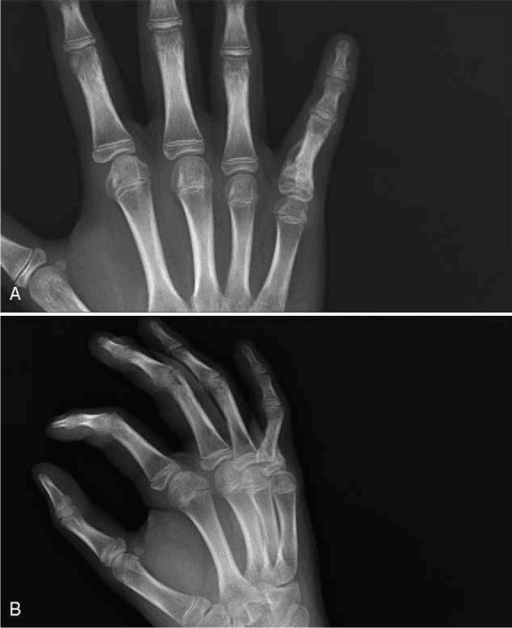
The post-traumatic mimic. A digit that catches after an injury and has no A1 nodule warrants a radiograph, because the mechanical catching may be at the bone rather than the pulley.
Investigations
Clinical diagnosis. A palpable nodule at A1 with triggering is pathognomonic, and typical trigger finger with clear clinical findings needs no imaging.
Screen for diabetes. Check HbA1c or fasting glucose in a patient not known to be diabetic. Diabetic patients need careful counselling about the lower success of injection.
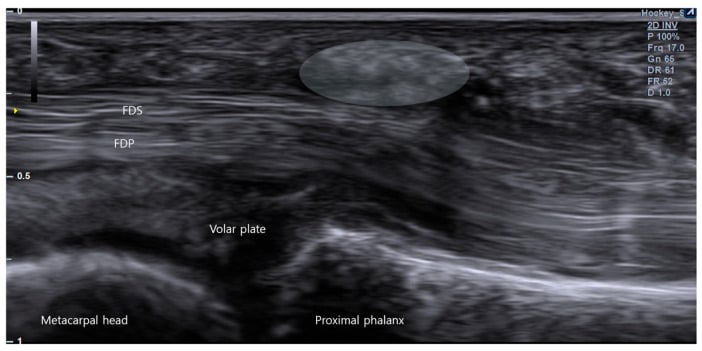
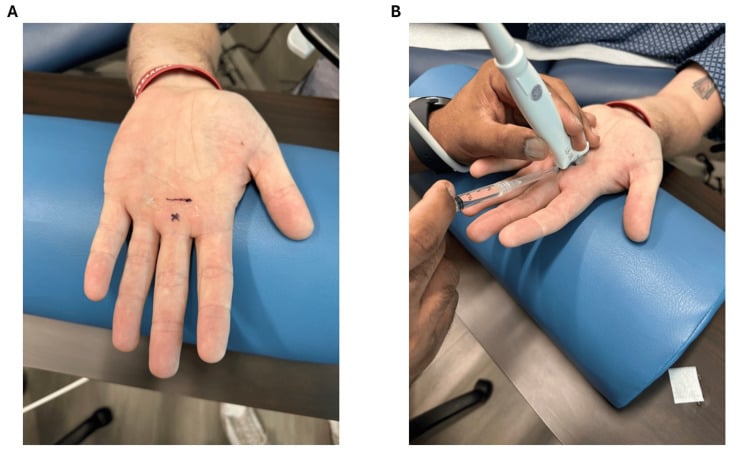
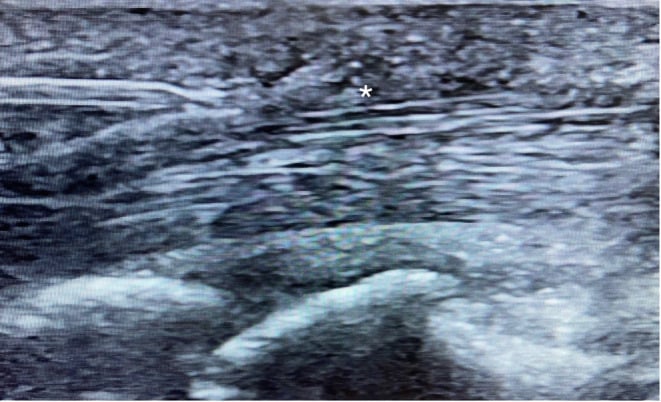
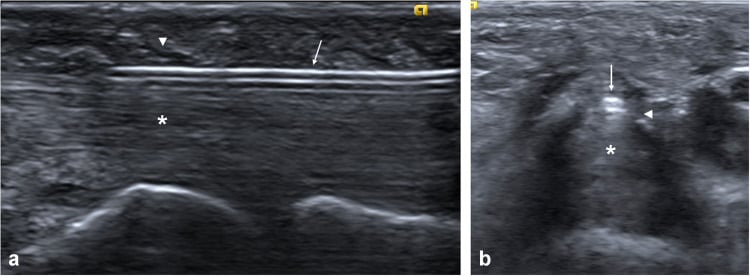
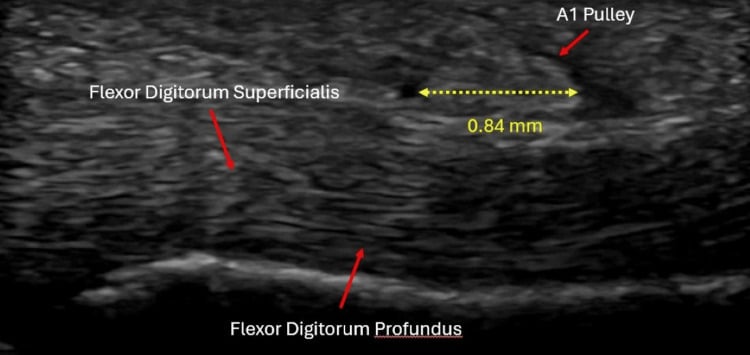
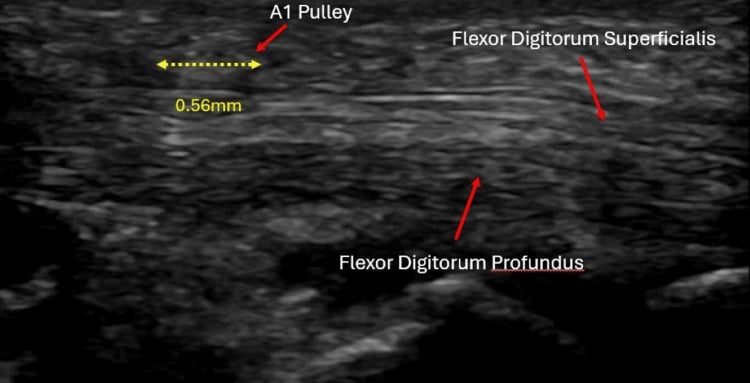
Ultrasound. Rarely required, and useful when the diagnosis is uncertain. It can show thickening of the tendon sheath and of the A1 pulley, and a tendon nodule. High-resolution ultrasound can measure A1 length and thickness at the metacarpal head and distinguish its distal edge from the A2 pulley. The pathological A1 pulley is thickened and hypoechoic over the FDS and FDP tendons at the MCP joint.
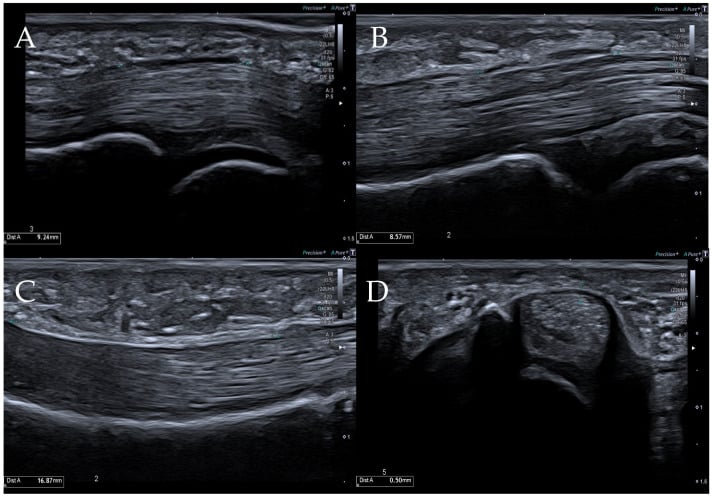
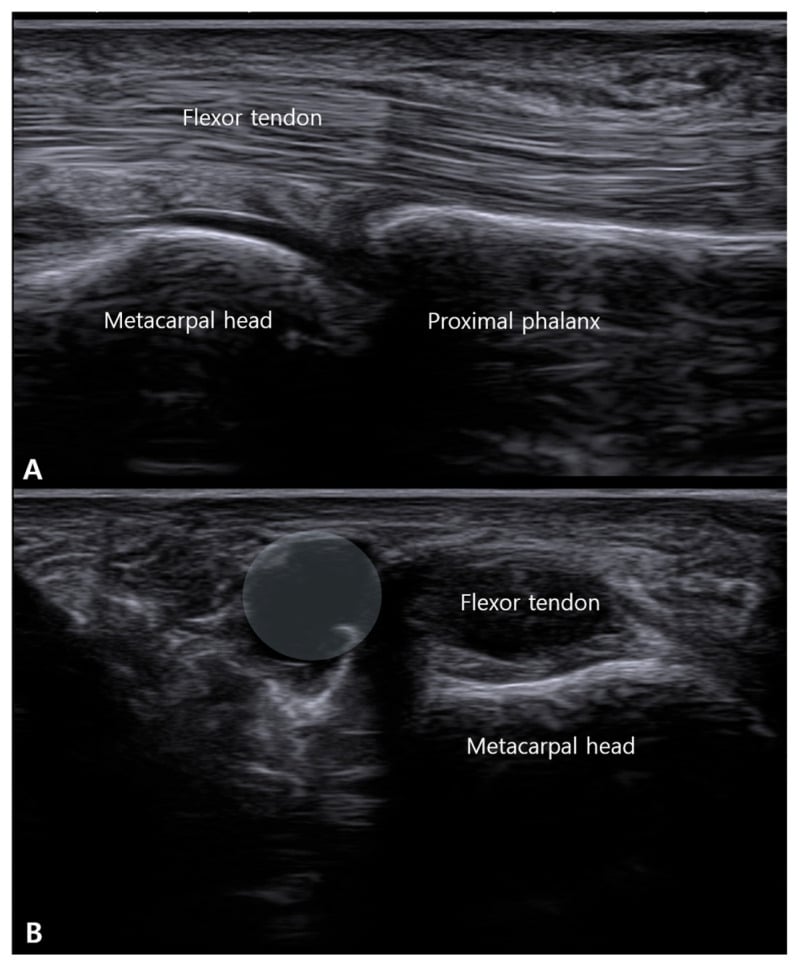
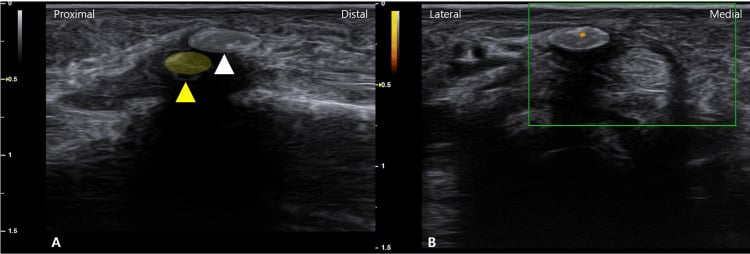
Atypical lesions. An A1 pulley ganglion may be inconspicuous on long-axis imaging and clear only in short axis, which is why dynamic biplanar ultrasound is useful when the palpable lesion is atypical. A discrete calcific focus superficial to A1, separate from the sesamoid and with adjacent Doppler signal, is a rare structural cause that can mimic ordinary stenosing tenosynovitis.
Management Algorithm
Activity modification. Reduce repetitive gripping, and modify work tasks where the cause is occupational. This addresses the load that provokes the tenosynovitis, not the stenosis itself.
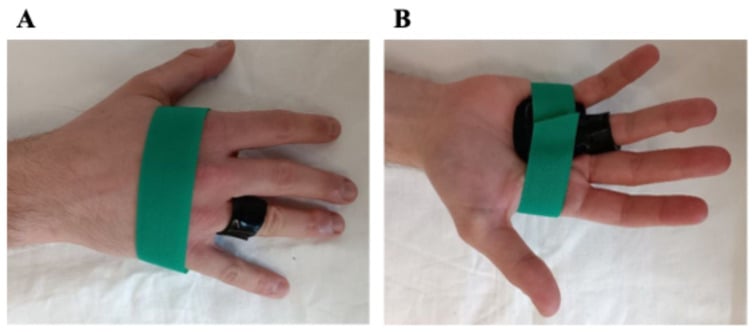
Extension splinting. A night splint holding the MCP joint in extension stops the nodule repeatedly passing under the A1 pulley overnight. That breaks the catch-inflame-swell cycle; it does not remove the nodule. Success is variable and depends on the patient actually wearing it.
NSAIDs. A short course gives symptom relief and may settle the synovitis, but cannot resolve a mechanical mismatch between a thickened tendon and a narrowed pulley.
The limit of conservative care. These three are parallel measures, not a ladder. All treat the inflammation and the load, and none enlarges the A1 pulley, which is why conservative treatment alone has limited long-term success. The problem is a size mismatch between the tendon and its sheath, so definitive treatment either shrinks the tendon and synovium (corticosteroid injection) or opens the pulley.
Surgical Technique
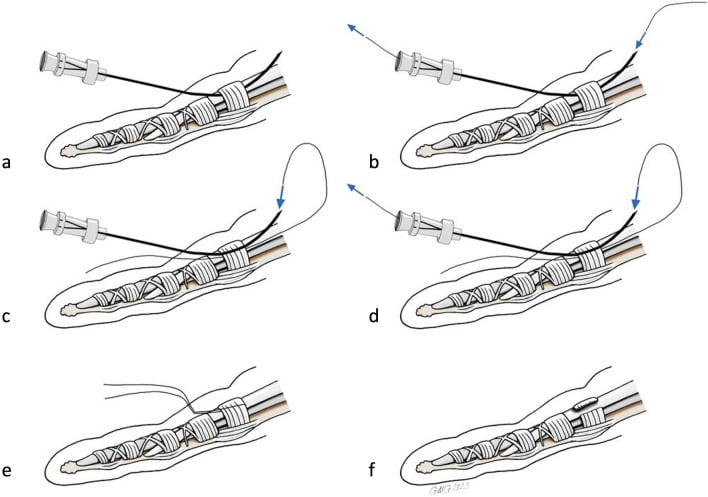
Open A1 Pulley Release
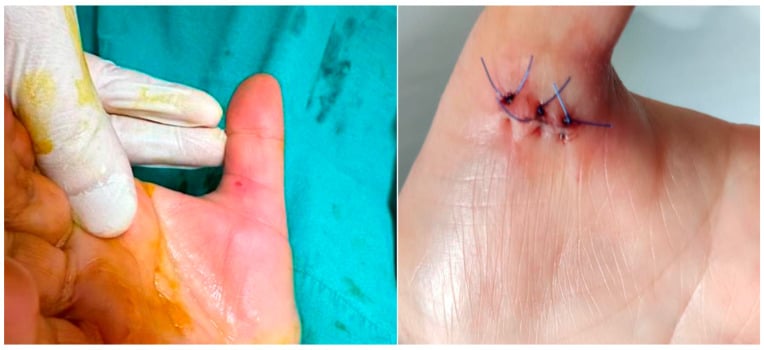
Local anaesthesia, with wide-awake local anaesthesia no tourniquet (WALANT) preferred. Hand on the table.
Transverse, at the MCP crease, 1-1.5 cm long, following the skin crease for cosmesis.
Blunt spreading to expose the A1 pulley. Identify and protect the digital nerves, which lie laterally.
Incise the A1 pulley longitudinally and divide it completely. Stop at A2.
Test tendon excursion: ask the patient to flex and extend, and confirm there is no triggering.
Skin only, with interrupted sutures or steri-strips, and a soft dressing.
The operation is simple and quick, taking less than 10 minutes, and local anaesthesia is suitable.
Complications and Consent for the Steroid Injection
These are the complications to consent for.
- Subcutaneous fat atrophy and skin hypopigmentation at the injection site. Steroid that tracks into the dermis or subcutaneous fat leaves a depressed, pale patch that is cosmetically distressing, often slow to recover or permanent, and more conspicuous in darker skin. Warn patients, and keep the injection deep to the dermis, in the sheath.
- Transient hyperglycaemia in diabetics. A single injection can raise blood glucose for several days, which matters both for consent and for the inject-or-operate-first debate in diabetes.
- Flexor tendon attenuation or rupture. Rare, but it is the reason the steroid goes into the sheath and not the tendon, and the reason to limit the number of injections: repeated intratendinous steroid weakens the tendon.
- Steroid flare - a short-lived increase in pain in the first 24-48 hours is common.
- Infection - rare with aseptic technique.
Complications
- Incidence
- 5%
- Prevention/Management
- Ensure complete A1 division, check glide
- Incidence
- Less than 1%
- Prevention/Management
- Direct vision, stay central, protect nerves
- Incidence
- Rare
- Prevention/Management
- NEVER release A2 - critical pulley
- Incidence
- Less than 1%
- Prevention/Management
- Sterile technique
- Incidence
- 5%
- Prevention/Management
- Early motion, hand therapy if needed
- Incidence
- Less than 3%
- Prevention/Management
- Complete release, address underlying disease
Bowstringing. A2 pulley injury causing bowstringing is a serious complication, and knowing the anatomy is the prevention. The bowstringing measured on ultrasound after A1 release alone is a different finding: in Park's trial it increased at 12 weeks after both open and percutaneous release, resolved by 24 weeks and was not associated with any clinical outcome.
When Triggering Persists After A1 Release
When a finger is still troublesome after release, first separate two different problems, because they have different solutions.
- What it is
- Still catching/locking despite a confirmed complete A1 release
- What to do
- Look at the flexor digitorum superficialis (FDS) - a thickened nodule or catching at the FDS decussation (Camper's chiasm); resect ONE slip (usually ulnar) of FDS to debulk and free the glide. NEVER release A2.
- What it is
- A fixed PIP flexion contracture, no triggering - common after a long-standing locked digit
- What to do
- Early active motion and hand therapy, not more surgery; a contracture may need serial splinting
- What it is
- Triggering returns after initial cure
- What to do
- Usually incomplete A1 release or unaddressed underlying disease (diabetes, RA); revise and confirm a complete release
Why WALANT. Operating wide awake lets the patient actively flex and extend on the table, so residual triggering from an FDS nodule is caught and dealt with at the index operation rather than discovered at the post-operative review. The answer to persistent triggering is to address the A1 release and the FDS, never to divide the A2 pulley.
Postoperative Care
Postoperative Protocol
Soft dressing and immediate finger movement. No splint is needed.
Active and passive range of motion, full motion as tolerated. Keep the wound dry.
Remove sutures; most patients are fully functional by this point. Scar massage.
Return to all activities, including gripping and lifting. Scar tenderness may persist.
Return to work. Light duties immediately, and full duties at 2-4 weeks.
Outcomes and Prognosis
Success rates. Splinting alone gives variable results (30-40%). Injection succeeds at the rates given under Management, and surgery in 95-100%.
- Better Outcome
- Short (under 6 months)
- Worse Outcome
- Long (over 1 year), fixed locked
- Better Outcome
- Non-diabetic
- Worse Outcome
- Diabetic (lower injection success)
- Better Outcome
- Lower grade
- Worse Outcome
- Higher grade (4 = surgery)
- Better Outcome
- Single digit
- Worse Outcome
- Multiple digits
After injection specifically. In the Rozental cohort, duration and severity of symptoms did not predict the outcome of injection; insulin-dependent diabetes, younger age, multiple digits and other upper-limb tendinopathies did.
Most patients do very well with injection or surgery.
Guidelines, Registries & Global Practice
Global epidemiology: Lifetime prevalence is approximately 2-3% in the general population, rising to 5-20% in people with diabetes. Peak onset is in the fifth-to-sixth decade, with a female predominance (roughly 2-6:1 across series). Trigger finger is one of the commonest reasons for elective hand surgery worldwide and is a recognised marker of impaired glucose tolerance.
Side-by-side guidance:
- First-line
- Corticosteroid injection for adult primary trigger finger
- Surgery
- Reserved for failed injection or fixed locking
- Notable position
- Injection is the default initial intervention
- First-line
- Single corticosteroid injection; up to two before surgery
- Surgery
- Open A1 release if injections fail
- Notable position
- Emphasises informed consent re digital nerve and recurrence
- First-line
- Injection, with splinting as adjunct
- Surgery
- Open or ultrasound-guided percutaneous release
- Notable position
- Percutaneous release accepted where expertise exists
- First-line
- Stepwise: activity modification then injection
- Surgery
- Definitive A1 release
- Notable position
- Diabetics counselled toward earlier surgery
Trigger finger is not tracked by arthroplasty registries (no implant), so the evidence base is observational and trial-derived rather than registry-derived. Pooled trial and cohort data consistently show injection short-term success of roughly 55-70% (markedly lower in diabetes, ~30-50%), recurrence in around half of patients by one year, and open surgical release success exceeding 95% with complication rates under 3%.
- High-resource settings: Office-based injection, WALANT release, and increasing use of ultrasound-guided percutaneous release; readily available hand therapy.
- Limited-resource settings: Greater reliance on a single definitive open release to avoid repeat visits; injection still first-line where steroid is accessible. Ultrasound guidance is less available, so blind injection and open release predominate.
Document grade and prior treatment, and consent specifically for digital nerve injury, incomplete release/recurrence, infection, and the principle of A1 release with A2 preservation. Record diabetes status and the counselling given about lower injection success.
Related pages: Trigger Thumb covers the paediatric entity, which is a different disease despite the shared name - Notta's node, frequent spontaneous resolution, and no role for injection; De Quervain Tenosynovitis is the other stenosing tenosynovitis of the hand and shares the injection-first algorithm and the same weak evidence base; Dupuytren Disease is the principal differential for a palmar nodule and coexists often enough that both should be examined for at every visit; Flexor Tenosynovitis is the infective mimic - Kanavel's signs and pain on passive extension distinguish it, and mistaking it for a trigger digit is the dangerous error on this page; Flexor Tendon Repair Techniques and Flexor Tendon Rehabilitation hold the pulley anatomy and the bowstringing consequences that make A2 preservation non-negotiable, and Flexor Tendon Lacerations covers the partial laceration that can catch without a nodule; Carpal Tunnel Syndrome coexists with trigger finger frequently and shares diabetes as a driver; and Ganglion Cysts include the flexor sheath (seed) ganglion, a tender palmar lump at the A1 pulley that does not trigger.
Controversies and Areas of Uncertainty
How many injections before surgery. Most surgeons offer one or two injections before recommending release, but the optimal ceiling is debated. Recurrence is around 56% at one year (Rozental 2008), and repeated injections of diminishing benefit carry cumulative cost and complication risk, so most clinicians proceed to release after one or two failed injections, sooner in high-risk patients (insulin-dependent diabetes, multiple digits, young age). Yet in that same cohort only 18% actually came to surgery, and freedom from surgical release was 83% at twelve months.
Recurrence is therefore not the same as failure: most recurrences were tolerated or re-injected. Both figures belong in the discussion, because the first argues for operating sooner and the second argues that most patients never need to.
Open or percutaneous release. Randomised data show equivalent clinical outcomes for open and percutaneous (including ultrasound-guided) release. The choice is largely dependent on operator expertise.
Ultrasound guidance for injection. It improves accuracy and may speed early recovery, but several trials show no difference in 3-6 month outcomes against a blind landmark-based injection. Routine use is not yet standard and depends on availability.
Diabetics: inject or operate first? Whether to attempt injection at all in insulin-dependent diabetic patients, given the transient glycaemic disturbance and low success, remains a point of practice variation.
Paediatric trigger thumb (Notta's node) is a distinct entity, not adult stenosing tenosynovitis. Many resolve spontaneously in the first years of life; surgery is considered for persistent fixed flexion, and injection has little role. Do not extrapolate adult management to children.
MCQ Practice Points
Q: At what level does trigger finger occur? A: A1 pulley at the MCP joint level. This is where the stenosis and nodule catching occurs.
Q: Which pulley must be preserved during trigger finger release? A: A2 pulley. A2 and A4 are critical for tendon function. Releasing A2 causes bowstringing.
Q: What is the success rate of steroid injection for trigger finger? A: Roughly 55-70% short-term in non-diabetic patients, and about 30-50% in diabetes. The single figures usually quoted - 70% and 50% - are convenient roundings of a range. This page's own Nimigan cohort gives 57% versus 32% (p=0.04), and the placebo-controlled trial found the benefit clear at one week but could not sustain a randomised comparison beyond it. Add the number that matters more than either: about 56% have symptom recurrence within a year (Rozental), though only 18% went on to surgery in that time.
Q: What is the prevalence of trigger finger in diabetics? A: 10% (vs 2-3% general population). Multiple digits common. Lower injection success.
Q: Which digit is most commonly affected in trigger finger? A: The thumb and ring finger, with series disagreeing about which leads. This page's own Rozental cohort of 124 digits found thumb 35%, ring 31%, long 23% - thumb first. Other series place the ring finger first. The safe answer names thumb and ring as the commonest, then long, and notes that the index and little fingers are least often affected. Do not quote a five-digit percentage breakdown: the neatly rounded distributions in circulation are not traceable to a cohort.
Q: What is WALANT and why is it ideal for trigger finger release? A: Wide Awake Local Anesthesia No Tourniquet. Allows patient to actively flex/extend to confirm complete release and resolution of triggering.
Exam Viva Scenarios
Practise clinical reasoning and management decisions out loud
“A 55-year-old woman has catching in her ring finger for 2 months. She feels a click at the palm and sometimes needs to straighten the finger with her other hand. There is a tender nodule at the MCP crease. What is your management?”
“A 60-year-old diabetic man has triggering in his ring, middle, and index fingers. He has had one injection to each finger with only partial improvement. What is your approach?”
“A 70-year-old woman presents with her middle finger locked in flexion for 2 weeks. She cannot straighten it actively or passively. Her MCP is tender. What is your management?”
Pathology
- Stenosing tenosynovitis at A1 pulley
- Thumb and ring most common, then long
- Nodule catches at narrowed pulley
- Diabetics: 10% prevalence
Clinical
- Catching/locking with flexion
- Worse in morning
- Palpable nodule at MCP crease
- Tender at A1 pulley
Green Classification
- 1: Pain, no catching
- 2: Catching, active extension
- 3: Locking, passive unlock
- 4: Fixed locked = surgery
Treatment
- Injection: 70% success (50% diabetics)
- Surgery: 95%+ success
- Grade 4 = surgery first-line
- Can repeat injection once if partial response
Surgical Principle
- Release A1 pulley completely
- PRESERVE A2 pulley (critical)
- Check tendon glide
- Protect digital nerves (lateral)
Key Points
- A2 and A4 = critical pulleys
- Diabetics: 10% prevalence
- Thumb and ring most common
- Multiple digits in diabetics
Evidence Base
Peters-Veluthamaningal et al — Cochrane review
- Two RCTs, 63 participants pooled
- Corticosteroid plus lidocaine superior to lidocaine alone at 4 weeks (RR 3.15, 95% CI 1.34 to 7.40)
- Number needed to treat to benefit = 3
- Benefit lasted up to 4 months in one trial; no adverse events reported
Peters-Veluthamaningal et al — placebo-controlled RCT
- Double-blind RCT, 50 adults in general practice
- Triamcinolone vs saline: satisfactory immediate response 16/25 vs 5/25 (p less than 0.001)
- Greater reduction in pain and perceived improvement with steroid
- Short-term benefit was clear; the 12-month durability figure comes from a single-arm analysis, not from the randomised comparison
Nimigan, Ross & Gan
- 118 trigger digits (92 nondiabetic, 26 diabetic)
- Injection success: nondiabetics 57% vs diabetics 32% (p = 0.04)
- All 5 type 1 diabetic digits failed injection and required surgery
- Surgical A1 release successful in 71/72 (99%), no excess complications in diabetics
Rozental, Zurakowski & Blazar
- 124 digits prospectively followed for 1 year after injection
- 56% had symptom recurrence (median 5.6 months); freedom from recurrence 70% at 6 months, 45% at 12 months
- Insulin-dependent diabetes, younger age, multiple digits and other upper-limb tendinopathies predicted failure
- Duration and severity of symptoms did NOT predict outcome
Park, Shin, Kim & Kim
- 62 resistant trigger digits randomised to open vs percutaneous A1 release
- Ultrasound-measured bowstringing increased at 12 weeks in both groups, greater after open release
- Bowstringing resolved by 24 weeks with no inter-group difference
- No association between bowstringing and any clinical outcome
Lan et al
- 72 grade 2+ trigger digits randomised to open surgery vs ultrasound-guided needle release
- Both groups improved significantly in VAS and Quinnell grade at 7 and 30 days
- No significant difference between techniques at any timepoint up to 180 days
- Level II therapeutic evidence