Periarticular Hydroxyapatite Masses | FGF23/GALNT3 Pathway | Hip, Shoulder, Elbow
- Periarticular lobulated masses of calcium hydroxyapatite, not a true neoplasm
- Hip, shoulder, elbow and wrist are the classic sites; mass often grows over years
- Hyperphosphataemic type = GALNT3, FGF23 or KLOTHO loss-of-function - phosphate retention
- Secondary type is far more common than familial, and is driven by chronic renal failure
- X-ray: lobulated, 'cloud-like' or 'chicken-wire' periarticular calcification is characteristic
- Biopsy is usually diagnostic; differentiate from parosteal osteosarcoma, myositis ossificans, tophaceous gout
- “Serum calcium is normal, phosphate is high (in familial hyperphosphataemic type) - 1,25-(OH)2 vitamin D is inappropriately normal or elevated (FGF23 normally suppresses it)
- “Chalky white 'toothpaste' discharge through skin is pathognomonic in ulcerated cases
- “Myositis ossificans forms mature lamellar bone attached to periosteum - tumoral calcinosis does not
- “Recurrence after excision is the rule, not the exception, in familial disease
- “Phosphate binders (sevelamer, lanthanum) are first-line metabolic therapy, with acetazolamide as an adjunct in familial disease
Overview and Epidemiology
Tumoral calcinosis is a lobulated periarticular deposit of calcium hydroxyapatite, and a frequently missed cause of a periarticular "tumour" in young patients. It is not a neoplasm. The deposition is almost always driven by one of two things: an inherited FGF23-axis defect, which is rare, familial and paediatric, or chronic renal failure with disordered mineral metabolism, which is common, adult and dialysis-dependent.
Why the diagnosis matters. Getting it right changes management completely. Surgery cures neither the familial form, in which recurrence is the rule, nor the uraemic form unless the metabolic state is corrected.
How common. The disease is rare, with an overall incidence estimated at roughly 1 in 100,000 to 1 in 1,000,000. Its forms occur in different populations:
- The familial (primary hyperphosphataemic) form is autosomal recessive and presents in the first or second decade, often in children of consanguineous parents. It has been described in clusters from the Middle East, North Africa and Turkey, and shows no strong sex predilection.
- The secondary (uraemic) form is the clinically dominant one and is rising in prevalence with the dialysis population. Its sex distribution tracks CKD demographics.
- High-frequency endemic clusters have been described in parts of sub-Saharan Africa and Papua New Guinea, often associated with low-calcium, high-phosphate dietary patterns.
Why surgeons see it. The typical referral pathway is biopsy or excision after the mass has been confused with a bone or soft-tissue tumour. Others present with mechanical symptoms, as large masses restrict joint motion, irritate a bursa or compress a nerve, or with functional limitation in sitting, walking and dressing, and some with skin breakdown. Recurrence after incomplete excision is the single most common reason for repeated referrals.
Pathophysiology
A deposition disorder, not a tumour. The mineral is calcium hydroxyapatite (calcium phosphate), not calcium oxalate or calcium pyrophosphate. It is laid down in lobulated sheets within periarticular soft tissue, often with a foreign-body giant cell reaction, and there is no cellular atypia.
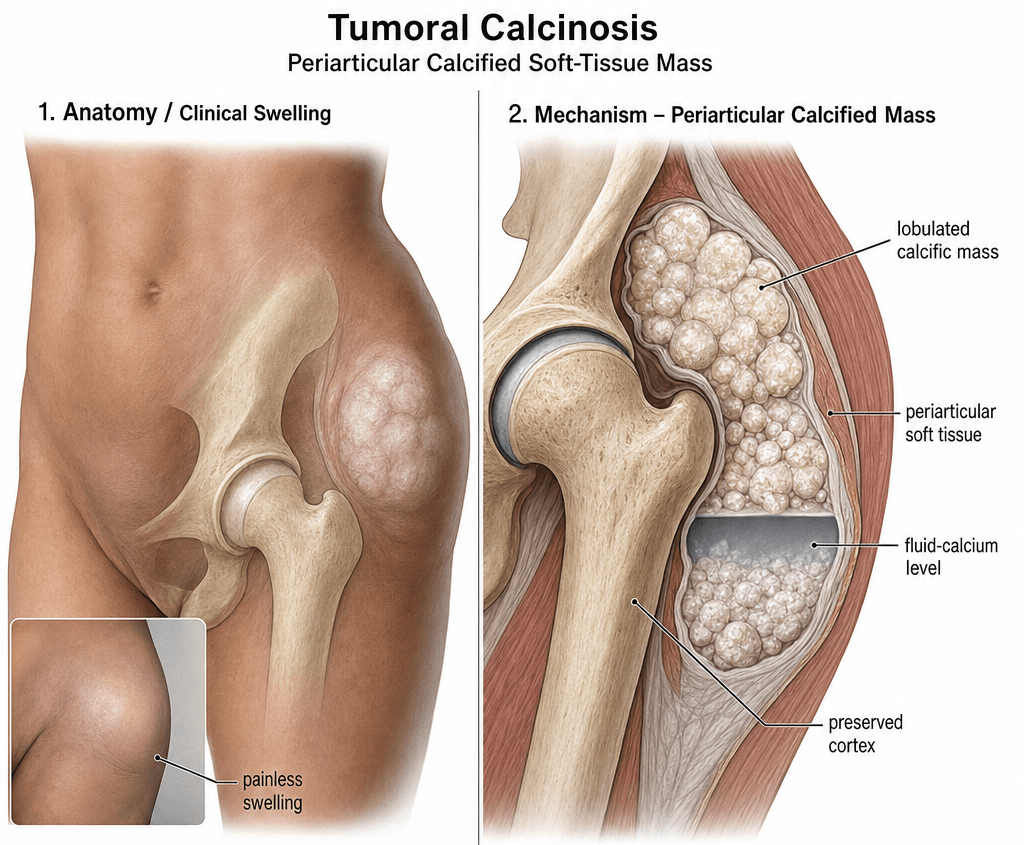
Where it forms. The deposits form at sites of microtrauma, repeated shear or bursal friction, which explains the predilection for the greater trochanteric, subdeltoid and olecranon bursae and the ischial region. Local tissue injury, an alkaline local pH and a high extracellular phosphate together favour hydroxyapatite rather than calcium oxalate precipitation.
The masses sit adjacent to the joint but not within it, and the mineral is rarely within the joint itself. They are lobulated and can exceed 20 cm.
The mass is not encapsulated. It tends to insinuate around tendons, bursae and neurovascular structures, and at times encases them, making it unresectable. That is what makes complete excision surgically challenging and recurrence common.
The FGF23 axis. FGF23 is secreted by osteocytes and osteoblasts in response to phosphate load and active vitamin D. To be secreted in its intact, active form it needs O-linked glycosylation by GALNT3, and in the kidney it acts through its co-receptor KLOTHO to drive renal phosphate wasting and suppress 1-alpha-hydroxylase.
The familial defect. Biallelic loss-of-function of any of these three genes, GALNT3 most commonly, prevents FGF23 signalling, so both the phosphate wasting and the 1-alpha-hydroxylase suppression are abolished. The net result is phosphate retention and hyperphosphataemia, an inappropriately normal or elevated 1,25-(OH)2 vitamin D, normal calcium, normal or low PTH, and progressive periarticular hydroxyapatite deposition.
Secondary (uraemic) disease. CKD-mineral and bone disorder (CKD-MBD) is the umbrella term. As GFR falls below roughly 30 mL/min/1.73 m², phosphate excretion fails, FGF23 rises, active vitamin D falls and PTH rises in secondary hyperparathyroidism. The drivers of soft-tissue calcification in CKD include:
- hyperphosphataemia and a raised calcium-phosphate product
- calciphylaxis-spectrum small-vessel disease
- vitamin D analogue dosing
- calcium-based phosphate binders
In dialysis patients the lesions can reach enormous size at the hip, shoulder, elbow, hand or wrist, and frequently ulcerate.
Hyperostosis-hyperphosphataemia syndrome. Hyperphosphataemic familial tumoral calcinosis (HFTC) and hyperostosis-hyperphosphataemia syndrome (HHS) are two phenotypes of one disease. HHS is caused by the same biallelic GALNT3 (or FGF23) loss-of-function mutations and shows identical biochemistry: high phosphate, normal calcium, an inappropriately normal or elevated 1,25-(OH)2 vitamin D and increased tubular phosphate reabsorption.
Instead of, or as well as, periarticular calcific masses, HHS presents with painful diaphyseal hyperostosis: cortical thickening and periosteal new bone, classically of the long bones (the tibia and ulna are typical), with recurrent episodes of bone pain, local swelling and raised inflammatory markers. It is a recognised mimic of chronic recurrent multifocal osteomyelitis (CRMO), osteomyelitis or a bone tumour.
Recognising the hyperphosphataemic biochemistry and the family history prevents misdiagnosis and unnecessary biopsy or antibiotics. The two phenotypes can coexist in the same family or even the same patient, so a child with unexplained diaphyseal hyperostosis and hyperphosphataemia should be worked up for the FGF23-axis defect. The metabolic phosphate-lowering treatment is the same.
Classification and Types
Classify by mechanism. Smack (1996) proposed classifying tumoral calcinosis by pathogenesis rather than by site, and pathogenesis matters because it dictates whether the disease is curable, controllable or simply manageable. The scheme has four groups:
- Primary (idiopathic) - hyperphosphataemic familial (GALNT3, FGF23, KLOTHO) and normophosphataemic sporadic. The familial form often begins in childhood or adolescence, and in it recurrence after surgery is the rule.
- Secondary - chronic renal failure with disordered mineral metabolism (the most common clinically), hyperparathyroidism (primary or secondary), vitamin D toxicity, milk-alkali syndrome, and connective tissue disease with dystrophic calcification.
- Dystrophic - calcification within damaged or devitalised tissue, post-traumatic, post-surgical or in areas of fat necrosis. Tumoral calcinosis-like lesions can form around the elbow or hip after local injury.
- Iatrogenic and miscellaneous - calcium-based binder excess, vitamin D analogue overdose, and tumoral calcinosis-like lesions in calcinosis cutis and CREST.
The four working types. Treatment decisions use four working types, which keep Smack's two primary forms, reserve "secondary" for uraemic (CKD and dialysis) disease, and group hyperparathyroidism, vitamin D toxicity and milk-alkali syndrome, which Smack lists as secondary, with local tissue damage as "dystrophic / other".
- Driver
- GALNT3, FGF23 or KLOTHO loss-of-function - renal phosphate retention
- Typical Patient
- Child or young adult, autosomal recessive, sibling cases, no renal disease
- Distribution
- Hip, shoulder, elbow; can be multifocal
- Histology
- Lobulated hydroxyapatite with giant cells
- Driver
- Unknown, possibly post-traumatic, local tissue injury
- Typical Patient
- Any age, often a solitary mass, no systemic disease or metabolic abnormality
- Distribution
- Hip, elbow, hand
- Histology
- Lobulated hydroxyapatite, often solitary
- Driver
- Hyperphosphataemia, secondary hyperparathyroidism, high Ca-P product, vitamin D analogues
- Typical Patient
- Adult on long-term dialysis or with advanced CKD
- Distribution
- Hip, shoulder, hand, wrist; often multiple sites
- Histology
- Multilobulated periarticular calcium deposits
- Driver
- Local tissue damage (trauma, surgery) or a systemic driver (hyperparathyroidism, vitamin D toxicity, milk-alkali, connective tissue disease)
- Typical Patient
- Local tissue damage or a systemic metabolic driver
- Distribution
- Often single, at the site of injury or systemic driver
- Histology
- Calcification within damaged tissue
Site. The order of frequency is hip, then shoulder, then elbow, then wrist. Location is the most important surgical variable, because neurovascular proximity dictates resectability.
- Frequency
- Most common site overall
- Typical Presentation
- Large lobulated mass lateral to trochanter
- Surgical Caveat
- Abuts sciatic nerve and abductors - high recurrence if residual
- Frequency
- Second most common
- Typical Presentation
- Restricts abduction, irritates subacromial bursa
- Surgical Caveat
- Risk of axillary nerve injury during excision
- Frequency
- Common, mimics olecranon bursitis
- Typical Presentation
- Can ulcerate, discharge chalky material
- Surgical Caveat
- Protect ulnar nerve at surgery
- Frequency
- Common in uraemic type
- Typical Presentation
- Multiple small lobulated periarticular deposits
- Surgical Caveat
- Tendon and joint involvement; high morbidity
Clinical Assessment
History. Years of slow, often painless growth is the rule. Pain usually comes late, when the mass irritates a bursa, compresses a nerve or ulcerates the skin, and an ulcerated mass may discharge chalky white "toothpaste". The rest of the history looks for the driver:
- Renal disease - dialysis vintage, transplant status, and medications (calcium-based binders, vitamin D analogues)
- Family history - sibling or parental cases, as inheritance is autosomal recessive
- Diet and drugs - high phosphate intake, vitamin D supplementation, calcium supplements
Examination. The mass is firm, lobulated and "stony-hard", non-tender, and often warm but not inflamed. It usually involves a single limb or a single joint, although familial disease can be multifocal and uraemic disease often involves multiple sites. It is usually fixed to the deep soft tissues but not to the skin until late, when tethering, erythema, ulceration and sinus tracts appear.
Joint range is often preserved unless the mass blocks it mechanically, and the lymph nodes are not enlarged, which is reassuring against malignancy. Document neurovascular function before any operation: the sciatic nerve at the hip, the axillary at the shoulder and the ulnar at the elbow.
- Significance
- Pathognomonic hydroxyapatite extrusion
- Sensitivity
- Low (most masses are intact)
- Specificity
- Very high
- Significance
- Distinguishes from solid tumour, lipoma, ganglion
- Sensitivity
- Moderate
- Specificity
- Moderate
- Significance
- Pattern recognition: 'cloud-like' or 'chicken-wire'
- Sensitivity
- High
- Specificity
- High in typical site
- Significance
- Suggests primary hyperphosphataemic type
- Sensitivity
- High in familial, low in secondary
- Specificity
- High for familial type
- Significance
- Suggests mature, organised deposit needing excision
- Sensitivity
- N/A
- Specificity
- N/A
Look beyond the joint. The familial form is a systemic phosphate-handling disorder, so deposition is not confined to the periarticular soft tissue, and the extra-skeletal features are powerful diagnostic and counselling clues:
- Teeth, near-characteristic - pulp stones, obliteration or narrowing of the pulp chambers, and short, bulbous ("thistle-shaped") roots, often visible incidentally on a panoramic dental radiograph and a useful confirmatory sign when the joint masses are atypical
- Eyes - conjunctival and eyelid calcific deposits, and angioid streaks
- Vessels - medial arterial calcification
- Testes - testicular microlithiasis has been reported
A child or young adult with periarticular calcific masses, the characteristic dental phenotype and hyperphosphataemia has hyperphosphataemic familial tumoral calcinosis until proven otherwise. These features support the diagnosis when imaging is equivocal, justify whole-patient surveillance, and inform genetic counselling for an autosomal recessive condition, which matters where consanguinity raises the sibling risk.
The differential. The two diagnoses that matter are parosteal osteosarcoma and myositis ossificans.
Parosteal osteosarcoma arises from the periosteal surface, often of the posterior distal femur, with mature lamellar bone attached to the cortex and a 'string sign' (a linear gap between tumour and cortex) on CT. Tumoral calcinosis is not attached to bone, is lobulated and amorphous rather than bone density, and does not invade the cortex. When in doubt, biopsy before definitive surgery.
- Typical Site
- Hip, shoulder, elbow, periarticular
- Key Feature
- Lobulated, periarticular, not attached to bone
- Discriminating Test
- X-ray pattern, serum phosphate, biopsy
- Typical Site
- Muscle belly (quadriceps, brachialis)
- Key Feature
- Mature lamellar bone, attached to periosteum over weeks
- Discriminating Test
- X-ray shows ossified rim with lucent centre; serial imaging
- Typical Site
- Posterior distal femur, proximal tibia, proximal humerus
- Key Feature
- Cortically based, mature bone, 'string sign'
- Discriminating Test
- CT, MRI, biopsy (only by sarcoma surgeon)
- Typical Site
- Intra-articular, knee, elbow, hip
- Key Feature
- Multiple intra-articular loose bodies, not periarticular mass
- Discriminating Test
- MRI, joint aspiration, arthroscopy
- Typical Site
- First MTP, ear, olecranon, Achilles
- Key Feature
- Soft tissue tophi, may calcify, hyperuricaemia
- Discriminating Test
- Serum urate, joint aspiration (urate crystals)
- Typical Site
- Fingertips, extensor surfaces
- Key Feature
- Small, multiple, skin-level calcifications
- Discriminating Test
- Clinical, ANA, capillaroscopy
- Typical Site
- Supraspinatus tendon
- Key Feature
- Hydroxyapatite within tendon, not lobulated mass
- Discriminating Test
- X-ray, ultrasound
- Typical Site
- Periarticular, vascular
- Key Feature
- Raised PTH, raised calcium in primary
- Discriminating Test
- Serum PTH, calcium, ultrasound of neck
Investigations
Radiographs first. AP and lateral views of the involved joint, plus a long-bone view. Pattern recognition is often diagnostic: lobulated, periarticular, 'cloud-like' calcification without cortical or medullary involvement in a young person is tumoral calcinosis until proven otherwise. Sensitivity is high at a typical site, and in familial or uraemic disease the film can be diagnostic. Look for:
- lobulated, dense periarticular calcification with a 'cloud-like' or 'chicken-wire' internal architecture
- a corticated or uncorticated margin
- no bony attachment and no periosteal reaction
- a preserved cortex, marrow and joint space, the point that separates it from a bone tumour or myositis ossificans
The sedimentation sign. Look specifically for horizontal fluid-calcium levels within the lesion, produced by hydroxyapatite crystals layering dependently inside cystic spaces. The sign was first described on plain radiographs, is seen readily on CT and MRI, and on ultrasound appears as echogenic debris settling in the dependent part of the cyst.
In this clinical context it is close to diagnostic, and it is the feature that most quickly separates tumoral calcinosis from the solid calcified matrix of a parosteal osteosarcoma or the zonal maturation of myositis ossificans.
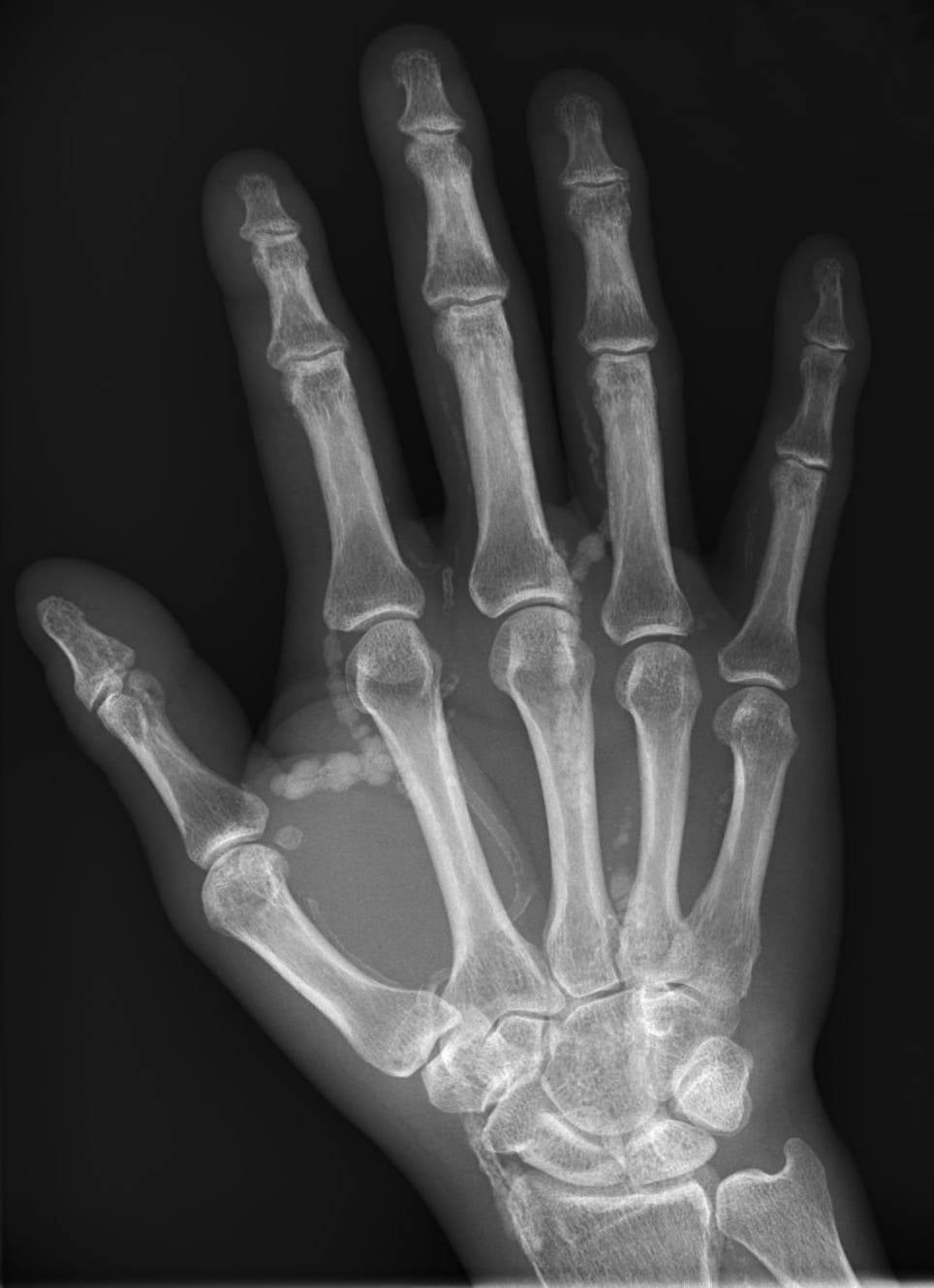
CT and MRI. In the typical case these are for surgical planning, not diagnosis. CT excludes bony attachment and confirms the lobulated architecture: there should be no continuity with the cortex, no marrow involvement and no soft-tissue mass with calcified matrix to suggest sarcoma, which separates it from parosteal osteosarcoma, myositis ossificans and synovial chondromatosis.
MRI is for an atypical site, atypical imaging or diagnostic doubt, when cancer is being considered. Expect homogeneous low T1 signal, variable T2 signal (often low because of the calcium), no marrow oedema and no enhancing soft-tissue mass, and avoid biopsy until the MRI and an orthopaedic oncology review are done.
The metabolic panel, always, and before any biopsy. The result may make the biopsy unnecessary. It separates primary hyperphosphataemic, primary normophosphataemic and secondary uraemic disease from hyperparathyroidism and vitamin D toxicity:
- Serum - calcium, phosphate, magnesium, alkaline phosphatase, 25-OH vitamin D, 1,25-(OH)2 vitamin D, PTH, creatinine, eGFR, urate
- Urine - 24-hour urinary phosphate (and calcium)
- Calculated - calcium-phosphate product, tubular reabsorption of phosphate (TRP), TmP/GFR
The FGF23 assay trap. If you send FGF23 in suspected hereditary disease, specify which assay, because the two give opposite-looking answers in GALNT3 disease. Failure of O-glycosylation means FGF23 is cleaved before secretion, so the intact (biologically active) FGF23 is low or inappropriately normal, which is what causes the hyperphosphataemia.
The C-terminal assay, which also detects the cleaved fragments, is markedly elevated, reported at roughly 40 times normal in one family and consistently high across the NIH cohort. A "raised FGF23" therefore does not exclude the diagnosis and may confirm it, and a normal intact FGF23 in a hyperphosphataemic patient is the expected finding, not a reassuring one.
- Primary Hyper-P
- Normal
- Primary Normo-P
- Normal
- Secondary (CKD)
- Low or normal (can be high with binders)
- Dystrophic / Other
- Normal (unless hyperparathyroidism)
- Primary Hyper-P
- Elevated (often greater than 2 mmol/L in adults)
- Primary Normo-P
- Normal
- Secondary (CKD)
- Elevated
- Dystrophic / Other
- Variable
- Primary Hyper-P
- Normal or low
- Primary Normo-P
- Normal
- Secondary (CKD)
- Elevated (secondary hyperparathyroidism)
- Dystrophic / Other
- Variable
- Primary Hyper-P
- Elevated / inappropriately normal
- Primary Normo-P
- Normal
- Secondary (CKD)
- Low or normal (CKD)
- Dystrophic / Other
- Variable
- Primary Hyper-P
- Intact: low or inappropriately normal; C-terminal: markedly elevated
- Primary Normo-P
- Normal
- Secondary (CKD)
- Markedly elevated
- Dystrophic / Other
- Normal
- Primary Hyper-P
- Normal
- Primary Normo-P
- Normal
- Secondary (CKD)
- Impaired (eGFR reduced or on dialysis)
- Dystrophic / Other
- Normal
Genetics. Test a child or young adult, sibling cases, consanguinity, recurrence after excision, and hyperphosphataemia with normal calcium and PTH. The genes are GALNT3, FGF23, KLOTHO, SLC34A3 (NaPi-IIc) and SLC9A3R1 (NHERF1), sought with a targeted panel or whole-exome sequencing, together with genetic counselling.
Biopsy. Reserve it for atypical imaging, a rapidly enlarging mass, suspected malignancy, or a first presentation in an older patient without metabolic risk factors. It is a core needle biopsy by the orthopaedic oncology service, placed in the planned resection tract. Histology shows lobulated basophilic calcium deposits with surrounding fibrosis, histiocytes and foreign-body giant cells, and no atypia.
Tumoral calcinosis is benign and biopsy is safe, but a presumed tumoral calcinosis that turns out to be a parosteal osteosarcoma must have its biopsy performed by the orthopaedic oncology service that will do the definitive resection. A poorly placed biopsy contaminates compartments and may cost the limb. If in doubt, refer for biopsy, do not perform it yourself.
Management Algorithm
Metabolic first, surgery for symptoms. The goal is to lower serum phosphate, correct the calcium-phosphate product and stop further deposition. This is the only durable therapy for familial disease and the only curative strategy for secondary uraemic disease. Never excise without a metabolic workup, and never operate without a metabolic plan. NSAIDs have no role in this metabolic process.
- First-Line Treatment
- Phosphate binder + low-phosphate diet, with acetazolamide as an adjunct
- Medical Control
- Good with binders, diet, acetazolamide; new biologics emerging
- Surgery and Recurrence
- Low cure rate - high recurrence (often greater than 50%)
- Long-Term Outlook
- Lifelong metabolic control; rare renal involvement
- First-Line Treatment
- Excision if symptomatic
- Medical Control
- Limited - no metabolic driver to correct
- Surgery and Recurrence
- High cure rate and low recurrence if completely excised
- Long-Term Outlook
- Excellent if no recurrence; monitor for new lesions
- First-Line Treatment
- Manage CKD-MBD, parathyroidectomy if needed
- Medical Control
- Possible with aggressive CKD-MBD management
- Surgery and Recurrence
- Moderate - recurrence common unless metabolic state corrected
- Long-Term Outlook
- Driven by renal disease; transplant is curative
- First-Line Treatment
- Treat underlying cause, excision of mass
- Medical Control
- Treat underlying cause
- Surgery and Recurrence
- Moderate to high cure rate; depends on cause control
- Long-Term Outlook
- Cure if underlying cause controlled
The medical protocol. It has five elements:
- Diet. A strict low-phosphate diet, avoiding processed meats, cola drinks, excess dairy, nuts and beans, with a typical target of less than 800-1000 mg/day of dietary phosphate in adults. Dietician input is essential, ideally a renal dietician for CKD patients.
- Phosphate binders, with meals. First-line are the non-calcium binders, sevelamer (hydrochloride or carbonate) and lanthanum carbonate, titrated to the pre-dialysis or fasting serum phosphate. Avoid calcium-based binders in patients with hyperphosphataemia and a high calcium-phosphate product, because they worsen soft-tissue calcification.
- Acetazolamide, as an adjunct. A carbonic anhydrase inhibitor that increases renal phosphate excretion, given at 250-500 mg twice daily with monitoring of bicarbonate and potassium. Case series in familial disease show mass reduction and a fall in phosphate. It can worsen acidosis and hypokalaemia.
- Sodium thiosulphate, case-specific. It forms soluble calcium thiosulphate complexes and is given topically for ulcerated lesions or intravenously in calciphylaxis-spectrum disease. The evidence is anecdotal and small case series, and it is not first-line.
- Treat the underlying cause, always. Parathyroidectomy or calcimimetics (cinacalcet) for hyperparathyroidism; stop vitamin D analogues and calcium for vitamin D toxicity; stop intake and hydrate for milk-alkali syndrome; and for CKD-MBD a KDIGO-aligned bundle of diet, binders, dialysis adequacy, vitamin D analogues and calcimimetics.
Acetazolamide is a useful adjunct in primary hyperphosphataemic disease because the kidneys are normal and can be coerced to waste more phosphate. It is not useful in uraemic secondary disease, and not for advanced CKD, because the failing kidneys cannot respond. For uraemic disease, intensify dialysis, switch to non-calcium binders, and consider parathyroidectomy.
When to operate. The aim of surgery is complete excision of the mass with relief of symptoms, protecting the neurovascular structures and minimising recurrence. In familial disease it is palliative: it relieves local symptoms but does not cure the metabolic defect.
- Definite indications - ulceration with discharge, infection, nerve compression, a mechanical block to the joint, diagnostic doubt after workup, and cosmesis after counselling
- Relative indications - a rapidly enlarging mass, pain limiting function
- Not indicated - a small, asymptomatic mass with well-controlled metabolic disease
Before the operation. CT or MRI maps the neurovascular structures at risk. Lower the phosphate beforehand if possible to reduce recurrence, below 1.5 mmol/L if it can be achieved. Consent covers recurrence, nerve injury, wound healing problems, and a skin closure that may need a flap.
The operation. Use a direct, extensile approach that follows the planned sarcoma biopsy tract if one exists. Extracapsular "shelling-out" is inadequate; the aim is complete removal of every lobule at the first operation, because debulking is rarely adequate.
Irrigate copiously and use intra-operative nerve stimulation at risk sites. Close primarily if the skin is intact, and with a local flap or VAC if it is ulcerated.
Afterwards. A drain is often required for 24-48 hours. Mobilise early but protect the limb for 2 weeks, restart binders and diet immediately, and review clinically and radiographically at 3, 6 and 12 months for recurrence.
Recurrent disease. In familial disease recurrence is often greater than 50%, sometimes approaching 100% after simple debulking. The goal is to avoid mutilating re-excision, treat the metabolic driver, and reserve surgery for genuinely symptomatic recurrence. It recurs because of:
- incomplete primary excision, the most common cause
- continuing metabolic drive, with phosphate still high and the FGF23 axis still defective
- a multilobulated architecture that leaves small residual lobules
- difficult anatomical sites (sciatic notch, subdeltoid) where complete resection is unsafe
Reducing it. Aggressive pre-operative metabolic control, complete primary excision and a combined medical-surgical pathway are the basis. In uraemic disease add renal transplantation if the mass is symptomatic and the patient is a candidate, and parathyroidectomy for secondary hyperparathyroidism. The adjuncts are sodium thiosulphate (topical or intravenous), bisphosphonates (limited evidence), and IL-1 antagonists where systemic inflammation dominates (NIH cohort).
Re-operation. The threshold for re-excision is a mass at least as large as it was pre-operatively on serial imaging, a symptomatic recurrence (pain, ulceration, nerve compression), metabolic control optimised beforehand, and a patient counselled that a second recurrence is common.
Emerging therapy. Burosumab (anti-FGF23) is licensed for X-linked hypophosphataemia and tumour-induced osteomalacia, where it raises serum phosphate, which is the wrong direction for this disease. In familial tumoral calcinosis the defect is too little functional FGF23, so FGF23-pathway agonism or replacement is the plausible but unproven direction. Cost and access are major barriers, and there are no randomised trial data yet.
Complications
- Incidence
- Up to 30 percent in uraemic type, lower in familial
- Risk Factors
- Mass size, skin pressure, poor nutrition
- Management
- Wound care, infection control, complete excision when feasible
- Incidence
- 10-20 percent in ulcerated cases
- Risk Factors
- Skin breakdown, immunocompromise (dialysis)
- Management
- Antibiotics, surgical drainage, excision
- Incidence
- Variable, common with large masses
- Risk Factors
- Mass size, periarticular location
- Management
- Physiotherapy, surgical excision
- Incidence
- Uncommon but disabling
- Risk Factors
- Mass in deep anatomical site
- Management
- Urgent surgical decompression
- Incidence
- 50-100 percent in familial, lower in sporadic
- Risk Factors
- Incomplete excision, uncontrolled metabolism
- Management
- Metabolic control, complete re-excision, transplant if uraemic
- Incidence
- Up to 15 percent in ulcerated uraemic cases
- Risk Factors
- Poor tissue quality, uraemia, diabetes
- Management
- VAC therapy, flap reconstruction
- Incidence
- Rare, but high mortality
- Risk Factors
- Advanced CKD, warfarin, obesity
- Management
- Sodium thiosulphate, supportive care
Outcomes and Prognosis
Best and worst. The best prognosis belongs to sporadic normophosphataemic disease with complete primary excision, and to dystrophic disease whose underlying cause is treated. The worst belongs to familial hyperphosphataemic disease with multiple recurrences, and to uraemic disease on long-term dialysis with poor metabolic control.
Cure. Outside dystrophic disease, whose outcome follows control of its cause, cure is achievable in two settings only: complete excision of a solitary normophosphataemic mass, and successful renal transplantation in uraemic disease. The single biggest prognostic factor is whether the metabolic driver can be corrected, and in familial disease it usually cannot be cured, only controlled.
Guidelines, Registries & Global Practice
- Tumoral calcinosis is rare worldwide - incidence estimated at roughly 1 in 100,000 to 1 in 1,000,000
- Familial hyperphosphataemic form clusters in populations with high consanguinity - Middle East, North Africa, Turkey, parts of South Asia
- Secondary (uraemic) form is rising globally as the dialysis population grows - the most common clinical scenario in high-income settings
- Endemic clusters of tumoral calcinosis-like lesions have been described in sub-Saharan Africa and Papua New Guinea, often associated with low calcium, high phosphate dietary patterns
- Site distribution is consistent across regions: hip, shoulder, elbow, wrist, hand
- High-resource: tertiary orthopaedic oncology and metabolic bone units offer genetic testing, FGF23 assays, modern phosphate binders, calcimimetics, and access to renal transplantation
- Limited-resource: dietary phosphate restriction, low-cost aluminium-based or calcium-magnesium binders, and acetazolamide remain the backbone of therapy; genetic testing rarely available
- Dialysis adequacy is the strongest single modifiable factor in the uraemic form - more frequent or longer sessions are protective
- Surgical excision is widely available but recurrence remains high without metabolic correction
- No global arthroplasty or implant registry is relevant - tumoral calcinosis is a soft-tissue metabolic disease
- Diagnostic Emphasis
- Treat hyperphosphataemia and raised PTH first; binders, dialysis dose, calcimimetics, parathyroidectomy
- Medical Therapy
- Non-calcium binders first in high Ca-P product; cinacalcet for refractory secondary hyperparathyroidism
- Surgical Role
- Excision for symptomatic, ulcerating or infected masses; transplant is curative
- Diagnostic Emphasis
- Imaging pattern recognition (lobulated periarticular calcification) and biopsy only by sarcoma service when atypical
- Medical Therapy
- Treat underlying cause; refer to endocrinology for familial forms
- Surgical Role
- Complete primary excision preferred over debulking; recurrence is high in familial disease
- Diagnostic Emphasis
- Metabolic workup before any biopsy; X-ray pattern usually diagnostic
- Medical Therapy
- Phosphate binders, diet, acetazolamide; genetic testing for familial forms
- Surgical Role
- Excision reserved for symptomatic or diagnostic doubt cases
- Diagnostic Emphasis
- Recognise as rare disease; centralised reference centres for genetic and metabolic workup
- Medical Therapy
- Multidisciplinary metabolic bone service; experimental FGF23-pathway therapies
- Surgical Role
- Surgery adjunctive; conservative and metabolic management first
There is no dedicated registry for tumoral calcinosis, because it is a rare, non-implant, non-arthroplasty disease. The evidence base is dominated by small case series, mechanistic molecular studies, and narrative reviews. Familial disease is best registered through rare-disease networks (Orphanet, NIH GARD) and genotype-specific cohorts. The uraemic form is captured indirectly within CKD-MBD and dialysis registries.
Record in every patient with a periarticular calcific mass:
- Serum calcium, phosphate, PTH, 25-OH vitamin D, 1,25-(OH)2 vitamin D, creatinine, eGFR, urate, alkaline phosphatase
- Urinary phosphate and tubular reabsorption of phosphate
- Family history and consanguinity
- Renal history, dialysis vintage, current binders and vitamin D analogues
- Imaging: X-ray in two views, CT or MRI when atypical
- Biopsy tract (if performed) and the sarcoma service involvement when in doubt
- Plan for metabolic correction and, if needed, referral for genetic testing
A presumed 'tumour' that turns out to be tumoral calcinosis, or vice versa, is a recurring source of complaints worldwide. Always do the metabolic workup before any biopsy unless the imaging is unequivocally diagnostic and the biopsy is being done by the sarcoma service.
Controversies & Areas of Uncertainty
Familial hyperphosphataemic tumoral calcinosis almost always recurs after surgery, but a young patient with a large, ulcerating, infected mass cannot be left untreated. The threshold for surgery is therefore a clinical decision weighing symptoms, anatomy, recurrence risk, and the patient's wishes. There is no randomised evidence to guide this.
Burosumab is licensed for X-linked hypophosphataemia and tumour-induced osteomalacia, where it RAISES serum phosphate by neutralising excess FGF23 - the opposite of what hyperphosphataemic familial tumoral calcinosis needs. In HFTC the defect is too little functional FGF23, so an anti-FGF23 antibody is mechanistically counterproductive; the plausible (unproven) direction is FGF23 agonism or replacement. No randomised trials exist for any biologic in this disease.
KDIGO suggests normalising phosphate in CKD-MBD, but in dialysis patients with established tumoral calcinosis the target is debated. Aggressive phosphate lowering may reduce new lesions but risks overshooting into hypophosphataemia, hungry bone, and adynamic bone disease. Individualised targets are accepted in practice but poorly evidence-based.
Complete primary excision is associated with lower recurrence than debulking, but in deep anatomical sites (sciatic notch, subdeltoid) complete excision carries real risk of nerve injury. There is no comparative trial. The pragmatic approach is: complete excision where safe, debulking where complete is unsafe, and aggressive metabolic control regardless.
Genetic testing is clearly useful in children, sibling cases, and consanguineous families. Its value in isolated adult cases, especially in uraemic patients, is less clear. Finding a heterozygous GALNT3 or FGF23 variant may not change management but does affect family counselling.
'Cure' means different things: anatomical (mass gone), biochemical (phosphate normal), genetic (mutation absent - impossible in familial), and patient-centred (symptom-free, functional). Most familial patients achieve only biochemical and patient-centred control, not anatomical cure.
MCQ Practice Points
Q: What is the molecular basis of autosomal recessive hyperphosphataemic familial tumoral calcinosis? A: Loss-of-function of GALNT3, FGF23 or KLOTHO, leading to impaired FGF23 signalling. GALNT3 glycosylates FGF23 so it can be secreted as an intact, biologically active phosphaturic hormone. Without intact FGF23 signalling, the kidney fails to waste phosphate, leading to hyperphosphataemia, inappropriately normal or elevated 1,25-(OH)2 vitamin D, and progressive periarticular hydroxyapatite deposition.
Q: Classify tumoral calcinosis by pathogenesis. A: Using the Smack (1996) classification: primary (idiopathic) - further split into hyperphosphataemic familial (FGF23 axis) and normophosphataemic sporadic; secondary - chronic renal failure / dialysis, hyperparathyroidism, vitamin D toxicity, milk-alkali syndrome; dystrophic - local tissue injury; iatrogenic / miscellaneous - calcium-based binder excess, calcinosis cutis in connective tissue disease. The dominant clinical form is secondary (uraemic).
Q: What does the plain radiograph show in tumoral calcinosis, and how does it differ from parosteal osteosarcoma? A: Tumoral calcinosis shows a lobulated, periarticular, 'cloud-like' or 'chicken-wire' calcific mass that is not attached to the underlying bone. Parosteal osteosarcoma is a cortically based, mature-bone-forming mass with a 'string sign' on CT, often posterior distal femur, with potential marrow involvement. Biopsy of a suspected parosteal osteosarcoma must be performed by the sarcoma service.
Q: A young patient with periarticular calcific masses has normal calcium, phosphate of 2.6 mmol/L, inappropriately normal or elevated 1,25-(OH)2 vitamin D and low-normal PTH. What is the most likely subtype? A: Primary hyperphosphataemic familial tumoral calcinosis. The biochemical pattern is high phosphate with normal calcium, inappropriately normal active vitamin D and low-normal PTH. Most cases are due to biallelic GALNT3, FGF23 or KLOTHO mutations. Genetic testing is indicated.
Q: What is the first-line treatment for a patient with secondary (uraemic) tumoral calcinosis on dialysis? A: Metabolic correction, not surgery. Switch from calcium-based to non-calcium phosphate binders (sevelamer, lanthanum), intensify dialysis, review vitamin D analogue dose, target pre-dialysis phosphate less than 1.5 mmol/L, and consider parathyroidectomy if PTH remains very high. Surgical excision is reserved for symptomatic (ulcerating, infected, mechanically limiting) masses. Renal transplantation is the only curative metabolic therapy.
Q: How do you distinguish tumoral calcinosis from myositis ossificans? A: Tumoral calcinosis is a periarticular, lobulated, calcium hydroxyapatite mass, typically around the hip, shoulder or elbow, in a patient with a metabolic driver (familial FGF23 axis defect or chronic renal failure). Myositis ossificans is a mature lamellar bone mass within a muscle belly (commonly quadriceps or brachialis), typically after trauma, attached to periosteum, with a peripheral ossified rim and a lucent centre on serial imaging. Tumoral calcinosis does not form bone; myositis ossificans does.
Q: What is the recurrence rate after surgical excision of familial hyperphosphataemic tumoral calcinosis? A: High, often greater than 50 percent, sometimes approaching 100 percent after simple debulking. Recurrence is the rule because surgery does not correct the underlying FGF23 axis defect. The only curative approach is metabolic control (phosphate binders, acetazolamide, low-phosphate diet) and, for solitary normophosphataemic masses, complete primary excision.
Exam Viva Scenarios
Practise clinical reasoning and management decisions out loud
“A 58-year-old man on haemodialysis for 9 years (end-stage renal disease from diabetes) presents with a slowly enlarging, firm, lobulated mass over the greater trochanter of his right hip. It is non-tender, stony-hard, and the overlying skin is intact. He is on calcium carbonate as a phosphate binder and alfacalcidol. Serum calcium is 2.4 mmol/L, phosphate is 2.6 mmol/L, PTH is 850 pg/mL, and 25-OH vitamin D is 30 nmol/L. What is the diagnosis and how do you manage him?”
“A 14-year-old boy, born to consanguineous parents, presents with recurrent lobulated masses around both hips and his right elbow. He had his first mass excised at age 8 with recurrence within a year. Serum calcium is normal, phosphate is 2.7 mmol/L, PTH is low-normal, 1,25-(OH)2 vitamin D is inappropriately normal, FGF23 is inappropriately normal for the degree of hyperphosphataemia, and renal function is normal. Genetic testing reveals homozygous GALNT3 mutations. How do you counsel and manage him?”
Definition and Pathology
- Periarticular, lobulated deposit of calcium hydroxyapatite - not a true neoplasm
- Mineral is calcium phosphate (hydroxyapatite), not calcium oxalate or CPPD
- Lobulated architecture with foreign-body giant cell reaction; no cellular atypia
- Most common sites: hip, shoulder, elbow, wrist
Classification (Smack 1996)
- Primary hyperphosphataemic (familial) - GALNT3, FGF23, KLOTHO mutations
- Primary normophosphataemic (sporadic) - often solitary
- Secondary (uraemic) - chronic renal failure, dialysis, high Ca-P product
- Dystrophic - local trauma, hyperparathyroidism, vitamin D toxicity, milk-alkali
Diagnosis
- X-ray: lobulated, 'cloud-like' or 'chicken-wire' periarticular calcification, not attached to bone
- CT: confirms no cortical continuity; MRI for atypical cases or surgical planning
- Lab panel: calcium, phosphate, PTH, 25-OH vitamin D, 1,25-(OH)2 vitamin D, creatinine, FGF23, urinary phosphate
- Biopsy only by sarcoma service when imaging atypical; metabolic workup before biopsy
FGF23 Axis
- FGF23 is secreted by osteocytes; requires GALNT3 O-glycosylation for intact secretion
- Binds FGFR1-KLOTHO complex in the kidney to promote phosphate wasting and suppress 1-alpha hydroxylase
- Loss-of-function of GALNT3, FGF23 or KLOTHO = hyperphosphataemia, inappropriately normal or elevated 1,25-(OH)2 vitamin D
- Net effect: high phosphate, normal calcium, normal or low PTH, periarticular hydroxyapatite
Differential Diagnosis
- Myositis ossificans - mature lamellar bone in muscle, attached to periosteum, post-trauma
- Parosteal osteosarcoma - cortically based, mature bone, 'string sign', biopsy only by sarcoma service
- Synovial osteochondromatosis - intra-articular loose bodies, not periarticular mass
- Tophaceous gout - urate tophi, hyperuricaemia, joint aspiration with urate crystals
Medical Management
- Low-phosphate diet (target less than 800-1000 mg/day in adults)
- Non-calcium phosphate binders (sevelamer, lanthanum) - avoid calcium binders with high Ca-P product
- Acetazolamide 250-500 mg twice daily - useful in familial, not in uraemic
- Treat underlying cause: parathyroidectomy, stop vitamin D analogues, transplant in CKD
Surgical Management
- Indications: ulceration, infection, nerve compression, mechanical block, diagnostic doubt, cosmesis
- Technique: complete primary extracapsular excision preferred over debulking
- Recurrence rate: 50-100 percent in familial disease, lower in sporadic
- Re-excision only for genuinely symptomatic recurrence after metabolic optimisation
Prognosis and Pitfalls
- Familial disease is controlled, not cured - lifelong phosphate management required
- Secondary (uraemic) disease can be cured by successful renal transplantation
- Sporadic normophosphataemic disease has the best prognosis after complete excision
- Do not biopsy a suspected parosteal osteosarcoma through the wrong tract - refer to sarcoma service
Evidence Base and Key Trials
Proposal for a pathogenesis-based classification of tumoral calcinosis
- Classifies tumoral calcinosis into primary (normophosphataemic and hyperphosphataemic familial) and secondary (uraemic, hyperparathyroidism, vitamin D toxicity, milk-alkali, connective tissue disease) subtypes based on pathogenesis rather than site
- Hyperphosphataemic familial subtype clusters in children of consanguineous parents, with autosomal recessive inheritance and high post-excision recurrence
- Secondary subtype is far more common clinically because of the dialysis population, with calcium-phosphate product as the principal driver
- Treatment is metabolic first in secondary disease, surgical only for symptomatic masses
Mutations in GALNT3, encoding a protein involved in O-linked glycosylation, cause familial tumoral calcinosis
- Identified biallelic loss-of-function mutations in GALNT3 as the cause of autosomal recessive hyperphosphataemic familial tumoral calcinosis
- GALNT3 encodes a glycosyltransferase required for O-linked glycosylation and secretion of intact, biologically active FGF23
- Affected patients had elevated serum phosphate, normal calcium, inappropriately normal or elevated 1,25-(OH)2 vitamin D, normal or low PTH, and active FGF23 substrate accumulation
- Established the FGF23-GALNT3-KLOTHO axis as central to phosphate handling
A novel recessive mutation in fibroblast growth factor-23 causes familial tumoral calcinosis
- Identified biallelic FGF23 mutations in a family with autosomal recessive hyperphosphataemic tumoral calcinosis, complementing GALNT3 findings
- FGF23 mutations impair either FGF23 protein stability or receptor binding, leading to loss of phosphaturic signalling
- Patients had the classic biochemical triad - high phosphate, normal calcium, inappropriately normal or elevated 1,25-(OH)2 vitamin D
- Demonstrated locus heterogeneity in familial tumoral calcinosis
Phenotypic and genotypic characterization and treatment of a cohort with familial tumoral calcinosis/hyperostosis-hyperphosphatemia syndrome
- Multicentre NIH-led cohort of 8 patients with familial tumoral calcinosis/hyperostosis-hyperphosphatemia syndrome, all with hyperphosphataemia, increased tubular reabsorption of phosphate, and elevated or inappropriately normal 1,25-(OH)2 vitamin D
- Biallelic GALNT3 mutations identified in 7 of 8 subjects; FGF23 and KLOTHO recognised as the other causal genes in the FTC/HHS spectrum
- Clinical phenotype ranged from asymptomatic to massive, disabling calcifications, with diaphyseal hyperostosis on radiographs; one subject had complete resolution of a calcific mass after 13 months of medical therapy
- Two subjects with severe calcifications also had overwhelming systemic inflammation that responded to IL-1 antagonists, a novel finding in FTC/HHS
Review of tumoral calcinosis: a rare clinico-pathological entity
- Clinicopathological review of tumoral calcinosis confirming the primary (hyperphosphataemic familial and normophosphataemic sporadic) and secondary (chronic renal failure, hyperparathyroidism) subtypes
- Hyperphosphataemic familial form attributed to mutations in GALNT3, KLOTHO or FGF23; normophosphataemic primary form increasingly linked to SAMD9 variants
- Endorses a stage-oriented approach: phosphate binders, low-phosphate diet and acetazolamide should be tried before surgery in primary disease because of high recurrence and complication rates
- Medical therapy is the mainstay for the secondary uraemic variety, with parathyroidectomy reserved for failure; surgical excision in uraemic patients is a last resort
Tumoral calcinosis: sonographic sedimentation sign
- Describes the 'sedimentation sign' - horizontal fluid-calcium levels within the lesion caused by dependent layering of hydroxyapatite crystals inside its cystic spaces
- Originally described on conventional radiography, and correlated here across radiography, CT, MRI and ultrasound in the same patients
- On ultrasound the sign appears as echogenic debris settling dependently, reported for the first time in these two cases
- The sign reflects the internal architecture of the lesion - cystic cavities containing a calcium suspension rather than a solid calcified matrix