First MTP Plantar Plate Injury | Hyperextension Mechanism | Athletes | Sesamoid Complex
- Hyperextension injury of first MTP with forefoot fixed on ground
- Plantar plate complex (plantar plate + sesamoids + FHB) is key structure
- Anderson Grade 3 with instability or sesamoid retraction may need surgery
- MRI essential for Grade 2-3 to assess soft tissue and surgical planning
- Turf toe plate (carbon fibre insole) essential for return to sport prevention
- “Flexible footwear on hard artificial surface is the classic mechanism
- “Sesamoid proximal migration over 50% suggests complete rupture requiring surgery
- “Loss of push-off strength correlates with plantar plate injury severity
- “Chronic turf toe can lead to hallux rigidus (traumatic arthritis)
Overview and Epidemiology
Turf toe is a hyperextension injury of the first metatarsophalangeal (MTP) joint: the toe is forced into dorsiflexion while the forefoot is fixed on the ground. The structure it injures is the plantar plate complex, and the Anderson grade of that injury guides management.
The name. The term was coined in 1976 (Bowers and Martin) after American football moved from grass to artificial turf. The harder, less forgiving surface, combined with lighter and more flexible shoes, allowed excessive first MTP dorsiflexion, and the original Arkansas series (Coker 1978) and subsequent reviews link the rising incidence to this shoe-surface change.
Who. Athletes, in whom it is common: well described in American football, and also seen in soccer, rugby, basketball, dance and wrestling. The peak is in adolescent and young adult athletes, roughly 15-35 years, and the sex distribution reflects participation in high-risk contact and cutting sports.
Risk factors. The injury is more frequent on hard artificial surfaces than on natural grass.
- Artificial turf - hard and less forgiving
- Flexible-soled shoes - allow excess MTP dorsiflexion
- Previous turf toe
- Hallux rigidus or prior first MTP disease - altered biomechanics
- First ray hypermobility
- Prevalence
- Variable
- Effect on Turf Toe
- Increased leverage, higher risk
- Prevalence
- Common in females
- Effect on Turf Toe
- Increased MTP dorsiflexion range
- Prevalence
- Older athletes
- Effect on Turf Toe
- Altered mechanics, may protect or predispose
Anatomy and Biomechanics
The plantar plate complex. The injured structure is not just the plantar plate. The complex comprises the fibrocartilaginous plantar plate, both sesamoids, the flexor hallucis brevis (FHB) insertions and the plantar capsule, and injury to any component can cause turf toe syndrome. Together it provides 90% of plantar restraint to hyperextension, with the collateral ligaments contributing stability.
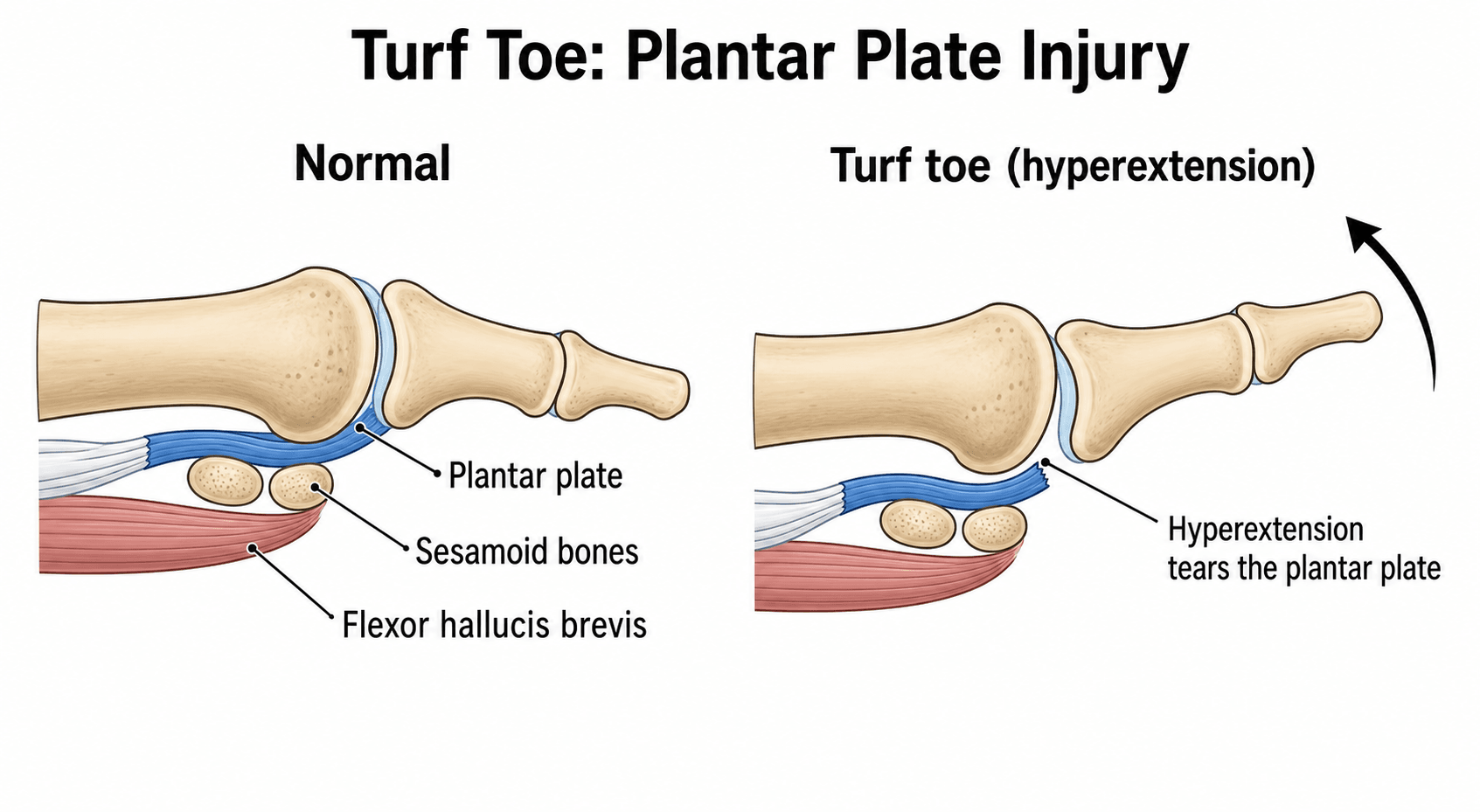
The plantar plate. A fibrocartilaginous structure of type II collagen, 8-10mm thick plantarly and thinning dorsally, that runs from the plantar surface of the metatarsal neck to the base of the proximal phalanx. Its superficial layer blends with the plantar fascia, its deep layer attaches to the sesamoids, and laterally it integrates with the collateral ligaments.
It is the primary restraint to MTP hyperextension and resists forces up to 45 degrees of dorsiflexion. Beyond this threshold, rupture occurs.
The sesamoid complex. Sesamoid pathology often coexists with plantar plate injury.
- Tibial (medial) sesamoid - the larger of the two and directly weight-bearing. It is the more commonly injured, being exposed to valgus forces, and a bipartite variant in 10-30% can mimic a fracture
- Fibular (lateral) sesamoid - smaller, less commonly injured, protected by adductor hallucis
- Intersesamoid ligament - connects the two sesamoids and creates the groove for the FHL tendon. Its rupture causes sesamoid diastasis, a Grade 3 finding
- FHB insertions - medial head to the tibial sesamoid, lateral head to the fibular sesamoid, providing active plantar flexion
- Sesamophalangeal ligaments - connect the sesamoids to the proximal phalanx
Load at push-off. In normal gait the first MTP bears 40-60% of forefoot load at push-off. The sesamoids distribute that pressure over a larger area, and FHB generates the plantar flexion force for propulsion.
The push-off deficit. When the complex fails, the sesamoids migrate proximally, FHB loses its mechanical advantage and propulsive force falls. These changes explain the functional deficit in turf toe.
Pathophysiology and Mechanism
The mechanism. Hyperextension of the first MTP joint while the forefoot is fixed on the ground. The detail that makes the mechanism work, and that is usually omitted, is that the heel must be raised: the ankle is in fixed equinus. An axial load down a leg with the foot flat cannot hyperextend the hallux; only when the heel is off the ground, and body weight or an opponent's weight drives down through the back of the leg, is the proximal phalanx levered into dorsiflexion against a planted toe.
The setting. The classic description is a player driving forward off the toe, or being landed on from behind in that position, as when a tackler lands on the heel. Cleats caught in the turf fix the forefoot, and high-velocity sports such as football, soccer and rugby contribute. The injury tracks with hard artificial turf plus flexible-soled shoes: turf does not absorb energy, and a flexible forefoot lets the joint reach the end of its range while the surface refuses to let the toe slide.
How the plate fails. Body momentum continues forward and drives the proximal phalanx into dorsiflexion beyond the 45-degree threshold, and the plantar plate fails in tension. Failure propagates distal to proximal through the plantar plate and sesamoid complex, which is why the sesamoids lose their distal tether and may displace proximally. The extent of the failure is the grade:
- Grade 1 - stretching without macroscopic tear
- Grade 2 - partial tear, usually distal to the sesamoids
- Grade 3 - complete rupture with sesamoid displacement
What follows. The capsule, collaterals and surrounding soft tissues are injured with the plate, and push-off is lost. Acute haemorrhage into the plantar capsule and an inflammatory response bring swelling and oedema. Scar formation may cause stiffness, sesamoid healing may end in nonunion, and chronic instability follows if the injury is not treated properly.
Classification - Anderson Grading System
- Pathology
- Plantar plate STRETCH
- Clinical Findings
- Minimal swelling, localised tenderness, normal ROM
- MRI Findings
- Oedema around plantar plate, no tear
- Treatment
- Rest 1-2 weeks, taping, early RTS
- Pathology
- Plantar plate PARTIAL TEAR
- Clinical Findings
- Moderate swelling, ecchymosis, pain with dorsiflexion, decreased ROM
- MRI Findings
- Partial tear visible, sesamoid position normal
- Treatment
- Walking boot 3-4 weeks, protected WB
- Pathology
- Plantar plate COMPLETE RUPTURE
- Clinical Findings
- Severe swelling, ecchymosis, joint instability, loss of push-off
- MRI Findings
- Complete disruption, sesamoid migration over 50%
- Treatment
- Immobilisation 6-8 weeks, may need surgery
Grade 1 or Grade 2. The Grade 1 patient can walk with minimal discomfort and returns in days. Grade 2 brings a significant antalgic gait and difficulty with push-off, and return is measured in weeks.
Grade 2 or Grade 3. Stability and sesamoid position separate them. Grade 2 has moderate swelling, a stable joint and normal sesamoid position; Grade 3 has severe swelling, an unstable joint and proximal sesamoid migration. Accurate grading guides treatment and prognosis counselling, and for Grade 3 look for:
- Sesamoid proximal migration over 50%
- Sesamoid diastasis from intersesamoid ligament rupture
- A positive vertical instability test
- Traumatic hallux valgus
Associated injuries. Always evaluate for these in Grade 2-3 turf toe.
- Sesamoid fracture - often associated with Grade 2-3. Sharp fracture margins distinguish it from the smooth edges of a bipartite sesamoid
- Traumatic hallux valgus - rupture of the medial capsule lets the great toe drift laterally, and may require surgical correction
- Osteochondral lesion - of the metatarsal head or proximal phalanx. Loose bodies may develop; consider arthroscopy if symptomatic
- FHL injury - associated in severe injuries; check for weakness of IP flexion
Clinical Presentation and Examination
History. Immediate pain at the great toe after forced hyperextension during sport, often on artificial turf in flexible-soled shoes or cleats. The athlete may report a "pop" or tearing sensation, and has difficulty with push-off and an antalgic gait.
Examination. Swelling and ecchymosis, plantar more than dorsal, with tenderness plantar to the first MTP and point tenderness over the sesamoids. Passive dorsiflexion is painful, FHB is weak on the push-off test, and the gait avoids toe-off.
The vertical instability test. Stabilise the metatarsal head and apply a vertical force to the proximal phalanx: more than 2mm of dorsal translation is positive and is regarded as pathognomonic of Grade 3, although the threshold has not been rigorously validated (see Controversies).
- Technique
- Stabilise MT head, dorsally translate PP
- Positive Finding
- Greater than 2mm dorsal translation
- Significance
- Grade 3 plantar plate rupture
- Technique
- Dorsiflex MTP with knee extended
- Positive Finding
- Pain at 30-45 degrees
- Significance
- Plantar plate/capsule injury
- Technique
- Direct pressure over sesamoids
- Positive Finding
- Focal tenderness
- Significance
- Sesamoid fracture or contusion
- Technique
- Single leg heel raise, push off great toe
- Positive Finding
- Weakness or avoidance
- Significance
- FHB dysfunction, functional loss
Clinical findings suggesting Grade 3:
- Massive swelling with ecchymosis extending to the arch
- Unable to weight-bear on the toes
- Palpable gap in the plantar plate
- Positive vertical instability test
- Obvious change in great toe position (traumatic hallux valgus)
- Mechanism / History
- Forced first MTP HYPERextension, forefoot fixed
- Key Distinguishing Features
- Plantar tenderness, pain on passive dorsiflexion, vertical instability if Grade 3
- Investigation
- MRI: plantar plate tear, sesamoid position
- Mechanism / History
- Forced first MTP HYPERflexion (soft surface, barefoot sports)
- Key Distinguishing Features
- DORSAL capsular pain, pain on forced plantarflexion
- Investigation
- MRI: dorsal capsule injury
- Mechanism / History
- Direct axial load or repetitive stress
- Key Distinguishing Features
- Focal sesamoid tenderness, pain on dorsiflexion loading
- Investigation
- Sesamoid views, CT for sharp margins vs bipartite
- Mechanism / History
- Overuse, dancers/runners
- Key Distinguishing Features
- Chronic plantar pain, smooth corticated edges on X-ray
- Investigation
- X-ray, MRI bone marrow oedema
- Mechanism / History
- Insidious, prior trauma or arthritis
- Key Distinguishing Features
- DORSAL osteophyte, painful and limited dorsiflexion, crepitus
- Investigation
- Weight-bearing X-ray: joint narrowing, osteophytes
- Mechanism / History
- Atraumatic, sudden nocturnal onset
- Key Distinguishing Features
- Erythema, warmth, exquisite tenderness, no clear injury
- Investigation
- Serum urate, joint aspirate (negatively birefringent crystals)
- Mechanism / History
- High-energy hyperextension
- Key Distinguishing Features
- Gross deformity, locked joint
- Investigation
- X-ray: frank dislocation, sesamoid entrapment
Investigations
Radiographs. They cannot assess the soft-tissue injury, but they show sesamoid position and fracture.
- AP foot - weight-bearing if possible
- Lateral foot - sesamoid position
- Oblique foot - additional detail
- Sesamoid view - axial projection
What to look for. Sesamoid fracture with sharp margins (a bipartite sesamoid may mimic one), sesamoid proximal migration, joint subluxation or diastasis, and avulsion fractures of the plantar base of the phalanx. Always compare sesamoid position with the contralateral foot: proximal migration over 50% means complete rupture, and diastasis means intersesamoid ligament rupture. On dorsiflexion views, loss of the sesamoids' normal distal excursion is a useful sign.
MRI is the gold standard and the imaging modality of choice for the soft tissue. Use T1, T2 and STIR sequences in axial, sagittal and coronal planes, with a small field of view focused on the first MTP. It is essential for surgical decision-making, and the indications are:
- All Grade 2-3 injuries
- Surgical planning
- Grade unclear from clinical examination
- Persistent symptoms despite treatment
Ultrasound can assess the plantar plate in experienced hands and allows dynamic assessment of sesamoid motion, but it is operator dependent and gives less detail than MRI.
CT is best for sesamoid fracture assessment, useful when bipartite sesamoid versus fracture is unclear, with 3D reconstruction for complex injuries.
Bone scan is rarely indicated. It may show stress reaction, and has been superseded by MRI.
Management Algorithm
The goal. Restore pain-free push-off and prevent chronic instability. The grade determines the intensity of treatment, but every athlete returns to sport in a turf toe plate (see Rehabilitation).
Who needs surgery. Very few: fewer than 2% of all turf toe injuries require operative repair (Gupta 2023), reserved for unstable Grade III and bony injury. Grades 1 and 2 are treated conservatively; Grade 3 is immobilised for a conservative trial, and surgery is considered when the indications below are met.
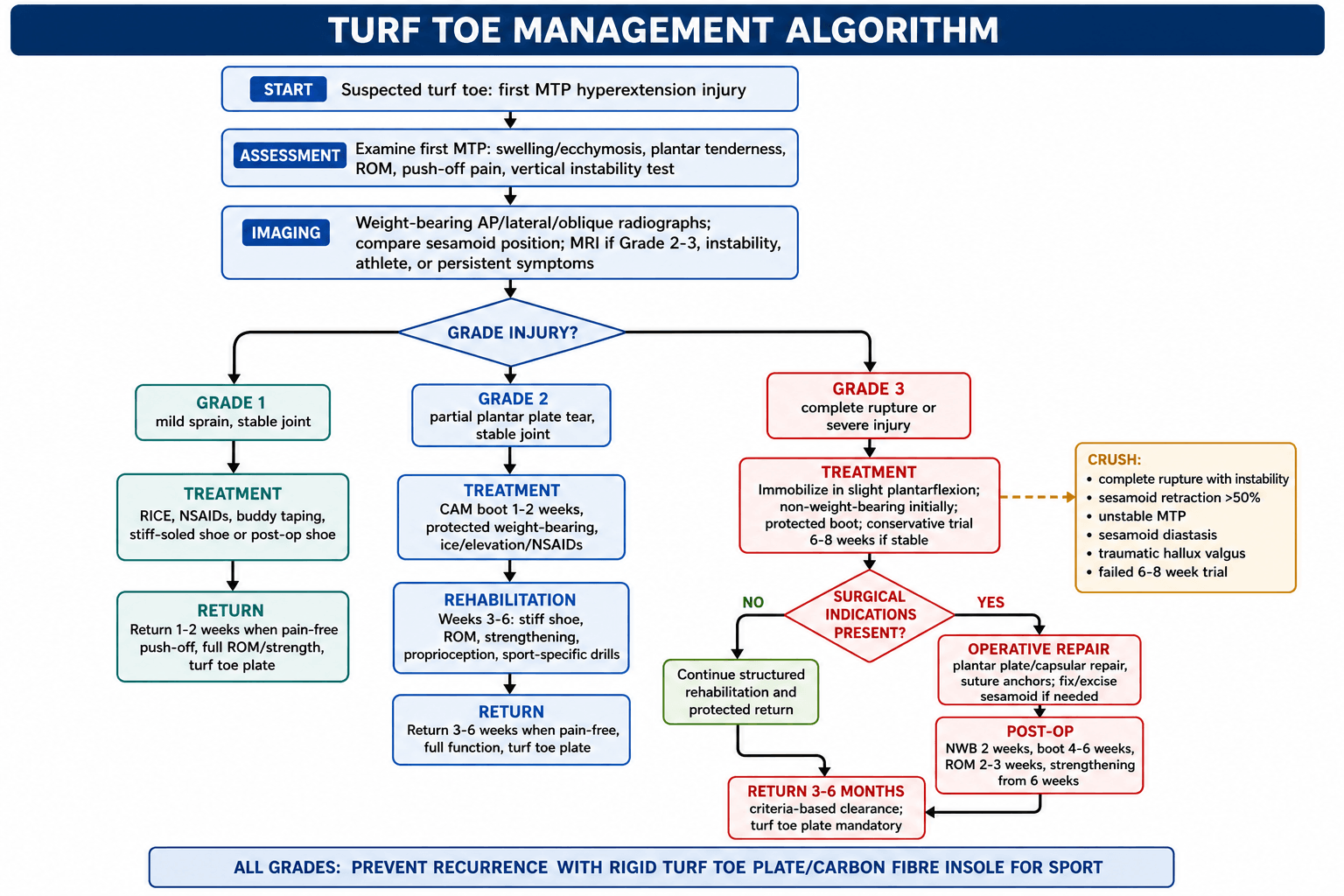
Days 1-7. RICE (rest, ice, compression, elevation), NSAIDs for pain and inflammation, buddy taping to the second toe, and a stiff-soled or post-op shoe.
Week 2. A gradual return to activity, with continued buddy taping, a turf toe plate or carbon-fibre insole, and strengthening exercises.
Return to sport is typically at 1-2 weeks, once push-off is pain-free with full range of motion and strength, and the athlete must wear the turf toe plate. The prognosis is excellent, with 100% returning to sport.
Complications
- Incidence
- 20-30%
- Risk Factors
- Grade 3, delayed treatment
- Prevention/Management
- Adequate healing, proper rehabilitation
- Incidence
- 10-15% of Grade 3 injuries
- Risk Factors
- Cartilage injury, repeated trauma
- Prevention/Management
- Protect joint, may need fusion long-term
- Incidence
- 5%
- Risk Factors
- Grade 3 without repair
- Prevention/Management
- Surgical repair if unstable
- Incidence
- 10-15%
- Risk Factors
- Return too early, no prevention
- Prevention/Management
- Turf toe plate, proper timing
- Incidence
- Rare
- Risk Factors
- Displaced fracture
- Prevention/Management
- Excision if symptomatic
- Incidence
- 5-10%
- Risk Factors
- Grade 3 not repaired
- Prevention/Management
- Late surgical stabilisation
Post-traumatic hallux rigidus. First MTP arthritis from cartilage damage is the most significant long-term complication. It may eventually require cheilectomy or fusion, and prevention lies in adequate initial treatment and protection. Examiners often follow a turf toe question straight into it, so know how it is graded and managed.
- Dorsiflexion
- 40-60 degrees (10-20% loss)
- Radiograph
- Normal
- Pain
- None
- Dorsiflexion
- 30-40 degrees
- Radiograph
- Dorsal osteophyte, minimal/no joint-space loss
- Pain
- Mild/occasional, at extremes
- Dorsiflexion
- 10-30 degrees
- Radiograph
- Moderate osteophytes, joint-space narrowing and sclerosis
- Pain
- Moderate/constant near maximal ROM
- Dorsiflexion
- Less than 10 degrees (and/or marked plantarflexion loss)
- Radiograph
- Severe changes, sesamoid involvement
- Pain
- Constant, but NO pain at mid-range on grind
- Dorsiflexion
- As grade 3
- Radiograph
- As grade 3
- Pain
- Definite PAIN AT MID-RANGE of passive motion (positive mid-range grind)
Mild to moderate disease. For grades 1-2 and early 3 with reasonable cartilage, cheilectomy (excision of the dorsal osteophyte plus the dorsal ~25-30% of the metatarsal head) relieves dorsal impingement and improves dorsiflexion. A Moberg dorsal closing-wedge phalangeal osteotomy can be added to shift the motion arc into dorsiflexion.
Severe disease. For grades 3-4, first MTP arthrodesis is the gold standard, with reliable pain relief. The joint is fused at roughly 10-15 degrees of dorsiflexion relative to the floor and 10-15 degrees of valgus, with neutral rotation.
Implants. Implant arthroplasty is generally avoided at the first MTP in young and active patients, given the historically high failure and osteolysis with silastic and metallic implants. Synthetic-cartilage implants (e.g. polyvinyl-alcohol) are an alternative with mixed evidence, but fusion remains the durable choice for the active athlete after turf toe.
Rehabilitation and Return to Sport
Rehabilitation Phases
Control pain and protect the healing tissue.
- RICE, protected weight-bearing
- Gentle range-of-motion exercises within pain limits
- Maintain cardiovascular fitness with the upper body
- Avoid push-off activities
Restore range of motion and begin strengthening.
- Full active and passive range-of-motion exercises
- FHB strengthening (towel scrunches, marble pick-up)
- Pool therapy for protected gait
- Balance and proprioception exercises
Sport-specific preparation.
- Progressive resistance exercises
- Single-leg heel raises, push-off drills
- Agility training (cutting, pivoting)
- Turf toe plate in athletic shoes
Full sport participation.
- Sport-specific skills without restriction
- Full-contact practice clearance
- Must pass functional testing
- Turf toe plate mandatory for competition
- Grade 1
- Full
- Grade 2
- Full
- Grade 3
- Near-full (90%)
- Grade 1
- Full
- Grade 2
- 90% contralateral
- Grade 3
- 85% contralateral
- Grade 1
- Pass
- Grade 2
- Pass
- Grade 3
- Pass
- Grade 1
- Pass
- Grade 2
- Pass
- Grade 3
- Pass
- Grade 1
- 1-2 weeks
- Grade 2
- 3-6 weeks
- Grade 3
- 3-6 months
The turf toe plate. A carbon-fibre or steel-shank insole that limits MTP dorsiflexion, and the standard for return to sport. It restricts the injurious dorsiflexion arc and is the cornerstone of recurrence prevention, although high-quality trials quantifying recurrence reduction are lacking (see Controversies). All athletes with turf toe should use one for return to sport, and stiffer-soled shoes and high-top footwear or cleats are also worth considering.
Outcomes and Prognosis
Prognostic factors. The outlook is better after a Grade 1-2 injury with a stable MTP joint and no sesamoid migration, with early diagnosis and treatment, compliance with rehabilitation and proper prevention with a turf toe plate. It is worse with Grade 3 instability, sesamoid proximal migration, traumatic hallux valgus, delayed presentation, premature return to sport and cartilage injury on MRI.
Outcomes by grade. The figures below come from the reviews by Gupta et al. (2023) and McCormick & Anderson (2010).
- Grade I - return as tolerated, typically 3-5 days; players generally regain prior performance
- Grade II - approximately 2-4 weeks lost; good recovery with protected return and taping support
Grade III. The two reviews quote different numbers, and they are measuring different things: 4-6 weeks or more of play lost, against at least 10-16 weeks to actual recovery, with operative rehabilitation running through four phases to around 20 weeks. Time out of competition is shorter than time to a fully recovered toe, and quoting the smaller figure to an athlete sets an expectation the injury will not meet. About 70% of higher-grade injuries maintain their prior performance level, whether treated operatively or not, which is the honest headline for a "minor" injury.
Chronic sequelae. Clanton's long-term series reported persistent symptoms in roughly half of athletes at over 5-year follow-up, including hallux rigidus.
Guidelines, Registries & Global Practice
Turf toe is a soft-tissue sports injury, so there is no implant registry and no single high-level guideline; practice is driven by expert reviews and society sports-medicine guidance. The principles below are consistent worldwide across examination frameworks.
- Grade-based treatment (Anderson / McCormick-Anderson scheme) is used internationally
- Conservative first: rest, immobilisation and rehabilitation for the large majority; fewer than 2% need surgery (Gupta 2023)
- MRI is the imaging standard for Grade II-III and surgical planning
- Rigid forefoot support (turf toe plate / carbon-fibre insole) for return to sport and prevention
- Threshold for surgery in elite vs recreational athletes (career considerations)
- Imaging access: MRI routine in high-resource settings; clinical grading and radiographs predominate where MRI is scarce
- Custom orthoses / carbon plates readily available in high-resource settings; improvised stiff-soled footwear or steel-shank inserts used elsewhere
- Return-to-sport criteria more formalised in professional sports medicine programmes
- Position on Turf Toe Management
- Grade-based algorithm; conservative care for most; surgical repair for unstable Grade III, sesamoid retraction or diastasis
- Position on Turf Toe Management
- Foot and ankle sports injury principles; MRI for instability; rehabilitation-led return with forefoot stiffening
- Position on Turf Toe Management
- Emphasis on restoring the plantar plate-sesamoid restraint and stable, pain-free push-off when operating
- Position on Turf Toe Management
- Graduated, criteria-based return to sport; protective footwear and load management to prevent recurrence
Wherever you sit your exam, the safe answer is the same: grade the injury, image instability with MRI, treat the great majority conservatively, reserve surgery for the unstable Grade III, and mandate a rigid turf toe plate for return to sport.
Controversies and Areas of Uncertainty
No randomised data compare repair with non-operative care for unstable Grade III. Decisions rest on case series and expert opinion (Coker 1978; Waldrop 2021). The unresolved question is which Grade III injuries truly need repair versus prolonged immobilisation.
The vertical (Lachman-type) instability test and the "over 50%" sesamoid migration threshold are widely quoted but not rigorously validated; inter-observer reliability and exact cut-offs remain uncertain.
Optimal timing is not evidence-defined. Premature return risks conversion to a higher grade or chronic instability, but precise functional clearance criteria vary between programmes.
Turf toe plates and stiffer footwear are biomechanically rational and standard, but high-quality trials quantifying recurrence reduction are lacking - most evidence is mechanistic or observational (Frimenko 2012).
MCQ Practice Points
Q: What is the mechanism of turf toe? A: Hyperextension of the first MTP joint with the forefoot fixed on the ground. Body momentum drives the proximal phalanx into forced dorsiflexion beyond 45 degrees.
Q: What is the primary structure injured in turf toe? A: Plantar plate (plantar capsular-sesamoid complex). This includes the plantar plate, sesamoids, and FHB insertions - provides 90% of plantar restraint to hyperextension.
Q: What finding on X-ray suggests a complete (Grade 3) plantar plate rupture? A: Sesamoid proximal migration greater than 50% compared to contralateral foot. Also look for sesamoid diastasis (intersesamoid ligament rupture).
Q: What are the surgical indications for turf toe? A: CRUSH: Complete rupture with instability, Retraction of sesamoid over 50%, Unstable MTP joint, Sesamoid diastasis, Hallux valgus (traumatic).
Q: What is the most important preventive measure for return to sport after turf toe? A: Turf toe plate (carbon fiber insole). Restricts the injurious MTP dorsiflexion arc and is the cornerstone of recurrence prevention on return to sport.
Exam Viva Scenarios
Practise clinical reasoning and management decisions out loud
“A 24-year-old NFL wide receiver hyperextended his great toe during a tackle on artificial turf. He has significant swelling, ecchymosis extending to the arch, and plantar MTP tenderness. He cannot push off. X-rays show no fracture but the tibial sesamoid appears proximally migrated compared to contralateral. What is your diagnosis and management?”
“A 19-year-old university footballer presents 2 days after hyperextending his great toe. Examination shows moderate swelling, ecchymosis, tenderness plantarly, and pain with passive dorsiflexion beyond 30 degrees. The MTP joint is STABLE on vertical instability test. X-rays normal. MRI shows partial tear of plantar plate distal to the sesamoids with edema but sesamoids are in normal position. He has an important match in 2 weeks. How do you manage him?”
“A 32-year-old former professional rugby player presents with 2 years of progressive great toe pain and stiffness. He had multiple turf toe injuries during his career, including one Grade 3 injury treated conservatively. X-rays show first MTP joint space narrowing, dorsal osteophytes, and subchondral sclerosis. He has 15 degrees dorsiflexion (normal 70 degrees). What is your diagnosis and management?”
DEFINITION
- First MTP hyperextension injury
- Plantar plate complex injury
- Artificial turf + flexible shoes = risk
- Sesamoid complex is key stabilizer
- FHB insertions form plantar restraint
ANDERSON GRADING
- Grade 1: Stretch - 1-2 wks RTS
- Grade 2: Partial tear - 3-6 wks RTS
- Grade 3: Complete rupture - 3-6 months
- Grade based on clinical + MRI findings
- Instability distinguishes Grade 2 vs 3
GRADE 3 INDICATORS
- Sesamoid migration over 50%
- Positive vertical instability test
- Sesamoid diastasis
- Traumatic hallux valgus
IMAGING
- X-ray: sesamoid position, fracture
- MRI: grade confirmation, surgical planning
- Compare sesamoids to contralateral
- Forced dorsiflexion views for instability
- T2 shows plantar plate edema/tear
SURGICAL INDICATIONS (CRUSH)
- Complete rupture + instability
- Retraction sesamoid over 50%
- Unstable joint on exam
- Sesamoid diastasis
- Hallux valgus (traumatic)
KEY POINTS
- Turf toe plate ESSENTIAL for RTS
- MRI for all Grade 2-3
- Grade 3: 50-70% return same level
- Long-term: hallux rigidus risk
Evidence Base and Key Studies
Original Turf Toe Series - University of Arkansas Football
- Over three football seasons 18 first MTP joint injuries caused 92 missed practices and 7 missed games, against 74 ankle sprains causing 152 missed practices and 6 missed games
- That is the comparison the paper rests on, and it is worth doing the arithmetic rather than asserting it: roughly 5.1 missed practices per MTP injury against 2.1 per ankle sprain, and MORE missed games in total from a quarter as many injuries
- Survey of 94 large US colleges (70% response) implicated artificial turf and lighter, more flexible footwear as contributors
- Rest is the treatment of first choice; taping and a 0.51-mm spring-steel splint were beneficial both pre- and post-injury
- Steroid injection to force early return was contraindicated; late and early surgical repair of capsular rupture could be of benefit
Turf Toe: Anatomy, Diagnosis, and Treatment (Grading Framework)
- Defines the three-grade plantar plate scheme: Grade I sprain/attenuation, Grade II partial rupture, Grade III complete rupture of the plantar capsuloligamentous complex
- Grade I athletes return as tolerated; Grade II typically ~2 weeks; Grade III at least 10-16 weeks to recover
- Some complete (Grade III) ruptures require surgical repair of the plantar plate-sesamoid complex
- MRI is central to confirming grade, defining sesamoid position and planning surgery