Principles, Transducers, Doppler & Artefacts
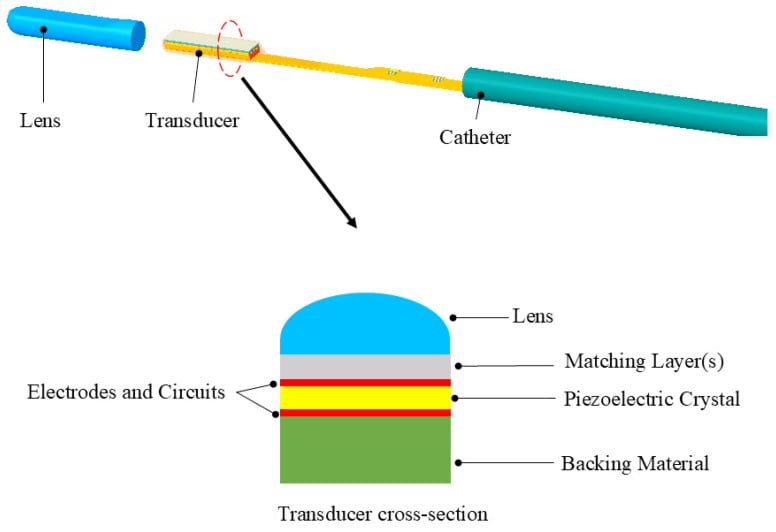
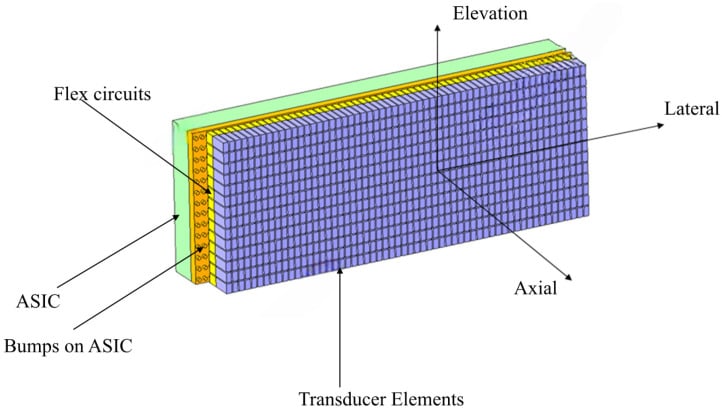
- Diagnostic ULTRASOUND uses high-frequency SOUND generated by a PIEZOELECTRIC TRANSDUCER, which converts electrical energy into sound and the returning echoes back into electrical signals; the PULSE-ECHO principle - sound is REFLECTED at interfaces between tissues of differing ACOUSTIC IMPEDANCE, and the machine uses the time-of-flight of the echoes to localise structures - produces a real-time image with NO ionising radiation.
- The FUNDAMENTAL TRADE-OFF is between frequency, resolution and penetration: HIGHER frequency gives better (axial) RESOLUTION but attenuates faster so PENETRATES less, while LOWER frequency penetrates deeper at the cost of resolution - hence superficial musculoskeletal structures are imaged with HIGH-frequency LINEAR probes and deeper structures (e.g. hip) with lower-frequency CURVILINEAR probes.
- The IMAGE MODES are A-mode (amplitude - a graph), B-mode (BRIGHTNESS - the standard 2D grey-scale image), and M-mode (MOTION over time); DOPPLER imaging - COLOUR, POWER and SPECTRAL Doppler - detects and characterises blood FLOW, useful for showing hyperaemia in inflammation/infection and the vascularity of lesions.
- ANISOTROPY is the most important MSK ultrasound ARTEFACT: the echogenicity of a structure (especially a tendon) changes with the ANGLE of the beam, so a normal tendon insonated obliquely appears artefactually HYPOECHOIC and can be misdiagnosed as a tear or tendinopathy - it is avoided by keeping the probe PERPENDICULAR to the structure, and it is the classic source of false-positive diagnoses.
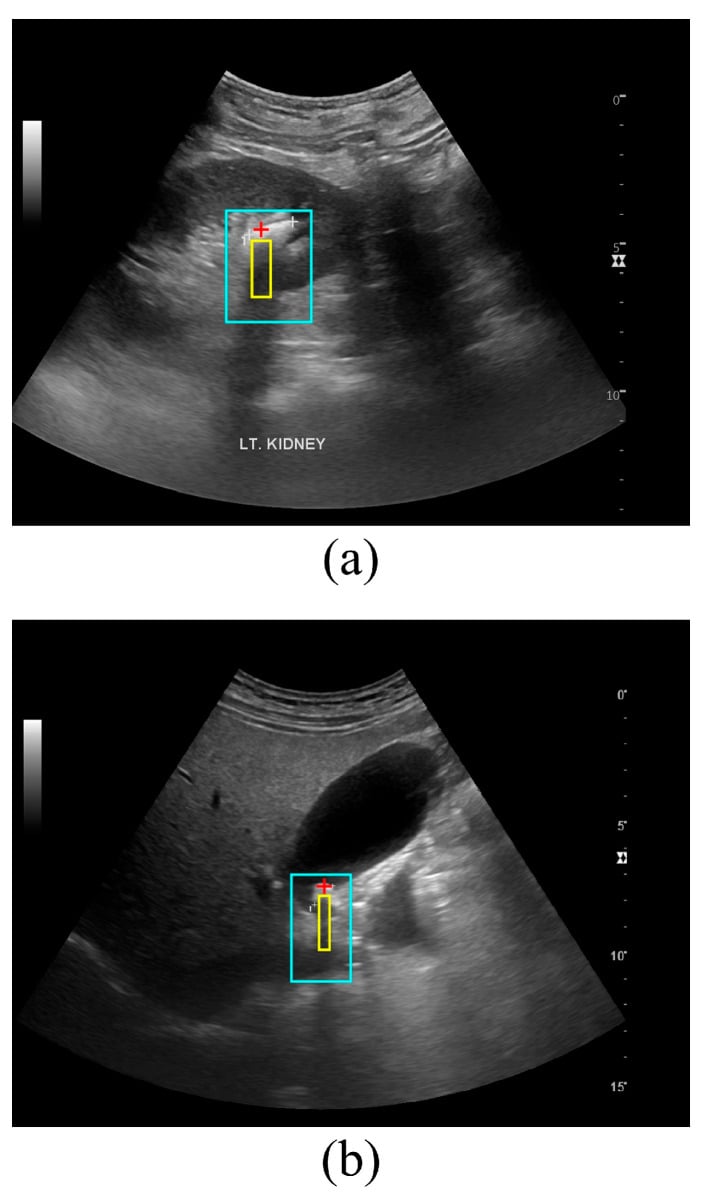
- Other key ARTEFACTS must be recognised and used: ACOUSTIC SHADOWING (a dark band behind bone/calcification/gas that blocks sound - confirms calcification), POSTERIOR (acoustic) ENHANCEMENT (increased brightness behind a fluid-filled/cystic structure - confirms a cyst), REVERBERATION/comet-tail, and the MIRROR-IMAGE artefact; some are diagnostically helpful (enhancement, shadow) while others (anisotropy, mirror) cause misdiagnosis.
- The PRACTICAL MESSAGE is that good MSK ultrasound depends on correct technique (equipment settings, transducer choice/positioning, standoff pads) and on recognising artefacts: limiting and correctly interpreting artefacts (especially anisotropy) is essential to avoid diagnosing pathology where none exists, while exploiting helpful artefacts (shadow behind calcification, enhancement behind fluid) aids correct diagnosis; ultrasound's strengths are being real-time, dynamic, cheap and radiation-free, and its weakness is being highly OPERATOR-DEPENDENT.
- DON'T CONCEDE THAT OPERATOR DEPENDENCE MEANS INFERIOR ACCURACY. In a meta-analysis of 65 studies, all using a SURGICAL reference standard, there was NO significant difference in sensitivity or specificity between ULTRASOUND and MRI for partial- or full-thickness ROTATOR CUFF tears (P greater than 0.05); the area under the summary ROC curve was 0.889 for ultrasound versus 0.878 for MRI. MR ARTHROGRAPHY outperformed both (P less than 0.05, area 0.935) at the cost of being invasive. The correct framing is that ultrasound matches MRI at this site IN EXPERIENCED HANDS - which is what operator dependence actually means - and that these figures are cuff-specific, not a general licence.
- “Piezoelectric transducer + pulse-echo (reflection at acoustic-impedance interfaces). FREQUENCY trade-off: HIGH frequency = better resolution, LESS penetration (linear probe, superficial); LOW frequency = deeper, poorer resolution (curvilinear, deep).
- “Modes: A/B/M-mode (B = brightness/2D image). Doppler (colour/power/spectral) = flow (hyperaemia, vascularity).
- “ARTEFACTS: ANISOTROPY (classic MSK pitfall - tendon falsely hypoechoic off-perpendicular → keep probe PERPENDICULAR), acoustic shadowing (behind calcification - helpful), posterior enhancement (behind fluid - confirms cyst), reverberation, mirror image. Operator-dependent; no ionising radiation.
- “ACCURACY: for ROTATOR CUFF tears, ultrasound EQUALS MRI (65-study meta-analysis, surgical reference standard; no significant difference in sensitivity or specificity; area under ROC 0.889 vs 0.878). MR ARTHROGRAPHY beats both (0.935) but is invasive. Cuff-specific figures, and they reflect experienced operators.
Higher frequency = better resolution but less penetration (linear probe, superficial); lower frequency = deeper but poorer resolution (curvilinear probe). Choose the probe to match the depth.
A normal tendon insonated off-perpendicular looks falsely hypoechoic and mimics a tear/ tendinopathy. Keep the probe perpendicular - the classic MSK ultrasound pitfall.
Principles, Transducers & Doppler
A piezoelectric transducer converts electrical energy into high-frequency sound and the returning echoes back into signals; the pulse-echo principle - sound reflected at interfaces of differing acoustic impedance, timed to localise structures - builds a real-time image with no ionising radiation. The fundamental trade-off: higher frequency gives better resolution but less penetration, lower frequency penetrates deeper with poorer resolution - so high-frequency linear probes image superficial structures and lower-frequency curvilinear probes image deep ones. Modes are A (amplitude), B (brightness - the 2D image) and M (motion); Doppler (colour/power/spectral) shows flow (hyperaemia, vascularity).
Artefacts - Pitfalls and Helpers
- What it is
- Echogenicity changes with beam angle (tendon falsely hypoechoic off-perpendicular)
- Significance
- PITFALL - mimics tear/tendinopathy; keep probe perpendicular
- What it is
- Dark band behind bone/calcification/gas (sound blocked)
- Significance
- Helpful - confirms calcification/bone
- What it is
- Increased brightness behind a fluid-filled structure
- Significance
- Helpful - confirms a cyst/fluid
- What it is
- Repeating echoes between two reflectors
- Significance
- Indicates metal/gas/foreign body
- What it is
- Duplicated structure across a strong reflector
- Significance
- Pitfall - false duplicate
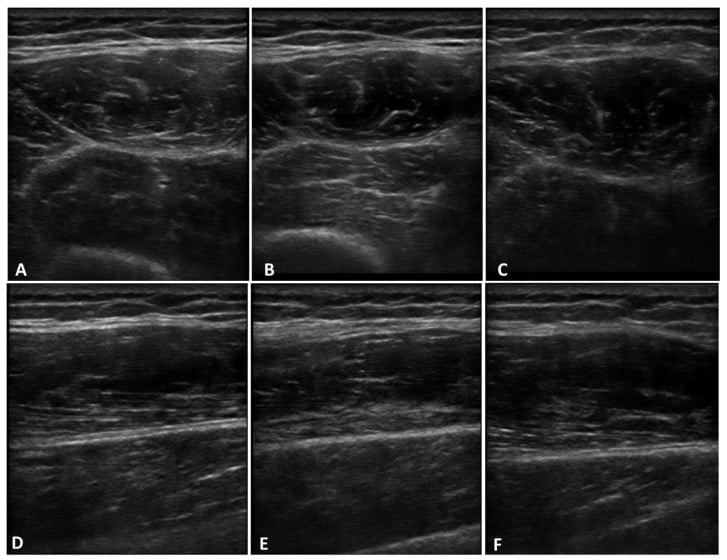
- Anisotropy is the classic MSK pitfall (tendon falsely hypoechoic) - keep the probe perpendicular to the structure; tilt/heel-toe to confirm.
- Acoustic shadowing behind a focus confirms calcification (e.g. calcific tendinopathy); posterior enhancement behind a lesion confirms it is fluid/cystic (e.g. ganglion).
- Reverberation/comet-tail indicates metal/gas/foreign body; mirror image can create a false duplicate.
- Optimise technique: correct probe/frequency, settings (depth, focus, gain/TGC), positioning and standoff pads to limit artefacts.
The most important practical pitfall in musculoskeletal ultrasound is anisotropy. Tendons (and other fibrillar structures) are highly reflective only when the beam strikes them perpendicularly; as soon as the probe is angled even a few degrees off perpendicular, the structure returns fewer echoes and appears artefactually hypoechoic, exactly mimicking a tear or tendinopathy. This is the classic source of false-positive ultrasound diagnoses, and it is avoided by keeping the transducer perpendicular to the structure being examined and by tilting (heel-toe manoeuvre) to confirm that an apparent hypoechoic area fills in when the angle is corrected. Equally, the helpful artefacts should be used deliberately - acoustic shadowing behind a focus confirms calcification, and posterior acoustic enhancement behind a lesion confirms it is fluid-filled - while reverberation and mirror-image artefacts are recognised so they are not mistaken for pathology. Because ultrasound is highly operator-dependent, correct technique (probe and frequency selection, machine settings, positioning) is what separates a reliable study from a misleading one.
The Quantitative Physics
- Acoustic impedance. Z = tissue density (ρ) × the speed of sound (c). The proportion of sound reflected at an interface depends on the mismatch in Z: a large mismatch (soft tissue↔bone or ↔gas) reflects almost all the sound (a strong echo, with shadowing beyond), while a small mismatch (soft tissue↔soft tissue) reflects a little and transmits the rest - which is what allows imaging.
- The assumed speed of sound. The machine assumes a fixed soft-tissue speed of about 1540 m/s to convert the echo time-of-flight into depth; real tissues differ (fat slower, bone far faster), a source of some artefacts.
- Attenuation. Sound weakens with depth (absorption/scatter/reflection), roughly 0.5-1 dB/cm per MHz - so higher frequencies attenuate more (the physics behind their poorer penetration); time-gain compensation (TGC) corrects for this depth-dependent loss.
- The two resolutions. Axial resolution (along the beam) improves with higher frequency (shorter pulse); lateral resolution (across the beam) improves with focusing and is best at the focal zone.
Q: What is acoustic impedance, the assumed speed of sound, and the two types of resolution?
A: Acoustic impedance Z = density × speed of sound; the fraction of sound reflected depends on the Z mismatch (large mismatch [bone/gas] reflects almost all → echo + shadow; small mismatch [soft tissue] transmits → imaging). The machine assumes ~1540 m/s soft-tissue speed for time-of-flight → depth. Attenuation ~0.5-1 dB/cm/MHz (higher frequency attenuates more → less penetration; TGC corrects depth loss). Axial resolution (along the beam) improves with higher frequency; lateral resolution (across the beam) improves with focusing.
Doppler Physics and Ultrasound Safety
- The Doppler equation - angle matters. The frequency shift is proportional to blood velocity × cos(angle) between the beam and flow, so the shift is maximal when the beam is parallel to flow and zero at ninety degrees - for accurate velocity keep the insonation angle low (ideally under 60 degrees).
- Aliasing. If the Doppler shift exceeds the Nyquist limit (half the pulse-repetition frequency), it aliases - the signal wraps around (colour reversal/spectral wrap); correct by raising the velocity scale/PRF, shifting the baseline, using a lower frequency or a smaller angle.
- Colour vs power vs spectral. Colour Doppler shows mean velocity and direction (angle-dependent, aliases); power Doppler shows the signal amplitude - more sensitive to slow flow, non-directional, less angle-dependent and does not alias (best for detecting hyperaemia); spectral/pulsed-wave gives a velocity waveform for quantification.
- Safety and bio-effects. Ultrasound is non-ionising but deposits energy, with thermal (heating - the displayed thermal index, TI) and mechanical (cavitation - the mechanical index, MI) bio-effects; the ALARA principle applies, especially in obstetric/ophthalmic use - diagnostic MSK ultrasound is very safe.
Q: What is the Doppler equation, what causes aliasing, and what are ultrasound's bio-effects?
A: The Doppler frequency shift ∝ velocity × cos(angle) - maximal when the beam is parallel to flow, zero at 90 degrees; keep the angle low (under 60 degrees) for accurate velocity. Aliasing occurs when the shift exceeds the Nyquist limit (half the PRF) → wrap-around; fix by raising the scale/PRF, shifting the baseline, or a smaller angle. Colour = mean velocity + direction (aliases); power = amplitude (more sensitive to slow flow, non-directional, no aliasing); spectral = velocity waveform. Bio-effects: non-ionising but thermal (TI) + mechanical/cavitation (MI) → ALARA.
Does the Operator Dependence Actually Cost Accuracy?
"Operator-dependent" is the stock criticism of ultrasound, and it is repeated so often that candidates assume the modality is second-rate. The accuracy data say otherwise for the commonest musculoskeletal indication.
- Ultrasound and MRI are equivalent for rotator cuff tears. A meta-analysis of 65 studies, all requiring an open or arthroscopic surgical reference standard, found no significant difference in either sensitivity or specificity between MRI and ultrasound for partial-thickness or full-thickness tears (P greater than 0.05). The area under the summary ROC curve was in fact numerically higher for ultrasound (0.889) than for MRI (0.878), though that pairwise difference was not significant.
- MR arthrography beat both. It was significantly more sensitive and specific than either (P less than 0.05), with the highest area under the curve at 0.935 - the trade-off being that it is invasive.
- How to use this in a viva. The right answer is not that ultrasound is inferior, but that for cuff tears it performs comparably to MRI at lower cost, in real time, with dynamic assessment and no ionising radiation, and that MR arthrography is the most accurate if the added invasiveness is justified.
- Where the operator dependence genuinely bites. These are pooled published studies, largely from centres with a declared interest in musculoskeletal ultrasound - so the figures describe the modality in experienced hands. That is precisely what operator dependence means: the technique can match MRI, but only if the person holding the probe knows the anatomy, keeps the beam perpendicular and recognises the artefacts. The physics does not transfer with the machine.
- What is not established here. These figures are for the rotator cuff, and should not be assumed to hold for every tendon, nerve or joint - no comparable pooled accuracy figure exists for most other musculoskeletal sites, and no published study measures how often anisotropy specifically produces a false-positive report.
Mnemonics & Memory Aids
ECHO
Hook:ECHO: Echo (pulse-echo/piezoelectric), Compromise (frequency trade-off), Hypoechoic = anisotropy, Other artefacts (shadow/enhancement/mirror).
Clinical Decision Scenarios
Practise clinical reasoning and management decisions out loud
“Explain the frequency trade-off in ultrasound and the anisotropy artefact.”
Principles
- Piezoelectric transducer (sound out and echoes in)
- Pulse-echo: reflection at acoustic-impedance interfaces; time-of-flight localises
- Real-time, dynamic, no ionising radiation; operator-dependent
Frequency & probes
- Higher frequency = better resolution, less penetration (linear, superficial)
- Lower frequency = deeper, poorer resolution (curvilinear, deep)
- Modes: A/B/M-mode (B = 2D grey-scale image)
Doppler
- Colour, power, spectral Doppler detect/characterise flow
- Shows hyperaemia (inflammation/infection) and vascularity
- Power Doppler more sensitive to low flow
Accuracy (rotator cuff)
- Ultrasound and MRI equivalent: no significant difference in sensitivity or specificity (65 studies)
- Area under summary ROC: MR arthrography 0.935, ultrasound 0.889, MRI 0.878
- MR arthrography significantly better than both, but invasive
- Figures reflect experienced operators and apply to the cuff, not every site
Artefacts
- Anisotropy (classic MSK pitfall - tendon falsely hypoechoic; keep perpendicular)
- Acoustic shadowing (calcification - helpful); posterior enhancement (fluid/cyst - helpful)
- Reverberation/comet-tail (metal/gas); mirror image (false duplicate)
Evidence & Key Studies
Diagnostic errors in musculoskeletal ultrasound and how to avoid them
- A NARRATIVE REVIEW of technique and artefacts. It reports NO error rate, no denominator and no measure of how often any artefact causes a misdiagnosis - so 'anisotropy frequently leads to diagnosing pathology where none exists' is expert description, not a measured false-positive rate. No such rate has been published.
- Correct musculoskeletal ultrasound technique - equipment settings, image-software innovations, standoff pads and correct transducer positioning - is fundamental to producing good-quality images and limiting artefacts.
- Artefacts divide into diagnostically HELPFUL ones (posterior echo enhancement deep to a fluid-filled structure; acoustic shadowing behind calcification) and MISLEADING ones - notably anisotropy-related artefacts and the mirror-reflection artefact.
- The review also covers correct differentiation of hypoechoic versus anechoic foci, and the atypical appearances that lead to specific conditions being misdiagnosed - the practical skill that separates a reliable study from a misleading one.
Accuracy of MRI, MR arthrography, and ultrasound in the diagnosis of rotator cuff tears: a meta-analysis
- Meta-analysis of 65 articles comparing MRI, MR arthrography and ultrasound, with an OPEN OR ARTHROSCOPIC SURGICAL REFERENCE STANDARD as an inclusion criterion - so the accuracy figures are anchored to what was actually found at operation.
- KEY RESULT FOR ORTHOPAEDIC PRACTICE: there was NO significant difference in either sensitivity or specificity between MRI and ultrasound for partial-thickness or full-thickness rotator cuff tears (P greater than 0.05). Operator dependence does not translate into inferior accuracy at this site.
- MR arthrography was significantly more sensitive and specific than either MRI or ultrasound (P less than 0.05) for both tear types.
- Areas under the summary ROC curve: MR arthrography 0.935, ULTRASOUND 0.889, MRI 0.878 - ultrasound numerically ahead of MRI, though pairwise comparison showed no significant difference between them.
- Limitations: pooled published studies, predominantly from centres with a declared musculoskeletal ultrasound interest, so these describe performance IN EXPERIENCED HANDS - which is the honest meaning of operator dependence. The findings are specific to the rotator cuff and should not be generalised to other tendons, nerves or joints. Published 2009, so it predates the most recent equipment generations.
The technique requirements and the division of artefacts into helpful (posterior enhancement behind fluid, shadowing behind calcification) and misleading (anisotropy, mirror image) come from the Serafin-Krol review (DOI) - a narrative review that reports no error rates. The comparative accuracy figures - no significant difference between ultrasound and MRI for partial- or full-thickness rotator cuff tears, MR arthrography superior to both, and the summary ROC areas of 0.935, 0.889 and 0.878 - come from de Jesus (DOI), a meta-analysis of 65 studies with a surgical reference standard. The piezoelectric pulse-echo principle, acoustic impedance, the assumed 1540 m/s soft-tissue speed, attenuation of roughly 0.5 to 1 dB/cm/MHz, the frequency-resolution-penetration trade-off, axial versus lateral resolution, the Doppler equation and Nyquist limit, and the thermal and mechanical indices with ALARA are standard, well-established physics.
What is not established: no published figure quantifies how often anisotropy actually produces a false-positive report - it is described as frequent by expert consensus, not measured. There is no pooled accuracy figure quoted here for sites other than the rotator cuff, no inter-observer reliability figure for musculoskeletal ultrasound generally, and no evidence defining how much training is needed to reach the accuracy reported in specialist series. The accuracy meta-analysis dates from 2009 and predates the most recent equipment.