Where Leukocyte Scintigraphy Still Adds Value
Leukocyte positive and marrow negative: infection likely
Leukocyte positive and marrow matched: marrow expansion or postoperative change
Leukocyte negative: infection less likely at the imaged site
Key: The marrow comparison is what turns leukocyte imaging into a high-specificity test for PJI.
- The best-established indication is chronic or prosthetic joint infection, not routine acute osteomyelitis.
- Interpretation hinges on mismatch: leukocyte uptake without matching marrow uptake suggests infection.
- MRI is superior for anatomy, marrow oedema, abscess extent, and vertebral infection.
- In the spine, labelled leukocyte imaging performs poorly and can even appear photopenic rather than hot.
- SPECT/CT improves localisation, particularly in the diabetic foot and around complex hardware.
- “If the stem is failed arthroplasty with equivocal aspiration, think combined leukocyte and marrow imaging.
- “A positive bone scan alone is not enough after arthroplasty because postoperative turnover stays high.
- “Do not recommend labelled white cell scanning as first-line imaging for vertebral osteomyelitis.
- “Tc-99m HMPAO gives better image quality, whereas In-111 provides more stable delayed imaging.
Overview
What it images. The patient's own white blood cells are labelled ex vivo, reinjected and tracked to sites of active neutrophil accumulation. In orthopaedics that is valuable when anatomical imaging is equivocal or limited by metal, and when the clinician needs a more specific answer than a three-phase bone scan can provide.
Where it sits. It is a problem-solving test, not reflex first-line imaging. MRI remains the best first-line test for most acute osteomyelitis, septic arthritis extent and spinal infection, and if the main question is early marrow infection or vertebral osteomyelitis, MRI is usually the better study. Order a labelled white cell scan when specificity matters more than raw sensitivity, especially around arthroplasty or chronic hardware.
The scan becomes attractive when marrow, postoperative change, Charcot change or hardware makes MRI and bone scan less decisive:
- Suspected PJI: a failed arthroplasty with equivocal aspiration, or where MRI is limited
- Chronic osteomyelitis, where the question is infection activity and specificity is needed beyond a bone scan
- Adjacent hardware, where metal limits MRI or confounds postoperative change
- Diabetic foot osteomyelitis, selectively (see Clinical Applications)
- Any case where standard imaging has not closed the question
Systematic Approach
Five questions take the request from the right patient to the right study.
- Question
- Is this a chronic, hardware-related, or post-arthroplasty question?
- Reason
- This is where specificity matters most
- Question
- Do you need same-day Tc-99m HMPAO or delayed In-111 imaging?
- Reason
- Balances workflow against delayed stability
- Question
- Will marrow expansion confound the leukocyte signal?
- Reason
- Critical in prosthetic joint infection
- Question
- Is planar imaging enough, or do you need SPECT/CT?
- Reason
- Improves anatomic localisation
- Question
- Would MRI answer the question better?
- Reason
- Avoids mis-ordering the wrong modality
Choosing the tracer. Both labels perform well. In-111 oxine gives stable delayed imaging and has the established literature, at the price of a higher radiation burden and a slower workflow. Tc-99m HMPAO gives superior count statistics and same-day imaging, but its label is less stable than In-111. In the diabetic foot, the Tc-99m HMPAO meta-analytic specificity (92 percent) outperformed In-111 (75 percent).
Adding the marrow scan. A sulfur colloid marrow scan maps marrow distribution. It adds a second acquisition but markedly improves specificity. Around hardware and in the postoperative skeleton, omitting the marrow correlation undermines specificity; in a virgin appendicular skeleton without marrow-altering disease, its incremental value is smaller.
What the report should say. A good report states whether uptake is focal or diffuse, whether marrow activity matches it, and whether SPECT/CT localises it to bone or soft tissue. It then says whether the pattern increases or decreases the probability of infection compared with MRI, aspiration and operative findings.
Image Timing: The Early–Delayed–Late Sequence
- Early image
- Around 3 to 4 hours
- Delayed / late image
- Around 20 to 24 hours
- Why the difference
- The stable In-111 label tolerates true 24-hour imaging — this is exactly why In-111 is described as giving more stable delayed images
- Early image
- Around 30 minutes to 1 hour
- Delayed / late image
- Around 3 to 4 hours
- Why the difference
- The short Tc-99m physical half-life (about 6 hours) plus label instability (progressive bowel, urinary and gallbladder activity) makes genuine 24-hour imaging impractical — better counts and a same-day answer, but a shorter usable window
- Early image
- Single acquisition paired to the leukocyte study
- Delayed / late image
- Compared at the matching time-point
- Why the difference
- Maps marrow so the leukocyte focus can be called matched or mismatched
The temporal principle. In infection, the focus increases in size, intensity or target-to-background ratio from the early to the delayed or late image, because neutrophils keep accumulating. Normal marrow, a healing surgical wound and sterile inflammation stay stable or fade over the same interval. In-111 is chosen when that 24-hour late image is needed.
A single early image is therefore not enough. It is the change over time, read alongside the marrow comparison, that separates infection from its mimics. General radiopharmaceutical physics is covered in the nuclear-medicine-orthopaedics topic.
Differential Interpretation & Mimics
Reading the uptake. The hardest part of a leukocyte study is deciding what the uptake means. The marrow scan, the time-course of the images and the clinical question separate true infection from physiological or sterile causes.
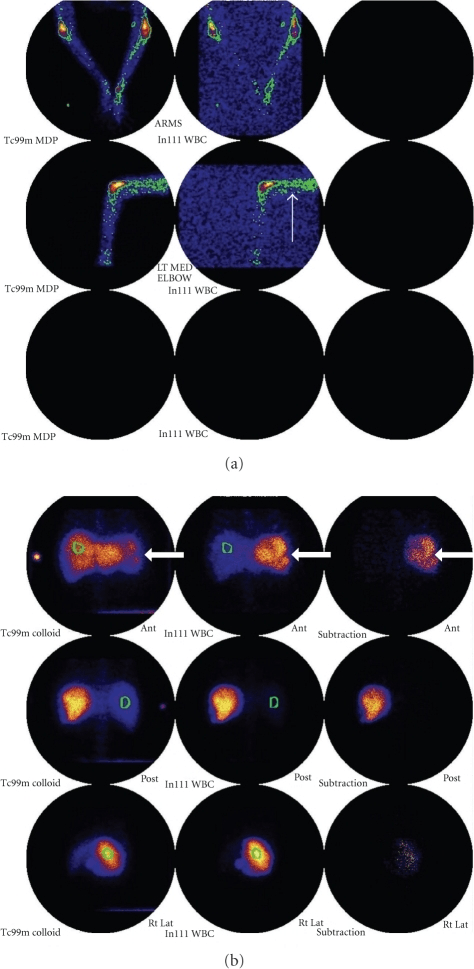
- Most likely cause
- Infection
- Discriminator
- The classic high-specificity signature; uptake usually intensifies on delayed images
- Most likely cause
- Marrow expansion or displaced marrow after arthroplasty
- Discriminator
- Matched marrow uptake at the same site argues strongly against infection
- Most likely cause
- Healing surgical wound or sterile inflammation
- Discriminator
- Stable or fading focus over early-to-delayed imaging favours non-infection
- Most likely cause
- Vertebral osteomyelitis (false negative for WBC)
- Discriminator
- Spine is unreliable for leukocyte imaging; switch to MRI or FDG-PET
- Most likely cause
- Reticuloendothelial physiology or recent transfusion
- Discriminator
- Symmetrical, non-focal; not a focal infective pattern
Clinical Applications
Prosthetic joint infection. This is the classic indication. Postoperative bone turnover produces bone scan false positives, and the marrow comparison improves specificity. Metal artefact can leave MRI non-diagnostic, and nuclear imaging is less affected by hardware. When aspiration is equivocal, the scan provides another line of evidence and guards against over-calling aseptic loosening.
Diabetic foot. Useful, but not a universal first choice. Labelled leukocyte imaging becomes most useful when MRI is equivocal, contraindicated, or anatomically confusing because of Charcot change or postoperative distortion. SPECT/CT is particularly helpful for localising uptake to bone rather than adjacent soft tissue.
The spine. Do not routinely recommend labelled leukocyte imaging for vertebral osteomyelitis. MRI and FDG PET/CT are better choices, because vertebral marrow activity makes leukocyte interpretation unreliable and infection may even appear photopenic rather than hot.
Why It Images Neutrophils — and What It Therefore Misses
An image of neutrophil traffic. The label sits on the patient's own leukocytes, the majority of which are neutrophils, so a labelled white cell scan is fundamentally an image of neutrophil traffic. As the cited review puts it, its accuracy is due to leukocyte imaging being most sensitive for neutrophil-mediated inflammation, that is, acute pyogenic infection. That is the one reason behind the evidence finding its sensitivity "more variable" and calling it "specific but not sensitive" around the shoulder.
Infections that are not neutrophil-rich are imaged poorly, and in them the scan may be falsely negative.
Chronic, low-grade, low-virulence infection. Indolent prosthetic infection by coagulase-negative staphylococci or Cutibacterium acnes, the classic shoulder-arthroplasty organism, provokes only a muted neutrophil response. That muted response is precisely the shoulder problem.
Granulomatous and atypical infection. Tuberculous spondylodiscitis and fungal and brucellar infection are macrophage- and lymphocyte-mediated, so a neutrophil tracer images them poorly. This compounds the vertebral-marrow problem in making the spine a weak indication.
Where FDG fits. FDG accumulates in activated macrophages, so FDG-PET detects the chronic and low-grade infection that the neutrophil scan misses. That is a major reason it is favoured for the spine and is the growing alternative around indolent prostheses. FDG-PET detail is developed in the pet-ct-orthopaedics topic; organism-specific management sits in the periprosthetic-joint-infection and pyogenic-discitis-osteomyelitis topics.
Reading a negative scan. A negative labelled-leukocyte scan never excludes a chronic, low-grade or granulomatous infection. Interpret it against the pre-test probability and the organism you actually fear.
Guidelines, Registries & Global Practice
Global epidemiology
-
Prosthetic joint infection complicates roughly 1 to 3 percent of primary lower-limb arthroplasties and is one of the leading causes of revision worldwide; the diagnostic challenge is separating it from aseptic loosening, the commonest cause of failure.
-
Diabetic-foot osteomyelitis is a high-volume global problem; imaging is invoked when probe-to-bone testing, plain films, and inflammatory markers leave the diagnosis open.
EANM (procedural guideline)- Emphasis
- Standardised WBC acquisition with early/delayed imaging plus marrow correlation and SPECT/CT
- Where leukocyte imaging sits
- Endorsed best-practice technique for neutrophil-mediated infection
MSIS / ICM (PJI consensus)- Emphasis
- Diagnosis is multi-criteria (aspiration, synovial markers, histology); imaging is adjunctive
- Where leukocyte imaging sits
- Nuclear imaging reserved for equivocal cases, not a stand-alone criterion
IDSA / IWGDF (diabetic foot)- Emphasis
- MRI first-line for bone infection; bone biopsy is reference standard
- Where leukocyte imaging sits
- Labelled WBC (ideally Tc-99m HMPAO SPECT/CT) when MRI is contraindicated or equivocal
IDSA (vertebral osteomyelitis)- Emphasis
- MRI first-line; FDG-PET as alternative
- Where leukocyte imaging sits
- Labelled WBC NOT recommended for the spine
Registry and access notes
- Arthroplasty registries (NJR, AOANJRR, AJRR, Swedish and Norwegian registers) track infection as a revision indication and confirm PJI as a major, costly failure mode, reinforcing the value of a high-specificity confirmatory test before revision surgery.
- Access varies widely: in vitro WBC labelling needs a licensed radiopharmacy, blood-handling facilities, and trained staff, so high-resource centres can offer leukocyte/marrow SPECT/CT or FDG-PET/CT, whereas limited-resource settings may rely on bone scintigraphy, plain radiography, aspiration, and clinical criteria.
- Where PET/CT is available it is increasingly favoured for the spine and for vascular-graft infection; where it is not, labelled leukocyte imaging remains the most specific functional option around hardware.
Controversies & Areas of Uncertainty
FDG-PET versus leukocyte/marrow for PJI. After two decades there is still no consensus on FDG for periprosthetic joint infection, because it cannot reliably separate infection from physiological or aseptic inflammation and lacks standardised uptake criteria. Combined leukocyte/marrow imaging retains the better specificity track record (Palestro, Semin Nucl Med 2023).
Shoulder and upper-limb arthroplasty. Evidence is limited, and suggests that leukocyte/marrow SPECT/CT and FDG-PET/CT are both specific but not sensitive there. A negative study is therefore less reassuring than around a hip or knee prosthesis.
Workflow burden. Ex-vivo labelling is labour-intensive, requires blood handling and is not available everywhere. That increasingly pushes practice toward FDG-PET/CT where access and expertise allow.
Clinical Decision Scenarios
Practise clinical reasoning and management decisions out loud
“A patient two years after total knee replacement has persistent pain, raised inflammatory markers, and equivocal aspiration.”
“A patient with diabetic foot ulceration has MRI findings that remain equivocal because of adjacent Charcot change.”
“A clinician asks whether labelled white cell scanning is appropriate for suspected vertebral osteomyelitis.”
Best Uses
- Equivocal prosthetic joint infection
- Chronic or hardware-associated osteomyelitis
- Selective diabetic-foot problem solving
- Cases where MRI is limited or non-diagnostic
Core Interpretation
- Leukocyte plus marrow mismatch suggests infection
- Matched leukocyte and marrow uptake favours marrow expansion
- Delayed images improve specificity
- Use SPECT/CT when localisation matters
Do Not Forget
- MRI first for most acute osteomyelitis
- MRI first for vertebral infection
- Bone scan alone is too non-specific after arthroplasty
- Tracer choice affects workflow and image quality
Limitations
- Poor spinal performance
- Time-consuming ex vivo labelling
- Needs specialist nuclear medicine support
- Not a replacement for aspiration or microbiology
Evidence Base
Combined Leukocyte/Marrow vs FDG in the Failed Joint Replacement
- In 59 painful, failed lower-limb prostheses (40 hip, 19 knee) with histopathological and microbiological confirmation, 25 (42 percent) were infected.
- Combined In-111 leukocyte/Tc-99m sulfur-colloid marrow imaging achieved sensitivity 100 percent, specificity 91 percent, and accuracy 95 percent.
- Coincidence-detection FDG was less accurate under every interpretation criterion (best accuracy 71 percent) and could not replace leukocyte/marrow imaging.
Combined Leukocyte/Marrow Imaging Is the Most Accurate Radionuclide Test for the Infected Prosthesis
- Bone scintigraphy alone is only 50 to 70 percent accurate and cannot separate infection from aseptic loosening, but a normal scan effectively excludes a prosthetic complication.
- Adding gallium-67 raises accuracy only to 70 to 80 percent, whereas combined leukocyte/marrow imaging reaches about 90 percent, the highest among radionuclide studies.
- The leukocyte-without-matching-marrow mismatch pattern is the diagnostic signature of infection; success is tempered by the limitations of in-vitro labelling.