Intra-articular Fracture-Subluxation | Thumb MC Base | AOL Anchors Fragment
- APL is the main deforming force - pulls shaft dorsally, radially, proximally
- AOL (anterior oblique ligament) keeps volar fragment reduced to trapezium
- Over 1mm articular step = surgical indication
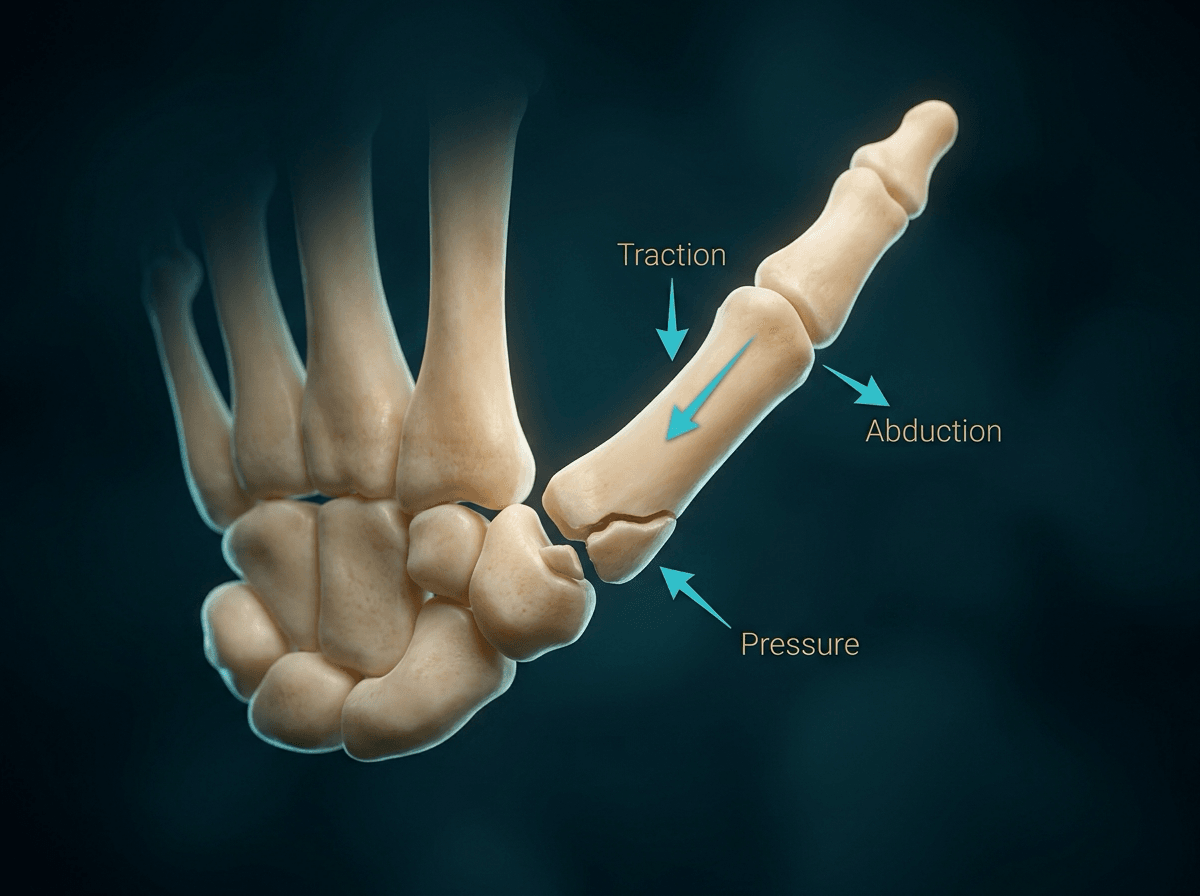
- Reduction: Traction, Abduction, Pressure on MC base (TAP manoeuvre)
- “Know the difference: Bennett (2-part) vs Rolando (comminuted)
- “K-wire MC1-trapezium is most common fixation method
- “Roberts view = true AP of thumb CMC (hyperpronated thumb)
- “Saddle joint anatomy is FREQUENTLY tested in vivas
Overview and Epidemiology
What it is. Bennett's fracture is an intra-articular fracture-subluxation of the first carpometacarpal (CMC) joint, first described by Edward Hallaran Bennett in 1882. It is the most common fracture of the thumb metacarpal base, approximately 80% of them, and it is an unstable injury because of the powerful deforming forces acting on the thumb.
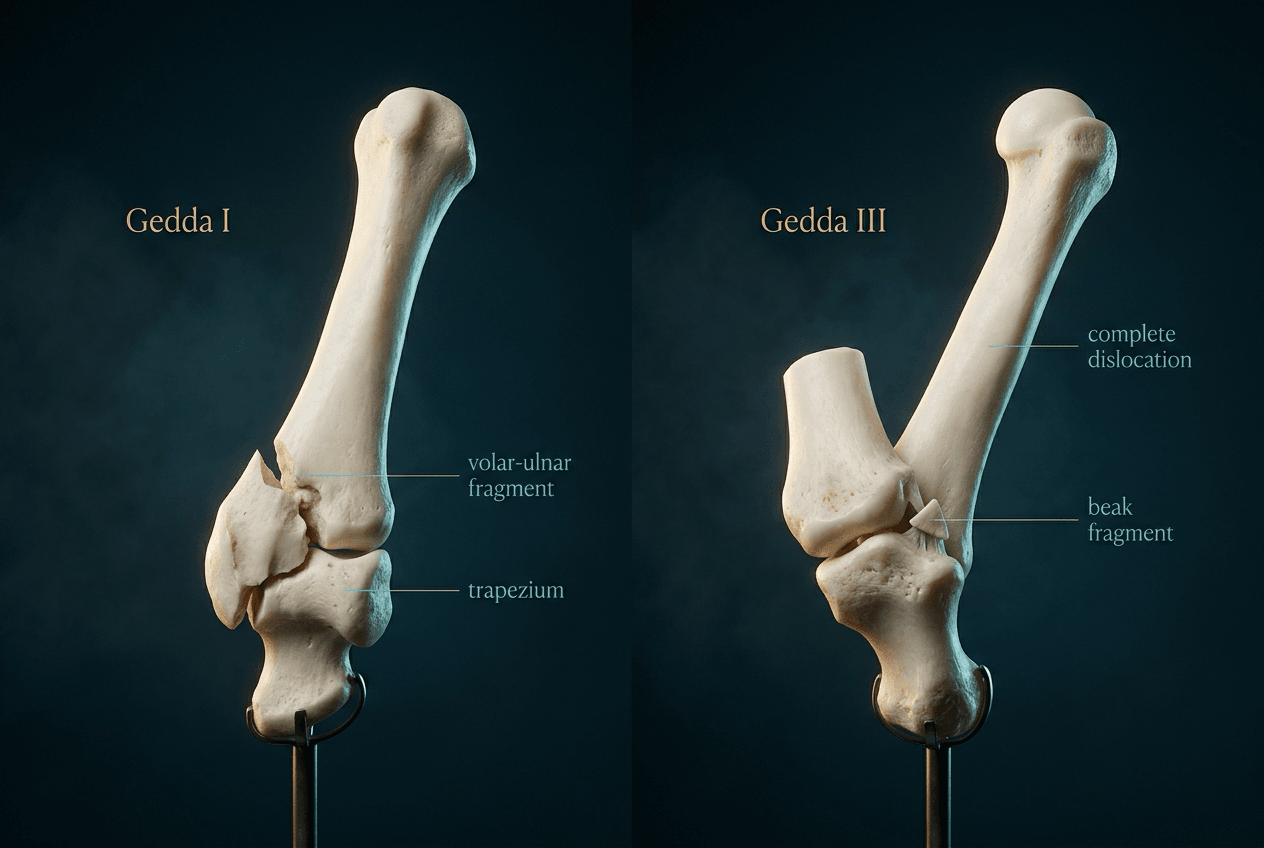
The pattern. A small triangular volar-ulnar fragment remains in anatomic position, held by the intact anterior oblique ligament, while the metacarpal shaft subluxates dorsally and radially under the pull of abductor pollicis longus (APL).
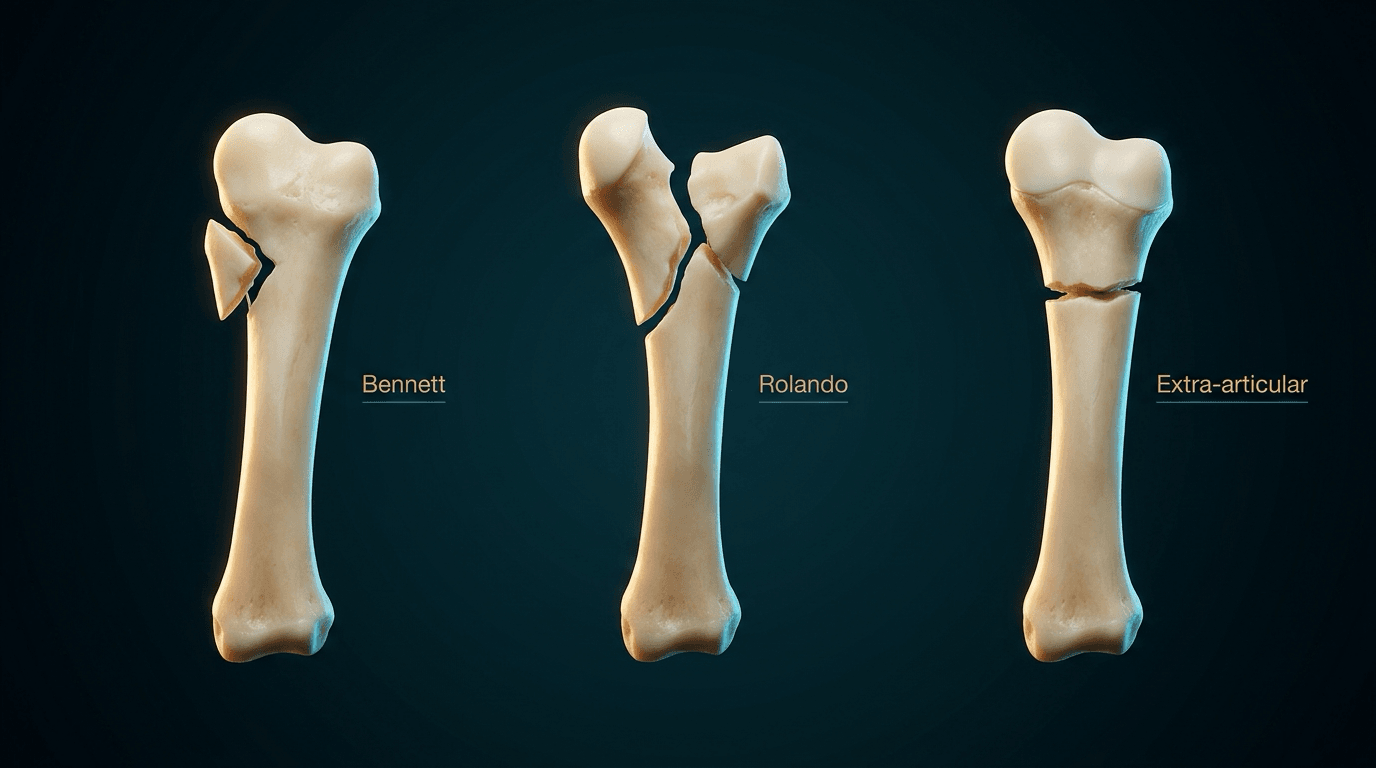
Its relatives. The comminuted intra-articular counterpart, a T- or Y-shaped fracture of the same base, is Rolando's fracture; it carries a worse prognosis because the articular surface cannot simply be reduced onto an intact beak fragment. The long-term consequence both share, and the reason anatomical reduction is pursued so hard here, is thumb CMC arthritis. The ligamentous injury of the same thumb is thumb UCL injury.
Anatomy and Biomechanics
The joint. The thumb CMC is a saddle-shaped joint, biconcave and biconvex. It allows circumduction and opposition and is the most mobile CMC joint in the hand. It is critical for grip strength and accounts for 40% of hand function.
The ligaments. The classic description of the stabilisers:
- Location
- Volar-ulnar
- Function
- Primary stabiliser - resists dorsal subluxation
- Location
- Dorsal-radial
- Function
- Secondary stabiliser
- Location
- Dorsal-ulnar
- Function
- Rotational stability
- Location
- Between MC1-MC2
- Function
- Limits abduction
- Location
- Dorsal
- Function
- Limits flexion
The AOL, the beak ligament. It runs from the volar tubercle of the trapezium to the volar-ulnar base of the first metacarpal and is classically described as the strongest stabiliser of the CMC joint. In a Bennett's fracture it remains attached to the volar (beak) fragment, which is why the small fragment stays reduced.
The classic (Eaton) teaching that the superficial anterior oblique ligament is the primary CMC stabiliser has been challenged. Modern anatomical and biomechanical work (Bettinger, Edmunds) identifies the dorsoradial ligament (DRL) as the primary restraint to dorsal(-radial) subluxation/dislocation, and the deep anterior oblique ligament (dAOL), not the superficial AOL, as the true beak ligament that anchors the volar fragment and is implicated in instability and CMC osteoarthritis. In a viva, state the classic view, then acknowledge that the dorsoradial ligament is now regarded as the key restraint to the dorsal subluxation seen in Bennett's.
The deforming forces. APL is the main deformer: it pulls the shaft dorsally and radially. Adductor pollicis pulls the shaft ulnarly, and EPL and EPB contribute to extension. The result is a shaft that subluxates dorsal, radial and proximal while the volar-ulnar fragment stays anatomic on its intact AOL, leaving a step-off and an incongruent joint. These forces make a closed reduction unstable.
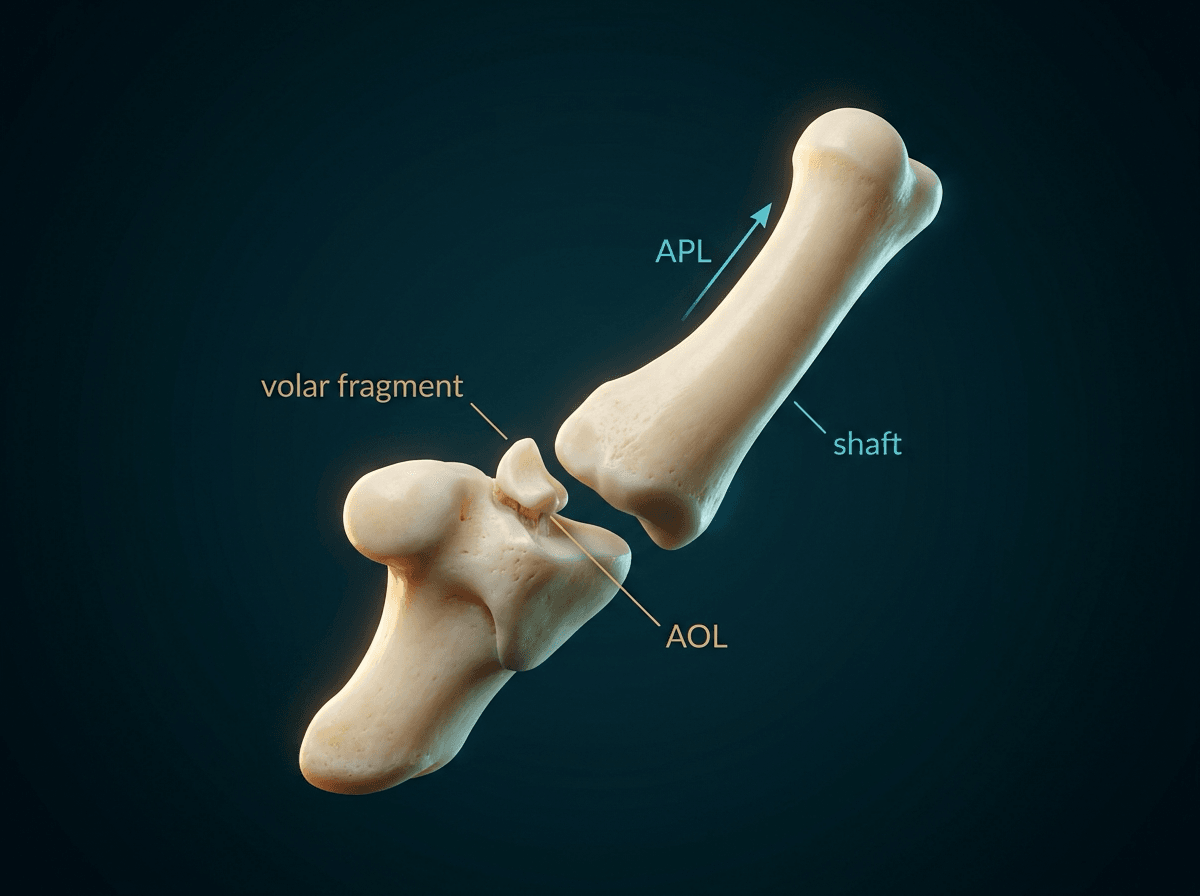
Mechanism. An axial load on a partially flexed thumb, transmitted along the thumb ray to the CMC joint: typically a punch or a fall onto the outstretched thumb, and also seen in sport (skiing, football, rugby) and motor vehicle accidents. The fracture it produces is two-part, a triangular volar-ulnar fragment that is typically small and a larger metacarpal shaft fragment that subluxates.
Classification Systems
Name the joint first: whether the fracture enters the CMC joint, and whether the articular surface is in two pieces or more, separates the three patterns.
Bennett. A two-part intra-articular fracture in which the volar-ulnar fragment stays attached to the trapezium and the shaft subluxates. It is the most common pattern.
Rolando. A comminuted intra-articular fracture of the same base, Y-shaped or T-shaped, with the articular surface in three or more pieces. Its prognosis is worse because of the articular damage.
Winterstein. The named extra-articular fracture: a transverse or oblique fracture of the thumb metacarpal base that spares the CMC joint. The APL still angulates it, typically apex-dorsal with an adduction/flexion deformity, but because it is extra-articular it tolerates more angulation, around 30°, and remodels. It is usually managed by closed reduction and a thumb spica cast, with fixation (K-wire or plate) reserved for unacceptable angulation or instability, and it is a cleaner, better-prognosis injury than the intra-articular Bennett or Rolando.
Clinical Presentation
History. Pain at the thumb base is immediate, with swelling over the thenar eminence and an inability to grip or pinch. The thumb appears deformed, shortened and pronated.
Examination. Inspect for swelling at the thenar eminence, ecchymosis at the thumb base, a shortened thumb and any angulation or deformity. On palpation there is point tenderness over the CMC joint and crepitus with gentle motion; assess the stability of the metacarpal. Document the neurovascular status, check for associated injuries, and test thumb opposition if the patient can tolerate it.
The grind test. Axial load with rotation at the CMC joint produces pain and crepitus, and indicates CMC pathology.
Instability. Assess dorsal-volar translation, compare it with the contralateral thumb and document the baseline laxity.
Investigations
Radiographs. The standard views, and what each is for:
- PA (posteroanterior) - oblique view of the CMC best
- True lateral - shows dorsal subluxation
- Roberts view - thumb fully pronated, beam perpendicular
- Stress views - if ligamentous injury is suspected
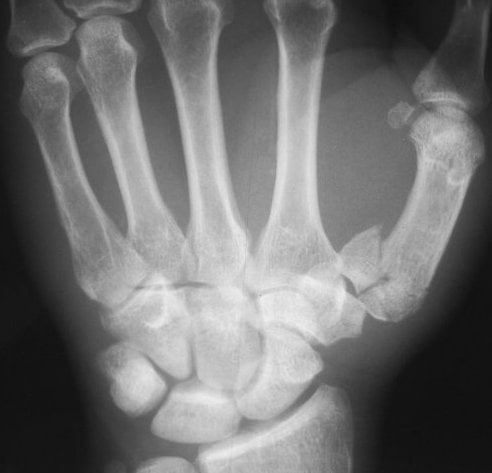
The Roberts view. Place the thumb flat on the cassette, hyperpronated, and direct the beam perpendicular to the thumb metacarpal. This shows the CMC joint in true AP.
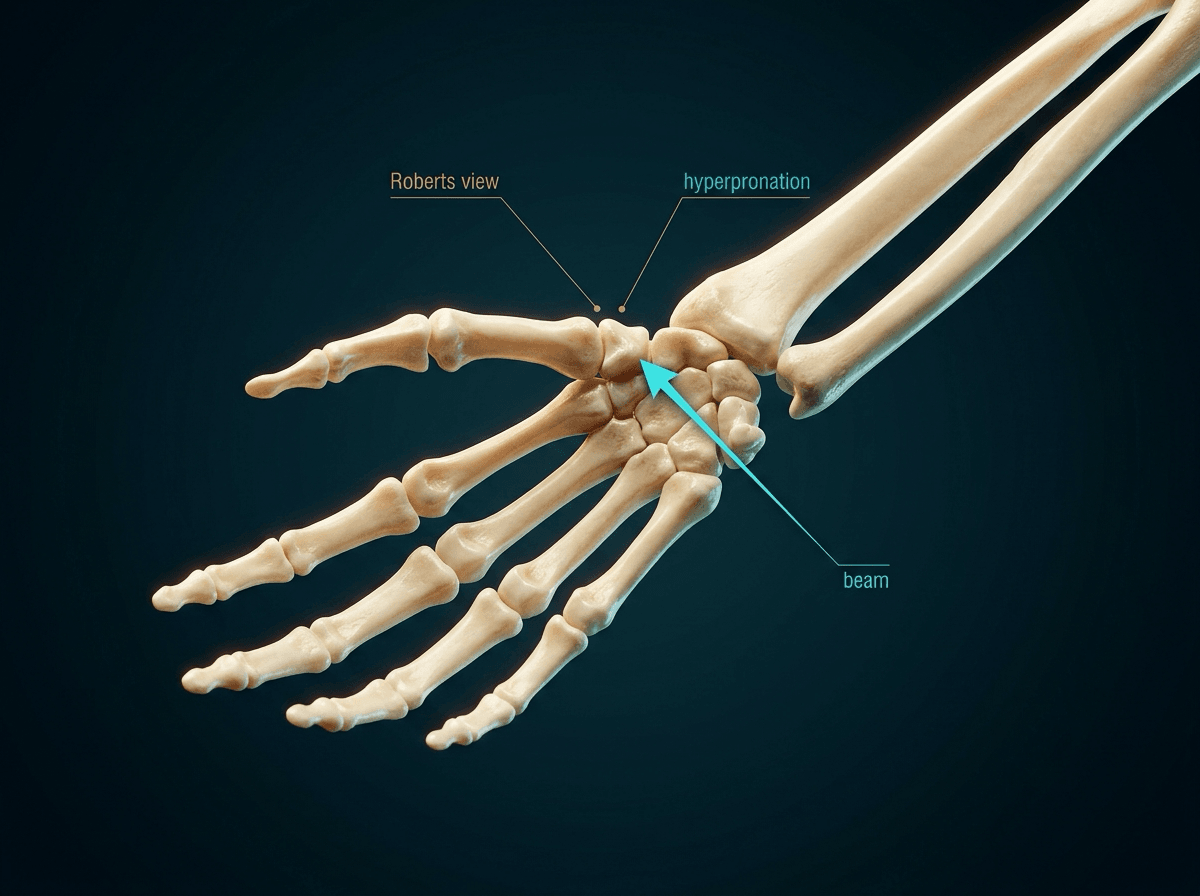
What the films show. The signs of a Bennett's:
- Triangular volar-ulnar fragment at the CMC joint
- Dorsal/radial subluxation of the metacarpal shaft
- Widening of the CMC joint space
- Overlap of MC1 and the trapezium on the lateral
What to measure. The articular step-off (greater than 1mm is significant), the fragment size as a percentage of the articular surface, and the degree of subluxation.
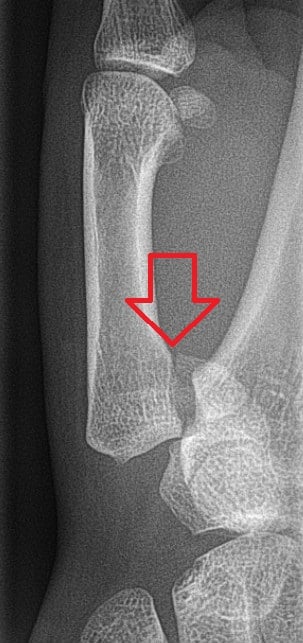
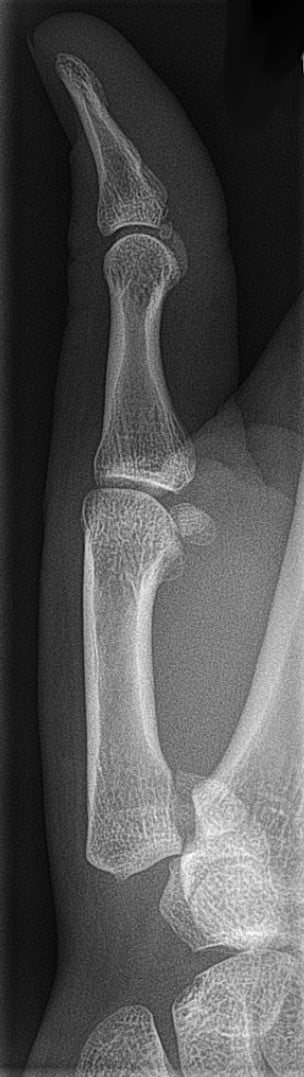
CT. For complex fracture patterns and surgical planning. It gives better delineation of fragment size, an assessment of comminution and articular congruity, and 3D reconstructions for planning the operation.
MRI. Rarely needed. Its place is suspected ligamentous injury without a fracture, evaluation of an occult fracture, and instability after reduction.
Differential diagnosis. The painful, swollen thumb base after axial loading has several mimics. The Roberts (true AP) and true lateral views, plus CT where needed, distinguish them.
- Key distinguishing feature
- Two-part intra-articular fracture with volar-ulnar fragment + dorsoradial shaft subluxation
- Why it matters
- Unstable; usually needs fixation
- Key distinguishing feature
- Comminuted T- or Y-shaped intra-articular base fracture
- Why it matters
- Worse prognosis; harder to fix
- Key distinguishing feature
- Transverse/oblique fracture sparing the CMC joint
- Why it matters
- Often managed in a thumb spica cast
- Key distinguishing feature
- Joint dislocated with no significant bony fragment; ligamentous failure
- Why it matters
- Reduces but is unstable; needs ligament assessment/repair
- Key distinguishing feature
- Tenderness and instability at the MCP joint, not the CMC base
- Why it matters
- Stener lesion may need surgery; different anatomy
- Key distinguishing feature
- Tenderness localised to carpus; CT clarifies
- Why it matters
- Different fixation and immobilisation
- Key distinguishing feature
- Older patient, chronic grind-test pain, osteophytes, no acute fragment
- Why it matters
- Non-operative or arthroplasty, not fracture fixation
Management Algorithm
The goals.
- Anatomic articular reduction (less than 1mm step)
- Stable fixation allowing early motion
- Restore CMC joint stability
- Prevent post-traumatic arthritis
Reduction quality versus fixation method. Comparative cohorts and a meta-analysis show that CRPP and ORIF give similar arthritis rates and functional scores when an acceptable reduction is achieved; the reduction itself matters more than the construct. [PMID 12631486] [PMID 37929064]
The under-1 mm dogma is debated. Older series tie residual displacement to arthritis [PMID 2307882] [PMID 7714650], yet a 7-year ORIF series found no correlation between reduction accuracy (gap/step under 2 mm) and arthritis [PMID 22438128]. Anatomic reduction remains the sensible goal, but the linear relationship is not absolute.
The ORIF trade-off. ORIF offers modestly higher grip and pinch strength and less adduction deformity, but at a higher complication rate. [PMID 37929064]
No RCT exists. Every recommendation rests on retrospective evidence; individualise by fragment size, reducibility, displacement and patient demand. [PMID 36514567]
Who. Rarely indicated. The indications are a non-displaced fracture with less than 1mm of step, a perfect reduction that is maintained in the cast, and the elderly or low-demand patient.
The reduction, TAP.
- Longitudinal Traction on the thumb
- Abduction of the thumb ray
- Direct Pressure over the metacarpal base, pushing it volar-ulnar
- Pronation of the thumb
- Hold the position and apply the thumb spica
The cast and the follow-up. Reduce under fluoroscopy and hold in a thumb spica in slight extension and abduction, with close radiographic follow-up, weekly for three weeks, to monitor for displacement. Total immobilisation is 4-6 weeks.
Why it usually fails. Redisplacement is frequent and the reduction is difficult to maintain, so most fractures go on to need surgical stabilisation. Non-operative treatment is rarely successful for a true Bennett's fracture because of the powerful deforming forces.
Surgical Technique
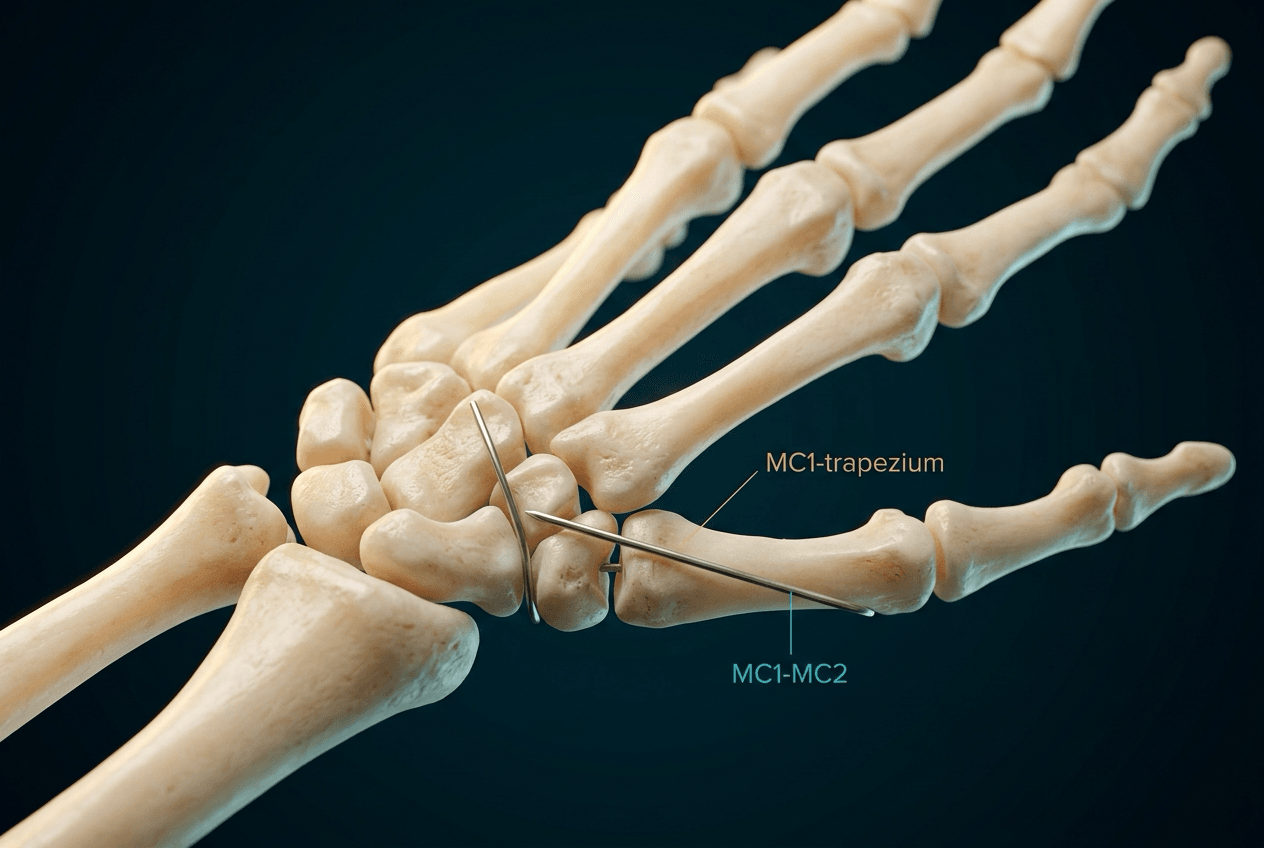
Closed reduction and percutaneous K-wire fixation is the most common technique.
The steps
- Closed reduction under fluoroscopy
- K-wire (1.1-1.4mm) through MC1 into the trapezium
- A second K-wire may be added through the fragment
- Or pin MC1 to MC2, which prevents redisplacement
- Protect in a thumb spica
- Remove the wires at 4-6 weeks
Where the wires go. A wire from MC1 into the trapezium stabilises the joint directly, a wire from MC1 to MC2 stabilises it indirectly, and a wire through the fragment fixes the fragment itself, if it is large enough to take one.
Avoid placing the wires too close to the articular surface: the entry point should be proximal enough to avoid penetrating the CMC joint. Fluoroscopy in multiple planes is essential.
Complications
Malreduction. The most common complication. A residual step greater than 1mm leads to arthritis and may require revision surgery.
Pin site infection. Occurs in 2-5% of K-wire cases, is usually superficial and is treated with oral antibiotics; a deep infection calls for early wire removal.
Loss of reduction. More common with conservative treatment, and it may also occur after wire removal, which is why close radiographic follow-up is essential.
Post-traumatic arthritis. The most significant long-term complication, with an incidence of 20-30% at long-term follow-up. The risk increases with articular incongruity, and it may require CMC arthrodesis or arthroplasty.
Stiffness. Common, especially after prolonged immobilisation. Start motion early once the fracture is stable; hand therapy is essential.
Weakness. Grip and pinch strength are affected and usually recover over 6-12 months, though a subtle weakness may persist.
CMC instability. Ligamentous incompetence after healing, rare if the fracture was anatomically reduced; it may require ligament reconstruction.
Malunion. Results from inadequate reduction, alters the mechanics of the CMC joint and may accelerate arthritic change. Corrective osteotomy is rarely indicated.
Postoperative Care
- Timeframe
- Weeks 0-4/6
- Focus
- Immobilisation, swelling control
- Timeframe
- Weeks 4/6-8
- Focus
- K-wire removal, gentle ROM
- Timeframe
- Weeks 8-12
- Focus
- Progressive grip/pinch
- Timeframe
- 12+ weeks
- Focus
- Sport-specific, full function
The splint. A thumb spica splint or cast for 4-6 weeks, with elevation and ice for the initial swelling, regular neurovascular checks, and protection of the pin sites if K-wires are present.
Pin site care. Clean daily with normal saline or dilute betadine, watch for the signs of infection (erythema, drainage), keep the pins out of water, and teach the patient the warning signs. Proper immobilisation and pin site care are essential for preventing complications.
Outcomes and Prognosis
What predicts a good result
- Anatomic reduction (less than 1mm step)
- Small articular fragment
- Young patient
- Early treatment
- Stable fixation
What predicts a poor one
- Articular step greater than 2mm
- Large fragment involvement
- Delayed treatment
- Associated soft tissue injury
- Comminuted pattern (Rolando)
Long-term results. With an anatomic reduction, 80-90% have good or excellent results, with a low rate of symptomatic arthritis and near-normal grip and pinch strength. With a non-anatomic reduction, 50-60% have good results, the rate of arthritis is higher, and a salvage procedure may be required.
Against Rolando.
- Bennett's
- 2-part
- Rolando
- Comminuted
- Bennett's
- Easier
- Rolando
- More difficult
- Bennett's
- Better
- Rolando
- Worse
- Bennett's
- 20%
- Rolando
- 40-50%
Guidelines, Registries & Global Practice
Guidelines, Registries & Global Practice
Bennett's fracture is a worldwide injury with a remarkably consistent demographic profile. The discussion below frames the global standard of care plus the regional nuances a candidate may be examined on, irrespective of board.
Global Epidemiology
Hand fractures are among the most common skeletal injuries. In a population-based study of approximately 4 million people, the annual incidence of hand fracture was around 36 per 10,000, of which roughly 42% involved the metacarpals, with a male-to-female relative risk of about 2:1 and a peak in young men aged 15–40 years. [PMID 16945705]
- Typical pattern
- Bennett's (~80% of base fractures)
- Typical pattern
- Young men, 15–40 years
- Typical pattern
- Axial load on partially flexed thumb (punch), fall, contact and ball sports
- Typical pattern
- Thumb CMC contributes substantially to overall hand function
- Position on Bennett's Fracture
- Anatomical reduction of the articular surface and stable fixation; CRPP for most, ORIF (lag screw) for larger or irreducible fragments
- Evidence Level
- Expert consensus / Level IV-V
- Position on Bennett's Fracture
- Displaced intra-articular thumb base fractures are unstable and warrant reduction and fixation; refer to hand/trauma service
- Evidence Level
- Consensus, low-level evidence
- Position on Bennett's Fracture
- Operative stabilisation for displaced fracture-subluxation; CRPP and ORIF both acceptable
- Evidence Level
- Consensus, retrospective evidence
- Position on Bennett's Fracture
- No RCT exists; ORIF may give modest strength/alignment gains with more complications; no single best treatment
- Evidence Level
- Level III (pooled retrospective)
There is no randomised controlled trial in Bennett's fracture. Guidance from the AO Foundation, BOA/BSSH and AAOS/ASSH is broadly concordant — reduce the joint, fix it stably — but rests on retrospective cohorts and two systematic reviews. The historical teaching that under-1 mm reduction prevents arthritis (Kjaer-Petersen, Thurston) is challenged by series showing no clear reduction–arthritis correlation (Leclère). State the controversy explicitly in a viva. [PMID 2307882] [PMID 8297298] [PMID 22438128]
Registry & Practice-Trend Evidence
Bennett's fractures are not tracked by joint-replacement registries (which cover arthroplasty), so evidence derives from national fracture cohorts and administrative datasets rather than implant registries. Population-level analyses report a clear secular trend away from closed reduction toward open reduction and internal fixation of metacarpal and phalangeal fractures over the past two decades, reflecting wider availability of fine fragment fixation and hand-surgery expertise. [PMID 35785509]
Global Practice Variation
- High-resource settings: ready access to fluoroscopy, fine K-wires/screws and arthroscopy; increasing use of ORIF and arthroscopic-assisted reduction.
- Limited-resource settings: closed reduction and percutaneous K-wiring predominate — low cost, widely available, and supported by evidence that technique matters less than reduction quality (Thurston). [PMID 8297298]
- Athletes / manual workers: lower threshold for stable internal fixation to allow earlier protected mobilisation and predictable return to work or sport.
- Elderly / low-demand patients: a degree of residual displacement may be accepted, balancing arthritis risk against surgical morbidity.
Viva Questions
Viva Scenarios
Clinical Decision Scenarios
Practise clinical reasoning and management decisions out loud
“A 28-year-old male presents after punching a wall with a painful swollen thumb. X-rays show a Bennett's fracture with 2mm subluxation. How would you manage this patient?”
MCQ Practice Points
MCQ Practice Points
Q: Which ligament keeps the volar-ulnar fragment of a Bennett's fracture reduced to the trapezium?
A: Anterior Oblique Ligament (AOL) - Also called the "beak ligament." This is the primary stabilizer of the thumb CMC joint and attaches to the volar-ulnar base of the first metacarpal. Because this ligament remains intact, the small triangular fragment stays in anatomic position.
Q: What is the main deforming force in a Bennett's fracture and in which direction does it displace the metacarpal shaft?
A: Abductor Pollicis Longus (APL) is the main deforming force. It pulls the metacarpal shaft dorsally, radially, and proximally. Secondary deforming forces include adductor pollicis and the extensor pollicis muscles.
Q: What is the articular step-off threshold for surgical intervention in Bennett's fracture?
A: Greater than 1mm of articular step-off is the accepted threshold for surgical intervention. Studies have shown that articular incongruity of more than 1mm is associated with significantly higher rates of post-traumatic arthritis at long-term follow-up.
Q: What is the Roberts view and why is it useful for evaluating Bennett's fractures?
A: The Roberts view is a true AP view of the thumb CMC joint obtained by placing the thumb flat on the cassette (hyperpronated) with the beam perpendicular to the metacarpal. It provides the best view of the CMC joint and accurately shows the articular step-off and subluxation.
Q: What is the key difference between a Bennett's fracture and a Rolando fracture?
A: Bennett's fracture is a two-part intra-articular fracture-subluxation with a small volar-ulnar fragment. Rolando fracture is a comminuted (three-part or more) intra-articular fracture with a Y or T pattern. Rolando fractures have a worse prognosis due to greater articular destruction.
Q: A patient has a Bennett's fracture with a fragment involving 10% of the articular surface. What is the preferred fixation method?
A: Percutaneous K-wire fixation is preferred for small fragments. K-wires from MC1 to trapezium (direct) and/or MC1 to MC2 (indirect) provide adequate stabilization. Screw fixation is not ideal for small fragments due to inadequate purchase and risk of fragmentation.
Exam Cheat Sheet
Exam Day Cheat Sheet
Definition
- Intra-articular fracture-SUBLUXATION of thumb MC base
- Two-part: volar-ulnar fragment + subluxated shaft
- NOT the same as Rolando (which is comminuted)
- Instability defined by dorsal/radial shaft migration
Key Anatomy
- AOL (anterior oblique ligament) = primary stabilizer
- AOL keeps volar fragment attached to trapezium
- APL = main deforming force (pulls dorsal/radial/proximal)
- Thumb CMC = saddle joint (40% of hand function)
Surgical Indications
- Articular step greater than 1mm
- Subluxation that cannot be reduced closed
- Unstable after closed reduction
- Rotational malalignment (rare but possible)
Fixation Options
- K-wire MC1 to trapezium (most common)
- K-wire MC1 to MC2 (indirect)
- Lag screw (if fragment large enough)
- ORIF via Wagner approach if closed fails
Complications
- Post-traumatic arthritis (20-30%)
- Malreduction
- Stiffness
- Pin site infection
Quick Reference: Key Numbers
- Value
- greater than 1mm = surgery
- Value
- 40%
- Value
- 4-6 weeks
- Value
- 4-6 weeks
- Value
- 20%
- Value
- 50%+
- Value
- 10-12 weeks
Evidence Base
Evidence Base
The contemporary evidence base for Bennett's fracture is built almost entirely on retrospective cohorts and two systematic reviews — there is no randomised controlled trial. The recurring themes are that (1) the quality of articular reduction historically correlated with long-term arthrosis, (2) open and closed techniques give broadly similar functional outcomes when an acceptable reduction is achieved, and (3) cast-only management gives poor long-term results.
Reduction Quality and Post-Traumatic Arthritis
- 41 Bennett's fractures reviewed at a median 7.3 years
- Symptom-free in 15 of 18 fractures healed in excellent position versus only 6 of 13 with residual displacement
- Radiographic arthritis in 3 of 14 with excellent reduction versus 7 of 10 with residual displacement
One-Millimetre Threshold — Medium-to-Long-Term Review
- 76 Bennett's fractures; 21 reviewed at mean 7 years 7 months
- Fractures healing with up to 1 mm displacement had superior clinical and radiological results
- Only 1 of 76 patients required later CMC fusion
- The method of achieving and holding reduction was 'immaterial' provided under-1 mm displacement was obtained
Non-Operative Treatment — 13-Year Follow-Up
- 20 of 22 cast-treated Bennett's fractures followed to 13 years
- 18 of 20 subjectively satisfactory, but 7 had radiographic CMC arthrosis (2 severe and painful)
- Non-anatomic reduction present in 6 of the 7 patients who developed arthrosis
Conservative Management — 26-Year Follow-Up
- 17 conservatively (cast-only) treated fracture-dislocations reviewed at mean 26 years
- All had reduced range of movement and grip strength; 12 had a characteristic hand deformity
- Persistent CMC subluxation with marked degenerative change on radiographs
CRPP versus ORIF — Comparative Cohort
- 32 single-large-fragment Bennett's fractures; ORIF versus closed transarticular K-wiring; mean 7-year follow-up
- Treatment type did not influence clinical outcome or prevalence of radiological arthritis
- The percutaneous group had a significantly higher incidence of first-metacarpal adduction deformity, attributed to wire placement near the fracture line
Open Reduction and Screw Fixation — 7-Year Outcomes
- 24 Bennett's fractures fixed with lag screws; mean follow-up 83 months
- Reduction maintained in 96% when two lag screws were used
- Pinch and grip strength about 92% and 89% of the contralateral side at 4 months
- No correlation between reduction accuracy (gap/step under 2 mm) and development of arthritis in this series
ORIF versus Closed Reduction — Systematic Review and Meta-Analysis
- Six retrospective studies pooled (no RCTs available)
- ORIF associated with higher grip and pinch strength, better thumb extension/flexion and smaller mean adduction deformity
- No difference in post-traumatic arthritis or functional scores
- Higher complication rate with ORIF
Systematic Review of Management Outcomes
- PRISMA review of 13 studies and 558 patients (439 operative, 119 conservative)
- Post-traumatic osteoarthritis reported in 50 of 558 (9%) where stated; pain in 13%; reoperation in 2%; no nonunion
- No randomised controlled trial exists; heterogeneity precluded a single recommendation