Primary-Quaternary Mechanisms | Zone of Injury | Damage Control | Reconstruction vs Amputation
- Secondary blast injury is the leading cause of extremity trauma (fragment penetration)
- Zone of injury extends well beyond visible wound margins — serial debridement is mandatory
- Damage control orthopaedics: external fixation first, definitive fixation once physiologically stable
- A LOW MESS predicts salvage potential; a HIGH MESS does NOT predict amputation — the score was prospectively tested and failed in that direction
- Never close a blast wound primarily — delayed primary closure at 3-5 days
- “Blast = four mechanisms (primary-quaternary), secondary dominates extremity pathology
- “Zone A = permanent cavity, Zone B = temporary cavitation, Zone C = molecular wound
- “Serial debridement every 48-72 hours until clean and viable tissue only
- “MESS less than 7 does not guarantee salvage; MESS greater than 7 does not mandate amputation
Overview and Epidemiology
Blast injury is the most complex form of extremity trauma met in either military or civilian practice. Four injury mechanisms arrive together, the zone of injury extends far beyond the visible wound margins, and the wound carries a heavy bacterial load on top of the physiological insult of polytrauma. Limb salvage versus amputation, the timing of definitive fracture management and the approach to wound coverage are all decided against that background.
What is specific to blast, and what is borrowed. Almost every management principle on this page is a general trauma principle applied to an unusually severe wound; the blast-specific content is the four mechanisms, the zone of injury extending beyond the visible wound, and the contamination load that makes serial debridement non-negotiable. Everything else has a fuller home: the salvage-versus-amputation decision belongs to mangled extremity and limb salvage decision-making; the staged-fixation logic to damage control orthopaedics and the whole-patient priorities to polytrauma management; wound classification, antibiotic timing and coverage to open fracture management; and the two complications a blast limb most reliably generates to compartment syndrome and crush syndrome.
Who is injured. 70-80 percent of all blast injuries affect the limbs. The dominant mechanism in modern conflict is the improvised explosive device; in civilian practice the mechanisms are industrial explosions, terrorist attacks and mining disasters.
What kills, and what disables. Mortality is determined by the primary blast — pulmonary and visceral injury — and by associated head and chest injury. Among those who survive, extremity blast wounds are the leading cause of long-term disability.
What comes with the limb. Blast injury rarely isolates to one limb, so the torso, head and contralateral limb are assessed in every case. Foreign material is driven deep into the tissues — soil, clothing, fragments of bone — and the soft tissue loss is massive and often underestimated on initial assessment. Post-traumatic stress disorder (PTSD) and chronic pain are nearly universal, and rehabilitation is protracted: months to years of reconstructive surgery and therapy.
Pathophysiology
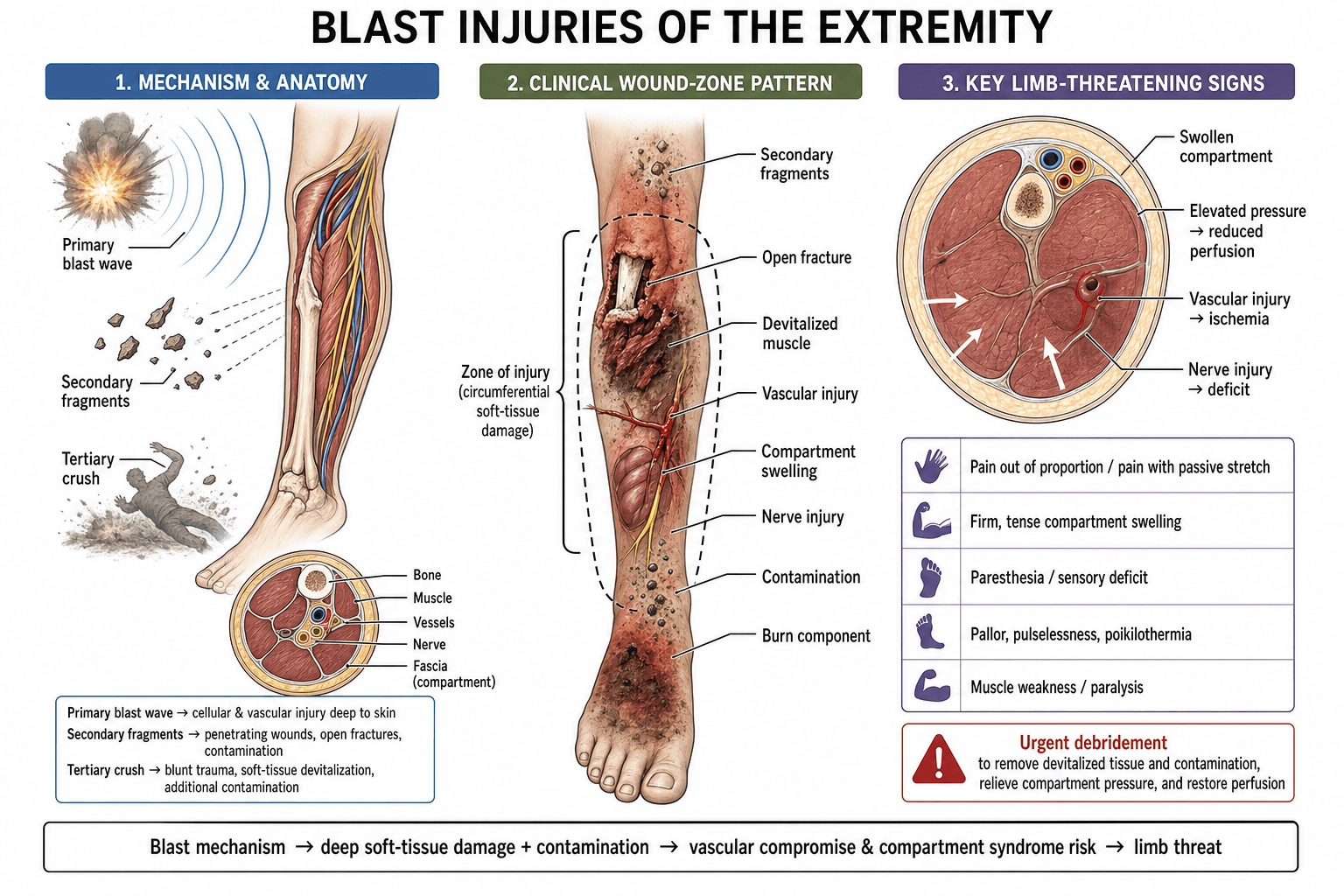
Four mechanisms, arriving together. An explosion generates a supersonic overpressure wave (primary blast) followed by a blast wind. The overpressure wave causes barotrauma at air-tissue interfaces — lung, bowel, tympanic membrane — so in the extremity it is secondary blast, fragment penetration, that dominates, and multiple wounds are expected. In a real blast event several mechanisms operate simultaneously; assume a mixed pattern.
How a fragment destroys tissue. Fragments are accelerated to high velocity by the blast wind and damage tissue in three ways: direct laceration along the projectile path, temporary cavitation as kinetic energy transfers into the surrounding tissue, and microscopic vascular injury at the cellular level that declares itself over 24-72 hours. The third is invisible at the index operation.
- Physics
- Spalling, implosion, inertia differential at gas-tissue interfaces
- Extremity Manifestation
- Limb compartment syndrome from blast wave, vacuum phenomenon; rare isolated extremity primary blast
- Contamination
- Low (no external wound)
- Priority and Key Management Difference
- Assess lungs and GI first — life-threatening; decompress compartments, monitor for pulmonary blast lung
- Physics
- Projectiles (metal, glass, bone, debris) accelerated by blast wind
- Extremity Manifestation
- Multiple small penetrating wounds, often without fracture
- Contamination
- High (environmental debris embedded)
- Priority and Key Management Difference
- Explore tract, serial debridement, foreign body retrieval
- Physics
- Projectiles (metal, glass, bone, debris) accelerated by blast wind
- Extremity Manifestation
- Devastating soft tissue destruction, comminuted fractures, vascular and nerve injury
- Contamination
- Very high (deep contamination)
- Priority and Key Management Difference
- Damage control, external fixation, vascular shunt or repair
- Physics
- Whole-body acceleration and deceleration, structural collapse
- Extremity Manifestation
- Blunt and open fractures, crush injury, traumatic amputation, degloving
- Contamination
- Moderate to high
- Priority and Key Management Difference
- High-energy blunt trauma — ATLS resuscitation, mangled extremity assessment
- Physics
- Burns, toxic inhalation, crush syndrome, radiation
- Extremity Manifestation
- Burns overlying fractures, rhabdomyolysis, compartment syndrome from crush
- Contamination
- Variable
- Priority and Key Management Difference
- Multidisciplinary: burn excision, fasciotomy, renal protection for crush syndrome
The zone of injury (Fackler). Three concentric zones surround every fragment wound.
- Zone A, the permanent cavity. Tissue directly crushed and destroyed by the passage of the projectile, irreversibly necrotic.
- Zone B, temporary cavitation. Tissue stretched by radial energy transfer, which then recoils; the muscle appears viable but is devascularised, and declares over 24-72 hours.
- Zone C, the molecular wound. Cells at the periphery appear viable on initial inspection but undergo apoptosis and necrosis from microvascular thrombosis and cellular membrane disruption.
Why it matters. What looks viable at the first debridement may not be viable at 48-72 hours.
Progressive necrosis is the reason no blast wound is closed primarily and serial debridement every 48-72 hours is mandatory until all zones have declared themselves.
Classification and Types
Classification by Wound Severity (Military-Relevant)
Grading guides the tempo of surgery and sets realistic expectations, but it must be reassessed at each debridement rather than fixed at the first.
- Description
- Small fragment wounds, no fracture, intact neurovascular status
- Typical Management
- Wound irrigation, outpatient or short-stay observation
- Description
- Larger wound, possible fracture, soft tissue loss manageable
- Typical Management
- Debridement, external fixation, delayed wound closure
- Description
- Major soft tissue loss, comminuted fracture, vascular injury possible
- Typical Management
- Serial debridement, vascular repair, external fixation, flap coverage
- Description
- Traumatic amputation or mangled extremity with devascularisation
- Typical Management
- Stump revision or formal amputation vs complex salvage attempt
Clinical Assessment
The primary survey, read for blast. Run the ATLS sequence, with the blast-specific question asked at each step.
- Airway with C-spine — airway burns and foreign body aspiration
- Breathing — primary blast lung: haemoptysis, hypoxia, bilateral infiltrates
- Circulation — haemorrhage control: tourniquet if there is active extremity bleeding, then direct pressure and tranexamic acid
- Disability — head injury and spinal clearance; tertiary blast causes traumatic brain injury
- Exposure — full exposure for all wounds, because blast produces multiple entry and exit sites
The limb. Record the findings that change management, and record them before anyone operates.
- Vascular — are pulses palpable distal to the injury? Doppler if they are not; an ABI less than 0.9 suggests vascular injury
- Neurological — motor and sensory function of every major nerve, documented individually, because a deficit changes management
- Compartment — a tense compartment, pain out of proportion, pain on passive stretch; measure compartment pressures
- Wound — location, size, depth, contamination, and visible bone, tendon or nerve. Do not explore it in the emergency department
- Fracture — splint or temporary external fixation, with the Gustilo-Anderson type documented
Investigations
The investigation that matters most is the serial examination. Do not delay operative management for imaging in a patient with hard signs of vascular injury or haemodynamic instability; plain radiographs taken in the emergency department are enough to plan damage control surgery, and CT angiography is for the haemodynamically stable patient with soft signs. Reassess the limb every 2-4 hours for vascular status, compartment tightness and neurological change.
Imaging and Investigation Protocol
AP and lateral of the injured extremity, including the joint above and the joint below.
Look for the fracture pattern (comminution suggests high energy), radiopaque foreign bodies, soft tissue gas (which raises the concern of gas gangrene), a vascular gas pattern and bone loss.
Any fracture in the setting of a blast wound is considered open until proven otherwise, and the radiograph underestimates the severity of the soft tissue injury.
Indicated for a blast wound in proximity to major vessels, absent or diminished distal pulses, or an ABI less than 0.9. It shows pseudoaneurysm, intimal flap, complete occlusion and active extravasation.
Hard signs of vascular injury — pulsatile bleeding, expanding haematoma, absent pulse, distal ischaemia — go straight to operative exploration without CTA. Soft signs get the CTA, to localise the injury.
FBC, coagulation profile, group and save with cross-match of a minimum of 4 units.
Urea, creatinine, electrolytes and lactate, where a lactate greater than 4 mmol/L suggests under-resuscitation. A rising serum CK, dark urine and myoglobinuria point to rhabdomyolysis; a CK greater than 5000 U/L suggests it is significant, with a high risk of acute kidney injury.
An ABG for acidosis (blast lung), carbon monoxide poisoning (inhalation) and the base deficit.
Stryker needle or slit catheter, measuring the delta pressure: diastolic blood pressure minus compartment pressure.
A delta pressure less than 30 mmHg is compartment syndrome and an emergency fasciotomy.
The clinical triggers are a tense compartment, pain out of proportion and pain on passive stretch. In blast injury a high index of suspicion is warranted.
Management Algorithm
Damage Control Orthopaedics (DCO)
The aim. Control haemorrhage, stabilise the fractures temporarily, control the source of infection, and get the patient to intensive care alive. Definitive management is deferred until physiological stability is achieved.
Damage Control Sequence
ATLS protocol: airway, breathing, circulation.
Haemorrhage control with a tourniquet to the wound, tranexamic acid within 3 hours of injury, and blood products by massive transfusion protocol.
Antibiotics start immediately rather than on arrival in theatre: a first-generation cephalosporin, or clindamycin if the patient is penicillin-allergic, with an aminoglycoside added for gross contamination. Tetanus prophylaxis as per guidelines.
Excise Zone A and clearly necrotic Zone B tissue, irrigate copiously with a minimum of 6-9 litres of pulsed lavage, and remove all accessible foreign material.
Stabilise the fracture with an external fixator spanning the zone of injury. Internal fixation through a blast wound at the index operation carries an unacceptable infection risk.
Restore perfusion to an ischaemic limb with a vascular injury using a temporary intravascular shunt; definitive repair belongs to a later stage once the patient is stable.
Perform a prophylactic four-compartment fasciotomy for any high-energy blast wound of the leg, and do not close it primarily.
Correct the lethal triad of coagulopathy, acidosis and hypothermia.
Monitor lactate clearance, urine output, and compartment pressures if fasciotomy has not been performed.
Plan the return to theatre at 48-72 hours for the second-look debridement.
Reassess all tissue viability: Zone C has now declared and more necrosis may be evident.
Repeat the debridement until the wound is clean and granulating, sending tissue for microbiology each time.
Once the wound is clean, plan definitive skeletal fixation and soft tissue coverage.
Early total care is definitive internal fixation within 24 hours, and it suits an isolated fracture in a stable patient. Damage control orthopaedics is external fixation now and conversion to definitive fixation later, and it is required for polytrauma, blast injury, or any patient with physiological derangement — ISS greater than 15, lactate greater than 2.5, coagulopathy.
The reason is the second hit: major surgery on an inflamed patient triggers a systemic inflammatory cascade that worsens outcomes, and early intramedullary nailing in polytrauma risks fat embolism, ARDS and multi-organ failure. Conversion waits until the inflammatory response settles, typically 5-14 days.
- Diagnosis
- Secondary blast injury, assess each wound for depth and neurovascular status
- Treatment
- Serial debridement, external fixation of fractures, delayed closure
- Key Pearl
- Zone of injury extends well beyond visible wound
- Diagnosis
- Tertiary blast + crush, assess MESS score and physiological reserve
- Treatment
- Damage control: ex-fix, haemorrhage control, ICU resuscitation
- Key Pearl
- Limb vs life — never sacrifice the patient for the limb
- Diagnosis
- High-energy blast amputation with extensive zone of injury
- Treatment
- Serial debridement of stump, revise amputation at definitive stage
- Key Pearl
- Preserve length and viable soft tissue whenever possible
Complications
- Incidence
- 20-40 percent in severe blast wounds
- Risk Factors
- Contamination burden, delay to debridement, open fractures, foreign bodies
- Management
- Serial debridement, targeted IV antibiotics, antibiotic beads, NPWT
- Incidence
- Rare but life-threatening when it occurs
- Risk Factors
- Devitalised muscle left in wound, delay to debridement, soil contamination
- Management
- Emergent radical debridement or amputation, IV penicillin + clindamycin, hyperbaric oxygen (adjunct)
- Incidence
- Up to 20 percent in high-energy blast limb injuries
- Risk Factors
- Crush component, reperfusion after vascular repair, tight dressings
- Management
- Emergency fasciotomy — prophylactic in high-energy injuries
- Incidence
- 10-30 percent in blast-related open fractures
- Risk Factors
- Gustilo IIIB/C fractures, infection, segmental bone loss, poor soft tissue envelope
- Management
- Bone grafting, Masquelet technique, Ilizarov bone transport
- Incidence
- Up to 60 percent in blast-related amputations (military data)
- Risk Factors
- High-energy injury, amputation through zone of injury, brain injury
- Management
- Prophylaxis with NSAIDs or radiation; excision if functional impairment
- Incidence
- Common after tertiary blast with prolonged entrapment
- Risk Factors
- Crush duration, muscle mass involved, delay to extrication
- Management
- Aggressive IV fluids (target urine output greater than 200 mL/hour), mannitol, bicarbonate, monitor CK and renal function
Clostridial myonecrosis is the most feared complication of blast wound contamination. It declares with rapidly progressive severe pain out of proportion, bronze or grey discolouration of the skin, crepitus, foul-smelling serosanguinous discharge, and systemic toxicity — tachycardia, fever, altered mental status.
Treatment is emergent radical surgical debridement or amputation, and it does not wait for cultures. Intravenous penicillin G and clindamycin are first-line; hyperbaric oxygen is an adjunct, not a substitute for surgery. Mortality approaches 100 percent without urgent surgical intervention.
This devastating, blast-specific entity is a major cause of late amputation and death after high-energy soil-contaminated blast wounds, and it deserves to be recognised in its own right.
Who and what. Classically the soil-contaminated dismounted (on-foot) blast injury, infected by Mucorales (Rhizopus, Mucor, Lichtheimia) and also by Aspergillus and Fusarium. The Mucorales are angioinvasive, thrombosing vessels and producing rapidly spreading necrosis.
The cardinal clue. The wound shows recurrent, progressive tissue necrosis at the margins that keeps advancing despite adequate serial debridement and broad-spectrum antibiotics. A wound that will not turn the corner is an invasive fungal infection until proven otherwise.
Confirming it. Frozen-section histology and fungal culture of debrided tissue; broad, ribbon-like, non-septate hyphae indicate Mucorales.
Management is dual. Aggressive, frequent (often daily) wide surgical debridement back to bleeding tissue, which frequently forces a more proximal amputation or stump revision, plus systemic antifungals — typically liposomal amphotericin B for Mucorales combined with a broad-spectrum azole (voriconazole or posaconazole) to cover Aspergillus and Fusarium. Morbidity and mortality are high, and this is a major driver of higher final amputation levels.
Outcomes and Prognosis
- Expected Outcome
- Near 100 percent recovery of limb function
- Return to Function
- Days to weeks
- Expected Outcome
- 80-90 percent limb salvage, functional outcome variable
- Return to Function
- Months — depends on fracture healing and soft tissue recovery
- Expected Outcome
- 50-70 percent achieve functional limb salvage; 30-50 percent eventual amputation
- Return to Function
- 12-24 months of reconstructive surgery and rehabilitation
- Expected Outcome
- Good function with modern prosthesis; phantom limb pain common
- Return to Function
- 6-12 months to independent mobility with prosthesis
What separates the good outcome from the bad. The best results follow low-energy fragments without fracture or vascular injury, early debridement, an adequate soft tissue envelope and a young fit patient. The worst follow a high-energy blast with massive soft tissue loss, vascular injury with prolonged warm ischaemia, polytrauma with a high ISS, delayed presentation, and infection requiring multiple debridements.
The LEAP study (Lower Extremity Assessment Project) showed that at 2 and 7 years, outcomes after limb salvage and amputation were broadly similar for quality of life — the critical message being that a good amputation may be preferable to a poor salvage.
Guidelines, Registries & Global Practice
- Military: Blast injury is the dominant mechanism in modern asymmetric warfare (IEDs account for the majority of casualties in Iraq and Afghanistan conflicts)
- Civilian: Industrial explosions, terrorist attacks, and mining disasters produce similar injury patterns
- Extremity dominance: 70-80 percent of surviving blast casualties have extremity wounds
- Resource disparity: Military medical systems in developed nations have advanced trauma chains; civilian blast management varies enormously by region
- High-resource: CT angiography, NPWT, free flap reconstruction, modular prostheses, multidisciplinary rehabilitation teams
- Limited-resource: Plain radiographs, saline dressings, skin grafting, basic external fixation, locally fabricated prostheses
- Universal principle: Serial debridement and delayed closure require no advanced technology — they are the standard everywhere
- Tourniquet use: Now universally accepted as first-line haemorrhage control in blast injury, regardless of resource setting
- Wound Management
- Irrigation and debridement, never close primarily, serial debridement every 48-72 hours
- Fracture Strategy
- Damage control: external fixation first; convert to definitive fixation at 5-14 days when physiologically stable
- Amputation Guidance
- No absolute indication — use MESS as adjunct, clinical judgement is paramount
- Wound Management
- Open fractures: antibiotics within 1 hour; debridement urgently but on a planned list - the six-hour rule is not evidence-based (PMID 34058873). Blast wounds are the exception where immediate, repeated debridement IS required, because contamination is deep and progressive
- Fracture Strategy
- DCO for polytrauma; ETC acceptable for isolated open fractures in stable patients
- Amputation Guidance
- Discuss at MDT before primary amputation; document decision-making clearly
- Wound Management
- Combat wound management principles: serial debridement, NPWT, delayed primary closure
- Fracture Strategy
- External fixation at forward surgical teams; convert at Role 3/4 facility
- Amputation Guidance
- MESS greater than 7 guides discussion; LEAP data supports functional equivalence of salvage and amputation
- Wound Management
- Minimum standard: wound excision, irrigation, delayed closure, no internal fixation through contaminated wounds
- Fracture Strategy
- External fixation or non-operative if no surgical capability; plaster and traction acceptable
- Amputation Guidance
- Functional amputation well performed is preferable to failed salvage with limited resources
Joint replacement registries (NJR, AJRR, AOANJRR) do not directly track blast outcomes. The primary evidence base comes from the Joint Theatre Trauma Registry (JTTR) for military data, the LEAP study for civilian severe limb trauma, and individual institutional series. The absence of a dedicated blast extremity registry means that most recommendations are Level 3-4 evidence, derived from expert consensus and observational data.
Record in every blast extremity injury:
- Mechanism classification (primary / secondary / tertiary / quaternary)
- Vascular status before and after intervention, with times (tourniquet time, ischaemia time)
- Neurological status of all major nerves documented before any surgical intervention
- MESS score with individual component scores
- Number and timing of each debridement
- Tissue viability findings at each debridement
- Decision-making for limb salvage versus amputation — including MDT discussion when possible
Missed or poorly documented blast wound assessment is a significant medico-legal risk worldwide. The key is serial assessment and clear documentation of evolving findings.
Controversies & Areas of Uncertainty
The optimal window for converting external fixation to definitive intramedullary nailing or plating is debated. Early conversion (5-7 days) risks operating in an inflamed wound bed; delayed conversion (greater than 14 days) increases pin-site infection and colonisation risk. Most guidance favours 7-14 days when inflammatory markers are settling, but there is no RCT-defined optimal timing.
Negative pressure wound therapy is now standard in high-resource settings for blast wounds between debridements, but robust RCT evidence demonstrating superiority over regular saline dressings in blast-specific injuries is limited. NPWT appears to reduce debridement frequency and promote granulation, but the absolute benefit remains uncertain.
Some military protocols recommend prophylactic four-compartment fasciotomy for all high-energy blast injuries of the leg, regardless of compartment pressure. Others advocate selective fasciotomy based on clinical assessment and pressure measurement. No RCT exists; practice is centre-dependent.
Through-knee amputation preserves superior gait biomechanics and energy efficiency compared to trans-femoral, but carries higher wound complication rates. In blast injuries where the zone of injury often extends proximal to the knee, the decision between through-knee revision and trans-femoral amputation must balance functional outcome against wound healing risk.
MCQ Practice Points
Q: Which blast injury mechanism is the most common cause of extremity trauma? A: Secondary blast injury (fragment penetration). Fragments (metal, glass, debris) accelerated by the blast wind are the dominant mechanism for extremity wounds. Primary blast (overpressure) primarily affects gas-containing organs (lungs, bowel, middle ear). Tertiary blast (body displacement) causes blunt injuries. Understanding the mechanism hierarchy is essential for anticipating associated injuries.
Q: What are the three zones of injury in a blast wound, and why does Zone C mandate serial debridement? A: Zone A = permanent cavity (tissue directly destroyed). Zone B = temporary cavitation (tissue crushed and devascularised but may appear viable initially). Zone C = molecular wound (cells appear viable but undergo necrosis over 24-72 hours due to microvascular thrombosis). Zone C mandates serial debridement because tissue that looks viable at the first operation may be necrotic by 48-72 hours. A single debridement misses this evolving necrosis, leading to infection and gas gangrene.
Q: What are the 4 Cs of muscle viability assessment during debridement? A: Colour (red and healthy, not pale or brown-grey), Consistency (firm, not mushy), Capacity to bleed (bright red bleeding when cut, not dark ooze), Contractility (contracts when pinched or stimulated with diathermy). Any muscle failing these criteria must be excised. Leaving devascularised muscle is the primary driver of gas gangrene and invasive fungal infection in blast wounds.
Q: What is the "second hit" theory, and how does it influence fracture management in blast polytrauma? A: The second hit theory proposes that major surgical intervention (such as intramedullary nailing) during the peak systemic inflammatory response to trauma worsens outcomes by triggering a secondary inflammatory cascade, increasing the risk of ARDS and multi-organ failure. This is the rationale for damage control orthopaedics (DCO): use external fixation for immediate skeletal stabilisation, and defer definitive internal fixation until the inflammatory response has settled (typically 5-14 days), as guided by lactate, CRP, and clinical parameters.
Q: A patient has a Gustilo IIIC open tibial fracture with absent pulses, sustained hypotension, and a high-energy blast mechanism. What is the approximate MESS score, and what does it imply? A: MESS approximately 11-12 (mechanism: high-energy = 3; ischaemia: absent pulses = 3; shock: sustained hypotension = 3; skeletal/soft tissue: Gustilo IIIC = 4). A MESS greater than 7 strongly predicts that limb salvage will have a poor outcome, but it does not mandate amputation — clinical judgement, patient factors, and resource setting all contribute to the final decision. No scoring system has sufficient sensitivity to be used in isolation.
Exam Viva Scenarios
Practise clinical reasoning and management decisions out loud
“A 28-year-old soldier sustains an IED blast injury to the right lower leg. He has multiple fragment wounds, a Gustilo IIIB open tibial fracture, absent dorsalis pedis pulse, and a tourniquet in situ applied 90 minutes ago in the field. He is haemodynamically stable after initial resuscitation. Discuss your management.”
“A 32-year-old civilian presents after an industrial boiler explosion. She has a mangled right lower extremity with a Gustilo IIIC open tibial fracture, complete tibial nerve disruption, 10 cm of segmental bone loss, and a warm ischaemia time of 7 hours. She is haemodynamically stable after resuscitation. Her MESS score is 9. How do you decide between limb salvage and amputation?”
Mechanisms
- Primary = overpressure barotrauma (lungs, bowel, tympanic membrane — not primarily extremity)
- Secondary = fragment penetration — dominant mechanism for extremity wounds
- Tertiary = victim thrown by blast wind — blunt fractures, crush, traumatic amputation
- Quaternary = burns, crush syndrome, inhalation, psychological trauma
Zone of Injury
- Zone A = permanent cavity — tissue directly destroyed, irreversibly necrotic
- Zone B = temporary cavitation — devascularised muscle, may appear viable
- Zone C = molecular wound — cells necrose over 24-72 hours despite appearing viable
- Clinical implication: serial debridement every 48-72 hours is mandatory
Damage Control Orthopaedics
- External fixation at index operation — never internal fixation through a blast wound
- Temporary vascular shunt for ischaemic limbs — definitive repair when wound clean
- Prophylactic fasciotomy for high-energy leg blast injuries
- Convert to definitive fixation at 5-14 days when physiologically stable and wound clean
Wound Management Rules
- Never close a blast wound primarily — delayed primary closure at 3-5 days minimum
- Serial debridement every 48-72 hours using the 4 Cs of muscle viability
- NPWT between debridements to reduce oedema and promote granulation
- Soft tissue coverage (flap or graft) once wound definitively clean
Amputation Decision
- MESS greater than 7 suggests amputation but does not mandate it
- Warm ischaemia greater than 6 hours is the most important single poor prognostic factor
- Complete tibial nerve injury = insensate foot = poor functional outcome regardless of salvage
- LEAP study: quality of life at 2 years is similar for amputation versus limb salvage
- Preserve maximum stump length — through-knee is preferable to trans-femoral when feasible
Complications to Anticipate
- Infection: 20-40 percent deep infection in severe blast wounds — serial debridement prevents
- Gas gangrene: emergent radical debridement/amputation + IV penicillin and clindamycin
- Heterotopic ossification: up to 60 percent after blast amputation — consider NSAID prophylaxis
- Crush syndrome: aggressive IV fluids, monitor CK, target urine output greater than 200 mL/hour
Evidence Base and Key Trials
Factors influencing the decision to amputate or reconstruct after high-energy lower extremity trauma (LEAP Study)
- Prospective multicentre cohort of 527 patients with severe lower extremity trauma (Gustilo IIIB/IIIC tibial, dysvascular limbs, severe ankle/hindfoot injuries)
- 408 left hospital with a salvaged limb; 119 amputated - 55 immediate, 64 delayed
- On multivariate analysis, ALL injury characteristics predicted limb status EXCEPT bone loss - soft-tissue injury severity and absent plantar sensation were the strongest
- Soft-tissue injury severity had the greatest impact on the salvage-versus-amputation decision
The timing of fracture treatment in polytrauma patients: relevance of damage control orthopedic surgery
- Review of damage control orthopaedics (DCO) versus early total care (ETC) in polytrauma
- Patients with ISS greater than 15 and elevated inflammatory markers had worse outcomes with early intramedullary nailing (second hit phenomenon)
- DCO with external fixation followed by conversion to definitive fixation at 5-14 days reduced ARDS incidence
- Lactate and IL-6 levels can guide timing of conversion to definitive fixation