Hydroxyapatite and Osteoconduction
- Synthetic bone void fillers that mimic the mineral phase of bone (hydroxyapatite)
- Osteoconductive (scaffold) but not osteoinductive (no growth factors)
- Sets by an isothermic (non-exothermic) reaction
- Must usually be protected with hardware (plate), as its shear and tensile strength is very low
- “High compressive strength (20-50 MPa, greater than cancellous bone)
- “Low tensile strength (brittle)
- “Excellent biocompatibility
- “Replaced by bone over months (brushite) to years (apatite)
Calcium Phosphate Cements
Overview
Calcium phosphate cements (CPCs) are synthetic, injectable bone-void fillers whose set product is the same mineral phase as bone, carbonated apatite or brushite. Brown and Chow first described them in 1983, and they reached clinical use in the 1990s as the Skeletal Repair System (Norian SRS). They fill the gap between inert acrylic cement (PMMA) and biological graft.
What they do. A CPC sets at body temperature by a dissolution-precipitation reaction that is isothermic and releases no toxic monomer. The set cement has high compressive but very low tensile and shear strength, and it is gradually resorbed and replaced by host bone, a process called osteotransduction.
Where they belong. The niche is the contained metaphyseal void: the cement buttresses an elevated articular fragment against subsidence while internal fixation neutralises bending and shear. Primary applications include metaphyseal void filling in tibial plateau and distal radius fractures.
What a Graft Substitute Must Provide
Any bone-graft substitute is judged on four properties, and a CPC has only two of them:
- Osteoconduction - a passive scaffold for ingrowth. CPC has it, as do allograft and autograft
- Osteoinduction - signalling (BMPs) that recruits and differentiates osteoprogenitors. CPC lacks it; BMP-2, autograft and DBM provide it
- Osteogenesis - living transplanted cells. CPC lacks it; autograft and RIA provide it
- Structural support - immediate mechanical load-sharing. CPC provides it in compression only
Material Science
Composition. The cement is mixed from a powder and a liquid phase.
- Powder - tetracalcium phosphate (TTCP, Ca₄(PO₄)₂O), dicalcium phosphate anhydrous (DCPA, CaHPO₄) and α-tricalcium phosphate (α-TCP, α-Ca₃(PO₄)₂), with calcium carbonate and calcium oxide as modifiers
- Liquid - water or sodium phosphate solution, with pH modifiers and accelerators such as citric acid
The setting reaction. Mixing starts a dissolution-precipitation sequence:
- The powder dissolves in the liquid, in an acidic microenvironment
- Calcium and phosphate ions reach supersaturation
- A new crystalline phase precipitates
- The interlocking crystal network provides the mechanical strength
The reaction generates no heat, unlike PMMA, and it sets in an aqueous (wet) environment. The cement sets over 10-30 minutes and reaches full strength at 24 hours.
Microstructure. Micropores of 1-10 μm are inherent to the setting reaction; macropores of 100-500 μm are created by incorporation techniques. The high surface area enhances osteoconduction. Hydroxyapatite forms hexagonal crystals and brushite monoclinic ones, and both are similar to biological bone mineral.
Clinical Indications
Metaphyseal fractures. The cement fills or supports the metaphyseal void at four sites:
- Tibial plateau - Schatzker II, III and VI with articular depression
- Distal radius - metaphyseal void after reduction in elderly osteoporotic bone
- Calcaneus - structural support of the posterior facet
- Proximal humerus - metaphyseal void filling
The tibial plateau. Once the depressed articular surface is elevated, the cement fills the metaphyseal void beneath it. Unlike cancellous chips, it gives immediate structural support against re-collapse and subsidence before the plate takes full load.
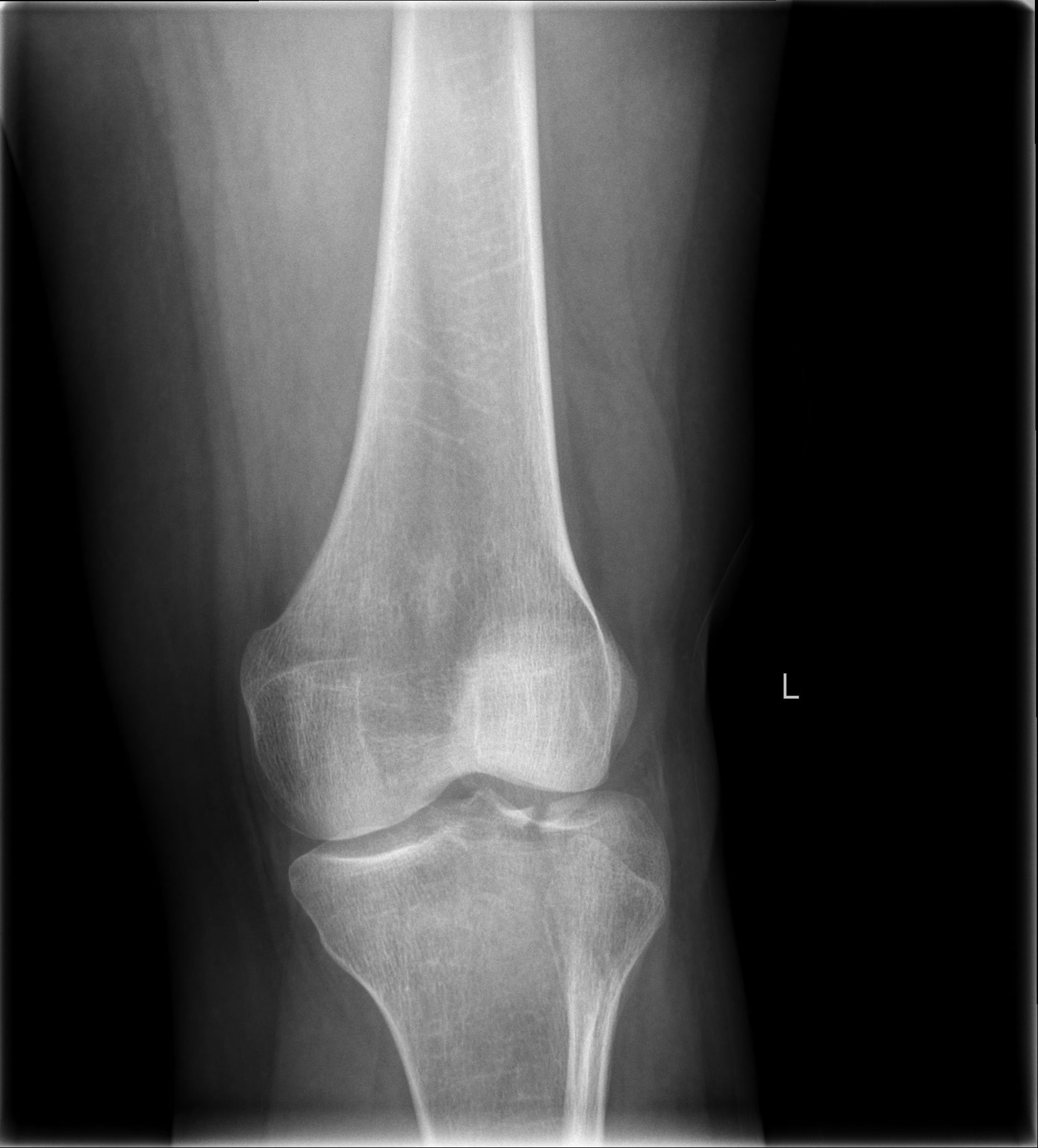
Tumour surgery. After curettage of a benign bone tumour (GCT, ABC, unicameral bone cyst) the cement fills the defect, and it may be combined with autograft or allograft.
Vertebral augmentation. CaP cement is an alternative to PMMA for kyphoplasty and vertebroplasty, with lower exothermic risk but higher cost.
Contraindications. They are graded as absolute or relative:
- Absolute - active infection; an uncontained defect, from which the cement will leak; a load-bearing diaphyseal site
- Relative - a large defect requiring structural support; poor soft-tissue coverage; an immunocompromised patient
Cement Augmentation of Screw and Implant Fixation
Augmenting metalwork is the second major use of CaP cement beyond void filling, and a recurring exam question in osteoporotic fixation.
The problem. In osteoporotic bone the trabeculae are sparse, so a screw thread engages little bone. Pull-out and cut-out are the dominant failure modes: the metalwork is fine, the bone holds it poorly.
How augmentation works. A small volume of cement is injected around the screw tip, often through a cannulated or fenestrated screw, before final tightening. The cured cement interdigitates with the surrounding trabeculae and converts a few thread-bone contacts into a large, load-distributing cement-bone block. Spreading the load over a wider volume lowers the peak stress at any single trabecula and resists the toggling that causes cut-out.
What it buys. Pull-out force, stiffness and fatigue life of the construct all rise. Cadaveric work (Larsson and Bauer) consistently shows cement-augmented metal fixation is stiffer and stronger than metal alone in the distal radius, tibial plateau, proximal femur and calcaneus.
CaP or PMMA. Both are used, and the trade-off mirrors the void-filling story. Prefer CaP when later remodelling and easier revision are wanted; PMMA is tougher, but a permanent PMMA mass can complicate any future revision.
- CaP cement augmentation
- Isothermic, no monomer
- PMMA augmentation
- Exothermic; monomer; small embolic/BCIS risk
- CaP cement augmentation
- Osteoconductive, remodels
- PMMA augmentation
- Inert, permanent
- CaP cement augmentation
- Resorbs/incorporates - easier later revision
- PMMA augmentation
- Permanent block - complicates revision/removal
- CaP cement augmentation
- Good in compression, brittle
- PMMA augmentation
- Tougher
The caveats. Augmentation is an adjunct that buys early fixation in poor bone; it does not correct malreduction. The evidence is largely biomechanical (cadaveric) rather than high-level clinical, and leakage into a joint or fracture gap must be avoided.
Technique
Planning. Assess the defect's size and containment, the load it must bear, and whether it needs structural support or simply a void filled.
Preparation. Read the manufacturer's instructions carefully, get the powder-to-liquid ratio right and prepare the cement before it is needed. Working time is typically 10-15 minutes, setting is faster if warm, and the cement must be injected before setting begins.
The tibial plateau, step by step.
- Reduce - elevate the depressed articular segment with a bone tamp or elevator through a cortical window, and confirm the reduction under fluoroscopy
- Prepare - mix powder and liquid per the manufacturer to a paste consistency, working within the time window
- Inject - through the cortical window or a cannula, filling the void completely with no air pockets, and overfill slightly because it will compress
- Fix - apply the buttress plate before the cement sets, with screws through or around the cement, to protect against shear forces
- Confirm - check fill, reduction, cement containment and hardware position under fluoroscopy
Containment. Create a cortical window if needed and block significant egress points; a small bone graft may be used to contain the cement.
Bleeding. Blood dilutes the cement and weakens its setting, so lavage the defect before injection. A tourniquet is useful where applicable.
Setting. Wait for the initial set before wound closure, typically 15-30 minutes, and test it with a probe.
Adjuncts. Buttress plating of metaphyseal fractures prevents shear and tensile failure and is essential in weight-bearing bones. Autograft may be added for osteoinduction; platelet-rich plasma has a theoretical benefit, and BMP addition is at the research stage.
Classification
By end product. The two end products differ in stoichiometry, in how fast they are resorbed and in strength (the figures are under Mechanical Properties).
- End Product
- Hydroxyapatite (HA)
- Ca/P Ratio
- 1.67
- Resorption
- Slow (years to decades)
- Strength
- Higher
- End Product
- Dicalcium phosphate dihydrate
- Ca/P Ratio
- 1.0
- Resorption
- Fast (6-12 months)
- Strength
- Lower
By form. Injectable cements are pastes delivered by syringe that set in situ after injection, which suits minimally invasive application; Norian SRS and HydroSet are examples. Pre-formed cements come as blocks, granules or putty, are shaped before or during surgery, and have higher initial strength.
By application. The product is chosen for the property the site needs:
- Product Type
- Injectable HA
- Key Property
- Structural support
- Product Type
- Low viscosity paste
- Key Property
- Injectability
- Product Type
- Granules/blocks
- Key Property
- Volume filling
- Product Type
- Fast-setting brushite
- Key Property
- Rapid integration
Commercial products. Each name maps to a phase or a handling property:
- Norian SRS/CRS - apatite cement, high strength
- ChronOS - β-TCP based, resorbable
- α-BSM - injectable, fast-setting
- HydroSet - brushite based, faster resorption
Mechanical Properties
A strut, not a plate. CPC behaves like a ceramic: strong when squeezed, brittle and weak in tension and shear. It supports a subarticular fragment against axial collapse but will fracture under bending, so it is always combined with neutralising or buttress hardware and never used alone in a load-bearing site.
Compression. In compression the cement is stronger than cancellous bone, which is what lets it prevent subsidence.
- Compressive Strength (MPa)
- 30-50
- Compressive Strength (MPa)
- 15-25
- Compressive Strength (MPa)
- 2-12
- Compressive Strength (MPa)
- 100-200
- Compressive Strength (MPa)
- 70-100
Tension and shear. Here the cement is very weak, 2-5 MPa, against 25-40 MPa for PMMA and 50-150 MPa for cortical bone.
Stiffness. The modulus of elasticity of CaP cement is 5-15 GPa, against 0.1-1 GPa for cancellous bone and 15-20 GPa for cortical bone.
Fatigue. Fatigue resistance is limited and failure under cyclic loading is catastrophic, so the cement is not suitable for high-stress cyclical loading.
Osteotransduction and the Resorption-Formation Balance
Creeping substitution. PMMA is simply encapsulated and stays forever; a CaP cement is biologically turned over and replaced by host bone. Two activities are coupled at the cement surface:
- Cell-mediated resorption - osteoclasts (and giant cells) resorb the cement much as they resorb bone, supplemented by simple chemical dissolution
- Appositional bone formation - osteoblasts lay down new bone onto the osteoconductive cement surface as it is resorbed
The result is gradual, front-by-front replacement of cement by living bone, the same creeping substitution seen with structural allograft.
The rates must match. How a cement performs clinically depends on whether resorption and bone formation stay in step. That balance, not raw strength, is what makes a good cement.
- Cement type
- Ideal (rarely achieved)
- Consequence
- Smooth hand-off of load from cement to new bone
- Cement type
- Apatite (HA)
- Consequence
- Cement persists for years/decades; mostly asymptomatic but can block remodelling and obstruct future drilling/revision
- Cement type
- Brushite
- Consequence
- Cement may disappear before bone replaces it, leaving a transient void and risking loss of support
Tuning the rate. Resorption is tunable through chemistry and structure: higher porosity and surface area, smaller crystals and the brushite phase all resorb faster. Brushite is designed for speed but can paradoxically convert to poorly resorbing apatite in vivo, which is why the ideal match remains unsolved.
Choosing a Void Filler
When a metaphyseal or cavitary defect must be filled, the answer the examiner wants is the right filler for the defect: its containment, the load it must carry and the biology it needs.
- Biology
- Conductive only
- Immediate structure
- High (compression)
- Best for
- Contained subarticular void needing anti-subsidence support
- Main limit
- Brittle; leaks if uncontained
- Biology
- Conductive + inductive + osteogenic
- Immediate structure
- Low (cancellous chips)
- Best for
- Biology-poor host, non-/delayed union
- Main limit
- Donor-site pain; finite volume
- Biology
- Conductive (± weak induction)
- Immediate structure
- Low-moderate
- Best for
- Large-volume fill, no harvest morbidity
- Main limit
- Slow incorporation; small disease-transmission risk
- Biology
- Inert (no remodelling)
- Immediate structure
- High (tougher than CaP)
- Best for
- Pathological/tumour defects, permanent fill
- Main limit
- Exothermic; never remodels; not for fresh fractures
Against PMMA and calcium sulfate. Calcium sulfate belongs in the comparison because it is the material calcium phosphate is most often confused with.
- Strength
- High Compression, Brittle
- Setting
- Cool (Isothermic)
- Fate
- Resorbed/Remodelled
- Strength
- High Compression, Tougher
- Setting
- Hot (Exothermic)
- Fate
- Permanent (Encapsulated)
- Strength
- Low Compression, Weakest
- Setting
- Cool (Isothermic)
- Fate
- Dissolves in Weeks
Calcium sulfate is a question of timing. It dissolves chemically over roughly six to twelve weeks, frequently faster than bone can fill the space. It can therefore leave a radiolucent void that is mistaken for infection or non-union, and its dissolution products draw fluid, producing the sterile serous wound drainage that is its characteristic complication.
Apatite is slower than most texts imply. It is removed cell by cell by osteoclasts over years, which is why residual cement on a two-year radiograph is expected rather than a failure.
Match the material to the question. A defect that needs structural support until union takes calcium phosphate. A defect being filled as an antibiotic carrier, or as a simple space-holder in a well-supported location, can take calcium sulfate.
CAPCaP vs PMMA: the C-A-P contrast
Hook:Cool, Absorbed, Plate-dependent — Three discriminators examiners love
Complications
Extravasation. Cement can leak into the soft tissues or joint, more commonly from an uncontained defect. It usually resorbs without issue, unlike PMMA.
Incomplete fill. Air pockets reduce strength and may require reoperation; proper technique prevents them.
Cement fracture. Failure under shear is catastrophic, and more common in brushite cements.
Infection. Infection is not inherent to the material, but biofilm formation is possible, and it requires debridement if it occurs. The infection risk is low with CaP cement, PMMA and autograft alike.
Subsidence. Subsidence can occur despite cement support, usually from poor technique or osteoporosis, and hardware failure is a common cause.
Postoperative Management
Weight-bearing. Protected weight-bearing at first, progressing as the bone heals; the hardware provides protection during healing.
Monitoring. Standard wound care, watching for signs of extravasation. Imaging at 2, 6 and 12 weeks assesses fracture healing and cement integration, with CT if there is concern about resorption.
Rehabilitation. Range of motion as tolerated, strengthening once the fracture is stable, and progression guided by clinical and radiographic healing.
Hardware removal. Not routinely required; consider it once the fracture has healed. The cement is usually incorporated or resorbed.
Outcomes
Tibial plateau. Cement is superior to autograft for structural support: less articular subsidence, 2-3 mm less in tibial plateau studies, maintained articular congruity and no donor-site morbidity. Functional outcomes have been reported as equivalent, but the landmark trial below reported no validated functional or patient-reported outcome; its single significant result is radiographic.
CaP cement vs iliac autograft in tibial plateau fractures (landmark RCT)
- Multicentre, prospective RCT: 120 acute tibial plateau fractures in 119 adults, 12 North American sites, randomised 2:1 to calcium phosphate cement (82) vs autogenous iliac graft (38)
- Significantly higher rate of articular subsidence at 3-12 months in the autograft group (p = 0.009)
- Union rates and time to union were equivalent between groups
- No donor-site morbidity with the synthetic cement
Distal radius. Cement is reported to maintain reduction in osteoporotic bone, with faster return to function and equivalent long-term outcomes. The Cassidy trial in the Evidence Base qualifies the first claim: ulnar variance collapsed more in the cement group, and extraosseous cement carried the highest loss of reduction.
Incorporation. Bone ingrowth is evident at 6-12 months, followed by progressive replacement by host bone; apatite cements may remain visible longer.
Patient-reported outcomes. There is no difference in pain scores and range of motion is equivalent, without the donor-site morbidity of autograft. Return to activity follows similar timeframes to other grafts, hardware removal rates are similar and long-term function is maintained. The one pain benefit in the evidence below, from the Bajammal meta-analysis, is against no graft at all.
Guidelines, Registries & Global Practice
Global Epidemiology & Use
- Bone-graft substitutes are used in a large minority of fracture and reconstructive procedures worldwide; CaP cements are the dominant injectable, resorbable, structural option for contained metaphyseal voids.
- Highest-volume indications globally: tibial plateau, distal radius (osteoporotic), calcaneus and proximal humerus metaphyseal voids, and curettage cavities after benign bone lesions.
- Uptake tracks with availability of fluoroscopy, theatre cost tolerance and surgeon familiarity rather than any single national guideline.
Society Guidance, Side by Side
- Position on CaP cement
- Recognised bone-graft substitute; no procedure-specific mandate — choice individualised to defect containment and load environment
- Position on CaP cement
- Void fillers permitted within fracture-management standards; emphasis on contained defects and adequate skeletal fixation
- Position on CaP cement
- Teaches CaP cement for subarticular metaphyseal void support combined with neutralising/buttress fixation; not for diaphyseal or uncontained defects
- Position on CaP cement
- Apatite vs brushite selection driven by required resorption rate and strength; injectability valued for minimally invasive augmentation
No major society endorses CaP cement as a stand-alone load-bearing construct; all frame it as an adjunct to internal fixation.
Regulatory & Registry Notes
- Regulated as implantable medical devices (e.g. FDA in the US, CE-mark/MDR in Europe). Norian SRS holds long-standing approval for selected distal radius and other metaphyseal fractures.
- There is no dedicated international registry for bone-graft substitutes comparable to arthroplasty registries (NJR, AJRR, AOANJRR); evidence rests on RCTs and meta-analysis (Bajammal 2008; Russell & Leighton 2008; Cassidy 2003) rather than registry survival data.
High- vs Limited-Resource Practice
- Well-resourced settings: ready access to injectable apatite/brushite cements and intra-operative imaging; cement chosen to avoid iliac-crest harvest morbidity.
- Limited-resource settings: autograft (iliac crest, RIA) and allograft remain first-line because synthetic cement cost and supply are limiting; the structural advantage of cement is weighed against expense.
Controversies & Areas of Uncertainty
- Apatite vs brushite resorption. Brushite is designed to resorb faster, but in vivo it can convert to poorly-resorbing apatite, and rapid resorption may outpace bone formation — leaving a transient defect. The "ideal" resorption-to-formation match is not solved.
- Extraosseous extravasation. In the distal radius RCT (Cassidy 2003), cement was extraosseous in 70% of wrists and that subgroup had the highest loss of reduction — the clinical significance of leakage versus a marker of poor containment is debated.
- Does it accelerate union or just resist subsidence? Trials consistently show better maintenance of reduction, but a true acceleration of fracture healing is not established; benefit may be purely mechanical.
- Stand-alone augmentation in osteoporotic fixation. Screw-tip cement augmentation improves pull-out in cadaver studies, but high-quality clinical evidence for routine use (and concern over complicating revision) remains limited.
- Vertebroplasty/kyphoplasty. CaP avoids PMMA's exotherm and monomer but has lower fatigue strength and higher cost; whether it improves outcomes over PMMA in the spine is unresolved.
- Function vs radiographs. Several RCTs show radiographic superiority (less subsidence) without a durable difference in patient-reported function at one year — the patient-relevant value is questioned.
MCQ Practice Points
Q: What are the two main types of calcium phosphate cement and their key differences?
A: (1) Apatite cement (Hydroxyapatite, HA): Sets to crystalline hydroxyapatite Ca₁₀(PO₄)₆(OH)₂, very slow resorption (years), excellent biocompatibility, used for bone void filling. (2) Brushite cement (DCPD): Sets to CaHPO₄·2H₂O, faster resorption (months), lower compressive strength. Both set via dissolution-precipitation reactions at body temperature.
Q: What is the mechanism of setting for calcium phosphate cements?
A: Acid-base or dissolution-precipitation reaction at room/body temperature (no exothermic heat unlike PMMA). Powder phase dissolves, supersaturates, and precipitates as new calcium phosphate crystite. Setting time: 10-30 minutes. No toxic monomer released. Final product resembles bone mineral (hydroxyapatite or brushite phase).
Q: What are the clinical advantages of calcium phosphate cement over PMMA bone cement?
A: (1) Osteoconductive - bone grows directly onto/into it. (2) Bioactive - integrates with host bone. (3) Resorbable (brushite) or slowly remodeled (HA). (4) No exothermic setting - no thermal necrosis. (5) No toxic monomer. Disadvantages: Weak in tension and shear, only suitable for compression loading (metaphyseal fractures), cannot be used for arthroplasty fixation.
Q: What is the compressive strength of calcium phosphate cements and how does this influence clinical applications?
A: Compressive strength: 20-50 MPa (similar to cancellous bone). Tensile/shear strength: Very low (2-5 MPa). Applications: Metaphyseal fractures (tibial plateau, distal radius, vertebral augmentation where compression dominates). Not suitable for: Diaphyseal fractures, arthroplasty fixation, or any load-bearing without metallic supplementation.
Q: How does calcium phosphate cement resorb and remodel?
A: Osteoclasts resorb the cement (cell-mediated resorption) similar to bone remodeling. Brushite cements: 6-12 months, faster resorption, replaced by woven bone. Apatite cements: Years to decades, very slow remodeling. Rate depends on porosity, surface area, and Ca/P ratio. Ideal for augmenting metaphyseal fractures where gradual load transfer to healing bone is desired.
Clinical Decision Scenarios
Practise clinical reasoning and management decisions out loud
Clinical Decision Scenarios
Practise clinical reasoning and management decisions out loud
Clinical Decision Scenarios
Practise clinical reasoning and management decisions out loud
Science
- Hydroxyapatite or Brushite
- Isothermic (Cool)
- Osteoconductive (Scaffold)
Uses
- Metaphyseal voids (Tibial Plateau)
- Tumour voids (GCT)
- Not for infection (biofilm risk)
Evidence Base
Calcium phosphate cement in fracture treatment — meta-analysis of RCTs
- Meta-analysis of 14 randomised trials (11 published, 3 unpublished) of metaphyseal fractures — distal radius, hip, tibial plateau, calcaneus
- Versus autograft: 68% relative risk reduction in loss of fracture reduction (95% CI 29-86%)
- Versus no graft: 56% relative risk reduction in fracture-site pain (95% CI 14-77%)
- Three trials independently showed improved functional outcomes vs no grafting
Norian SRS cement vs conventional fixation in distal radius fractures (RCT)
- Prospective, randomised, multicentre study of 323 distal radial fractures
- Cement group had better grip strength, wrist/digit motion and earlier function at 6-8 weeks; clinical differences had largely equalised by 1 year
- Extraosseous cement seen in 70% of treated wrists; this subgroup had the highest loss of reduction (37%), and supplemental K-wires were recommended
- Radiographic collapse was WORSE with cement: mean change in ulnar variance +2.0 mm vs +1.4 mm in controls (p less than 0.02)
- No increase in total complications; lower infection rate than the externally-fixed/pinned controls
Injectable calcium phosphate cement for fracture fixation — review
- Cements harden with little heat, develop compressive strength and remodel slowly in vivo
- Primary role is filling metaphyseal voids and augmenting screw/device purchase in osteoporotic bone
- Cadaveric work shows cement-augmented metal fixation is stiffer and stronger than metal alone in distal radius, tibial plateau, proximal femur and calcaneus
- Early clinical series report reduced time to full weight-bearing after augmentation
Physical and chemical aspects of calcium phosphates used in spinal surgery
- Dates the field precisely: in 1983 Brown and Chow discovered the first calcium phosphate cement, which opened the modern era of calcium phosphates as bone substitutes.
- Compares the calcium phosphates traditionally used in SPINAL surgery with the newly introduced cements, with particular emphasis on bone augmentation.
- Notes that the first commercial cements had only just been introduced and that porous calcium phosphates with new properties were expected to follow.
References
- Larsson S, Bauer TW. Use of injectable calcium phosphate cements for fracture fixation: a review. Clin Orthop Relat Res. 2002.
- Bajammal SS, et al. The use of calcium phosphate bone cement in fracture treatment. JBJS Am. 2008.