Matrix-plus-Reinforcement and a Bone-like Polymer
- A COMPOSITE material is made of two or more constituents - a continuous MATRIX plus a REINFORCEMENT (fibres or particles) - combined so the result has SUPERIOR properties to either component alone; the body contains natural composites, notably BONE (a composite of collagen, which gives toughness, and hydroxyapatite mineral, which gives stiffness/strength) and tendon.
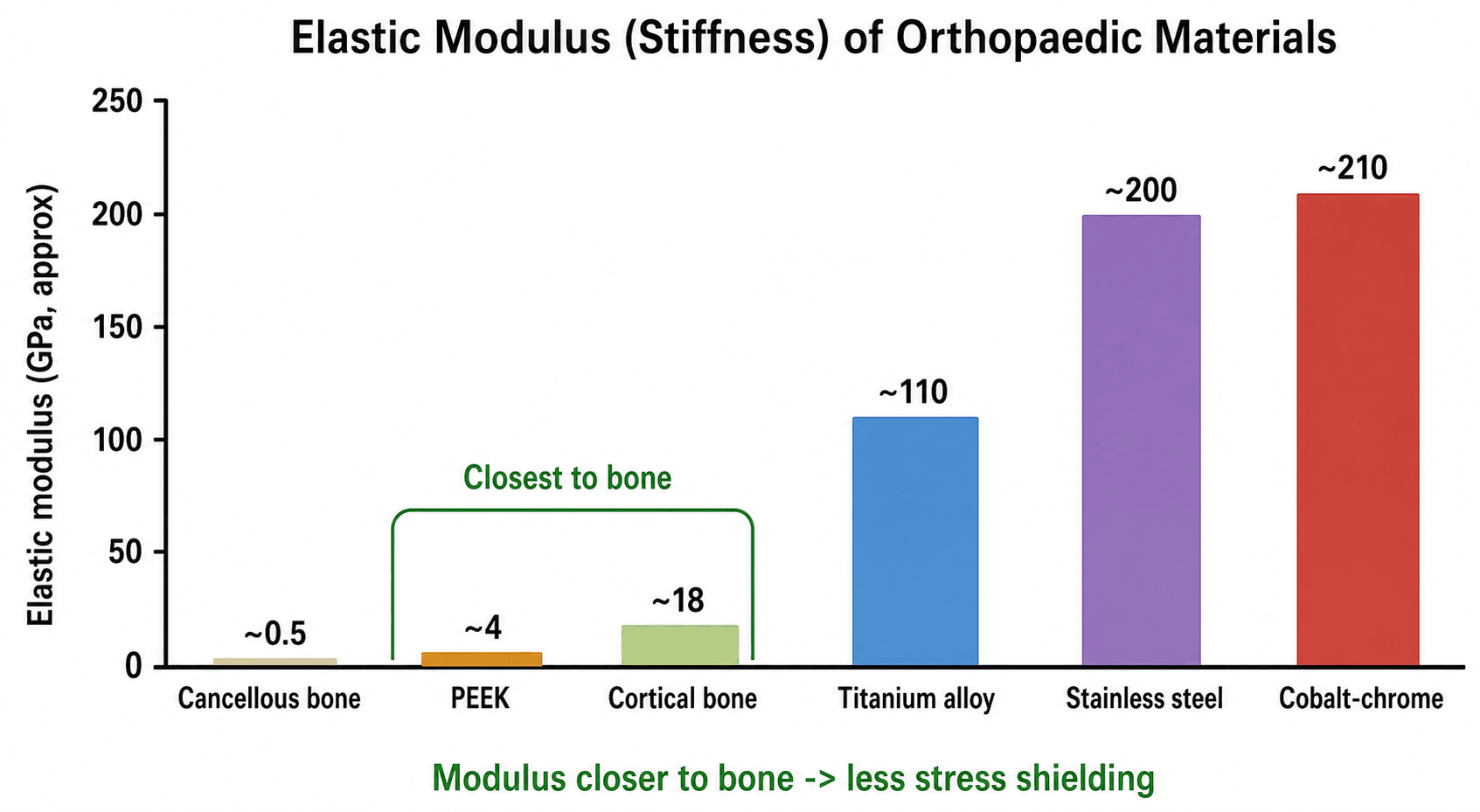
- PEEK (POLYETHERETHERKETONE) is a semi-crystalline thermoplastic polymer increasingly used in orthopaedic implants because of three favourable properties: an ELASTIC MODULUS (~3-4 GPa) much CLOSER to cortical bone (~18 GPa) than the metals (titanium ~110, stainless steel ~200, cobalt-chrome ~210 GPa); RADIOLUCENCY (it does not obscure radiographs/fusion assessment and produces minimal CT/MRI artefact); and good BIOCOMPATIBILITY, fatigue and chemical/heat resistance.
- Because PEEK's modulus is near that of bone, a PEEK implant transfers more load to the adjacent bone and causes LESS STRESS SHIELDING than a stiff metal implant - stress shielding being the bone resorption (by Wolff's law) that occurs when a stiff implant unloads the bone around it.
- PEEK's main LIMITATION is that it is BIOINERT - it does NOT bond to bone (poor osseointegration) - so it is often SURFACE-MODIFIED (hydroxyapatite or titanium coating, plasma treatment, surface roughening) or made POROUS to encourage bone on-/in-growth; experimental composites add antibacterial or bioactive functionality.
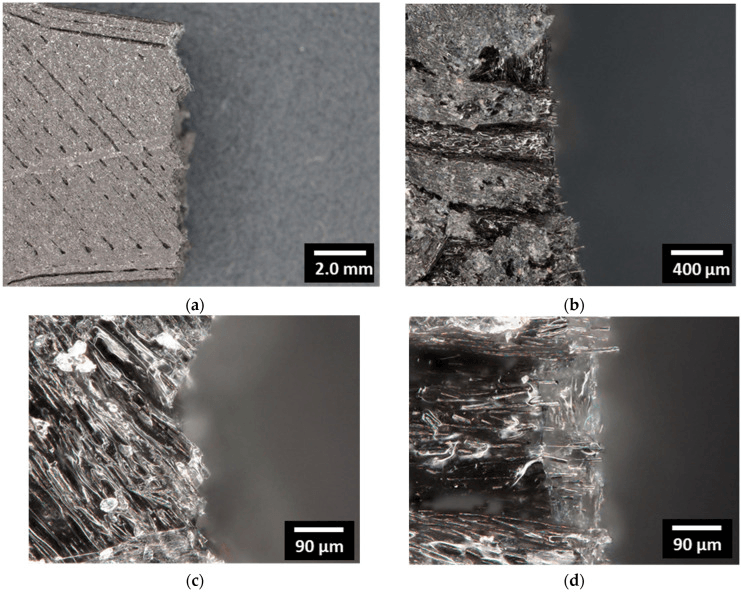
- PEEK can itself be made into a COMPOSITE - CARBON-FIBRE-REINFORCED PEEK (CFR-PEEK) - in which carbon fibres in the PEEK matrix give a tunable, higher strength and a modulus that can be tailored toward bone; CFR-PEEK is used in trauma plates and spinal implants and is also radiolucent.
- Typical orthopaedic USES of PEEK/CFR-PEEK: spinal INTERBODY FUSION CAGES (radiolucent so fusion can be assessed; modulus near bone), TRAUMA PLATES (CFR-PEEK), some arthroplasty components and suture ANCHORS - chosen where radiolucency and reduced stress shielding are advantageous, accepting the need to address its bioinert surface.
- “Composite = matrix + reinforcement (bone = collagen + hydroxyapatite, a natural composite).
- “PEEK: modulus near bone (~4 GPa) → LESS stress shielding; RADIOLUCENT; biocompatible. Limitation = BIOINERT (poor osseointegration) → surface coat (HA/Ti) or roughen.
- “Carbon-fibre-reinforced PEEK (CFR-PEEK) = tunable strength + radiolucent; uses: interbody cages, trauma plates, anchors.
Modulus near bone (less stress shielding), radiolucent (imaging/fusion assessment, minimal MRI/CT artefact), biocompatible, fatigue/chemical resistant.
Bioinert - does not bond to bone (poor osseointegration). Addressed by HA/titanium coating, plasma treatment, roughening or porosity.
Composite Materials
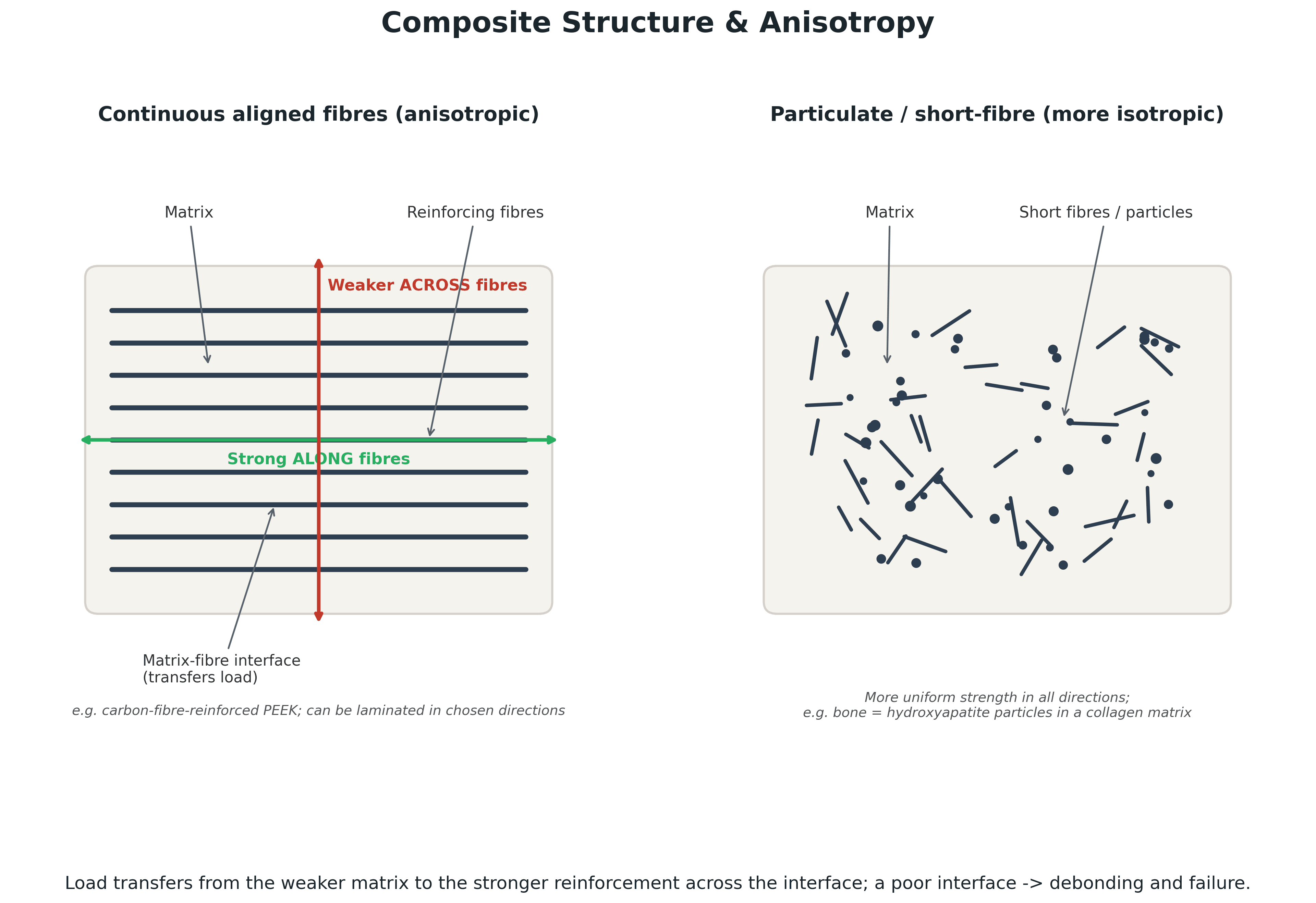
A composite combines a continuous matrix with a reinforcement (fibres or particles) so that the combination has better properties than either constituent alone - for example, high strength with a tailored stiffness. The principle is everywhere in the musculoskeletal system: bone is a natural composite of collagen (which provides toughness and tensile strength) and hydroxyapatite mineral (which provides compressive stiffness and strength), and tendon is collagen within a ground-substance matrix. Engineered orthopaedic composites include carbon-fibre-reinforced polymers and glass-fibre composites, where strong fibres in a polymer matrix give high strength-to-weight and tunable modulus. Fibre-reinforced composites are typically anisotropic - their properties depend on direction (strongest along the fibres).
Types of Composite: Matrix, Reinforcement and Anisotropy
Composites are classified by the matrix, by the reinforcement form, and by the resulting directional behaviour - and it is these three that determine an implant's strength and stiffness.
- Matrix type: polymer-matrix composites (PMC - e.g. CFR-PEEK, glass-fibre; the main orthopaedic class), metal-matrix (MMC) and ceramic-matrix (CMC).
- Reinforcement form: continuous (long, aligned) fibres give the highest directional strength; discontinuous (short/chopped) fibres or particulate give lower but more uniform strength. Bone's hydroxyapatite is essentially a particulate/platelet reinforcement in a collagen matrix.
- The interface does the work: load is transferred from the weaker matrix to the stronger reinforcement across the matrix-fibre interface - a good interface means effective reinforcement, a poor one means debonding and failure.
- Isotropy vs anisotropy: aligned-fibre composites are anisotropic (strongest along the fibres) and can be laminated in chosen orientations to tune properties; particulate composites are more isotropic.
PEEK: Properties, Limitation and Uses
PEEK (polyetheretherketone) is a semi-crystalline thermoplastic with a favourable orthopaedic profile:
- Elastic modulus close to bone (~3-4 GPa against cortical bone ~18 GPa, far below metals), giving less stress shielding (the bone resorption that follows when a stiff implant unloads adjacent bone, per Wolff's law).
- Radiolucent, so it does not obscure radiographs, allows fusion assessment, and gives minimal CT/MRI artefact (an advantage over metal).
- Biocompatible, with good fatigue, wear and chemical/heat resistance. Limitation - BIOINERT: PEEK does not bond to bone (poor osseointegration), so it is commonly surface-modified (hydroxyapatite or titanium coating, plasma treatment, surface roughening) or made porous to encourage bone on-/in-growth; research composites add antibacterial (e.g. metal-ion) or bioactive coatings.
CFR-PEEK (carbon-fibre-reinforced PEEK) is a composite that embeds carbon fibres in the PEEK matrix to give higher, tunable strength and a tailorable modulus while remaining radiolucent. Typical orthopaedic uses of PEEK and CFR-PEEK include spinal interbody fusion cages (radiolucent for fusion assessment, modulus near bone), trauma plates (CFR-PEEK, radiolucent, fatigue-resistant), some arthroplasty components and suture anchors - chosen where radiolucency and reduced stress shielding help, while accepting the need to manage the bioinert surface.
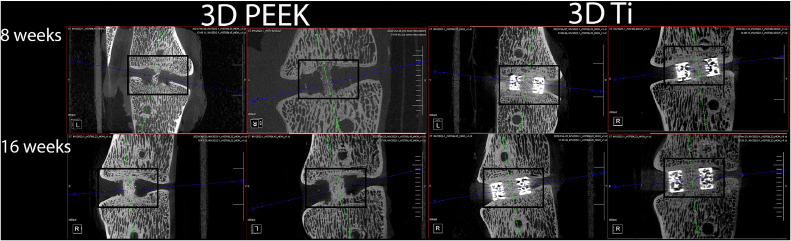
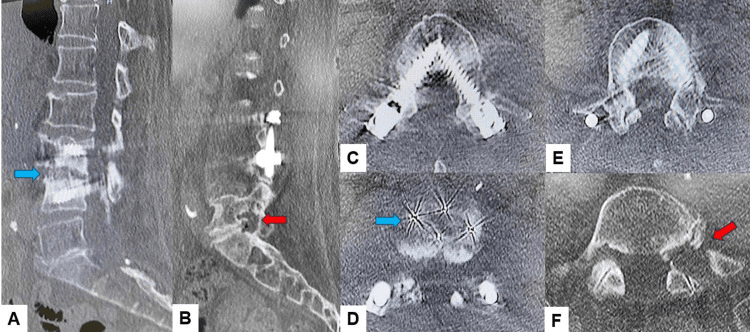
- The bioinert interface: plain PEEK's smooth, non-bonding surface tends to form a thin fibrous-tissue layer at the implant-bone junction, which can show as a radiolucent "halo"/lucency around a PEEK interbody cage and is associated with slower or less reliable osseointegration/fusion than an osteoconductive surface.
- The titanium response: this drove titanium-coated PEEK and porous-titanium/PEEK hybrid cages (and roughened or HA surfaces), which add bone on-growth while keeping much of PEEK's modulus and imaging advantage.
- The trade-off: a solid titanium cage osseointegrates well but is stiffer (more stress shielding) and obscures imaging (artefact, harder fusion assessment) - so titanium-coated/porous-titanium PEEK aims for the best of both.
- What the clinical data actually show, and it is not what the modulus argument predicts. Two meta-analyses of interbody cages agree that titanium fuses more reliably than PEEK (Massaad: OR 0.62 for fusion with PEEK; Tan: OR 2.12 favouring titanium in the lumbar subgroup). On subsidence - the outcome PEEK's bone-like modulus is supposed to prevent - they do not agree: one found no difference, and the other found titanium subsided MORE, which is the opposite of the prediction. So the honest position is that PEEK's demonstrated clinical advantage is imaging, not mechanics. Modulus matching remains a sound principle, but at the bone-implant interface the surface appears to decide the outcome, and PEEK's surface is its weakness - which is exactly why the fix has been to put titanium on it rather than to abandon the polymer.
PEEK's central trade-off is radiolucency plus a bone-like modulus versus a bioinert, non-bonding surface. Titanium-coated or porous-titanium PEEK tries to get both - the osseointegration of titanium with the modulus and imaging of PEEK.
Mnemonics & Memory Aids
PEEK
Hook:PEEK: bone-like modulus, easy imaging, biocompatible, but bioinert (Keeps off bone).
COMPOSITE
Hook:Composite = matrix + reinforcement; bone and CFR-PEEK are examples.
Clinical Decision Scenarios
Practise clinical reasoning and management decisions out loud
“What is a composite material, and what are the advantages and limitations of PEEK as an orthopaedic implant material?”
“Why is PEEK used for spinal interbody fusion cages, and what is stress shielding?”
Composites
- Matrix + reinforcement → superior combined properties
- Bone = natural composite (collagen + hydroxyapatite); tendon too
- Fibre-reinforced composites are anisotropic (direction-dependent)
PEEK properties
- Modulus ~3-4 GPa (near bone ~18) → less stress shielding (vs metals 110-210)
- Radiolucent (fusion assessment, minimal CT/MRI artefact)
- Biocompatible, fatigue/chemical resistant
Limitation & solutions
- Bioinert → poor osseointegration (does not bond to bone)
- Surface modify: HA/titanium coating, plasma, roughening, porosity
- Composite functionalisation (e.g. antibacterial coatings) - experimental
Uses
- Spinal interbody fusion cages (radiolucent, modulus near bone)
- CFR-PEEK trauma plates (radiolucent, fatigue-resistant)
- Some arthroplasty components and suture anchors
Evidence & Key Studies
Biofunctionalization of 3D-printed PEEK by integrated plasma coating: antimicrobial and bioactive PEEK
- PEEK is widely used in biomedical engineering for its excellent mechanical properties, biocompatibility and radiolucency.
- However, its BIOINERT nature limits infection prevention and bone integration, so surfaces are modified. Three agents were compared - silver oxide, copper and zinc - and ZINC was the most effective, reducing bacterial adhesion by over 4 log; a TiO2/Zn composite coating combined that antimicrobial activity with cytocompatibility, and the coating was applied by a vacuum arc plasma source built into the 3D-printing process so that printing and biofunctionalisation happen in one step.
- Illustrates both PEEK's advantages and the need for surface modification to overcome its bioinertness.
Enhanced antibacterial activity of copper sulfide/PEEK biocomposites
- PEEK is used for orthopaedic implants, and composites can add functionality - here a CuS/PEEK biocomposite to reduce post-operative infection risk.
- The CuS/PEEK composite achieved over 99.8% antibacterial activity against S. aureus and E. coli (enhanced by light/photothermal effect and copper-ion release).
- Demonstrates the composite strategy of combining PEEK with a reinforcement/additive to gain new properties.
Titanium may be superior to PEEK in lumbar interbody fusion (systematic review and meta-analysis)
- Eleven comparative studies, 743 patients, titanium versus PEEK interbody cages.
- Fusion at final follow-up did not differ overall (OR 1.50, 95% CI 0.57-3.94), but in the LUMBAR subgroup titanium achieved superior fusion (OR 2.12, 95% CI 1.05-4.28, p=0.04).
- COUNTER-INTUITIVELY, in non-infective conditions it was TITANIUM that subsided more, not PEEK (RR 2.17, 95% CI 1.13-4.16, p=0.02) - the opposite of what the modulus argument predicts.
- Operating time, haematoma, neuropathic pain, segmental angle correction and clinical improvement were similar.
PEEK versus titanium cages for posterior lumbar interbody fusion (meta-analysis)
- Eleven studies, 1,094 patients - 421 with titanium or titanium-coated cages and 673 with PEEK.
- PEEK was associated with a significantly LOWER fusion rate than titanium (OR 0.62, 95% CI 0.41-0.93, p=0.02).
- NO difference in subsidence between the two materials (OR 0.91, 95% CI 0.54-1.52, p=0.71).
- Back pain and functional scores were equivalent, though the PEEK group reported less postoperative leg pain (OR 0.61, 95% CI 0.28-0.94).
PEEK's bioinert limitation, and the fact that surface modification rather than bulk change is the route around it, comes from the cited Phruekthayanon study; the composite strategy of dispersing a functional additive in a PEEK matrix from the cited Pan study. Both are benchtop materials papers with no clinical data, so neither supports any statement about how a PEEK implant performs in a patient - that comes from the two cited clinical meta-analyses (Tan 2021; Massaad 2020), which together establish the finding that matters most on this page: titanium fuses more reliably than PEEK, and PEEK's bone-like modulus has not translated into a demonstrated reduction in subsidence.
The definition of a composite, bone as a natural collagen-hydroxyapatite composite, the modulus values themselves and the range of CFR-PEEK applications are standard, well-established biomaterials teaching rather than claims resting on any single paper. (See also our Stress-Strain & Modulus, Stress Shielding, Bone Composition and Ceramics/Polyethylene topics.)