Function, classification, timing and reconstruction
- Describe the anatomy before naming an operation: thumb, digits, web spaces, wrist, forearm, skin, nails, joints, tendons and function.
- Use the Oberg-Manske-Tonkin framework to organise congenital hand differences, but do not let classification replace clinical description.
- Thumb function is the central decision point because opposition, stability and first web space determine pinch.
- Syndactyly release is web reconstruction; timing depends on border digits, growth tethering, complexity and skin cover.
- Polydactyly reconstruction is not simple amputation; the retained ray often needs ligament, tendon, bone and nail alignment.
- Screen for associated anomalies when the pattern suggests radial deficiency, syndromic syndactyly, bilateral disease or multi-system involvement.
- “Watch the child play before looking at the X-ray; spontaneous use often defines the real problem.
- “Border-digit syndactyly is released earlier because unequal digit lengths can tether growth and create angular deformity.
- “A small duplicated digit may carry collateral ligament, tendon or nail-fold anatomy needed for the retained digit.
- “A floating or unstable hypoplastic thumb may be less functional than an index finger pollicisation.
- “Families need a staged plan: diagnosis, development, surgery, therapy, scars, possible revision and realistic functional goals.
Parents may first ask about appearance, but congenital hand surgery is judged by function, sensibility, growth, scars, revision risk and the child's ability to use the hand in daily life.
Overview
The spectrum. Congenital hand differences range from a small extra digit to complex bilateral syndromic limb deficiency. The presentation may be a newborn with an obvious anomaly, a toddler with delayed function, or a child referred for a specific problem such as syndactyly, thumb hypoplasia, clinodactyly or camptodactyly.
Two tasks in one consultation. First, explain the visible difference in language that parents can understand. Second, identify the functional and safety implications: is the thumb useful, are digits tethered, is there enough skin for reconstruction, and is the pattern isolated or does it suggest cardiac, renal, haematological, vertebral or genetic associations?
Why refer early. Most decisions are not urgent on the day of birth, but early referral matters. Families need counselling, the child may need therapy, and some conditions have timing windows; border-digit syndactyly and severe thumb deficiency are examples where delaying assessment can reduce the quality of later function.
Pathophysiology
The mechanism predicts the company. Upper limb development depends on coordinated patterning in several directions. The clinical value is practical: the developmental mechanism predicts what else may be abnormal besides the visible digit.
- Typical hand pattern
- Absent or hypoplastic structures such as radial deficiency, absent thumb or central ray deficiency.
- What to check clinically
- Forearm, wrist, thumb, elbow motion and associated systemic anomalies.
- Typical hand pattern
- Syndactyly, synostosis, camptodactyly and complex fusions.
- What to check clinically
- Skin shortage, neurovascular sharing, joint motion and growth tethering.
- Typical hand pattern
- Polydactyly and thumb duplication.
- What to check clinically
- Which ray has the best nail, joint, tendon, collateral ligament and alignment.
- Typical hand pattern
- Macrodactyly, abnormal soft tissue, nail or skeletal overgrowth.
- What to check clinically
- Progression, nerve symptoms, soft-tissue bulk and recurrence risk.
- Typical hand pattern
- Constriction rings, distal swelling, acrosyndactyly or amputations.
- What to check clinically
- Lymphoedema, vascularity, distal function and staged release need.
Rarely just bone. Tendons, intrinsic muscles, digital nerves, vessels, collateral ligaments, nail folds and skin cover may all be abnormal. That is why congenital hand surgery is reconstructive surgery, not simply removal, release or straightening.
Classification
The OMT system. The Oberg-Manske-Tonkin (OMT) classification, adopted by the IFSSH in 2014, replaced the older Swanson/IFSSH system that grouped anomalies as failure of formation, failure of differentiation/separation, duplication, overgrowth, undergrowth and constriction-band syndrome. OMT is dysmorphology-based, organising congenital upper-limb differences into developmental groups, with three top-level groups: (I) Malformations, (II) Deformations (for example trigger thumb, constriction ring, an extrinsically bent formed part) and (III) Dysplasias (overgrowth such as macrodactyly, and tumorous conditions). In practice a fourth heading, syndromes, is added for hand findings that are part of a wider multi-system condition.
How malformations are subdivided. The examinable refinement is that malformations are subdivided by the developmental axis affected: the proximodistal axis (transverse/symbrachydactyly, radial/ulnar longitudinal deficiency), the radioulnar (anteroposterior) axis (radial deficiency/thumb hypoplasia, ulnar deficiency, radial/ulnar polydactyly) and the dorsoventral axis (nail-patella-type and dorsal-ventral defects), and further by whether the whole limb or the hand plate alone is involved.
Label, then describe. Cite OMT in international exams, but classification must be followed by a concrete anatomical description. A clear description is often more useful than a label alone, and the condition-specific systems below organise the diagnosis without replacing that description.
- Syndactyly: simple or complex, complete or incomplete, complicated when additional skeletal anomalies exist.
- Thumb duplication: Wassel classification is commonly used, but stability and alignment are more important for treatment.
- Thumb hypoplasia: Blauth-type severity helps decide reconstruction versus pollicisation.
- Cleft hand: classify the central deficiency, first web, thumb-index function and associated syndactyly.
- Radial deficiency: forearm, wrist and thumb deficiency must be described together.
Clinical Presentation
Newborn presentation
Visible at birth. Many congenital hand differences are visible at birth, and parents may be distressed and need clear, calm explanation. The first response should not be to name an operation. Explain that hand function depends on the thumb, digits, skin, joints, tendons, nerves and how the child learns to use the limb.
Later presentation
Function declares itself with development. Some children present later because function becomes more obvious as they grow. A toddler may avoid pinch, struggle with grasp, catch a flexed finger, have progressive web tethering, or show increasing angular deformity as the digits grow. School-age children may present with writing difficulty, sport limitations, pain from a prominent duplicated ray, or concern about appearance and peer interaction.
History
What to ask. Pregnancy, family history, bilateral disease and associated anomalies are the domains that change management, and the questions worth asking specifically are set out below.
- Ask specifically
- Prenatal scans, birth finding, unilateral or bilateral involvement and progression.
- Why it matters
- Separates isolated anomaly from broader developmental pattern.
- Ask specifically
- Family history, consanguinity where relevant, pregnancy exposures and syndromic clues.
- Why it matters
- Guides genetics referral and recurrence counselling.
- Ask specifically
- Feeding, cardiac history, renal anomalies, vertebral issues, haematological problems and other limb findings.
- Why it matters
- Prevents unsafe elective surgery when systemic disease is possible.
- Ask specifically
- Grasping blocks, holding utensils, dressing, toileting, writing, play, sport and bimanual tasks.
- Why it matters
- Defines the treatment goal better than appearance alone.
Examination
Observe before testing. Observe spontaneous use first: a child reaching for a toy often demonstrates opposition, grasp, release and bimanual strategy better than a formal command. Then examine both upper limbs from shoulder to fingertip, and describe the thumb, digits, webs, skin, nails, wrist and forearm.
- Assess
- Presence, stability, opposition, thenar function and web depth.
- Decision it informs
- Reconstruction versus pollicisation, and pinch potential.
- Assess
- Number, length, webbing, nail folds, duplicated parts and growth tethering.
- Decision it informs
- Timing of syndactyly or duplication reconstruction.
- Assess
- Passive motion, active motion, stability, contracture and tendon balance.
- Decision it informs
- Whether surgery can improve function without causing stiffness.
- Assess
- Skin shortage, scars, vascularity and sensibility where testable.
- Decision it informs
- Flap/graft planning, staged surgery and safety.
- Assess
- Wrist position, forearm length and elbow motion.
- Decision it informs
- Identifies longitudinal deficiency and associated treatment limits.
Investigations
Radiographs. Plain radiographs are the main investigation when skeletal anatomy will change treatment, because they define the duplicated, fused, absent or hypoplastic skeleton. Include the hand and often the wrist and forearm, especially when thumb hypoplasia or radial deficiency is suspected. In infants some anatomy is cartilaginous, so repeat imaging later may be more informative.
Is the thumb reconstructable? Clinical assessment plus radiographs answer this, by assessing the CMC and MCP joints, the first web and thenar function.
Ultrasound and MRI. Rarely first-line, but useful in selected complex cases if tendons, vessels, soft tissue or a mass-like component will change surgery.
Could this be syndromic? Genetic, cardiac, renal or haematological investigations should be targeted to the pattern rather than ordered indiscriminately, and the targeted paediatric, genetics, cardiac, renal or haematology review comes before elective surgery. The prior probability is high enough that the systemic work-up is the main event, not a formality: in radial longitudinal deficiency, about two-thirds of children have an associated medical or musculoskeletal disorder and about one-third have a recognised syndrome. The hand difference is often the visible marker of something that changes anaesthetic risk, transfusion planning or the child's whole prognosis, which is why the cardiac, renal, haematological and vertebral screen precedes elective hand surgery rather than running alongside it.
What should treatment improve? Therapy assessment and functional observation set realistic goals and the post-operative therapy plan.
Major Conditions
Syndactyly
Definition and types. Syndactyly is failure of separation between adjacent digits. It may be incomplete or complete; it is simple when only soft tissue is involved, complex when bone or nail structures are fused, and complicated when additional skeletal anomalies exist.
Which web. The ring-small finger web is commonly affected, but border-digit involvement is more urgent because unequal digit lengths can tether growth and create angular deformity.
Polydactyly and thumb duplication
An extra digit or ray. Polydactyly may be preaxial, central or postaxial. Thumb duplication is commonly discussed with the Wassel classification, but management depends on the function of the retained thumb: alignment, nail, joint stability, collateral ligaments, tendon insertions and first web space.
Thumb hypoplasia
The spectrum. Thumb hypoplasia ranges from a mild small thumb to an absent or floating thumb. Mild forms may need observation or first-web release, and reconstructable thumbs may need web deepening, opponensplasty and MCP stabilisation. Severe unstable or floating thumbs often function better after index pollicisation than after attempted preservation of a non-functional thumb.
What to examine. Is there a thumb, and is it sensate? CMC and MCP stability decide reconstructability, a first web contracture blocks opposition, and thenar function and tendon balance matter. The question that settles it is whether the thumb creates useful pinch in real life.
The Blauth grades, and the one boundary that decides the operation. Blauth-type severity is the language of thumb hypoplasia, so it is worth stating what the grades are and, more importantly, where the decision actually turns:
- Anatomy
- Minor hypoplasia, all structures present
- Operation
- Usually observation
- Anatomy
- Narrow first web, thenar hypoplasia, unstable MCP ulnar collateral
- Operation
- First-web release, opponensplasty, MCP stabilisation
- Anatomy
- As II, plus extrinsic tendon and skeletal deficiency, but a PRESENT carpometacarpal joint
- Operation
- Reconstruct
- Anatomy
- As IIIA, but the carpometacarpal (basal) joint is ABSENT
- Operation
- Pollicisation
- Anatomy
- "Floating" thumb (pouce flottant) on a skin bridge
- Operation
- Pollicisation
- Anatomy
- Complete absence
- Operation
- Pollicisation
The watershed is IIIA versus IIIB, and the discriminator is a single anatomical fact: is there a carpometacarpal joint? Manske's contribution was to show that IIIA, where the basal joint is present, can be reconstructed; where the basal joint is absent, pollicisation is the answer, because no amount of distal reconstruction gives a stable post to pinch against. Examine the base of the thumb and image it; do not decide on the size of the thumb.
One honest qualifier. A series that reconstructed 14 type III thumbs, including 4 type IIIB with a free vascularised second metatarsophalangeal joint transfer, found the results functionally and cosmetically inferior to pollicisation, but concluded reconstruction "remains worthwhile" when the family declines pollicisation or the child presents late (PMID 10855319). So pollicisation is the better operation for IIIB, not the only possible one, and family preference is a legitimate part of the decision.
Symbrachydactyly
Usually sporadic and unilateral. Symbrachydactyly includes short digits, absent phalanges, nubbins, central deficiency and variable thumb involvement. Assessment turns on the available sensate digits, web spaces, toe transfer suitability and prosthetic needs.
Counselling is the main task. Surgery may improve pinch space, length or grasp in selected children, but it cannot create a normal hand. Prosthetic, adaptive and therapy options should be discussed without framing them as inferior to surgery.
Cleft hand
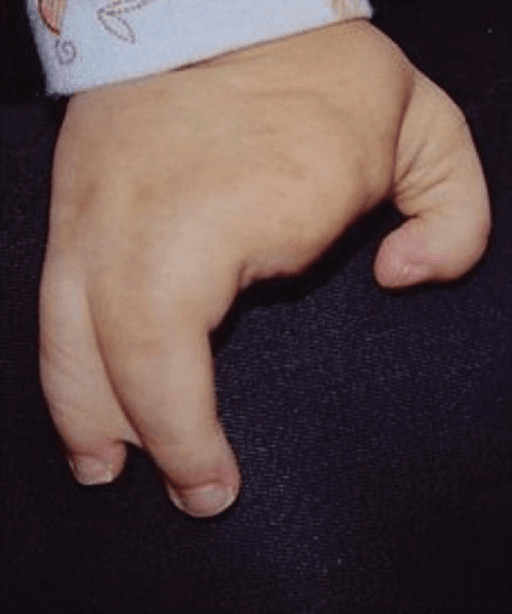
A central deficiency. Cleft hand has an absent central ray or rays and variable syndactyly, and some children have excellent function despite a dramatic appearance. Surgery is considered for first web narrowing, transverse bones, progressive deformity, unstable pinch, syndactyly or functional limitations, and the plan should protect the thumb-index pinch space.
Camptodactyly, clinodactyly and trigger thumb
Do not over-treat. These smaller conditions are mostly observed, and surgery is reserved for the deformity that is severe, progressive or functionally limiting.
- Clinical focus
- PIP flexion deformity, flexibility, progression and functional limitation.
- Usual treatment logic
- Observe or splint mild flexible cases; consider surgery only for severe or progressive functional contracture.
- Clinical focus
- Coronal-plane curvature, often from delta phalanx, plus function and cosmesis.
- Usual treatment logic
- Usually observe; corrective osteotomy is reserved for severe deformity or functional interference.
- Clinical focus
- IP flexion, palpable Notta nodule, reducibility, age and duration.
- Usual treatment logic
- Many early cases are observed; persistent fixed triggering may need A1 pulley release.
Madelung deformity
The missing wrist diagnosis. Madelung deformity is a growth-disturbance dysplasia of the volar-ulnar distal radial physis. It presents in adolescent girls (often bilateral) with a dorsally prominent (subluxed) ulnar head, a "bayonet" wrist, pain and limited rotation/extension.
The anatomy. The radius develops increased volar and ulnar inclination, with a triangulated, proximally migrated lunate sitting in the resulting V. It is classically tethered by an abnormal Vickers ligament, a thick volar radiolunate ligament.
The genetics cue. It is strongly associated with SHOX-gene haploinsufficiency / Léri-Weill dyschondrosteosis (and seen in Turner syndrome), so it is a marker for short stature and a genetics cue.
Management. This ranges from observation to Vickers ligament release with physiolysis (Vickers procedure) in the growing child, and dome or radial osteotomy with ulnar shortening for the mature symptomatic wrist. A reverse Madelung (dorsal-ulnar tethering, post-traumatic or infective) is the differential.
Differential Diagnosis
Patterns that look alike. The hand difference is often obvious; the exam skill is distinguishing patterns that look similar but carry different prognosis, screening needs and surgical plans. The two highest-stakes distinctions are isolated versus syndromic syndactyly, and a deficient central ray (cleft hand) versus transverse or symbrachydactyly deficiency.
- Distinguishing features
- Soft-tissue web only, normal nails and skeleton, no systemic features.
- Key action
- Plan web reconstruction; timing by border versus central.
- Distinguishing features
- Complex or complicated webs, craniofacial features (Apert) or absent pectoralis and limb hypoplasia (Poland).
- Key action
- Genetics and systemic assessment before staged surgery.
- Distinguishing features
- Extra radial digit with shared or duplicated joints; assess best ray.
- Key action
- Reconstruct retained ray, do not simply amputate.
- Distinguishing features
- Extra ulnar digit; often familial, more common in African ancestry.
- Key action
- Excise with collateral ligament reconstruction if well-formed.
- Distinguishing features
- Small or absent thumb, radial wrist deviation, short forearm; the associated-anomaly rate makes the screen high-yield, not defensive.
- Key action
- Mandatory cardiac, renal and haematology (Fanconi, TAR) screen BEFORE elective hand surgery.
- Distinguishing features
- Central V-shaped cleft, absent central ray, often good function.
- Key action
- Protect thumb-index pinch; operate for first-web or function.
- Distinguishing features
- Short or absent digits with nubbins, usually unilateral and sporadic.
- Key action
- Counsel; prosthetic or toe transfer in selected cases.
- Distinguishing features
- Constriction rings, distal swelling, acrosyndactyly, normal proximal anatomy.
- Key action
- Assess vascularity; urgent release if circulation threatened.
- Distinguishing features
- Enlarged digit, may be progressive, nerve-territory distribution.
- Key action
- Monitor progression; debulking or epiphysiodesis if needed.
- Distinguishing features
- Isolated flexion or angular deformity without true deficiency or duplication.
- Key action
- Mostly observe; surgery only for progressive functional loss.
Management Principles
Counselling comes first. Management begins with honest counselling. The family should understand the diagnosis, what function is present, what treatment can improve, and what surgery cannot change. Many children benefit from therapy, adaptive strategies and observation; surgery is chosen when it improves function, prevents deformity, supports development or solves a specific practical problem.
Observation and therapy. Observation is appropriate when function is good, deformity is mild, or surgery is unlikely to improve the hand. Therapy supports range, splinting, sensory use, bimanual skill and post-operative recovery, and adaptive tools may be more useful than surgery for some tasks.
Reconstruction. The reconstructive options are syndactyly release, first web deepening, opponensplasty, collateral ligament reconstruction, osteotomy, tendon transfer, polydactyly reconstruction, pollicisation, release of contractures and staged soft-tissue reconstruction.
Timing. Operate early enough to prevent growth tethering or missed functional development, but late enough for safer anaesthesia, better tissue size and effective therapy; the aim is to avoid both delayed tethering and premature scarring. Border-digit syndactyly and severe thumb deficiency tend to need early planning, and mild central conditions can often wait. Condition by condition:
- Border-digit syndactyly: earlier planning; release the web with durable commissure reconstruction and safe skin cover
- Central simple syndactyly: often can wait until the child is larger and tissue handling is safer; release when function, growth, family goals and surgical safety align
- Thumb hypoplasia: early assessment because pinch development and radial deficiency screening matter; reconstruct a stable thumb if possible, and pollicise when the thumb is absent, floating or non-reconstructable
- Thumb duplication or polydactyly: plan once anatomy, nail, joint stability and tendon balance are defined; build the best single ray rather than simply amputating the smaller part
- Camptodactyly or clinodactyly: observe mild flexible deformity and intervene for progression or function; splint, therapy or osteotomy/release only when the deformity justifies stiffness and scar risk
Bilateral planning. Bilateral cases require practical sequencing, staged so the child keeps useful function during recovery. The child must retain enough function for feeding, toileting, mobility and play, and the plan protects family care capacity as well; staged surgery, splints and family support are part of it.
Operative Concepts
Syndactyly release. Create a durable commissure, separate the digits with zig-zag incisions, protect the neurovascular bundles and close without tension, using flaps or full-thickness graft when needed. Avoid releasing both sides of one digit at the same operation, and stage release for multiple webs. The pitfalls are linear scars, inadequate skin, web creep, vascular compromise and stiffness.
Polydactyly reconstruction. Build one straight, stable, sensate digit by choosing the best skeletal, ligament, tendon and nail components. The pitfall is treating it as simple amputation and leaving instability, malalignment or nail deformity.
Pollicisation. Rotate, shorten and reposition the index finger while preserving its neurovascular supply and balancing the tendons to create opposition. The pitfall is trying to preserve a floating non-functional thumb when pollicisation would give better pinch.
Contracture or deformity surgery. Reserve surgery for progressive or functionally important deformity and combine it with therapy. The pitfall is creating stiffness or recurrence by operating on mild flexible deformity.
Complications
Early complications
- Skin graft loss or flap edge necrosis.
- Vascular compromise after complex digit separation.
- Infection or wound breakdown.
- Scar sensitivity and pain.
- Stiffness after immobilisation.
- Family distress if expectations were not clear.
Late complications
- Web creep after syndactyly release.
- Scar contracture and limited motion.
- Angular deformity or instability after polydactyly reconstruction.
- Poor pinch after inadequate thumb reconstruction.
- Growth-related recurrence.
- Need for revision surgery.
- Dissatisfaction if appearance was over-promised.
In congenital hand surgery, a technically successful operation that creates stiffness, poor sensibility or unstable pinch is not a functional success.
Counselling and Follow-up
Function first. Explain what the hand can already do and what treatment may realistically improve. Follow-up tracks pinch, grasp, release, bimanual skill and independence.
Appearance. Avoid promising a normal-looking hand; scars and residual difference are common. Follow-up attends to child confidence, peer concerns and family expectations.
Staged care. Some children need therapy, splints, one operation, revision or staged reconstruction. The things to watch are growth, web creep, angular deformity and therapy progress.
Risk. Discuss stiffness, scar sensitivity, graft problems, vascular risk and recurrence before elective surgery, and follow up with early wound review and long-term functional review.
The extra thumb is not simply removed. Across 545 thumbs in 500 patients, excision with reconstruction was needed in 73.9% and simple excision in only 24.8%, so in roughly three of four children the operation rebuilds the retained ray (collateral ligament, tendon centralisation, joint realignment) rather than amputating a spare part. Ulnar-dominant duplication was the commonest pattern at 67.5%, with the hypoplastic type accounting for 14.5%. Telling a family "we will take the extra thumb off" sets the wrong expectation for both the operation and the scar; the evidence is a single-centre series without standardised long-term functional scores.
Decision-Making in Practice
Function before appearance. The key questions are whether the child can pinch, grasp, release, oppose, feel, play, perform self-care and participate socially. Anatomy matters because it determines whether reconstruction can improve function without creating stiffness, scarring or repeated operations that add little value, and classification helps communication but should not replace a hand-by-hand functional plan.
Radial or ulnar deficiency. Assess wrist position, thumb function, elbow motion, forearm length and syndromic associations. Treatment is therapy, splintage and staged reconstruction depending on severity and the child's function.
Stable sensate pinch. Create or preserve a thumb or pinch post that the child can use. The failure mode is a straight-looking hand with poor opposition or no stability.
First web space. Deepen or protect the web when thumb-index span limits pinch. The failure mode is a good-looking thumb that cannot oppose because the web is narrow.
Growth and scars. Release tethering tissue early when growth will worsen deformity, and avoid scars that contract across joints. The failure modes are web creep, angular deformity or recurrent contracture.
Staging. Stage procedures when blood supply, skin coverage or bilateral function makes one-stage surgery unsafe. The failure modes are vascular compromise or loss of independence during recovery.
Therapy. Plan splinting, motion and functional retraining before operating. The failure mode is technically correct surgery followed by stiffness and poor use.
Clinical Reasoning Notes
Structured clinical approach
Start with the child's age, side, function and pattern. Then describe the anatomy: thumb, web spaces, number of rays, digits involved, joints, skin, nail and forearm. State whether the condition is isolated or syndromic. Finally, give a plan for investigation, counselling, therapy and timing.
Common pitfalls
- Starting with an operation instead of function.
- Saying "remove the extra digit" without reconstructing the retained ray.
- Treating all syndactyly with the same timing.
- Missing radial deficiency or haematology risk in thumb hypoplasia.
- Preserving a non-functional thumb when pollicisation would give better pinch.
- Ignoring the first web space.
- Promising normal appearance.
- Forgetting therapy and revision risk.
Integrated clinical approach
"I would assess the child in a paediatric hand clinic. I would first observe spontaneous function, then describe the thumb, digits, web spaces, skin, joints, tendons, sensibility and forearm. I would classify the pattern but base management on functional goals, growth and associated anomalies. Treatment may be observation, therapy, reconstruction or pollicisation, with timing chosen to support development while minimising stiffness, scarring and revision risk."
Guidelines, Registries & Global Practice
Congenital hand surgery is delivered very differently across high- and limited-resource settings, but the functional principles are universal. There is no single global guideline; practice is shaped by specialist society reviews, classification consensus and national registries.
- Approximate figure
- Roughly 1 to 2 per 1000 live births
- Source population / note
- Population registry estimates vary with ascertainment and minor-anomaly inclusion.
- Approximate figure
- Among the most common; postaxial more frequent in African ancestry, preaxial in East Asian and European ancestry
- Source population / note
- Ancestry-dependent distribution is a recognised exam point.
- Approximate figure
- Around 1 in 2000 to 3000 births
- Source population / note
- Often the ring-small or long-ring web; can be syndromic (Apert, Poland).
- Approximate figure
- Around 1 in 30,000 to 100,000
- Source population / note
- Two-thirds have associated anomalies; mandatory systemic screen.
- Emphasis
- Dysmorphology-based grouping adopted as the global standard since 2014.
- Practical implication
- Use OMT terminology in international exams and correspondence.
- Emphasis
- Function-led assessment, staged reconstruction and early referral for border-digit and thumb deficiency.
- Practical implication
- Refer neonatal anomalies early to a specialist congenital hand service.
- Emphasis
- Reconstruct the retained ray; protect neurovascular bundles and the first web.
- Practical implication
- Avoid framing duplication surgery as simple amputation.
- Emphasis
- Screen radial deficiency for Fanconi anaemia (chromosomal breakage) and TAR before surgery.
- Practical implication
- Haematology clearance can change anaesthetic and surgical timing.
- High-resource setting
- Antenatal ultrasound, early genetics and multidisciplinary clinic.
- Limited-resource setting
- Often first seen at walking age or school entry; late presentation common.
- High-resource setting
- Microsurgery, toe transfer and staged web reconstruction available.
- Limited-resource setting
- Focus on high-impact, single-stage procedures and durable web release.
- High-resource setting
- Hand therapy, custom splints and myoelectric prostheses accessible.
- Limited-resource setting
- Adaptive low-cost devices and family-led therapy emphasised.
- High-resource setting
- Long-term growth and revision review routine.
- Limited-resource setting
- Single definitive procedure prioritised where follow-up is uncertain.
Controversies and Areas of Uncertainty
Name it, give both sides, commit. Even at consultant level, several decisions in congenital hand surgery remain genuinely contested. Examiners reward a candidate who can name the controversy, give both sides and then commit to a defensible position.
- One side
- Early release (before 12-18 months) limits growth tethering of border webs and gives a longer remodelling period.
- Other side
- Later release allows larger structures, easier dissection and lower anaesthetic and vascular risk for non-border webs.
- One side
- An absent carpometacarpal joint usually dooms reconstruction, so pollicisation gives more reliable pinch.
- Other side
- Some surgeons and families prefer to preserve a five-digit hand and accept a weaker but present thumb.
- One side
- Full-thickness grafts reliably resurface defects and are the traditional standard.
- Other side
- Defatting, local flaps and dermal substitutes can avoid donor sites and graft pigmentation in selected webs.
- One side
- Centralisation or radialisation improves wrist alignment and hand position.
- Other side
- High recurrence, ulnar growth arrest and stiffness lead some to favour soft-tissue distraction or vascularised transfers.
- One side
- Bilhaut preserves combined width and joint stability for symmetric duplicates.
- Other side
- It risks nail ridging and joint stiffness, so most use ablation of the smaller ray with reconstruction.
Clinical Decision Scenarios
Practise clinical reasoning and management decisions out loud
“A newborn is referred with an abnormal hand. How do you assess and counsel the family?”
“Why is border-digit syndactyly usually released earlier than central simple syndactyly?”
“A child has a very small unstable thumb. How do you decide between reconstruction and pollicisation?”
“A toddler has a duplicated thumb with two similar-sized radial digits. The family asks you to remove the extra one. How do you plan surgery?”
Assess
- Watch function
- Describe anatomy
- Thumb and web
- Whole upper limb
- Associated screen
Classify
- Malformation
- Deformation
- Dysplasia
- Syndrome
- Condition-specific system
Treat
- Observe
- Therapy
- Web reconstruction
- Ray reconstruction
- Pollicisation
Pitfalls
- Cosmetic-only plan
- No systemic screen
- Web creep
- Unstable retained ray
- Poor pinch
Evidence Signals
OMT classification: dysmorphology-based framework
- The Oberg-Manske-Tonkin system separates malformations, deformations and dysplasias using dysmorphological concepts.
- Malformations are subgrouped by whether the hand alone or the whole limb is affected and by the axis of development involved.
- The framework is expandable so that future gene and chromosomal defects can be incorporated.
Epidemiology of congenital upper-limb anomalies (OMT applied)
- 641 children with 653 anomalies were classified across three centres over one year; 74% were malformations.
- Among hand-plate malformations, radial polydactyly (15%) was most common, then symbrachydactyly (13%) and cleft hand (11%).
- All individuals could be classified with OMT, though Madelung deformity and symbrachydactyly needed clarification.
Evidence Base
Radial polydactyly: physical-characteristic classification
- Across 545 thumbs in 500 patients, ulnar-dominant duplication was most frequent (67.5%) and the hypoplastic type accounted for 14.5%.
- Excision with reconstruction was needed in 73.9% and simple excision in only 24.8%, confirming most duplicates require reconstruction not amputation.
- Stratifying by floating, symmetry, dominant side and joint angulation predicted the operation as well as the radiographic Wassel-Flatt system.
Syndactyly web reconstruction: dorsal flap technique
- 39 webs were reconstructed in 26 children using a hexagonal dorsal flap with mid-lateral closure; grafts were needed in only 2 complex or complicated cases.
- Web creep occurred in a single child after a self-induced postoperative infection, underscoring that closure technique and wound integrity drive outcome.
- Mean parental cosmetic and functional satisfaction scores were 87 and 92 of 100 at 1.3 years.
Pollicisation for thumb aplasia and severe hypoplasia
- 13 index pollicisations (Blauth IIIB, IV and V thumbs) were assessed at a mean 6.5 years; mean Percival score was 18 of 22.
- Pollicisation reliably created a sensate, mobile thumb with satisfactory strength and appearance in the majority of children.
- Transient psychosocial discomfort was reported, reinforcing the need for family counselling alongside the technical result.
Radial longitudinal deficiency: associations and treatment
- About two-thirds of children with radial longitudinal deficiency have an associated medical or musculoskeletal disorder, and one-third have a recognised syndrome.
- Centralisation and radialisation improve wrist position but carry high recurrence and ulnar growth-arrest rates.
- Microsurgical options (vascularised fibula or second-toe transfer) and management of the associated hypoplastic thumb are evolving alternatives.