Craniocervical Junction Instability
- NEVER apply traction to a distraction-type atlanto-occipital dissociation - it further distracts the disrupted junction and can kill or cause devastating cord injury. This is the single most important safety point. Rigid immobilisation instead.
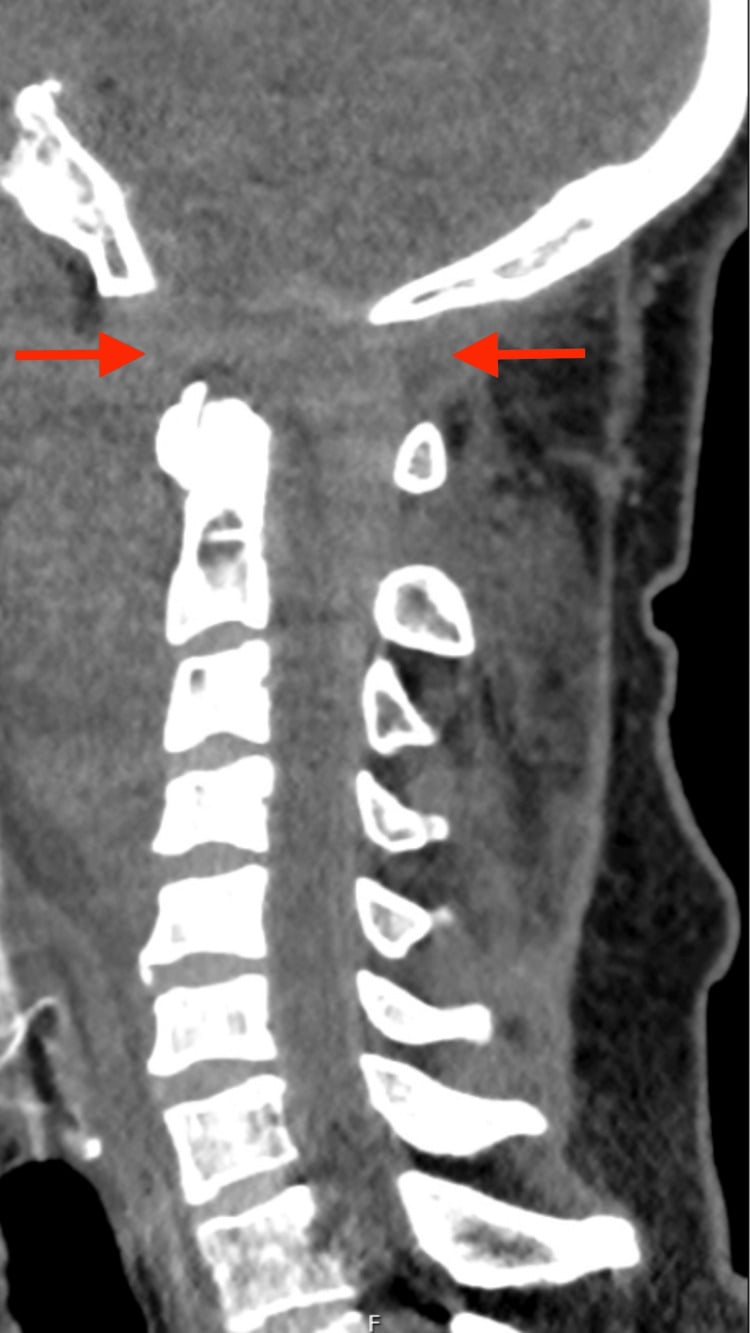
- AOD is a measurement/ligamentous diagnosis - the bones often look aligned. Actively measure the C1-condyle interval (CCI, the MOST sensitive sign) on CT; do not be reassured by a "normal-looking" lateral.
- The CCI is far more sensitive than the older criteria - Harris BDI/BAI, Powers and Wholey ratios miss a large fraction of AOD (Harris ~27% sensitive, Powers ~55%). Know CCI as the lead measurement.
- Children are predisposed (horizontal condyles, large head) - have a low threshold in the paediatric high-energy trauma.
- Screen the atraumatic at-risk groups - rheumatoid arthritis (pannus, cranial settling), Down syndrome (laxity, os odontoideum) - especially before intubation/anaesthesia.
- Match the fusion to the level - C1-C2 fusion for isolated atlanto-axial instability, but INCLUDE the occiput (C0-C2) when the occipito-atlantal junction is disrupted.
Overview & Epidemiology
Craniocervical junction (CCJ) instability spans two very different clinical worlds: a catastrophic high-energy traumatic injury (atlanto-occipital dissociation, AOD) and an insidious atraumatic instability in predisposed patients. Both matter because the upper cervical cord and brainstem are at stake.
- Traumatic AOD - a rare, highly unstable distraction injury from motor-vehicle and pedestrian trauma; historically often fatal at the scene, though better pre-hospital care has improved survival and detection. Children and young adults are over-represented (more horizontal occipital condyles, a relatively large head).
- Atraumatic instability - rheumatoid arthritis (the classic), Down syndrome, and congenital os odontoideum / skeletal dysplasias produce slowly progressive atlanto-axial or occipito-atlantal instability, sometimes with myelopathy.
- Why it is examinable: AOD is lethal and easily missed, the no-traction rule is a hard safety point, and the at-risk-group screening (RA, Down) is a recurring clinical-governance theme.
Anatomy — a ligament-dependent junction
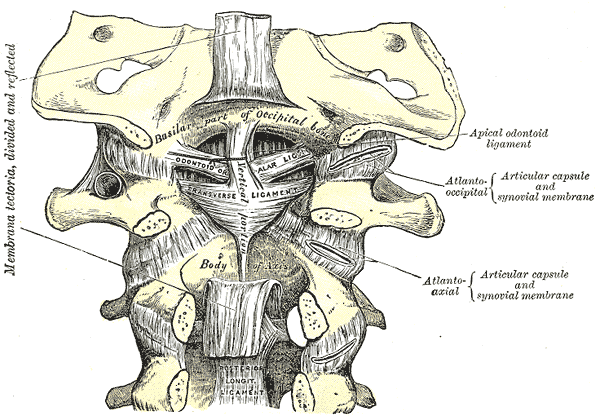
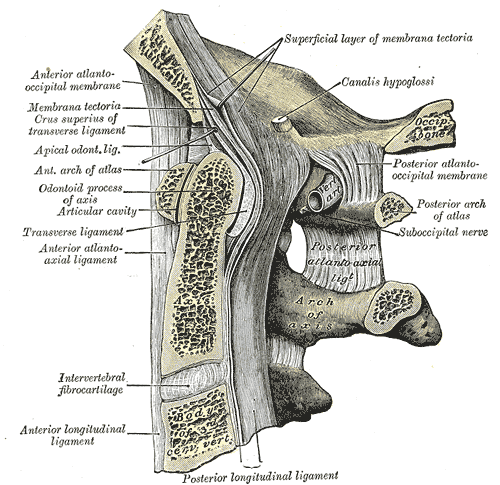
The craniocervical junction (CCJ) — the occiput, atlas (C1) and axis (C2) — provides nearly half of cervical flexion-extension and rotation, yet its bony articulations are shallow and incongruent, so stability depends on ligaments:
- the transverse ligament (part of the cruciate ligament) holds the odontoid (dens) against the anterior arch of the atlas — the key restraint to anterior atlanto-axial translation;
- the alar ligaments run from the dens to the occipital condyles, restraining rotation and distraction;
- the tectorial membrane (the cephalad continuation of the posterior longitudinal ligament) and the apical and atlanto-occipital membranes/ligaments span the dens/atlas to the occiput.
Disruption of these — by trauma or disease — produces craniocervical instability.
Pathophysiology & causes
Instability arises whenever the ligamentous restraints fail faster than the shallow bony joints can compensate - acutely, by high-energy distraction (trauma), or chronically, by inflammatory/erosive or congenitally lax tissue. The result is pathological motion at occiput-C1 (occipito-atlantal) and/or C1-C2 (atlanto-axial), threatening the cervicomedullary cord.
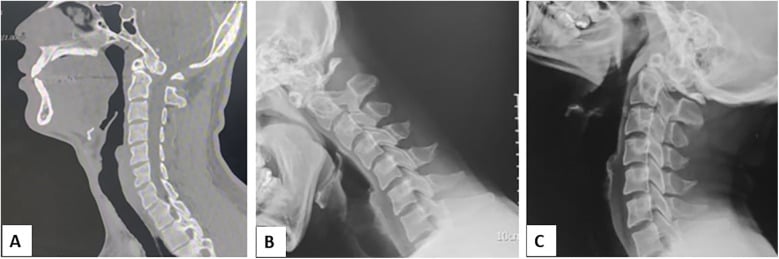
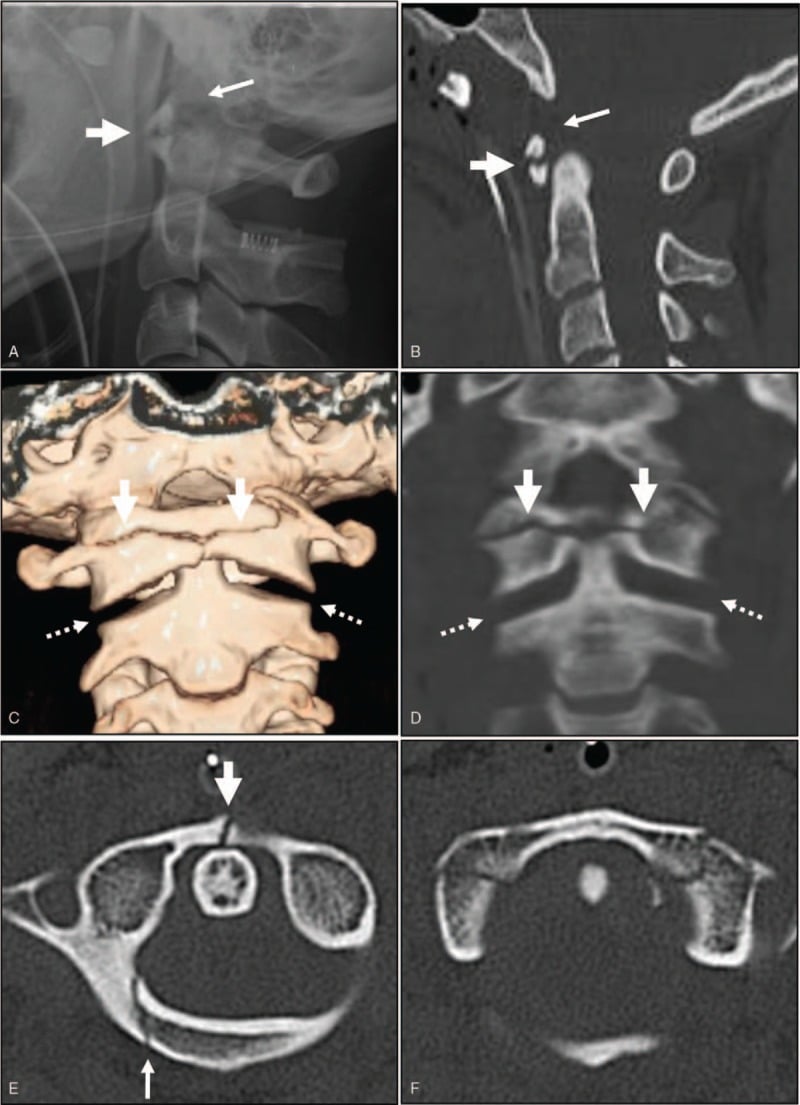
Atlanto-occipital dissociation is a rare, highly unstable ligamentous injury of the occiput–C1 junction from high-energy hyperextension/distraction — typically motor-vehicle and pedestrian trauma. It carries very high morbidity and mortality (often fatal at the scene from brainstem/upper cord injury), and children and young adults are disproportionately affected because of their relatively horizontal occipital condyles and large head. Survivors may present with cranial-nerve palsies, brainstem/cord signs or, with milder unilateral injuries, neck pain — CCJ ligamentous injury is best thought of as a spectrum, a subset of which can be managed non-operatively.
Clinical Presentation
- High-energy mechanism (MVC, pedestrian); often multi-trauma and reduced consciousness
- May be fatal at the scene (brainstem/upper-cord injury); survivors range from lower cranial-nerve palsies and brainstem/cord signs to neck pain alone
- A subtle deficit or isolated neck pain in a high-energy injury is the warning - have a low threshold
- Examine cranial nerves, long tracts and respiratory function; assess the whole cervical spine
- Insidious neck pain, occipital headache, and progressive myelopathy (gait/hand dysfunction, hyperreflexia)
- In rheumatoid arthritis: long-standing erosive disease; watch for cranial settling/basilar invagination
- In Down syndrome / congenital disease: often asymptomatic, detected on screening; symptoms may emerge with minor trauma
- Pre-anaesthetic concern: instability risks cord injury at intubation/positioning
Investigations
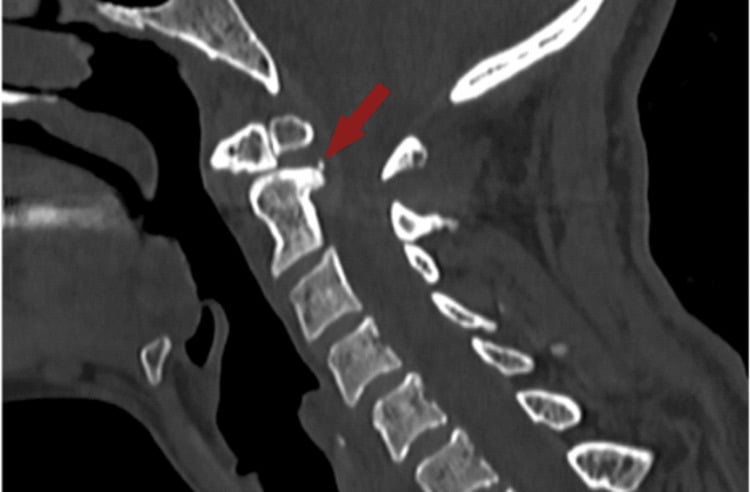
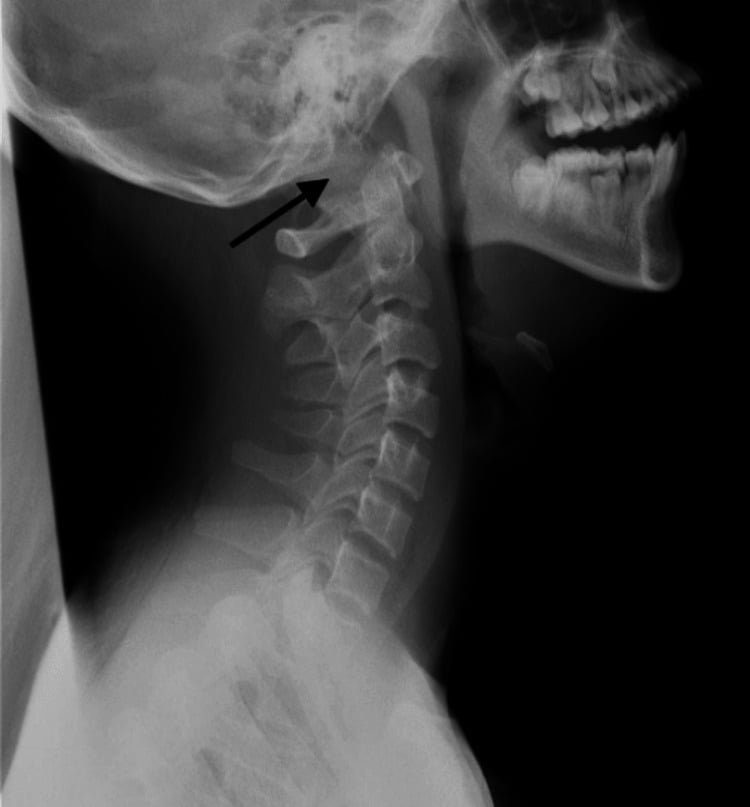
AOD is frequently missed, so look for it actively on the craniocervical CT using objective measurements:
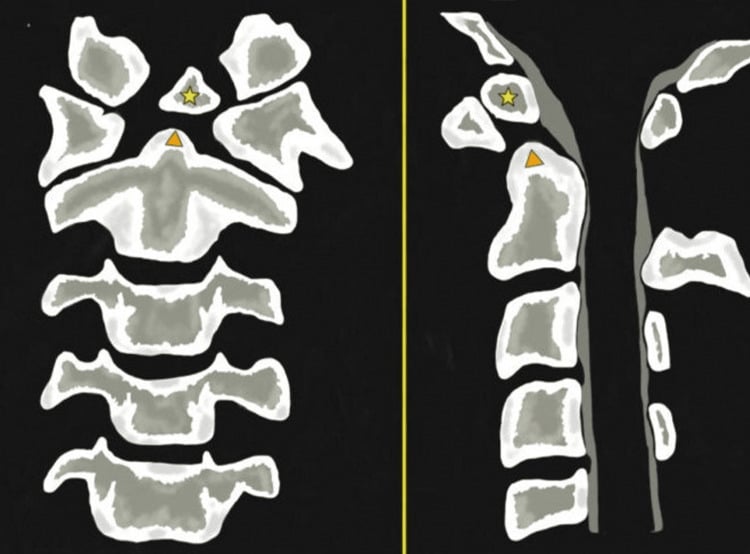
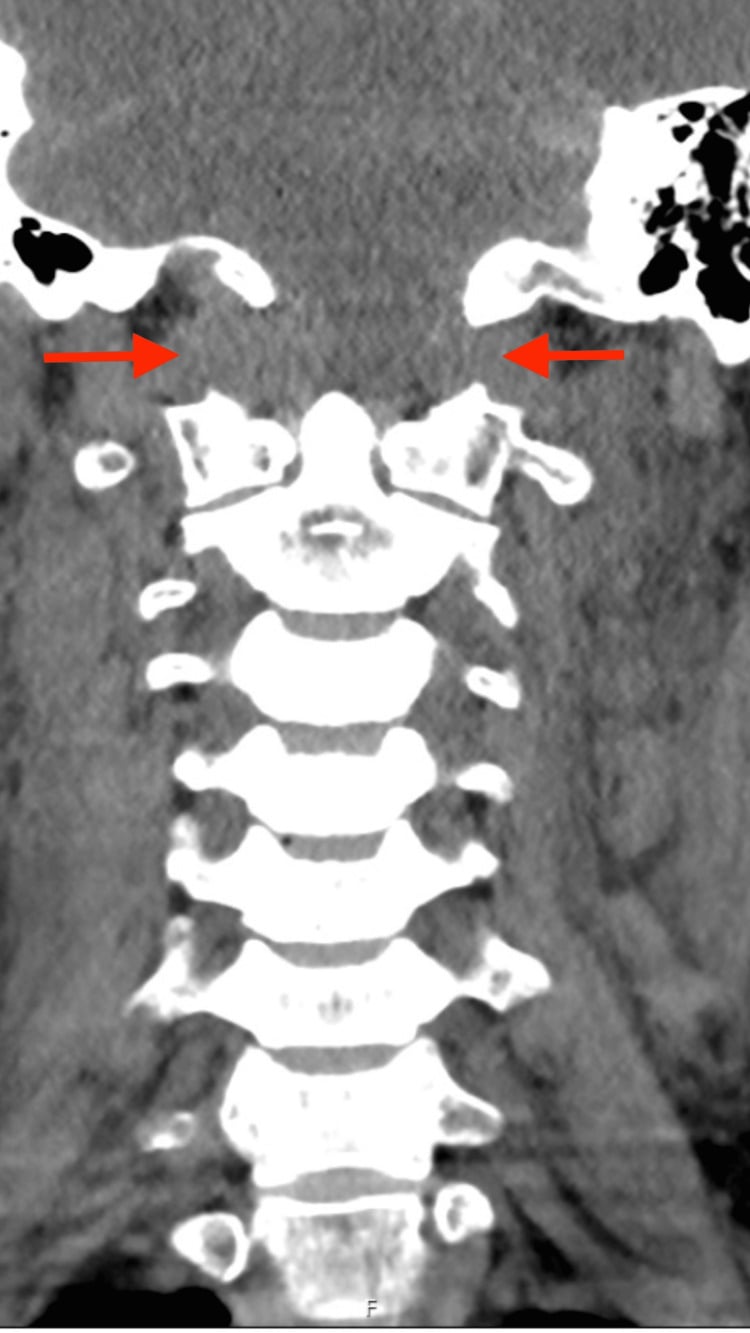
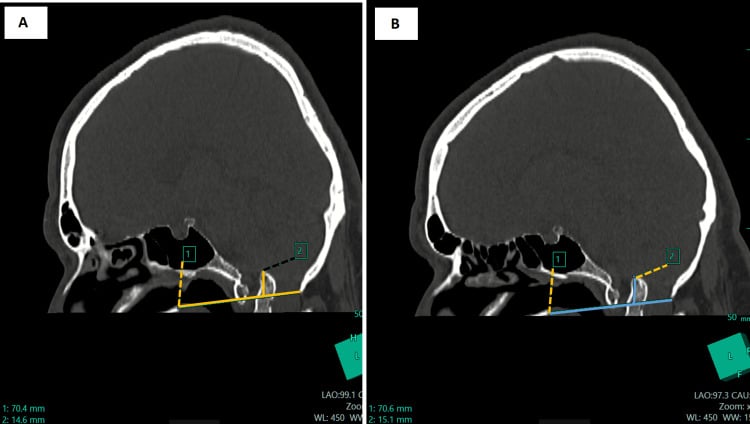
- C1-condyle interval (CCI) — the gap between the occipital condyle and the C1 lateral mass; an increased CCI is the most sensitive sign of AOD (in adults and children). Know the number, and know that it differs by age — see the box below.
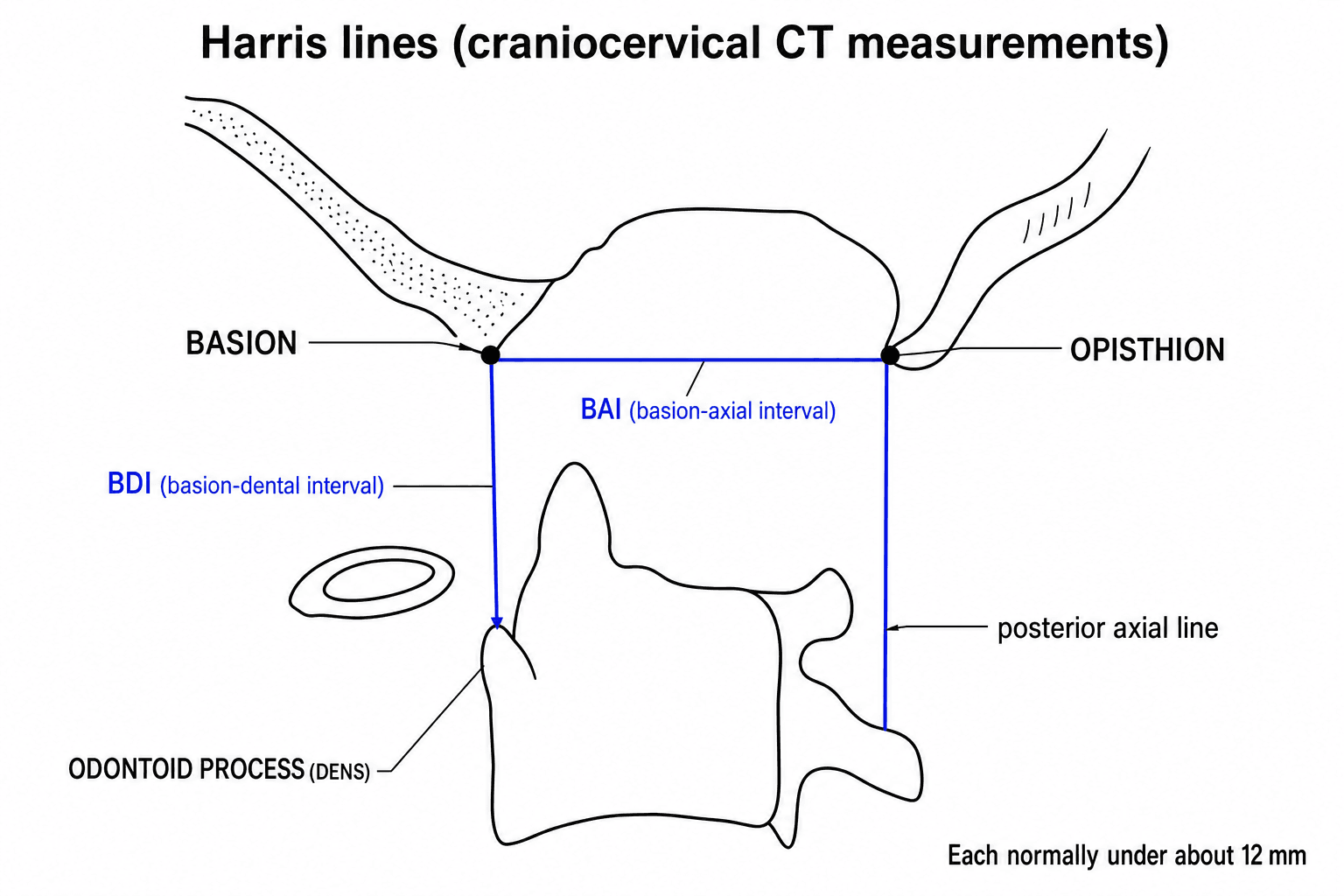
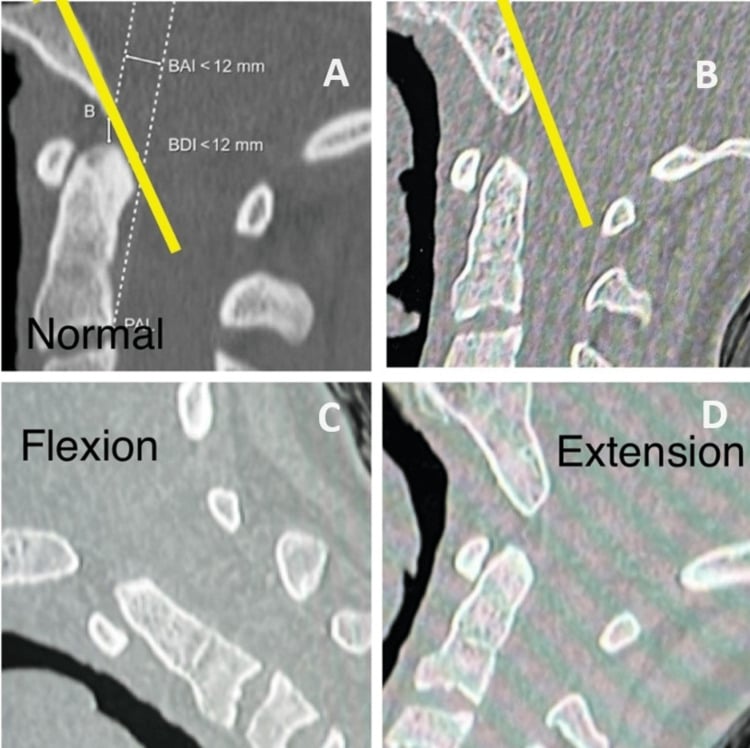
- Harris lines — the basion-dental interval (BDI) (basion to the tip of the dens) and the basion-axial interval (BAI) (basion to the posterior axial line); each should normally be under about 12 mm.
- Powers ratio (basion–posterior arch / opisthion–anterior arch) — over ~1 suggests anterior dislocation (less reliable for distraction/posterior injuries).
MRI assesses the ligaments, cord signal, oedema and epidural haematoma. Always evaluate the whole cervical spine and the neurology.
- What it assesses
- Occipital condyle to C1 lateral mass gap
- Note
- MOST SENSITIVE. Adult cutoff 1.5 mm; the paediatric cutoff is larger (~4 mm) - do NOT use the child's number in an adult
- What it assesses
- Both joints added together
- Note
- Cutoff 3.0 mm in adults; sensitivity 1 alongside the CCI, and it catches the asymmetric injury
- What it assesses
- Basion to tip of dens (Harris)
- Note
- Normally under ~12 mm - but sensitivity only 0.27, so a normal BDI does NOT exclude AOD
- What it assesses
- Basion to posterior axial line (Harris)
- Note
- Normally under ~12 mm - same poor sensitivity as the BDI
- What it assesses
- Basion–posterior arch / opisthion–anterior arch
- Note
- Over ~1 = anterior AOD. Sensitivity 0.55 - the best of the old measures and still misses nearly half
It is not enough to know that the CCI is the most sensitive measurement; you have to know what value is abnormal, and the adult and paediatric thresholds are different because the adult joint is tighter. The largest adult series measuring this (Martinez-Del-Campo, 81 patients, 22 with AOD, 1,296 individual CCI measurements, interrater reliability above 0.98) found:
- Normal adults: mean CCI 0.89 mm (SD 0.12). The single largest measurement in any healthy adult was 1.4 mm.
- Adults with AOD: mean CCI 3.35 mm (range 1.5 to 6.4 mm).
- Cutoff 1.5 mm for the CCI and 3.0 mm for the condylar sum - both with a sensitivity of 1 and a false-negative rate of 0 in that cohort.
- The authors' explicit conclusion: "The CCI is shorter in adult patients as opposed to the pediatric population."
So the trap is real and it is one-directional. The paediatric literature that made the CCI famous uses a cutoff around 4 mm. Carry that number to an adult trauma CT and a genuinely dissociated joint measuring 2 or 3 mm reads as normal - you will have applied the most sensitive test available and still missed a lethal injury.
And this is why you must not stop at the Harris lines. In the same cohort the older criteria performed poorly, which is the quantitative justification for everything above:
- Sensitivity for AOD
- 1.00
- Sensitivity for AOD
- 1.00
- Sensitivity for AOD
- 0.55
- Sensitivity for AOD
- 0.46
- Sensitivity for AOD
- 0.41
- Sensitivity for AOD
- 0.41
- Sensitivity for AOD
- 0.27
- Sensitivity for AOD
- 0.23
Read that Harris figure again: it misses roughly three AODs in four. A normal BDI and BAI is not a negative test - it is a test that was never much good on its own. Measure the condyle-C1 joints on every craniocervical trauma CT.
Traumatic atlanto-occipital dissociation is classified by the direction of occipital displacement on the atlas:
- Type I - anterior displacement (occiput translated forward on the atlas) - the commonest pattern in many series.
- Type II - longitudinal / vertical distraction (the occiput separated upward from the atlas) - the most unstable, pathognomonic pattern, and the one in which traction is most dangerous.
- Type III - posterior displacement.
The classification aids communication and flags the unstable distraction pattern, but note it did not predict mortality in the pooled data - associated traumatic brain injury was the dominant prognostic factor.
The CCI and Harris lines diagnose the occipito-atlantal (AOD) injury; the atlanto-axial axis and rheumatoid cranial settling have their own measurements:
- Anterior atlanto-dental interval (AADI) - the gap between the anterior arch of the atlas and the dens; abnormal above ~3 mm in adults (above ~5 mm in children), indicating transverse-ligament incompetence / atlanto-axial instability.
- Posterior atlanto-dental interval (PADI) - the space available for the cord behind the dens; a PADI below ~14 mm predicts neurological compromise and is the better operative indicator in rheumatoid disease (Boden) once erosion has occurred.
- Basilar invagination / cranial-settling lines - McRae (foramen magnum), Chamberlain (hard palate-opisthion) and McGregor (hard palate-occiput) lines for the dens tip, plus the Ranawat and Redlund-Johnell criteria for vertical settling.
So measure the AADI/PADI for atlanto-axial instability and the settling lines for the rheumatoid dens, alongside the CCI/Harris for AOD.
Management
In a distraction-type atlanto-occipital dissociation, cervical traction is contraindicated — it can further distract the already-disrupted junction and worsen neurological injury or cause death. Immobilise the head and neck rigidly (collar/sandbags; halo with great caution), avoid traction, and proceed to definitive stabilisation. This is a classic exam safety point.
- 1Suspect and measureIn any high-energy injury (especially a child/young adult) with neck pain or a subtle deficit, scrutinise the CT for an increased C1-condyle interval and Harris BDI/BAI; MRI for the ligaments and cord. AOD is easily missed when the bones look aligned.
- 2Immobilise rigidly — NO tractionRigid collar/sandbags; traction is contraindicated in a distraction injury. Resuscitate and protect the airway/cord.
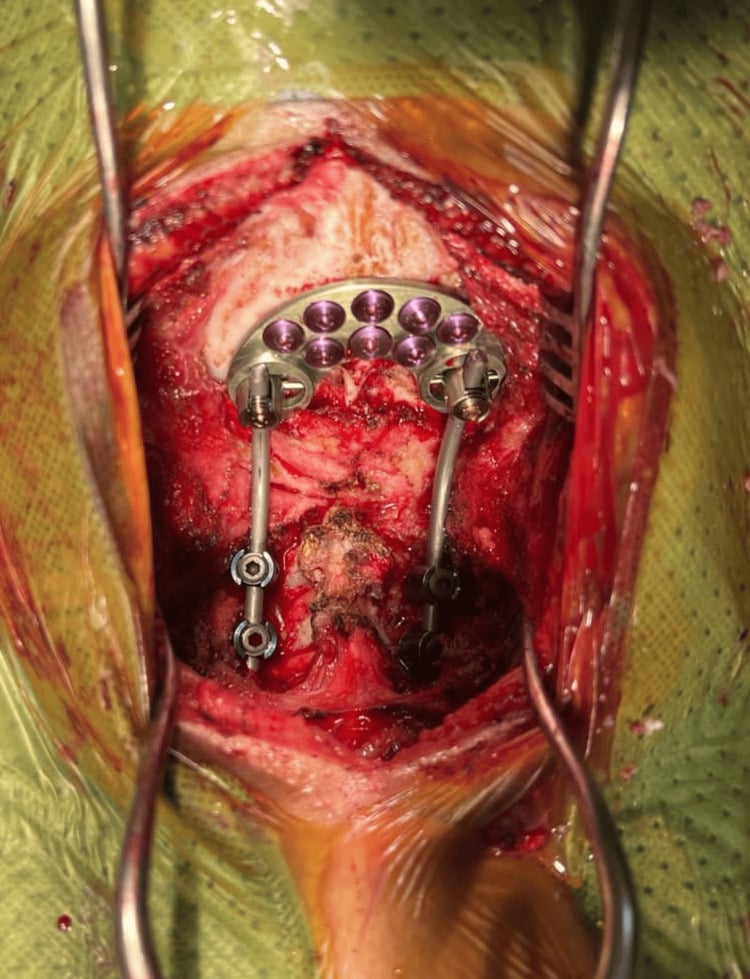
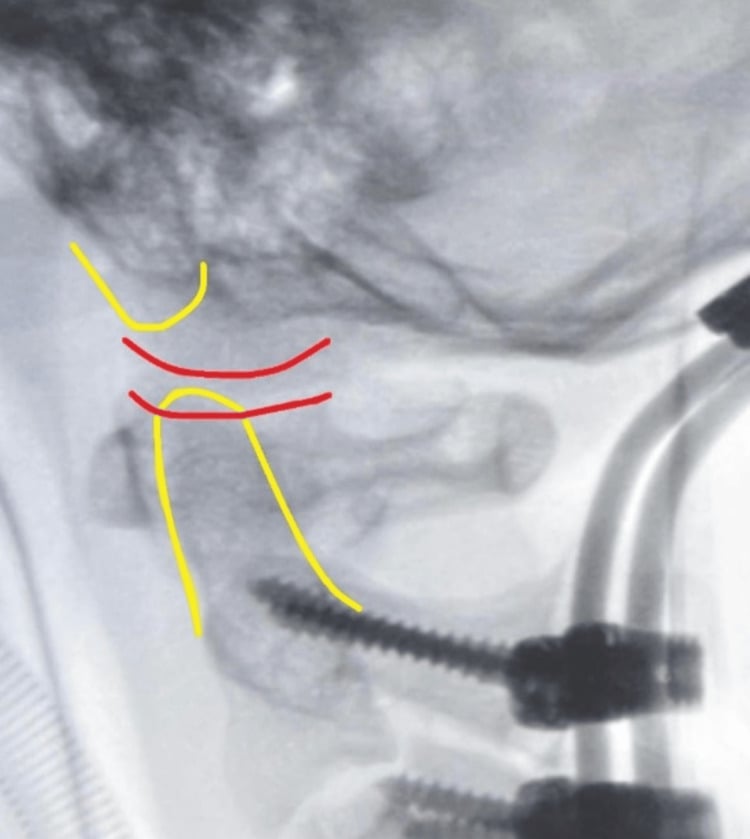
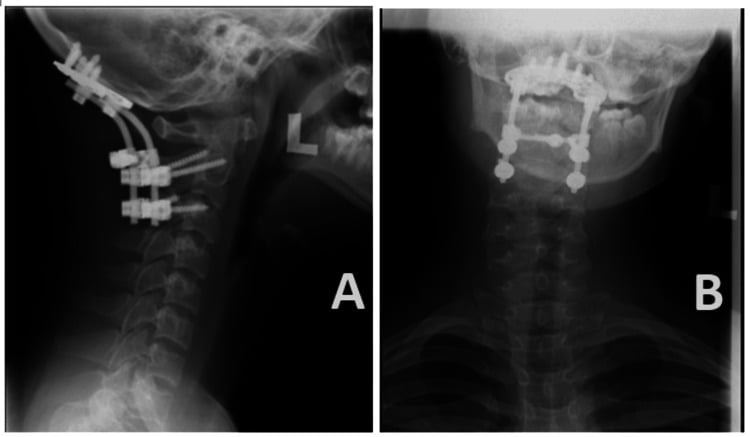
- 3Fuse the unstable junctionPosterior occipitocervical stabilisation and fusion, commonly occiput–C2, with an occipital plate and C1/C2 screw-rod construct + graft. Tailor levels: C1–C2 fusion (Goel-Harms/Magerl) for isolated atlanto-axial instability; include the occiput for occipito-atlantal disruption.
- 4Individualise the milder spectrumMilder, stable unilateral ligamentous injuries may be treated non-operatively with immobilisation and follow-up. Screen rheumatoid and Down-syndrome patients (e.g. before anaesthesia) for instability/myelopathy.
Acute distraction AOD: rigid external immobilisation (collar/sandbags; halo with great caution) and resuscitation. Traction is contraindicated in a distraction injury. This is a temporising bridge to definitive fixation, not a definitive treatment for an unstable injury.
Unstable craniocervical injury/instability is treated with posterior occipitocervical stabilisation and fusion — commonly occiput to C2 (C0–C2) — using an occipital plate and C1/C2 (± occipital) screw-rod constructs with bone graft. Isolated atlanto-axial instability (transverse-ligament rupture, os odontoideum) may be treated by C1–C2 fusion, whereas occipito-atlantal disruption requires inclusion of the occiput. In rheumatoid disease, decompression and fusion address instability/cranial settling and myelopathy. Milder, stable unilateral ligamentous injuries may be managed non-operatively. Recognising the injury early, before deterioration, is the key to survival and outcome.
Complications
- Complication
- Death / devastating cord-brainstem injury
- Note
- AOD is frequently fatal; survival hinges on early recognition before deterioration
- Complication
- Missed diagnosis
- Note
- AOD is easily missed when the bones look aligned - measure the CCI actively
- Complication
- Traction-induced over-distraction
- Note
- Applying traction to a distraction injury can worsen neurology or kill - contraindicated
- Complication
- Progressive myelopathy, cranial settling/basilar invagination
- Note
- Superior dens migration through the foramen magnum threatens the cervicomedullary cord
- Complication
- Vertebral artery injury, dural tear/CSF leak, hardware failure/nonunion
- Note
- CCJ instrumentation is technically demanding; the vertebral artery is at risk at C1-C2
- Complication
- Loss of CCJ motion
- Note
- Occipitocervical fusion sacrifices ~half of cervical rotation/flexion - counsel the patient
The two ways to kill this patient are missing the injury and applying traction to it. Measure the C1-condyle interval on every high-energy craniocervical CT, immobilise rigidly WITHOUT traction, and escalate to early occipitocervical stabilisation - deterioration can be sudden and fatal.
Mnemonics & Memory Aids
- CCJ stability is ligamentous — transverse (odontoid–atlas), alar (rotation/distraction), tectorial membrane; the bone alone is insufficient.
- AOD is highly lethal and easily missed — children predisposed; diagnose on CT (C1-condyle interval most sensitive; Harris BDI/BAI under ~12 mm; Powers ratio).
- NEVER apply traction to a distraction injury — rigid immobilisation instead.
- Atraumatic at-risk groups: rheumatoid arthritis (pannus, cranial settling), Down syndrome (laxity/os odontoideum), congenital os odontoideum/dysplasias — screen them.
- Unstable → posterior occipitocervical fusion (C0–C2); C1–C2 for isolated atlanto-axial instability.
- Milder stable unilateral injuries can be non-operative — CCJ injury is a spectrum.
CCJThe junction
Hook:CCJ: check the ligaments, CT-measure it, and (just) no traction - fuse occiput to C2.
DROPDrop the traction
Hook:DROP the traction in AOD: distraction, rheumatoid/Down at risk, occipitocervical fusion, Powers/CCI/Harris.
CRODAt-risk atraumatic groups
Hook:CROD: Congenital, Rheumatoid, Os odontoideum, Down - the atraumatic CCJ-instability groups to screen.
Viva practice
Viva practice
Practise clinical reasoning and management decisions out loud
“A young patient after a high-speed motor-vehicle collision has neck pain and a subtle neurological deficit. Why must you consider atlanto-occipital dissociation, what stabilises the craniocervical junction, and how would you diagnose it?”
“How would you manage a confirmed unstable atlanto-occipital dissociation, what must you avoid, and in which non-traumatic patients do you worry about craniocervical instability?”
Exam cheat sheet
Anatomy
- CCJ stability is LIGAMENTOUS (shallow bony joints)
- Transverse ligament (odontoid-atlas), alar (rotation/distraction), tectorial membrane
- Occiput-C1-C2 provide ~half of cervical flexion/rotation
Causes
- Traumatic: atlanto-occipital dissociation (high-energy, highly lethal, children predisposed)
- Rheumatoid arthritis: atlanto-axial instability + cranial settling/basilar invagination
- Down syndrome (laxity/os odontoideum), congenital os odontoideum, dysplasias
Diagnosis
- CT: C1-condyle interval (most sensitive), Harris BDI/BAI (under ~12 mm), Powers ratio
- MRI for ligaments/cord/oedema
- AOD frequently missed - look for it actively
Management
- Distraction AOD: NO traction - rigid immobilisation
- Unstable: posterior occipitocervical fusion (C0-C2); C1-C2 for isolated atlanto-axial
- Milder stable unilateral injuries: non-operative with follow-up; screen RA/Down before anaesthesia
Evidence Base
Atlanto-occipital dissociation
- Series of 7 AOD patients (mean age 19.6 years, all from car accidents): AOD is rare, highly unstable, with very high morbidity and mortality (4 died early during CPR; 2 more within 3 days).
- The diagnostic method of choice is CT assessment of the C1-condyle interval (CCI) together with cervical MRI.
- Standard treatment of stable patients with an unstable AOD injury is posterior occipitocervical stabilisation and fusion (C0-C2).
Computed tomography parameters for atlantooccipital dislocation in adult patients: the occipital condyle-C1 interval
- 81 adults (22 with AOD): mean occipital condyle-C1 interval (CCI) was 0.89 mm without AOD vs 3.35 mm with AOD.
- A CCI cutoff of 1.5 mm (and condylar sum 3.0 mm) gave a sensitivity of 1.0 for AOD with excellent interrater reliability.
- The older criteria were far less sensitive: Powers 0.55, Wholey 0.46, Harris 0.27, Sun 0.23, Wackenheim 0.41, Lee 0.41.
Unilateral atlanto-occipital injury: A case series and detailed radiographic description
- 8 patients with unilateral atlanto-occipital injury: all had a widened condyle-C1 interval (over 2 mm).
- Three patients were managed without surgery; there were no delayed neurologic injuries or deaths.
- The authors propose craniocervical ligamentous injury functions as a spectrum rather than a dichotomous diagnosis, a subset of which can be safely managed non-operatively.
Prognostic factors in traumatic atlanto-occipital dislocation
- Literature review of 141 traumatic AOD patients from 60 studies, analysed for predictors of mortality.
- Associated traumatic brain injury was the dominant predictor of death (OR 8.05) - patients with TBI were ~8x more likely to die.
- Spinal cord injury, age, sex, polytrauma and the Traynelis AOD classification did not reach statistical significance for mortality.
The lethality and CCI-plus-MRI diagnostic pathway come from Vachata et al. 2020 (DOI); the quantified CCI cutoff (1.5 mm, sensitivity 1.0) and the relative insensitivity of Harris/Powers from Martinez-Del-Campo et al. 2016 (DOI); the spectrum concept from Lepard et al. 2022 (DOI); and the TBI-as-prognosticator data from Fard et al. 2016 (DOI). The stabilising-ligament anatomy, the Harris lines and Powers ratio, and the no-traction caution are standard, well-established craniocervical teaching. (See also our Jefferson Fracture and Rheumatoid Cervical Spine material.)