Nutcracker Mechanism | Compression Injury | ORIF Required
- Nutcracker mechanism (the classic crush pattern) - compression between calcaneus and 4th/5th metatarsals during forced plantarflexion and abduction
- Often associated with Lisfranc injuries - Cuboid fracture suggests midfoot instability, check for Lisfranc injury
- ORIF required if displaced - Prevents lateral column shortening and midfoot collapse
- Lateral column key - Cuboid is keystone of lateral column, loss of length causes lateral foot pain and midfoot instability
- Bone graft often needed - Compression mechanism causes impaction, bone loss requires grafting
- “Nutcracker mechanism = compression between calcaneus and metatarsals
- “Often associated with Lisfranc injuries
- “ORIF required if displaced - prevents lateral column shortening
- “Bone graft often needed for impaction
Overview and Epidemiology
What it is. The cuboid sits in the lateral midfoot as the keystone of the lateral column. Its fractures are rare but important, and they are often associated with Lisfranc injuries and other midfoot trauma.
How common. Under 1% of foot fractures, with a peak at 20-40 years in the trauma population and no clear gender predominance. Those three figures are conventional teaching estimates: no cited series reports a foot-fracture denominator or an age peak. The measured distributions on this page are Fenton's five-pattern split (n=192) and Ruffing's paediatric series (n=16).
Mechanism. High-energy trauma forcing the foot into plantarflexion and abduction. The classic result is the nutcracker fracture, set out in the next section, although in Fenton's series the true crush pattern is a minority and a capsular avulsion is the commonest cuboid fracture.
Anatomy and Pathophysiology
The bone. The cuboid articulates with the calcaneus proximally, the fourth and fifth metatarsals distally, and the navicular and lateral cuneiform medially. Its blood supply comes from branches of the dorsalis pedis and lateral plantar arteries.
The lateral column. Calcaneus, cuboid and the fourth and fifth metatarsals make up the lateral column, which provides lateral foot stability and carries weight. The cuboid is its keystone and maintains its length.
The nutcracker. Hermel and Gershon-Cohen described "the nutcracker fracture of the cuboid by indirect violence" in Radiology in 1953 (PMID 13064390). When the forefoot is forcibly abducted on a fixed hindfoot, the cuboid is crushed between the anterior calcaneus behind and the bases of the fourth and fifth metatarsals in front, as a nut is cracked between the two arms of a nutcracker. The compression impacts the bone, causing bone loss and lateral column shortening.
Indirect violence. This is the load-bearing phrase. The bone fails from a force applied at a distance through the lateral column, not from a direct blow, which is why the mechanism must be reconstructed from the history and why the injury is so often missed when the foot looks unremarkable.
Why displacement matters. Displacement costs the lateral column its length. Shortening leads to midfoot collapse and instability, and a malunion leads to lateral column arthritis.
Why fixation. Anatomic reduction restores lateral column length and prevents midfoot collapse. Bone graft is often needed to fill the impaction defect.
The Lisfranc association. A cuboid fracture suggests midfoot instability, so look for a Lisfranc injury whenever the cuboid is fractured. When the midfoot is unstable, both injuries need ORIF.
Classification Systems
Fenton. The most widely cited descriptive system, derived from 192 fractures in 188 patients (Bone Joint J 2016) and based on the mechanism of injury. Avulsion is by far the commonest pattern; the classic nutcracker is Type 5.
- Proportion
- 48.4%
- Pattern
- Capsular avulsion of the calcaneocuboid joint; usually benign
- Proportion
- 13%
- Pattern
- Isolated extra-articular fracture of the body
- Proportion
- 6.8%
- Pattern
- Intra-articular fracture confined to the cuboid body
- Proportion
- 18.2%
- Pattern
- With midfoot and tarsometatarsal (Lisfranc) disruption
- Proportion
- 13.5%
- Pattern
- Mid-tarsal (Chopart) disruption with crushing of the lateral column (5a) or both columns (5b)
Displacement. Graded by articular step-off: under 2mm is non-displaced and over 2mm is displaced. Where that 2mm comes from, and how much weight it deserves, is taken up under Management.
Impaction. Impaction determines the need for bone graft.
- No impaction - a simple fracture with no bone loss; ORIF without graft, and the outcome is better than with impaction
- Impaction - compression has caused bone loss; ORIF with bone graft, and the outcome is good if length is restored
Clinical Assessment
History. Lateral foot pain after forced plantarflexion and abduction, with swelling localised to the lateral midfoot and pain on weight bearing. The risk factors are high-energy trauma, a Lisfranc injury mechanism and midfoot instability.
Examination. Swelling sits over the lateral midfoot, ecchymosis may be delayed, and a displaced fracture shows deformity from lateral column shortening. Palpation finds tenderness over the cuboid, Lisfranc joint tenderness if the injuries are associated, and lateral column instability. Midfoot movement is limited and painful, and inversion, eversion, plantarflexion and dorsiflexion all hurt.
Special tests. Cuboid fractures are often associated with Lisfranc injuries, so check for a Lisfranc injury and for midfoot instability:
- Lisfranc stress test - for midfoot instability
- Lateral column stress - pain with stress
- Midfoot alignment - for collapse
- Typical Mechanism
- Forced abduction / axial crush
- Key Clinical/Imaging Feature
- Cuboid tenderness; lateral column shortening on CT
- Discriminator
- Direct cuboid tenderness + CT fracture
- Typical Mechanism
- Axial load on plantarflexed foot
- Key Clinical/Imaging Feature
- Plantar ecchymosis; TMT diastasis on weight-bearing/CT
- Discriminator
- Instability at tarsometatarsal joints
- Typical Mechanism
- Inversion + plantarflexion
- Key Clinical/Imaging Feature
- Tenderness anterior process, dorsolateral foot
- Discriminator
- Fracture seen on oblique X-ray/CT of calcaneus
- Typical Mechanism
- Inversion injury
- Key Clinical/Imaging Feature
- Tenderness at MT base; peroneus brevis avulsion
- Discriminator
- Fracture at metatarsal base, not cuboid
- Typical Mechanism
- Inversion / eversion strain
- Key Clinical/Imaging Feature
- Retromalleolar/lateral pain, subluxation
- Discriminator
- Tenderness along tendon, no bony injury
- Typical Mechanism
- Inversion
- Key Clinical/Imaging Feature
- ATFL tenderness, normal bony exam
- Discriminator
- No midfoot bony tenderness; normal CT
Investigations
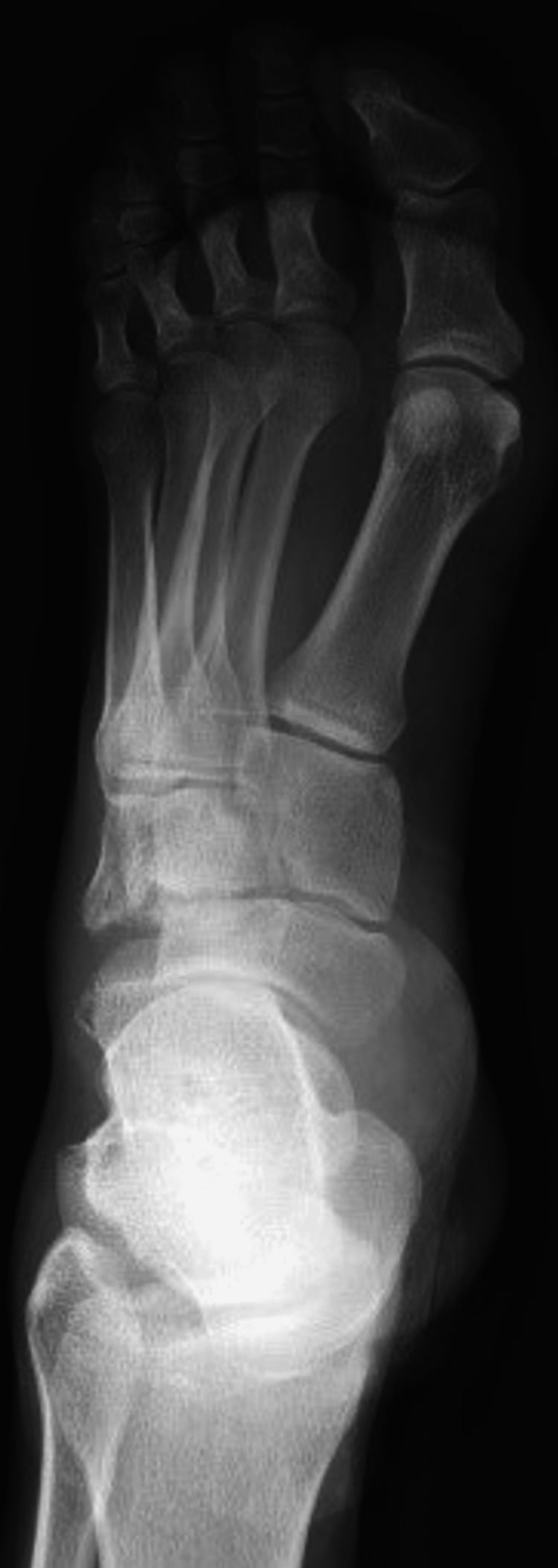
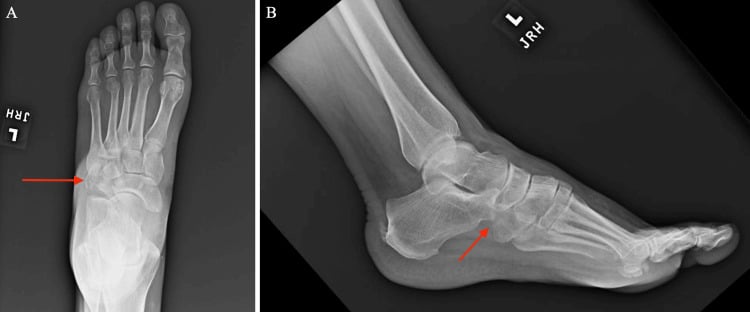
Radiographs. AP, lateral and oblique views of the foot. The fracture may show on any of them, and may show better on the oblique. Each view also has its own job:
- AP - check for a Lisfranc injury
- Lateral - lateral column alignment
- Oblique - a view of the Lisfranc joint
Why plain films are not enough. Cuboid fractures are difficult to see on X-ray alone: the fracture line lies in the lateral midfoot and can be obscured by the overlapping tarsal bones. Persistent focal cuboid tenderness with a negative or equivocal radiograph warrants CT or MRI, and oblique views and CT are obtained when pain is disproportionate or column length is uncertain.
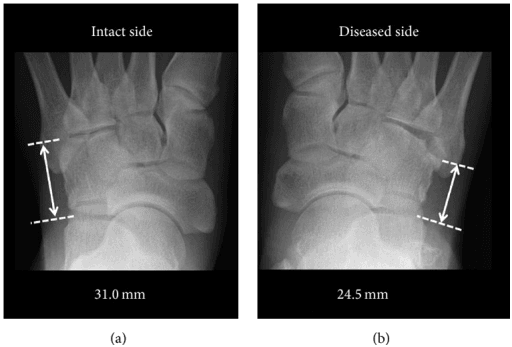
Compare with the other foot. Clinically important lateral column shortening can be difficult to appreciate on an isolated projection. Measuring the column on both sides exposes it.
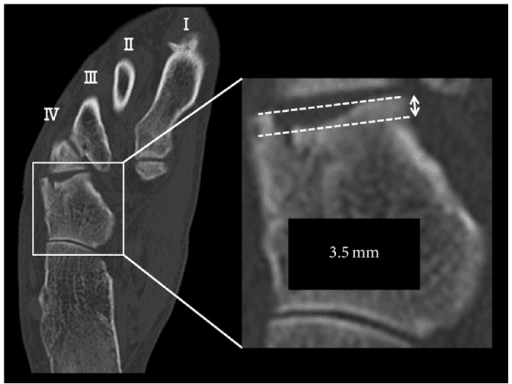
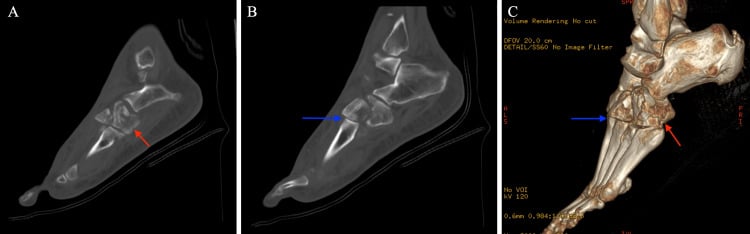
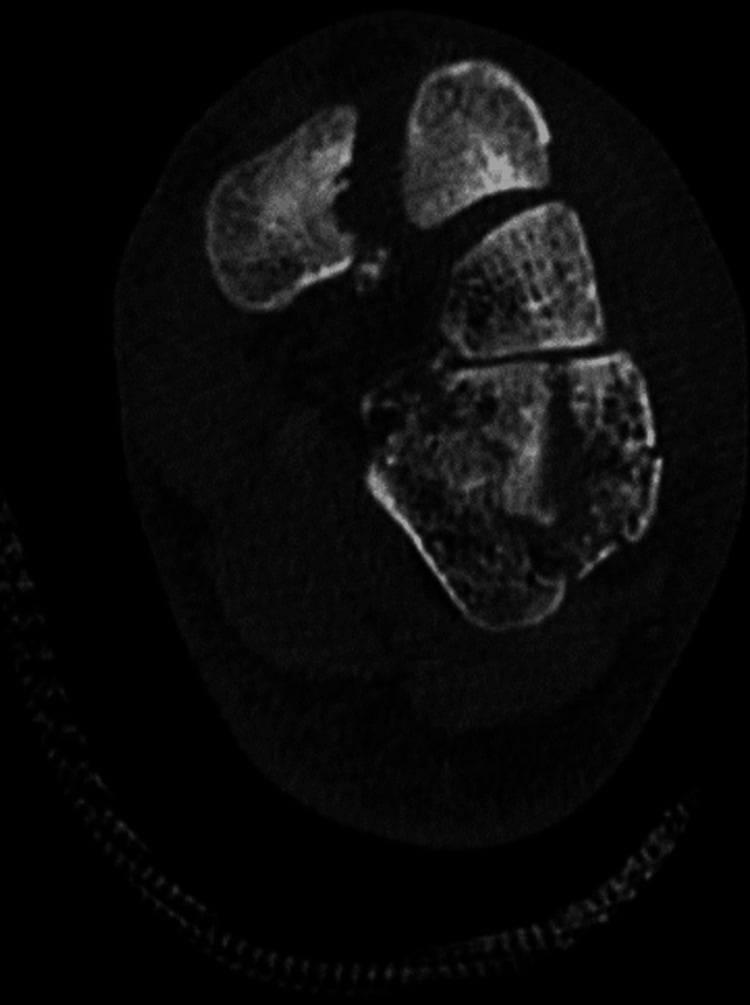
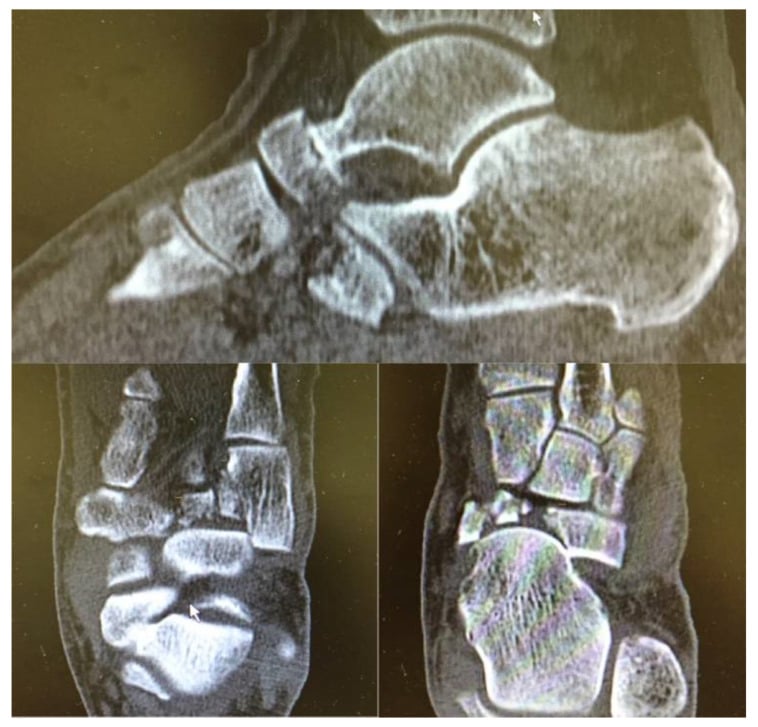
CT. CT is usually required, for diagnosis and for planning. It is recommended for a suspected cuboid fracture, an associated Lisfranc injury, or before surgery, and it is often needed to assess the cuboid and the Lisfranc injury together. It is mandatory when swelling, plantar ecchymosis or the mechanism suggests a complex Lisfranc or Chopart injury. What CT shows:
- The fracture pattern and its fragments
- Displacement, with the step-off measured
- Impaction and bone loss
- An associated Lisfranc or Chopart injury
- Lateral column length and alignment
Management Algorithm
The decision. A non-displaced, isolated fracture is treated in a cast. ORIF, for the indications below, restores lateral column length and grafts any impaction.
- Pattern
- CCJ capsular avulsion
- Treatment
- Conservative
- Key Point
- Most common; benign
- Pattern
- Extra-articular body
- Treatment
- Conservative if undisplaced
- Key Point
- Watch lateral column length
- Pattern
- Intra-articular body
- Treatment
- ORIF if step-off or displaced
- Key Point
- Restore articular congruity
- Pattern
- With TMT (Lisfranc) injury
- Treatment
- ORIF midfoot + cuboid
- Key Point
- Always check Lisfranc
- Pattern
- Nutcracker / midtarsal crush
- Treatment
- ORIF +/- graft, bridge plate/ex-fix
- Key Point
- Restore lateral column length
Where the 2mm comes from. It is the general intra-articular fracture convention applied to the cuboid, and no cuboid series has tested it. The only paper on this page that proposes a threshold is Yu, which recommends operating for articular displacement over 1mm or any column shortening, and does so from six patients. Fenton's paper recommended fixation for significant articular disruption or loss of lateral column length, but his 188-patient series describes which fractures were fixed without comparing them with fractures that were not.
How to use it. Treat 2mm as a working convention, not a validated cut-off. Let lateral column length, which every source here agrees on, carry more weight in the decision than the step-off measurement.
Non-operative. For a non-displaced fracture (under 2mm step-off) that is isolated, or where the patient prefers it. A short leg cast, non-weight bearing, for 6-8 weeks, with serial X-rays or CT to monitor healing. Expect a good result in an extra-articular fracture: it is the one pattern with reassuring published data (see Outcomes).
Operative indications. Four are absolute:
- Displacement greater than 2mm step-off
- Part of a Lisfranc injury
- Lateral column shortening
- Impaction with bone loss
Failed conservative treatment and a high-demand patient are relative indications.
Timing. Within 2 weeks if the fracture is isolated; as part of the Lisfranc ORIF if the injuries are associated.
With a Lisfranc injury. Address both injuries, fixing the cuboid as part of the Lisfranc fixation and restoring lateral column length and midfoot stability.
Counselling. Be realistic. The worst prognosis belongs to fractures that involve the midtarsal joint, and even after ORIF the largest operative series of adult nutcracker fractures reported no excellent result; the figures are set out under Outcomes.
Surgical Technique
Isolated cuboid ORIF. Through a lateral approach to the cuboid, protecting the peroneal tendons (their anatomy is set out below). Restoring length, preventing midfoot collapse and allowing early motion are what ORIF buys.
- Exposure - expose the fracture, protecting the peroneal tendons
- Debridement - remove impacted bone fragments and assess the bone loss
- Bone graft - fill the impaction defect: autograft from the calcaneus or iliac crest, allograft acceptable
- Reduction - restore lateral column length and reduce the fracture anatomically
- Fixation - screws (2.7-3.5mm) or a mini-fragment plate (2.0-2.7mm)
- Verification - confirm the reduction, hardware position and restored lateral column length on fluoroscopy, which shows length and alignment; the joint-surface reduction needs direct visualisation
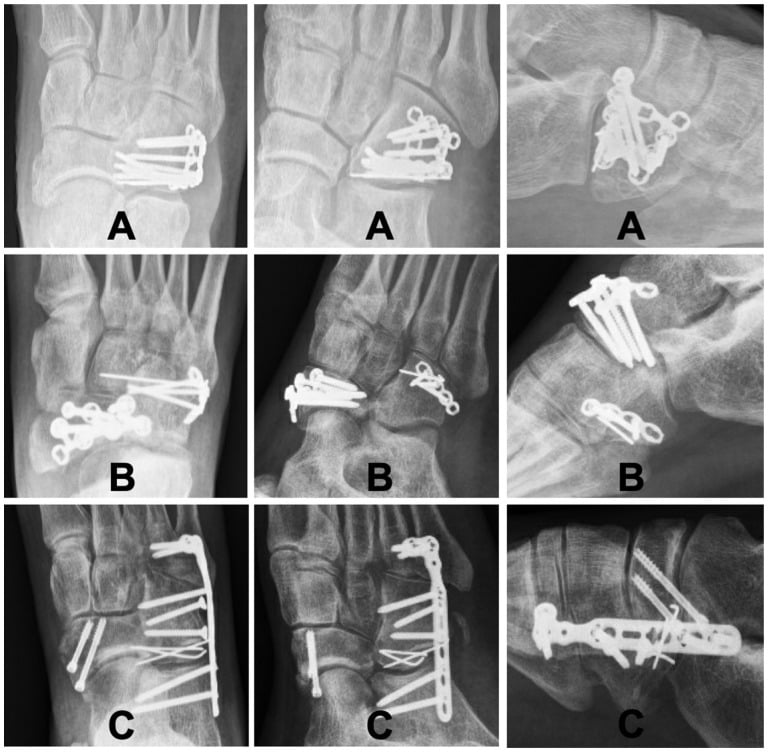
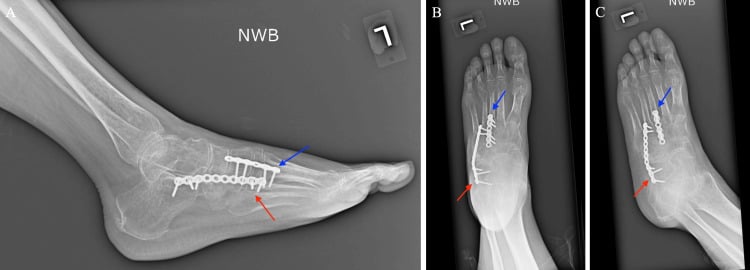
Within a Lisfranc fixation. Fixing the cuboid as part of a Lisfranc injury is the most common scenario. The Lisfranc injury is addressed first, through the primary dorsal approach, with screws or a plate. The cuboid is then exposed through a lateral approach, its length restored with bone graft if needed and fixed with screws or a plate, and both injuries are confirmed fixed with lateral column length restored.
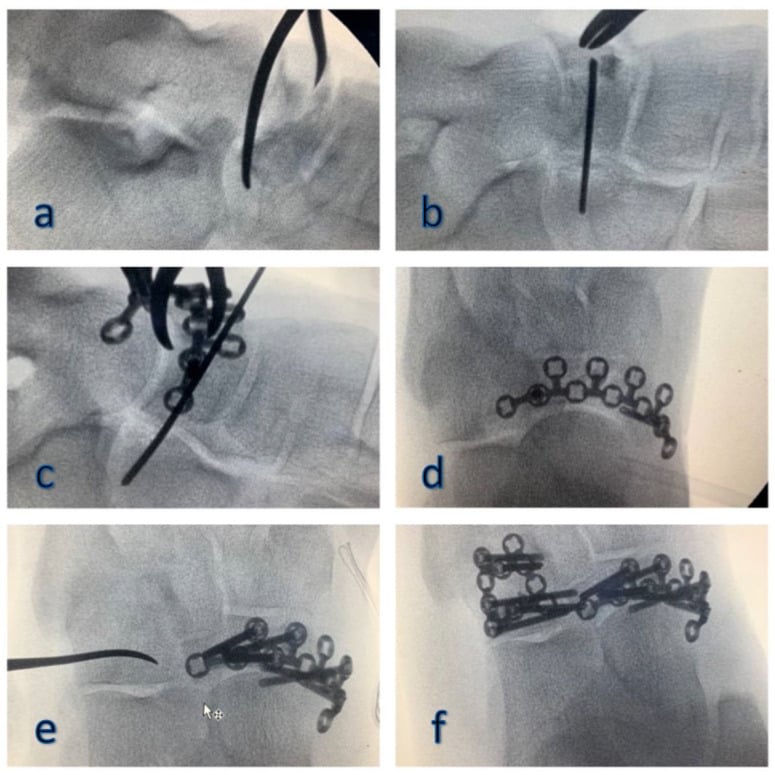
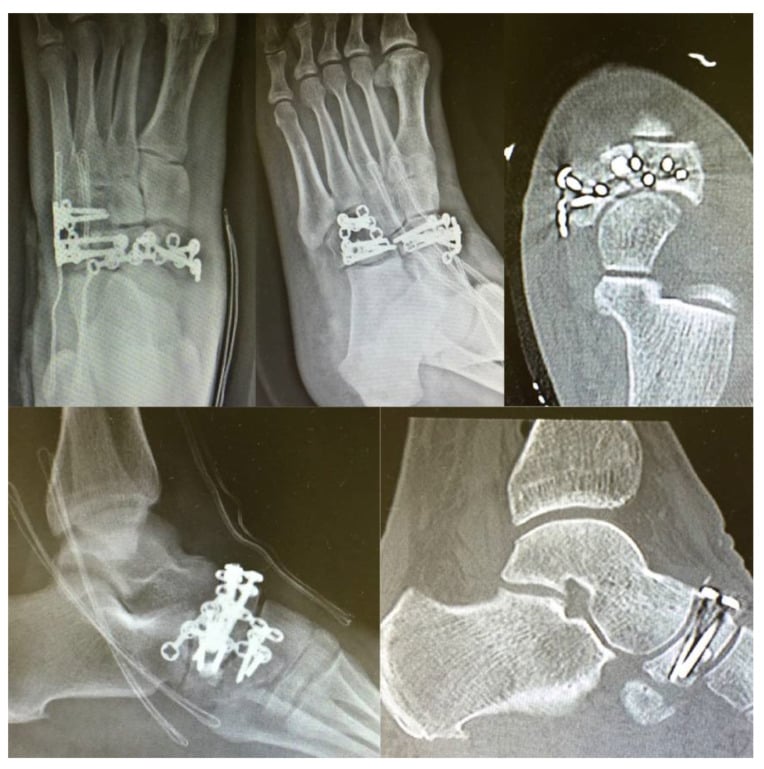
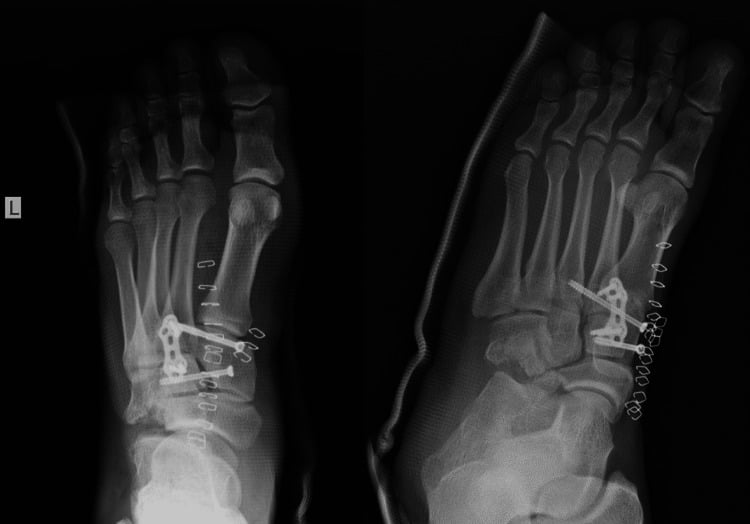
Complications
- Incidence
- 10-15%
- Risk Factors
- Impaction, inadequate reduction
- Prevention/Management
- Bone graft, restore length
- Incidence
- 10-15%
- Risk Factors
- Lateral column shortening
- Prevention/Management
- Restore length, adequate fixation
- Incidence
- Underreported
- Risk Factors
- Normal-looking plain films, focus on cuboid only
- Prevention/Management
- Routine CT; examine whole midfoot
- Incidence
- 5-10%
- Risk Factors
- Displacement, inadequate fixation
- Prevention/Management
- Rigid fixation, bone graft
The incidences are conventions. The figures in this table are conventional teaching ranges, not measured rates from a cited cohort: as the Outcomes section sets out, no cuboid series reports complication rates by treatment arm. The sourced anchors are Yu 2012 and Ruffing 2019.
Lateral column shortening. Caused by impaction, inadequate reduction and bone loss, and prevented by bone graft, restored length and adequate fixation. A symptomatic shortening is managed by revision ORIF with bone graft.
Midfoot collapse. Conventionally quoted at 10-15% if untreated, a teaching figure and not a measured cohort rate. It follows lateral column shortening or inadequate fixation, is prevented by restoring length with adequate fixation, and when severe is managed by revision ORIF or midfoot fusion.
Peroneus Longus and the Peroneal Groove of the Cuboid
Protecting the peroneal tendons is standard advice in cuboid surgery, but why the peroneus longus is uniquely at risk in these injuries rests on an anatomical relationship examiners like to probe.
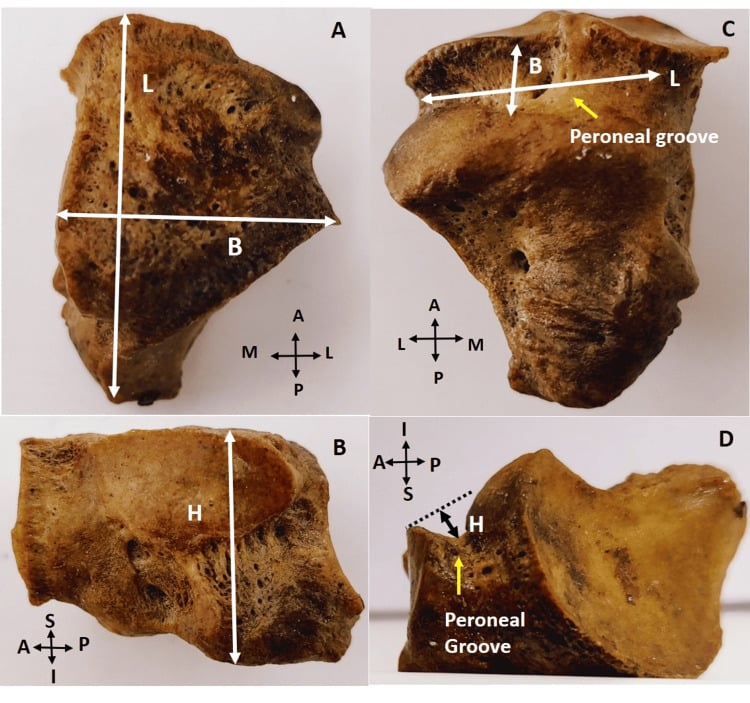
The peroneal sulcus. The cuboid carries a distinct oblique groove, the peroneal sulcus (groove), on its plantar-lateral surface, running infero-medially from the lateral margin toward the plantar tuberosity. The long plantar ligament roofs the sulcus and converts it into a fibro-osseous tunnel.
The tendons. Peroneus longus (fibularis longus) turns around the lateral cuboid and enters the sulcus to cross the sole obliquely, inserting on the plantar base of the first metatarsal and the medial cuneiform, where it is a key stabiliser of the medial (first-ray) column and the transverse arch. Peroneus brevis lies more superficially and inserts on the fifth metatarsal base.
Os peroneum. A sesamoid within the peroneus longus tendon, lying at the level of the calcaneocuboid joint in a variable minority of feet, and it may be bipartite. On radiographs it must not be mistaken for an avulsion fracture; conversely, a genuine os peroneum fracture (painful os peroneum syndrome) is a differential for lateral midfoot pain.
Injury to the tendon. Because the tendon is intimate with the plantar-lateral cuboid, plantar and lateral cuboid avulsion and crush fractures can lacerate, entrap or dislocate peroneus longus, or fracture the os peroneum. That is an overlooked cause of persistent lateral-column pain and weak eversion after apparent bony union.
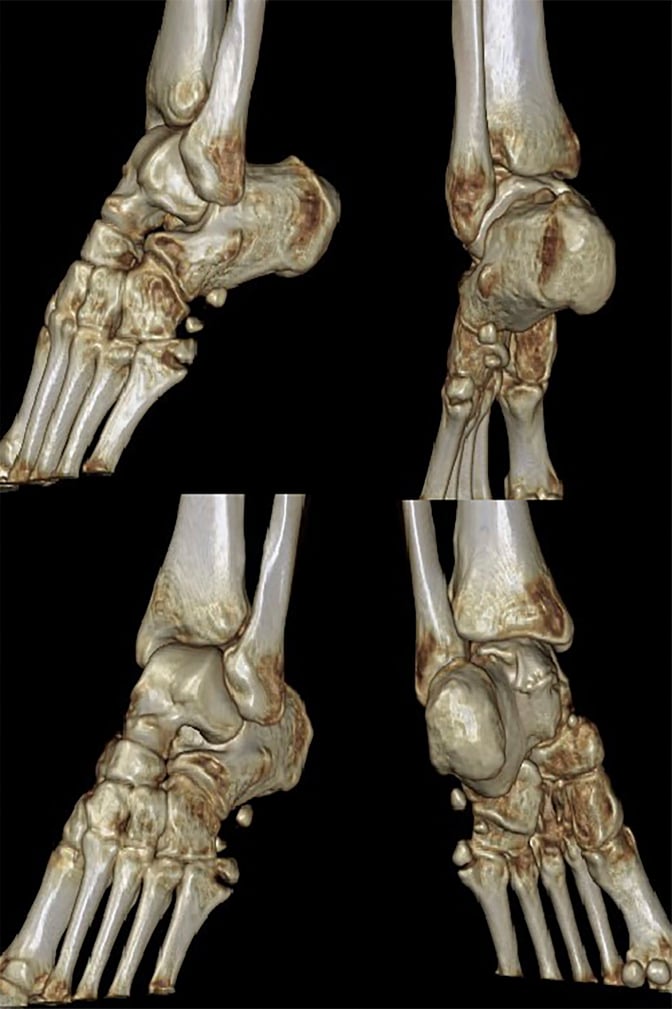
At surgery. In the lateral (Ollier-type or longitudinal) approach for cuboid ORIF, the peroneus longus and brevis tendons and the sural nerve overlie the field and must be identified and retracted. Hardware placed on the plantar-lateral surface can irritate the tendon.
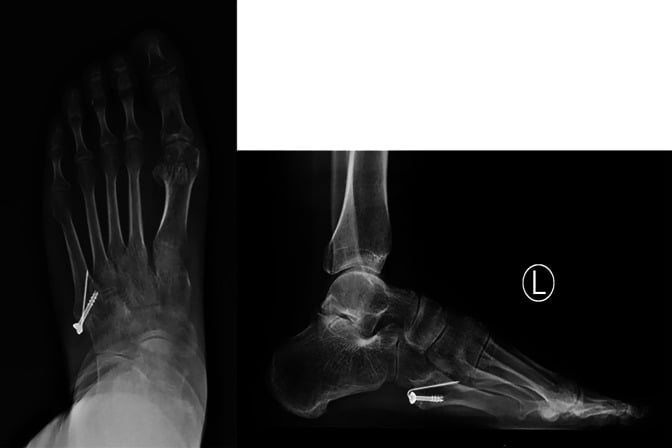
Foot Compartment Syndrome in Crush (Nutcracker) Patterns
Foot compartment syndrome is the limb-threatening companion of the crush cuboid, and formal assessment for it is recommended in exactly these high-energy patterns. A crush or nutcracker cuboid rarely occurs alone, so every high-energy midfoot injury is screened for it.
Why it happens. High-energy nutcracker and Chopart crush patterns (Fenton Type 5, and Type 4 with Lisfranc disruption) transmit large compressive and shearing loads across the midfoot. The result is marked oedema and bleeding within the osseofascial compartments of the foot, classically described as nine to ten, including the deep calcaneal compartment that communicates with the deep posterior compartment of the leg. The risk is greatest with delayed presentation, associated Lisfranc or tarsometatarsal disruption, and polytrauma.
Diagnosis. Pain out of proportion, a tensely swollen foot and pain on passive extension of the toes are the key clinical signs; pulses and capillary refill are unreliable and typically preserved. Compartment pressures support the diagnosis when the difference between diastolic blood pressure and compartment pressure (delta-p) falls to fewer than 30 mmHg, equivalently an absolute pressure within roughly 30 mmHg of diastolic.
Treatment. Emergent foot fasciotomy, commonly through two dorsal incisions over the second and fourth intermetatarsal spaces, with a medial incision added to release the calcaneal and deep compartments if pressures remain elevated.
The cost of missing it. Ischaemic contracture with claw-toe deformity, intrinsic muscle fibrosis, chronic pain and sensory loss. That is a far worse outcome than the fracture itself, and it outweighs any benefit from a perfect cuboid reduction.
Postoperative Care
Postoperative Protocol
- Short leg cast, strict non-weight bearing
- Elevation to reduce swelling
- Ankle ROM exercises (if fixation stable)
- CT to confirm healing (union and maintained lateral column length)
- Cast removal if healed; transition to walking boot
- Progressive weight bearing
- Full weight bearing in boot, then wean to normal shoes
- Midfoot ROM and strengthening with physiotherapy
- Progressive activity; return to sport at 3-4 months
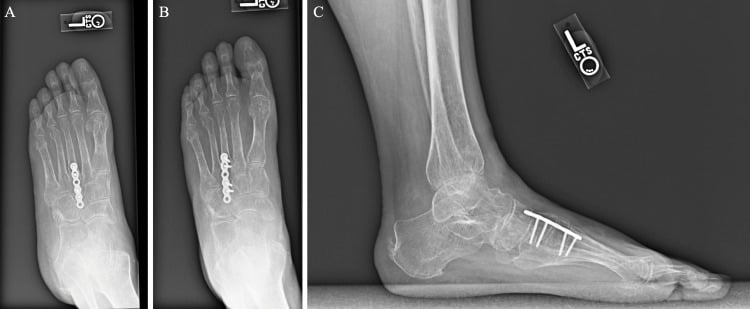
Outcomes and Prognosis
What the literature contains. There is no comparative outcome study of cuboid fracture, and no series large enough to give a success rate for any treatment arm. Percentages quoted for "cuboid fracture outcome" in review articles and algorithms are conventions, not measurements. The published figures, in full, are these:
- Patients
- 6
- Outcome reported
- 2 good, 4 fair, none excellent
- Patients
- 11
- Outcome reported
- mean AOFAS Midfoot 100
- Patients
- 2
- Outcome reported
- mean AOFAS Midfoot 95
- Patients
- 3
- Outcome reported
- mean AOFAS Midfoot 66
- Patients
- 188
- Outcome reported
- no outcome data - a classification series
- Patients
- 58 papers, 36 case reports
- Outcome reported
- no pooled outcome possible
Read the pattern, not the percentage. Every source agrees on the same gradient: an extra-articular cuboid fracture does well, an intra-articular one does less well, and involvement of the midtarsal joint or loss of lateral column length is what turns a nuisance injury into a poor foot. That gradient is the prognostic information worth giving a patient. The denominators behind it are 6, 11, 2 and 3, and Ruffing's children were followed for a mean of nine years.
Long-term shortening. Progression of lateral column shortening is conventionally quoted at 10-15% with proper treatment and 20-30% without; impaction, displacement and delayed treatment are the risk factors. These are teaching figures, not measurements, and the table above shows why: no cuboid cohort reports shortening rates by treatment arm.
Guidelines, Registries & Global Practice
Global Epidemiology
- Cuboid fractures account for under 1% of all foot fractures; isolated cuboid fractures are rarer still, as most occur within a midtarsal (Chopart) or tarsometatarsal injury.
- In the largest series (Fenton 2016, n=192), capsular avulsion (Type 1) made up nearly half of all cuboid fractures, while true crush "nutcracker" patterns were a minority (~14%).
- Paediatric distribution differs - extra-articular body fractures predominate and grafting is rarely required (Ruffing 2019).
Guideline and Society Positions (side by side)
- Emphasis
- Lateral column integrity
- Practical Recommendation
- Restore and maintain lateral column length; bridge/span comminution if needed
- Emphasis
- Soft-tissue first, CT for midfoot
- Practical Recommendation
- Low threshold for CT in suspected midfoot injury; senior decision-making for operative cases
- Emphasis
- Articular congruity and function
- Practical Recommendation
- Fix displaced intra-articular fractures; AOFAS Midfoot score used for outcome reporting
- Emphasis
- Treat within Chopart spectrum
- Practical Recommendation
- Early anatomical reduction, exclude compartment syndrome, ORIF for displaced patterns
Note: there is no dedicated high-level guideline specific to cuboid fractures. Practice is extrapolated from midfoot/Chopart injury principles. No national joint registry captures cuboid fracture fixation (registries track arthroplasty, not midfoot trauma).
High- vs Limited-Resource Practice
- Routine CT for suspected midfoot injury and pre-operative planning
- Locking plates, mini-fragment systems and bone substitutes readily available
- Early ORIF for displaced/crush patterns
- Reliance on plain radiographs (oblique views) and clinical examination; risk of missed injuries
- Greater use of K-wires, external fixation and autograft (e.g. local calcaneal/iliac crest) where implants are scarce
- Threshold for transfer/referral when crush patterns or compartment syndrome are suspected
Cuboid fractures are a common viva topic. Anchor your answer to the Fenton classification (avulsion most common; nutcracker/Type 5 is the crush pattern), the nutcracker mechanism (forced abduction compressing the cuboid between calcaneus and 4th/5th metatarsals), the imperative to restore lateral column length and exclude an associated Lisfranc/midtarsal injury, and the role of CT in diagnosis and planning.
Controversies and Areas of Uncertainty
The evidence base is limited to small retrospective series and case reports, so several questions remain genuinely unresolved:
No agreed numeric threshold exists. Reported indications range from articular displacement over 1 mm (Yu, Acta Orthop Belg 2012) to any loss of lateral column length (Fenton 2016). The pragmatic consensus is that lateral column shortening or intra-articular incongruity - not an arbitrary millimetre cut-off - drives the decision to operate.
Screws, mini-fragment plates, locking plates, bridging plates and external fixation have all been described. Comminuted crush patterns may need a bridging/spanning construct to hold length; simpler patterns suit direct fixation. No comparative data favour one construct.
Impaction voids have been filled with autograft, allograft and synthetic substitutes. Children frequently need no graft (Ruffing 2019). There is no evidence that one void filler is superior.
Arthroscopic-assisted elevation with percutaneous void filling has been reported successfully (Ohmori 2016), but remains anecdotal. Its role versus open reduction is undefined.
MCQ Practice Points
Q: What is the nutcracker mechanism for cuboid fractures? A: Compression between calcaneus and 4th/5th metatarsals - During forced plantarflexion and abduction. Causes impaction and bone loss. Often associated with Lisfranc injuries.
Q: Why are cuboid fractures often associated with Lisfranc injuries? A: Cuboid fracture suggests midfoot instability - in the Fenton series roughly one in five cuboid fractures (Type 4, ~18%) involved a tarsometatarsal (Lisfranc) injury, and Type 5 added midtarsal disruption. Always check for an associated Lisfranc/midtarsal injury; both require ORIF.
Q: Why is the cuboid important for lateral column stability? A: Cuboid is keystone of lateral column - Loss of length causes lateral column shortening and midfoot collapse. ORIF required if displaced to restore length. Bone graft often needed for impaction.
Q: When is ORIF required for cuboid fractures? A: Displacement greater than 2mm or part of Lisfranc injury - Prevents lateral column shortening and midfoot collapse. Bone graft needed for impaction. Know that the 2mm is convention, not a validated cuboid threshold - Yu proposed 1mm from six patients - and that lateral column length matters more than the step-off.
Q: Why is bone graft often needed for cuboid fractures? A: Compression mechanism causes impaction and bone loss - Bone graft required to restore lateral column length. Autograft from calcaneus or iliac crest. Prevents lateral column shortening.
Exam Viva Scenarios
Practise clinical reasoning and management decisions out loud
“A 30-year-old patient presents with lateral foot pain after forced plantarflexion and abduction injury. CT shows displaced cuboid fracture with 3mm displacement and impaction. No associated Lisfranc injury.”
“A 35-year-old patient has a cuboid fracture as part of a Lisfranc injury. The examiner asks you to explain how you manage both injuries.”
“A 28-year-old is reviewed in fracture clinic two weeks after an inversion ankle injury. Foot radiographs were reported as normal in the emergency department, but he has persistent, well-localised lateral midfoot pain and tenderness over the cuboid. How do you proceed?”
Key Concepts
- Nutcracker mechanism = compression between calcaneus and 4th/5th metatarsals
- Associated tarsometatarsal/midtarsal injury in a substantial minority (Fenton Type 4 ~18%, Type 5 ~14%)
- Cuboid is keystone of lateral column
- ORIF required if displaced (restores lateral column length)
Classification
- Fenton Type 1 (~48%): CCJ capsular avulsion - conservative
- Fenton Type 2 (~13%): extra-articular body - conservative if undisplaced
- Fenton Type 3 (~7%): intra-articular body - ORIF if displaced
- Fenton Type 4 (~18%): with tarsometatarsal (Lisfranc) injury - ORIF midfoot + cuboid
- Fenton Type 5 (~14%): nutcracker / midtarsal crush - ORIF +/- graft, restore length
Treatment
- Non-displaced, isolated: Conservative (cast, NWB 6-8 weeks)
- Displaced, isolated: ORIF with bone graft if impaction - counsel that the only adult series reported 2 good and 4 fair in 6
- Part of Lisfranc or midtarsal: ORIF as part of the whole injury - the worst prognostic group
- Displacement greater than 2mm: ORIF required
Surgical Technique
- Lateral approach: Protect peroneal tendons
- Debride impacted bone, assess bone loss
- Bone graft: Fill impaction defect (autograft from calcaneus or iliac crest)
- Fixation: Screws (2.7-3.5mm) or mini-fragment plate (2.0-2.7mm)
- Restore lateral column length
- Verify reduction fluoroscopically
Complications
- Lateral column shortening: 10-15% conventional range with treatment (prevent with bone graft, restore length)
- Midfoot collapse: 10-15% conventional range if untreated (prevent with adequate fixation)
- Missed associated injury: Lisfranc/midtarsal/navicular often overlooked (prevent with routine CT)
- Nonunion: 5-10% conventional range (prevent with rigid fixation, bone graft)
Evidence Base
The literature on cuboid fractures is dominated by small retrospective series and case reports - there are no randomised trials. The strongest single dataset is the Fenton classification series of 192 fractures. Treatment principles (restore lateral column length, fix displaced intra-articular fractures, always exclude associated Lisfranc/midtarsal injury) are consistent across all reports.
Fenton Classification of Cuboid Fractures (landmark series)
- Largest cuboid fracture series (n=192) - basis of the standard classification
- Avulsion (Type 1) is by far the most common pattern (~48%)
- Only a minority are true crush/nutcracker (Type 5, ~14%)
- Indications for fixation: articular disruption or lateral column shortening
Nutcracker Fracture: ORIF + Graft Restores Lateral Column
- All nutcracker fractures had lateral column shortening
- Surgical threshold proposed: articular displacement over 1 mm or any column shortening
- Allograft used to fill impaction defects
- Outcomes good-to-fair - reflects difficulty of these injuries