Posterolateral Most Common | LCL Always Injured | Early Motion Essential
- Posterolateral is the most common direction (90%)
- LCL complex always injured - primary lateral restraint
- Simple dislocations usually stable after reduction
- Complex patterns - terrible triad, coronoid, Monteggia variant
- Early motion is essential to prevent stiffness
- “LCL fails first, then anterior capsule, then MCL (outside-to-inside pattern)
- “Simple dislocations: if stable through 30-130° = non-operative
- “Check for associated fractures - radial head, coronoid are commonly missed
- “PLRI (posterolateral rotatory instability) is chronic sequela of LCL injury
Overview and Epidemiology
The elbow is the second most common large joint to dislocate, after the shoulder. The injuries it produces range from simple ligamentous injuries to complex fracture-dislocations with significant instability.
Mechanism. A fall on the outstretched hand with the elbow slightly flexed. The axial load arrives with a valgus and supination moment, which drives the ulna posterolaterally on the humerus, and that is why posterolateral displacement is the commonest pattern.
- FOOSH - the most common mechanism
- Direct trauma - less common
- Sports injuries - common in young adults
- Motor vehicle accidents - often high-energy, with complex patterns
Simple or complex. Simple means ligament injury with no fracture; complex means a fracture as well, and takes in the terrible triad, radial head fracture-dislocation, coronoid fracture-dislocation and the transolecranon pattern. The division decides the treatment and most of the prognosis, which is why it is the first thing said about any dislocated elbow.
Anatomy and Biomechanics
The bony architecture. The ulnohumeral joint is the primary source of stability and works as a hinge; the radiocapitellar joint is a secondary stabiliser. The trochlea sits in the greater sigmoid notch, buttressed in front by the coronoid and behind by the olecranon, so the notch is a socket for only as long as both of its walls are intact.
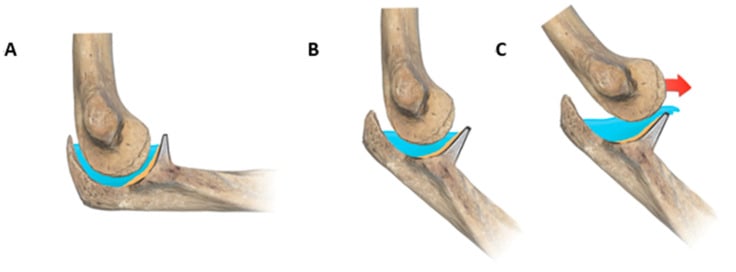
Why the elbow comes out. A semi-flexed elbow is the vulnerable one. As the trochlear centre rises relative to the coronoid buttress, a smaller posteriorly directed force is enough to lever the ulna out of the joint.
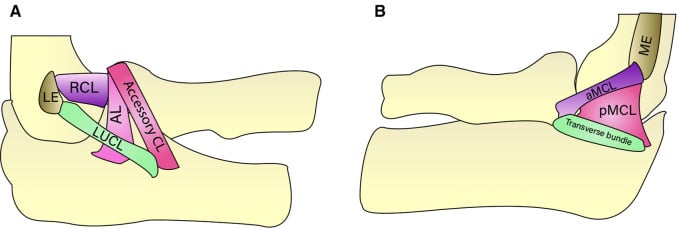
The lateral collateral complex. The lateral ulnar collateral ligament (LUCL) is the component that matters: it runs from the lateral epicondyle to the supinator crest of the ulna and is the primary restraint to posterolateral rotatory instability. The radial collateral ligament blends with the annular ligament, and the annular ligament holds the radial head to the ulna.
The medial collateral complex. Here the anterior bundle is the important one, running from the medial epicondyle to the sublime tubercle as the primary valgus stabiliser. The posterior bundle tightens in flexion, and the transverse ligament contributes little.
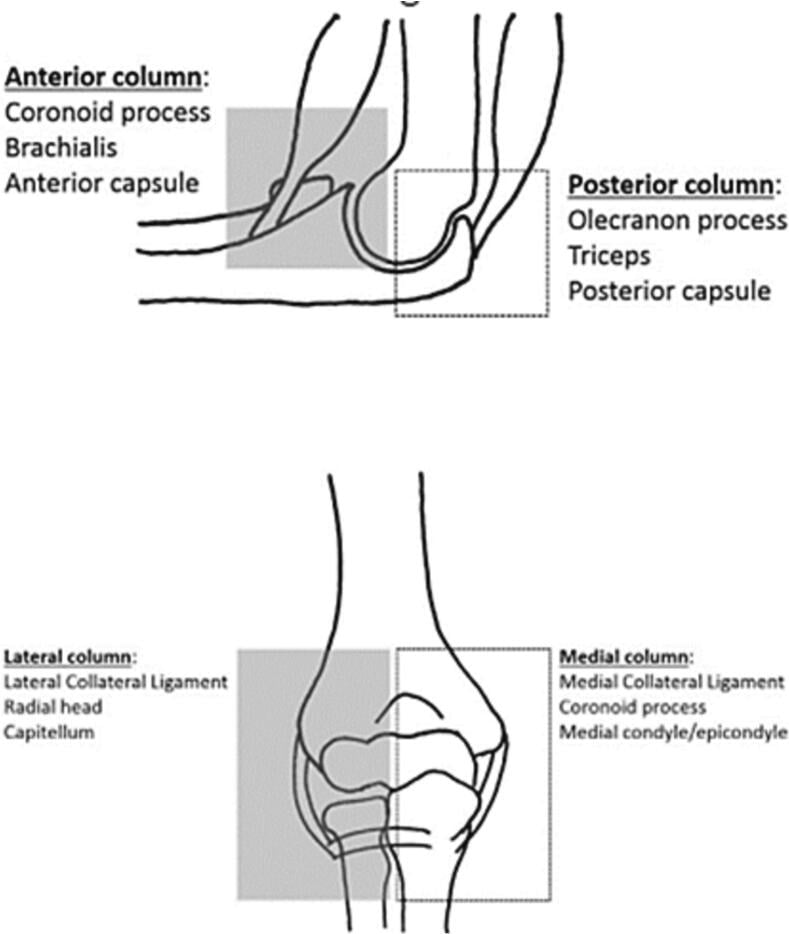
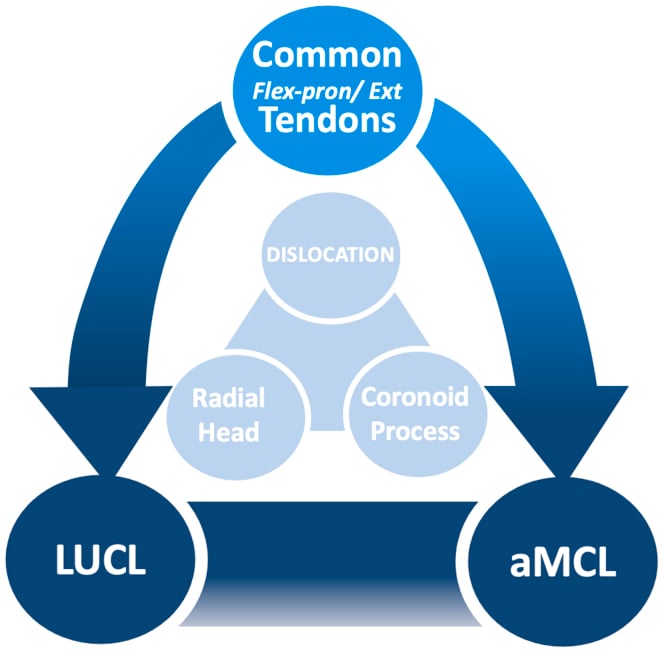
Static and dynamic. The ligaments and the bony congruity are the static stabilisers. The muscles crossing the joint - triceps, biceps, brachialis and the flexor and extensor origins - are the dynamic ones. The column model below groups the two kinds together: the anterior and posterior columns contain the coronoid, olecranon, capsule, brachialis and triceps, the lateral and medial columns the radial head, collateral ligament complexes, coronoid and flexor-pronator or extensor origins.
The Horii circle. O'Driscoll's account of how the soft tissue fails: disruption travels from lateral to medial, taking the LCL complex first, then the anterior and posterior capsule, then the MCL. Two things follow. The LCL complex is always injured in a posterolateral dislocation, and how far round the circle the injury has travelled is exactly what the O'Driscoll stages number.
Classification Systems
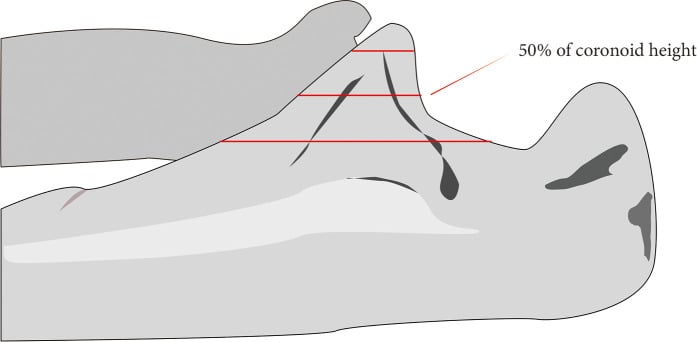
The classifications answer different questions, and an examiner will want all of them: whether a bone is broken, which way the ulna went, how far round the soft-tissue circle the injury travelled, and what shape the coronoid fragment is.
The primary division, and the one that sets both the treatment and the prognosis.
- Definition
- No fracture, ligament injury only
- Incidence
- 50-60%
- Definition
- With associated fracture(s)
- Incidence
- 40-50%
Simple. Ligamentous injury alone, usually stable after closed reduction, and with an excellent prognosis provided motion starts early.
Complex. A fracture as well as the dislocation - the terrible triad, a radial head pattern, a coronoid pattern or a transolecranon injury. Usually operative, and with higher complication rates.
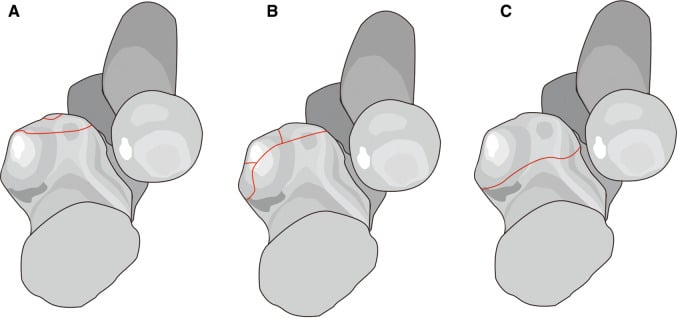
Clinical Presentation and Assessment
History. Ask the mechanism and whether the elbow reduced itself before arrival. Then the time since injury, any previous elbow problem, and hand dominance and occupation.
Examination. The limb is held deformed with the olecranon prominent behind, and the diagnosis is rarely the difficulty; what gets missed is everything that should be recorded beside it. These go in the notes, and the first of them twice, before and after the manipulation:
- Neurovascular status - median, ulnar and radial nerves, and the brachial artery
- Skin integrity - open or closed
- Associated injuries - the rest of the ipsilateral limb
- Deformity pattern - it predicts the direction
The nerve and the vessel. The ulnar nerve is the one most commonly injured, and its paraesthesiae are usually transient and settle with reduction. Brachial artery injury is rare but does happen, particularly with an anterior or an open dislocation.
- Significance
- Unreduced dislocation
- Action
- Assess NV, reduce urgently
- Significance
- Posterior dislocation
- Action
- Confirm with X-ray, reduce
- Significance
- Arterial injury/kinking
- Action
- Urgent reduction
- Significance
- Nerve injury/entrapment
- Action
- Document, usually resolves with reduction
- Significance
- Open dislocation
- Action
- Antibiotics, urgent OR
- Significance
- High energy, compartment risk
- Action
- Monitor compartments
What else it could be. A deformed, painful elbow that has already reduced, or one whose films are hard to read, is where the mimics live. Each has its own discriminating feature and its own confirmatory test.
- Discriminating feature
- Loss of normal three-point bony relationship; ulna posterior to trochlea, no fracture
- Key investigation
- AP and lateral radiograph
- Discriminating feature
- Dislocation PLUS radial head and/or coronoid and/or olecranon fracture
- Key investigation
- Radiograph + CT for fragment characterisation
- Discriminating feature
- Deformity with crepitus; intact ulnohumeral articulation on lateral film, fracture line proximal to joint
- Key investigation
- Radiograph (look for fat-pad sign, fracture proximal to joint)
- Discriminating feature
- Localised lateral tenderness, painful rotation, joint reduced and congruent
- Key investigation
- Radiograph; radiocapitellar (Greenspan) view
- Discriminating feature
- Arm held pronated and slightly flexed, refusal to use; normal radiograph
- Key investigation
- Clinical; radiograph usually normal
- Discriminating feature
- Fever or no clear trauma, global swelling, congruent joint on film
- Key investigation
- Aspiration, inflammatory markers
- Discriminating feature
- Recurrent clicking/giving way, positive pivot-shift, reduced at rest
- Key investigation
- Stress radiographs / examination under anaesthesia
Investigations
Before reduction. Get an AP and a lateral, accepting that a true view is often impossible through the deformity. They confirm the dislocation and its direction, show any associated fracture of the radial head or coronoid, and show where a displaced fragment has come to lie.
Do not delay reduction waiting for imaging if neurovascular compromise is present. A single lateral view can confirm dislocation. Reduce urgently, then obtain post-reduction imaging.
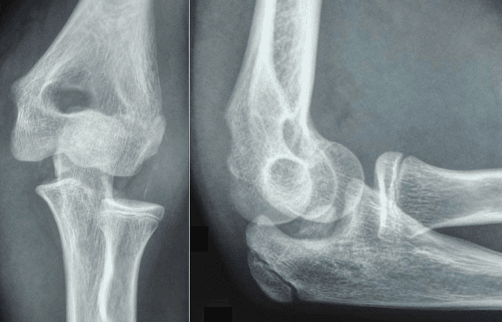
After reduction. Repeat the AP and lateral and read them properly, because this is where a simple dislocation gets reclassified as complex:
- Radial head fracture - often subtle
- Coronoid fracture - usually visible on the lateral
- Joint widening - suggests an interposed fragment
- Radiocapitellar alignment - the test of a truly concentric reduction
CT. Get one when the plain films leave a question:
- A suspected associated fracture that is not clear on radiographs
- A complex dislocation pattern
- Surgical planning
- Any joint incongruency on plain films
It characterises the radial head and coronoid fractures, counts and sizes the fragments, and picks up the associated injuries.
Management
The decision. Reduce the elbow, then answer two questions: is a bone broken, and will the joint stay in? The answers sort the patient into one of three groups - stable simple, unstable simple, or complex - and each has its own pathway.
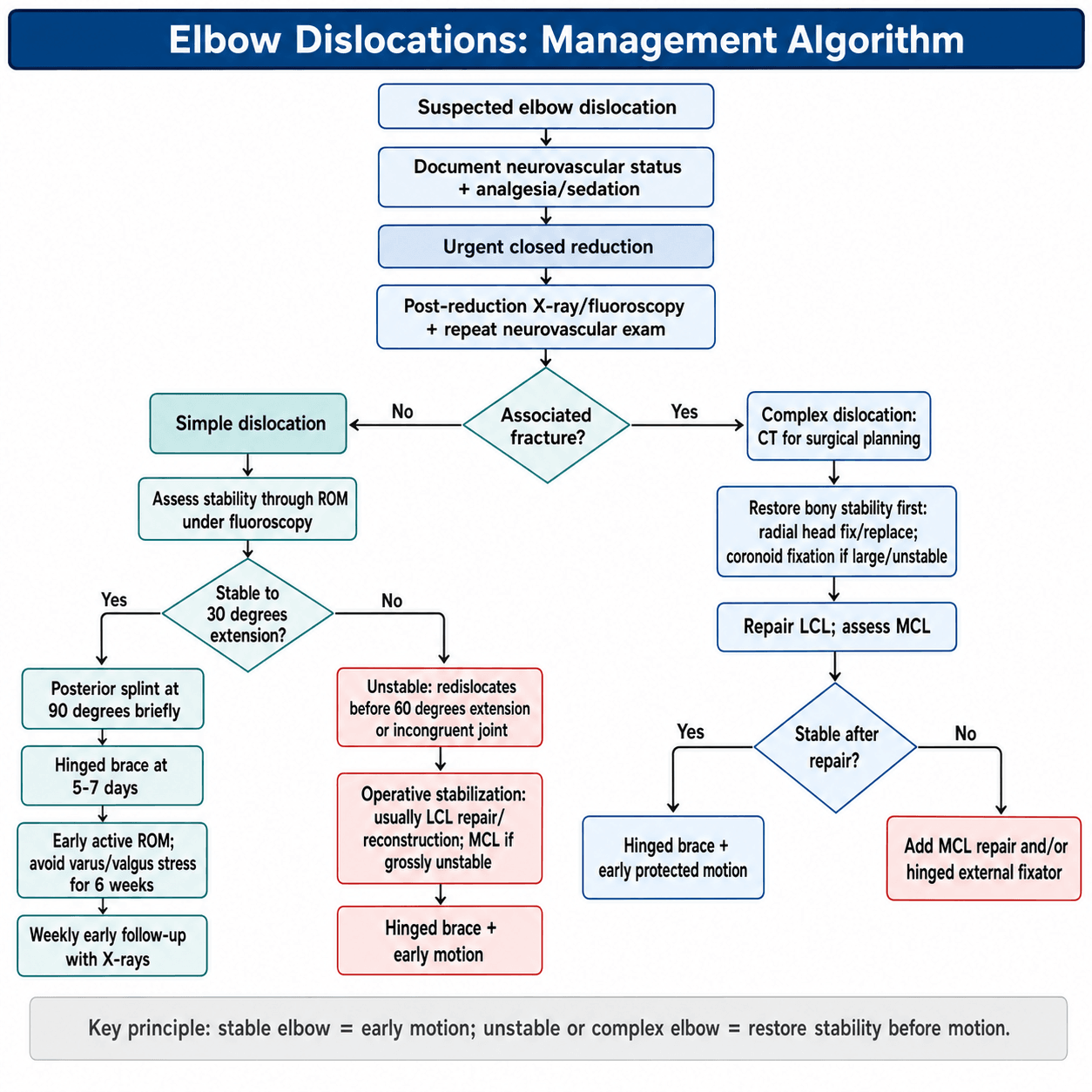
- Key Finding
- Stable after reduction (30-130°)
- Treatment
- Early ROM in hinged brace, non-operative
- Key Finding
- Unstable after reduction
- Treatment
- Consider operative LCL repair
- Key Finding
- Dislocation + radial head + coronoid
- Treatment
- Fix/replace RH, repair LCL, +/- coronoid
- Key Finding
- Mason IV
- Treatment
- Address radial head + ligaments
- Key Finding
- Olecranon impales trochlea
- Treatment
- Reduce carefully, assess for olecranon fracture
- Key Finding
- Radius and ulna separate
- Treatment
- Reduce, high likelihood of instability
- Key Finding
- Unreduced over 3 weeks
- Treatment
- Complex reconstruction required
Reduction. The manoeuvre reverses the displacement that produced the injury, and the sequence below is what that looks like at the bedside.
- Adequate analgesia/sedation (or general anaesthesia)
- Assistant for counter-traction
- Fluoroscopy available if possible
- Document pre-reduction neurovascular status
- Patient supine, arm abducted
- Assistant holds upper arm for counter-traction
- Operator controls forearm
- Apply longitudinal traction along forearm
- Slight supination to correct the rotational component
- Flex elbow while applying pressure to olecranon
- May need brief hyperextension to unlock coronoid
- Guide olecranon over trochlea into reduced position
- Palpable/audible clunk confirms reduction
- Confirm reduction with fluoroscopy/X-ray
- Test stability through ROM
- Document neurovascular status
- Splint in stable position
The arc is the test. Take the reduced elbow through flexion and extension under fluoroscopy and note the angle at which it lets go. That angle decides the treatment.
- Reduction held through 30-130° - stable, and managed non-operatively with early motion
- Redislocation before 60° of extension - operative stabilisation is usually needed
Then the stress tests. Valgus stress tests the MCL and varus stress the LCL. A lateral pivot shift tests for PLRI if the patient is awake. A block to motion points to an associated fracture.
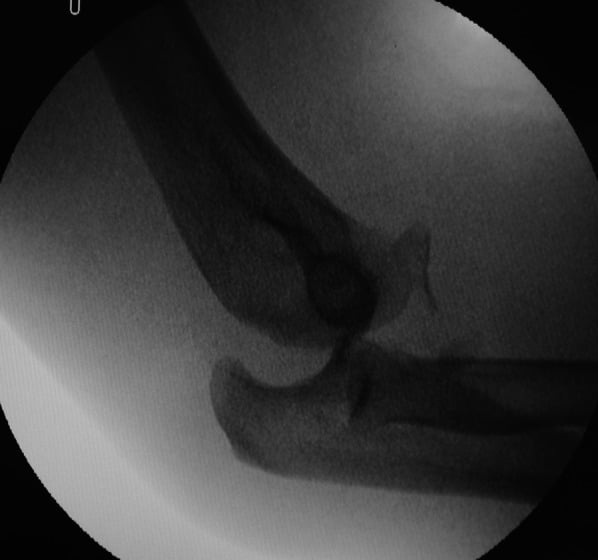
Surgical Technique
Kocher (Lateral) Approach
What it gives you. The lateral approach is the workhorse: LCL repair, radial head fixation or replacement, and access to the lateral coronoid all come through it.
The interval. Between anconeus and ECU.
- Incision from the lateral epicondyle towards the ulna
- Identify the anconeus-ECU interval
- Elevate the anconeus from the posterior ulna
- Expose the LCL complex, usually avulsed from the lateral epicondyle
- Address the radial head
- Repair the LCL with suture anchors
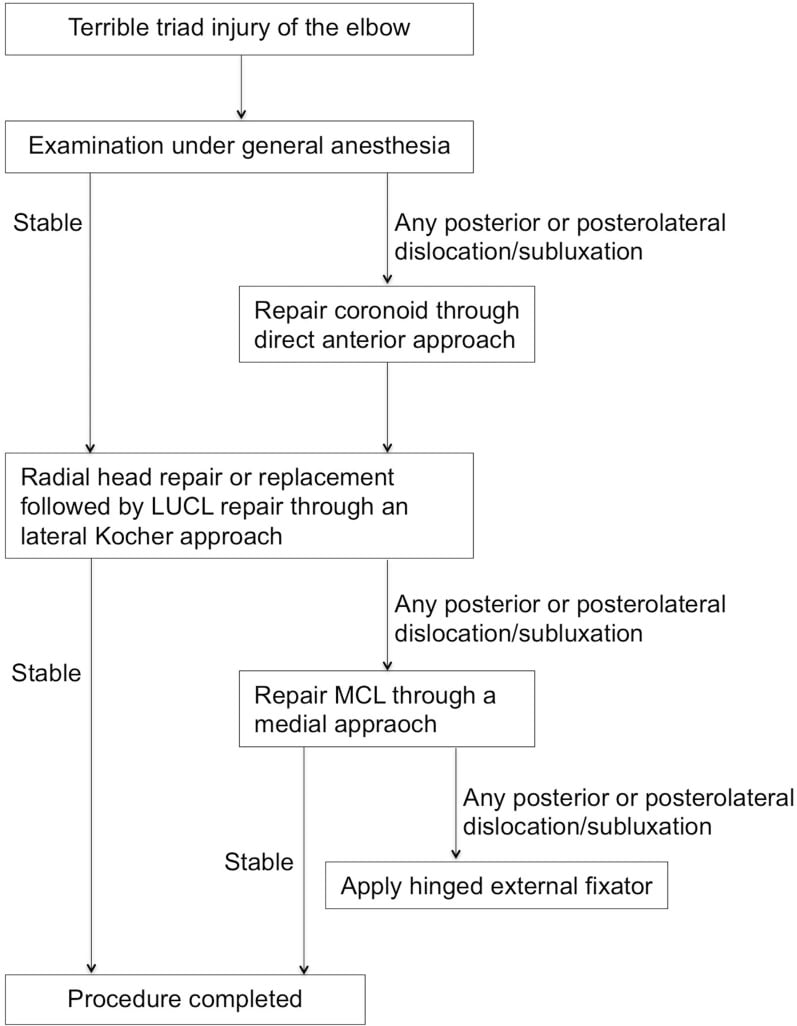
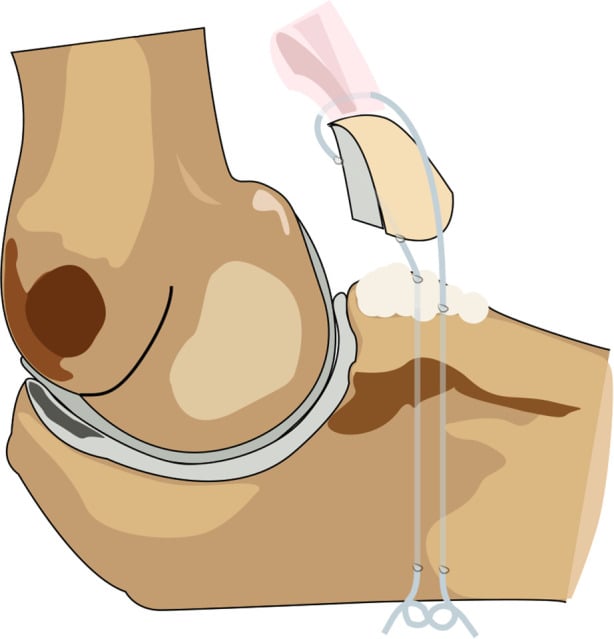
Complications
- Incidence
- 20-30%
- Management
- Early motion, physio, capsular release if severe
- Incidence
- 1-2% simple, higher complex
- Management
- LCL reconstruction, address all structures
- Incidence
- 5-10%
- Management
- Prophylaxis (indomethacin), excision if limiting
- Incidence
- 5-10%
- Management
- Activity modification, eventual arthroplasty
- Incidence
- Variable
- Management
- LCL reconstruction
- Incidence
- 10-20% transient
- Management
- Usually resolves, may need exploration
- Incidence
- Rare
- Management
- Urgent vascular repair
- Incidence
- Rare
- Management
- Emergency fasciotomy
Stiffness. The commonest complication, and the reason the whole treatment plan is built around early motion. The usual pattern is a flexion contracture; once it is established the options are physiotherapy, dynamic splinting and surgical release.
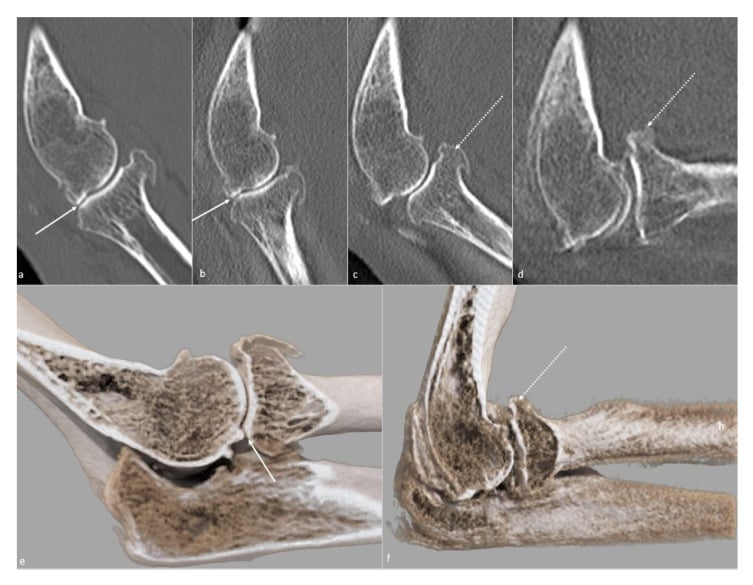
What blocks what. Posterior radial-head and capitellar osteophytes block extension, and anterior osteophytes block flexion. Imaging the elbow through its arc shows which prominence is doing the blocking, and lets the release be a targeted osteoplasty rather than an indiscriminate one.
Posterolateral rotatory instability. The chronic sequela of an LCL that was never repaired or never healed properly. The patient describes apprehension or frank instability, and the treatment is LCL reconstruction.
- Lateral pivot-shift test (O'Driscoll): supine, arm overhead; apply supination, valgus and axial compression while flexing from extension - the radiohumeral joint subluxates then reduces with a clunk around 40 degrees of flexion. Often needs anaesthesia.
- Posterolateral rotatory drawer test: an antero-posterior "drawer" of the forearm on the humerus producing posterolateral rotation.
- Chair push-up (push-up) sign: pushing up from a chair with forearms supinated reproduces apprehension/subluxation.
- Active floor push-up (prone push-up) test: apprehension/subluxation pressing up from the floor with arms abducted and forearms supinated.
- Table-top relocation test: pain/apprehension leaning on the affected hand on a table in supination, relieved when the examiner supports (relocates) the radial head.
On imaging, the "drop sign" - ulnohumeral joint widening/incongruity (the trochlea "dropping" away from the olecranon) on a lateral radiograph - signals residual instability after reduction or surgery and mandates reassessment (often a hinged external fixator or further ligament work).
Exam point: PLRI is diagnosed by the lateral pivot-shift plus the awake-patient apprehension tests (chair push-up, floor push-up, table-top relocation), and a postreduction drop sign on the lateral film means the joint is not concentrically stable.
Heterotopic ossification. The risk rises with head injury, burns, delayed surgery and aggressive physiotherapy. Prophylaxis is indomethacin 25mg TDS for 3 weeks, or radiation, and bone that is mature and limiting function is excised.
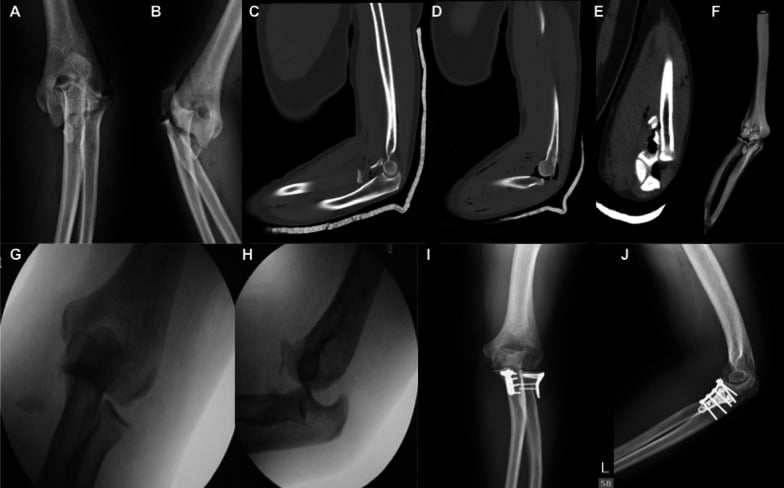
Entrapment of the medial epicondyle. The fragment can be drawn into the joint during reduction, where it blocks full extension. Miss it and the elbow stays unstable and stiff; it has to be extracted and fixed.
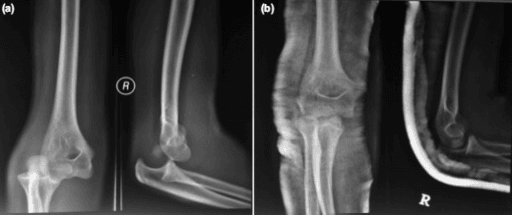
The examinable framework around the entrapped fragment shown above is when to operate on the paediatric medial epicondyle avulsion (the apophysis to which the MCL and flexor-pronator origin attach, often avulsed during a paediatric elbow dislocation):
- Absolute (uncontested) operative indications: a fragment incarcerated within the joint (cannot be reduced closed - the classic "missed" cause of a blocked, unstable elbow), an open fracture, and ulnar nerve dysfunction that warrants exploration. Valgus instability in the high-demand throwing/overhead athlete is a strong relative indication.
- The displacement controversy: there is no agreed displacement threshold for fixing a non-incarcerated fragment - historical cut-offs of about two, five and up to fifteen millimetres are all quoted, displacement is notoriously hard to measure on plain films (the apophysis is posteromedial; oblique/distal-humerus views or CT improve accuracy), and several series show good results with non-operative management of even quite displaced fragments (fibrous union is often asymptomatic).
- Operative technique: open reduction and fixation (screw in the adolescent with a large fragment, or sutures/anchors in the very young), restoring the MCL/flexor-pronator origin; protect/identify the ulnar nerve.
Exam point: incarceration in the joint, an open injury, or ulnar nerve dysfunction mandate surgery (with valgus instability in the throwing athlete a strong relative indication); for the isolated displaced fragment the displacement threshold is genuinely controversial and measurement is unreliable, so decisions are individualised rather than driven by a single millimetre cut-off.
Postoperative Care and Rehabilitation
After a simple dislocation. The programme below is for the elbow that held its reduction through a useful arc, and it is deliberately front-loaded: the protection comes off as soon as the joint can be trusted.
- Posterior splint at 90°
- Elevation, ice
- Finger motion
- Convert to hinged elbow brace
- Begin active ROM in brace
- Flexion-extension exercises
- Light supination/pronation
- Progressive ROM
- May wean from brace if stable
- Target functional ROM
- No valgus/varus stress
- Full ROM expected
- Begin strengthening
- Progressive activity
- May resume light sport
- Full activity
- Sports clearance
- Final outcome assessment
After an LCL repair or a complex reconstruction. More protection early: a hinged brace with an extension block if one is needed, motion started early but kept inside the safe arc, and progression governed by the stability and the healing rather than by the calendar.
Functional elbow ROM for most activities: 30-130° flexion-extension and 50° supination/pronation. Focus rehabilitation on achieving this functional arc. Some terminal limitation may be well-tolerated.
Outcomes and Prognosis
What to expect. The pattern sets the ceiling, and the simple stable dislocation sits at the top of it.
- Good/Excellent
- 90-95%
- Key Factors
- Early motion critical
- Good/Excellent
- 85-90%
- Key Factors
- Quality of repair
- Good/Excellent
- 70-80%
- Key Factors
- Address all structures
- Good/Excellent
- 60-80%
- Key Factors
- Pattern-dependent
What moves a patient within it. Beyond simple versus complex, the outcome turns on the time to reduction and the quality of that reduction, on how soon motion started, on the associated injuries, and on whether the patient does the rehabilitation.
Guidelines, Registries & Global Practice
Global epidemiology
- Figure
- 5.21 per 100,000 person-years (US NEISS)
- Source
- Stoneback 2012 (PMID 22298056)
- Figure
- 10-19 years (6.87 per 100,000; 43.5% of cases)
- Source
- Stoneback 2012
- Figure
- Essentially equal (rate ratio 1.02)
- Source
- Stoneback 2012
- Figure
- 44.5% (football/wrestling in males; gymnastics/skating in females)
- Source
- Stoneback 2012
- Figure
- Roughly half of dislocations are simple (no fracture)
- Source
- Josefsson 1987 (PMID 3571318)
Elbow dislocation is the second most common large-joint dislocation after the shoulder and is predominantly an injury of active adolescents and young adults.
Guidance and evidence, side by side
There is no single dedicated international society guideline for elbow dislocation comparable with hip-fracture pathways; practice is driven by high-level trial and consensus evidence that is broadly concordant across regions.
- Position
- Closed reduction then early active mobilisation; avoid prolonged immobilisation
- Evidence basis
- Level I RCT (FuncSiE, PMID 26175020) and Level I (Josefsson, PMID 3571318) - no benefit from routine ligament repair or plaster
- Position
- As short as comfort allows (days, not weeks); immobilisation beyond ~1-2 weeks increases stiffness
- Evidence basis
- Level IV (Mehlhoff, PMID 3343270): immobilisation strongly linked to flexion contracture
- Position
- Systematic operative repair - radial head, coronoid, LCL +/- MCL/hinged fixator
- Evidence basis
- Level IV reference protocol (Pugh/King/McKee, PMID 15173283); endorsed by AO Foundation and elbow-surgeon consensus
- Position
- Lateral ligament reconstruction (tendon graft preferred over direct repair)
- Evidence basis
- Level IV (Sanchez-Sotelo, PMID 15686238)
- Position
- Emergent reduction and surgical management (general trauma/BOA-style principles)
- Evidence basis
- Open-fracture and limb-threatening-injury principles (BOAST, AO)
Registry evidence
Elbow dislocation is a soft-tissue / fracture-dislocation injury and is not tracked by the arthroplasty joint registries (NJR, AJRR, AOANJRR, SHAR, NZJR), which capture joint replacement rather than acute trauma. Epidemiology therefore derives from national injury-surveillance datasets (e.g. the US NEISS database) rather than implant registries.
Global practice variation
- High-resource settings: ready access to fluoroscopy, CT for complex patterns, radial head arthroplasty and hinged external fixators; early supervised hand-therapy-led mobilisation is standard.
- Limited-resource settings: reliance on plain radiographs and closed reduction; restricted access to radial head prostheses and hinged fixators may favour fixation or, where unavoidable, excision strategies and longer protected mobilisation.
- Convergent core: across all settings the principles are identical - reduce promptly, document neurovascular status before and after, classify simple versus complex, test the stable arc, and mobilise early.
Be prepared to discuss reduction technique, stability assessment, simple vs complex classification, and terrible triad management. Understanding the Horii circle, the FuncSiE early-mobilisation evidence, and when to operate are key viva topics in fellowship examinations.
MCQ Practice Points
Q: What is the most common direction of elbow dislocation? A: Posterolateral - accounts for approximately 90% of elbow dislocations. The mechanism (FOOSH with valgus and supination moment) drives the ulna posterior and lateral to the humerus.
Q: What differentiates simple from complex elbow dislocation? A: Simple = no fracture (ligament injury only). Complex = with associated fracture (radial head, coronoid, olecranon). Simple dislocations are usually stable after reduction with excellent prognosis.
Q: In what order do structures fail in posterolateral elbow dislocation? A: According to the Horii circle, injury progresses from lateral to medial: Stage 1 (LCL complex), Stage 2 (anterior/posterior capsule), Stage 3 (MCL). The LCL is always injured first.
Q: What is the threshold for stable vs unstable simple elbow dislocation? A: If the elbow maintains reduction through 30° extension to full flexion, it is considered stable for non-operative treatment. If it redislocates before 60° extension, operative stabilization is usually recommended.
Q: What is the most common complication of elbow dislocation? A: Stiffness - occurs in 20-30% to some degree. Prevention through early motion is key. Prolonged immobilization (greater than 3 weeks) significantly increases stiffness risk.
Clinical Decision Scenarios
Practise clinical reasoning and management decisions out loud
“A 25-year-old man falls while skateboarding, landing on his outstretched hand. He presents with obvious elbow deformity. X-rays confirm a posterior elbow dislocation with no fracture. How do you manage this injury?”
“You reduce a simple posterior elbow dislocation in a 35-year-old woman. After reduction, under sedation, you assess stability. The elbow redislocates when you extend beyond 50 degrees. What is your management?”
“A 45-year-old woman falls down stairs. Her elbow was dislocated and has been reduced in the emergency department. CT shows a Mason Type III radial head fracture with 5 fragments and a small coronoid tip fracture. How do you approach this injury?”
CLASSIFICATION
- Simple = no fracture, ligament injury only
- Complex = with fracture(s)
- Posterolateral = 90% (most common)
- LCL always injured in posterolateral
HORII CIRCLE (INJURY PROGRESSION)
- Stage 1: LCL complex (lateral)
- Stage 2: Anterior/posterior capsule
- Stage 3A: Posterior MCL
- Stage 3B: Entire MCL (medial)
REDUCTION TECHNIQUE
- Document NV status before and after
- Adequate sedation essential
- Traction + supination + olecranon pressure + flex
- Confirm with X-ray
STABILITY ASSESSMENT
- Test ROM under sedation/anesthesia
- Stable if maintains reduction to 30° extension
- Unstable if redislocates before 60° extension
- Unstable = likely needs operative repair
SIMPLE DISLOCATION MANAGEMENT
- If stable: early motion, hinged brace
- Begin ROM within first week
- Avoid prolonged immobilization (greater than 3 weeks)
- If unstable: LCL repair
TERRIBLE TRIAD PROTOCOL
- Dislocation + radial head + coronoid + LCL
- 1. Fix/replace radial head
- 2. Repair LCL (always injured)
- 3. Fix coronoid if still unstable
- 4. Consider hinged fixator if needed
Evidence Base
O'Driscoll, Bell & Morrey - Posterolateral Rotatory Instability
- First description of posterolateral rotatory instability (PLRI) of the elbow in five patients. Identified laxity of the ulnar part of the lateral collateral ligament (LUCL) as the essential lesion, producing transient rotatory subluxation of the ulnohumeral joint with the annular ligament intact. Defined the pivot-shift (posterolateral rotatory-instability) test; operative repair of the LUCL eliminated instability in all five.
Josefsson et al. - Surgical vs Non-surgical Ligament Treatment (RCT)
- Prospective randomised trial of 30 adults with simple elbow dislocation examined under anaesthesia, then randomised to surgical ligament repair versus non-operative care. All elbows had medial and most had combined medial and lateral collateral ligament rupture. At follow-up both groups had generally good results with no statistically significant difference - surgical repair conferred no advantage over closed treatment.
Mehlhoff, Noble, Bennett & Tullos - Simple Dislocation Outcomes
- Long-term review of 52 adults with simple elbow dislocation treated by closed reduction (mean follow-up 34 months). 60% reported residual symptoms; flexion contracture greater than 30 degrees in 15%, residual pain in 45%. Prolonged immobilisation was strongly associated with larger flexion contracture (p less than 0.001) and more severe pain.
Pugh, Wild, Schemitsch, King & McKee - Terrible Triad Protocol
- Defined the standard surgical protocol for the terrible triad in 36 consecutive elbows: radial head fixation or replacement, coronoid fixation where feasible, lateral collateral ligament repair, and selective MCL repair or hinged external fixation. At a mean of 34 months the mean Mayo Elbow Performance Score was 88; 28 of 36 (78%) were excellent or good and concentric stability was restored in 34 of 36. Eight patients required reoperation.
Sanchez-Sotelo, Morrey & O'Driscoll - LCL Repair vs Reconstruction for PLRI
- 44 patients with posterolateral rotatory instability followed at a mean of six years after 12 direct LCL repairs or 33 tendon-graft reconstructions. Surgery restored stability in all but five; mean Mayo Elbow Performance Score 85, with 86% subjectively satisfied. Augmented tendon-graft reconstruction gave better and durable results compared with simple repair (p = 0.04), and outcomes did not deteriorate with time.
Iordens et al. - FuncSiE Multicentre RCT (early mobilisation)
- Multicentre randomised trial of 100 adults with simple elbow dislocation comparing immediate active mobilisation with 3 weeks of plaster immobilisation. At 6 weeks the early-mobilisation group had less disability (DASH 12 vs 19) and a larger flexion-extension arc (121 vs 102 degrees) and returned to work sooner (10 vs 18 days). No recurrent dislocations occurred and the complication rate did not differ; 1-year DASH was equivalent.
Stoneback et al. - Incidence of Elbow Dislocation (NEISS)
- National (US) Electronic Injury Surveillance System analysis estimated an elbow dislocation incidence of 5.21 per 100,000 person-years. The highest rate (43.5% of cases) occurred in 10-19 year-olds (6.87 per 100,000); incidence was essentially equal between sexes. Nearly half (44.5%) of dislocations in those aged 10 or older were sports-related - football and wrestling in males, gymnastics and skating in females.