Real-Time Intraoperative Imaging for Orthopaedic Surgery
Continuous: Constant X-ray output — highest dose, smoothest image (rarely needed)
Pulsed: Intermittent X-ray pulses (1-30 per second) — significant dose reduction, adequate image quality
Last Image Hold: Stores the last frame for review — zero additional radiation
Screening (low-dose): Reduced tube output for positioning — image quality reduced but acceptably so
Cine acquisition: High-dose recording for documentation — minimal use in orthopaedics
Key: Pulsed fluoroscopy at low pulse rates with last image hold should be the default mode for all orthopaedic procedures
- Fluoroscopy is continuous or pulsed X-ray imaging providing real-time visualisation during procedures.
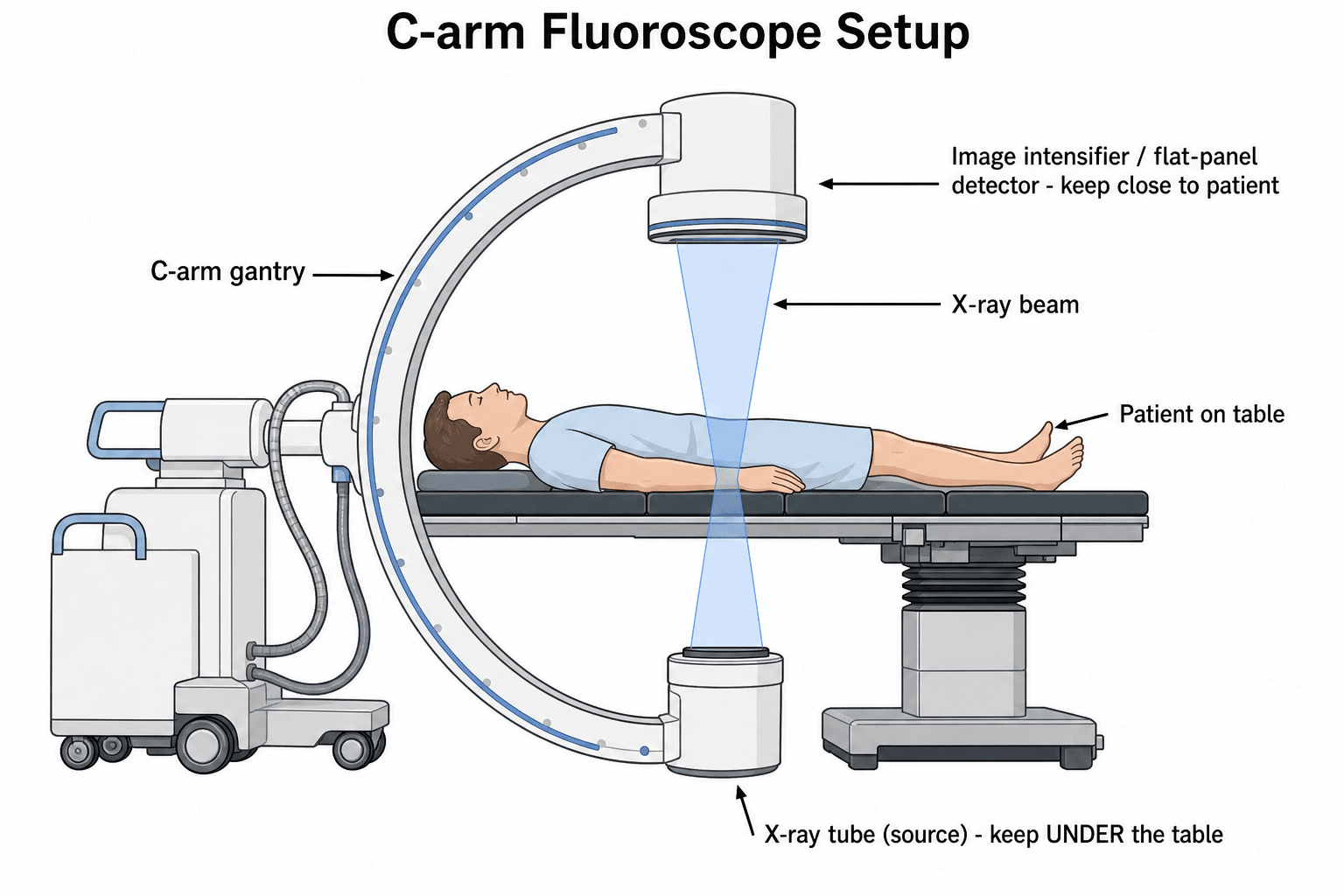
- The C-arm consists of an X-ray tube (below the patient) and an image receptor (above) connected by a C-shaped frame.
- Scatter is generated in the irradiated patient, and is most intense back towards the beam entry surface - so it is greatest on the tube side, and the surgeon stands on the IMAGE RECEPTOR side.
- Pulsed fluoroscopy reduces radiation dose by up to 90% compared to continuous fluoroscopy.
- The inverse square law: doubling the distance from the X-ray source reduces dose to one-quarter.
- “The PATIENT is the source of scatter, not the tube - but scatter is most intense back towards the beam entry surface, which is the tube side. That is why the tube goes under the table and you stand on the detector side.
- “Last image hold (LIH) stores the last fluoroscopic frame, reducing the need for additional exposure.
- “Mini C-arm (extremity fluoroscopy) produces significantly lower radiation than a standard C-arm.
- “Magnification and collimation both shrink the field but do OPPOSITE things to dose: magnification makes the system raise tube output to keep a smaller receptor area equally bright, so skin dose rate rises 2-4x; collimation shrinks the field with no compensation, so total dose falls.
- “Lead thyroid shield reduces thyroid dose by 90% and is mandatory for all fluoroscopy-exposed personnel.
Overview
Fluoroscopy is real-time X-ray imaging, continuous or pulsed, and it is the most commonly used intraoperative imaging modality in orthopaedic surgery. It is what lets a surgeon reduce a fracture, place an implant, assess a joint and verify a screw trajectory while the operation is under way, and the mobile C-arm that provides it is a fundamental tool in every orthopaedic operating theatre.
Why the physics matters. Orthopaedic surgeons are among the highest-exposed medical professionals to occupational radiation, and the cumulative effect of years of fluoroscopy exposure must be actively minimised through proper technique and protective equipment. Understanding how the image is made and where the dose goes is what makes that possible.
The C-arm. Six components:
- X-ray tube - generates the beam (a cathode and anode system)
- Image receptor - an image intensifier (older) or a flat-panel detector (newer)
- C-shaped gantry - connects tube and receptor and allows rotation in multiple planes
- Monitor - displays the real-time image
- Pedal controls - foot-operated start and stop of exposure
- Collimator - adjustable shutters that narrow the beam
ALARA. As Low As Reasonably Achievable is the foundational principle of radiation protection: every exposure uses the minimum dose necessary for adequate image quality for the clinical task, and it applies to the patient and the operating team alike. In practice that means pulsed mode, collimation, distance, shielding, last image hold and the least screening time, each of which is taken up in the protection section.
Physics and Equipment
X-ray production. The tube's cathode is a tungsten filament, heated by an electrical current until it releases electrons by thermionic emission. A high voltage (the kV) accelerates them across a vacuum into the tungsten anode, where approximately 99% of their kinetic energy becomes heat and only 1% produces X-rays, by two processes:
- Bremsstrahlung (braking) radiation - electrons decelerated by the nuclear electric field of tungsten atoms produce a continuous spectrum of X-ray energies. This is the dominant process.
- Characteristic radiation - an electron knocks an inner-shell electron out of a tungsten atom, and the resulting cascade produces X-rays at energies characteristic of tungsten.
The two dials. kV controls the energy, and so the penetrating power, of the beam: higher kV means a more penetrating beam, and typical fluoroscopy runs at 60-120 kV. mA controls the number of X-rays produced per unit time: higher mA means more X-rays, a brighter image and more dose.
Automatic brightness control (ABC). The system adjusts kV and mA on its own to hold the image brightness constant as patient thickness varies. This is why obese patients receive significantly more radiation: the machine raises its output to compensate for the greater tissue attenuation, and larger patients produce more scatter, so dose to patient and staff both increase.
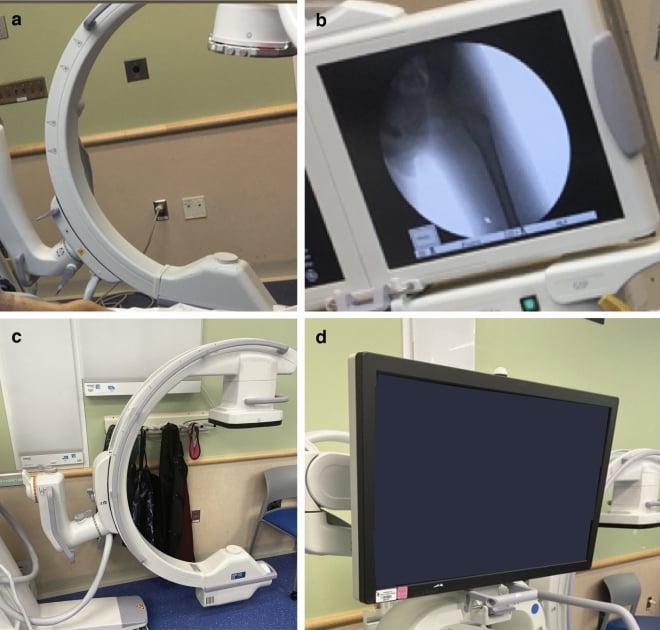
The image intensifier. The older receptor. The beam that has passed through the patient strikes an input phosphor of caesium iodide on a curved vacuum tube and produces light; the light releases electrons from a photocathode, and these are accelerated and focused onto an output phosphor to produce the visible image. It has four characteristic artefacts:
- Pincushion distortion - peripheral image warping
- S-distortion - from the earth's magnetic field
- Vignetting - reduced brightness at the edges
- Veiling glare - reduced contrast from internal scatter
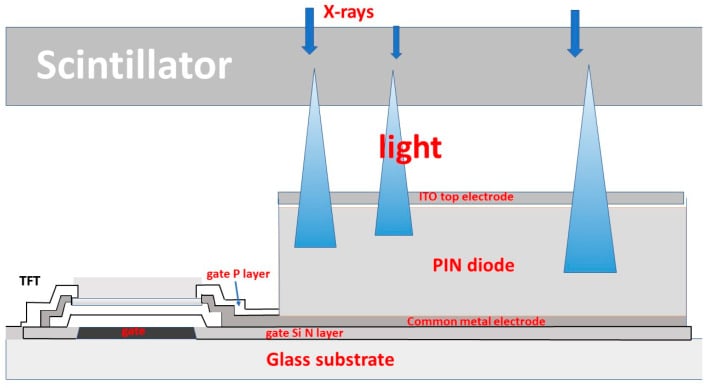
The flat-panel detector. A matrix of amorphous silicon photodiode detectors that converts the X-ray signal to a digital image. In the indirect design shown below, a scintillator first converts the X-rays to visible light, the photodiode array converts that light to charge, and a thin-film transistor matrix reads out each pixel. Over the image intensifier it offers no pincushion distortion, better dynamic range, better contrast resolution, faster readout, lower dose for equivalent image quality and a more compact design; flat panels are standard on modern C-arms and have largely replaced image intensifiers.
Equipment Comparison
The mini C-arm. A smaller, dedicated extremity fluoroscopy unit operating at lower kV and mA. It produces significantly less radiation than a standard C-arm: in phantom measurements the exposure rates were one to two orders of magnitude lower, approximately one-tenth the dose for hand and wrist procedures. Its small field of view and limited penetration confine it to the hand, wrist and foot, and for those distal extremity procedures, where the smaller field is sufficient, it is the ideal unit.
- Image Intensifier (II)
- Pincushion and S-distortion, vignetting, veiling glare
- Flat-Panel Detector (FPD)
- No geometric distortion, better dynamic range and contrast
- Mini C-arm
- Adequate for distal extremity; small field of view
- Image Intensifier (II)
- Higher
- Flat-Panel Detector (FPD)
- Lower
- Mini C-arm
- Lowest (1-2 orders of magnitude below large C-arm)
- Image Intensifier (II)
- Large, good penetration
- Flat-Panel Detector (FPD)
- Large, good penetration
- Mini C-arm
- Small; limited penetration (hand/wrist/foot only)
- Image Intensifier (II)
- Bulky curved tube
- Flat-Panel Detector (FPD)
- Compact, lighter
- Mini C-arm
- Very compact, mobile
- Image Intensifier (II)
- Legacy units still in service
- Flat-Panel Detector (FPD)
- Standard for axial and long-bone work
- Mini C-arm
- Distal extremity surgery
Radiation Units and Dose Quantities
Dose figures are quoted throughout in millisieverts; the examinable framework behind them is the hierarchy of radiation quantities. Absorbed dose, in gray, is pure energy deposition. Equivalent and effective dose, in sieverts, add weighting for the type of radiation and the sensitivity of the tissue, which is why dose limits and stochastic risk are quoted in sieverts.
- Unit
- Gray (Gy = 1 J/kg)
- What it measures
- Energy deposited per unit mass of tissue (replaces the old rad; 1 Gy = 100 rad)
- Unit
- Sievert (Sv)
- What it measures
- Absorbed dose times the radiation weighting factor; for X-rays the factor is 1, so 1 Gy gives 1 Sv
- Unit
- Sievert (Sv)
- What it measures
- Sum of equivalent doses weighted by tissue radiosensitivity; used for stochastic risk and the dose limits
- Unit
- Gy times cm squared
- What it measures
- Air kerma times beam area; a whole-procedure measure that reflects the total radiation delivered and tracks stochastic risk, displayed live on the C-arm
- Unit
- milligray (mGy)
- What it measures
- Cumulative air kerma at the reference point; a surrogate for peak skin dose and deterministic risk that warns of skin injury during prolonged screening
Radiation Protection in Theatre
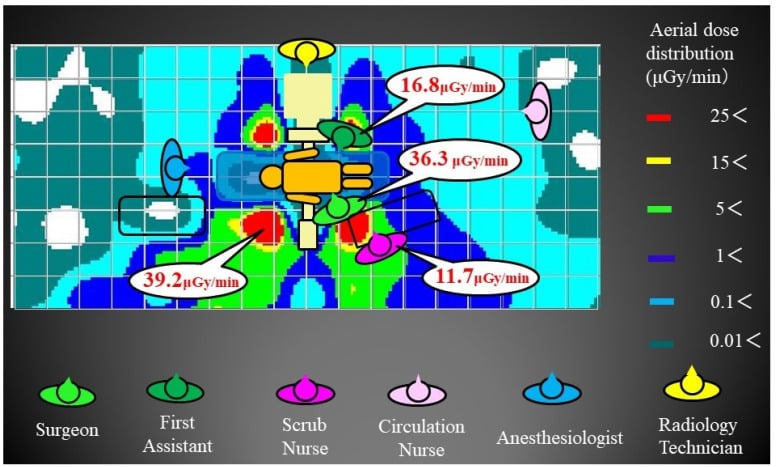
Where the dose comes from. Scatter radiation is the primary source of occupational dose to the operating team, and the single most useful correction to make is about where it comes from: it is generated inside the patient, not by the X-ray tube. The tube emits the primary beam; the irradiated tissue volume then re-radiates in all directions, and that Compton scatter is what reaches you. Three consequences follow, and they are the reason the standard advice works.
- Scatter is most intense back towards the beam entry surface, that is, towards the tube. With the standard orientation (tube below, receptor above) the surgeon stands on the receptor side, above the table.
- The patient, not the tube, is the object to step away from. The inverse square law applies from the scattering volume: doubling the distance cuts the dose to a quarter, and stepping back one pace from the patient does more than any adjustment to where the tube sits.
- Collimation is a scatter-reduction measure, not just a patient-dose measure. Less irradiated tissue means less tissue re-radiating, so tightening the shutters lowers the dose to everyone standing around the table as well as to the patient.
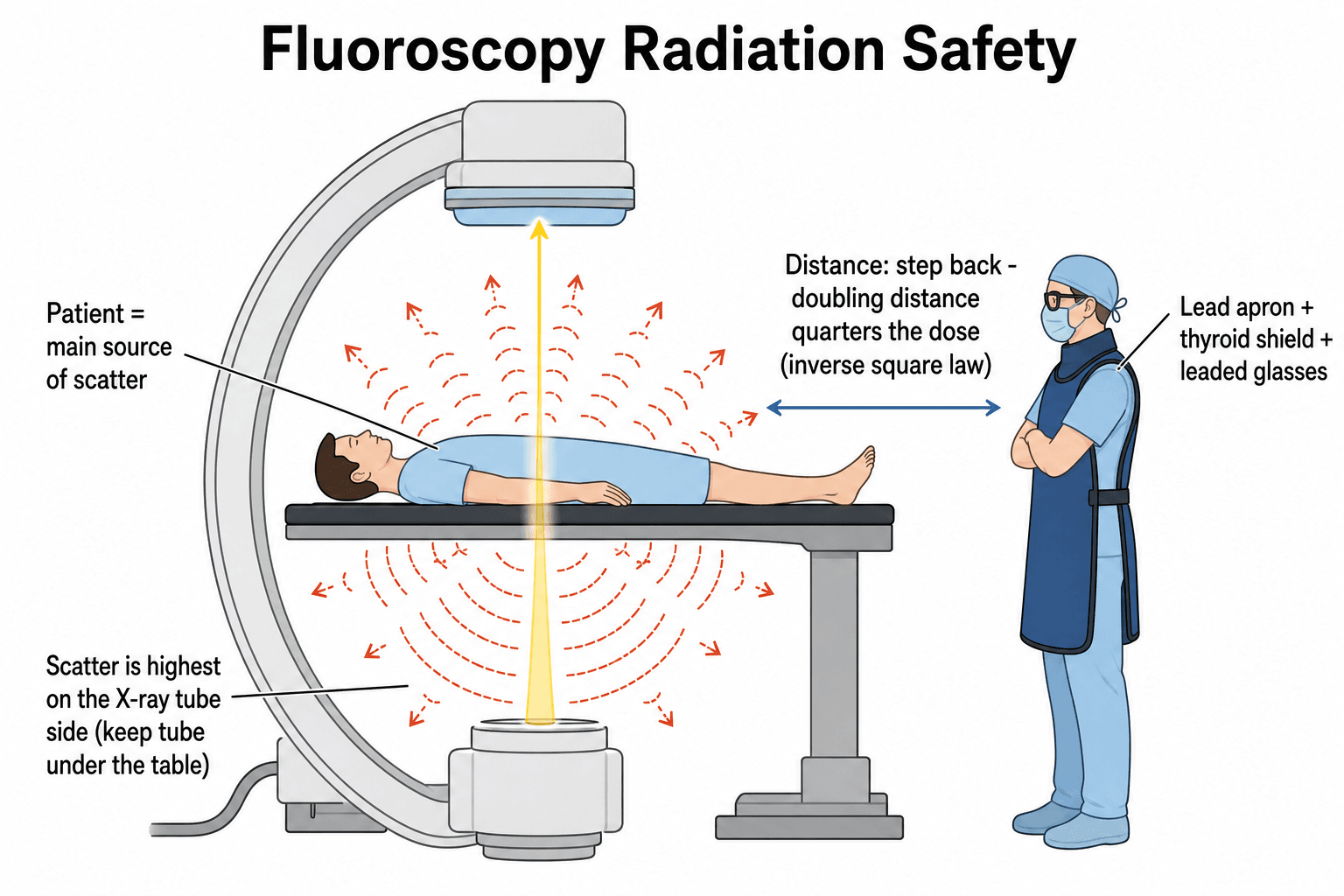
Shielding. A 0.5 mm lead-equivalent apron attenuates approximately 90-95% of scatter at orthopaedic beam energies, and is worn with a thyroid shield and leaded glasses.
Geometry: three free dose reductions. These cost nothing, require no equipment, and are examined because they follow directly from the physics rather than from a protocol.
Keep the receptor as close to the patient as it will go. Pulling the detector away lets the beam diverge before it arrives, so automatic brightness control raises the output to keep the image bright, and the image is magnified geometrically at the same time. A close receptor means lower dose and less geometric unsharpness.
Keep the tube as far from the skin as the work allows. Entrance skin dose falls with the square of the source-to-skin distance, which is why regulators specify a minimum, 30 cm on mobile fluoroscopes in most jurisdictions, enforced by a removable spacer cone that should not be left off.
Never invert the C-arm without a reason. With the tube above the table, the beam entry surface, where backscatter is most intense, faces the operator at chest, thyroid and eye level instead of pointing at the floor, and dose to the head and neck rises severalfold. If the anatomy forces an overhead tube, step back and shorten the screening runs.
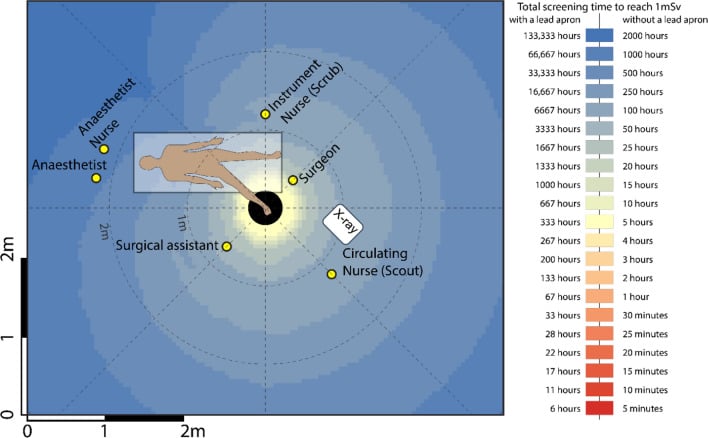
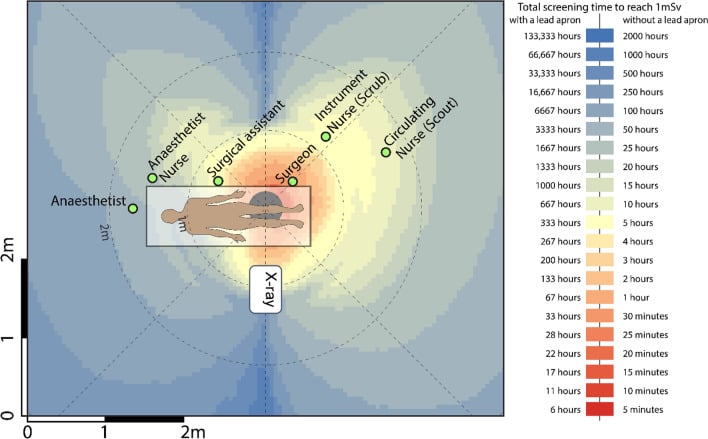
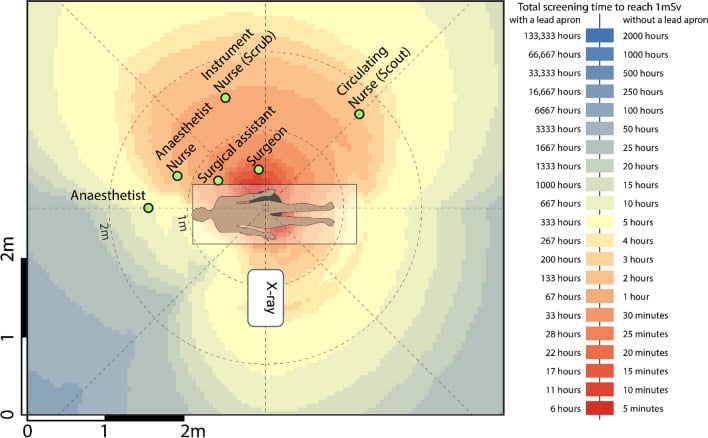
Magnification is not collimation. Both shrink the field, and they do opposite things to dose. In magnification mode a smaller receptor input field must be kept equally bright, so automatic brightness control raises the tube output and the skin dose rate rises roughly with the square of the magnification factor, typically 2-4x. Collimation shrinks the field without compensation, so the total dose falls.
The measures the operator controls, with what each is worth:
- Implementation
- Use lowest acceptable pulse rate (1-4 pulses/second for positioning; 8-15 for dynamic assessment)
- Expected Dose Reduction
- Roughly tracks the pulse rate divided by 30 frames/second, so 15 p/s halves the dose and 4 p/s cuts it by about 85% - slightly less in practice, because each pulse carries more mAs to keep it sharp
- Implementation
- Review stored images instead of firing additional exposures
- Expected Dose Reduction
- Eliminates unnecessary repeat exposures — cumulative benefit
- Implementation
- Narrow the beam to the exact region of interest using the shutters
- Expected Dose Reduction
- Reduces irradiated volume AND scatter by 30-50%
- Implementation
- Step back from the beam when not actively operating; extend hands from beam path
- Expected Dose Reduction
- Doubling distance = 75% dose reduction (inverse square law)
- Implementation
- Use brief exposures (less than 2 sec each); release pedal between checks
- Expected Dose Reduction
- Direct proportional reduction — halving time halves dose
- Implementation
- Use magnification mode only when absolutely necessary for detail
- Expected Dose Reduction
- Avoids the rise in skin dose rate that magnification triggers
CLAPTDRadiation Dose Reduction
Hook:CLAPTD to reduce dose: Collimate, Last image hold, ALARA, Pulsed mode, Time reduction, Distance.
Leaded gloves in the primary beam. A leaded glove offers very little protection inside the primary beam, and worse, the automatic brightness control sees the attenuating glove, decides the image is too dark and raises the tube output - increasing dose to the patient, to the rest of your hand, and to everyone in the room. Leaded gloves are for incidental scatter near the field, never for holding something in the beam. The correct answer is to take the hand out of the beam and use an instrument.
Fluoroscopy time as a measure of dose. Screening time in minutes is what gets recorded in the operation note, and it is a weak surrogate: it takes no account of pulse rate, magnification, patient thickness, collimation, or how many high-output lateral runs were used. Two procedures with identical screening times can differ several-fold in delivered dose. The quantities that actually measure it are the two displayed on the C-arm, dose-area product and reference air kerma, and those are the numbers to quote if an examiner asks how you audit your practice.
Operating on a pregnant patient. A fracture that needs fixing is fixed. For any procedure where the uterus is outside the primary beam, the whole upper limb and the leg below the mid-femur, the fetus receives only internal scatter, and the dose is a small fraction of a milligray. The threshold below which deterministic fetal effects are not expected, and below which radiation is never a reason to consider termination, is around 100 mGy, an amount that limb fluoroscopy cannot approach.
Where the uterus is in or adjacent to the field (pelvis, hip, lumbar spine) involve medical physics for a dose estimate, collimate hard, and use the lowest pulse rate that lets you work. One subtlety is examined often: a lead sheet over the abdomen protects against external scatter reaching the uterus, but not against scatter generated inside the mother's own tissues, which is the dominant contribution when the beam is close by. Collimation is what reduces that; the drape is not.
Operating while pregnant. Once a pregnancy is declared, the dose limit applied to the fetus is 1 mSv for the remainder of the pregnancy under ICRP and European rules (the US NRC uses 5 mSv over the gestation). In practice a surgeon wearing a correctly fitted 0.5 mm lead apron, working with normal C-arm discipline, stays comfortably inside that.
The way to demonstrate it rather than assume it is a second dosimeter worn at waist level under the apron, which estimates fetal dose directly, alongside the usual collar badge worn outside. Declaring the pregnancy triggers monitoring, not exclusion from theatre: a blanket policy of removing pregnant surgeons from fluoroscopy cases is not supported by the dose data.
Intraoperative Applications
Each application has its own views and its own question for the screen to answer; the table sets them out, and the figures that follow show what the views look like in practice.
- Typical Views
- AP and lateral of fracture site; inlet/outlet for pelvis
- Key Technical Points
- Verify reduction, alignment, and implant position. Use traction views for length assessment
- Typical Views
- AP and lateral at fracture and at proximal/distal locking sites
- Key Technical Points
- Freehand interlocking screw technique relies on 'perfect circle' fluoroscopic alignment of the screw hole
- Typical Views
- AP and lateral hip views
- Key Technical Points
- Ensure tip-apex distance (TAD) is less than 25mm on combined AP and lateral views
- Typical Views
- AP, lateral, and oblique views of the spine
- Key Technical Points
- AP view confirms medial/lateral position; lateral confirms depth and angulation
- Typical Views
- AP and lateral views of the joint
- Key Technical Points
- Verify component position, alignment, and cement distribution in cemented arthroplasty
- Typical Views
- AP and lateral of the target area
- Key Technical Points
- Real-time guidance for percutaneous fixation. Use mini C-arm for distal extremity
The perfect circle. For freehand interlocking screw placement in intramedullary nailing, the C-arm is rotated until the nail hole appears as a perfect circle on the screen, which means the beam is perfectly aligned with the axis of the hole. A drill or screw inserted toward the centre of that circle is then aligned with the hole axis. The technique eliminates the need for jig-based targeting systems, and it reduces radiation exposure because it minimises the number of screening attempts needed.
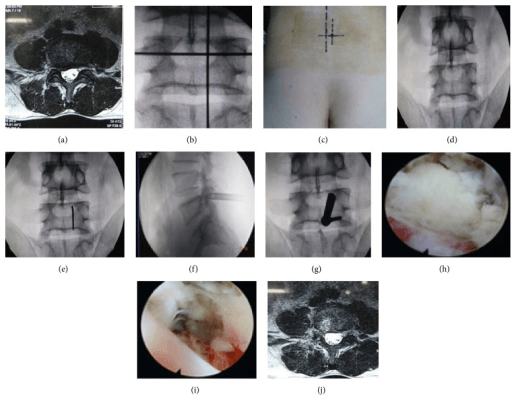
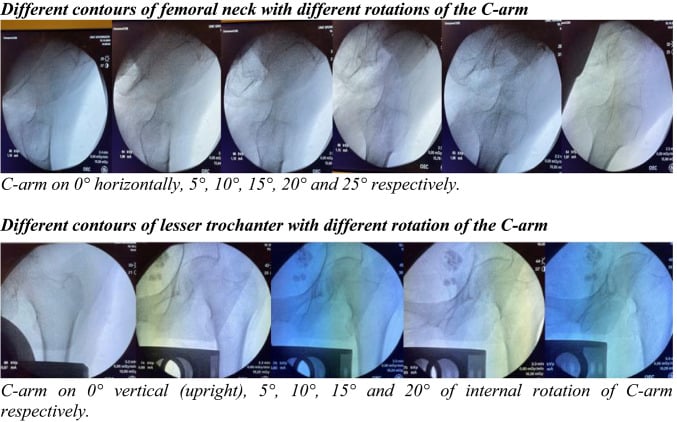
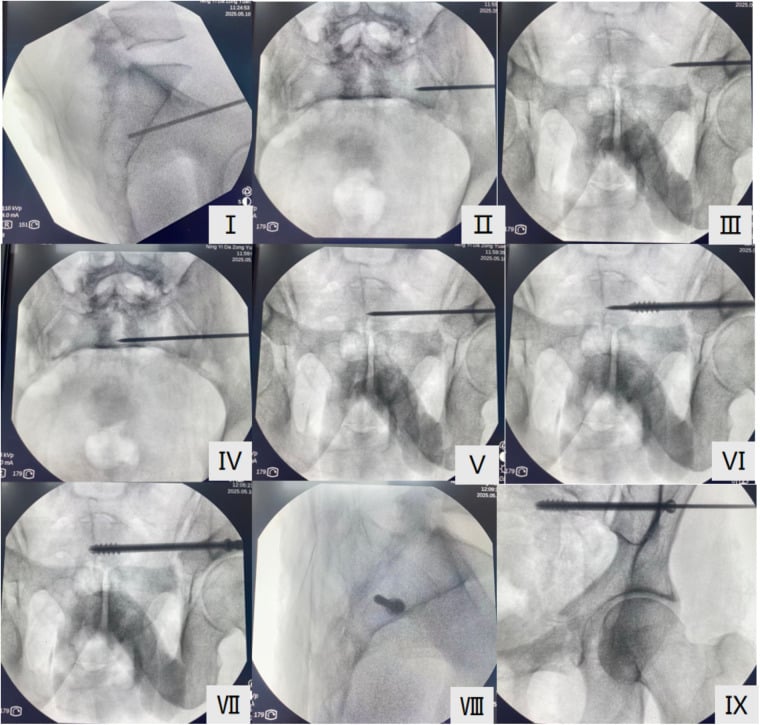
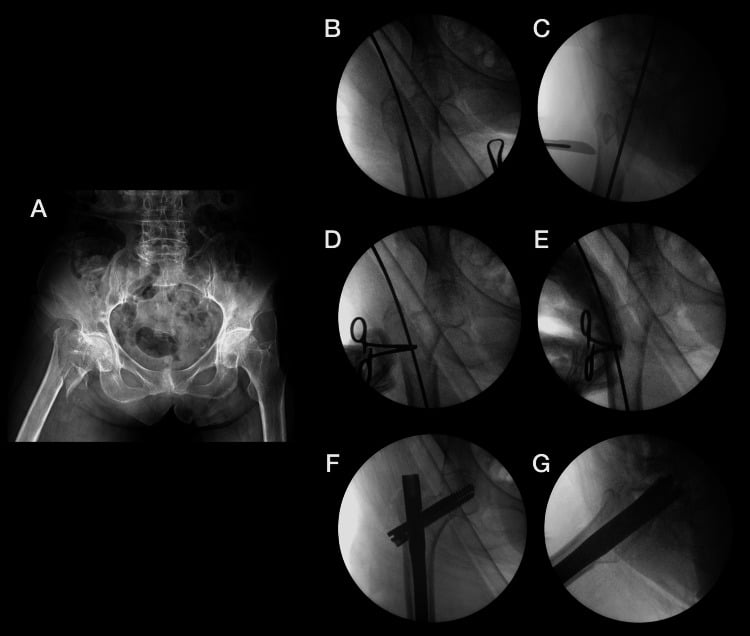
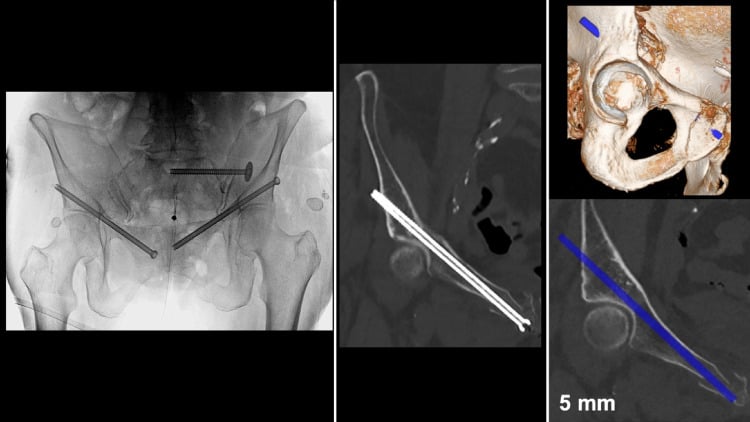
Intraoperative 3D Imaging and Navigation
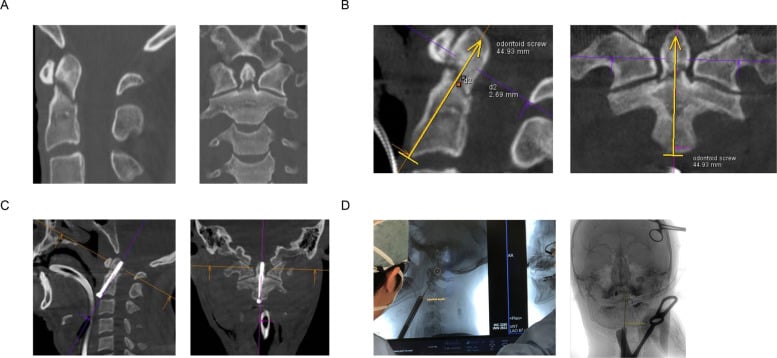
Beyond 2D screening, modern C-arms and dedicated units can rotate around the patient to acquire a cone-beam CT (CBCT) dataset, and that 3D volume can then drive surgical navigation.
- Conventional 2D fluoroscopy
- Single real-time projections
- Cone-beam CT / navigation
- An automated rotational spin (about 190 to 360 degrees) reconstructed into a CT-like volume (3D C-arm, O-arm)
- Conventional 2D fluoroscopy
- Reduction, implant position, interlocking screws
- Cone-beam CT / navigation
- Pedicle-screw verification and complex intra-articular fractures (tibial plateau, calcaneus, pilon, syndesmosis) and pelvis/acetabulum
- Conventional 2D fluoroscopy
- Operator-dependent 2D interpretation
- Cone-beam CT / navigation
- 3D confirmation of screw containment; navigation tracks instruments and reduces repeated live screening
- Conventional 2D fluoroscopy
- Low per image but cumulative with repeated shots
- Cone-beam CT / navigation
- A single spin is a substantial dose, but may replace many 2D shots and a postoperative CT
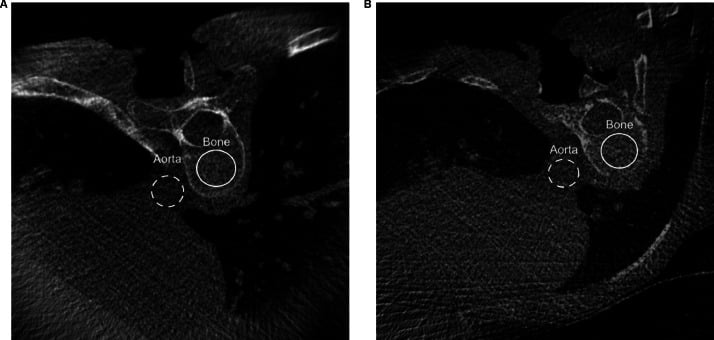
A cone-beam 3D acquisition is an unattended, high-output rotational scan that produces far more scatter than a single 2D shot - scatter is highest on the assistant's side and for pelvic spins. Non-essential staff should step behind shielding or leave the room during the spin, and a low-dose 3D protocol should be selected (Schuetze showed a dose-reduction protocol cut scatter by about two-thirds). The net dose advantage over 2D fluoroscopy depends on the protocol and on avoiding repeated spins.
Guidelines, Registries & Global Practice
Occupational radiation protection for fluoroscopy is harmonised worldwide around the ICRP (International Commission on Radiological Protection) 2007 recommendations, adopted into the IAEA Basic Safety Standards and into national law by individual radiation regulators. The figures below are essentially identical across the major jurisdictions because they derive from the same ICRP source — examiners expect you to quote the international limits, not a single country's.
- Limit
- 20 mSv/year averaged over 5 years; no single year over 50 mSv
- Notes
- Same limit in EU (EURATOM 2013/59), UK (IRR17), US (NRC, though US states a 50 mSv/year single-year figure), Australia (ARPANSA), India (AERB)
- Limit
- 20 mSv/year averaged over 5 years; no single year over 50 mSv
- Notes
- Reduced from 150 mSv following ICRP 2011 statement — adopted by EU/UK; US NRC retains 150 mSv/year
- Limit
- 500 mSv/year
- Notes
- Relevant to surgeons' hands near the beam
- Limit
- 1 mSv/year
- Notes
- Applies to visitors and unmonitored staff
- Focus
- Dose limits and principles
- Key Recommendation
- Justification, optimisation (ALARA), dose limitation; the source framework for all national rules
- Focus
- Surgeon protection
- Key Recommendation
- ALARA, personal dosimetry, lead 0.5mm Pb equivalent, thyroid shield, leaded glasses, distance and collimation
- Focus
- Employer duties
- Key Recommendation
- Designated controlled areas, local rules, radiation protection supervisor, mandatory monitoring
- Focus
- Training and limits
- Key Recommendation
- Mandatory radiation-protection training for operators; 20 mSv eye-lens limit
- Focus
- Clinical practice
- Key Recommendation
- Pulsed fluoroscopy as default, last image hold, physicist-led equipment QA
Global epidemiology of occupational exposure. Orthopaedic and trauma surgeons are among the most heavily fluoroscopy-exposed non-radiologist physicians. Typical effective dose per straightforward fracture procedure is low (often well under 0.1 mSv to the surgeon under the apron), but high-volume trauma and spine surgeons may approach meaningful annual extremity, eye-lens and (for women) breast doses, and chronic lens changes are demonstrable in heavily exposed interventional staff (RELID).
High-resource vs limited-resource practice variation. In well-resourced settings, flat-panel detectors, pulsed low-dose protocols, ceiling-suspended shields, leaded glasses, real-time dosimetry and intraoperative navigation/3D imaging are increasingly standard. In limited-resource settings, older image-intensifier C-arms predominate, dosimetry compliance and lead-apron testing are often inconsistent, and fixed/continuous-mode units may default to higher dose. The protective priorities that require no capital cost — collimation, brief intermittent screening, last image hold, maximising distance, correct C-arm orientation and standing on the detector side — therefore matter most where equipment is least advanced, and are the universally examinable answers.
Controversies & Areas of Uncertainty
Validity of the linear no-threshold model. Radiation protection limits and ALARA rest on the LNT model: any dose carries proportional stochastic (cancer) risk with no safe threshold. LNT is extrapolated from high-dose atomic-bomb-survivor data, and whether very low occupational doses carry genuine excess risk, as against hormesis or a practical threshold, is genuinely debated among radiobiologists. For exams, defend LNT as the prudent, regulator-endorsed working model while acknowledging the uncertainty at low doses.
Lead apron weight against musculoskeletal harm. Conventional 0.5 mm Pb aprons are protective but heavy, and chronic wear is linked to spinal and shoulder disorders in surgeons. Lighter composite (antimony, bismuth, barium) and two-piece skirt-and-vest designs reduce the load but may attenuate slightly less at some beam energies, and vendor-quoted attenuation often overstates real-world performance, a recognised regulatory gap. The trade-off between musculoskeletal protection and radiation attenuation is unresolved.
Real cumulative cancer risk to surgeons. Per-procedure doses are low, but reports of elevated breast cancer in female orthopaedic surgeons and lens opacities in heavily exposed interventionalists keep the question of meaningful cumulative career risk open. Personal dosimetry compliance is poor in many settings, so true cumulative doses are uncertain and probably underestimated.
Navigation and 3D imaging: the net dose effect. Computer navigation and intraoperative cone-beam imaging can reduce repeated 2D screening and improve implant accuracy, but a single 3D spin delivers a substantial scatter dose, and the net dose balance against conventional fluoroscopy depends on protocol, anatomy and how often staff leave the room during acquisition.
Clinical Decision Scenarios
Practise clinical reasoning and management decisions out loud
“An examiner asks: 'Where should you stand relative to the C-arm during fluoroscopy and why?'”
“You are performing an intramedullary nail for a tibial shaft fracture and need to place the distal interlocking screws using fluoroscopy.”
“An examiner asks you to discuss the physiological effects of ionising radiation and the annual dose limits for radiation workers.”
C-arm Basics
- X-ray tube below, image receptor (detector) above = standard orientation
- Stand on the IMAGE RECEPTOR side (away from the tube)
- The PATIENT generates the scatter, not the tube - scatter is most intense back towards the beam entry surface
- Receptor as CLOSE to the patient as possible; tube as FAR from the skin as possible (30cm minimum, spacer cone on)
- Flat-panel detector (FPD) is superior to image intensifier (II) — less dose, no distortion
- Mini C-arm: approximately 1/10th dose of standard C-arm for extremity procedures
Dose Reduction (CLAPTD)
- Collimate — narrow beam to region of interest
- Last image hold — review stored frames, not new exposures
- ALARA — use minimum technique factors for adequate image quality
- Pulsed — 50-90% dose reduction vs continuous
- Time — brief exposures, release pedal between checks
- Distance — inverse square law: 2x distance = 1/4 dose
Radiation Safety
- Lead apron: 0.5mm Pb equivalent attenuates 90-95% of scatter
- Thyroid shield: 90% thyroid dose reduction — mandatory for all
- Lead glasses: 85-90% lens dose reduction
- Personal dosimetry badge is mandatory for radiation workers
Dose Limits (ICRP/IAEA - global)
- Occupational: 20 mSv/year averaged over 5 years (max 50 mSv any single year)
- Eye lens: 20 mSv/year (reduced from 150 mSv; US NRC still 150)
- Skin and extremities: 500 mSv/year
- General public: 1 mSv/year
Dose Increases With
- Magnification mode (2-4x increase — use sparingly). NOT the same as collimation: magnification triggers ABC compensation, collimation does not
- Continuous vs pulsed fluoroscopy
- Greater patient thickness (ABC compensates with higher output)
- Closer distance to the X-ray source
- Inverting the C-arm (tube above) — the entry surface now faces your thyroid and eyes
- A leaded glove held IN the primary beam — ABC sees the attenuation and raises output for everyone
Pregnancy
- Fetus outside the primary beam (whole upper limb, leg below mid-femur): dose is a fraction of a mGy - fix the fracture
- Deterministic threshold approximately 100 mGy; below this, radiation is never grounds to consider termination
- An abdominal lead drape blocks external scatter only, NOT scatter generated inside the mother - collimation is what reduces that
- Declared-pregnant worker: 1 mSv to the fetus for the remainder of the pregnancy (ICRP/EU; US NRC 5 mSv over gestation)
- Demonstrate it with a SECOND dosimeter at waist level UNDER the apron - declaring triggers monitoring, not exclusion from theatre
Evidence Base
Scatter Radiation Exposure with Mini C-arm Fluoroscopy
- Using a phantom upper extremity and 13 dosimeters, only the sensor placed directly in the imaging beam recorded substantial measurable radiation after 155 exposures (300 seconds of imaging).
- Outside the direct beam path, scatter dose to the surgical team during routine mini C-arm use was minimal.
- The principal hazard with the mini C-arm is the operator's hand or body entering the direct (primary) beam, not ambient scatter.
Fluoroscopy Dose Reduction Techniques
- Patient skin dose can be substantial during prolonged fluoroscopy and depends on examination type, patient size, equipment and technique.
- Effective dose reduction techniques include intermittent exposures, grid removal, last image hold, beam filtration, dose spreading and pulsed fluoroscopy.
- Operator training and understanding of the factors influencing dose are central to effective dose management.
Read together, these two studies point at the same behavioural target rather than an equipment one. The mini C-arm study found essentially no ambient hazard and one large one - a body part in the primary beam - and the dose-reduction review found that the biggest gains come from how the pedal is used rather than from what the machine is. The corollary for a viva answer is that a surgeon who screens intermittently at a low pulse rate, collimates, and keeps their hands out of the field will out-perform a colleague with better equipment and worse habits.