Mechanical axis planning, temporary hemiepiphysiodesis and rebound surveillance
- Separate physiological genu varum or valgum from pathological deformity before planning treatment.
- Plan from standing hip-to-ankle radiographs, not cropped knee images.
- Mechanical axis deviation tells you the effect; LDFA, MPTA and JLCA help identify the source.
- Guided growth requires open physes and enough growth remaining.
- Correction runs at just under one degree per month, and rebound after removal is common rather than rare - around 59 percent of legs in idiopathic genu valgum - so follow-up continues well past implant removal.
- “The implant is small; the analysis is the operation.
- “The mechanical axis tells you where load passes, not why it got there.
- “Treat rickets, Blount disease and physeal bars as specific diagnoses, not as simple knock-knee or bow-leg.
- “Guided growth does not correct rotation, severe joint incongruity or a child who is too close to maturity.
Overview and Epidemiology
The normal arc. Coronal lower-limb alignment changes normally during childhood. Infants often have genu varum, toddlers pass into genu valgum, and older children gradually settle toward adult alignment, which is a little valgus, about 5-7° at the knee; more than 7° is genu valgum. Guided growth is for the child whose alignment is not following that expected pathway, or whose deformity is symptomatic, asymmetric, progressive or pathological.
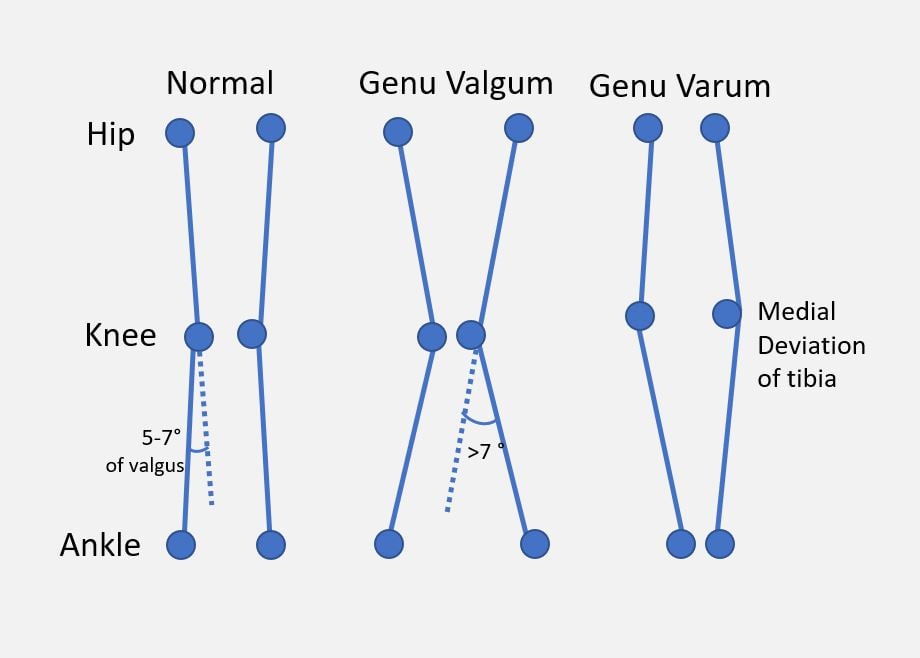
The clinical problem. The common presentation is genu valgum or genu varum around the knee, and whether the knees touch or the ankles separate is only the beginning. The questions that matter are where the mechanical axis passes, which bone creates the deformity, whether the physis is open, how much growth remains, and whether the underlying biology is normal.
Indications. Guided growth is smaller than osteotomy, but it is not casual: it requires reliable follow-up, timely implant removal and continued surveillance for rebound. Typical indications are:
- Persistent genu valgum
- Pathological genu varum
- Blount disease in selected stages
- Post-traumatic physeal disturbance
- Skeletal dysplasia
- Metabolic bone disease, after medical optimisation
Pathophysiology
How deformity arises. Angular deformity develops when growth is asymmetric across a physis or when a bone or joint segment has abnormal orientation. The mechanical axis is the functional consequence: it shows where load passes from the hip to the ankle across the knee. A medial mechanical axis overloads the medial side; a lateral mechanical axis overloads the lateral side. Genu varum sends the axis medial; genu valgum sends it lateral.
The Hueter-Volkmann law. Guided growth works by temporary hemiepiphysiodesis, and the principle it exploits has a name worth using in a viva. Sustained compression across a physis slows longitudinal growth, while reduced load or tension accelerates it. Tethering one side of an open physis therefore slows that side; the untethered side keeps growing, and the joint orientation rotates gradually towards neutral.
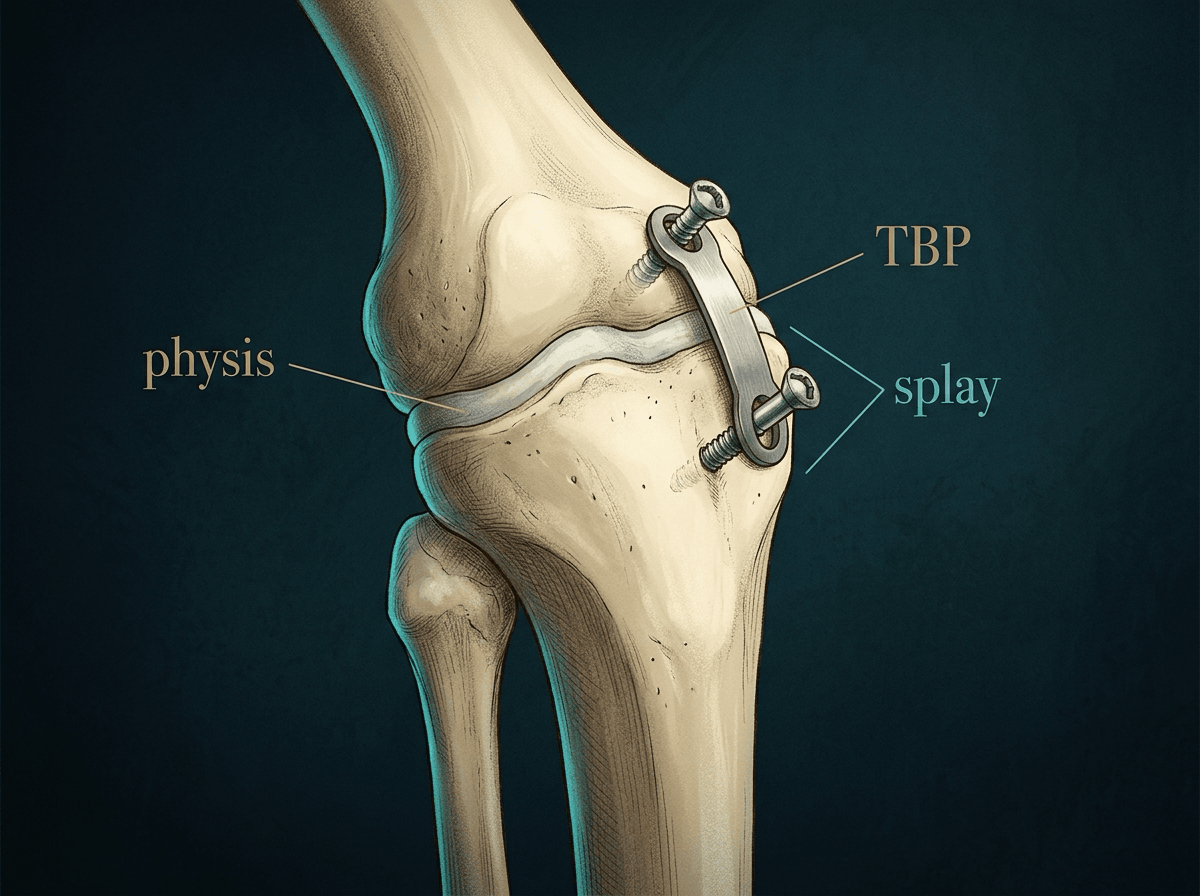
Plate, not staple. The tension-band plate is not simply a modern staple, and the difference is mechanical. A staple compresses the physis directly and can injure it, which is why permanent arrest was a real risk with the original Blount staples. The tension-band plate sits extraperiosteally, outside the physis, anchored by one epiphyseal and one metaphyseal screw, and behaves as a flexible hinge at the periphery of the physis rather than a clamp across it.
Screw divergence. The screws are deliberately non-locking so that they can splay. As the untethered side grows the two screws diverge, and increasing divergence on serial films is the visible confirmation that correction is actually happening; a construct in which the screws have not diverged has not corrected.
The rate. Put a number on it before you counsel a family. Pooled multicentre data give roughly 0.77 degrees per month at the distal femur and 0.79 degrees per month at the proximal tibia, just under one degree a month at either physis. A 12 degree deformity therefore takes approximately 15 months, and this arithmetic, not the appearance of the knee, is what decides whether a child has enough growth left. Correction is faster in younger children and slower in pathological physes.
Pathological physes. Blount disease has disordered medial proximal tibial growth and may recur or fail to correct if severe. Rickets and metabolic disease need medical correction before mechanical correction. Post-traumatic physeal bars can create focal angular growth disturbance and may require bar resection, epiphysiodesis or osteotomy rather than a simple plate.
Classification
Physiological or pathological. Physiological alignment is symmetric, painless, age-appropriate and improving. Pathological valgum or varum is persistent, progressive, asymmetric, painful or outside the expected developmental range. Two further patterns change the weight of the decision:
- High-risk pattern: lateral thrust, severe obesity, short stature, signs of rickets, skeletal dysplasia or prior physeal injury
- Functional problem: pain, fatigue, patellar symptoms, gait difficulty or sport limitation
By treatment category. The working classification is by what the child needs:
- Observation: physiological or mild stable alignment
- Medical optimisation: rickets, renal osteodystrophy or endocrine disorder
- Guided growth: open physis, correctable angular source, enough growth remaining and reliable follow-up
- Osteotomy: severe deformity, near maturity, joint incongruity, multiplanar deformity or failed guided growth
Blount Disease: Langenskiold Staging and the Drennan Angle
Blount disease (tibia vara) is the key pathological cause of genu varum to separate from physiological bowing, and it has its own staging and a measurement that vivas demand.
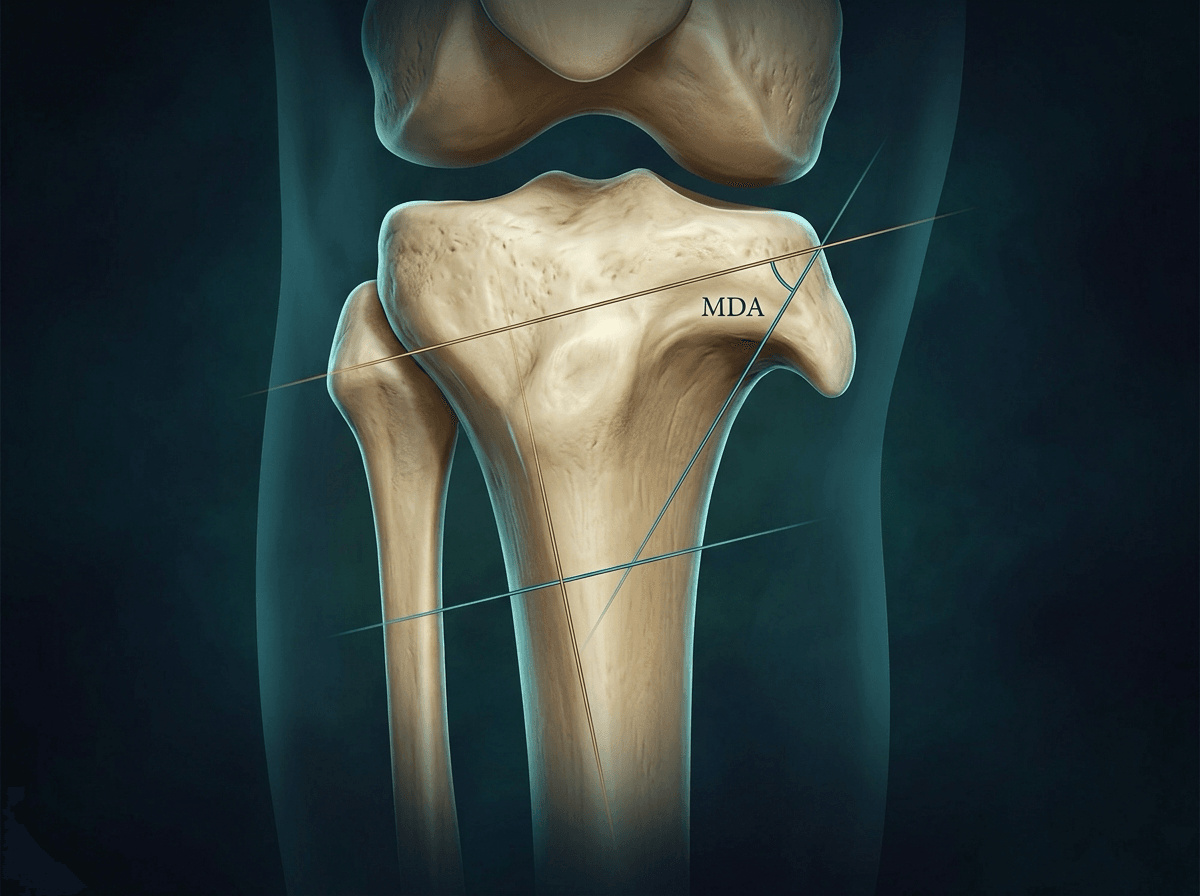
Drennan metaphyseal-diaphyseal angle (MDA). The angle between a line across the proximal tibial metaphyseal beaks and a line perpendicular to the tibial diaphyseal axis:
- Under about 10 degrees: usually physiological bowing
- Over about 16 degrees: likely pathological (Blount disease)
- About 10 to 16 degrees: indeterminate, warranting close follow-up
Langenskiold stages (I to VI). A radiographic progression of the medial proximal tibial physis and epiphysis in infantile (early-onset) Blount disease: medial metaphyseal beaking and irregularity (stages I-II), progressive medial physeal depression and fragmentation (III-IV), then a bony bar across the medial physis with a sloped epiphysis (V-VI). Lower stages in a young child may respond to bracing and then guided growth. Higher stages (especially V-VI, with a medial physeal bar) and late-onset or high-BMI disease tend to need osteotomy, often with bar resection, because growth modulation alone undercorrects and the implants break.
Implant breakage. Across 246 tension-band procedures in Blount disease, overall breakage was 12 percent, roughly twenty times the 0.55 percent seen in unselected guided growth, and solid 3.5 mm screws broke in half of late-onset cases. Higher BMI and greater varus each raised the risk, and the screw that fails is usually the metaphyseal one.
Do not forget the femur in tibia vara. The name points at the tibia and the eye follows it, but in a review of 127 varus limbs a substantial proportion had concurrent femoral varus contributing to the malalignment, which is why the mLDFA must be measured and not assumed normal. The useful distinction is by age: in early-onset disease, 73 percent of femurs corrected on their own with tibial plating alone, so the femur can usually be observed; in late-onset disease it more often needs its own lateral plate, and femoral plating brought the mLDFA from 98 to 87 degrees with 80 percent achieving full correction.
Early-onset versus late-onset. Early-onset (infantile, under about 3 to 4 years) disease is bilateral in up to half and linked to early walking and obesity. Late-onset (juvenile or adolescent) disease tracks adolescent obesity and is more often unilateral, with less growth remaining.
Clinical Presentation
History. Ask about age at onset, progression, symmetry and function. Pain, lateral thrust, fatigue, patellofemoral symptoms and unilateral progression are more concerning than cosmetic concern alone. Ask about previous physeal injury, infection, fracture, metabolic disease, vitamin D risk, renal disease, skeletal dysplasia features, family history and obesity.
Whether follow-up is practical. Ask the family. Guided growth is a commitment to serial imaging and planned hardware removal.
Examination. Observe the child standing and walking. Look for varus thrust, patellar tracking, foot progression, limb length difference, pelvic level and rotational profile. Measure intercondylar or intermalleolar distance as a clinical baseline, but do not use it as a substitute for full-length alignment. Then assess:
- Hip, knee and ankle range of motion
- Coronal alignment and patella direction
- Ligament laxity and joint line opening
- Lateral thrust in varus knees
- Rotational profile, so torsion is not mistaken for coronal deformity
- Signs of rickets, skeletal dysplasia or systemic disease
- Skin, BMI and soft-tissue envelope for implant planning
Investigations
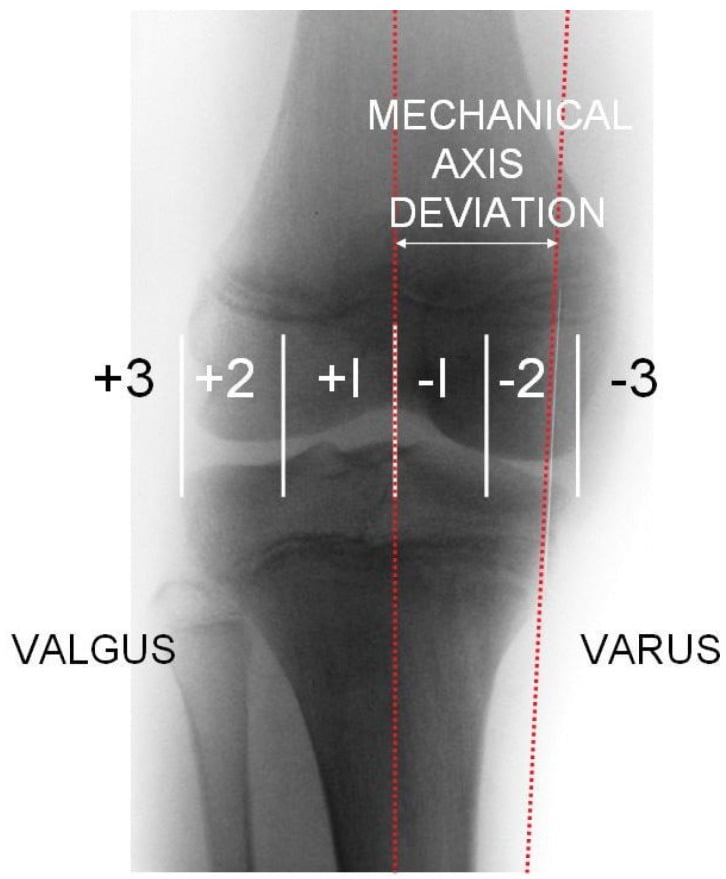
The standing hip-to-ankle radiograph. This is the key investigation, taken with the patellae facing forward where possible. It allows mechanical axis deviation, LDFA, MPTA and joint line convergence to be assessed. A cropped knee film can miss femoral, tibial, limb-length or global alignment contribution.
- Investigation
- Standing hip-to-ankle radiograph
- Decision it informs
- Measures mechanical axis deviation and bilateral alignment.
- Investigation
- LDFA, MPTA and JLCA
- Decision it informs
- Localises femur, tibia, joint or combined source.
- Investigation
- Bone age and maturity assessment
- Decision it informs
- Determines guided-growth feasibility and timing.
- Investigation
- Vitamin D, calcium, phosphate, ALP, renal/endocrine tests when indicated
- Decision it informs
- Optimises metabolic disease before mechanical correction.
- Investigation
- Sagittal and rotational assessment, CT only when needed
- Decision it informs
- Prevents using coronal guided growth for the wrong problem.
A knee that looks valgus or varus is not enough. Confirm mechanical axis, localise the bone and physis causing deformity, assess growth remaining and identify pathological causes before implanting a plate.
Normal Joint-Orientation Angles and the Malalignment Test
The angles are only useful against their normal values, and the malalignment test (Paley) is the systematic way to turn a standing film into a deformity diagnosis.
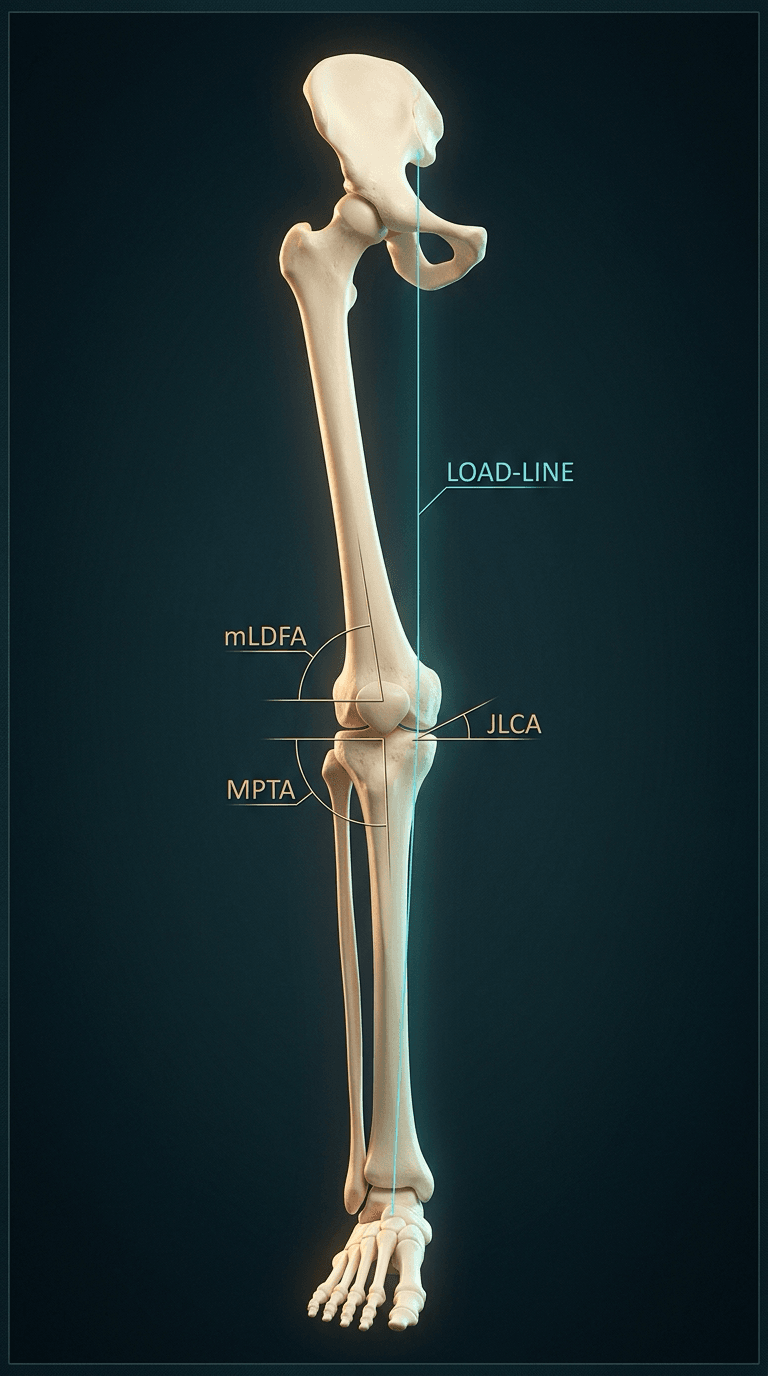
- Approximate normal
- About 8 mm (plus or minus 7) medial to the knee centre
- What it localises
- Overall coronal malalignment / load path
- Approximate normal
- About 85-90 degrees (mean ~88)
- What it localises
- Distal femoral source (raised = femoral varus; lowered = femoral valgus)
- Approximate normal
- About 85-90 degrees (mean ~87)
- What it localises
- Proximal tibial source (lowered = tibial varus; raised = tibial valgus)
- Approximate normal
- About 0-2 degrees
- What it localises
- Intra-articular / ligamentous / cartilage-wear contribution
The malalignment test. Read the standing film in four steps, in this order:
- Measure MAD on the standing hip-to-ankle film. The mechanical axis is a line from the centre of the femoral head to the centre of the ankle and normally passes just medial to the knee centre; the tibial plateau can be divided into zones, and a line falling into the medial or lateral outer zones confirms significant deviation.
- Find the femoral contribution with the mLDFA. If it is abnormal, the distal femur is a source, or the source.
- Find the tibial contribution with the MPTA.
- Account for the joint with the JLCA. A raised value means part of the "deformity" is intra-articular or ligamentous (joint-line opening or cartilage wear), which guided growth will not correct.
How Much Growth Is Enough
"Enough growth remaining" is the phrase every candidate uses and few can quantify. It is an arithmetic question, and the arithmetic is short.
Divide the deformity by the correction rate. At roughly 0.8 degrees per month, a 10 degree deformity needs about 12 months of physeal activity, a 15 degree deformity about 19 months, and a 20 degree deformity over two years. Add a margin, because the last months before physeal closure contribute very little growth: the physis does not stop abruptly, it decelerates. As a working rule, a significant coronal deformity wants at least 18 to 24 months of meaningful growth remaining, and a child with less than a year is usually better served by an osteotomy than by an implant that will run out of physis before it runs out of deformity.
Then establish how much growth there actually is. Bone age, pubertal stage and growth velocity all inform it; chronological age is the least reliable input available, and it is the one most often used. Skeletal age, ideally elbow-based during the spurt, tells you the months you have. If that number is smaller than the months you need, the answer is osteotomy.
- What it uses
- Hand and wrist radiograph compared with an atlas standard
- When it is the right tool
- The default skeletal-age assessment; least discriminating precisely during the pubertal spurt
- What it uses
- Ossification of the olecranon and distal humerus
- When it is the right tool
- The best resolution during the growth spurt itself (about 11-13 years in girls, 13-15 in boys), when guided-growth timing decisions are hardest
- What it uses
- Iliac apophysis ossification
- When it is the right tool
- A late and coarse marker - useful to confirm that growth is nearly over, not to plan a two-year correction
- What it uses
- Distal femur grows about 10 mm/year, proximal tibia about 6 mm/year; growth ends around 14 in girls and 16 in boys
- When it is the right tool
- Quick bedside arithmetic and epiphysiodesis timing
- What it uses
- A published multiplier applied to current length by age and sex
- When it is the right tool
- Predicting final length and timing without serial measurements
Differential Diagnosis
The differential for a child referred with knock-knee or bow-leg:
- Physiological genu varum or genu valgum
- Infantile or adolescent Blount disease
- Nutritional rickets or hypophosphataemic rickets
- Renal osteodystrophy or endocrine bone disease
- Post-traumatic physeal bar
- Skeletal dysplasia
- Ligamentous laxity or joint line convergence
- Rotational profile creating apparent coronal malalignment
- Limb-length difference with pelvic compensation
Management
Observe or optimise. Physiological, symmetric, age-appropriate alignment is observed: explain the natural history and the triggers for review, because physiological varus and valgus usually improve without surgery. Metabolic disease is treated before mechanical surgery, since a plate cannot correct abnormal growth biology if rickets or renal osteodystrophy remains untreated. In obesity or where Blount disease is a risk, address modifiable load and assess for lateral thrust, progression and joint depression.
Guided growth. Guided growth is a timed growth-modulation operation, not an acute correction. It is preferred where gradual correction is safe, there is enough growth remaining and the joint surface is acceptable; for an open physis with a localised coronal deformity, gradual correction can avoid osteotomy when follow-up and timing are reliable.
Which physis, which side. The question is whether the deformity arises from the distal femur, the proximal tibia, both, joint-line obliquity, ligament laxity or an extra-articular deformity, because guided growth works poorly if the wrong physis is tethered or if the deformity is mainly intra-articular. Choose the physis and side from the measured deformity source and place the tether on the convex side of growth. Implant choice, between a tension-band plate, a staple or a transphyseal screw, follows diagnosis, size, physis, surgeon preference and recurrence risk, and the three behave differently.
The endpoint. Define it before surgery, track correction on serial standing alignment films, and remove the hardware when the planned target is reached. Counsel that correction takes months, that follow-up is not optional, and that overcorrection, undercorrection and rebound are surveillance problems.
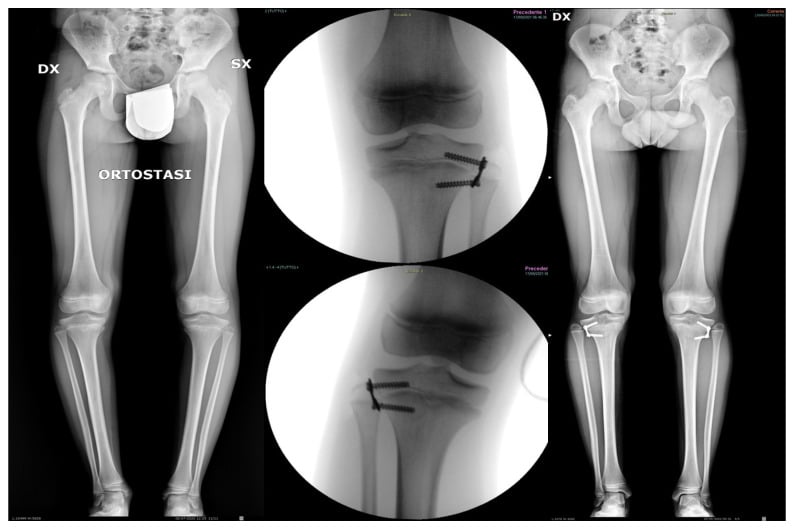
Osteotomy or complex correction. Osteotomy is preferred when correction is urgent, growth remaining is insufficient, deformity is severe and rigid, there is joint depression, or the child is near maturity. It is also preferred for the multiplanar deformity, the deformity associated with joint incongruity, and the deformity unlikely to correct with growth, because growth modulation is too slow or too limited for these problems. Physeal bar surgery, epiphysiodesis, length correction or frame-based correction may be needed in complex cases. A post-traumatic physeal bar is mapped with MRI or CT and treated by bar resection, epiphysiodesis or osteotomy depending on its size and the growth remaining, because the arrest is focal and may not be solved by a simple tension-band plate.
- What the surgeon does
- Mark the mechanical axis, identify the abnormal physis and choose medial or lateral tethering from LDFA, MPTA and JLCA.
- Safety point
- Wrong-side or wrong-level tethering is a planning error, not a technical complication.
- What the surgeon does
- Supine positioning with fluoroscopy; confirm true AP and lateral views of the target physis.
- Safety point
- Poor intra-operative imaging risks screw placement across the physis or wrong plate position.
- What the surgeon does
- Small medial or lateral incision centred on the physis, protecting periosteum and soft tissues.
- Safety point
- Avoid damaging the physis; the implant should act as a tether, not a physeal bar.
- What the surgeon does
- Place tension-band plate, staple or transphyseal screw according to surgeon preference and diagnosis.
- Safety point
- Screws should hold epiphysis and metaphysis without crossing into the joint.
- What the surgeon does
- Serial standing alignment radiographs until target correction, then planned removal.
- Safety point
- The operation fails if correction is not tracked or removal is missed.
- What the surgeon does
- Continue alignment surveillance for rebound, especially in young children and pathological physes.
- Safety point
- Removal is not discharge.
Beyond the Knee: Other Sites and Other Planes
Guided growth is discussed almost entirely around the knee, but the principle is indifferent to location: any extra-articular deformity arising at an open physis can be tethered, in any plane except rotation.
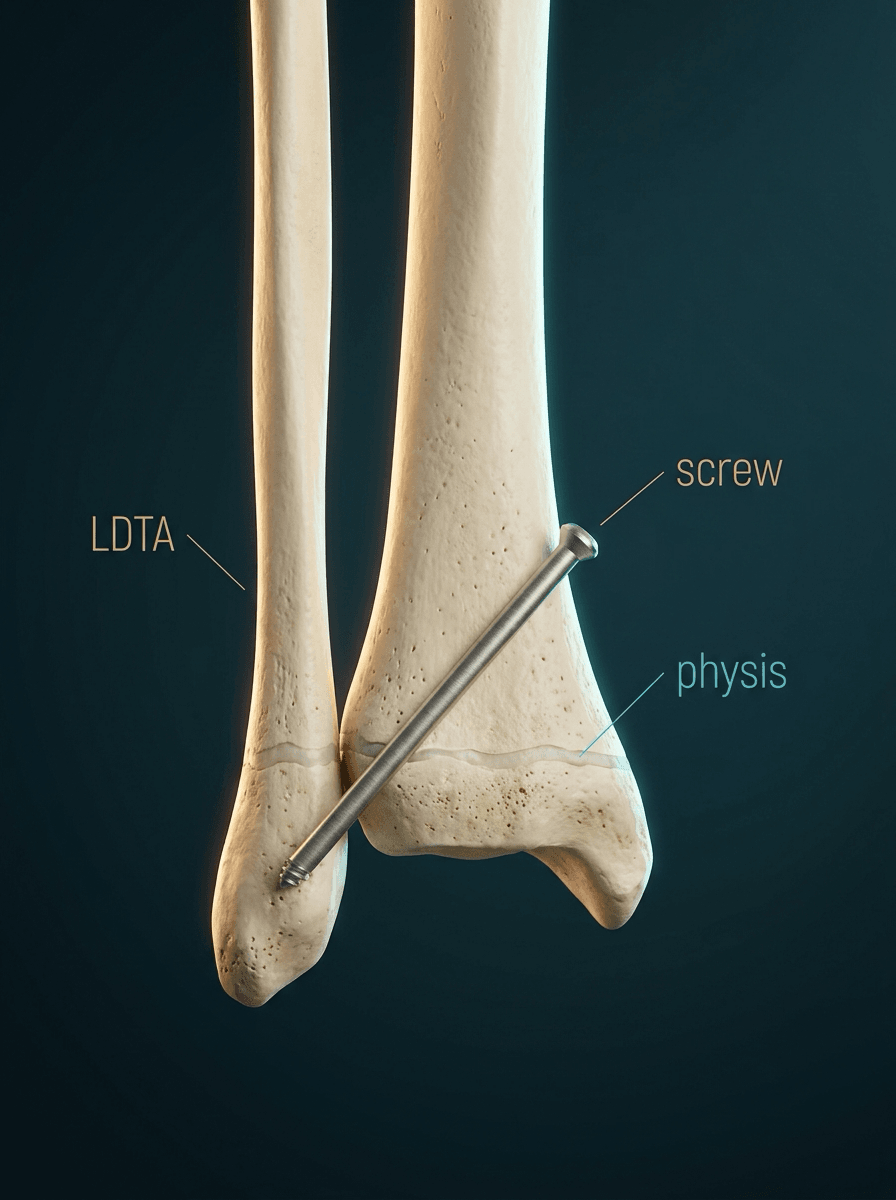
Ankle valgus. The second commonest site. It arises where the medial distal tibial physis outgrows a short or tethered fibula (multiple hereditary exostoses, fibular hemimelia, myelomeningocele, poliomyelitis) or after physeal injury. Measure the lateral distal tibial angle (LDTA), normally about 89 degrees (roughly 86 to 92), on a standing film, together with the talar tilt within the mortise; valgus lowers the LDTA.
Look at the fibula before blaming the tibia. In exostoses and fibular hemimelia the deformity is often driven by relative fibular shortening, and correcting the tibia alone leaves the ankle mechanically unsound.
The ankle construct. The classic construct is a single transphyseal screw placed from the tip of the medial malleolus across the medial distal tibial physis: low profile, well tolerated under a boot, and easily removed. A medial tension-band plate is the alternative where a screw would be prominent. Removal timing and rebound follow the same rules as at the knee.
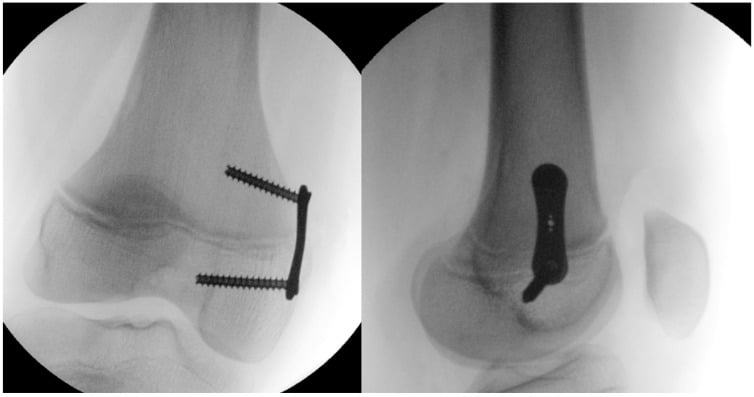
The sagittal plane: fixed knee flexion contracture. An anterior distal femoral hemiepiphysiodesis, usually paired plates, one medial and one lateral, on the anterior aspect of the distal femoral physis, gradually extends a knee held in fixed flexion. It is used in cerebral palsy and myelomeningocele, where a growing child would otherwise face an extension osteotomy, and it is attractive precisely because it corrects without shortening the limb or destabilising the extensor mechanism.
Its requirements. They are the same as in the coronal plane: an open physis, a genuine bony source rather than a purely soft-tissue contracture, and enough growth. It is slow, and a severe contracture in a child near maturity remains an osteotomy problem.
Growth modulation corrects angular deformity of physeal origin - coronal or sagittal, at the knee, the ankle, the proximal femur or the distal radius. It cannot correct rotational malalignment, because a physis cannot untwist a bone when there is no side of it to slow; intra-articular deformity (a raised JLCA, a depressed plateau); or limb-length difference; and it cannot work at all through a closed or barred physis. Naming those four exclusions is a complete answer to "what are the limitations".
Complications
Early
- Wrong diagnosis: physiological alignment treated surgically
- Wrong level or wrong side tethering
- Infection, wound irritation or hardware prominence
- No correction because growth remaining is inadequate
- Family lost to follow-up before planned removal
Late
- Overcorrection
- Undercorrection
- Rebound deformity after removal
- Hardware breakage or migration
- Physeal tethering or bar formation
- Need for repeat guided growth or osteotomy
Rebound: how common, in whom, and what to do about it
Rebound is the expected behaviour of a physis that is still open, not an unusual complication, and the numbers matter for consent. In a series of 189 legs treated for idiopathic genu valgum, 59 percent rebounded after plate removal, 30 percent remained stable and 11 percent went on correcting. In a separate cohort followed to maturity, rapid correctors rebounded in 79 percent of limbs, by a mean of about 4 degrees. Telling a family that "the deformity can come back" without a number lets them hear "unlikely", when the truth is closer to a coin toss weighted the wrong way.
The predictors are consistent across studies and all point the same way:
- Rate of correction carries the highest odds of any variable. A physis that corrected fast is a physis with a great deal of growth left, and it will keep using it after the tether comes off.
- Young age at implantation, for the same reason.
- Larger initial deformity and body mass index also independently predict rebound.
- Aetiology: Blount disease and metabolic bone disease have higher risk.
Two practical consequences. First, the child who corrects quickly is the child who most needs deliberate overcorrection and the closest surveillance, which feels counter-intuitive, because a fast correction looks like a success at the time. Second, the radiograph taken on the day of removal is not the outcome: alignment should be re-checked at intervals until skeletal maturity, and families must be told that at consent rather than at the recurrence.
Guidelines, Registries and Global Practice
Guided growth is practised worldwide, but the supporting framework is principle-based and society reviews rather than randomised trials or implant registries, because these are paediatric soft-tissue-sparing procedures in growing bone.
Global epidemiology
- Physiological genu varum is usual in infancy and physiological genu valgum peaks around age 3 to 4 years, settling toward adult alignment (mild valgus) by about age 7, across populations.
- Idiopathic genu valgum needing intervention is uncommon; most referrals are physiological and resolve with observation.
- Blount disease prevalence varies by region and body habitus: infantile (early-onset) disease is more frequent where early walking and higher childhood BMI are common, while late-onset (adolescent) disease tracks adolescent obesity.
- Nutritional rickets remains a leading cause of pathological bowing in limited-resource settings, whereas X-linked hypophosphataemic rickets dominates where nutrition is adequate.
Side-by-side guidance
- Emphasis for paediatric angular deformity
- Distinguish physiological from pathological alignment; image with full-length standing radiographs before any intervention.
- Emphasis for paediatric angular deformity
- Reserve surgery for progressive, asymmetric or pathological deformity; observation and natural-history counselling for physiological alignment.
- Emphasis for paediatric angular deformity
- Deformity analysis (mechanical axis, joint orientation angles, CORA) drives the choice between growth modulation and osteotomy.
- Emphasis for paediatric angular deformity
- Endorse temporary hemiepiphysiodesis as first line for suitable coronal deformity with open physes, with planned removal and rebound surveillance.
The common thread across societies is that the analysis (full-length alignment, source localisation, growth remaining and underlying diagnosis) governs the decision, not the appearance of the knee.
Registry and evidence notes
- There is no dedicated international guided-growth implant registry comparable to arthroplasty registries (NJR, AJRR, AOANJRR); evidence comes from multicentre series such as the multinational tension band plating cohort of 967 physes.
- Best available data are cohort-level (Level III to IV), so counselling rests on pooled series rather than registry survivorship.
High- versus limited-resource practice
- Where full-length standing radiography and reliable follow-up are available, tension band plating with planned removal is standard.
- Where imaging or follow-up is limited, percutaneous transphyseal screws (lower cost, low profile) or single-stage osteotomy may be preferred, because guided growth fails without serial alignment review.
- In settings with high nutritional rickets burden, medical optimisation precedes any mechanical correction, and untreated metabolic disease is a frequent reason guided growth fails.
Controversies and Areas of Uncertainty
Guided growth is established, but several questions remain genuinely contested and are favourite viva territory.
- One view
- Aim past neutral to offset expected rebound in young, fast correctors.
- Counter view
- Overcorrection risks creating the opposite deformity and a second operation; aim for neutral and watch.
- One view
- Tension band plates allow faster, growth-arrest-sparing correction than staples.
- Counter view
- Percutaneous transphyseal screws are lower profile and cheaper; staples remain effective in some hands.
- One view
- Remove promptly at neutral to avoid overcorrection.
- Counter view
- Some retain the plate as a guide during continued growth, accepting closer review.
- One view
- Effective in selected early or mild cases and avoids osteotomy.
- Counter view
- High implant breakage and undercorrection in late-onset, high-BMI, severe varus argue for osteotomy.
- One view
- Earlier intervention uses abundant growth and is gentle.
- Counter view
- Very young children rebound more and may simply be physiological; observation may suffice.
Viva Approach and Common Pitfalls
The sequence to speak out loud
- Define physiological versus pathological alignment.
- Describe symptoms, progression and asymmetry.
- Obtain standing hip-to-ankle films.
- State mechanical axis deviation.
- Use LDFA, MPTA and JLCA to localise source.
- Check growth remaining and bone age, and do the arithmetic out loud - degrees divided by 0.8 per month.
- Look for metabolic disease, Blount disease or physeal bar.
- Choose observation, medical treatment, guided growth or osteotomy.
- Plan follow-up, removal timing and rebound surveillance.
Common pitfalls
- Planning from a knee-only X-ray.
- Operating on physiological alignment.
- Ignoring bone age.
- Saying "enough growth remaining" without being able to quantify it.
- Forgetting rickets or renal bone disease.
- Confusing rotational deformity with coronal deformity.
- Assuming the tibia is the only problem in tibia vara.
- Using guided growth when osteotomy is required.
- Not removing implants on time.
- Discharging after removal without rebound surveillance.
Clinical Decision Scenarios
Practise clinical reasoning and management decisions out loud
“A ten-year-old has progressive genu valgum. How do you plan guided growth?”
“A child with genu varum has lateral thrust and obesity. What are you worried about?”
“An eight-year-old corrected to neutral had her tension band plate removed six months ago. The latest standing film shows the valgus is returning. How do you explain and manage this?”
Measure (and the normal value)
- Standing hip-to-ankle film, patellae forward — never a knee-only film
- MAD: about 8mm (plus or minus 7) medial to knee centre
- mLDFA: about 85-90 degrees (mean 88) — distal femoral source
- MPTA: about 85-90 degrees (mean 87) — proximal tibial source
- JLCA: about 0-2 degrees — raised means intra-articular, and a plate will not fix it
- LDTA at the ankle: about 89 degrees
- Skeletal age — elbow-based (Sauvegrain/Dimeglio) during the growth spurt, Greulich-Pyle otherwise
The Numbers
- Correction rate: 0.77 deg/month femur, 0.79 deg/month tibia — just under 1 degree a month
- Growth needed = deformity in degrees divided by 0.8; want 18-24 months for a significant deformity
- Rebound after removal: about 59% of legs in idiopathic genu valgum; 79% in rapid correctors
- Implant breakage: 0.55% overall, but 12% in Blount disease and 50% for solid 3.5mm screws in late-onset Blount
- Drennan MDA: under 10 deg physiological, over 16 deg Blount
- Infection: about 1.5%
Indications
- Progressive
- Asymmetric
- Symptomatic
- Outside age range
- Growth remaining
Treatment
- Observe physiological
- Correct metabolic disease
- Guided growth
- Osteotomy
- Monitor rebound
Pitfalls
- Wrong source — tethering the tibia when the femur is the problem
- No follow-up; removal date treated as discharge
- Overcorrection from a missed removal
- Rebound not mentioned at consent
- Rotation ignored — guided growth cannot untwist a bone
What It Cannot Do
- Rotational malalignment — there is no side of the physis to slow
- Intra-articular deformity — a raised JLCA or a depressed plateau
- Limb-length discrepancy (that is epiphysiodesis or lengthening)
- Anything through a closed or barred physis
Evidence Base
Guided growth principles and indications
- Temporary hemiepiphysiodesis tethers one side of an open physis to allow differential growth and correct coronal deformity around the knee.
- Staples, percutaneous transphyseal screws and tension band plates are all described constructs.
- Undercorrection and overcorrection are common; careful preoperative planning and follow-up minimise complications.
Multinational tension band plating series defines correction rate
- 967 physes in 537 patients across multiple centres; mean age at implantation 11.4 years.
- Calculated correction rate was 0.77 degrees per month for the femur and 0.79 degrees per month for the tibia.
- Infection rate 1.48 percent and screw breakage 0.55 percent; age at implantation and direction of deformity influenced correction.
Tension band plate corrects faster than stapling
- 34 patients with 65 deformities treated by a non-locking tension band plate; 32 of 34 patients (63 of 65 deformity levels, 97%) corrected to neutral at a mean of 11 months.
- Correction was approximately 30 percent faster than reported with stapling, with no permanent growth arrest.
- Four idiopathic genu valgum patients rebounded and underwent repeat guided growth; two late-onset Blount cases undercorrected.
Rebound predictors after stapling for genu valgum
- 37 limbs with idiopathic genu valgum followed to maturity or beyond two years after staple removal.
- Rate of correction, BMI, age and initial valgus angle were independent predictors of rebound on multivariate analysis.
- Rapid correctors had a 79 percent rebound incidence (mean 4 degrees); slow correctors with low BMI had less rebound, and none when BMI was at or above 21.
Rebound is common and driven by young age and fast correction
- 100 patients (189 legs) with idiopathic genu valgum analysed on serial long-leg radiographs.
- 59 percent of legs showed rebound growth after plate removal, 30 percent stayed stable and 11 percent continued correcting.
- Sex, age, baseline mechanical axis deviation, mLDFA, mMPTA and the correction rate were significant, with correction rate carrying the highest odds ratio.
Implant breakage is far higher in Blount disease
- 246 tension band implant procedures in 113 patients with Blount disease across 8 centres.
- Overall implant breakage 12 percent (mean 1.6 years after implantation), mostly metaphyseal screws.
- Higher BMI and greater varus deformity raised breakage risk; solid 3.5 mm screws had a 50 percent breakage rate in late-onset Blount disease.
Femoral deformity contributes to malalignment in tibia vara
- 127 limbs with tibia vara reviewed; many had concurrent femoral varus contributing to overall malalignment.
- Femoral lateral tension band plating corrected mLDFA from 98 to 87 degrees, with 80 percent achieving full femoral correction.
- In early-onset tibia vara, 73 percent of femurs corrected with tibial plating alone, supporting observation of the femur in young children.
Salenius & Vankka - the development of the tibiofemoral angle in children
- The primary source for the developmental arc of the tibiofemoral angle from birth to maturity, and the reason age-appropriate angular variation is treated as physiological
- Maximal varus in infancy, passing through neutral in the second year to peak valgus at around 3 years, then settling to the adult value of mild valgus by about 7 years
- PubMed's record confirms that AGE FACTORS and SEX FACTORS were examined, which is why the modern reference values are stratified by age rather than being a single number
- The practical corollary for this page: an alignment that is abnormal for an adult may be entirely normal for a three-year-old, so the FIRST question before any guided-growth plan is whether the deformity is outside the range for that age