Diaphyseal Radius and Ulna Fractures - The 'Forearm Joint'. ORIF with 3.5mm compression plates remains the gold standard treatment for displaced adult injuries.
- Restoration of the radial bow is critical for rotation; loss of bow creates a mechanical block.
- The 6-cortex rule (minimum 3 screws per fragment) is the mechanical requirement for stable fixation.
- Always exclude Monteggia (ulna + radial head) and Galeazzi (radius + DRUJ) injuries by imaging elbow/wrist.
- Volar compartments are at highest risk for compartment syndrome; check pain on passive stretch.
- “The PIN is at highest risk in proximal Henry approaches; protect by fully supinating the forearm.
- “Use two separate incisions for a both-bone fracture. The mechanism is real - loose fragments left in the interosseous space and screws broaching the far cortex are what seed a cross-union - but treat the often-quoted single-incision percentages as convention, not measured risk.
- “Isolated ulnar fractures ('Nightstick') with under 50% displacement and under 10° angulation can be treated in a brace.
Forearm Shaft Fracture (Adult)
Overview and Epidemiology
Adult forearm shaft fractures are significant injuries because the forearm behaves as a functional joint, allowing an average rotation of 180°. Unlike many other long-bone fractures, non-operative management of a displaced adult forearm fracture leads to poor functional outcomes, loss of rotation and high nonunion rates.
Incidence and who. Approximately 1-2% of all adult fractures, with a bimodal distribution: young males aged 15-30 after high-velocity trauma, and older females over 65 after low-energy osteoporotic falls. Both bones are involved most often (60%); an isolated ulna (25%) and an isolated radius (15%) are less frequent.
Mechanism. Three patterns of injury:
- High-energy: motor vehicle and motorcycle accidents, falls from height. Leads to comminution and significant soft-tissue compromise.
- Low-energy: ground-level falls in the elderly.
- Direct blow: the "nightstick" fracture, sustained when an individual raises the arm to protect against a strike (the classic defensive injury).
"Why ORIF the adult but not the child?" is a frequent viva framing, and the contrast explains the whole adult anatomic-reduction imperative. The child has open physes and powerful remodelling, so considerable angulation, and even some malrotation in the very young, corrects with growth; the adult has none, so any malreduction is permanent and directly costs pronation and supination. Children therefore tolerate age-dependent angulation (more in the young, with remodelling), whereas the adult threshold for displaced both-bone and radius fractures is essentially anatomic.
Children also sustain patterns adults do not, plastic (bowing) deformation, greenstick and buckle (torus) fractures, and these are often managed by closed reduction and casting. The caveat is plastic deformation, which must be corrected: it blocks rotation and will not remodel like an angulated fracture. Where a child's fracture needs fixation the workhorse is flexible (elastic/titanium) intramedullary nailing; the adult standard is open compression plating, which restores the radial bow and rotation precisely.
Anatomy/Biomechanics
The radius and ulna are connected by the interosseous membrane (IOM), and functionally the forearm is a ring structure. A fracture with displacement in one bone almost always implies a second fracture or a dislocation of either the proximal (PRUJ) or distal (DRUJ) radioulnar joint.
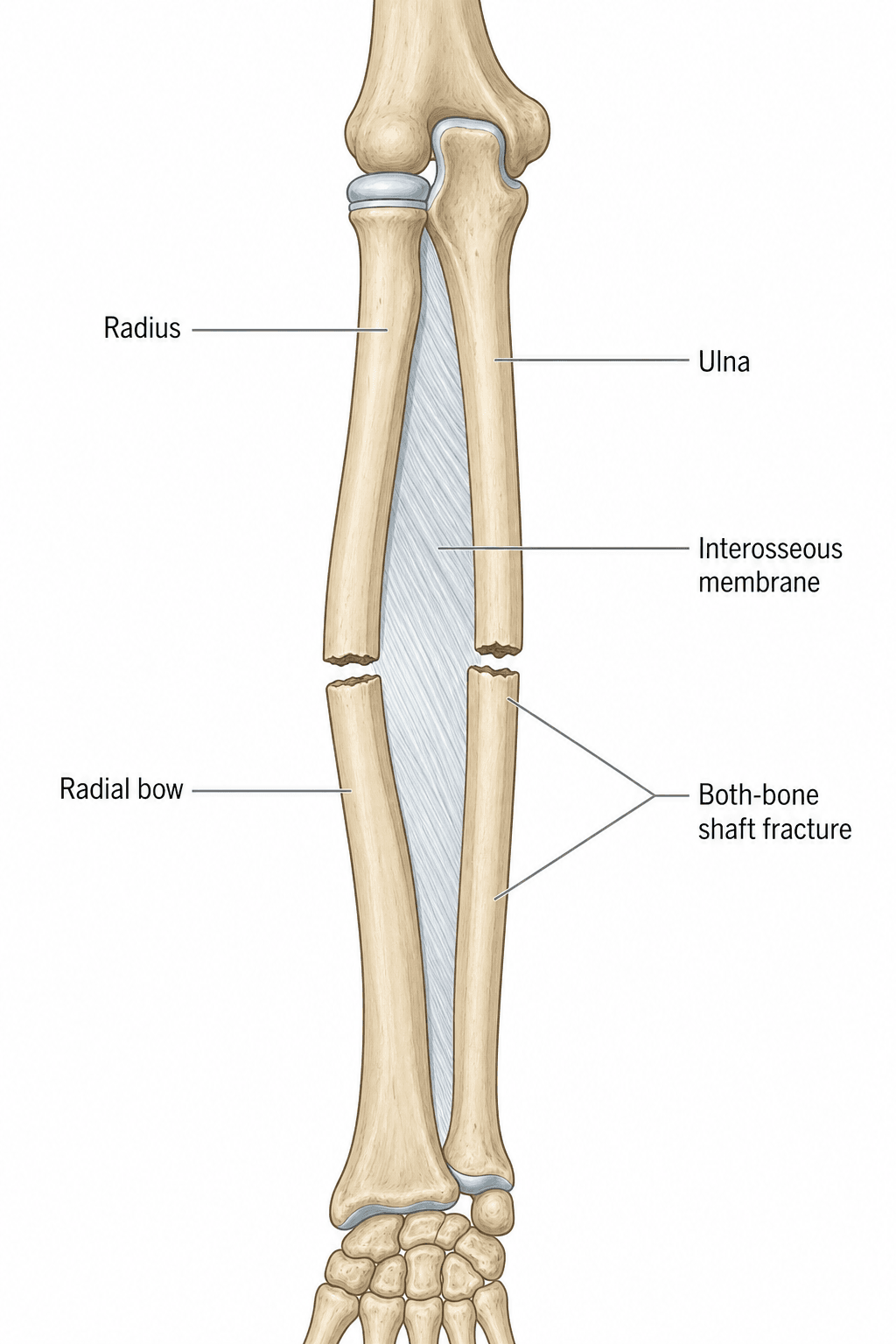
The interosseous membrane. A complex ligamentous structure with 5 parts. The central band is the strongest portion and provides 70% of the longitudinal stiffness. The membrane transfers load from the radius to the ulna and maintains the relationship between the two bones during rotation.
The radial bow. The radius is not straight: it has a lateral convex curvature whose apex lies at the junction of the proximal and middle thirds, at the pronator teres insertion. The axis of rotation runs from the centre of the radial head proximally to the ulnar fovea distally, and the radius rotates around the fixed ulna while the IOM maintains tension throughout the arc.
Why the bow matters. Loss of the bow (straightening the radius) produces a mechanical block to rotation and significant loss of supination and pronation. Schemitsch and Richards (1992) showed that restoration of the magnitude and location of the radial bow to within approximately 5% of the contralateral limb correlates directly with the recovered rotational arc and grip strength.
Muscle deforming forces. The supinators act proximally: biceps brachii, inserting on the radial tuberosity, and supinator. The pronators are pronator teres in the middle of the bone and pronator quadratus distally. The level of the fracture relative to the pronator teres insertion therefore predicts the deformity:
- Proximal to PT: the proximal fragment is supinated by biceps and supinator; the distal fragment is pronated by PT and PQ.
- Distal to PT: the proximal fragment stays neutral, counterbalanced; the distal fragment remains pronated by PQ alone.
Pathophysiology of Bone Healing
Fracture healing in the forearm requires a delicate balance between mechanical stability and molecular signalling. With ORIF and compression plating the goal is absolute stability, which leads to primary (direct) bone healing.
Molecular signalling. Injury brings the immediate release of the pro-inflammatory cytokines TNF-alpha, IL-1beta, IL-6 and IL-10, activation of the MAPK (mitogen-activated protein kinase) and NF-kappaB pathways in osteoblast precursors, and recruitment of mesenchymal stem cells along SDF-1 and CXCR4 gradients.
Primary bone healing (absolute stability). Occurs when the fracture gap is under 0.1mm and strain is under 2%, and no external callus forms. Osteoclasts, formed through RANKL/OPG signalling, tunnel across the fracture site as cutting cones, followed by osteoblasts depositing new lamellar bone. The key growth factors are BMP-2, BMP-4, BMP-7 and TGF-beta1.
Secondary bone healing (relative stability or gaps). This is the pathway if bridging or intramedullary nailing is used, and it runs in stages:
- Inflammation: haematoma formation and fibrin clot
- Soft callus: chondrocytes produce type II collagen, regulated by Sox9
- Hard callus: endochondral ossification, with type X collagen and VEGF for angiogenesis
- Remodelling: conversion of woven bone to lamellar bone over months to years
Classification Systems
The AO/OTA system (region 22, forearm) provides a standardised language for describing fracture morphology and complexity:
- 22A: Simple fracture
- 22A1: Simple ulna, radius intact
- 22A2: Simple radius, ulna intact
- 22A3: Simple both bones
- 22B: Wedge fracture
- 22B1: Wedge ulna, radius intact
- 22B2: Wedge radius, ulna intact
- 22B3: Wedge both bones
- 22C: Complex fracture
- 22C1: Complex ulna, radius intact
- 22C2: Complex radius, ulna intact
- 22C3: Complex both bones
Clinical Assessment
A thorough clinical assessment is mandatory to exclude limb-threatening complications, particularly compartment syndrome.
Presentation. Obvious deformity, swelling and localised tenderness. The patient often supports the injured limb in a neutral position and has significant pain with any attempt at passive or active rotation.
Skin. There is a high incidence of open fractures in the forearm, since the ulna is subcutaneous. Check for small "poke-through" wounds.
Nerves. Three checks cover the three nerves:
- AIN (median): the "OK sign" (FPL and FDP to the index)
- PIN (radial): finger extension at the MP joints (EIP/EDC)
- Ulnar: interossei strength and sensation in the fifth digit
Joint stability. Always palpate the elbow (PRUJ) and the wrist (DRUJ). Tenderness at these joints suggests a Galeazzi or Monteggia pattern.
Compartments. Palpate for tenseness. The most sensitive sign is pain on passive stretch of the fingers, extension for the volar compartment.
Investigations
Radiographs. AP and lateral views of the entire forearm, which must include the elbow and the wrist on the same film or as separate orthogonal views of the joints. On a true lateral the radius and ulna should appear parallel; crossing or overlap suggests malrotation or dislocation.
Signs of dislocation.
- Monteggia: the radiocapitellar line must intersect the centre of the capitellum in all views.
- Galeazzi: look for the signs of DRUJ instability: an ulnar styloid fracture at its base; widening of the DRUJ on the AP view (greater than 2mm); dorsal or volar displacement of the ulna relative to the radius on the lateral; radial shortening greater than 5mm relative to the distal ulna.
CT is rarely indicated for a simple shaft fracture. It is useful for complex intra-articular extension at the elbow or wrist, or for planning nonunion surgery.
MRI is reserved for suspected IOM injury (when an Essex-Lopresti lesion is suspected) or for assessing occult tendon or joint injury.
Management Algorithm
The decision. Assessment is clinical examination with AP and lateral radiographs of elbow and wrist, and the choice then turns on which bone is broken and how far it has moved. The isolated ulnar shaft fracture is the one group with a non-operative option: a stable, simple fracture goes into a functional brace with weekly radiographs for 3 weeks, and an unstable one is plated. A displaced radius or both-bone fracture goes to ORIF with 3.5mm compression plates, the gold standard, and a Monteggia or Galeazzi pattern, a fracture with a joint dislocation, needs emergency ORIF with restoration of joint stability.
- Criteria
- under 50% disp, under 10° ang
- Management
- Functional Brace
- Criteria
- Displaced
- Management
- ORIF (DCP/LCP)
- Criteria
- Fracture + Joint Dislocation
- Management
- Emergency ORIF + Joint Stability
In closed injuries without compartment syndrome, surgery can be delayed until the soft tissues are favourable. Open fractures, however, require urgent debridement and stabilisation.
Perioperative drugs. The doses below reflect common international practice; follow local antimicrobial stewardship policy and weight-based adjustment.
Table 1: Perioperative Antibiotic Prophylaxis (general principles)
- Typical Dose
- 2g IV (3g if over 120kg)
- Timing
- within 60 min pre-incision
- Rationale
- First-line cover for skin Gram-positives
- Typical Dose
- 600mg IV
- Timing
- within 60 min pre-incision
- Rationale
- Alternative for beta-lactam allergy
- Typical Dose
- 5mg/kg IV
- Timing
- within 60 min pre-incision
- Rationale
- Added Gram-negative cover for Gustilo III open fractures
- Typical Dose
- 1.5g IV
- Timing
- start 120 min pre-incision
- Rationale
- High MRSA-colonisation risk or local policy
- Typical Dose
- 500mg IV
- Timing
- within 60 min pre-incision
- Rationale
- Anaerobic cover for gross soil contamination (Type III)
Surgical Technique
Radius, volar (Henry). The standard approach for the proximal, middle and distal thirds. The internervous plane lies between brachioradialis (radial nerve) and pronator teres/FCR (median nerve). Proximally the PIN is at risk where it wraps around the radius within supinator.
Radius, dorsal (Thompson). The internervous plane lies between ECRB (radial nerve) and extensor digitorum (PIN). Best for proximal/middle third radial neck or dorsal pathology.
Ulna. A direct incision over the subcutaneous border, in the internervous plane between FCU (ulnar nerve) and ECU (PIN).
When performing a proximal Henry approach, the PIN is at risk. It should be protected by supinating the forearm during dissection; this moves the PIN laterally away from the radial neck and protects it within the supinator muscle fibres.
Compression plating. Use a 3.5mm DCP or LCP. A transverse fracture is compressed by placing screws in the "load" position for dynamic compression; an oblique fracture takes a 3.5mm lag screw, through or outside the plate. The 6-cortex rule is the mechanical requirement: a minimum of 3 screws (6 cortices) on each side of the fracture.
Restoring the bow. The plate must be contoured to match the lateral radial bow, checked by intraoperative comparison with the contralateral side, if fluoroscopy allows, or by clinical assessment of rotation.
Order in a both-bone fracture. Usually fix the radius first, as it is harder to reduce. If one bone is simple and the other complex, a simpler ulna for instance, fix the simple fracture first to restore length, then fix the complex one.
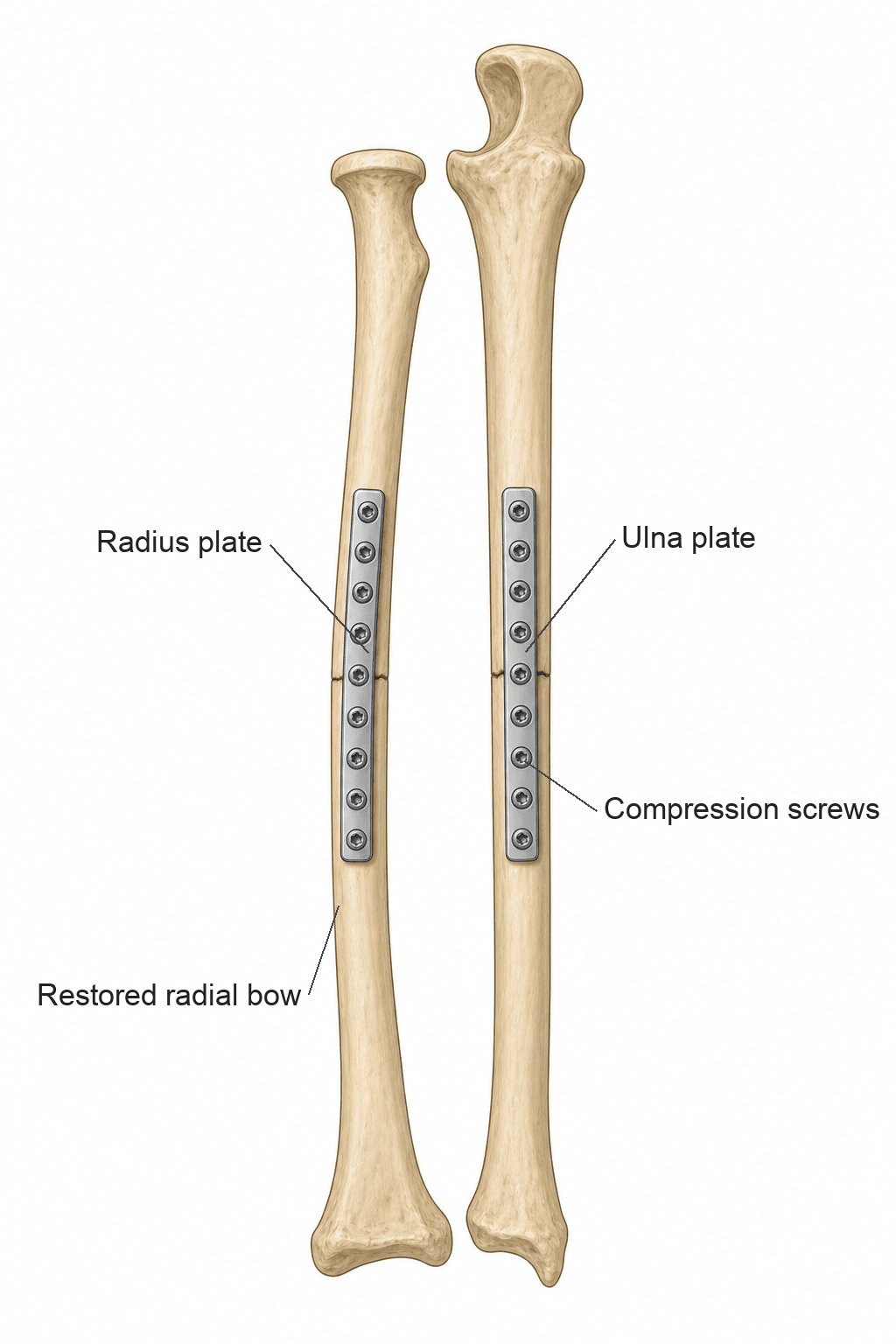
The 10-step forearm ORIF.
- Positioning: supine on a hand table with a tourniquet.
- Approach: standard Henry or Thompson (radius) and subcutaneous (ulna).
- Reduction: direct reduction with pointed reduction forceps; restore the radial bow apex.
- Provisional fixation: K-wires or forceps.
- Plate selection: 3.5mm LCDCP or LCP, contoured.
- Lag screw: if an oblique or spiral pattern exists.
- Compression: apply across the transverse component.
- Screw placement: achieve 6 cortices minimum per fragment.
- Irrigation and closure: haemostasis, layered closure.
- Assessment: confirm a full pronation/supination arc under GA.
Plating is the default because older, non-interlocked nails do not control rotation or restore the radial bow reliably, so they historically gave higher malunion and nonunion rates and worse rotation than plates. Contemporary rigid, anatomically bowed, interlocked forearm nails are designed to reproduce the bow and control rotation, narrowing the gap with plating in selected fractures; they still require the same goals of length, bow and rotation, and the same exclusion of DRUJ and PRUJ injury.
The genuine indications:
- Segmental fractures, where one device spans multiple levels
- Poor soft-tissue envelope (burns, degloving, multiple prior incisions), where an extensile plate exposure is hazardous
- Selected open fractures
- The polytrauma or damage-control patient needing rapid closed stabilisation
- Cosmesis (small incisions) in selected patients
Whichever device is used, restore the radial bow and length, confirm a full rotational arc on the table, and address any associated Monteggia or Galeazzi joint injury.
Complications
Compartment syndrome. Incidence 1-10%, highest in high-energy or crush injuries. Three compartments are at risk: the volar (FPL and FDP), the most commonly affected; the dorsal (extensors); and the mobile wad (brachioradialis, ECRL, ECRB), which is often overlooked. The earliest sign is pain out of proportion, followed by the pain on passive finger extension described under Clinical Assessment, which stretches the volar flexors; the median nerve is affected first. Management is emergency dual-incision (volar and dorsal) fasciotomy releasing all three compartments.
Nerve injury. PIN palsy is the most common, with proximal radius surgery. The dorsal (Thompson) approach carries a documented postoperative PIN palsy rate of approximately 18% even when the nerve is identified and protected (Perretta and Tejwani, 2016), usually a transient neurapraxia. Median and ulnar nerve injuries carry a higher risk in distal-third fractures or penetrating trauma. Across pooled compression-plating series, postoperative nerve injury is the single most common adverse event, at approximately 7% (Vasara et al., 2024).
Infection. Under 2-3% in closed fractures and significantly higher in Gustilo III open fractures, with deep infection of approximately 2-4% even with immediate fixation of open injuries (Moed et al., 1986). Management is irrigation and debridement, retention of hardware if stable, and suppressive antibiotics.
Postoperative Care and Rehabilitation
Phase I, protection (0-2 weeks). A splint or heavy dressing in neutral rotation, with elevation and finger range of motion to minimise oedema, and neurovascular checks in the postoperative clinic.
Phase II, functional range of motion (2-6 weeks). Sutures come out and active and active-assisted range of motion begins, in flexion, extension, pronation and supination. Lifting is restricted to "cup of tea" weight.
Phase III, strengthening (6-12 weeks). Progressive resistance once early bridging callus is visible, with weight-bearing status progressed on the radiology. From 12 weeks the patient returns to activity.
Outcomes and Prognosis
Adult forearm ORIF consistently achieves high union and good function. The union rate is over 95% with modern 3.5mm compression plating in closed injuries, and most patients recover a functional rotational arc when the radial bow and length are anatomically restored: a good result, over 80% of normal rotation, tracks with restoration of the bow (Schemitsch & Richards, 1992).
Patient scores. Pooled DASH scores average around 12.5, that is, good function with a minor residual disability in some patients (Vasara et al., 2024). Subjective weakness can persist despite an objectively good arc.
Guidelines, Registries & Global Practice
Adult forearm shaft fractures are managed with broadly convergent principles worldwide, with the main variation driven by resource setting and the timing/logistics of definitive care.
Global epidemiology
- Diaphyseal forearm fractures represent roughly 1-2% of adult fractures, with a bimodal pattern: high-energy injuries in young men (road traffic and sport) and low-energy osteoporotic injuries in older women.
- High-energy and open patterns predominate where road-traffic and occupational trauma are common; fragility-type injuries dominate in ageing populations.
Side-by-side society guidance
- AO Foundation: Anatomic reduction, restoration of the radial bow, and absolute stability with 3.5mm compression plates (minimum 3 screws / 6 cortices per main fragment) for displaced injuries.
- AAOS / general trauma consensus (US): ORIF is standard for displaced both-bone and displaced isolated radius fractures; selected isolated ulnar (nightstick) fractures with under 50% displacement and under 10° angulation are braced.
- BOA / BOAST (UK) open-fracture principles: Prompt IV antibiotics, early senior-led debridement, and combined ortho-plastic management with early definitive skeletal fixation and soft-tissue cover for open injuries (the ulna is subcutaneous and frequently open).
- EFORT / European practice: Similar plate-osteosynthesis emphasis; intramedullary nailing is reserved for selected segmental or open injuries with poor soft tissues rather than as a default in adults.
Registry and outcome signals
- There is no dedicated arthroplasty-style registry for forearm shaft fractures; the best pooled outcome data come from systematic review (Vasara et al., 2024): 944 adults, 24% adverse-event rate, nerve injury approximately 7% and nonunion approximately 5%, mean DASH 12.5.
High- vs limited-resource variation
- In well-resourced systems, displaced fractures undergo early ORIF, often within 24-72 hours once soft tissues allow.
- In limited-resource or remote settings, initial management is a well-padded above-elbow backslab in neutral rotation with the elbow at 90°, then transfer for definitive plating; the "image both joints" rule (elbow and wrist) is critical at first contact to avoid missing a Galeazzi or Monteggia pattern.
- Functional outcome scores (e.g. DASH) are used internationally to track recovery and guide return to manual work.
MCQ Practice Points
Q: Why is ORIF the standard treatment for adult forearm shaft fractures?
A: The forearm functions as a ring structure requiring anatomic restoration for pronation/supination (180° arc). Non-anatomic reduction causes loss of rotation and radioulnar synostosis. Radial bow must be restored - maximum bow at junction of proximal and middle thirds. Cast treatment acceptable only for isolated ulna fractures with minimal displacement.
Q: What is the optimal plate position for forearm fractures?
A: Radius: Volar (Henry) approach - plate on volar surface (tension side); Thompson approach - plate on dorsal surface. Ulna: Plate on dorsal or medial surface (tension side), avoiding subcutaneous border. 3.5mm LC-DCP or locking plates. Minimum 6 cortices (3 screws) each side of fracture. Compression plating preferred.
Q: What is a nightstick fracture and its treatment?
A: Isolated ulna shaft fracture from direct blow (defensive injury blocking strike). Treatment depends on displacement: Less than 50% displacement and less than 10° angulation: Cast/functional bracing acceptable. Greater than 50% displacement: ORIF. Associated injuries (radial head dislocation = Monteggia) must be excluded - always image elbow and wrist.
Q: What must be assessed with any isolated forearm bone fracture?
A: Always assess for associated joint injury: Monteggia: Ulna fracture + radial head dislocation (check radiocapitellar line). Galeazzi: Radius fracture + DRUJ disruption (check DRUJ on lateral, ulnar fovea tenderness). Essex-Lopresti: Radial head fracture + IOM disruption + DRUJ instability. "Fracture of necessity."
Q: What is the risk of compartment syndrome in forearm fractures?
A: Forearm has three compartments (volar, dorsal, mobile wad) all at risk. High-energy fractures, crush injuries, and combined radius-ulna fractures increase risk. Volar compartment most commonly affected. Monitor closely post-op. Fasciotomy via volar (Henry) + dorsal incisions if suspected. Median nerve first affected.
Exam Viva Scenarios
Practise clinical reasoning and management decisions out loud
“A 30-year-old male labourer presents to the emergency department after a fall from height, landing on his outstretched dominant right forearm. X-rays show displaced mid-shaft fractures of both the radius and ulna at the middle third level. The fractures are transverse with minimal comminution. Neurovascular examination is intact, the skin is closed, and there are no signs of compartment syndrome. How do you manage this patient?”
“A 45-year-old man presents after an assault where he raised his forearm to block a blow from a baseball bat. X-rays show an isolated ulnar shaft fracture at the middle third with 60% displacement and 15 degrees of angulation. There is no radial fracture. He is complaining of severe pain in the forearm that seems out of proportion to the injury, and pain is worse with passive finger extension. The forearm feels tense on palpation. What are your immediate concerns and how do you proceed?”
“You are asked to see a 35-year-old man in clinic who underwent ORIF of both-bone forearm fractures 9 months ago at another hospital. He is very frustrated because despite the fractures healing well on X-ray, he has essentially no pronation or supination - his forearm is fixed in approximately 30 degrees of pronation. He works as an electrician and cannot perform his job. X-rays show healed radius and ulna fractures with well-positioned plates, but there is a 4cm bridge of heterotopic bone connecting the radius and ulna in the middle third of the forearm. What has happened and how do you manage this complication?”
Mandatory Steps
- Include elbow AND wrist in all imaging.
- Check PIN function (EIP/EDC) before every Henry approach.
- Restore radial bow apex to within 5% of contralateral side.
- Use 3.5mm plates with minimum 6 cortices per fragment.
Approaches
- Radius Volar: Henry (Interval: BR & FCR)
- Radius Dorsal: Thompson (Interval: ECRB & EDC)
- Ulna: Subcutaneous (Interval: FCU & ECU)
Surgical Dangers
- PIN in proximal third (Henry/Thompson).
- Median Nerve (Henry approach retraction).
- Synostosis (Single incision both-bone exposure).
- Compartment Syndrome (Missed deep volar release).
Evidence Base
Anderson et al. (1975) - Landmark
- Radius union 97.9%, ulna union 96.3%
- Established rigid compression plating as definitive treatment
- Underpins the modern 6-cortex / 3.5mm plating principle
Schemitsch & Richards (1992) - Landmark
- Restoring the normal radial bow correlated with a good result (over 80% of normal rotation, p less than 0.05)
- Recovery of grip strength linked to restoring the location of the bow (p less than 0.005)
- 84% achieved an excellent/good/acceptable result
- Bone grafting did NOT affect the rate of union - the evidence against routinely grafting acute comminuted fractures
Chapman et al. (1989)
- 98% union rate; 92% excellent or satisfactory function
- Infection rate 2.3%
- No refractures after removal of a 3.5mm plate (vs refracture after 4.5mm) - basis for choosing 3.5mm implants
Vasara et al. (2024) - Systematic Review
- Overall adverse-event rate 24%; major (reoperation/persistent) 14%
- Most common AEs: nerve injury 7% and nonunion 5%
- Mean DASH 12.5 (range 0-61) - good function with minor residual disability
Bergeron et al. (2012) - Review
- Risk relates to injury severity and surgical management (e.g. single shared exposure)
- Patients present with complete loss of active and passive rotation
- Early resection at 6-12 months is safe once radiographs show bony maturation; low recurrence after primary excision
Nappo et al. (2019)
- Final union 96% (primary 85%); nonunion linked to bone loss and infection
- Heterotopic ossification in 55%, radioulnar synostosis in 19%
- Synostosis (not HO alone) was the main driver of lost pronation-supination arc
Zhao et al. (2017) - Meta-analysis, plate versus nail
- NO significant difference in union rate, time to union, radial-bow magnitude or loss of forearm rotation
- IM nailing had the significantly SHORTER operation time
- IM nailing had the significantly LOWER complication rate
- Findings were consistent in the adult subgroup except for complications
Vince & Miller (1987) - Landmark, cross-union
- Type 1 distal intra-articular, Type 2 middle third, Type 3 proximal third
- Types 2 and 3 typically followed SEVERE local trauma and DELAYED open reduction
- Bone fragments left in the interosseous space, and screws broaching the opposite cortex, were common findings - the modifiable surgical causes
- Recurrence after excision was level-dependent: 3 of 4 Type 1 recurred, NONE of 10 Type 2, 2 of 3 Type 3
- ORIF Plating
- 95-98%
- Interlocking IM Nail
- 95%+ - meta-analysis finds NO significant difference
- ORIF Plating
- Reference standard
- Interlocking IM Nail
- No significant difference in pooled data
- ORIF Plating
- Superior - restores the contralateral ratio better
- Interlocking IM Nail
- Bow magnitude equivalent, but the ratio to the normal side is less well restored (no effect on final function in the RCT)
- ORIF Plating
- Superior on biomechanical testing
- Interlocking IM Nail
- Lower but sufficient
- ORIF Plating
- Longer; higher pooled complication rate
- Interlocking IM Nail
- Shorter; lower pooled complication rate
The often-quoted "nails unite in 80-90% with poor rotational control" describes the old non-locked rods, not the interlocking compression nails in use now. In the pooled comparison (Zhao 2017, 13 studies) union rate, time to union, radial-bow magnitude and loss of rotation were all statistically indistinguishable from plating, and nailing had the shorter operation and the lower complication rate. Plating remains the default because it restores the bow ratio most reliably and gives the stiffest construct in torsion - not because nails fail to unite.
References
- Anderson LD, Sisk D, Tooms RE, Park WI. Compression-plate fixation in acute diaphyseal fractures of the radius and ulna. J Bone Joint Surg Am. 1975;57(3):287-97. PMID: 1091653
- Schemitsch EH, Richards RR. The effect of malunion on functional outcome after plate fixation of fractures of both bones of the forearm in adults. J Bone Joint Surg Am. 1992;74(7):1068-78. PMID: 1522093
- Chapman MW, Gordon JE, Zissimos AG. Compression-plate fixation of acute fractures of the diaphyses of the radius and ulna. J Bone Joint Surg Am. 1989;71(2):159-69. PMID: 2918001
- Moed BR, Kellam JF, Foster RJ, Tile M, Hansen ST. Immediate internal fixation of open fractures of the diaphysis of the forearm. J Bone Joint Surg Am. 1986;68(7):1008-17. PMID: 3745238
- Vasara H, Stenroos A, Aspinen S, Kosola J, Anttila T, Nordback PH. Both-Bone Forearm Shaft Fractures Treated with Compression Plate Fixation in Adults: A Systematic Review on Adverse Events and Outcomes. JB JS Open Access. 2024;9(4). PMID: 39600799 DOI
- Bergeron SG, Desy NM, Bernstein M, Harvey EJ. Management of posttraumatic radioulnar synostosis. J Am Acad Orthop Surg. 2012;20(7):450-8. PMID: 22751164 DOI
- Nappo KE, Hoyt BW, Balazs GC, Nanos GP, Ipsen DF, Tintle SM, Polfer EM. Union Rates and Reported Range of Motion Are Acceptable After Open Forearm Fractures in Military Combatants. Clin Orthop Relat Res. 2019;477(4):813-820. PMID: 30811353 DOI
- Perretta DJ, Brock KM, Tejwani NC. Early Complications Associated with the Thompson Approach to the Proximal Radius. Bull Hosp Jt Dis (2013). 2016;74(4):293-297. PMID: 27815953
- Ryan MK, MacKay BJ, Tejwani NC. Both-bone forearm fracture with distal radioulnar joint dislocation. Am J Orthop (Belle Mead NJ). 2013;42(5):E30-2. PMID: 23710483
- Galeazzi R. Di una particolare sindrome traumatica dello scheletro dell'avambraccio. Arch Ortop. 1934;50:823. (Historical citation - predates PubMed indexing)