Highly Crosslinked & Vitamin-E Polyethylene
- Conventional ultra-high-molecular-weight polyethylene (UHMWPE) bearing WEAR is a major cause of long-term arthroplasty failure: the submicron wear particles provoke a macrophage-driven inflammatory response causing PERIPROSTHETIC OSTEOLYSIS, which leads to aseptic loosening and revision in both total hip and total knee arthroplasty.
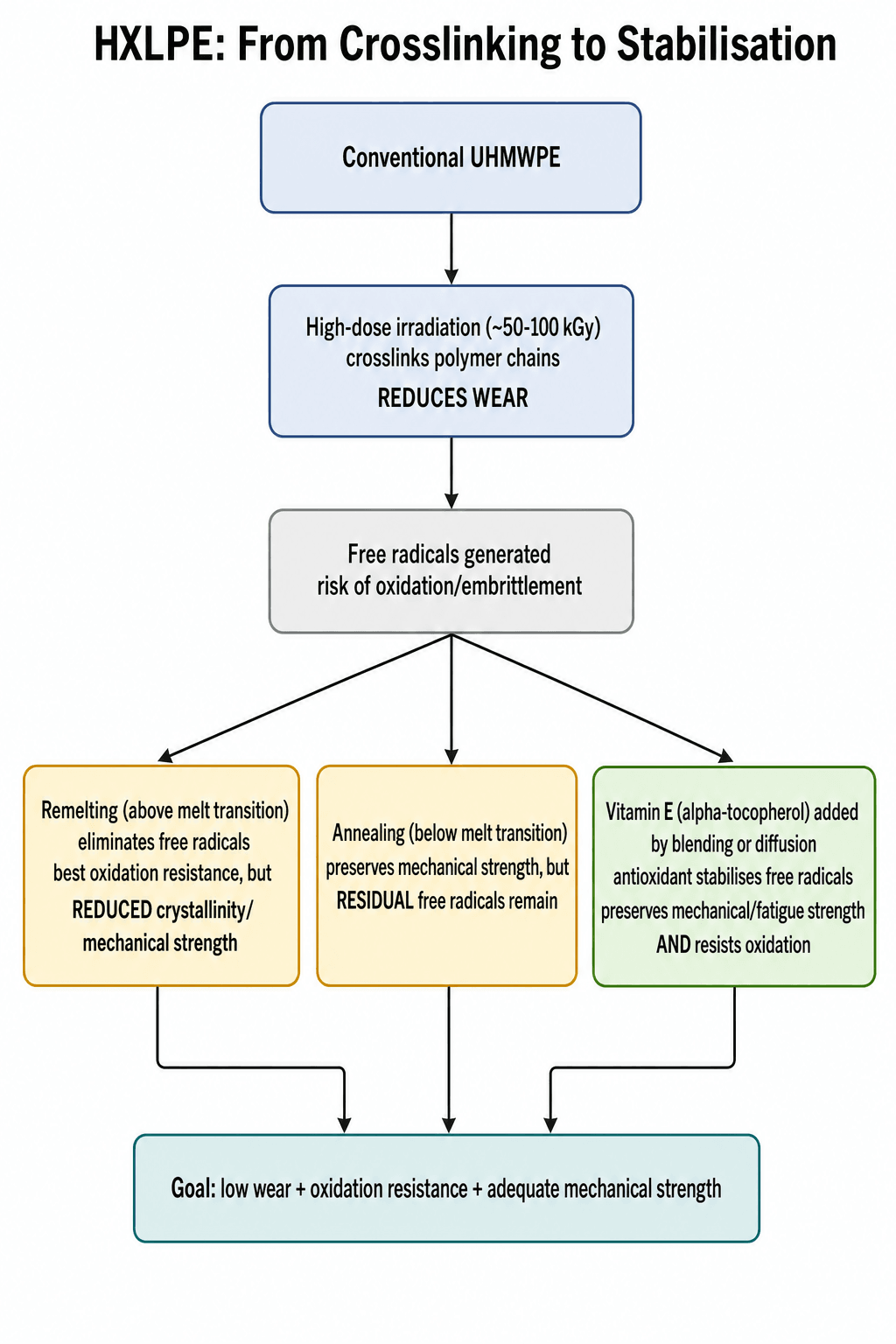
- HIGHLY CROSSLINKED POLYETHYLENE (HXLPE), developed in the late 1990s, is produced by HIGH-DOSE IRRADIATION (typically around 50-100 kGy of gamma or electron-beam radiation) that creates cross-links between the polymer chains; this markedly REDUCES adhesive and abrasive WEAR compared with conventional UHMWPE.
- The HIP REGISTRY evidence is strong: HXLPE has a significantly LOWER cumulative revision rate than conventional UHMWPE in total hip arthroplasty - for example about 6.2% versus 11.7% at a mean 16 years in the Australian registry - confirming the in-vitro wear reduction translates into fewer revisions.
- The fundamental TRADE-OFF of crosslinking is that the irradiation also generates FREE RADICALS, which over time react with oxygen to cause OXIDATION, embrittlement and a reduction in the mechanical and fatigue properties of the polyethylene (an important concern especially for the thinner, higher-stress bearings used in the knee) - so the free radicals must be addressed.
- Two STABILISATION strategies are used. THERMAL treatment: REMELTING (heating above the melt transition) eliminates free radicals most completely but reduces crystallinity and therefore some mechanical strength, whereas ANNEALING (heating below the melt transition) preserves mechanical properties but leaves some residual free radicals (and thus some oxidation potential). The alternative is VITAMIN E (alpha-tocopherol), an ANTIOXIDANT incorporated by blending before irradiation or diffusion afterwards, which stabilises free radicals and resists oxidation while PRESERVING mechanical/fatigue properties (and can allow higher crosslinking).
- Vitamin-E HXLPE has shown wear resistance similar to remelted HXLPE with better-preserved mechanical properties, and registry data show its survivorship is at least equivalent to other antioxidant/HXLPE liners at short-to-mid term; importantly, the wear-reduction BENEFIT of HXLPE is clearer in the HIP (THA) than in the KNEE (TKA), where the different (multidirectional/higher-stress) wear environment means HXLPE has not consistently shown the same advantage.
- “Conventional UHMWPE WEAR → particle-induced OSTEOLYSIS → aseptic loosening (major long-term arthroplasty failure).
- “HXLPE = high-dose irradiation (~50-100 kGy) crosslinks PE → markedly reduced wear; THA registry: ~6% vs ~12% revision at 16y. Trade-off: irradiation → FREE RADICALS → oxidation/embrittlement.
- “Quench radicals: THERMAL (REMELTING = no radicals but weaker mechanics; ANNEALING = better mechanics but residual radicals) OR VITAMIN E (antioxidant - preserves mechanics, resists oxidation). Benefit clearer in THA than TKA.
HXLPE (high-dose irradiation) markedly reduces wear and, in the hip, halves the revision rate versus conventional UHMWPE - tackling particle-induced osteolysis.
Irradiation makes free radicals → oxidation/embrittlement. Fix by remelting (no radicals, weaker mechanics), annealing (better mechanics, residual radicals), or vitamin E (antioxidant, preserves mechanics).
From Wear to Crosslinking to the Oxidation Trade-off
Conventional UHMWPE bearing wear generates particles that drive macrophage-mediated osteolysis, aseptic loosening and long-term arthroplasty failure. Highly crosslinked polyethylene (HXLPE) is made by high-dose irradiation (around 50-100 kGy) that crosslinks the polymer chains and markedly reduces wear, with strong hip registry evidence (about half the conventional revision rate at long term). The trade-off is that irradiation generates free radicals, which over time oxidise the polymer, causing embrittlement and loss of mechanical/fatigue strength. This is addressed by thermal treatment - remelting (eliminates radicals but reduces crystallinity/strength) or annealing (preserves mechanics but leaves residual radicals)
- or by vitamin E (an antioxidant, blended or diffused) that stabilises radicals while preserving mechanical/fatigue properties. The wear-reduction benefit is clearer in the hip than the knee.
- Free radicals / oxidation
- Few radicals but higher WEAR (osteolysis)
- Mechanical properties
- Good mechanics, poor wear resistance
- Free radicals / oxidation
- Free radicals eliminated (best oxidation resistance)
- Mechanical properties
- Reduced crystallinity → lower mechanical/fatigue strength
- Free radicals / oxidation
- Residual free radicals (some oxidation potential)
- Mechanical properties
- Mechanical properties better preserved
- Free radicals / oxidation
- Radicals stabilised, resists oxidation
- Mechanical properties
- Mechanical/fatigue properties preserved (allows higher crosslinking)
Vitamin E, the Hip-vs-Knee Difference & Practice
- Vitamin E (alpha-tocopherol): incorporated by BLENDING before irradiation or DIFFUSION afterwards; it quenches free radicals, resists oxidation, and preserves mechanical/fatigue properties - giving wear resistance similar to remelted HXLPE with better-preserved mechanics, and registry survivorship at least equivalent to other antioxidant/HXLPE liners.
- Hip (THA): HXLPE has clear, registry-proven wear and revision benefit over conventional UHMWPE - it is the standard bearing.
- Knee (TKA): the benefit is LESS consistent - the different (multidirectional, higher-contact-stress) wear environment and the importance of mechanical/fatigue strength for thinner tibial inserts mean HXLPE has not reliably shown the same advantage, and oxidation-resistant/vitamin-E options are attractive there.
- Practical point: modern bearings aim for low wear (crosslinking) AND oxidation resistance (vitamin E or thermal treatment) AND adequate mechanical strength - vitamin E is the strategy that best balances all three.
The central principle of modern polyethylene bearings is balancing three competing demands: low WEAR (to prevent osteolysis), OXIDATION resistance (to prevent long-term embrittlement), and adequate MECHANICAL/fatigue strength (to prevent insert fracture, especially the thinner, higher-stress knee inserts). Crosslinking buys low wear but introduces free radicals that, if not quenched, cause oxidation and embrittlement; remelting removes the radicals but weakens the material, and annealing preserves strength but leaves oxidation potential. Vitamin E is the strategy that best reconciles all three by acting as an antioxidant while preserving mechanical properties. The practical lesson is that 'highly crosslinked' is not automatically better in every situation - the bearing strategy must suit the joint (the registry-proven hip benefit is clearer than in the knee) and avoid trading low wear for an oxidation- or fracture-prone insert.
Putting a Number on Wear: The Osteolysis Threshold
The whole topic turns on "wear" and "reduced wear" without a number or a method. Wear is quantified as a rate:
- Linear (penetration) wear - how far the head sinks into the cup per year (mm per year) - and volumetric wear - the volume of polyethylene removed (mm cubed per year). Volumetric wear is roughly the penetration multiplied by the bearing cross-section, so a larger head produces more volumetric wear for the same penetration.
- The osteolysis threshold: osteolysis is rare when linear wear is below about 0.1 mm per year (and uncommon below roughly 0.05) - the established "wear threshold". Conventional UHMWPE often exceeds it, whereas HXLPE penetration is roughly an order of magnitude lower, frequently below the threshold, which is why osteolysis is so much less common.
- Separate the early bedding-in (run-in) creep/penetration from the lower true steady-state wear when interpreting rates.
- Wear is measured radiographically; radiostereometric analysis (RSA) is the gold standard - far more sensitive and earlier than plain-film penetration measurements - and HXLPE wear is so low it can sit near the limit of measurement.
The clinical corollary: because HXLPE keeps penetration below the threshold even with a larger femoral head, surgeons can use bigger heads (better stability and range before impingement) without the osteolysis penalty that the same head would have caused with conventional polyethylene. (General wear mechanisms and tribology are covered in our Wear Mechanisms and Tribology topics; the point here is the threshold that justifies HXLPE.)
Quantify wear: linear (penetration, mm/yr) vs volumetric (mm cubed/yr, scales with head size); osteolysis is rare below about 0.1 mm/yr. HXLPE penetration is roughly an order of magnitude lower (often below the threshold), measured most sensitively by RSA - which is what lets larger heads be used without the osteolysis penalty.
When HXLPE Fails Mechanically
The safety message warns of "insert fracture" without the mechanism. Crosslinking - and especially remelting - reduces the polyethylene's toughness, ductility and resistance to crack propagation (fracture toughness / fatigue-crack resistance) even as it reduces wear. Clinically this appears as mechanical failure of the bearing:
- Most characteristically fracture of the acetabular liner rim or the locking mechanism, and in the knee fatigue cracking/delamination or insert fracture.
- Favoured by a thin liner (a small cup with a large head, or a thin tibial insert), component malposition (a steep or retroverted cup edge-loads the rim), impingement (neck-on-rim levering), and elevated/oxidised first-generation material.
Mitigations: respect a minimum liner thickness (do not pursue a head so large that the liner is too thin), correct component position to avoid edge-loading and impingement, and prefer stabilisation that preserves toughness - vitamin-E and annealed HXLPE retain more toughness than remelted HXLPE. This is the other half of "highly crosslinked is not automatically better": the gain in wear can cost fracture resistance if the material and the implantation are not chosen well.
Crosslinking (especially remelting) lowers toughness and crack resistance, so HXLPE can fail mechanically - liner-rim or locking-mechanism fracture (and knee insert fatigue/fracture) - favoured by thin liners, malposition/edge-loading and impingement. Mitigate with adequate liner thickness, correct cup position, and toughness-preserving vitamin-E/annealed polyethylene.
Mnemonics & Memory Aids
CROSSLINK
Hook:CROSSLINK: Conventional wears, Radiation crosslinks, Oxidation trade-off, Stabilise (remelt/anneal), Supplement vitamin E, Lower THA revision, Inconsistent in TKA, Need balance.
Clinical Decision Scenarios
Practise clinical reasoning and management decisions out loud
“Why was highly crosslinked polyethylene developed, and what is its main drawback?”
“How are the free radicals in HXLPE dealt with, and where does vitamin E fit?”
The problem
- Conventional UHMWPE wear → submicron particles → macrophage-driven osteolysis
- → aseptic loosening and long-term arthroplasty failure
- Major driver of revision in THA and TKA
HXLPE
- High-dose irradiation (~50-100 kGy) crosslinks the polymer → markedly reduced wear
- THA registry: lower revision (~6.2% vs 11.7% conventional at 16y)
- Benefit clearer in THA than TKA
Trade-off
- Irradiation generates free radicals → oxidation/embrittlement over time
- Loss of mechanical/fatigue strength (important for thin knee inserts)
- Free radicals must be quenched
Stabilisation
- Remelting: eliminates radicals but reduces crystallinity/strength
- Annealing: preserves mechanics but leaves residual radicals
- Vitamin E (blended/diffused): antioxidant - resists oxidation, preserves mechanics
Evidence & Key Studies
UHMWPE in hip and knee arthroplasty: crosslinking, oxidation and vitamin E (review)
- UHMWPE wear and particle-induced osteolysis contribute to THA and TKA failure; highly crosslinked polyethylene (HXLPE, irradiation up to ~100 kGy) reduces wear and loosening compared with conventional UHMWPE.
- In the Australian registry, HXLPE had a significantly lower cumulative revision rate (6.2%) than conventional UHMWPE (11.7%) at a mean 16 years in THA, but HXLPE does not confer the same advantage in TKA.
- Crosslinking induces free-radical formation and oxidation; thermal treatment (remelting/annealing) and vitamin-E addition reduce free radicals, with vitamin E preserving mechanical properties and giving wear resistance similar to HXLPE.
Short-term survivorship of antioxidant (vitamin-E) highly crosslinked polyethylene hip liners (AJRR)
- Antioxidant (vitamin-E-containing) highly crosslinked polyethylene hip liners were developed to reduce oxidation and consequential wear, loosening and osteolysis.
- In the American Joint Replacement Registry, three-year survivorship of antioxidant XLE hip liners was about 97.7-99%, with no failures due to wear.
- Antioxidant XLE hip liner survivorship and revision rates were equivalent to other antioxidant hip liners at short-term follow-up.
The wear/osteolysis problem, the wear reduction with HXLPE (and the registry finding of a lower THA revision rate, 6.2% vs 11.7% at 16 years, with a less consistent TKA benefit), the free-radical/ oxidation trade-off, and the stabilisation strategies (thermal remelting/annealing and vitamin E, with vitamin E preserving mechanical properties) come from the cited Hasegawa review; the short-term registry survivorship of antioxidant (vitamin-E) HXLPE hip liners (no wear failures, equivalent to other antioxidant liners) from the cited Jones AJRR study. The irradiation doses, the remelting-versus-annealing distinction, and the blending- versus-diffusion vitamin-E incorporation are standard, well-established teaching. (See also our Osteolysis / Aseptic Loosening and Bearing Surfaces topics.)