Coronal Plane | Often Missed | Anatomic Reduction Essential | Posterior-to-Anterior Screws
- Coronal plane fracture - often missed on AP and lateral X-rays
- Lateral condyle more commonly affected (2:1 ratio)
- Complete fractures are avascular - no anterior soft-tissue attachments
- Anatomic reduction essential - articular surface fracture
- Posterior-to-anterior lag screws are BIOMECHANICALLY superior - but that superiority is cadaveric, not clinical, and anterior-to-posterior fixation remains widely and legitimately used because it carries a LOWER risk of iatrogenic neurovascular injury (Rabelo). State the trade-off rather than calling either a gold standard
- “Look for sagittal CT - Hoffa often missed on plain films
- “Mechanism: direct blow to flexed knee or axial load
- “Gastrocnemius attachment may aid lateral fragment vascularity
- “Associated with high-energy trauma and other knee injuries
Overview and Epidemiology
A Hoffa fracture is a coronal-plane fracture of the posterior aspect of a femoral condyle, first described by Albert Hoffa in 1904. It is relatively rare and it is frequently missed.
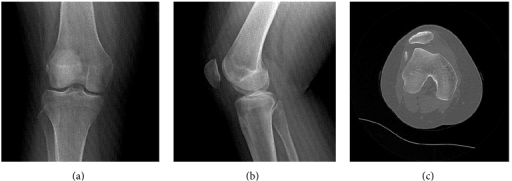
Mechanism. A direct blow to the flexed knee, the dashboard injury, or an axial load with the knee in flexion, and usually high-energy trauma. With the knee flexed the load produces combined shear and compression that splits the posterior condyle off in the coronal plane. That coronal orientation is why the fracture is so easily missed on AP and lateral radiographs: the line is often invisible on the AP view and tangential on the lateral.
Who. Coronal-plane condylar fractures are rarer than sagittal-plane condylar fractures. There is a male predominance, the patient is typically a young adult, and the mechanism is usually high-energy: motor vehicle and motorcycle collisions, and falls.
Why lateral. The lateral condyle is involved about twice as often as the medial, a 2:1 ratio. It is the more prominent condyle, and the typical blow lands on the lateral side of a flexed knee. An external rotation moment is a common loading pattern, and tension from the iliotibial band may contribute to the lateral forces.
Associated injuries. The fracture may be isolated or one part of a larger injury:
- Supracondylar or intercondylar femoral fracture, in 30-40%
- ACL or PCL injury
- Tibial plateau fracture
- Patellar fracture
- LCL and posterolateral corner (may be injured)
- Neurovascular injury (rare)
Anatomy and Biomechanics
The condyles. The distal femur has two condyles articulating with the tibia, and they are not symmetrical:
- Lateral condyle
- More prominent
- Medial condyle
- Less prominent
- Lateral condyle
- Smaller
- Medial condyle
- Larger
- Lateral condyle
- Lateral gastrocnemius
- Medial condyle
- Medial gastrocnemius
The blood supply. A complete Hoffa fragment is essentially avascular. It has no anterior soft-tissue attachments and no ligamentous attachments; what remains is the posterior periosteum and capsule, and the gastrocnemius origin, which may provide some blood supply, especially on the lateral side. The vessels at stake are the lateral superior and inferior geniculate arteries and their medial counterparts, which reach the posterior condyle through the capsule. The fracture line, the surgical dissection and posterior countersinking all threaten that same narrow pedicle.
Why it matters. In many fractures the periosteal supply helps the bone heal; a Hoffa fragment relies entirely on healing from the intact condyle once it is fixed. That is the argument for anatomic reduction and stable fixation, and for technique that spares the pedicle: preserve every millimetre of posterior capsular attachment you can, and clear the cartilage rather than stripping bone when seating screws.
Biomechanics. The posterior condyle is the weight-bearing surface in flexion, and the fragment may rotate or displace with knee motion. Malreduction alters knee mechanics, and any articular step-off accelerates arthritis.
Posterior structures at risk during surgery. Each has an approach that endangers it:
- Popliteal vessels: central, protected by fascia
- Common peroneal nerve: the lateral approach
- Saphenous nerve: the medial approach
- Gastrocnemius muscle: retracted, not cut
Classification Systems
Letenneur. The most widely used system, defined by the orientation of the fracture line relative to the posterior femoral cortex:
- Fracture line
- Vertical, parallel to the posterior cortex
- Fragment
- The whole posterior condyle
- Implications
- Largest fragment; best purchase for P-A lag screws
- Fracture line
- More horizontal, at the base of the posterior condyle
- Fragment
- Variable size (subtypes IIa-IIc)
- Implications
- Smaller fragment, less bone for screw purchase
- Fracture line
- Oblique
- Fragment
- Variable, often comminuted
- Implications
- Shear pattern; buttress or antiglide plating usually needed
What drives difficulty is fragment size and comminution rather than the type number: the smaller the posterior fragment, the less subchondral bone there is for screw purchase, and the more a buttress or antiglide plate earns its place.
Blumensaat line is the radiographic representation of the intercondylar roof: on the lateral view, a line along the roof of the intercondylar notch. It is useful for judging patellar height and for spotting a displaced posterior condylar fragment, but it is not what the Letenneur classification is built on. Sources that define the types against Blumensaat's line or the intercondylar notch are repeating a common misstatement; the published system is defined against the posterior cortex.
By condyle. The condyle involved sets the approach:
- Condyle
- Lateral condyle
- Frequency
- 65-70%
- Approach
- Lateral or posterolateral
- Condyle
- Medial condyle
- Frequency
- 30-35%
- Approach
- Medial or posteromedial
- Condyle
- Both condyles
- Frequency
- Rare
- Approach
- Combined approaches
Clinical Presentation and Assessment
History. The answers that matter:
- Mechanism: dashboard, direct blow, fall
- High-energy or low-energy
- Associated injuries
- Pre-injury function and activity level
Examination. The findings and what each one means are tabulated below. Assess ligamentous stability, accepting that pain may limit the examination. Three things the table does not say: check the skin for open wounds, abrasions and fracture blisters; check the compartments after a high-energy mechanism; and the neurovascular examination is pulses, motor function and sensation.
- Significance
- Haemarthrosis common
- Action
- Aspiration if tense
- Significance
- May localise Hoffa fracture
- Action
- Palpate both condyles
- Significance
- Expected finding
- Action
- Examine under anaesthesia if needed
- Significance
- Associated ligament injury
- Action
- Document, may need staged repair
- Significance
- Open fracture
- Action
- Urgent washout, IV antibiotics
- Significance
- Vascular injury or compartment syndrome
- Action
- Urgent intervention
Have a high index of suspicion in any high-energy knee injury. If the mechanism fits, a direct blow to the flexed knee, order CT even when the initial radiographs look normal.
Investigations
Radiographs. AP, lateral and oblique views of the knee. The fracture may be subtle or invisible. What there is to see: a coronal fracture line through the posterior condyle; on the lateral view, the fragment overlapping the intact condyle, the double density sign of superimposed condyle and fragment; and any associated supracondylar fracture. Measure fragment size and displacement where the films allow it.
CT. Thin-slice CT with sagittal and coronal reconstructions is mandatory for every suspected Hoffa fracture; plain radiographs alone are insufficient. It shows the orientation of the fracture line, the fragment size as a percentage of the condyle, displacement and comminution, and it is where the screw trajectory is planned.
- Significance
- Lateral vs medial
- Impact on surgery
- Determines approach
- Significance
- Percentage of condyle
- Impact on surgery
- Fixation method
- Significance
- Articular step-off
- Impact on surgery
- Urgency of fixation
- Significance
- Multiple fragments
- Impact on surgery
- May need plate
- Significance
- Supracondylar component
- Impact on surgery
- Surgical sequence
MRI. Not routine. It may help where a ligament injury is suspected and it can assess cartilage damage; in practice it is usually obtained after the fracture has healed if symptoms persist.
Differential. The acutely painful, swollen knee after distal femoral trauma:
- Distinguishing features
- Coronal-plane line through posterior condyle, often invisible on AP, tangential on lateral; lateral more common
- Key investigation
- CT with sagittal and coronal reconstructions
- Distinguishing features
- Vertical split visible on the AP view; far more common than coronal pattern
- Key investigation
- AP radiograph, confirmed on CT
- Distinguishing features
- Metaphyseal or T/Y articular pattern; may harbour an occult coexisting Hoffa fragment
- Key investigation
- CT to exclude a coronal component
- Distinguishing features
- Tibial-side bony injury, often with ligamentous instability
- Key investigation
- CT plus stress or MRI assessment
- Distinguishing features
- No fracture line; positive laxity tests once pain settles
- Key investigation
- MRI if radiographs and CT are normal
Management
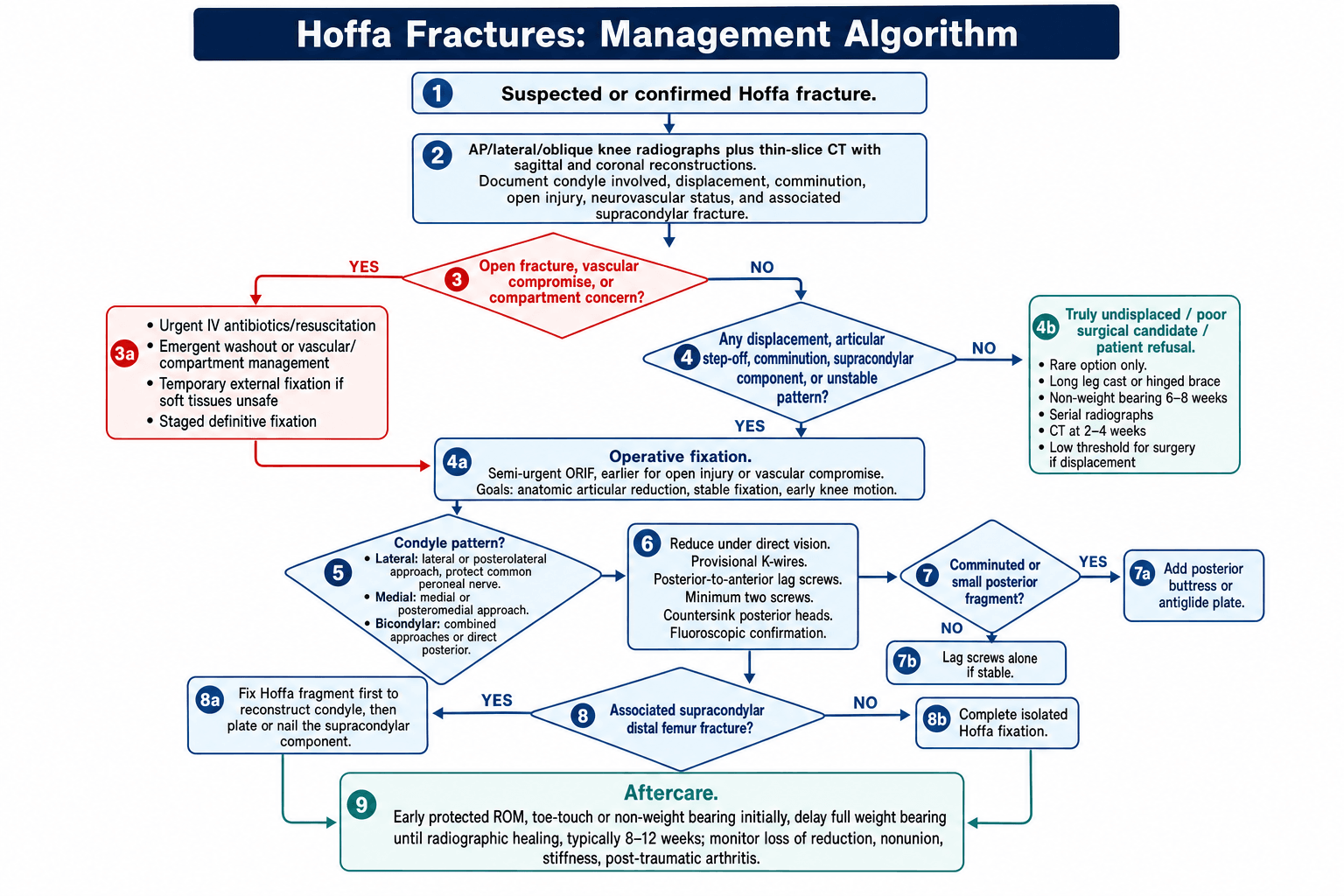
The decision. Nearly every displaced Hoffa fracture is fixed, and most surgeons fix the undisplaced ones as well. The anatomy explains why: the posterior condyle bears load during knee flexion and the fragment has few soft-tissue attachments to hold it in position, so even an undisplaced fracture may displace with knee motion, and non-operative management carries a high risk of secondary displacement.
- Implication
- May be managed non-operatively if truly undisplaced
- Management
- Very close follow-up with CT, consider fixation
- Implication
- Will not heal, high risk of displacement
- Management
- Operative fixation required
- Implication
- Fix Hoffa first to restore condyle anatomy
- Management
- Then address supracondylar component
- Implication
- May need buttress plate
- Management
- Posterolateral or posteromedial approach
- Implication
- Emergent washout, staged fixation
- Management
- External fixation if soft tissue concerns
Who. Non-operative treatment is reserved for:
- Truly undisplaced fractures (rare)
- Non-ambulatory patients
- Severe medical comorbidities precluding surgery
- Patient refusal of surgery
The protocol. A long leg cast or hinged knee brace, non-weight bearing for 6-8 weeks, very close follow-up with serial imaging including CT at 2-4 weeks to look for displacement, and a low threshold for surgery if any displacement appears.
Surgical Technique
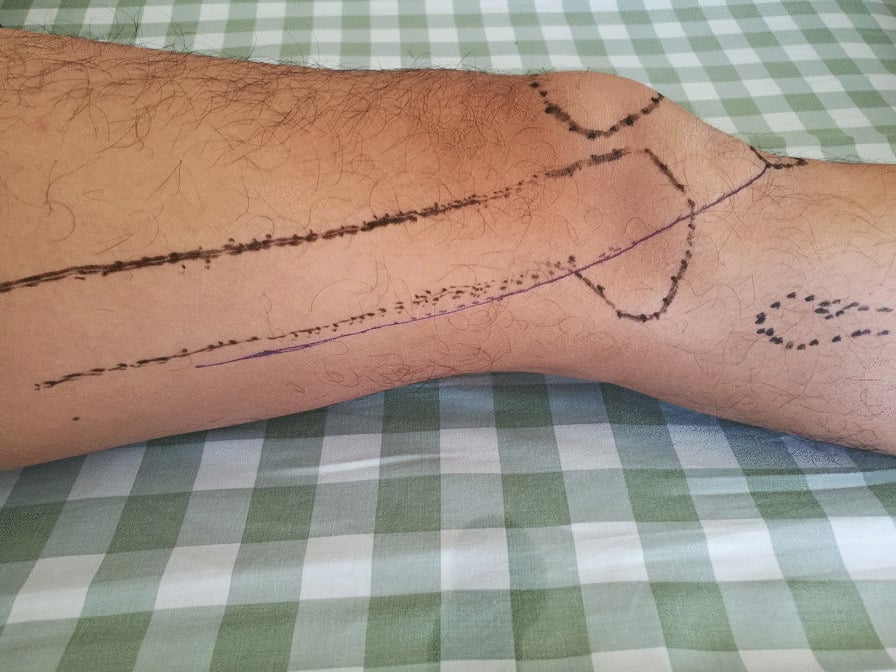
Positioning. For a lateral approach, supine with a bump under the ipsilateral hip, the knee flexed to 20-30 degrees over a bolster and the leg draped free for intraoperative flexion and extension; a tourniquet is optional. A dedicated posterior approach is planned with lateral or prone positioning.
Lateral approach, for a lateral Hoffa:
- Incision along the distal iliotibial band to the lateral epicondyle
- Develop the interval between the iliotibial band and biceps
- Incise the lateral capsule to expose the condyle
- Protect the common peroneal nerve posteriorly
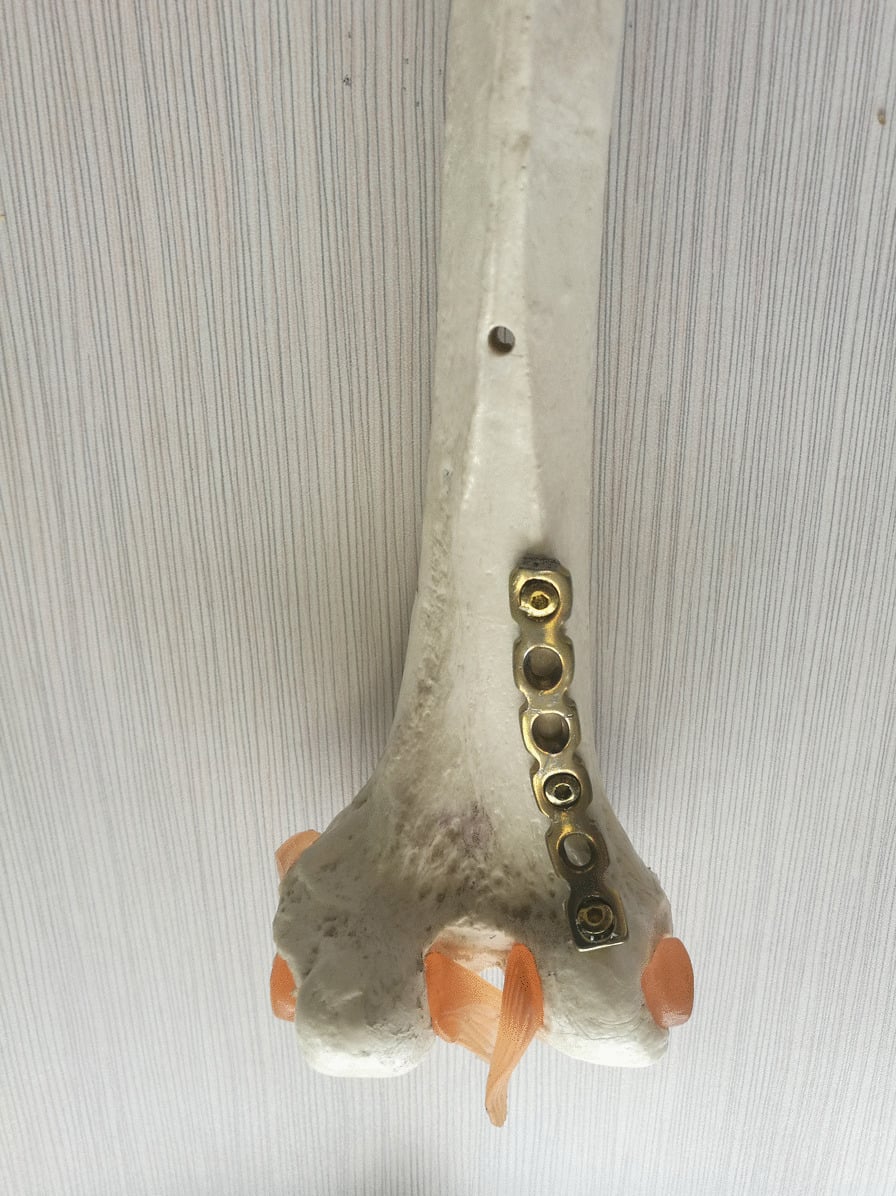
Posterolateral approach, often preferred because it gives direct visualisation of the posterior condyle:
- Incision posterior to the lateral epicondyle
- Identify and protect the peroneal nerve
- Split the lateral gastrocnemius if needed
- Excellent access to the posterior condyle
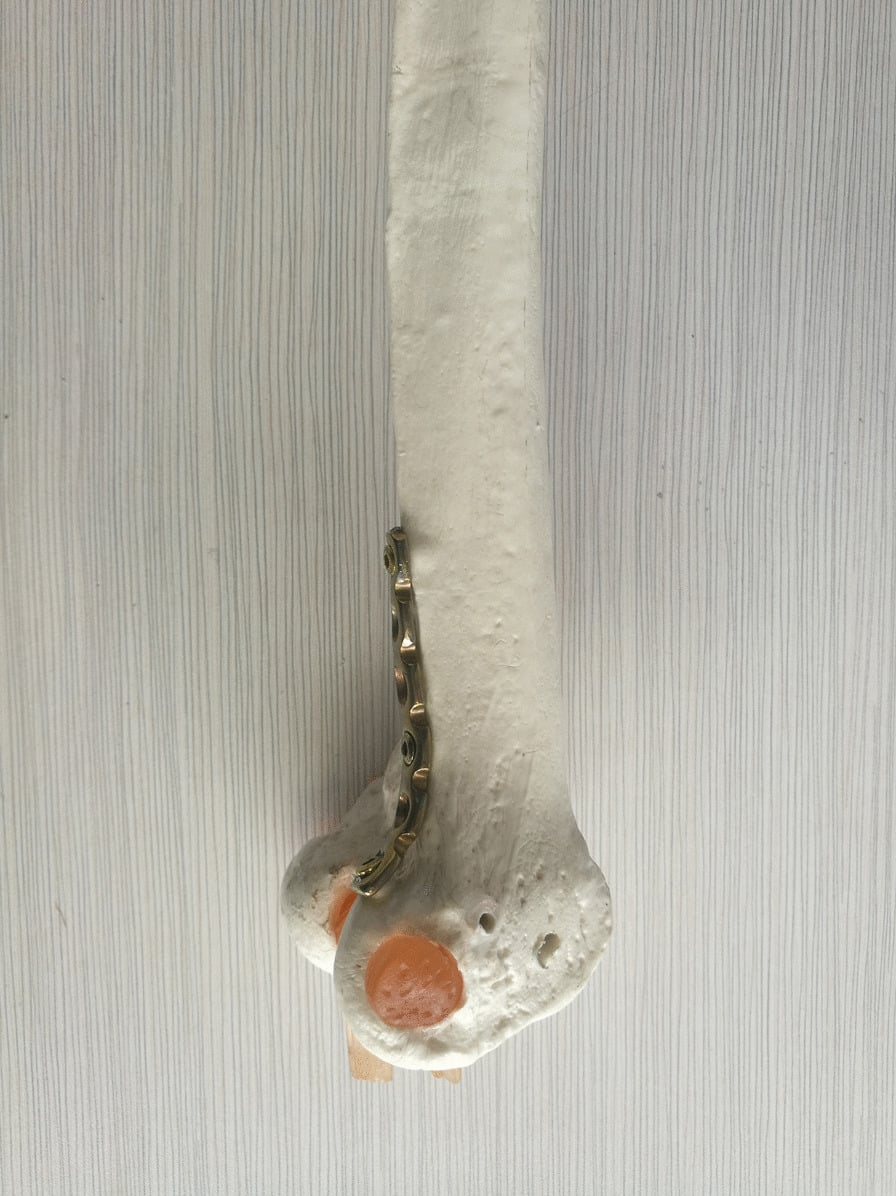
Match the approach to the construct. A standard lateral or anterolateral (Swashbuckler) approach gives good articular visualisation and easily permits anterior-to-posterior or oblique screws, but it does not allow a true posterior-to-anterior screw or a posterior buttress plate. To place P-A lag screws and a posterior antiglide plate, a dedicated posterior approach is required: posterolateral for the lateral condyle, protecting the common peroneal nerve; posteromedial for the medial condyle, protecting the saphenous nerve and vessels; or a direct posterior (Lobenhoffer) approach for posterior or bicondylar fragments. The logic runs one way: decide whether the fracture geometry needs a posterior buttress, then let that decision drive the approach and the patient's position.
Complications
- Incidence
- 10-20%
- Prevention/Management
- Anatomic reduction, stable fixation, avoid smoking
- Incidence
- Variable
- Prevention/Management
- Anatomic reduction at surgery, confirm with fluoro
- Incidence
- 20-30%
- Prevention/Management
- Anatomic reduction, no step-off acceptable
- Incidence
- Rare if fixed
- Prevention/Management
- Stable fixation allows revascularisation
- Incidence
- 15-25%
- Prevention/Management
- Early ROM, physiotherapy
- Incidence
- 1-5%
- Prevention/Management
- Antibiotic prophylaxis, atraumatic technique
- Incidence
- Variable
- Prevention/Management
- Countersink screws, consider removal later
Nonunion. The major concern, because the fragment is avascular. The risk factors are inadequate fixation, smoking and displacement; prevention is stable fixation with good compression, anatomic reduction and smoking cessation. An established nonunion needs revision fixation with bone graft, and plate fixation if the screws have failed.
Malunion. It alters knee mechanics, and even a small step-off wears cartilage. Prevention is the treatment: confirm the reduction intraoperatively, because correction afterwards requires an osteotomy, which is difficult.
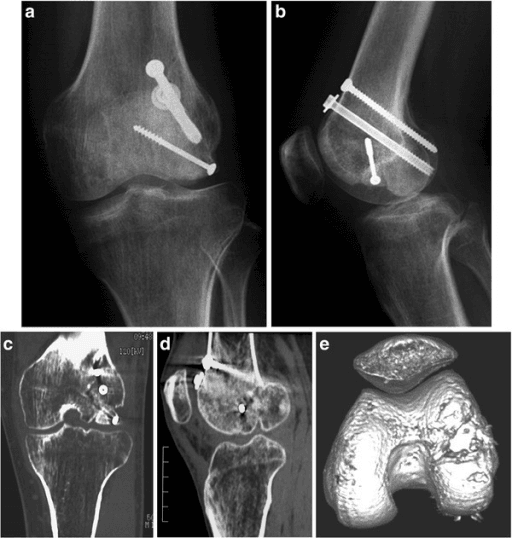
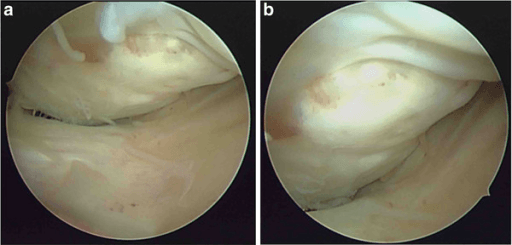
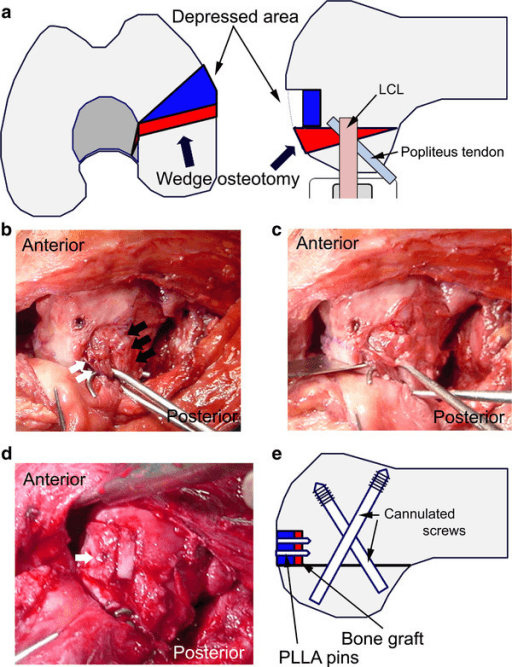
Post-traumatic arthritis. The table's 20-30% occurs despite good treatment; it is related to the cartilage damage sustained at injury, and malreduction increases the risk. The one-page summary's 54% is a different measurement: Onay's series, 7 of 13 patients at a mean follow-up of 93 months. Read the two figures together. Arthrosis after an intra-articular fracture takes years to appear, so the longer a series looks, the more it finds. Severe cases may require arthroplasty.
Postoperative Care and Rehabilitation
The principles. Early motion prevents stiffness. Delayed weight bearing protects the fixation, because the posterior condyle bears load in knee flexion and premature loading may lose the reduction or lead to nonunion; full weight bearing waits for radiographic evidence of healing. Monitor for loss of reduction, individualise the programme to the stability of the fixation, and follow up long term for arthritis.
- Knee immobiliser for comfort
- Toe-touch weight bearing with crutches
- Ice, elevation, wound care
- Gentle ROM exercises as pain allows
- CPM machine optional
- Progressive ROM (goal: 0-90 degrees by week 4)
- Continue partial weight bearing (25-50% body weight)
- Quadriceps strengthening (isometrics, SLR)
- Stationary bike when ROM allows
- Pool exercises if incisions healed
- Radiographic assessment of healing
- Progressive weight bearing based on healing
- Full weight bearing typically by 8-12 weeks
- Aggressive ROM (goal: full ROM by 12 weeks)
- Progressive strengthening
- Full activity as tolerated
- Sport-specific training
- May require ongoing physiotherapy
- Hardware removal if symptomatic
Outcomes and Prognosis
What decides the result. Anatomic reduction and stable fixation. Any articular step-off leads to accelerated arthritis, and stable fixation allows the early motion that prevents stiffness while protecting healing.
- Better outcomes
- Anatomic
- Worse outcomes
- Any step-off
- Better outcomes
- Stable, multiple screws
- Worse outcomes
- Unstable, single screw
- Better outcomes
- Isolated Hoffa
- Worse outcomes
- Combined patterns
- Better outcomes
- Non-smoker, young
- Worse outcomes
- Smoker, elderly
- Better outcomes
- Larger
- Worse outcomes
- Small/comminuted
Long-term concerns. The problems that surface late:
- Post-traumatic arthritis, which may develop years later
- Stiffness, usually manageable with physiotherapy
- Hardware prominence, which may need removal
- Functional limitations in high-demand activities
Guidelines, Registries & Global Practice
Global epidemiology:
- Global picture
- Coronal-plane condylar (Hoffa) fractures are rarer than sagittal-plane condylar fractures
- Source
- Zhou 2019 systematic review
- Global picture
- Lateral more frequent than medial; lateral fractures have a more vertical line over the weight-bearing zone
- Source
- Rabelo 2023 systematic review
- Global picture
- Male predominance, typically young adults
- Source
- Onay 2017; Zhou 2019
- Global picture
- Predominantly high-energy (road traffic and motorcycle collisions, falls); low-energy and iatrogenic cases also reported
- Source
- Zhou 2019
- Global picture
- Post-traumatic osteoarthritis in roughly half of a small surgically treated series (7 of 13)
- Source
- Onay 2017
Guideline and consensus position (there is no dedicated single-society Hoffa guideline):
- Position relevant to Hoffa fractures
- Classifies as a partial articular coronal fracture of the distal femur (AO/OTA 33-B3). Recommends anatomic articular reduction and absolute stability with interfragmentary lag screws, plus a buttress/antiglide plate when comminuted
- Evidence level
- Expert/principle-based
- Position relevant to Hoffa fractures
- CT mandatory for articular distal femur fractures; fix displaced articular fragments; fix the coronal (Hoffa) fragment before the metaphyseal component
- Evidence level
- Consensus, Level IV-V
- Position relevant to Hoffa fractures
- Generic complex articular fracture principles: CT for intra-articular involvement, senior decision-making, fixation that permits early movement
- Evidence level
- Guideline (indirect)
- Position relevant to Hoffa fractures
- Endorses posterior-to-anterior screw orientation with posterior buttress plating for unstable patterns
- Evidence level
- Consensus, Level IV
The recommendations converge: there is broad international agreement on CT diagnosis, anatomic reduction, lag-screw fixation and fixing the Hoffa fragment first in combined injuries.
Registry evidence:
- There is no joint or fracture registry that tracks Hoffa fractures specifically; major registries (NJR, AJRR, AOANJRR, SHAR, Norwegian, NZJR) capture arthroplasty, not coronal condylar fixation. Evidence therefore rests on systematic reviews and single-centre series.
Practice variation:
- Variation
- Posterior-to-anterior (biomechanically favoured) versus anterior-to-posterior (familiar approach, lower neurovascular risk)
- Reason
- Surgeon familiarity and approach choice; Rabelo 2023
- Variation
- Headless compression versus headed cannulated lag screws
- Reason
- Headless reduce prominence and implant failure; Maheshwari 2018
- Variation
- Added for Letenneur I and III and comminuted patterns; omitted for simple osteochondral type II
- Reason
- Fracture geometry; Rabelo 2023
- Variation
- High-resource centres use CT routinely and complex posterior approaches; limited-resource settings rely more on radiographs, increasing the missed-fracture and nonunion burden
- Reason
- Imaging access
In any orthopaedic exam, be prepared to discuss why Hoffa fractures are missed (coronal plane poorly seen on AP and lateral X-rays), the mandatory role of CT, the AO/OTA 33-B3 designation, and the technical aspects of fixation (posterior-to-anterior lag screws, at least two screws, countersinking, buttress plate for comminution). Also know the sequence for combined injuries: fix the Hoffa fragment first.
MCQ Practice Points
Q: What is a Hoffa fracture? A: A coronal plane fracture of the posterior femoral condyle. The fracture line runs in the coronal plane, separating the posterior condyle from the anterior condyle and shaft.
Q: Why are Hoffa fractures frequently missed on plain X-rays? A: The fracture occurs in the coronal plane, which is parallel to the X-ray beam on AP view and tangential on lateral view. CT with sagittal reconstructions is required for diagnosis.
Q: Why is the Hoffa fragment essentially avascular? A: The fragment has no anterior soft tissue attachments (capsule, ligaments) and only posterior periosteum. It is essentially a free bone fragment relying on fixation-mediated healing.
Q: Why should screws be placed posterior-to-anterior in Hoffa fracture fixation? A: P-A screw placement puts the threads in the well-vascularized intact bone rather than the avascular fragment, providing better purchase. The screw heads are also easier to countersink posteriorly.
Q: In a combined Hoffa and supracondylar fracture, which component should be fixed first? A: Fix the Hoffa fracture first. This reconstitutes the condyle anatomy, creating a solid block to which the shaft can then be reduced and fixed.
Clinical Decision Scenarios
Practise clinical reasoning and management decisions out loud
“A 35-year-old man presents to ED after a motorcycle accident. Initial knee X-rays were reported as normal, but he has significant pain and cannot bear weight. You examine him 2 days later in fracture clinic. What is your approach?”
“CT scan of a 50-year-old woman after MVA shows a distal femur fracture with both a supracondylar component and a Hoffa fracture of the lateral condyle. How do you approach this complex injury?”
“A patient presents 6 months after Hoffa fracture fixation with persistent pain and CT showing nonunion. The original fixation was with a single 6.5mm screw. What is your management?”
DEFINITION AND KEY POINTS
- Coronal plane fracture of posterior femoral condyle
- Frequently missed on initial X-rays - CT essential
- Lateral condyle more common (2:1 ratio)
- Complete fragments are avascular
CLASSIFICATION
- Letenneur Type I: vertical, parallel to posterior cortex — whole condyle
- Letenneur Type II: horizontal at condyle base — fragment of variable size
- Letenneur Type III: oblique fracture line
- Also classified by condyle: lateral, medial, or bicondylar
SURGICAL PRINCIPLES
- Anatomic reduction is essential (articular fracture)
- Posterior-to-anterior lag screws (gold standard)
- Minimum 2 screws for rotational control
- Countersink screw heads posteriorly
COMBINED INJURIES
- Fix Hoffa FIRST to reconstitute condyle
- Then fix supracondylar component
- Lateral locked plate or retrograde nail for metaphysis
- May need combined approaches for bicondylar
COMPLICATIONS
- Nonunion (10-20%) - due to avascular fragment
- Malunion - any step-off causes arthritis
- Post-traumatic arthritis (20-30%)
- Stiffness (15-25%)
TRAPS AND PEARLS
- High-energy knee + normal X-rays = get CT
- Single screw fixation is insufficient
- A-P screws are inferior to P-A
- Early motion, delayed weight bearing
- Anatomic reduction is non-negotiable
Evidence Base
Rabelo et al. Busch-Hoffa Fracture: A Systematic Review
- 113 studies synthesised. Lateral coronal-plane fractures are more frequent than medial, have a more vertical fracture line and concentrate on the weight-bearing zone. The Letenneur system is the most widely used classification. Posterior-to-anterior lag screws (with a posterior buttress plate for Letenneur types I and III) are biomechanically more efficient than anterior-to-posterior fixation; no consensus exists on screw number or diameter.
Zhou et al. Hoffa Fracture: Injury Mechanism, Classification, Diagnosis and Treatment
- 105 articles reviewed. Coronal-plane condylar fractures are rarer than sagittal-plane fractures and usually follow high-energy trauma. Letenneur, CT-based, AO and modified-AO classifications are all in use. Radiographs may be negative in questionable cases, so CT and MRI should be obtained. Non-displaced fractures carry a high risk of redisplacement, so open reduction and internal fixation is preferred with headless compression screws inserted perpendicular to the fracture line from posterior to anterior.
Onay et al. Surgically Treated Hoffa Fractures with Poor Long-Term Functional Results
- 13 surgically treated isolated coronal-plane condylar fractures, mean follow-up 93 months. All united (mean 10 weeks). Post-traumatic osteoarthritis developed in 7 of 13 (54%) and avascular necrosis in 2 of 13 (15.4%). Medial Hoffa fractures had worse functional scores (mean KSS 66.5) than lateral fractures (mean KSS 83.8). Fractures may be overlooked if imaging is not scrutinised.
Trikha et al. Functional Outcome of Hoffa Fractures
- 32 isolated Hoffa fractures fixed with cancellous lag screws and/or antiglide plate (lateral approach for lateral, medial for medial). All united at a mean of 11.6 weeks with no subsequent displacement, fixation failure, arthritis or avascular necrosis. Mean Knee Society Score 83.2 and mean IKDC 81.6; knee stiffness in 4 patients.
Maheshwari et al. Headless Compression Screw versus Headed Cancellous Screw
- 30 coronal-plane condylar fractures randomised between headless compression screws and cannulated cancellous (headed) screws. Good Neer outcomes in 13 of 15 (86.7%) headless versus 10 of 15 (66.7%) headed. Range of motion did not differ, but complications and implant failure were significantly higher with headed cancellous screws.
Bhowmick et al. Surgical Treatment of Lateral Hoffa Fracture Nonunions
- 12 lateral Hoffa nonunions, frequently the sequel of a missed acute fracture, treated at a tertiary referral centre. All 12 united (one after re-fixation); loss of reduction 7.7% and post-traumatic arthrosis 7.7%. Mean final knee flexion 104.5 degrees with significant range-of-motion improvement.