From Fat Pad Signs to Advanced MRI Assessment
Radiography: First-line for ALL elbow presentations. AP + lateral minimum in trauma
Ultrasound: Dynamic ligament assessment, effusion detection, guided injection
MRI: Gold standard for ligaments (UCL/LCL), tendons, OCD, bone marrow oedema
CT: Complex fracture characterisation (coronoid, radial head comminution), terrible triad planning
MR Arthrography: Osteochondral lesion staging, intra-articular loose bodies
Key: Start with radiographs. CT for fracture detail. MRI for soft tissue pathology.
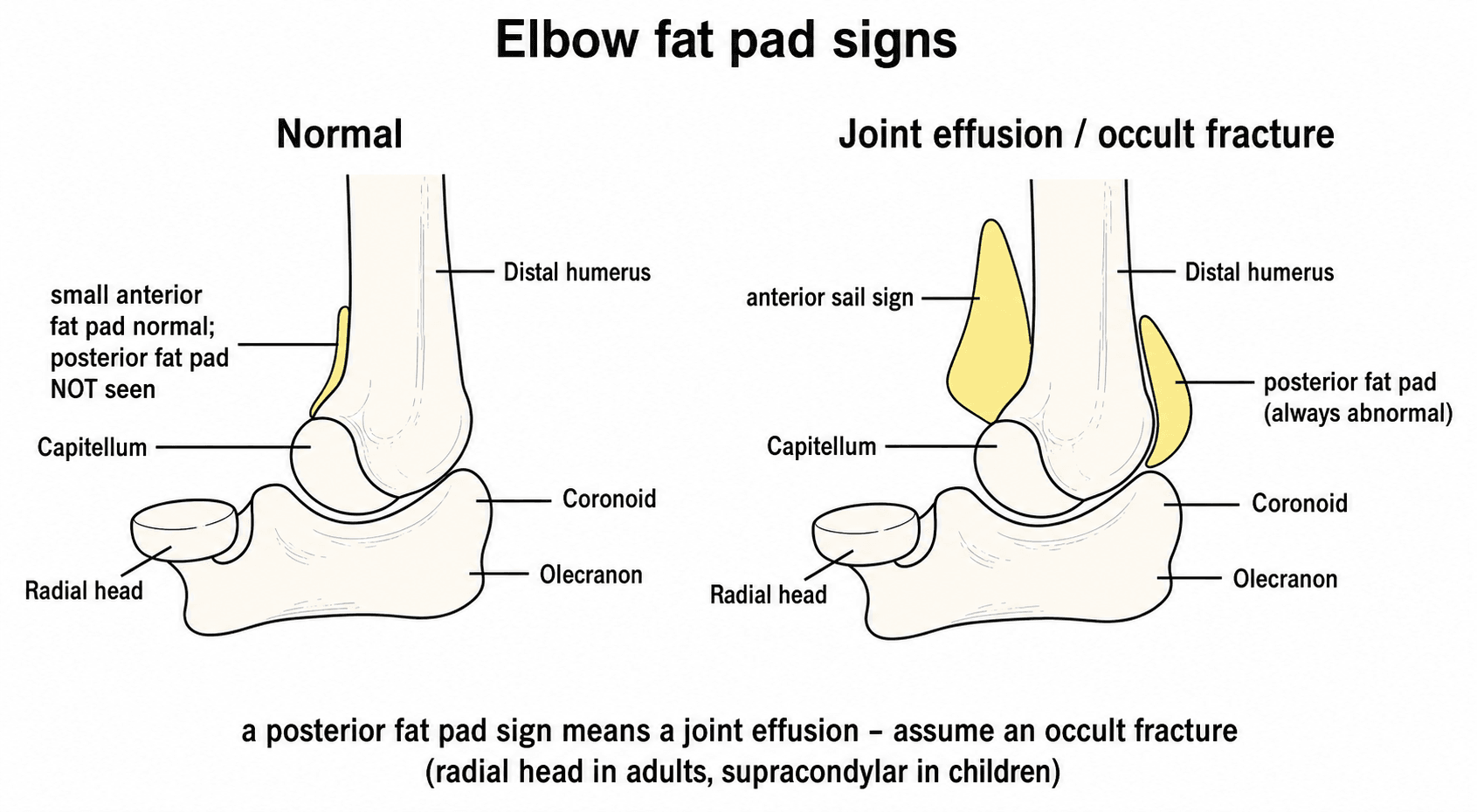
- The posterior fat pad sign on lateral radiograph indicates an intra-articular effusion and, in the setting of trauma, represents an OCCULT FRACTURE until proven otherwise.
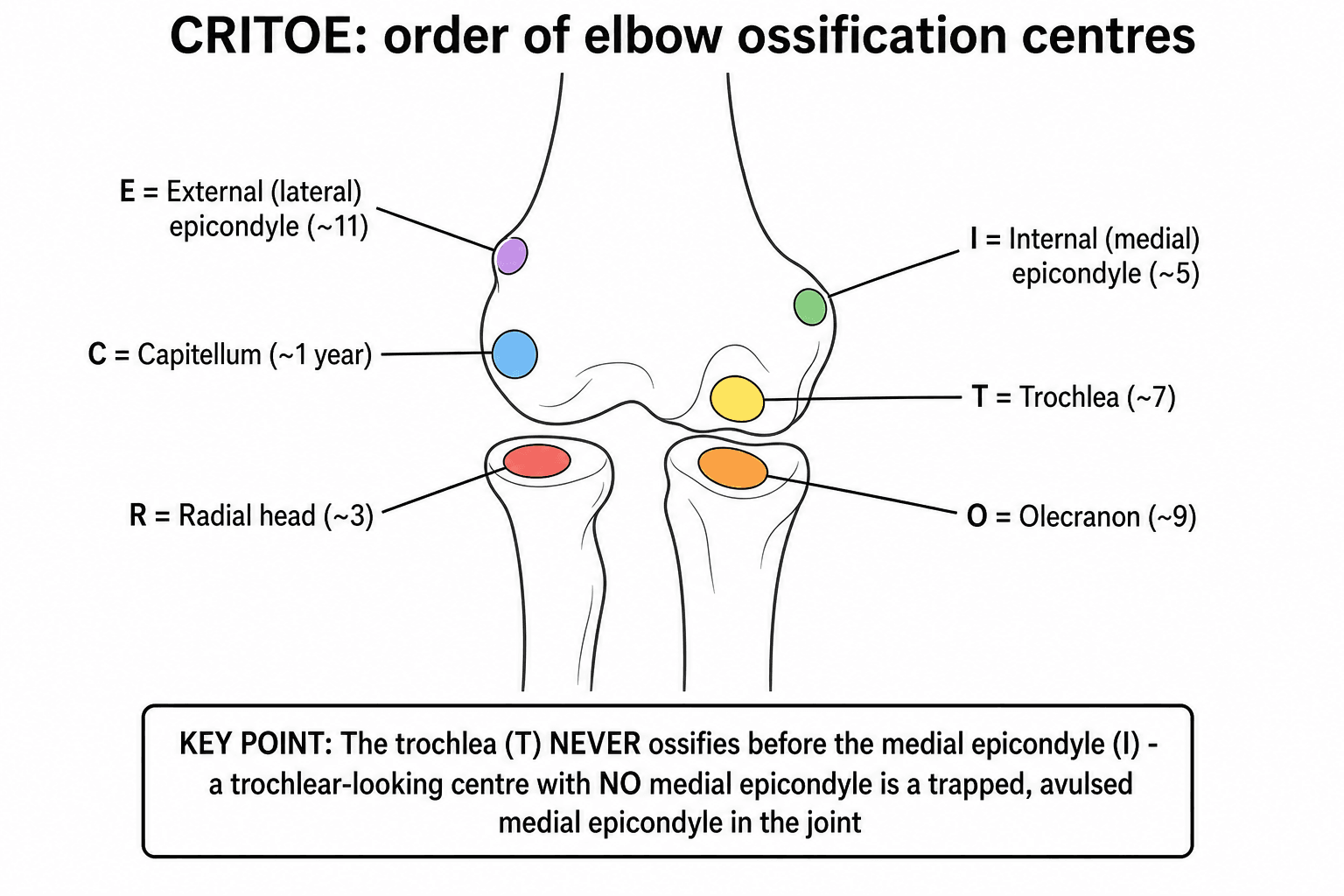
- CRITOE: the sequence of ossification centre appearance — Capitellum (1yr), Radial head (3yr), Internal (medial) epicondyle (5yr), Trochlea (7yr), Olecranon (9yr), External (lateral) epicondyle (11yr).
- Two views are the MINIMUM for elbow trauma: AP and lateral. Oblique views may be added for specific indications.
- MRI is the gold standard for assessment of collateral ligaments (UCL, LCL complex), tendon pathology, and osteochondral lesions.
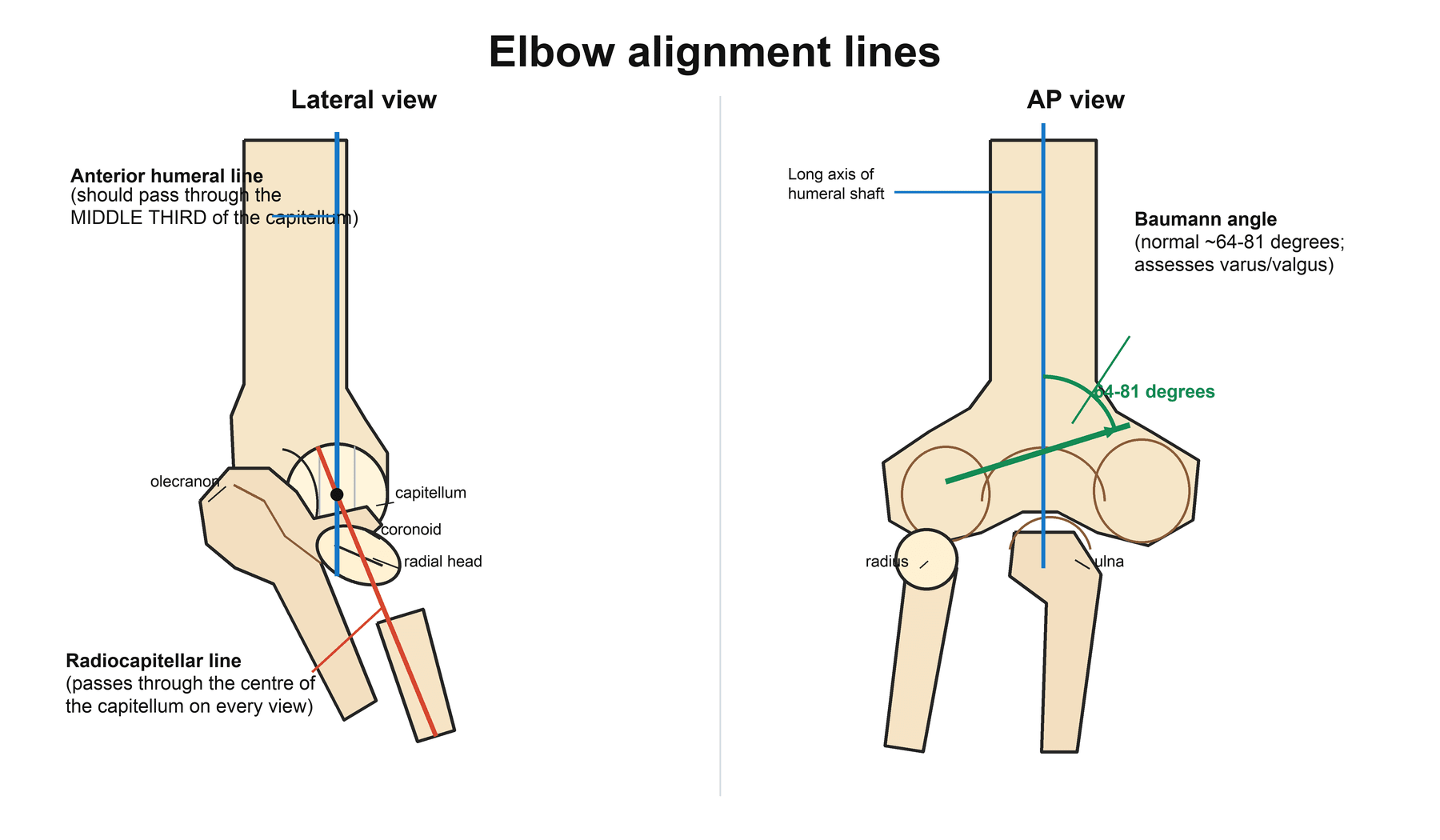
- The anterior humeral line on a true lateral should pass through the middle third of the capitellum — posterior displacement indicates a supracondylar fracture with posterior angulation.
- “Posterior fat pad sign + no visible fracture = radial head fracture (most common occult elbow fracture in adults) or supracondylar fracture (in children).
- “The radiocapitellar line: a line drawn through the radial shaft should bisect the capitellum on ALL views — failure indicates radial head subluxation/dislocation (Monteggia).
- “The carrying angle (normal 5-15 degrees valgus) is measured on the AP view — increased after malunited lateral condyle fracture (cubitus valgus).
- “UCL injury (Tommy John): MRI shows high T2 signal or disruption of the anterior bundle of the medial UCL at its sublime tubercle insertion.
- “Olecranon stress fractures in throwing athletes show focal uptake on bone scan and subtle lucency on CT — MRI shows marrow oedema.
Overview
Why the elbow is hard to read. The elbow has three articulations (ulnohumeral, radiocapitellar and proximal radioulnar), the overlapping bony anatomy needs precise positioning for a true AP and a true lateral, and in the child the ossification centres appear in sequence and can mimic fractures. Subtle fractures of the radial head and coronoid are easily missed, and the neurovascular structures lie close by.
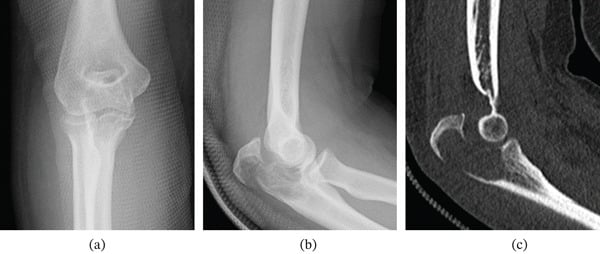
What radiographs cannot show. Ligament injuries of the UCL and LCL complex are not visible on radiographs and need MRI. The terrible triad (dislocation with radial head and coronoid fractures) needs CT for full characterisation and surgical planning.
The principle. Read every elbow radiograph systematically. Start with the fat pad signs, the most sensitive radiographic indicator of intra-articular pathology and the indirect evidence of a fracture when direct visualisation fails; then the alignment lines (anterior humeral line, radiocapitellar line); then, in a child, the ossification centres.
Systematic Approach
The minimum series. AP and true lateral in every trauma presentation, with oblique views added for specific indications. Confirm that the lateral is true before reading anything from it: the olecranon is in profile and the trochlea forms concentric circles. Fat pad signs are only reliably assessed on a true lateral, and an oblique lateral invalidates the assessment.
The anterior fat pad. Normally a small triangle. An effusion lifts it into the sail sign. A small anterior fat pad may be normal, which is why it is less specific than the posterior one.
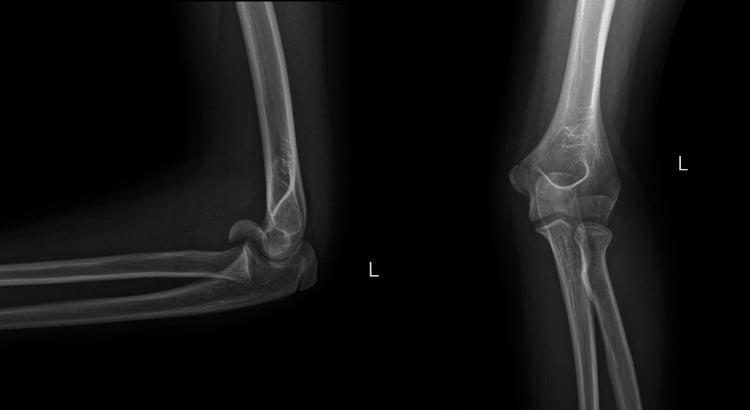
The posterior fat pad. It lies in the olecranon fossa and is hidden there on a normal true lateral. Joint distension by effusion or haemarthrosis pushes it out of the fossa, where it appears as a small lucent line behind the distal humerus. A visible posterior fat pad is always abnormal, and after trauma it means an occult fracture until proven otherwise even when no fracture line is visible: most commonly a radial head fracture in an adult and a supracondylar fracture in a child.
The number behind "until proven otherwise". When adults with a post-traumatic effusion and normal radiographs were scanned, MRI found an occult fracture in 75%, and 87% of those were of the radial head. In children with an elevated posterior fat pad and no other radiographic abnormality, 76% went on to show periosteal new bone confirming a fracture. That paediatric figure changed practice: older series had put the risk at only 6-29%, which is why the sign was once treated as soft evidence and is now treated as a fracture.
Size does not stratify the risk. Neither the volume of the effusion nor the degree of fat pad elevation predicted whether a fracture was present. The size of the fat pad decides whether there is an effusion, not how bad the injury is, so a barely lifted posterior fat pad carries the same implication as a dramatic one, and "it was only a small effusion" is not a reason to relax follow-up. Treat the patient as having a fracture: immobilise and repeat the radiographs at 7-10 days, or obtain CT or MRI if clinical concern persists.
Radiographic Assessment
Anterior humeral line. Drawn along the anterior cortex of the distal humerus on the true lateral, it should pass through the middle third of the capitellum. A line through the anterior third, or one that misses the capitellum entirely, means the capitellum is displaced posteriorly relative to the shaft, the pattern of a posteriorly displaced supracondylar fracture. It is the most important line for assessing supracondylar fracture reduction.
It is less reliable in normal children than its reputation suggests. Herman and colleagues measured it on 60 normal paediatric elbows, read twice by each of three observers (DOI): it passed through the middle third in only 52%, the anterior third in 31% and the posterior third in 18%, with only moderate-to-substantial reliability. Under four years of age it fell nearly equally in the anterior or middle third; in older children it reached the middle third in 62%. The practical consequence is over-diagnosis. An anterior-third line in a toddler is often normal, so do not use it alone to declare a fracture or to condemn an otherwise acceptable reduction.
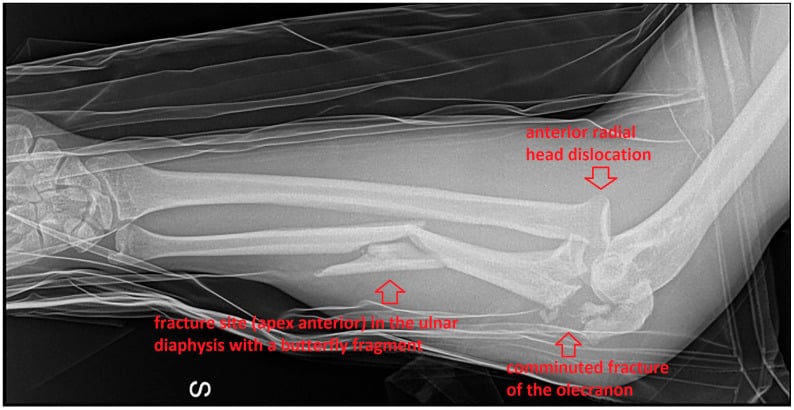
Radiocapitellar line. A line through the centre of the radial shaft and proximal radius should pass through the centre of the capitellum on every view: AP, lateral and oblique. If it fails to bisect the capitellum on any view, the radial head is dislocated. This is the key to the Monteggia fracture-dislocation, an ulnar shaft fracture with an associated radial head dislocation; the ulnar fracture may be subtle, and the dislocation may be apparent on one view only.
Baumann angle. Measured on the AP view between the lateral condylar physis and the long axis of the humeral shaft, and not to be used as an absolute number. Two healthy-child series put the mean at essentially the same place, 71 degrees plus or minus 3.2 in 56 children (PMID 36550703) and 71.5 degrees in 148 elbows (PMID 42024825), but the second reports the observed range across normal elbows as 54 to 90 degrees, and interobserver reliability is only moderate to good (ICC 0.71-0.78). The two studies differ because one reports the spread of a mean and the other the spread of individuals: a tight "normal 70-75" quotes the former as if it were the latter, and will label plenty of normal elbows abnormal.
So the angle is comparative. Measure the injured elbow against the uninjured one; an angle more than about 5 degrees less than the uninjured side indicates varus malreduction (cubitus varus, the gunstock deformity). If the contralateral elbow is unavailable, treat the number as weak evidence and lean on the anterior humeral line and column alignment instead.
Carrying angle. Measured on the AP view between the long axis of the humerus and the long axis of the ulna; normal is 5-15 degrees of valgus, slightly higher in females. An increased carrying angle (cubitus valgus) is associated with a malunited lateral condyle fracture and may cause a delayed ulnar nerve palsy.
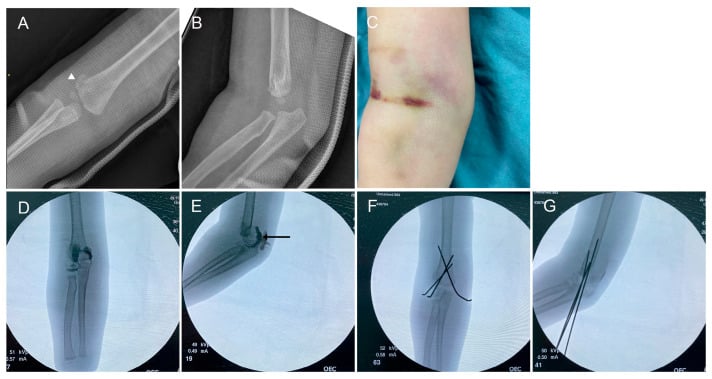
FABLESystematic Elbow Radiograph Assessment
Hook:FABLE: the five-point systematic elbow radiograph assessment for trauma.
The classic traps: dismissing a posterior fat pad sign as normal, confusing an ossification centre with an avulsion fracture, and not recognising a Monteggia fracture-dislocation.
Choosing the Modality
- First-Line Imaging
- AP + true lateral radiographs: fat pads, radiocapitellar line, visible fractures
- Advanced Imaging
- CT for complex fractures (radial head comminution, coronoid, terrible triad planning). MRI for occult fracture, ligament injury
- First-Line Imaging
- AP + lateral radiographs; compare with the contralateral side if uncertain
- Advanced Imaging
- MRI (without contrast) for a clinically significant injury with normal radiographs. Ultrasound for supracondylar fracture effusion
- First-Line Imaging
- AP radiograph: medial joint space widening under stress
- Advanced Imaging
- MRI for the anterior bundle at the sublime tubercle; add arthrography for partial tears
- First-Line Imaging
- Radiographs usually normal (calcification occasionally)
- Advanced Imaging
- Ultrasound first. MRI if the ultrasound is equivocal or for pre-surgical planning
- First-Line Imaging
- AP radiograph: lucency or irregularity of the capitellum, and the physeal status
- Advanced Imaging
- MRI for staging as stable or unstable
- First-Line Imaging
- Lateral + oblique radiographs (extent of HO, joint congruence)
- Advanced Imaging
- CT for surgical planning of HO excision; 3D reconstruction for complex anatomy
Ultrasound. Dynamic assessment of ligaments and tendons, effusion detection and guided injection. In lateral epicondylitis it shows a hypoechoic, thickened common extensor origin with neovascularisation and tears.
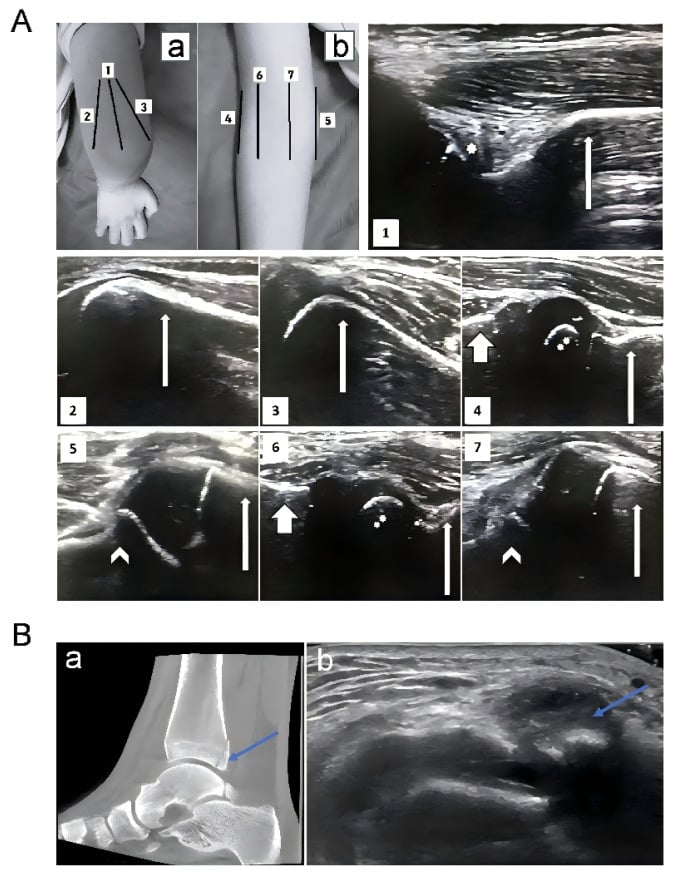
The UCL, and why arthrography is added. MRI is the gold standard for the UCL and shows the anterior bundle at its sublime tubercle insertion. Unenhanced MRI detects complete tears essentially every time, but its sensitivity across all UCL tears is only about 57% because it misses the partial undersurface tear. Intra-articular contrast lifts sensitivity to roughly 86% by showing dye tracking around the detached deep fibres while still contained by the intact superficial layer, the T-sign.
OCD of the capitellum. The physeal status on the AP radiograph is the single most decisive variable, and MRI is the gold standard for staging. A lesion is stable with an open physis, localised flattening or lucency and good motion; it is unstable with a closed physis, or fragmentation, or a loss of motion of 20 degrees or more. Stable lesions with an open physis heal with rest; once the physis is closed, surgery outperforms rest; and for unstable lesions fixation or articular reconstruction beats simple fragment excision. MR arthrography also stages osteochondral lesions and finds intra-articular loose bodies.
Radiographic Differential of the Painful/Injured Elbow
A positive fat pad sign or an abnormal alignment line is a starting point, not a diagnosis. The table maps the common radiographic appearances to their differentials and the discriminating feature that resolves them.
- Key differentials
- Radial head/neck fracture; coronoid fracture; capitellar fracture; non-traumatic effusion (septic/inflammatory arthritis)
- Discriminating feature / next step
- Mechanism + focal tenderness. Radial head fracture most likely; if non-traumatic consider aspiration. CT or MRI if management depends on confirmation
- Key differentials
- Supracondylar fracture; lateral condyle fracture; radial neck fracture; proximal ulna fracture
- Discriminating feature / next step
- Check the anterior humeral line (supracondylar) and the lateral column (lateral condyle)
- Key differentials
- Monteggia fracture-dislocation; congenital radial head dislocation; chronic/missed dislocation
- Discriminating feature / next step
- Congenital/chronic shows a dome-shaped (convex) radial head and hypoplastic capitellum; acute Monteggia has an ulnar fracture or plastic bow
- Key differentials
- Trapped medial epicondyle; normal trochlear ossification centre; intra-articular loose body
- Discriminating feature / next step
- Apply the CRITOE order: if the medial epicondyle is absent, the fragment is the epicondyle
- Key differentials
- OCD of capitellum; Panner disease (osteochondrosis); pseudodefect of the capitellum (normal posterolateral notch)
- Discriminating feature / next step
- Panner is younger (under 10) and self-limiting; pseudodefect is a constant posterolateral location on a normal surface; OCD shows focal subchondral change — stage with MRI
- Key differentials
- Lateral epicondylitis (common extensor origin); radiocapitellar plica; PIN/radial tunnel syndrome; early OCD
- Discriminating feature / next step
- Ultrasound findings of epicondylitis; MRI for plica/cartilage; nerve studies for PIN
Guidelines, Registries & Global Practice
Across all major training systems, elbow imaging follows the same evidence-based, stepwise logic: plain radiographs first, CT for fracture detail, and MRI or ultrasound for soft tissue. Differences between societies are largely about access and the threshold for advanced imaging rather than the fundamental algorithm.
- Position
- Radiographs first-line for acute elbow trauma; CT for complex/comminuted intra-articular fractures; MRI for suspected ligament, tendon or occult osseous injury
- Practical implication
- Provides the most explicit modality-by-indication framework; widely referenced internationally
- Position
- Emphasises AP + lateral radiographs as the baseline; advanced imaging reserved for surgical planning or soft-tissue diagnosis
- Practical implication
- Aligns with stepwise escalation; no routine cross-sectional imaging for simple trauma
- Position
- Two orthogonal radiographs; neurovascular documentation; comparison views discouraged as routine but acceptable when ossification assessment is uncertain
- Practical implication
- Stresses clinical assessment and timely senior review over extra imaging
- Position
- Promotes CT (with 3D reconstruction) for articular fracture mapping — coronoid, radial head, distal humerus — to plan fixation vs replacement
- Practical implication
- Underpins terrible-triad and distal humerus planning worldwide
- Position
- Ultrasound endorsed as first-line for epicondylitis and dynamic UCL assessment; MR arthrography for partial UCL tears and OCD stability
- Practical implication
- Ultrasound used more readily where MSK sonography expertise is embedded
Global epidemiology. Radial head/neck fractures are the most common adult elbow fracture (roughly a third of elbow fractures) and the most common occult fracture behind a positive fat pad sign. Supracondylar humerus fractures are the most common paediatric elbow fracture and the leading operatively-treated fracture in children, peaking at ages 5-7 — exactly the cohort where ossification-centre interpretation is hardest. Osteochondritis dissecans of the capitellum and UCL injury cluster in adolescent and adult overhead/throwing athletes.
Registry note. Unlike hip and knee arthroplasty, elbow imaging is not tracked by joint registries; the comparative evidence base is radiology and trauma cohort literature rather than implant-survival data. Where total elbow replacement is performed (e.g. for distal humerus fractures in low-demand elderly patients), national registries such as the NJR (UK), AOANJRR (Australia) and the Norwegian Arthroplasty Register report on implant outcomes, but pre-operative characterisation still rests on CT.
High- vs limited-resource practice variation. In well-resourced settings CT and MRI are obtained promptly for complex fractures and soft-tissue diagnosis. In limited-resource settings the diagnosis frequently rests on radiographs plus disciplined clinical examination and contralateral comparison views; ultrasound — portable, inexpensive and radiation-free — is an especially valuable substitute for MRI in assessing effusion, the UCL and the common extensor/flexor origins. The systematic radiograph (fat pads, anterior humeral line, radiocapitellar line, CRITOE) is therefore the one universal, resource-independent skill every candidate must master.
Controversies & Areas of Uncertainty
Comparison views in children. Contralateral radiographs help when ossification-centre interpretation is genuinely uncertain: the centres should be symmetric, and any asymmetry suggests either a fracture or a normal variant, a normal variant being bilateral. Routine bilateral imaging doubles the radiation and rarely changes management in straightforward cases, so most guidance, including BOAST, discourages reflex comparison views in favour of disciplined CRITOE assessment and selective use only when there is real diagnostic doubt.
Does the fat pad sign mandate further imaging? A positive posterior fat pad sign after trauma predicts an occult fracture in roughly three-quarters of patients, yet MRI confirmation rarely alters acute management because most occult fractures are stable radial head injuries treated symptomatically. The pragmatic, evidence-aligned approach is to treat as a fracture and reserve CT or MRI for the cases where confirmation would change the plan: suspected displacement, a mechanical block, or an athlete who needs a prognosis.
MRI versus ultrasound for the UCL. MRI, or MR arthrography for partial tears, is the reference standard for UCL anatomy, but dynamic stress ultrasound assesses functional valgus laxity in real time and is radiation-free and repeatable. Throwing-arm thickening, hypoechoic foci and increased gapping are normal adaptive findings, so ultrasound must be interpreted against the contralateral side and the symptoms; a single study does not predict who will tear the ligament.
2D versus 3D CT for articular fracture mapping. For coronoid and radial head fragments, CT consistently reveals anatomy underestimated by radiographs, and 3D reconstruction improves appreciation of fragment size and pattern. Whether 3D meaningfully changes the operative plan over good 2D multiplanar CT remains debated, but CT in some form is now standard for terrible triad and complex distal humerus planning.
Clinical Decision Scenarios
Practise clinical reasoning and management decisions out loud
“A 7-year-old child falls on an outstretched hand. The lateral elbow radiograph shows a positive posterior fat pad sign but no visible fracture. The AP view appears normal.”
“A 12-year-old child has an elbow dislocation that is reduced in the emergency department. Post-reduction radiographs show the joint is congruent, but you notice that the medial epicondyle is not visible.”
“An examiner asks you to explain the systematic approach to assessing a lateral elbow radiograph in trauma, using alignment lines.”
CRITOE Ossification Centres
- Capitellum (1yr), Radial head (3yr), Internal epicondyle (5yr)
- Trochlea (7yr), Olecranon (9yr), External epicondyle (11yr)
- Ages 1-3-5-7-9-11 (odd numbers)
- KEY: Internal (medial) epicondyle MUST appear BEFORE trochlea
- Missing medial epicondyle after dislocation = trapped in joint (surgical emergency)
Fat Pad Signs
- Posterior fat pad: ALWAYS abnormal when visible = intra-articular effusion
- In trauma: posterior fat pad = occult fracture until proven otherwise
- Most common occult fracture: radial head (adults), supracondylar (children)
- Anterior fat pad (sail sign): less specific — can be normal if small
Alignment Lines (FABLE)
- Anterior humeral line: middle third of capitellum on true lateral
- Radiocapitellar line: must bisect capitellum on ALL views (Monteggia diagnosis)
- Baumann angle: mean about 71 degrees on AP, normal range 54-90 — compare with the uninjured side (varus/valgus alignment)
- Carrying angle: 5-15 degrees valgus (cubitus valgus = lateral condyle malunion)
Advanced Imaging Selection
- CT: complex fractures (terrible triad, comminuted radial head). It reveals fragment anatomy radiographs underestimate — coronoid fragments average only about a third of coronoid height. 3D adds reliability, not accuracy
- MRI: OCD staging, bone marrow oedema, ligaments — but plain MRI is only ~57% sensitive for UCL tears overall (100% specific); it is complete tears it never misses
- MR/CT arthrography for the partial undersurface UCL tear: sensitivity ~86%, the T-sign
- MR arthrography: partial UCL tears, OCD stability, loose body detection
- Ultrasound: dynamic UCL assessment, tendon pathology, guided injection
Evidence Base
Fat Pad Sign and MRI-Confirmed Occult Fracture in Adults
- In 20 adults with a post-trauma elbow effusion (fat pad elevation) but no visible fracture on radiographs, MRI revealed a radiographically occult fracture in 75% (15 of 20).
- Of the occult fractures, 86.6% involved the radial head, with the remainder in the lateral epicondyle (6.7%) and olecranon (6.7%); 90% showed bone marrow oedema on MRI.
- Neither the size of the effusion nor the degree of anterior/posterior fat pad elevation predicted the likelihood of an underlying fracture.
Posterior Fat Pad Sign and Occult Fracture in Children
- In 45 children (mean age 4.5 years) with an elevated posterior fat pad and no other radiographic evidence of fracture, 76% (34 of 45) had a confirmed occult fracture on follow-up radiographs showing new-bone formation.
- The occult fractures were supracondylar in 53%, proximal ulna in 26%, lateral condyle in 12% and radial neck in 9%.
- This far exceeded the previously reported fracture prevalence (6-29%), supporting management as a non-displaced fracture whenever the posterior fat pad is elevated after trauma.
Fat pad signs are the most sensitive radiographic indicator of elbow fracture.