Imaging in Acute Orthopaedic Trauma
- Two views minimum: At 90° to each other. One view is never enough for fracture assessment.
- Joint above and below: Always include adjacent joints in long bone imaging.
- CT for polytrauma: Pan-scan (C-spine through pelvis) is standard for major trauma.
- Never clear C-spine on X-ray alone: CT is required for obtunded patients.
- Systematic approach: ABCS for every image - Alignment, Bone, Cartilage, Soft tissue.
- “Satisfaction of search: Finding one injury doesn't mean there aren't more. Complete your systematic review.
- “10% of spinal fractures have a second non-contiguous spinal injury.
- “Pelvic ring injuries require two breaks - always look for the second injury.
- “CT reconstructions (sagittal, coronal, 3D) are essential - axial slices alone are insufficient.
- “Occult fractures: If X-ray negative but clinical concern high, CT or MRI is indicated.
Systematic Approach: Imaging Pitfalls
The injuries that get missed. The commonly missed fractures are worth carrying as a list.
SCALPCommonly Missed Fractures
Hook:Don't let injuries SCALP you
Satisfaction of search. The search stops once one injury has been found, and the second injury is missed. The classic example is a displaced distal radius fracture found and the associated ulnar styloid avulsion or DRUJ disruption overlooked. The defence is to complete the ABCS review of every image even after a fracture has been found, to look actively for associated injuries rather than anchoring on the obvious one, and to know the patterns: an ACL tear sends you to the meniscus, a pelvic ring break to the second break, and 10% of spinal fractures have a second, non-contiguous spinal injury.
Before calling an image normal. Seven questions, answered honestly:
- Are there two views at 90 degrees?
- Are the joints above and below included?
- Is the image quality adequate (penetration, rotation, coverage)?
- Have I completed ABCS systematically?
- Have I looked at all cortices?
- Does the clinical picture match my interpretation?
- If the X-rays are normal but clinical concern persists, have I considered CT or MRI?
If any answer is no, obtain additional imaging or review the film with a senior.
Principles of Trauma Imaging in the ATLS Framework
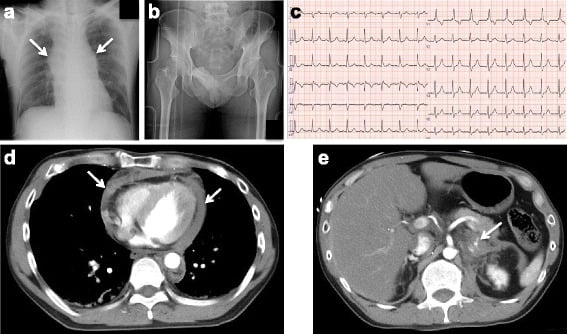
Life-threatening injuries first. Imaging in major trauma follows the ATLS sequence, and the first two films are adjuncts to the primary survey, obtained during or immediately after the ABCDE assessment. An AP chest radiograph looks for a pneumothorax or haemothorax and checks tube position; an AP pelvis radiograph looks for pelvic ring disruption. Neither is allowed to delay resuscitation.
The unstable patient. Resuscitation takes priority. The chest and pelvis films are its primary-survey adjuncts, and the patient may go directly to theatre or interventional radiology on those two films alone. CT is obtained only if it will not delay definitive treatment.
The stable patient. Once haemodynamically stable, a patient with a significant mechanism goes to the CT trauma series, the pan-scan described in the next section. It detects injuries missed on plain films and is the standard for haemodynamically stable polytrauma. There is then time for the secondary-survey imaging and for detailed fracture assessment.
The secondary survey. Radiographs of clinically suspected extremity injuries are taken during the secondary survey, to the rules in the next section; consider CT for complex fractures. Before the patient is moved for any of this imaging, splint the fractures, document the neurovascular status before and after the move, and photograph open wounds. Hand the imaging findings over clearly to the receiving team.
Plain Radiograph Principles
Two views, at right angles. A single radiographic view is never adequate for fracture assessment, because a fracture can be invisible on one projection and obvious on another. The minimum is two views at 90 degrees to each other, an AP and a lateral at the least, and the table lists the injuries that hide on one of them.
- View That May Miss It
- AP
- View That Shows It
- Lateral
- View That May Miss It
- AP
- View That Shows It
- Lateral
- View That May Miss It
- PA
- View That Shows It
- Scaphoid view
- View That May Miss It
- AP
- View That Shows It
- Lateral
- View That May Miss It
- AP ankle
- View That Shows It
- Full-length tibia/fibula
Joint above and below. A long bone is imaged with both adjacent joints on the film. Associated injuries are found there, and the position of the fracture relative to the joints affects its classification.
The ABCS review. Every image is read the same way, in the same order, without exception. Alignment covers joint congruity, the axis and angulation of the bone, any subluxation or dislocation, and rotational deformity. Bone means a cortical break on any of the cortices, trabecular disruption, bone density and periosteal reaction. Cartilage and joint means joint space width, the subchondral bone, intra-articular fragments and effusion. Soft tissue means swelling that localises the injury, fat pads as the sign of an effusion, foreign bodies, and gas (see open fractures below).
Radiation Dose and ALARA in Trauma Imaging
The benefit of rapid, complete CT is weighed against ionising-radiation dose, and the viva will ask the approximate dose of a trauma CT. Effective doses (approximate, for orientation, not exact figures):
- Approx effective dose
- ~0.02 mSv
- Background equivalent
- ~3 days
- Approx effective dose
- ~0.7 mSv
- Background equivalent
- ~4 months
- Approx effective dose
- ~2 mSv
- Background equivalent
- ~8 months
- Approx effective dose
- ~3 mSv
- Background equivalent
- ~1 year
- Approx effective dose
- ~10 mSv
- Background equivalent
- ~3 to 4 years
- Approx effective dose
- ~20 to 30 mSv
- Background equivalent
- ~7 to 10 years
Natural background radiation is roughly 2 to 3 mSv per year for reference.
Why it matters. A pan-scan delivers the radiation of several years of background exposure in seconds. Because REACT-2 showed no mortality benefit for indiscriminate pan-scan, the dose is justified by patient selection, not reflex. The concern is greatest in children and young polytrauma survivors, where the lifetime stochastic (cancer) risk is highest, which drives an ALARA approach: image only when it will change management, use low-dose and weight- or age-adapted CT protocols, and prefer ultrasound (FAST) and MRI where they can answer the question without ionising radiation.
Regional Trauma Imaging
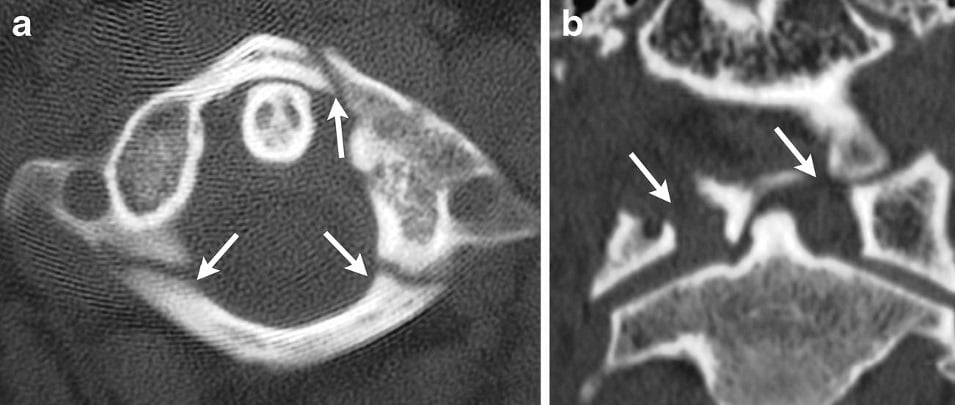
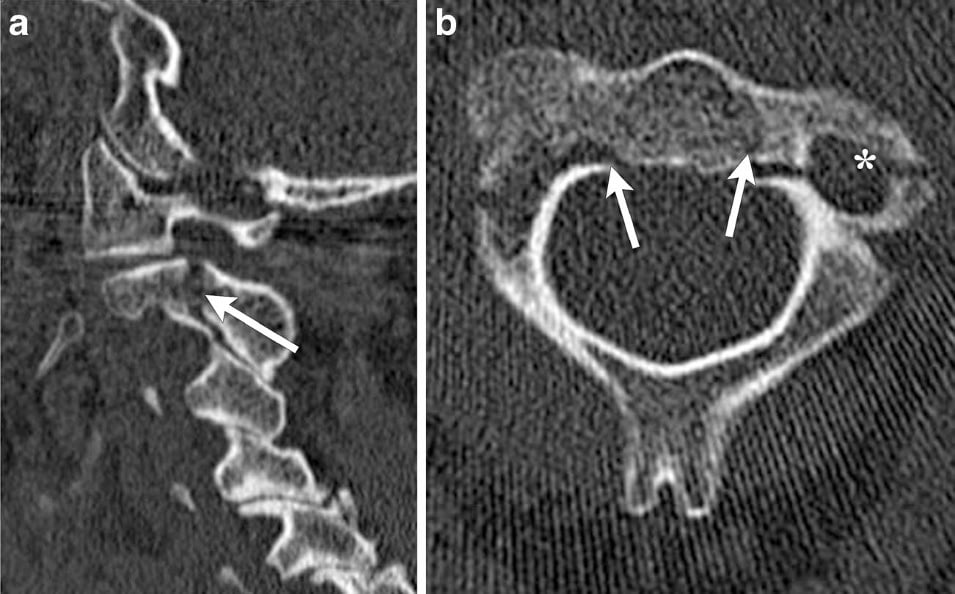
Cervical spine. Clinical clearance follows the NEXUS or Canadian C-spine rules: a patient who is alert, with no midline tenderness, no distracting injury, no intoxication and no neurological deficit needs no imaging. When imaging is required, CT is the gold standard, not plain films, which miss up to 50% of fractures. MRI is added for a neurological deficit, a suspected ligamentous injury, or the obtunded patient with a normal CT. An obtunded patient is never cleared on plain films alone.
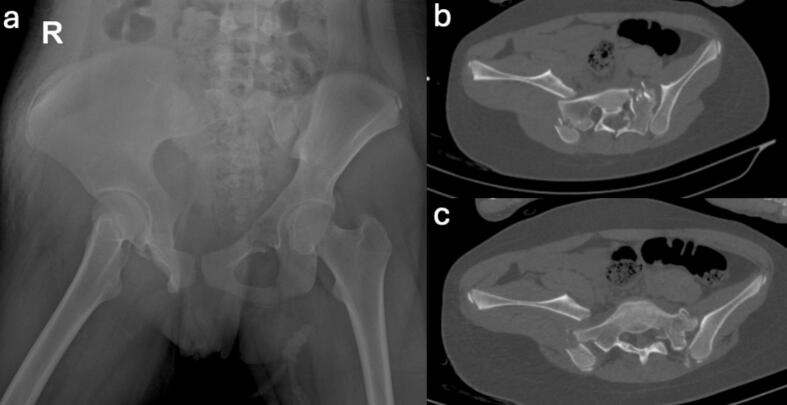
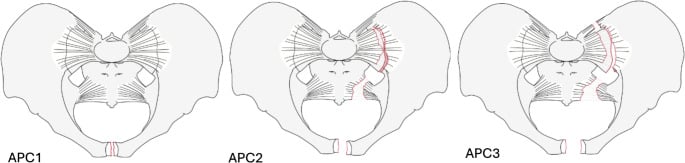
Pelvic ring. The AP pelvis is the primary-survey adjunct, and on it you assess ring integrity, the pubic symphysis and the sacroiliac joints. A ring breaks in two places: find both injuries. CT is essential for every pelvic ring injury: it assigns the Young-Burgess classification, shows acetabular involvement and assesses the posterior ring.
Long bones. The two-view and two-joint rules above apply. Beyond them, assess rotation by comparing with the normal side, to prevent a rotational malunion, and consider CT when there is intra-articular extension or surgery to plan.
Differential Diagnosis: Choosing the Right Modality
When initial radiographs are negative but suspicion persists, the choice between CT, MRI and bone scintigraphy depends on the anatomical region, the urgency, radiation considerations and local availability. Picking the wrong second-line test wastes time and may still miss the injury.
- First-Line
- PA, lateral, scaphoid views
- Best Second-Line
- MRI first, CT second
- Key Reasoning
- The three second-line options are NOT interchangeable. Pooled figures: MRI sensitivity 0.88, specificity 1.00; CT 0.72 and 0.99; bone scintigraphy 0.99 and 0.86. MRI has the best balance. CT misses roughly a quarter of these fractures, so 'MRI or CT' understates a 16-point sensitivity gap. Bone scan finds almost all of them but its low specificity drives substantial over-treatment
- First-Line
- AP pelvis + lateral hip
- Best Second-Line
- MRI
- Key Reasoning
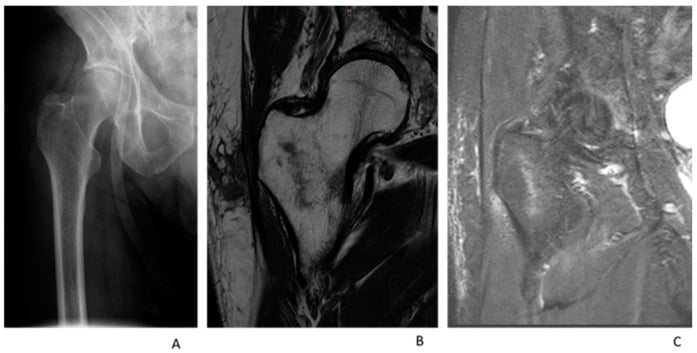
- MRI is gold standard; CT can miss non-displaced femoral neck fractures
- First-Line
- None - go to CT
- Best Second-Line
- CT C-spine
- Key Reasoning
- Plain films miss many fractures; CT sensitivity over 99%
- First-Line
- CT (bone)
- Best Second-Line
- MRI
- Key Reasoning
- MRI shows cord, disc, ligament and SCIWORA in children
- First-Line
- AP pelvis
- Best Second-Line
- CT with reconstructions
- Key Reasoning
- Defines posterior ring, columns, planning
- First-Line
- AP/lateral region
- Best Second-Line
- MRI
- Key Reasoning
- Marrow oedema visible before cortical change
- First-Line
- FAST / CXR
- Best Second-Line
- CT angiography
- Key Reasoning
- Plain films cannot assess; CTA defines active bleeding
The occult fracture. For most occult fractures (scaphoid, hip, sacrum, stress fractures) MRI is the most useful single second-line test, because it shows marrow oedema before any cortical change and has the best balance of sensitivity and specificity. CT is faster and excellent for cortical and comminuted detail and for surgical planning, but can miss non-displaced trabecular fractures. Bone scintigraphy is highly sensitive but poorly specific and carries a diagnostic delay, so it is rarely first choice in modern practice.
Guidelines, Registries & Global Practice
Global Epidemiology
Trauma is a leading cause of death and disability worldwide, accounting for roughly 4 to 5 million deaths each year, with road-traffic injury the single largest contributor and a disproportionate burden in low- and middle-income countries. Imaging is central to early decision-making, but access to CT and MRI varies enormously between high-resource trauma systems and limited-resource settings.
Side-by-Side Guideline Comparison
- Cervical Spine
- CXR + pelvis as primary-survey adjuncts; CT for clearance
- Whole-Body CT
- Adjunct once stabilised
- Emphasis
- ABCDE, life-threatening injuries first
- Cervical Spine
- Canadian C-Spine Rule to select CT; CT first-line if indicated
- Whole-Body CT
- Whole-body CT for adults with suspected multiple injuries
- Emphasis
- Selective imaging, avoid plain C-spine films in adults
- Cervical Spine
- CT for moderate/high risk
- Whole-Body CT
- Supports CT for major mechanism
- Emphasis
- Evidence-based modality selection
- Cervical Spine
- CT-led work-up
- Whole-Body CT
- Pan-scan in haemodynamically stable polytrauma
- Emphasis
- FAST in unstable patients, CT when stable
NICE explicitly advises against plain-film (three-view) cervical-spine series as the primary imaging in adults who need imaging, going straight to CT. This contrasts with older or resource-limited protocols where plain films remain the only available first-line test. Be able to justify CT-first on sensitivity grounds while acknowledging that plain radiography retains a role where CT is unavailable.
Registry & System-Level Evidence
National and regional trauma registries (for example the UK Trauma Audit and Research Network and the US National Trauma Data Bank) consistently link the introduction of in-resuscitation-room or rapid-access CT and standardised pan-scan protocols to shorter times to diagnosis and definitive care. These are observational, system-level signals rather than randomised mortality benefit, consistent with REACT-2.
High- vs Limited-Resource Practice Variation
- High-resource trauma centre: CT in or adjacent to the resuscitation bay, rapid pan-scan for major trauma, MRI readily available for cord and occult fracture, formal radiologist reporting.
- Limited-resource setting: Plain radiography and clinical decision rules (NEXUS, Canadian C-Spine Rule, Ottawa rules) become even more valuable to triage scarce CT; FAST ultrasound substitutes for CT in assessing free fluid; transfer pathways and clear documentation matter most.
- Universal principles: ABCDE first, two views minimum, joint above and below, systematic ABCS review, and never clearing the obtunded C-spine clinically - these hold regardless of available technology.
Special Situations
Open fractures. Radiographs show radiopaque foreign bodies such as metal and glass, and may miss wood, plastic and cloth; CT is indicated when the radiograph is negative but contamination is suspected. Gas in the soft tissues may indicate an open fracture even when the wound appears small, and in a delayed presentation consider gas gangrene. Antibiotic administration should not be delayed for imaging beyond the initial radiographs.
Children. The bone is different: growth plates and their Salter-Harris injuries, plastic deformation (bowing) and greenstick fractures, and a higher sensitivity to radiation. Comparison views may help, because ossification centres vary. Consider non-accidental injury when the injury does not match the history; if it is suspected, obtain a full skeletal survey and date the fractures by callus and healing stage.
FAST and eFAST Ultrasound
What it answers. FAST is an ultrasound search for free fluid in the dependent spaces, and its key role is the haemodynamically unstable patient: a positive scan points to the abdomen as the bleeding source and mandates laparotomy rather than a trip to the CT scanner. The four standard windows are:
- Right upper quadrant: the hepatorenal recess (Morrison's pouch), the most sensitive single view for free fluid
- Left upper quadrant: the splenorenal recess
- Pelvis: the rectovesical pouch or pouch of Douglas, behind the bladder
- Subxiphoid: the pericardial view, for a pericardial effusion or tamponade
eFAST adds the anterior chest views, to detect a pneumothorax (loss of lung sliding) and a haemothorax.
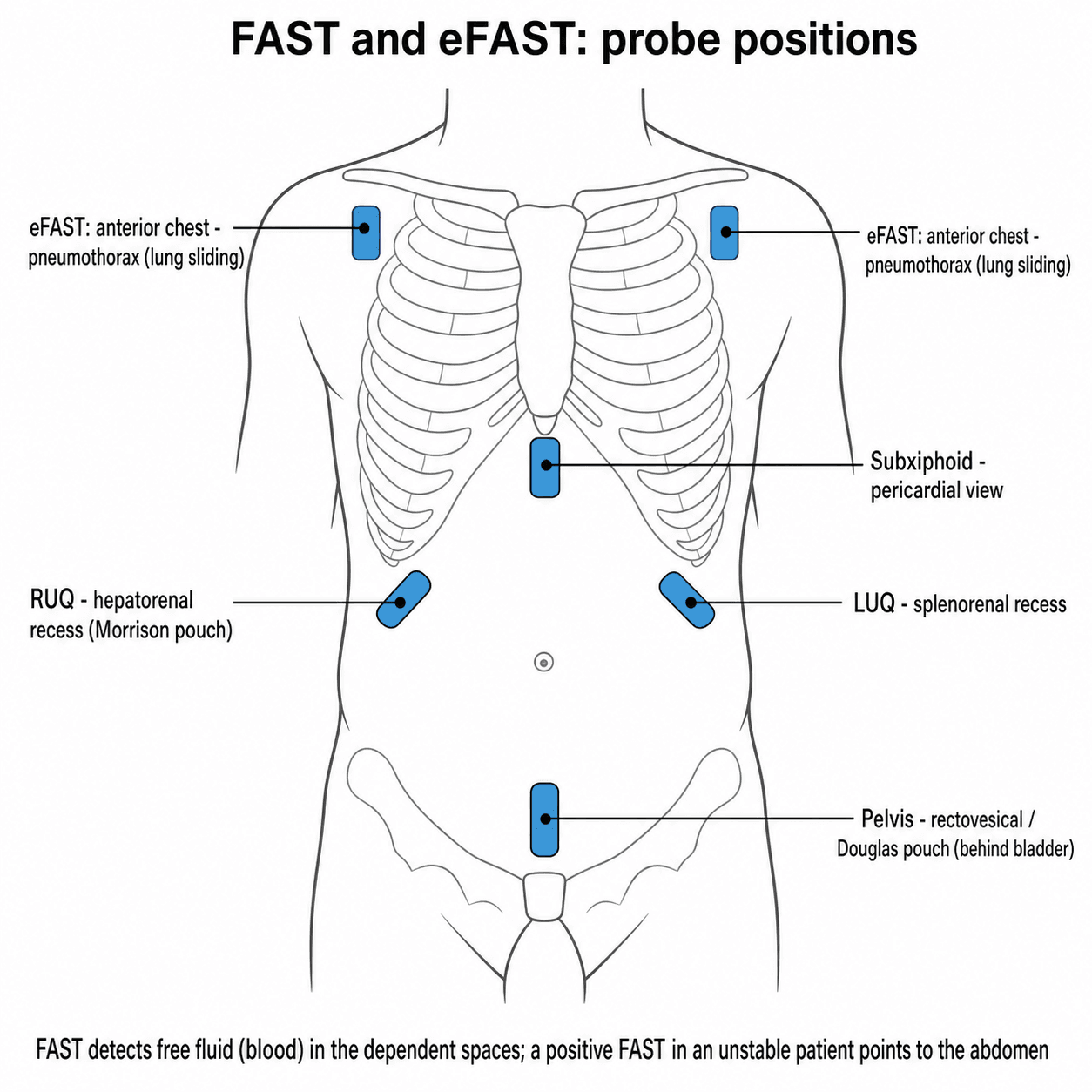
Limitations. It is operator-dependent, detects fluid rather than the specific organ injury, needs roughly 200 mL or more to be reliably positive, and misses retroperitoneal bleeding and hollow-viscus injury. A negative FAST does not exclude significant injury; in the stable patient, CT remains the definitive test.
Clinical Imaging: CT in Trauma
When to pan-scan. The trauma CT series is a non-contrast head followed by C-spine through pelvis with IV contrast. Consider it for:
- High-energy mechanism (motor vehicle accident over 60 km/h, ejection, rollover)
- Fall from over 3 metres
- Pedestrian versus vehicle
- Motorcycle accident
- GCS under 15
- Multiple injuries apparent
- Haemodynamically abnormal, or recently unstable
- Polytrauma
The haemodynamically abnormal patient is on that list, but the scan is obtained only once it will not delay definitive treatment.
What CT adds. Feature by feature against the plain film, with the higher total dose as the price.
- Plain X-ray
- 50-60%
- CT
- Greater than 99%
- Plain X-ray
- Limited
- CT
- Excellent
- Plain X-ray
- Cannot assess
- CT
- Gold standard
- Plain X-ray
- Faster per image
- CT
- Faster comprehensive assessment
- Plain X-ray
- Lower per image
- CT
- Higher total
- Plain X-ray
- Not possible
- CT
- Excellent for planning
Read the reconstructions, not just the axials. The common error is reviewing only the axial images and missing fractures that are obvious on the reformats. Sagittal reconstructions show spine alignment and vertebral body height; coronal reconstructions show the pelvic ring, the acetabular columns and alignment; 3D surface reconstructions are for visualising complex fractures and for surgical planning. Review both bone and soft tissue windows on every trauma CT.
Clinical Decision Scenarios
Practise clinical reasoning and management decisions out loud
“A patient presents after an MVA with left thigh pain. The AP X-ray shows no obvious fracture. Is this adequate imaging?”
“A 35-year-old pedestrian struck by a car at 50km/h arrives with GCS 13. Describe your imaging approach.”
“What are commonly missed orthopaedic injuries and how do you avoid missing them?”
“An 80-year-old woman cannot weight-bear after a fall, but her AP pelvis and lateral hip radiographs look normal. What is your next step and what is the evidence?”
Fundamental Rules
- TWO views minimum at 90°
- Include joint ABOVE and BELOW
- Complete ABCS for every image
- Don't stop after finding one injury
ATLS Imaging
- Primary survey: CXR + Pelvis X-ray
- CT pan-scan when stable
- Never clear C-spine on X-ray alone
- CT required for GCS less than 15
Commonly Missed (SCALP)
- Scaphoid: MRI/CT if X-ray negative
- C-spine: CT mandatory, not X-ray
- Ankle: Posterior malleolus, syndesmosis
- Lisfranc: Weight-bearing views essential
- Pelvis: Ring breaks twice - find both
CT Essentials
- Review sagittal AND coronal reconstructions
- 3D for complex fractures
- Bone AND soft tissue windows
- CT C-spine sensitivity greater than 99% vs 50% for X-ray
Evidence Base & Landmark Studies
The modern approach to trauma imaging is built on a small number of large, high-quality decision-rule studies and one landmark randomised trial of pan-scan. Knowing these by name, design and headline number is high-yield for vivas.
REACT-2: Immediate Total-Body CT vs Standard Work-Up (RCT)
- International multicentre RCT of 1403 severely injured adults randomised to immediate total-body CT versus conventional imaging with selective CT.
- In-hospital mortality was identical (16% vs 16%, p=0.92), with no benefit in the polytrauma or traumatic brain injury subgroups.
REACT-2: Cost-Effectiveness of Immediate Total-Body CT
- Economic analysis of 928 REACT-2 patients: overall hospital costs were similar between the two strategies.
- Immediate total-body CT had a high probability of being cost-effective specifically in multiple trauma (0.8 to 0.9) and traumatic brain injury (over 0.9).
Areas of Controversy & Uncertainty
- Pan-scan vs selective CT: REACT-2 showed no mortality benefit overall (16% vs 16%, p=0.92), yet pan-scan is widely used for speed and completeness. The economic analysis of 928 of those patients sharpens rather than settles it: overall hospital costs were similar, but immediate total-body CT had a high probability of being cost-effective specifically in multiple trauma (0.8-0.9) and traumatic brain injury (over 0.9). So the honest position is not "pan-scan does not work" but "pan-scan has not been shown to save lives across an unselected population, while looking economically sensible in the subgroups most likely to be injured in several places at once". The debate is about selection and radiation stewardship, not diagnostic accuracy.
- Clearing the C-spine in the obtunded patient with a normal CT: Modern multidetector CT has very high sensitivity, and several groups now clear the collar on CT alone. Others still obtain MRI to exclude purely ligamentous injury. Practice varies and guidelines are not unanimous.
- Radiation in young patients: Cumulative dose from repeated CT (especially in children and young polytrauma survivors) drives an ALARA approach and increasing use of MRI and low-dose CT protocols.
- Whole-body MRI and dual-energy CT: Emerging roles for marrow oedema and bone-bruise detection without ionising radiation, but availability, time and cost limit acute use.