Intra-articular Elbow Fracture | Bicolumnar Fixation | Early Motion Essential
- Bicolumnar anatomy: Medial and lateral columns form triangular construct
- Dual plate fixation required - single plate inadequate
- Orthogonal plating (90°) or parallel plating both effective
- Early motion critical - stiffness is the enemy
- Olecranon osteotomy provides best articular visualization
- “Columns diverge distally to support trochlea and capitellum
- “Articular reconstruction priority before column fixation
- “Ulnar nerve must be identified and protected
- “TEA is reasonable option for elderly with comminution
Overview
Intercondylar fractures of the distal humerus are complex intra-articular injuries. The fracture disrupts the bicolumnar architecture of the distal humerus and separates the articular surface from the humeral shaft, and restoring elbow function depends on anatomic reduction and stable fixation.
Who. About 2% of all fractures and 30% of elbow fractures, in a bimodal distribution: young adults after high-energy trauma and elderly women after low-energy falls. The young males are hurt in motor vehicle accidents and sport; the elderly females have low-energy falls and osteoporosis, and the incidence in the elderly population is increasing. The risk factors are osteoporosis, a high-energy mechanism and direct trauma to the elbow.
Mechanism. The olecranon is driven into the trochlea, splits the columns apart and creates the characteristic T or Y pattern. The energy of the injury separates the two groups of patients:
- High energy - motor vehicle accidents, falls from height, sports injuries, a direct blow to the elbow
- Low energy - a fall onto the flexed elbow, or onto the outstretched hand with the elbow flexed, common in the osteoporotic elderly
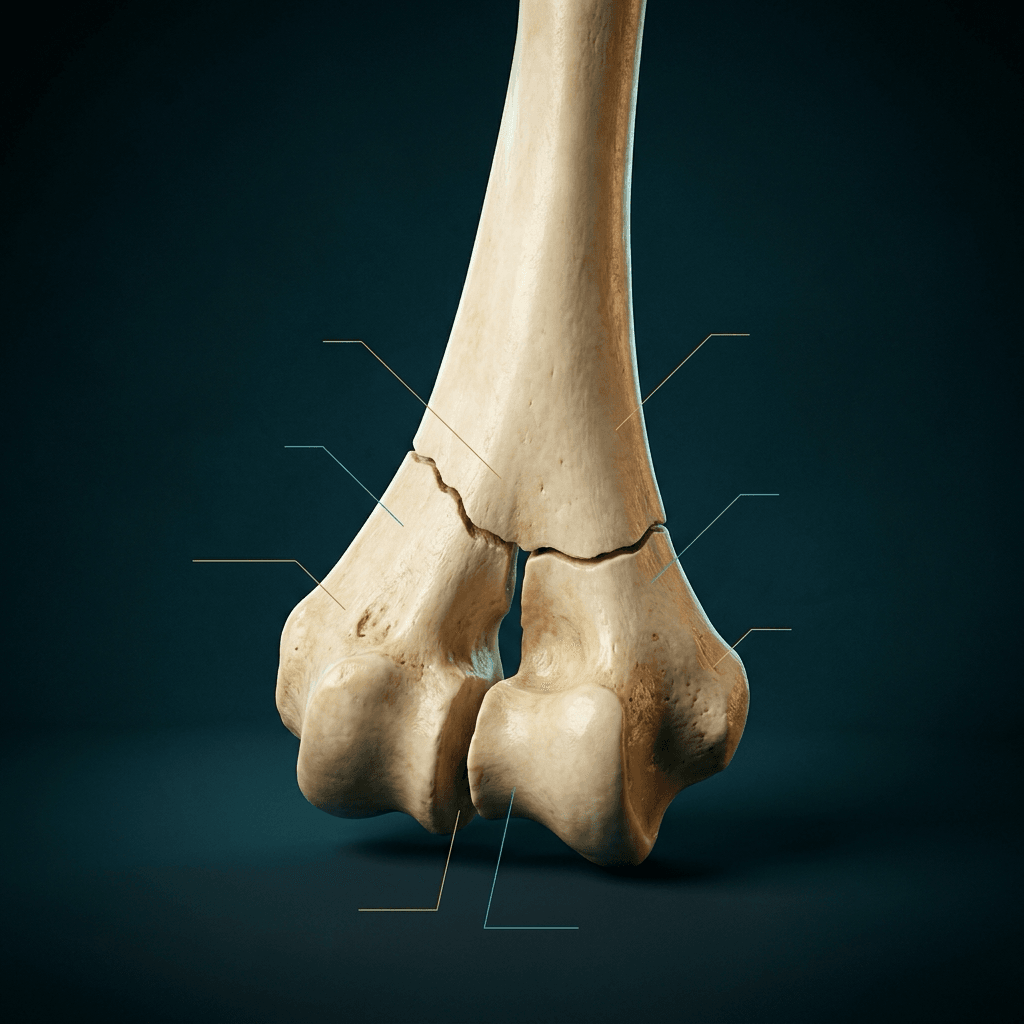
Associated injuries. Open fractures in 15-20%, nerve injuries, of which the ulnar nerve is the most common, and, rarely, vascular injury.
Anatomy and Pathophysiology
The two columns. Two columns diverge distally from the humeral shaft to support the articular surface, so that viewed end-on the distal humerus is a triangle: the columns are the sides and the trochlea and capitellum the base. The medial column supports the trochlea and the lateral column the capitellum; both epicondyles are non-articular. The bone is thicker posteriorly and medially, and the best plate positions are posteromedial on the medial column and posterolateral on the lateral column.
The thin zones. The olecranon fossa posteriorly and the coronoid fossa anteriorly are thin bone, unsuitable for screw placement. This is the anatomy that dictates dual plating: fixation must restore both columns for stability, and a single plate will fail.
The articular surface. Its anatomic restoration is critical for function.
- Trochlea - spool-shaped, articulates with the olecranon through an arc of 300-330°; the lateral ridge is the more prominent
- Capitellum - spherical, articulates with the radial head through roughly 180°, on its anterior and inferior surfaces only
- Trochlear ridge - separates trochlea from capitellum and is the key landmark for reduction
- Carrying angle 11-14° valgus; trochlear tilt 3-8° internal rotation
The soft tissues. The ulnar nerve lies posterior to the medial epicondyle in the cubital tunnel, where it is at risk during the surgical approach, and it must be identified in every case. The medial collateral ligament runs from the medial epicondyle to the sublime tubercle and the lateral collateral ligament complex from the lateral epicondyle to the ulna; both usually remain attached to the epicondyles. The common flexor origin is on the medial epicondyle, the common extensor origin on the lateral epicondyle, and the triceps inserts on the olecranon.
Classification
Three systems are in use. AO/OTA or Jupiter is used to plan; Jupiter describes the geometry of the fracture lines; Riseborough-Radin is the eponym most likely to appear in a written question.
The distal humerus is bone segment 13. Type C, the complete articular fracture, is the intercondylar fracture and the focus of this page.
- Subtype
- A1
- Description
- Avulsion
- Subtype
- A2
- Description
- Simple metaphyseal
- Subtype
- A3
- Description
- Multifragmentary metaphyseal
- Subtype
- B1
- Description
- Sagittal lateral condyle
- Subtype
- B2
- Description
- Sagittal medial condyle
- Subtype
- B3
- Description
- Coronal plane (capitellum/trochlea)
- Subtype
- C1
- Description
- Simple articular, simple metaphyseal
- Subtype
- C2
- Description
- Simple articular, comminuted metaphyseal
- Subtype
- C3
- Description
- Comminuted articular
What the AO letter predicts. Grading the complexity up front helps set realistic patient expectations.
- Articular
- Simple
- Metaphyseal
- Simple
- Treatment Challenge
- Low - large fragments in good bone; standard dual plating; good prognosis
- Articular
- Simple
- Metaphyseal
- Comminuted
- Treatment Challenge
- Moderate - metaphyseal reconstruction, may need bone graft; standard dual plating
- Articular
- Comminuted
- Metaphyseal
- Variable
- Treatment Challenge
- High - articular comminution, osteoporotic bone; consider TEA in appropriate patients
Clinical Assessment
History. The mechanism is a fall onto the flexed elbow, a direct blow, a motor vehicle accident or a fall from height, and the energy is read from it: motor vehicle accidents and falls from height are high energy, the simple fall in the elderly is low energy. The patient has severe elbow pain, cannot move the elbow, and has swelling and deformity. Energy level and patient factors guide treatment, so ask about osteoporosis, rheumatoid arthritis (which affects the treatment choice), previous elbow problems and functional demands.
Examination. Swelling is often marked, with deformity and ecchymosis, and the skin must be checked for an open fracture. There is tenderness throughout the distal humerus and crepitus; avoid excessive manipulation. The olecranon prominence is preserved, which distinguishes the fracture from a dislocation. Motion is limited by pain and instability, so document the baseline and do not force it.
Neurovascular examination is mandatory before any treatment: ulnar nerve function, since it is the nerve most commonly injured, radial and median nerve function, and the distal pulses and perfusion.
ALWAYS document ulnar nerve function before any treatment. The ulnar nerve lies posterior to the medial epicondyle and is at risk from both the injury and surgical approach. Pre-operative deficit must be documented.
Soft tissues. Their condition may dictate the timing of surgery.
- Open fractures - classified by Gustilo-Anderson; urgent debridement is required
- Compartment syndrome - rare but possible; assess the forearm compartments, with a high index of suspicion after high energy
- Skin - the posterior skin is often compromised and fracture blisters are common; either may delay surgery
- Swelling - often severe; may need elevation and ice, with soft-tissue recovery before ORIF
Differential diagnosis. The other causes of a painful, swollen adult elbow after injury, and what separates each from the intercondylar fracture.
- Distinguishing features
- Intra-articular crepitus, gross instability, both columns disrupted
- Key investigation
- AP/lateral X-ray + CT (articular comminution, column split)
- Distinguishing features
- Deformity above joint, articular surface intact
- Key investigation
- X-ray - fracture line proximal to fossae
- Distinguishing features
- Anterior fragment, double-arc sign on lateral, block to flexion
- Key investigation
- Lateral X-ray + CT (coronal plane fragment)
- Distinguishing features
- Partial articular, one column only, may be subtle
- Key investigation
- X-ray +/- CT; stress views
- Distinguishing features
- Loss of olecranon-epicondyle relationship; radial head + coronoid involvement
- Key investigation
- X-ray pre/post reduction + CT
- Distinguishing features
- Posterior tenderness, loss of active extension, palpable gap
- Key investigation
- Lateral X-ray of elbow
- Distinguishing features
- Lateral tenderness, painful rotation, often subtle
- Key investigation
- AP/lateral + radiocapitellar view
Investigations
Radiographs. AP and lateral views of the elbow, with obliques if needed. Read them for the fracture pattern (T, Y, H or lambda), the degree of comminution, articular involvement and the column fractures, and look for the associated injuries: radial head, coronoid and olecranon fractures. Overlapping fragments obscure detail and the films may underestimate comminution, which is why CT is usually needed for planning.
CT. CT with 3D reconstruction is the gold standard for surgical planning and is obtained for all intercondylar fractures: thin cuts of 1-2mm in coronal, sagittal and axial planes. It reveals articular comminution that may not be apparent on plain radiographs, and gives the number, size and position of the articular fragments, the column fracture patterns, trochlear comminution and the bone quality. Those answer the planning questions: where the plates will go, whether bone graft will be needed, whether the fracture is reducible and, in severe comminution, whether ORIF or TEA is more appropriate.
Other imaging is rarely needed for acute fracture management.
- MRI - rarely needed acutely; may help assess ligament injuries; useful in chronic cases
- Angiography - if vascular injury is suspected: absent pulses after reduction, or an expanding haematoma
- Stress views - not useful acutely; may be used post-operatively to assess stability and ligament healing
Management Algorithm
The decision. Most intercondylar fractures require operative treatment, which is the standard of care for displaced fractures, and the choice is between ORIF and total elbow arthroplasty. Non-operative management is reserved for non-ambulatory patients and for those whose medical comorbidities preclude surgery; the historical "bag of bones" technique gave poor outcomes.
What the evidence says. McKee's randomised trial in patients over 65 found that TEA gave significantly better Mayo Elbow Performance Scores than ORIF, and that a quarter of the fractures randomised to fixation were converted to arthroplasty on the table because stable fixation could not be achieved. The pooled review by Githens found the functional scores and range of motion after the two operations similar. The two are reconciled by treating the choice as patient-specific: reconstructability, activity demands and the lifelong load restriction after TEA decide it, rather than expected function alone.
- Patient
- Any
- Bone Quality
- Good
- Treatment
- ORIF dual plating
- Patient
- Any
- Bone Quality
- Good
- Treatment
- ORIF dual plating
- Patient
- Young/Active
- Bone Quality
- Good
- Treatment
- ORIF dual plating with articular reconstruction
- Patient
- Elderly/Low demand
- Bone Quality
- Poor
- Treatment
- Consider TEA (total elbow arthroplasty)
- Patient
- Elderly with RA/osteoporosis
- Bone Quality
- Poor
- Treatment
- TEA preferred
Who. The young or active patient with good bone quality, a reconstructable fracture pattern and high functional demands.
Goals. An anatomic articular reduction, stable bicolumnar fixation, and fixation stable enough to allow early motion. How that is achieved, the approach, the plating construct and the reduction sequence, is in the surgical technique section below.
Surgical Technique
Why. The olecranon osteotomy is the approach for most intercondylar fractures and for complex articular patterns, because it gives the best view of the articular surface and direct access to both columns, and that is what makes an anatomic reduction possible.
How. Through a posterior midline incision, identify and mobilise the ulnar nerve. Pre-drill the fixation before cutting, so the osteotomy reduces accurately at the end, and make a chevron or transverse osteotomy, the chevron for rotational stability. Elevate the olecranon with the triceps attached and the trochlea is in direct view.
The price. An additional fracture, with a nonunion rate of 2-5% and prominent hardware.
Plating. Dual plate fixation is mandatory, and the two constructs are biomechanically equivalent, so surgeon preference and the fracture pattern dictate the choice. Orthogonal plating puts the medial plate on the posteromedial column and the lateral plate on the posterolateral column, at 90° to each other, in a stable construct. Parallel plating puts both plates in the sagittal plane on the medial and lateral columns, at 180°, and is easier to apply.
Screws. A minimum of 2-3 screws in each distal fragment, directed so that the distal screws interdigitate between the plates and lock the distal fragments for maximum stability. Contour the plates carefully.
Reduction sequence. Articular surface first, then the columns, then the plates:
- Articular reconstruction - identify the key articular fragments; reduce the trochlea first, medial to lateral; hold with provisional K-wires; lag screws for the articular fragments
- Column reconstruction - reduce the articular block to the medial column, then to the lateral column, restoring column length and alignment
- Plate application - apply the first plate (usually medial), then the second; final tightening; check range of motion intraoperatively
The ulnar nerve. Identification is mandatory in every case: it lies posterior to the medial epicondyle and may be involved in the fracture. Leaving it in situ in the cubital tunnel is rarely done; subcutaneous transposition is the most common choice and submuscular transposition the more involved one. Most surgeons transpose, which protects the nerve from hardware irritation, allows it to be inspected and reduces late ulnar neuritis; monitor for symptoms afterwards.
Complications
Stiffness is the most common complication, in 20-40%, worse after prolonged immobilisation and with heterotopic ossification. Prevention is stable fixation and early motion within 1-2 weeks; indomethacin may be considered for HO prophylaxis, though prophylaxis is controversial. Established stiffness is treated with aggressive physiotherapy, dynamic splinting, manipulation under anaesthesia, and arthroscopic or open release.
What the elbow needs. An arc of 30-130° is adequate for most activities of daily living. Loss of terminal extension is common; loss of flexion is more functionally limiting.
Ulnar nerve problems occur in 10-20%, as a pre-operative injury (document it), an intraoperative injury, or post-operative compression or traction. Prevention is careful identification, gentle handling, transposition in most cases and avoiding excessive traction. Most recover with observation; transpose if symptoms persist and perform a neurolysis if the nerve is tethered.
Nonunion occurs in 2-10%, with comminution, poor fixation and infection as the risk factors, and is treated by revision with bone graft. Malunion is usually an articular incongruity that results in arthritis and may need arthroplasty.
Hardware, HO and infection.
- Fixation failure - usually from inadequate fixation
- Hardware problems - prominence requiring removal; higher with tension band wires, lower with plates
- Heterotopic ossification - 5-10%; may limit motion; prophylaxis controversial
- Infection - 1-5%, higher in open fractures and a risk of extensive surgery and hardware; may need hardware removal
Careful technique and early motion minimise all of them.
Postoperative Care
The principle. Early motion is critical and begins within 1-2 weeks; strengthening starts once union is progressing on radiographs.
Goals: protect the fixation, begin early range of motion, control swelling.
- Week 0-2 - posterior splint at 90° flexion; elevation; active finger, wrist and shoulder motion
- Week 1-2 - begin active-assisted elbow motion, removing the splint for exercises; gravity-assisted flexion and extension stretching
- Week 2-6 - progress range of motion with active motion in all planes; a hinged brace may be used for protection; continue to avoid loading
Goals: restore strength, improve range of motion, functional activities.
- Week 6-8 - progressive range of motion, light resistance exercises, functional activities
- Week 8-12 - progressive strengthening with resistance increased gradually; activity modification
- Precautions - avoid heavy lifting until union, no contact sports, avoid falls
Goals: full function, return to work and sport, long-term maintenance.
- Week 12-16 - progressive loading, sport-specific training, work hardening
- Week 16+ - return to full activities; contact sports when strength is equal; a permanent limitation of motion is possible
- Long-term - monitor for arthritis; remove hardware if symptomatic
Most patients achieve a functional range of motion, but some limitation is common and some never regain full motion.
Outcomes
After ORIF. Results are good to excellent in 75-85%, fair in 10-15% and poor in 5-10%, and patients return to their activities. The average arc is 100-110°: an extension loss of 20-30° is common and flexion is usually 120-130°. The complication rates to quote are stiffness 20-40%, ulnar nerve symptoms 10-20%, hardware removal 15-25% and nonunion 2-10%. Outcome depends on the fracture complexity (C1 does better than C3), the quality of the reduction, the early motion protocol and the patient's compliance.
After TEA. Pain relief is excellent in 85-95%, satisfaction is high in appropriate patients, and the arc is typically 100-120°. The complications are wound problems in 5-10%, infection in 5-10%, loosening in 10-20% at 10 years and revision in 10% at 10 years, against which the long-term follow-up of the McKee cohort in the evidence section found only one revision in 25, in a low-demand cohort most of whom died with the implant in place. The patient lives with a lifelong 5kg lifting restriction and no impact activities, and revision surgery is difficult. Selection is critical: the results are best in the low-demand elderly and poor in the young and active, and the 65-75 age group needs careful individual assessment.
Prognosis. Fracture complexity and patient factors both influence outcome.
- Good - a simple fracture pattern (C1), good bone quality, an anatomic reduction, early motion, a compliant patient
- Poor - a comminuted articular surface (C3), osteoporosis, an open fracture, delayed treatment, associated injuries
Age. In the young, ORIF is preferred despite the complexity; in the elderly, TEA is increasingly used; between 65 and 75 the decision is individual.
Guidelines, Registries & Global Practice
Global Epidemiology
Distal humeral fractures account for roughly 2% of all fractures and about a third of elbow fractures, with a characteristic bimodal age-sex distribution: high-energy injuries in young men and low-energy fragility fractures in older women. Population-based registry data from Finland show the age-adjusted incidence of osteoporotic distal humeral fractures in women aged 60 and over rising from 12 to 28 per 100,000 between 1970 and 1995, with absolute numbers projected to almost triple by 2030 (Palvanen et al., 1998).
- Figure
- ~2%
- Source / Notes
- Distal humerus, all ages
- Figure
- ~30%
- Source / Notes
- Adult elbow injuries
- Figure
- 28 / 100,000
- Source / Notes
- Palvanen 1998 (Finland, age-adjusted)
- Figure
- Almost x3
- Source / Notes
- Driven by ageing + rising age-specific risk
- Figure
- ~15-20%
- Source / Notes
- Higher in high-energy young cohort
Guideline & Registry Landscape
There is no single dedicated AAOS/NICE/BOA clinical practice guideline specific to intercondylar (OTA 13-C) distal humeral fractures; recommendations are derived from elbow-fracture management literature, the AO Surgery Reference, fragility-fracture pathways and elbow-arthroplasty registries. The table below summarises the practical positions that converge across major bodies.
- Position on intercondylar fractures
- Dual-column fixation; articular reconstruction first; parallel or orthogonal plating; early motion
- Underlying evidence
- Biomechanical + cohort evidence (Sanchez-Sotelo, Schwartz, Arnander)
- Position on intercondylar fractures
- ORIF standard for reconstructable fractures; primary TEA an option for comminuted fractures in low-demand elderly
- Underlying evidence
- Level I RCT (McKee) + meta-analyses
- Position on intercondylar fractures
- Frail/fragility limb fractures: senior decision-making, early surgery and early mobilisation within orthogeriatric pathways
- Underlying evidence
- Fragility-fracture and frailty standards
- Position on intercondylar fractures
- No fracture-specific guideline; covered by falls/fragility-fracture and osteoporosis (NG) guidance plus bone-health assessment
- Underlying evidence
- Fragility-fracture prevention evidence
- Position on intercondylar fractures
- Endorse TEA in selected elderly comminuted fractures; caution re lifelong load limit and revision burden
- Underlying evidence
- RCT + registry/long-term cohort data
Registry Evidence
National joint registries (e.g. the UK NJR elbow dataset, the Australian Orthopaedic Association National Joint Replacement Registry [AOANJRR] and the Norwegian Arthroplasty Register) capture total elbow arthroplasty undertaken for acute fracture and report this as a recognised indication distinct from inflammatory and degenerative arthritis. Registry signals consistently show that fracture is a substantial minority indication for TEA and that revision risk is influenced by patient activity and adherence to load restrictions. Long-term follow-up of the McKee trial cohort found only 1 of 25 fracture-TEA implants required revision at a mean of 12.5 years, supporting durable survivorship in genuinely low-demand patients (Dehghan et al., 2019).
Practice Variation
ORIF remains the default worldwide for reconstructable fractures and for essentially all younger or active patients. Primary TEA is used selectively for comminuted, unreconstructable fractures in low-demand elderly patients; its uptake varies by surgeon elbow-arthroplasty experience and by health-system access to implants and revision services, and complex reconstruction is often concentrated in specialist or metropolitan trauma centres. Distal humeral hemiarthroplasty is offered in some centres for isolated articular destruction in patients considered too young/active for the TEA load restriction, though evidence remains lower-level.
Rehabilitation access is decisive for outcome: supervised early-motion physiotherapy is essential, and some elderly patients, particularly after TEA, benefit from a period of inpatient rehabilitation.
MCQ Practice
High-Yield Exam Facts
Q: Why is dual plate fixation mandatory for intercondylar fractures? A: The distal humerus has a bicolumnar architecture where medial and lateral columns diverge distally to support the articular surface. Both columns must be stabilized for adequate fixation; single plate fixation will fail.
Q: What are the AO/OTA 13-C subtypes and how do they guide treatment? A: C1 (simple articular, simple metaphyseal) - standard ORIF; C2 (simple articular, comminuted metaphyseal) - ORIF with possible bone graft; C3 (comminuted articular) - ORIF in young patients or TEA in elderly. Treatment selection depends on fracture complexity, patient age, and bone quality.
Q: Compare orthogonal vs parallel plating configurations. A: Both are biomechanically equivalent. Orthogonal (90°) positions plates posteromedially and posterolaterally at 90° to each other. Parallel (180°) positions both plates in the sagittal plane on the medial and lateral columns. Both require minimum 2-3 screws in each distal fragment with interdigitating screws for stability.
Q: When is TEA preferred over ORIF for intercondylar fractures? A: TEA is preferred in elderly patients (over 65-70) with severe osteoporosis and unreconstructable articular comminution (C3 fractures). Level I evidence (McKee 2009) shows better DASH scores and fewer complications than ORIF in this population.
Q: What is the most common complication and how is it prevented? A: Elbow stiffness (20-40% incidence) is most common. Prevention requires stable fixation allowing early motion within 1-2 weeks. The functional ROM arc needed for ADLs is 30-130° (100° total arc). Early aggressive physiotherapy is critical.
Q: How should the ulnar nerve be managed during surgery? A: Ulnar nerve identification is mandatory in all cases - it runs posterior to the medial epicondyle. Most surgeons transpose the nerve (subcutaneously or submuscularly) to prevent late ulnar neuritis from hardware irritation, though in situ management is an option.
Self-Assessment Questions
Question 1: What is the primary reason dual plate fixation is required for intercondylar distal humerus fractures?
- A. To increase stability against rotational forces
- B. Because of the bicolumnar anatomy requiring both columns to be stabilized
- C. To allow placement of more screws
- D. Because single plates are not strong enough
- E. To facilitate hardware removal
Answer: B - The distal humerus has a bicolumnar architecture with medial and lateral columns supporting the articular surface. Both columns must be stabilized for adequate fixation, requiring dual plates.
Question 2: Which surgical approach provides the best visualization of the articular surface in intercondylar fractures?
- A. Medial approach
- B. Lateral approach
- C. Olecranon osteotomy
- D. Bryan-Morrey approach
- E. Paratricipital approach
Answer: C - The olecranon osteotomy provides the best direct visualization of the articular surface (trochlea), allowing anatomic reduction of complex articular fractures.
Question 3: What is the most common complication following ORIF of intercondylar fractures?
- A. Infection
- B. Nonunion
- C. Stiffness
- D. Ulnar nerve injury
- E. Hardware failure
Answer: C - Elbow stiffness is the most common complication, occurring in 20-40% of cases. Prevention through early motion is essential.
Question 4: In which patient would TEA be preferred over ORIF for an intercondylar fracture?
- A. 35-year-old manual laborer with C1 fracture
- B. 80-year-old with RA and C3 fracture with severe comminution
- C. 50-year-old with C2 fracture
- D. 25-year-old athlete with C3 fracture
- E. 60-year-old with C1 fracture and good bone quality
Answer: B - TEA is appropriate for elderly, low-demand patients with osteoporosis or RA and unreconstructable articular comminution (C3). Young active patients should have ORIF attempted regardless of complexity.
Question 5: When performing dual plating, what is the recommended minimum number of screws in each distal fragment?
- A. 1
- B. 2-3
- C. 4-5
- D. 6
- E. As many as possible
Answer: B - A minimum of 2-3 screws in each distal fragment is recommended. Screws should interdigitate between the two plates for maximum stability.
Exam Viva Scenarios
Practise clinical reasoning and management decisions out loud
“A 45-year-old man sustains an AO 13-C2 intercondylar distal humerus fracture in a motorcycle accident. Describe your management.”
“A 78-year-old active female presents after a fall with a comminuted intra-articular distal humerus fracture (AO type 13-C3). She has osteoporosis but lives independently. How do you manage this?”
“At your post-operative review 6 weeks after ORIF, your patient has only 30-100 degrees of motion (70 degree arc). What is your approach?”
“Describe the bicolumnar anatomy of the distal humerus and how this guides your fixation strategy.”
Classification (AO 13-C)
- 13-C1: Simple articular, Simple metaphyseal
- 13-C2: Simple articular, Comminuted metaphyseal
- 13-C3: Comminuted articular/metaphyseal
- Frequency: C3 (comminuted) most common
- High T vs Low T patterns
Key Concepts
- Bicolumnar Anatomy (Structure)
- Tie Arch Concept (Articular Block)
- Dual Plating Mandatory
- Orthogonal (90°) or Parallel (180°)
- Early Motion is Critical
Treatment Priorities
- Young/Active: ORIF (Dual Plate)
- Elderly/C3: TEA (Arthoplasty)
- Approach: Olecranon Osteotomy (Best view)
- Ulnar Nerve: Transpose or Protect
- Reduction: Articular first then Columns
Complications & Pitfalls
- Stiffness (Most common 20-40%)
- Ulnar Nerve Neuropathy (15%)
- Non-union/Malunion (5-10%)
- HO (Heterotopic Ossification)
- Hardware Failure/Prominence
Evidence Base
Key Studies
McKee et al. - ORIF vs TEA in the Elderly (Multicentre RCT)
- Multicentre RCT of 42 patients over 65 with OTA 13-C distal humeral fractures (15 ORIF, 25 TEA after intention-to-treat)
- 5 of 21 (25%) randomised to ORIF were converted to TEA intra-operatively because stable fixation could not be achieved
- TEA gave significantly better Mayo Elbow Performance Scores at 3, 6, 12 and 24 months (86 vs 73 at 2 years, p=0.015)
- DASH favoured TEA in the short term but was not significantly different at 2 years; reoperation rates (12% TEA vs 27% ORIF) did not differ statistically
Schwartz et al. - Parallel vs Perpendicular Plating (Biomechanical)
- Bicolumnar intra-articular fractures created in 10 composite humeri, randomised to parallel or perpendicular plating
- No statistically significant difference in construct stiffness in any loading direction (flexion, extension, varus, valgus, axial, torsion)
- Plate-strain patterns differed (90° lower longitudinal strain in axial compression; 180° lower transverse strain in torsion)
- Authors conclude surgeon experience and preference may dictate plate construct choice
Sanchez-Sotelo et al. - Principle-Based Parallel-Plate ORIF
- 34 consecutive complex distal humeral fractures (26 type C3, 14 open) fixed with two parallel plates in the sagittal plane
- Primary union in 31 of 32 fractures followed; no hardware failure or fracture displacement
- Mean flexion-extension arc 99°; mean Mayo Elbow Performance Score 85 (excellent/good in 27 of 32)
- Technique maximises distal articular fixation and supracondylar stability to permit intensive early rehabilitation
Ring et al. - Olecranon Osteotomy for Distal Humeral Exposure
- 45 consecutive apex-distal chevron olecranon osteotomies (16 fractures, 29 nonunions) repaired with K-wires and figure-of-eight tension wires
- 44 of 45 osteotomies (98%) healed within 6 months; one early failure from premature loading required ulnar plating
- 12 of 45 (27%) had wire removal, but only 6 (13%) for symptoms directly related to the wires
- Demonstrates that osteotomy complications are low when a precise apex-distal chevron technique is used
Githens et al. - ORIF vs TEA Systematic Review & Meta-Analysis
- Systematic review and meta-analysis of geriatric distal humeral fractures treated with locked-plate ORIF or primary TEA
- TEA and ORIF produced similar functional outcome scores and range of motion
- A non-significant trend toward higher major complication and reoperation rates was seen after ORIF
- Methodological quality of included studies was generally weak; prospective and cost data were called for
Dehghan & McKee et al. - Long-Term TEA Implant Survival
- Long-term follow-up (mean 12.5 years in survivors) of the original McKee RCT cohort (25 TEA, 15 ORIF)
- Only 1 of 25 TEA patients required revision arthroplasty (an early revision); no late revisions occurred
- 15 patients died with a well-functioning implant in situ and 7 retained their original implant
- Confirms durable long-term implant survival of TEA for fracture in elderly patients
Palvanen et al. - Epidemiology of Distal Humeral Fractures
- Population-based Finnish registry analysis of osteoporotic distal humeral fractures in women aged 60 and over, 1970-1995
- Age-adjusted incidence rose from 12 to 28 per 100,000 women over the study period
- Increase exceeded that explained by demographic change alone, implying a true rising age-specific risk
- Projected an almost three-fold increase in absolute fracture numbers by 2030