Nightstick Fracture | Direct Blow | Nonoperative vs ORIF
- Nightstick fracture = isolated ulna shaft from direct blow (defensive mechanism)
- EXCLUDE Monteggia (check radial head position on all views)
- Nonoperative threshold: less than 50% displacement, less than 10° angulation
- ORIF with 3.5mm DCP plate - 6+ cortices each side
- High union rate both operative and nonoperative
- “ALWAYS check PRUJ - rule out Monteggia lesion
- “Functional bracing allows early motion
- “Plate fixation is gold standard for displaced
- “Refracture risk higher with plate removal
Overview and Epidemiology
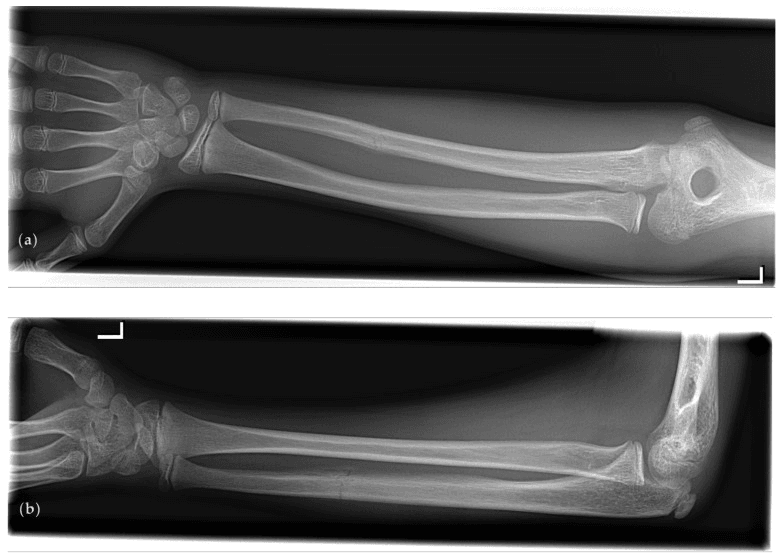
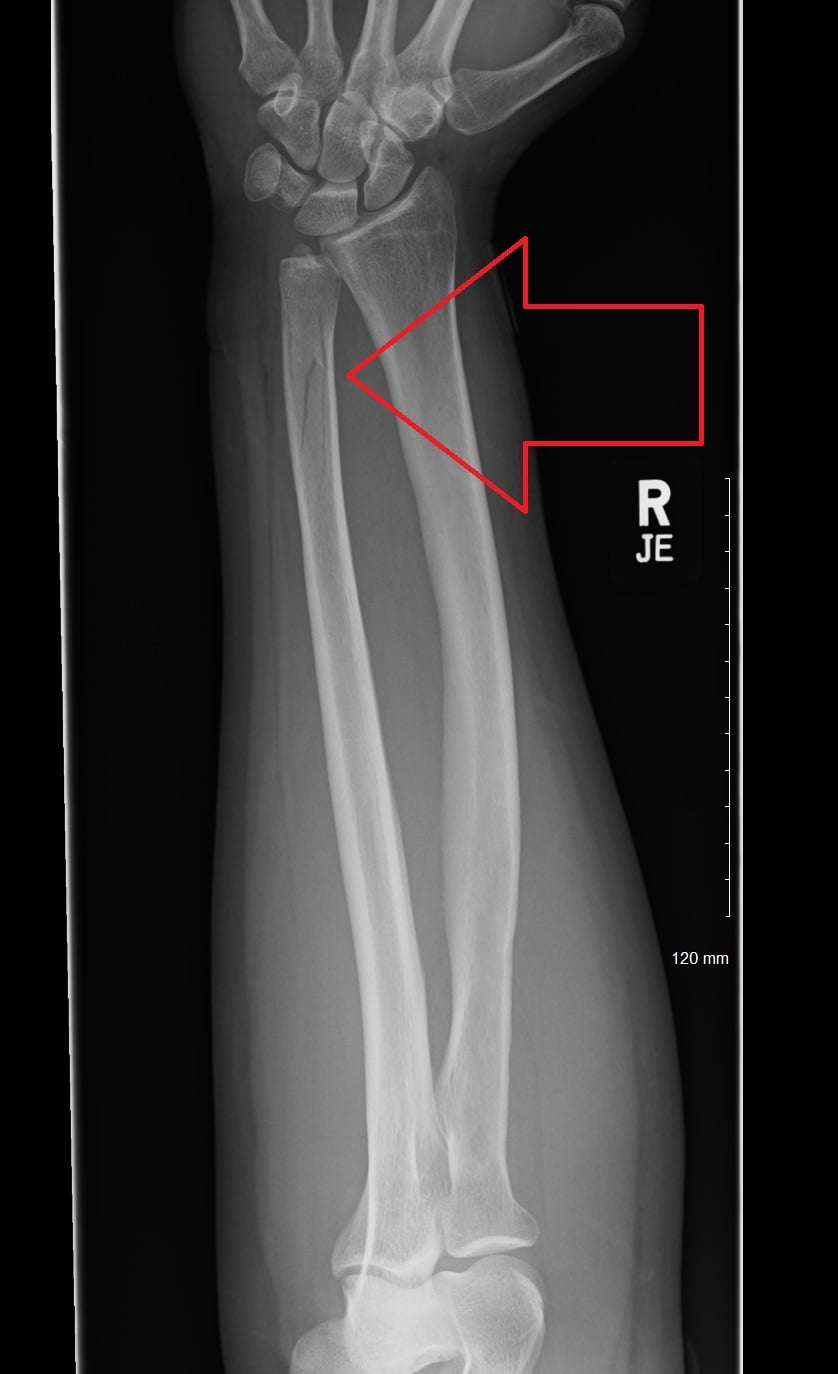
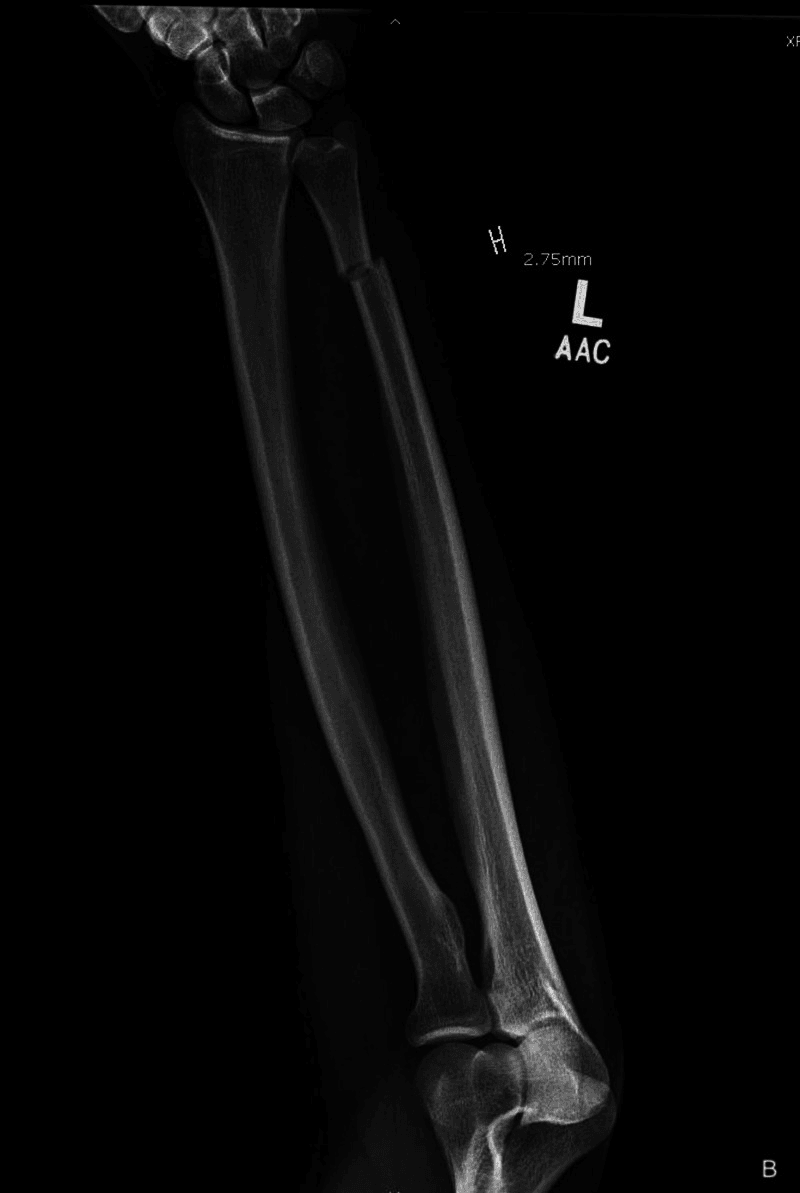
An isolated fracture of the ulnar shaft, with the radius intact and both radioulnar joints in place, is the nightstick fracture. The name comes from the classic mechanism: a direct blow to the raised forearm, as when defending against an assault with a nightstick (baton).
Who. Isolated ulna fractures make up 2-5% of forearm fractures and are more common in males. The distribution is bimodal: young men injured in assaults, and elderly patients injured in falls.
Mechanism. A direct blow to the subcutaneous border of the ulna, classically with the arm raised in a defensive guard against an assault. A fall onto a hard edge or object, or a blow in sport from a hockey stick or bat, does the same, so ask about the mechanism carefully.
Anatomy and Biomechanics
The shaft. The posterior border of the ulna is subcutaneous throughout its length, which is what leaves it exposed to direct trauma. In cross-section the shaft is triangular proximally and becomes more rounded distally.
The interosseous membrane. It connects the ulna to the radius and is important for load transfer and forearm stability. Disruption creates longitudinal instability, the Essex-Lopresti injury.
Load and rotation. The ulna is the primary stabiliser of the elbow through its articulation with the trochlea, while the radius bears more of the axial load at the wrist. The radius rotates around the ulna, so an ulnar malunion affects pronation and supination: angulation greater than 10-15° can limit forearm rotation and weaken grip strength.
Classification
OTA/AO. The classification describes complexity, but treatment is decided primarily on displacement and angulation:
- 22-A1 - simple fracture of the ulna only
- 22-B1 - wedge fracture of the ulna only
- 22-C1 - complex fracture of the ulna only
Location. Middle- to distal-third fractures are the most common.
- Proximal third - higher complication rate and lower union rate with nonoperative treatment; consider a lower threshold for ORIF
- Middle third - the most common location for the nightstick fracture; good outcomes with either treatment if the criteria are met
- Distal third - more displacement is tolerated, and functional bracing is often successful
Clinical Assessment
History. Establish the mechanism (direct blow or fall, assault or accident) and the location and timing of the impact. Ask about previous forearm injury and hand dominance.
Examination. Inspect for deformity and swelling, and palpate the entire ulna and radius. Check the DRUJ and PRUJ, test forearm rotation and complete a neurovascular examination.
Differential diagnosis. The table sets the isolated ulnar shaft fracture against its mimics.
- Key Distinguishing Feature
- Single ulna fracture, radiocapitellar line intact, DRUJ congruent
- Pitfall if Missed
- —
- Key Distinguishing Feature
- Ulna fracture PLUS radial head dislocation (radiocapitellar line broken)
- Pitfall if Missed
- Missed radial head dislocation leads to chronic instability and poor function
- Key Distinguishing Feature
- Radius AND ulna both fractured
- Pitfall if Missed
- Treating as isolated underestimates instability
- Key Distinguishing Feature
- Radial shaft fracture with DRUJ disruption (not ulnar shaft)
- Pitfall if Missed
- Different injury; DRUJ must be reduced
- Key Distinguishing Feature
- Radial head fracture, IOM disruption, DRUJ instability (longitudinal)
- Pitfall if Missed
- Missed longitudinal forearm instability
- Key Distinguishing Feature
- Low-energy mechanism, lytic/sclerotic lesion on imaging
- Pitfall if Missed
- Fixing without addressing underlying lesion
Investigations
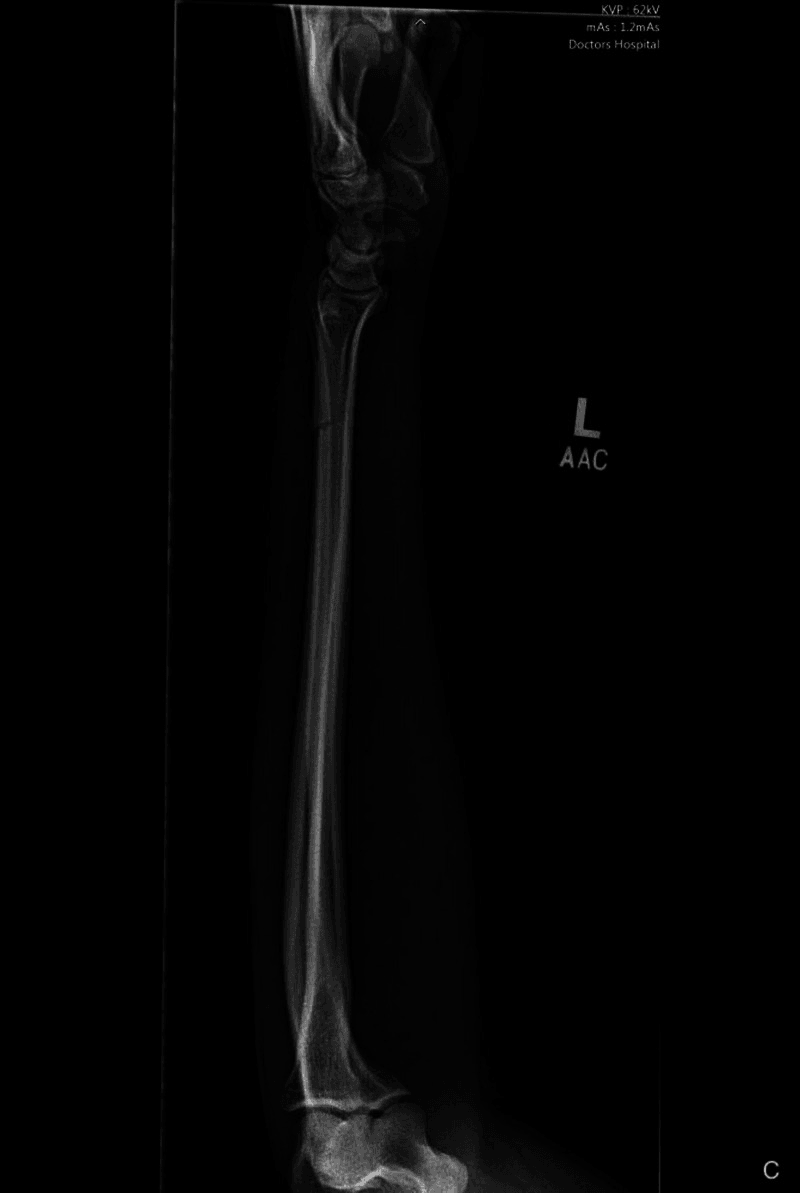
Radiographs. Forearm AP and lateral views showing both bones, full length, with the joint above and below. The elbow is included to assess radiocapitellar alignment and exclude Monteggia; the wrist is included to assess the DRUJ for longitudinal instability.
What to measure. Displacement as a percentage of bone width, angulation in degrees, and the location as proximal, middle or distal third. The thresholds they are judged against are set out under Management.
Reading the Radiocapitellar Line: Excluding Monteggia
Calling a fracture isolated depends entirely on reading the radiocapitellar line correctly.
The line. A line drawn down the long axis of the radial neck and shaft should pass through the centre of the capitellum on every projection: AP, lateral and oblique. The radial head can dislocate in any direction, so a dislocation missed on one view may be obvious on another, and a normal lateral does not exclude an anterior, posterior or lateral Monteggia.
Suspicion. Any angulated ulnar shaft fracture should raise it, because the ulnar deformity and the radial dislocation are mechanically linked. The commonest reason a Monteggia is missed is inadequate imaging, a forearm film that does not include a true elbow, so obtain dedicated elbow (and wrist) films.
The paediatric trap. In children the ulna may show only plastic (bowing) deformation or a greenstick fracture alongside a frankly dislocated radial head, an easily missed Monteggia-equivalent.
A bowed but apparently unbroken ulna with a displaced radiocapitellar line is still a Monteggia. Bado types and paediatric Monteggia detail are in the Monteggia topics.
Only once the radiocapitellar line is confirmed intact on all views, with a congruent DRUJ, can the injury be labelled an isolated ulnar shaft fracture and treated on the displacement and angulation criteria. If the radial head is dislocated, it is a Monteggia fracture-dislocation.
Management
The decision. Once the fracture is confirmed isolated, treatment turns on displacement, angulation and location, then is adjusted for the patient: age, activity level, compliance, hand dominance and occupation.
- Angulation
- Less than 10°
- Location
- Middle/distal
- Treatment
- Functional brace
- Angulation
- 10-15°
- Location
- Any
- Treatment
- Borderline - consider ORIF
- Angulation
- Greater than 15°
- Location
- Proximal
- Treatment
- ORIF recommended
- Angulation
- Any
- Location
- Open fracture
- Treatment
- ORIF + debridement
Functional bracing: who. The criteria for nonoperative treatment:
- Displacement less than 50% of bone width
- Angulation less than 10° in the proximal two-thirds; in the distal third, up to 15° may be acceptable
- Middle- or distal-third location
- Intact radiocapitellar joint
- A patient who can manage the brace and comply with follow-up
Functional bracing: how. An initial long-arm splint for 1-2 weeks is converted to a functional brace that allows elbow and wrist motion, with serial radiographs at 2, 4 and 6 weeks. Union is expected in 8-12 weeks, with good functional results if the criteria are met. If displacement increases or the patient is non-compliant, convert to ORIF.
Why bracing works. The interosseous membrane and surrounding soft tissues provide stability. Early motion prevents stiffness while the fracture heals through micromotion, and because the ulna is primarily a stabiliser, not weight-bearing like the radius, moderate displacement is tolerated.
What bracing trades. It avoids the complications of surgery and the need for hardware removal, carries a lower infection risk, allows early joint motion and is cost-effective. In return, patient compliance is critical, regular follow-up with serial radiographs is essential, some residual deformity is accepted and union takes longer.
ORIF: who. Plate fixation is the gold standard for the displaced fracture:
- Displacement greater than 50%
- Angulation greater than 10-15°
- Proximal-third fracture
- Open fracture
- Polytrauma
- Patient factors, including expected poor compliance with a brace
Fixation principles. Compression plating is used for simple patterns, and periosteum is preserved where possible. For comminuted fractures, bridge plating preserves the soft tissues at the fracture site, restores length and alignment and achieves fixation away from the comminution zone. The plate acts as an internal splint, allowing biological healing.
Surgical Technique
Position. Supine with the arm across the chest, or lateral with the arm on the table.
Approach. A direct posterior (or posterolateral) incision over the subcutaneous ulnar border, in the internervous plane between ECU (posterior interosseous nerve) and FCU (ulnar nerve).
The ulna is subcutaneous, so minimal dissection is needed. The ulnar nerve lies anterior and does not need to be identified for shaft fractures.
The plate. A 3.5mm narrow or standard DCP or LCP, typically 8-10 holes, on the posterior or posterolateral surface. The narrow DCP is the standard choice, and the LCP is for osteoporotic bone.
Screws and compression.
- Minimum 6 cortices (3 screws) each side of the fracture; ideally 8 cortices each side
- Lag screw through the plate if the fracture is oblique
- Compression by eccentric screw placement or an articulated tensioning device
Complications
- Incidence
- 5-10% (nonoperative)
- Management
- ORIF with bone graft
- Incidence
- Variable
- Management
- Osteotomy if symptomatic
- Incidence
- Up to 20% in some series
- Management
- Protect arm, consider leaving plate
- Incidence
- 1-2% (operative)
- Management
- Antibiotics, debridement
- Incidence
- Common
- Management
- Plate removal after union
Postoperative Care
Rehabilitation Protocol
Splint or brace. Wound care. Finger and shoulder ROM.
Begin elbow and wrist ROM. Gentle forearm rotation. Sling for comfort.
Full ROM goal. Light strengthening. X-ray to confirm healing.
Progressive strengthening. Return to work based on healing. Sports at 4-6 months.
Outcomes and Prognosis
Prognostic factors. A distal-third fracture, minimal displacement, good compliance and anatomic reduction favour a good outcome. A proximal-third fracture, comminution, delayed treatment and smoking count against it.
Why the union figures disagree. Three series reach very different conclusions about non-operative treatment, and the difference is selection rather than biology:
- Sarmiento braced 444 isolated ulnar shaft fractures and reports 99% union, but the figure is calculated on the 287 (65%) who returned, and the series carries no comparison group
- Ali reports 5 of 10 non-operatively treated fractures failing, in a unit that operated on 42 of 52, so the ten left in a brace were a residue, not a representative group
- Coulibaly found non-operative treatment associated with both nonunion and malunion, in a cohort that was 85.7% high-energy, which is not the classic defensive-blow nightstick fracture
The reconciliation. A low-energy, minimally displaced, distal- or middle-third ulnar shaft fracture in a compliant patient does very well in a functional brace, and that is the population Sarmiento braced.
Displacement, a high-energy mechanism and a proximal-third location each move the patient toward fixation, and each is over-represented in the series that report non-operative failure. Quote 99% only for the fracture that matches Sarmiento's; quote the failure rates only for the fracture that matches theirs.
Guidelines, Registries & Global Practice
- Isolated ulnar shaft fractures are uncommon (a small fraction of forearm fractures) and remain under-studied
- Bimodal: young men (assault, the classic "nightstick" mechanism) and older adults (low-energy falls)
- High-energy mechanism predominated (85.7%) in one Level I trauma-centre series of 70 cases (Coulibaly 2015)
- Mechanism varies by region: interpersonal violence in urban trauma centres, falls in ageing populations, sport elsewhere
- No dedicated arthroplasty-style registry exists for diaphyseal forearm fractures
- Evidence base is small retrospective series and case-control studies, not RCTs
- No high-level consensus on the exact operative threshold for moderately displaced fractures
- This makes individualised, shared decision-making essential
- Position on Isolated Ulnar Shaft Fractures
- Classify as 2U2 (ulna diaphysis); plate compression for simple, bridge plating for comminuted; minimum 6 cortices each side
- Position on Isolated Ulnar Shaft Fractures
- Nonoperative bracing for minimally displaced (under 50% displacement, under 10° angulation, radial head reduced); ORIF for displaced or proximal-third
- Position on Isolated Ulnar Shaft Fractures
- Lower angulation tolerance suggested (8° or more linked to worse function); favour fixation when displacement near threshold
- Position on Isolated Ulnar Shaft Fractures
- Exclude Monteggia in every case (radiocapitellar line on dedicated elbow views) before labelling 'isolated'
- Prefabricated functional braces readily available for nonoperative pathway
- Locking plates (LCP) stocked for osteoporotic bone
- Early supervised hand therapy and serial imaging routine
- Day-case ORIF feasible with image intensifier
- Custom moulded casts/braces substitute for prefabricated braces
- Standard (non-locking) DCP plating remains effective and lower cost
- Reliable follow-up for serial radiographs may favour definitive fixation when displacement is borderline
- Implant removal may be deferred indefinitely to conserve theatre resources and avoid refracture risk
Safeguarding remains global. In a child or in any patient where the history does not match the injury, an isolated ulnar fracture should prompt consideration of non-accidental injury and appropriate safeguarding pathways, irrespective of healthcare system.
Why the Proximal Third Is Different: Deforming Muscle Forces
A proximal-shaft fracture sits between powerful, opposing muscle vectors:
- Triceps, inserting on the olecranon, pulls the proximal fragment posteriorly and into extension
- Brachialis, inserting on the coronoid and ulnar tuberosity, flexes the proximal fragment and pulls it anteriorly
- Anconeus (lateral proximal ulna) and the deep forearm muscles that take origin from the volar and subcutaneous ulnar shaft (flexor digitorum profundus, flexor carpi ulnaris and extensor carpi ulnaris) add rotational and angular deforming pull
- Supinator and pronator forces act across the interosseous space in opposing rotational directions
Consequences for management. These forces make a proximal-third fracture harder to reduce and to hold in a brace. Sarmiento's own series showed the greatest loss of pronation in proximal-third fractures, which is the biomechanical basis for the lower operative threshold proximally.
The same forces make a borderline proximal fracture, even one below the 50% rule, more likely to displace secondarily, and the controversies data link secondary displacement to malunion and nonunion.
Controversies and Areas of Uncertainty
The 50% / 10° threshold. The classic nonoperative criteria come from Sarmiento-era series. Newer data (Coulibaly 2015) link angulation of 8° or more to failure to return to prior activity, and secondary displacement greater than 2 mm to malunion and nonunion, suggesting the traditional limits may be too permissive for active patients.
Moderately displaced fractures. Fractures near the 50% threshold are genuinely contested: Ali's non-operative failures have to be weighed against the surgical and hardware risk that operative treatment adds. No RCT resolves this, and decisions are individualised by age, demand, compliance and follow-up reliability.
Routine bone grafting. Anderson's use of iliac bone graft for severely comminuted patterns is no longer supported: Ring (2005) found bone grafting was not associated with a lower nonunion rate in comminuted forearm fractures. Bridge plating with biological technique is now preferred.
Plate removal. Whether to remove a subcutaneous, prominent ulnar plate is debated. Removal relieves symptoms but carries a refracture risk, and a retained plate carries its own refracture risk, concentrated at the plate ends (Lindgren, paediatric).
Many surgeons leave asymptomatic plates in situ; counsel patients about the risk, and if the plate is removed, protect the arm for 6-12 weeks afterwards.
MCQ Practice Points
Q: What is the displacement threshold for nonoperative treatment of isolated ulna fractures? A: Less than 50% of bone width. Beyond this, ORIF is recommended.
Q: What angulation is acceptable for nonoperative treatment? A: Less than 10 degrees in proximal/middle third, up to 15 degrees in distal third.
Q: What must be confirmed before diagnosing an isolated ulna fracture? A: Radial head is located. Check radiocapitellar line on all views to exclude Monteggia lesion.
Q: What is the minimum fixation required for ulna shaft ORIF? A: 6 cortices (3 screws) on each side of the fracture with a 3.5mm DCP or LCP.
Q: What is a significant risk after plate removal from the ulna? A: Refracture (up to 20%). Recommend waiting 18-24 months before removal if indicated.
Q: What is the mechanism of a nightstick fracture? A: Direct blow to the subcutaneous ulna border, typically when arm is raised in defense.
Exam Viva Scenarios
Practise clinical reasoning and management decisions out loud
“A 28-year-old man presents after an altercation where he raised his arm to defend himself. X-rays show an isolated mid-shaft ulna fracture with 30% displacement and 5 degrees of angulation. How would you manage this?”
“A 35-year-old woman falls onto a metal railing, striking her forearm. X-rays show an isolated ulna fracture with 75% displacement and 20 degrees of angulation. How would you treat this?”
“An isolated ulna fracture in the proximal third with 40% displacement. The radial head is confirmed located. How would your management differ from a mid-shaft fracture?”
“A 42-year-old motorcyclist presents with a Gustilo grade II open isolated ulna fracture. The radial head is confirmed located. How would you manage this injury?”
Key Features
- Nightstick = direct blow mechanism
- Must exclude Monteggia (check PRUJ)
- Subcutaneous position vulnerable
- Middle/distal third most common
Nonoperative Criteria
- Less than 50% displacement
- Less than 10° angulation prox/mid
- Less than 15° angulation distal
- Radial head located
ORIF Indications
- Greater than 50% displacement
- Greater than 15° angulation
- Proximal third (lower threshold)
- Open fractures
Operative Technique
- Posterior approach to ulna
- 3.5mm DCP or LCP
- 6+ cortices each side
- Lag screw if oblique
Outcomes
- 95%+ union rate (ORIF)
- Union in the large majority non-operatively (99% of Sarmiento's followed cohort)
- Refracture risk with plate removal
- Prox third higher complications
Evidence Base and Key Studies
Functional Bracing - Landmark Series (Sarmiento)
- 444 isolated ulnar shaft fractures braced; 287 (65%) followed up
- Union in 99% of fractures; mean shortening only 1.1 mm
- Mean final radial and dorsal angulation 5° each
- Good-to-excellent function in more than 96% (greatest pronation loss in proximal-third)
Compression Plating of Forearm Diaphysis (Anderson)
- 330 acute diaphyseal radius/ulna fractures plated; 137 isolated/combined ulna fractures
- Union rate 96.3% for the ulna and 97.9% for the radius
- Established ASIF compression plating as the standard for forearm diaphyseal fractures
- Iliac bone graft used for severely comminuted patterns (later questioned)
Bone Graft Not Required for Comminution (Ring)
- 41 comminuted both-bone forearm fractures plated with 3.5/4.5 mm DCP (6+ holes)
- Nonunion in 12% (5 patients)
- Bone grafting NOT associated with lower nonunion (OR 0.98, 95% CI 0.15-6.42)
- Open fracture, multiple injury, ipsilateral injury also not significant
Operative vs Nonoperative Nightstick Outcomes (Ali)
- 52 isolated ulnar shaft fractures; 42 ORIF (incl. 6 open) vs 10 nonoperative
- 5 of 10 nonoperative cases failed and required more follow-up visits
- ORIF gave satisfactory outcome with early non-load-bearing mobilisation
- Fractures with less than 50% displacement individualised by age, function, compliance
Displacement Drives Complications (Coulibaly)
- 70 isolated ulnar shaft fractures; 33 nonoperative vs 37 ORIF
- 14 nonunions and 17 malunions overall; nonoperative significantly associated with both
- Angulation of 8° or more linked to failure to return to prior activity level
- Secondary displacement greater than 2 mm contributed to malunion and nonunion
Refracture With the Implant Still In Situ (Lindgren, paediatric)
- 349 surgically fixed forearm fractures; subsequent fracture rate 5-11%
- Plate refractures 10.9% vs flexible-nail 5.1% - a difference that did NOT reach significance (p = 0.056)
- 90% of plate refractures occurred at the proximal or distal plate edge
- 90% of plate refractures required revision surgery