FDP Avulsion Injury
- Caused by forced extension of a flexed DIPJ (e.g., grabbing a jersey).
- Ring finger is most commonly affected due to tethering by lumbricals/connections.
- Type I injuries lose blood supply (vincula) and must be repaired within 7-10 days.
- Type II/III retain some blood supply via vincula and can be repaired later (up to 3-6 weeks).
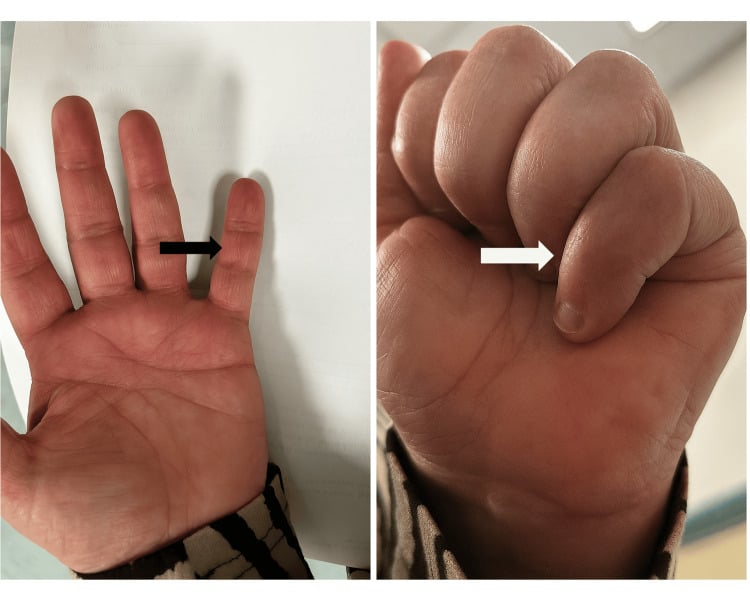
- Clinical sign: Loss of active DIP flexion. Finger lies in extension in resting cascade.
- Repair involves re-attaching tendon to bone (Suture anchor or Pull-out button).
- “Beware the 'sprained finger' diagnosis. Always test active DIP flexion isolation.
- “The FDP avulsion often includes a bony fleck visible on X-ray (Type III).
- “Chronic injuries (greater than 3 months) usually require fusion or 2-stage reconstruction.
Overview
Jersey finger is avulsion of the flexor digitorum profundus (FDP) tendon from its insertion at the base of the distal phalanx, in zone I of the flexor system. The name describes how it happens: a player in a contact sport grabs an opponent's jersey, the flexed fingertip is forced into extension, and the tendon tears off the bone.
Why it matters. The FDP is the only flexor of the DIP joint, so its avulsion leaves the fingertip with no active flexion at all. The tendon may then retract along the sheath, and retraction can cost it its blood supply, which is what dictates how urgently it must be repaired.
Mechanism. A sudden hyperextension force applied to an actively flexing finger. The failure point is the insertion into bone, where the tendon is weakest in young people.
Why the ring finger. It is the ring finger in about 75% of cases. The FDP to the ring finger shares a common muscle belly with the tendons to the middle and little fingers, and is tethered further by the lumbricals and by connections between the tendons, all of which restrict its independent excursion. When the ring finger is pulled open while the others are still gripping, its FDP is placed under maximal strain.
Pathophysiology and Mechanisms
The muscle. Flexor digitorum profundus arises from the ulna in the forearm as a single muscle belly, and sends four tendons through the carpal tunnel and the finger flexor sheaths to insert on the volar base of each distal phalanx. It flexes the DIP joint, and beyond that the PIP joint, the MCP joint and the wrist.
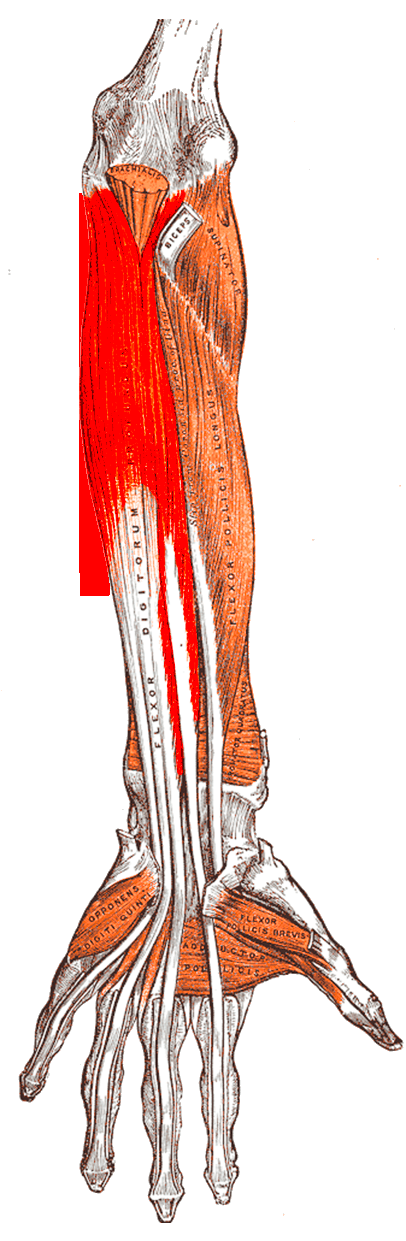
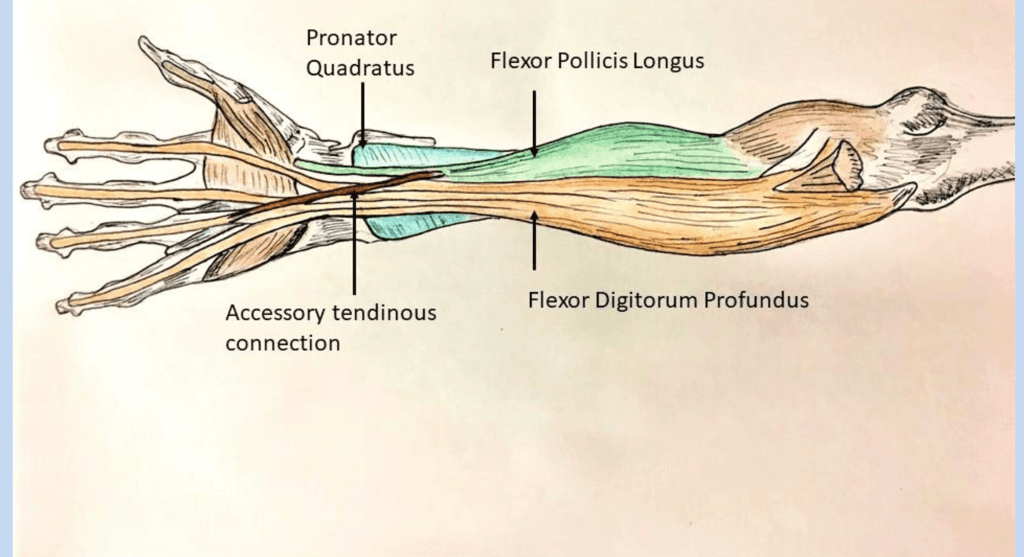
The blood supply. Inside the sheath the tendon is fed by its vincula and by diffusion from the synovial fluid. The vinculum longum comes from the dorsal mesentery at the level of the PIP joint; the vinculum breve comes from the volar plate at the level of the DIP joint. The watershed zone that governs zone II is less relevant here.
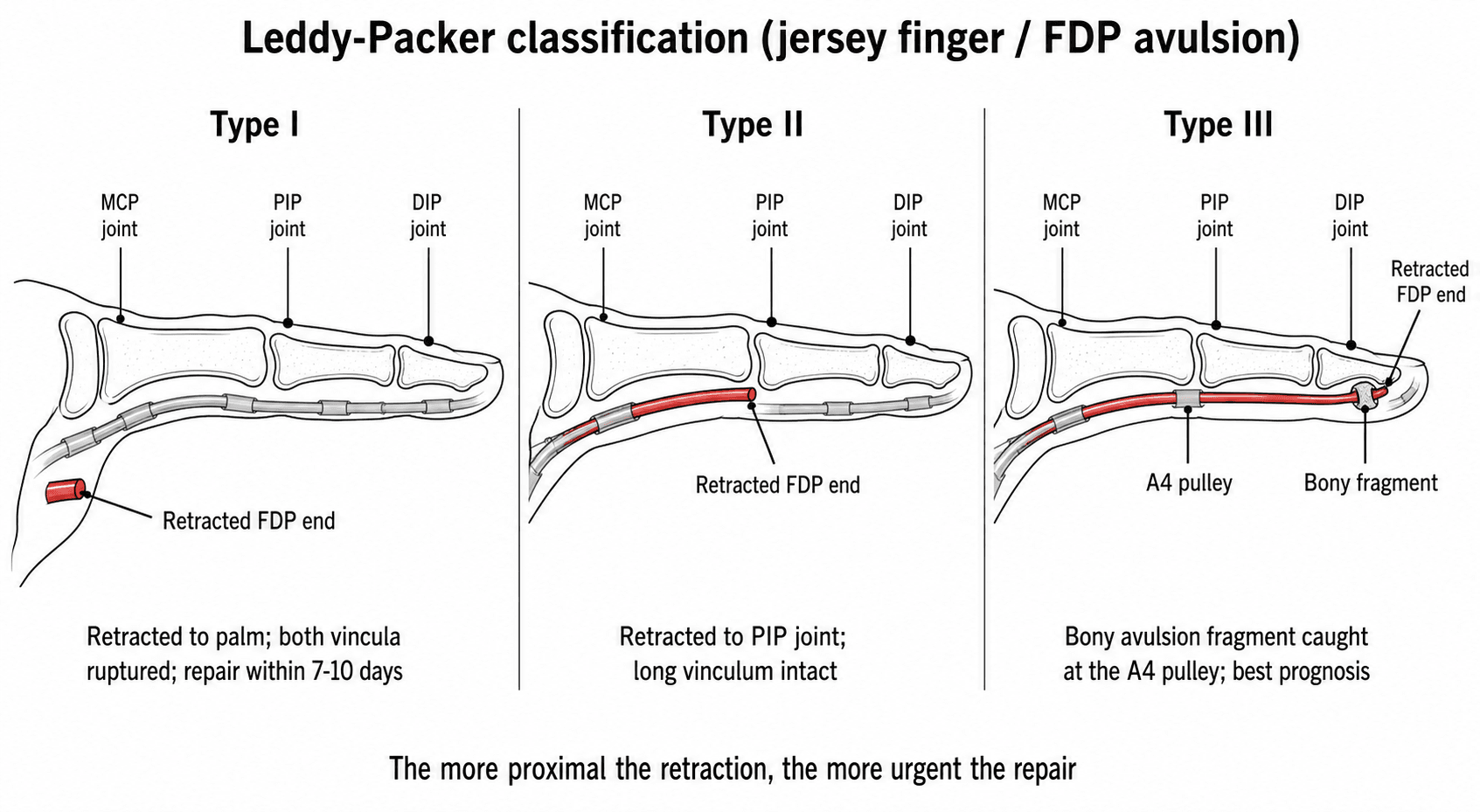
Why retraction matters. How far the avulsed tendon retracts tells you which vincula have torn with it. A tendon that stops at the PIP joint has kept its long vinculum and with it a blood supply; a tendon that reaches the palm has torn both vincula and is severely ischaemic, heading for necrosis and myostatic contracture. Vincular preservation is the key determinant of prognosis, and the level of retraction is what the classification records.
The pulley system. The digital flexor sheath holds the tendons against the phalanges and converts excursion into joint flexion. It has five annular pulleys and three cruciate pulleys:
- A1, A3 and A5 lie over the MCP, PIP and DIP joints, on the volar plates
- A2 and A4 lie over the shafts of the proximal and middle phalanges
- C1 to C3 are the cruciate pulleys
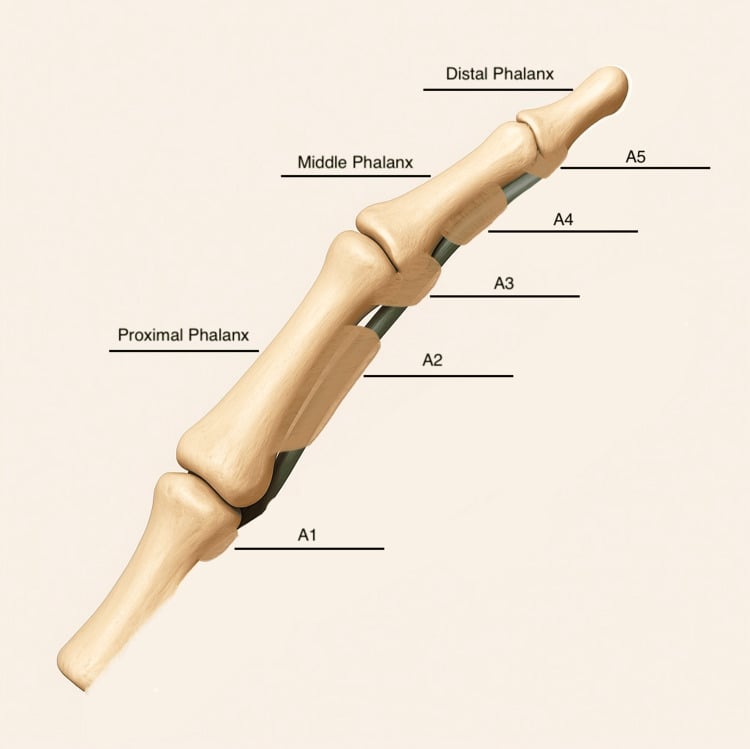
Why A2 and A4 matter. They are the biomechanically critical pulleys. Lose them and the tendon lifts away from the bone, which is bowstringing: excursion is wasted, the flexion arc shrinks and the finger develops a flexion contracture. A4 has a second role in this injury, because it is the pulley on which a Type III bony fragment catches, holding the tendon out to length.
Classification Systems
Leddy and Packer classified the injury by the level to which the avulsed tendon retracts, which reflects the state of the vincula and dictates the timing of repair. The original system described Types I to III; Types IV and V were later additions.
- Definition
- Tendon retracted into the palm; both vincula ruptured, so the tendon is ischaemic
- Urgency
- Urgent
- Definition
- Tendon held at the PIP joint (zone II) by the intact long vinculum at Camper's chiasm; the FDS allows some blood supply
- Urgency
- Semi-urgent
- Definition
- Large bony fragment caught on the A4 pulley (zone I); vincula intact
- Urgency
- Elective; the best prognosis
- Definition
- Fracture of the distal phalanx with the tendon avulsed off the fragment, or a double-level injury; rare
- Urgency
- Urgent
- Definition
- Extra-articular bony avulsion with comminution
- Urgency
- Urgent, as for Type IV
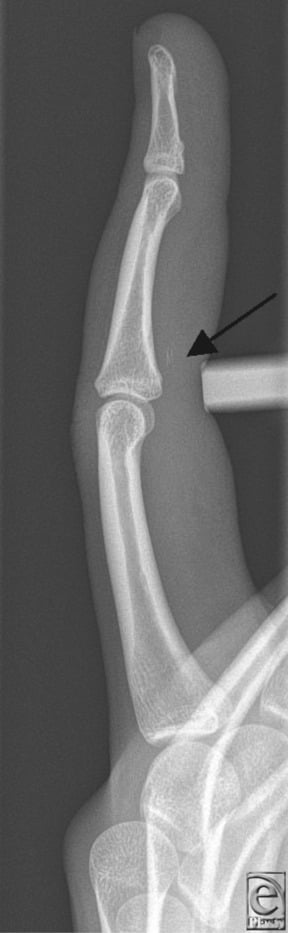
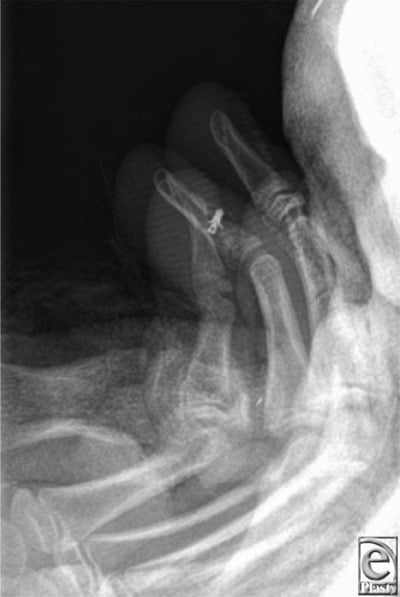
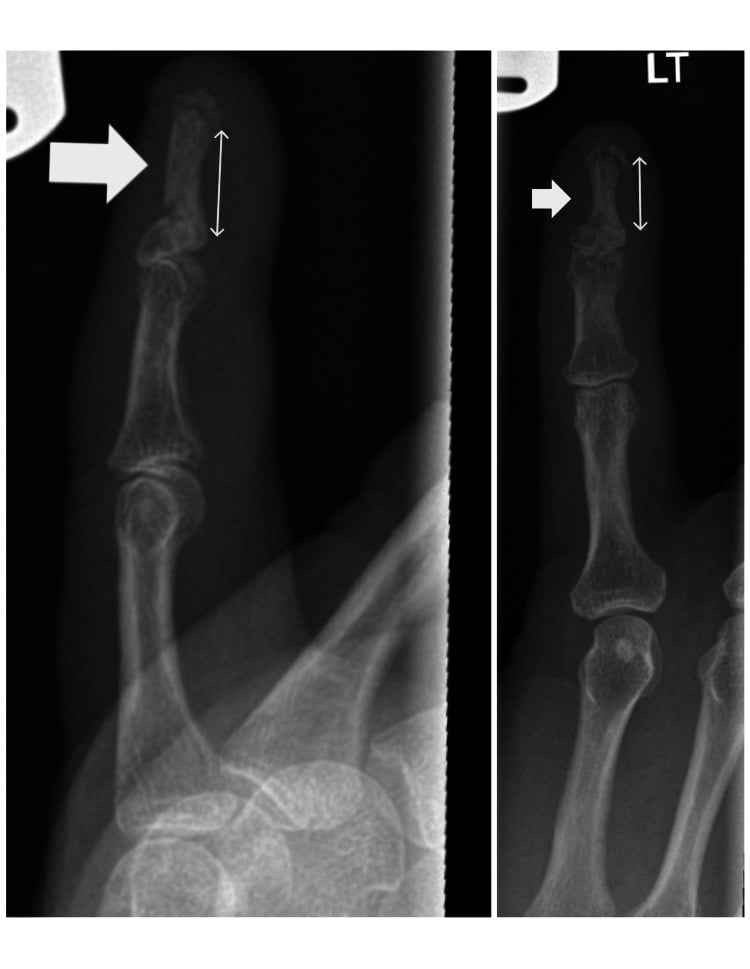
The type is usually diagnosed on the radiograph, but a small fragment can travel proximally with the tendon, as the film below shows.
Clinical Presentation
History. The patient says the finger was caught in a jersey or got stuck, and often felt a pop or snap in the finger or the palm. Ask about the exact moment, the tackle or the grip release, and where it hurts: pain in the palm points to a Type I, pain in the finger to a Type II or III. Ask about the sport or activity:
- Rugby, American football and Australian rules football
- Grappling sports
- Rock climbing
Examination. At rest the finger lies in extension relative to its neighbours, having lost its flexor tone; compare the cascade with the other hand. Then isolate the DIP joint: hold the PIP and MCP joints in extension and ask the patient to flex the fingertip. In a jersey finger there is zero active DIP flexion. Palpate along the flexor sheath for the tender retracted stump, in the palm in a Type I and at the PIP joint in a Type II.
Two checks not to skip. Test the digital nerves, which often show a neuropraxia. Confirm the superficialis is working, because a combined FDP and FDS avulsion changes the operation.
The trap is "just a sprain". The finger is swollen and painful, and the patient can still flex the PIP joint because the FDS is intact, so unless you isolate the DIP joint you will miss the FDP rupture. A missed Type I becomes a permanently functionless FDP through retraction and necrosis.
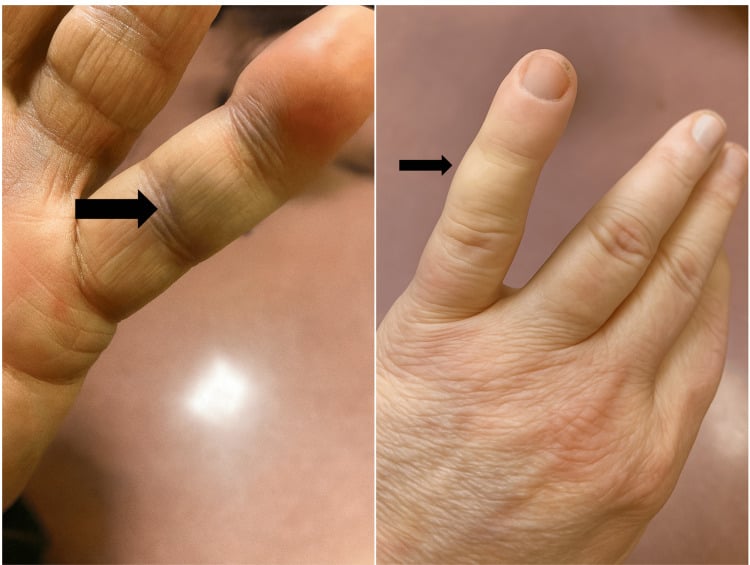
The differential is the other injuries that present as a swollen, painful finger; the tendon involved, the deformity and the urgency separate them.
- Tendon
- FDP Avulsion
- Deformity
- Loss of DIP Flexion
- Urgency
- High (Type I)
- Tendon
- Extensor Avulsion
- Deformity
- Loss of DIP Extension
- Urgency
- Medium (Splint)
- Tendon
- Stenosing Tenosynovitis
- Deformity
- Locking in Flexion
- Urgency
- Low (Elective)
- Tendon
- Ligament Avulsion
- Deformity
- PIPJ Hyperextension
- Urgency
- Medium (Splint)
Investigations
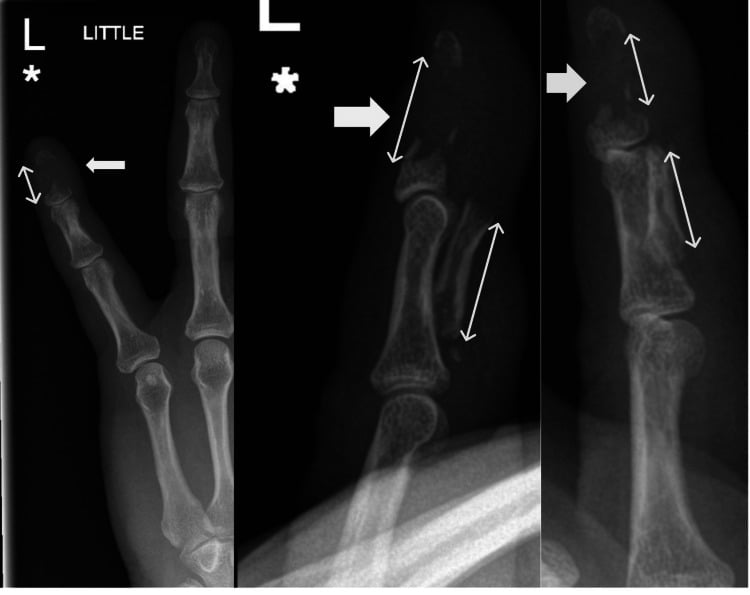
Radiographs. AP, lateral and oblique views of the finger. A pure tendon avulsion, Type I or II, is usually radiographically normal unless a small fleck is visible in the tendon sheath; a Type III shows a large bony fragment at the base of the distal phalanx. The film is critical because the position of a fragment reveals the level of retraction.
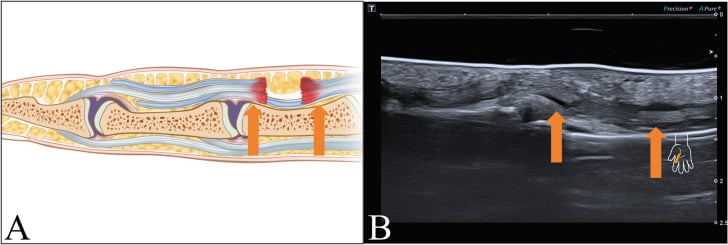
Ultrasound and MRI. Rarely needed, because the examination is usually diagnostic. Their place is the unclear diagnosis or the stump whose position is unknown: the sheath is empty distally and the tendon is bunched up proximally. In the chronic case MRI assesses the quality of the tendon.
Treatment
The acute injury (under 3 weeks). A closed zone I avulsion is a surgical injury, and the Leddy-Packer type sets the clock. The tendon is reattached to the base of the distal phalanx, and the fixation options and the retrieval of a retracted stump are described in the next section.
- Type I: must be repaired within 7-10 days, before myostatic contracture and necrosis. Leddy and Packer's original figure was about 7 days
- Type II: repair within 2-3 weeks. The intact long vinculum keeps the tendon perfused, which is why it can wait 3-6 weeks, and in Leddy and Packer's own series tendons held at the PIP joint could sometimes be repaired months later
- Type III: the same 2-3 week window, with bony fixation of the fragment by screw or wire
- Type IV and V: urgent, and two problems to solve: fixation of the fracture and reattachment of the tendon
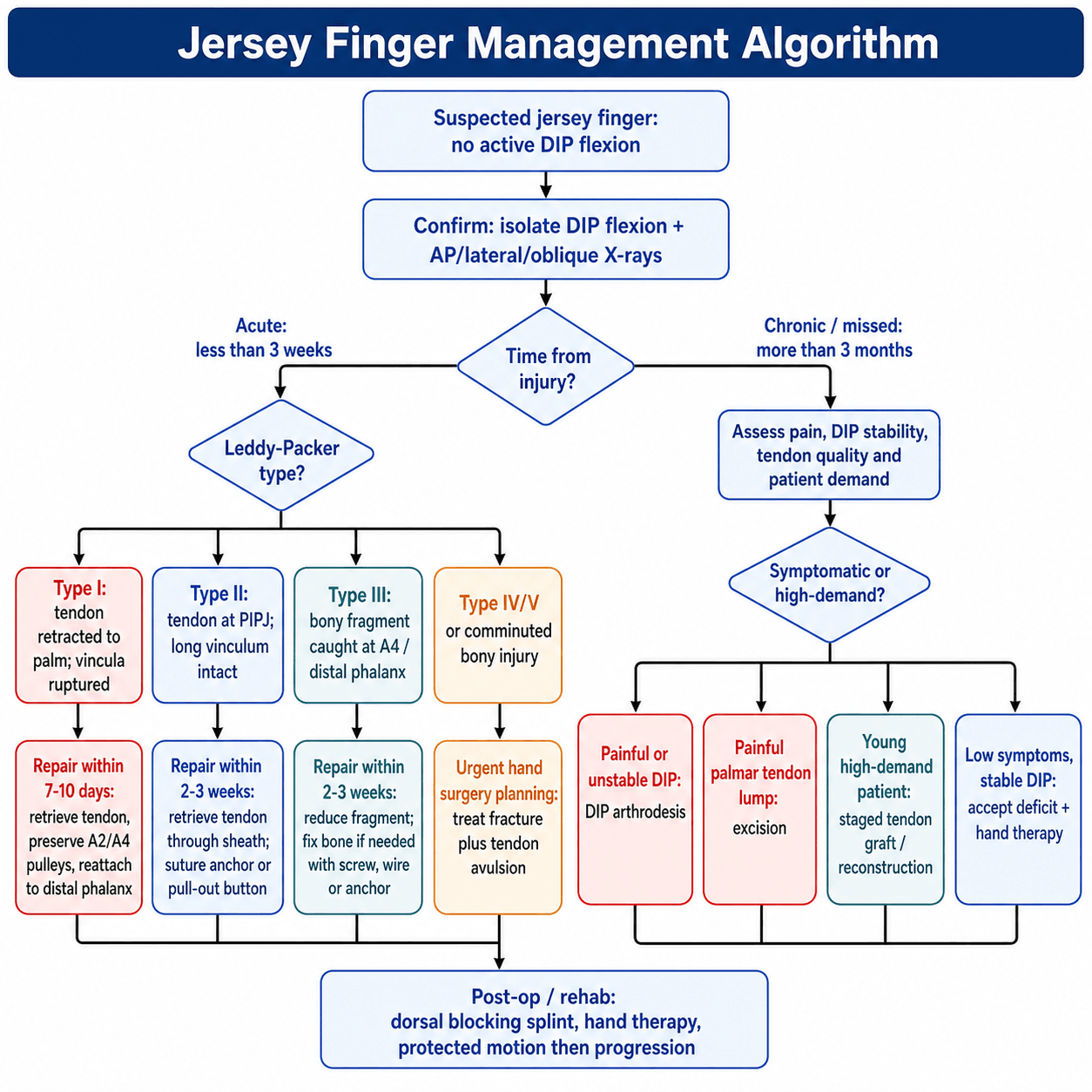
The chronic or missed injury (over 3 months), and the failed primary repair. In the late presentation the tendon is contracted and scarred and the muscle fibrosed, so repair is unlikely to work. The same salvage options serve a failed primary repair. Management is driven by symptoms:
- DIP joint arthrodesis: reliable and pain-free, the most reliable salvage, excellent for grip strength and good for labourers
- Two-stage tendon graft: a Hunter rod, then a palmaris longus graft. It can restore active DIP flexion but carries a high complication rate and a 30-40% failure rate; for the young, high-demand patient
- Tenodesis: a hemitendon slip of FDS
- Excision of a painful lump in the palm
- Accept the deficit: some patients adapt well without intervention
The selection rule comes from Leddy and Packer themselves: a graft passed through an intact, functioning superficialis is seldom indicated. A finger with an isolated FDP deficit but a working FDS still flexes at the PIP joint and grips - it is a useful finger. A two-stage graft threads a rod and then a tendon through that working apparatus and can leave the patient with adhesions, a flexion contracture, or a lumbrical-plus digit: a worse hand than the one they walked in with. Reserve reconstruction for the young, high-demand, well-motivated patient who genuinely needs independent DIP flexion, and be willing to offer nothing at all to the patient who is merely aware of the deficit rather than limited by it. Even with a suboptimal outcome, most patients achieve functional pinch and grip for the activities of daily living.
Surgical Considerations
The goals. Surgery has to restore tendon gliding within the sheath, secure fixation to bone, and preserve the A2 and A4 pulleys.
Exposure and retrieval. A Bruner zig-zag volar incision. The retracted stump is passed back through the pulleys with a catheter, a paediatric feeding tube or a tendon passer, and a Type I may need a separate palmar incision to find it. Do not fish for the tendon blindly, because that damages the sheath, and never divide a pulley to ease the passage: a sacrificed pulley means bowstringing, and A4 is preserved at all costs.
Button or anchor. Either fixes the tendon to the base of the distal phalanx. The pull-out button passes the suture through the bone and ties it over a button on the nail plate; the suture anchor, a Mitek anchor into the base of P3, keeps the whole construct inside the finger.
- Advantages
- Cheap, strong
- Disadvantages
- External hardware; nail bed injury, infection, catching on clothes
- Advantages
- Internal, easy to use, no button complications
- Disadvantages
- Cost; implant prominence or pull-out
The current trend favours suture anchors (minilok or micro).
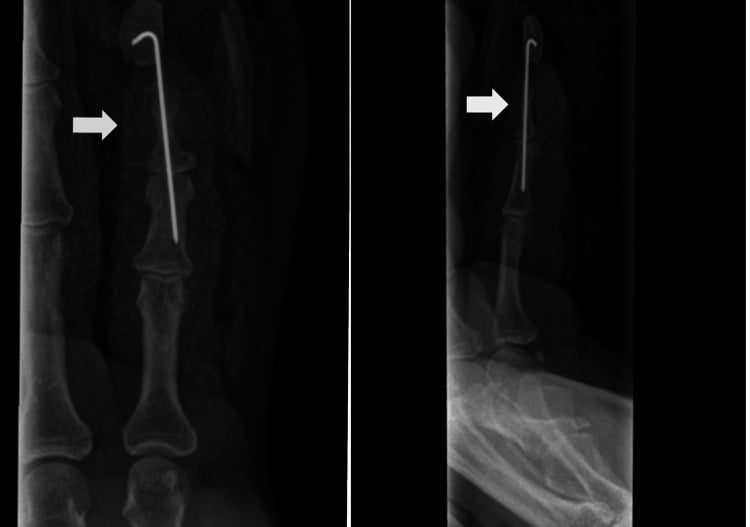
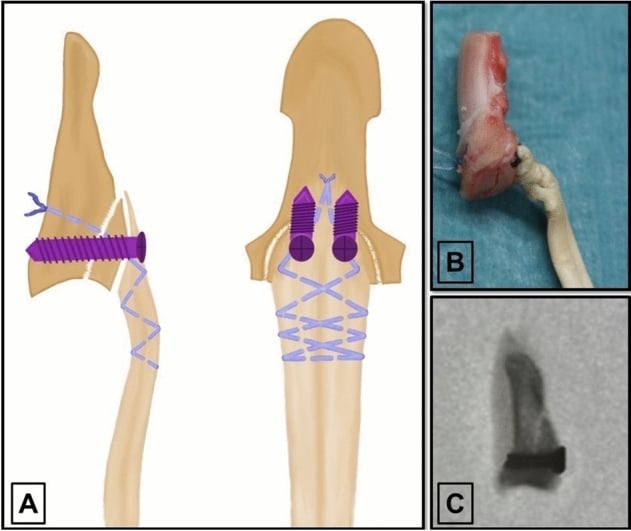
The bony fragment. A Type III fragment is reduced and fixed with a screw or wire. Fixation must restore the tendon insertion without penetrating the DIP joint or leaving proud hardware, and the repair is protected while the bone-tendon unit heals.
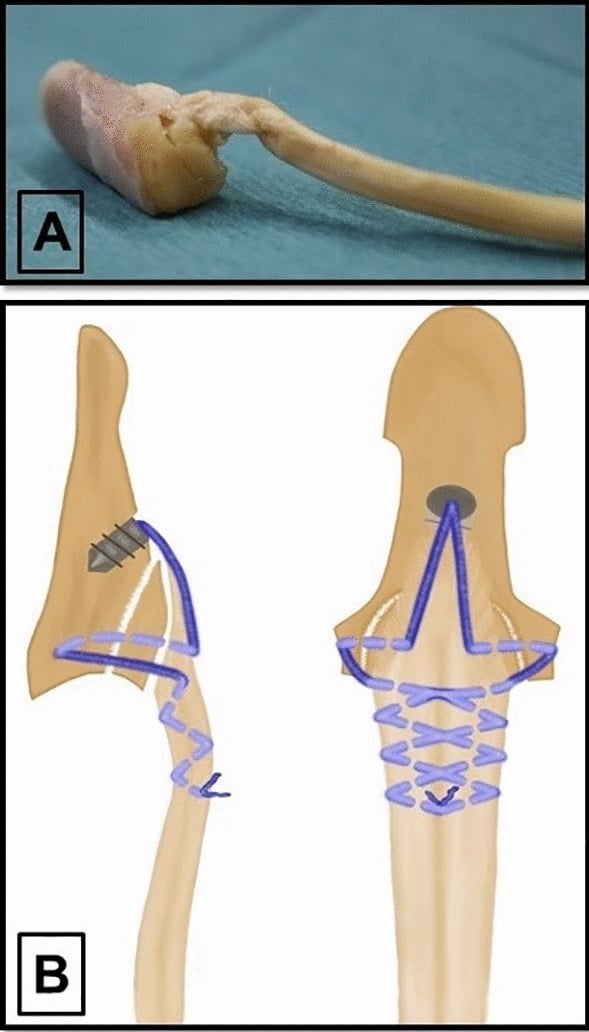
Type IV. The tendon has come off the fragment, so fragment and tendon need separate control: restore the articular contour of the distal phalanx and the tendon insertion, keeping sutures and implant away from the joint surface. A suture anchor can secure both; a fragment large enough takes minifragment screws, with an independent interosseous suture reattaching the FDP. Fragment size, comminution and bone quality decide between screws, K-wires, interosseous sutures and an anchor.
Complications
Stiffness. DIP joint stiffness is almost guaranteed, and a flexion contracture of the PIP or DIP joint is very common. Patients must be warned.
Re-rupture. About 5-10% of repairs, with the highest risk between weeks 3 and 6, when the patient feels better but the tendon is still soft.
Quadriga. If the FDP is shortened too much, the repaired tendon tethers the others through the common muscle belly, and the uninjured fingers cannot flex fully. How much advancement is too much is discussed under Controversies.
Bowstringing. If the pulleys are sacrificed the tendon moves away from the bone. The moment arm increases, but the finger develops a flexion contracture and loses its tuck.
Lumbrical-plus finger. The opposite tethering problem, and a classic pairing with quadriga. The lumbrical originates on the FDP tendon and inserts into the radial lateral band of the extensor mechanism. If the FDP is divided or avulsed distal to the lumbrical origin, or is left slack after repair or an over-long graft, contraction pulls the lax FDP proximally and the lumbrical with it, so an attempt to flex tightens the lumbrical and extends the IP joints instead: paradoxical extension. Quadriga is the FDP repaired too tight, costing the other fingers their flexion; lumbrical-plus is the FDP left too loose, costing the same finger. Tensioning the repair correctly, and limiting advancement, avoids both.
The remaining complications are the general ones of finger surgery:
- Infection, especially with button sutures, and at pin sites when K-wires are used
- Nail deformity if the button compresses the germinal matrix
- Complex regional pain syndrome, a risk with any digit surgery
- Scar sensitivity: a volar scar can be painful to grip on
Rehabilitation
The tendon heals in phases: inflammation, days 0 to 5, when the repair is at its weakest; a repair phase of fibroplasia in which strength increases; loading, which increases strength further (Wolff's law); and a remodelling phase as the scar matures. The protocol is staged to match, protecting the repair before it loads it.
- Dorsal blocking splint, wrist flexed 30° and MCP joints flexed 60-70°
- Modified Duran or Belfast protocol: passive flexion and active extension within the block
- Hand therapy 2-3 times per week
- No active flexion and no resisted motion
- Day splint discontinued; night splint continues
- Active flexion begins, with blocking exercises to isolate the DIP joint
- Desensitisation and scar massage
- Progressive resistance begins
- Therapy putty and grip dynamometer
- Return to light duties and activities of daily living
- Clearance for full contact by 4-6 months
- Some athletes wear buddy tape or protection initially
- Watch for signs of rupture during high-load activity
Prognosis
Outcomes by Leddy-Packer Type
- Prognosis
- Guarded
- Key Factor
- Ischaemic if delayed
- ROM Recovery
- 60-80%
- Prognosis
- Good
- Key Factor
- Vincula intact
- ROM Recovery
- 80-90%
- Prognosis
- Excellent
- Key Factor
- Bone-to-bone
- ROM Recovery
- 90-100%
- Prognosis
- Variable
- Key Factor
- Fracture healing
- ROM Recovery
- 70-85%
After a successful repair, expect:
- DIP flexion typically 50-70° (normal 80-90°)
- An extension lag of 10-20° is common and acceptable
- Grip strength usually recovers to 85-95% of the other side
Favourable factors: early presentation (under 7 days for a Type I), a Type III pattern, a younger patient and compliant rehabilitation.
Unfavourable factors: delayed presentation, a Type I retracted to the palm, smoking, a manual occupation with its higher demands, and poor compliance with therapy.
Guidelines, Registries & Global Practice
Global Epidemiology
Jersey finger is the classic closed flexor avulsion and is strongly associated with grappling and jersey-grabbing sports worldwide:
- Rugby union and league (UK, Australia, New Zealand, South Africa, France) - the tackle and shirt-grab mechanism
- American football (the eponymous "jersey" injury) and Australian Rules football (guernsey marking contests)
- Grappling sports - judo, Brazilian jiu-jitsu and wrestling, where forced grip release loads the FDP
- Rock climbing - a recognised cause of closed FDP avulsion from crimp grips, more often involving the middle finger
The ring finger accounts for the large majority of cases, a finding established in the original 36-patient Leddy-Packer series and repeatedly confirmed since. The injury predominates in young, male, athletic populations.
Side-by-Side Guidance (No Single Country Frame)
- Position on Closed Zone I FDP Avulsion
- Operative repair is standard; urgency follows level of retraction; preserve A4/A2 pulleys; early protected motion
- Position on Closed Zone I FDP Avulsion
- Repair Type I within ~7-10 days before retraction/ischaemia; Type II/III may tolerate later repair; chronic/missed - DIPJ fusion, staged graft, or accept deficit
- Position on Closed Zone I FDP Avulsion
- Urgent hand-surgery referral for suspected closed FDP avulsion; protocol-driven hand-therapy rehabilitation
- Position on Closed Zone I FDP Avulsion
- Suture anchor or pullout button both acceptable; anchors avoid button morbidity and allow earlier motion
There is no high-level RCT dictating one fixation over another; recommendations are consensus- and cohort-based. The genuine point of agreement across societies is timing by Leddy-Packer type and pulley preservation, not the specific implant.
Registry & Outcome Evidence
Unlike arthroplasty, jersey finger has no dedicated national implant registry (suture anchors and buttons are not tracked the way joint prostheses are). The evidence base is therefore built from case series, small comparative cohorts, and biomechanical studies. Reported outcomes:
- Re-rupture rates of roughly 5-10%, highest in weeks 3-6 of rehabilitation
- Equivalent clinical ROM and grip between anchor and button techniques, with faster return to work for anchors (McCallister 2006)
- Type III bony avulsions carry the best prognosis (bone-to-bone healing); palm-retracted Type I the worst if delayed
High- vs Limited-Resource Practice Variation
- Well-resourced settings: MRI/ultrasound to localise a retracted stump when unclear; suture anchors; certified hand therapists delivering Duran/Belfast/early-active protocols; rapid access to urgent operating lists for Type I.
- Limited-resource settings: Reliance on clinical examination and plain radiographs (entirely adequate for diagnosis); pullout-button-over-button or transosseous suture techniques where anchors are unaffordable; greater reliance on DIPJ arthrodesis as a definitive, low-cost salvage where staged grafting and intensive therapy are not feasible.
- Common to all settings: The decisive variable is time to diagnosis. Delayed presentation - from initial "sprain" misdiagnosis, distance to specialist care, or athletes playing on - converts a repairable Type I into a salvage problem regardless of resources.
Controversies & Areas of Uncertainty
There is no randomised controlled trial guiding fixation choice. Most recommendations rest on small cohorts, case series, and cadaveric biomechanics. State this openly in the viva - examiners reward candidates who know the limits of the evidence.
Anchor, button or transosseous suture. Clinical outcomes are equivalent (McCallister 2006), and the biomechanical superiority of anchors (Putnam 2019) has not translated into a proven clinical advantage beyond faster return to work and avoidance of button morbidity. Implant choice is largely surgeon preference and resource availability.
The true repair window for Type I. The classic "7-10 days" figure comes from the original series, not from controlled data. Some palm-retracted tendons remain reparable slightly longer if a vinculum is unexpectedly intact; conversely, an ischaemic tendon may be unsalvageable earlier. The number is a guide, not a hard rule.
Single or double anchor. A second anchor improves rotational control and pull-out strength biomechanically, but adds bone insult in a small distal phalanx; routine use is not established.
Chronic reconstruction or fusion. Staged (Hunter rod) grafting can restore active DIP flexion but carries a high complication and failure rate; many surgeons favour DIPJ arthrodesis or simply accepting the deficit, especially in manual workers. There is no consensus on the threshold for offering reconstruction.
Quadriga risk in advancement. Advancing a retracted tendon to bridge a gap shortens the FDP and risks quadriga. The commonly cited ~1 cm limit is often dismissed as a rule of thumb, but it does have a source: Malerich 1987 (PMID 3805640) derived it in a cadaver model, written expressly because the limits then circulating ranged from 0.75 to 2.5 cm on clinical impression alone. The evidence is cadaveric and therefore weak, but it is not absent - and Schannen 2017 (PMID 30211370) sharpens it, finding a significant quadriga at 10 mm of shortening, worst when the shortened tendon is the small or ring finger. Read 1 cm as the point at which a deficit is already measurable rather than a safe allowance.
MCQ Practice Points
Q: Why is the Ring finger most commonly affected (75%)? A: The FDP is tethered by the common muscle belly and lumbricals, limiting independent extension during grip.
Q: Which Vincula are ruptured in a Type I injury? A: Both Vincula Longa and Brevia.
Q: What is the Quadriga effect? A: Incomplete flexion of adjacent fingers due to overtightening of the repaired FDP (shared muscle belly).
Q: What is the maximal delay for primary repair of a Type I injury? A: 7-10 days (before necrosis/contracture).
Q: What is the clinical sign of a jersey finger? A: Loss of isolated DIPJ flexion. The finger lies in extension in the resting cascade.
Q: Which Leddy-Packer type has the best prognosis? A: Type III - bony fragment prevents retraction, vincula intact, bone-to-bone healing.
Viva Scenarios
Practise clinical reasoning and management decisions out loud
“A rugby player presents 4 weeks after 'spraining' his ring finger. He has no active DIP flexion. X-ray is normal. What is the diagnosis and management?”
“X-ray shows a large bony fragment at the volar aspect of the DIPJ. 10 days post injury.”
“A patient complains of a tender lump in the palm 3 months after a finger injury. No DIP flexion.”
“A 22-year-old rugby player presents 2 days after a tackle. He cannot flex the tip of his ring finger in isolation. X-rays are normal. How do you proceed and what do you tell him?”
Classification (Leddy-Packer)
- Type I: Palm (Urgent)
- Type II: PIP (Semi-Urgent)
- Type III: DIP (Bone)
- Type IV: Fx + Avulsion
Management
- Acute: Repair (Anchor/Button)
- Chronic: Fusion / Graft
- Rehab: Dorsal Block 6w
- Preserve A2/A4 pulleys
Key Concepts
- Ring Finger (75%)
- Vincula Blood Supply
- Quadriga Effect
- Isolate DIP Flexion
Evidence Base
Leddy & Packer: The Original Classification
- Retrospective review of 36 profundus avulsions in athletes over 5 years; the ring finger was the most commonly involved digit
- Classified into 3 types by presence of a bony fragment, level of tendon retraction, and status of the blood supply (vincula)
- Tendons retracting into the palm should be repaired within ~7 days; tendons held at the PIPJ could sometimes be repaired months later
- Late, relatively asymptomatic patients were left alone; unstable DIPJs were treated by fusion or tenodesis
- THE SELECTION RULE THE PAPER ENDS ON: a flexor tendon graft passed through an INTACT, FUNCTIONING superficialis in the ring finger was SELDOM indicated. An FDP-only deficit with a working FDS is already a useful finger, and a two-stage graft risks converting it into a worse one
Type IV Injury (Smith)
- Case report describing profundus avulsion with a simultaneous intra-articular fracture of the distal phalanx
- The tendon was avulsed off (separated from) the bony fragment - the basis of the 'Type IV' pattern
- Requires treating two problems: reduction/fixation of the fracture AND reattachment of the tendon
- Recognition matters because treating it as a simple Type III misses the displaced tendon