Nurick Grading of Cervical Spondylotic Myelopathy
A Nurick grade of 3 or higher means the patient can no longer work because of walking difficulty — this is the widely accepted threshold for surgical intervention in progressive CSM. Grade 2 (slight difficulty walking, still employed) is a judgement call that depends on progression, occupation, and patient preference. Examiners expect you to know that Nurick alone is insufficient for detailed monitoring and to name the mJOA as the complementary scale.
The Nurick Grading System
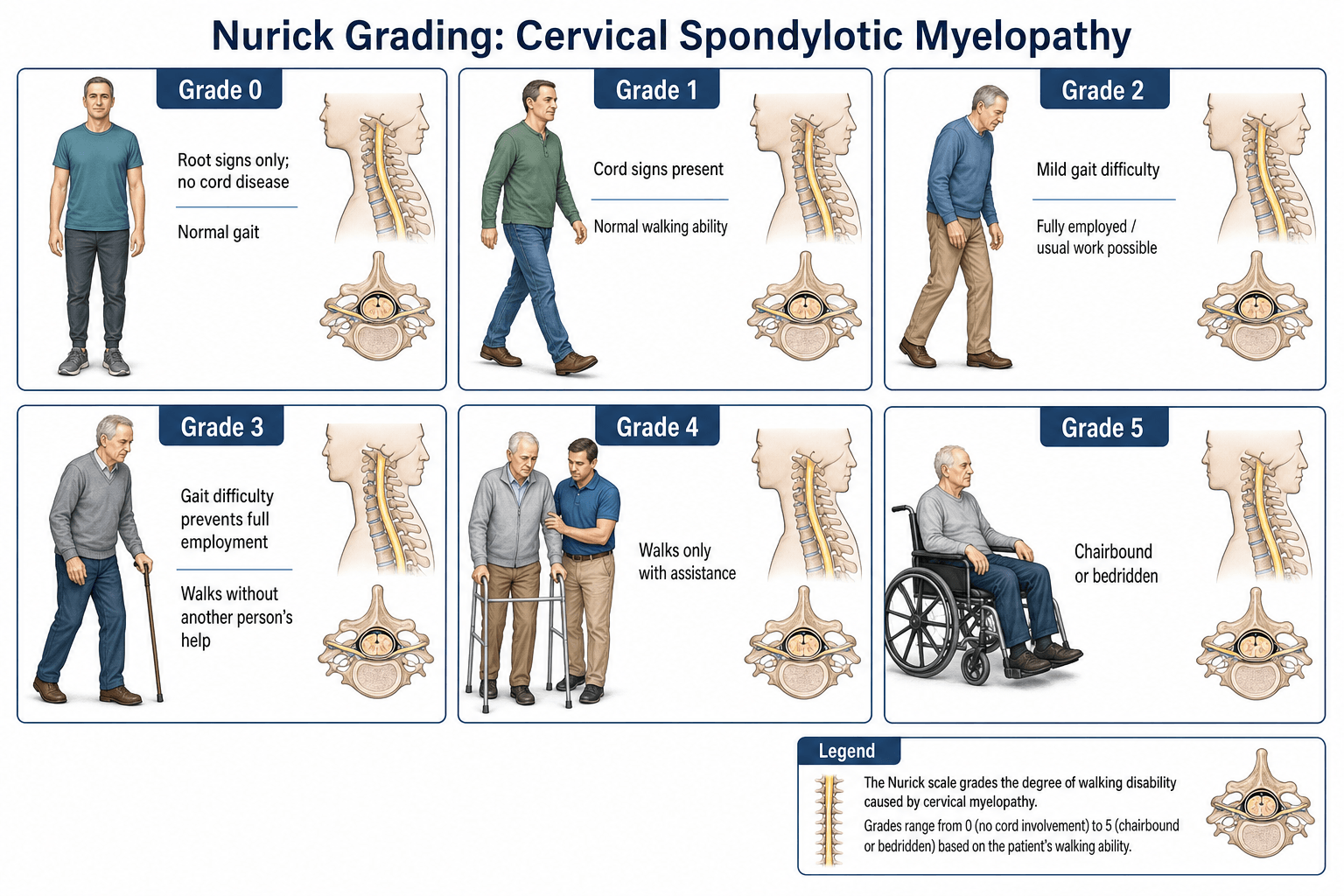
The Nurick grade classifies the functional severity of cervical spondylotic myelopathy on a six-point ordinal scale (0 to 5). It was designed for speed at the bedside: ask the patient about gait and occupation, observe walking, and assign the grade. No measurement tools are required.
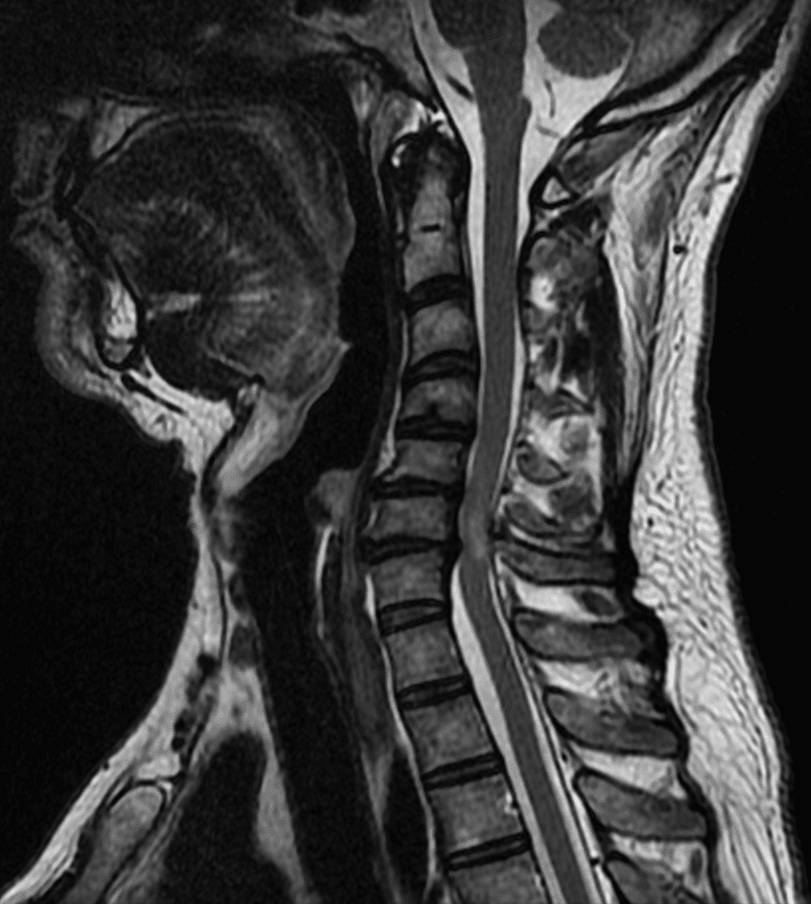
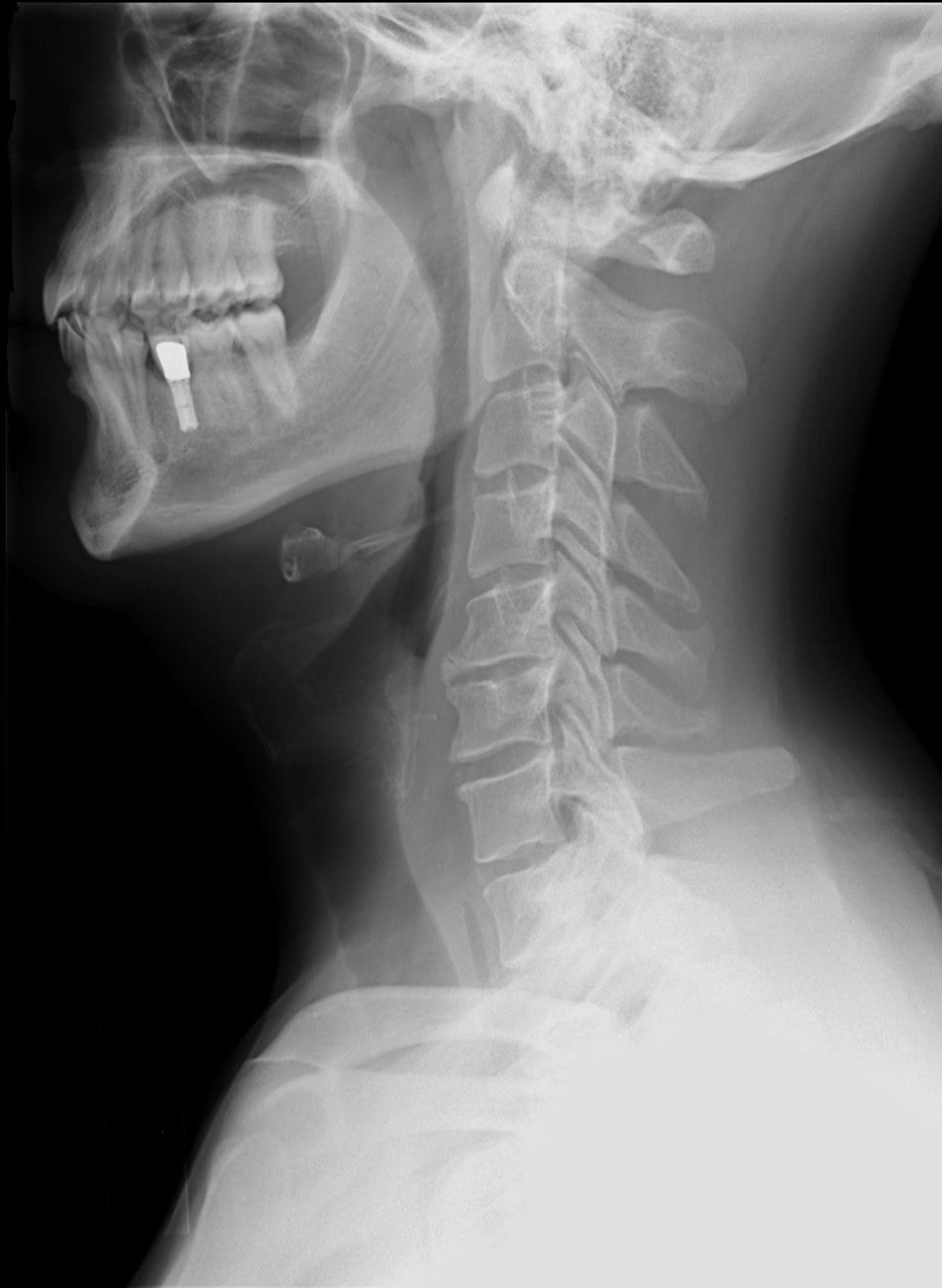
- Gait and Ambulation
- Normal gait; root signs and symptoms only
- Clinical Meaning
- Cervical radiculopathy without myelopathy — cord is spared
- Gait and Ambulation
- Signs of cord involvement; normal gait, no difficulty walking
- Clinical Meaning
- Early myelopathy — upper-limb signs (Hoffmann, inverted supinator), hyperreflexia, but gait is still preserved
- Gait and Ambulation
- Slight difficulty walking; employment still possible
- Clinical Meaning
- Established myelopathy — gait is detectably abnormal (spastic, wide-based, or unsteady) but the patient is still working
- Gait and Ambulation
- Difficulty walking prevents employment; walks unaided
- Clinical Meaning
- Moderate-to-severe myelopathy — ambulation is impaired enough to force job change or retirement; no walking aid yet
- Gait and Ambulation
- Able to walk only with assistance or a walking aid
- Clinical Meaning
- Severe myelopathy — requires a stick, frame, or another person to walk any meaningful distance
- Gait and Ambulation
- Chairbound or bedbound
- Clinical Meaning
- Very severe myelopathy — unable to walk; may have lost bladder and bowel control
Roots — Signs — Slight — Stopped — Stick — StuckThe six grades by one-word shorthand
Hook:All six words start with S except Roots — the root signs come first, then the S-scale descends from Signs through Slight, Stopped, Stick, to Stuck.
Grade 0 is not myelopathy. If a patient has neck pain and a C6 radiculopathy with a normal gait and no upper motor neurone signs in the legs, that is Nurick grade 0 — radiculopathy only. The moment you detect Hoffmann sign, gait spasticity, or hyperreflexia in the lower limbs, you are at least at grade 1, even if walking is still normal.
Grade Interpretation and Surgical Thresholds
- Grades
- 0 – 1
- Typical Presentation
- Root signs only or early cord signs with preserved gait
- Surgical Approach
- Conservative (physiotherapy, collar, activity modification) unless clearly progressive; monitor with serial clinical assessment and MRI
- Grades
- 2 – 3
- Typical Presentation
- Gait difficulty; grade 2 still working, grade 3 cannot
- Surgical Approach
- Strong indication for surgical decompression if symptoms are progressive or the patient is functionally limited; grade 3 is a near-universal surgical indication
- Grades
- 4 – 5
- Typical Presentation
- Requires aid to walk (4) or cannot walk (5)
- Surgical Approach
- Surgical decompression indicated if there is residual function and reasonable prognosis; recovery is less complete at grade 5 but may still arrest decline and improve quality of life
Two or Three — discuss the knifeWhen to operate
Hook:At grade 2, start the conversation. By grade 3, the conversation is over — operate. Earlier decompression equals better recovery.
A patient presenting at Nurick grade 4 or 5 has already suffered significant and possibly irreversible cord damage. Delaying surgery after the myelopathy becomes moderate-to-severe reduces the chance of functional recovery. The exam-tested principle is: decompress before the patient reaches grade 3. Earlier surgery correlates with better outcomes in every major CSM series.
How to Assess at the Bedside
Assessing the Nurick grade takes less than a minute. Ask three questions, then observe.
- Are you able to walk as far and as fast as you could a year ago?
- Has your walking affected your ability to work or do your usual activities?
- Do you need a stick, frame, or someone to hold onto when walking?
- Watch the patient walk unaided along a corridor. Look for a wide-based, spastic, or shuffling gait.
- Test for Hoffmann sign, inverted supinator reflex, clonus, and hyperreflexia in the lower limbs — these place the patient at grade 1 even if gait looks normal.
- Check proprioception in the great toes (dorsal column involvement worsens the Nurick grade and surgical prognosis).
- Ask about hand function (buttoning clothes, handwriting, dropping objects) and bladder symptoms — these do not change the Nurick grade but they are critical for overall myelopathy severity and for the mJOA score.
HANDS — what gait grading can't seeWhat Nurick misses (and why mJOA matters)
Hook:Nurick tells you how the legs are; mJOA tells you how the whole patient is. Use both.
In the viva, if you are shown a CSM case and asked to grade it, assign the Nurick grade from the gait description and immediately add: "and I would formally score the mJOA for detailed monitoring." This shows you know both tools and understand their complementary roles.
Elicit the full myelopathic syndrome — and exclude the mimics. Beyond gait, look for the signs that confirm CSM and the conditions that imitate it:
- Hand involvement: loss of dexterity (buttoning, handwriting, dropping objects) and intrinsic wasting; the finger-escape (Wartenberg) sign (the ulnar fingers drift into abduction/flexion) and an abnormal grip-and-release test (fewer than ~20 cycles in 10 seconds).
- Long-tract signs: upper motor neurone signs below the level (hyperreflexia, clonus, Babinski, Hoffmann) with possible lower motor neurone signs (segmental wasting/hyporeflexia) at the level; the inverted supinator reflex; Lhermitte's sign; and Romberg/proprioceptive loss.
- Differential of a myelopathic presentation: multiple sclerosis; motor neurone disease/ALS (mixed UMN+LMN but no sensory or sphincter involvement, with fasciculations — the key discriminator); subacute combined degeneration (vitamin B12 deficiency — dorsal columns plus corticospinal tracts); an intramedullary or extramedullary cord tumour or syringomyelia; normal-pressure hydrocephalus (gait + urinary + cognitive); and the gait confounders (lumbar stenosis, peripheral neuropathy, hip/knee osteoarthritis) that can falsely inflate the Nurick grade.
Limitations and Modern Context
- It is coarse. Six grades compress a wide spectrum into broad bands. Two patients both graded 2 may have vastly different hand function, bladder control, or quality of life.
- Gait is influenced by comorbidity. Osteoarthritis of the knee or hip, lumbar stenosis, peripheral neuropathy, and general deconditioning can all worsen gait independently of CSM. A Nurick grade of 3 in a patient with concurrent lumbar spinal stenosis does not mean the cervical myelopathy alone is that severe.
- It is insensitive to change. A patient who improves from grade 3 to grade 2 after surgery has had a clinically meaningful change, but finer improvements (better hand function, less urinary urgency, improved balance) are invisible to the scale.
- The mJOA is now the standard. The modified Japanese Orthopaedic Association score captures upper-limb motor function, lower-limb motor function, sensory function, and sphincter function on a detailed 18-point scale. It is used in every major CSM trial and registry and is the required outcome measure for most international guidelines.
- The Nurick grade is still useful. Despite its limitations, it remains the fastest clinical shorthand for communicating CSM severity between clinicians, in clinic letters, and in theatre lists. It is also the historical comparator for decades of published CSM outcome literature.
- Nurick does not predict surgical outcome on its own. Duration of symptoms, MRI signal change in the cord, age, comorbidities, and the number of involved levels all modify prognosis. A Nurick grade of 2 present for three months has a very different surgical outlook from a grade 2 present for three years.
Know the mJOA in detail — it is what the modern guideline thresholds use. The modified Japanese Orthopaedic Association score is an 18-point scale (18 = normal) summing four domains: upper-limb motor (0–5), lower-limb motor (0–7), sensory function in the upper limbs (0–3), and sphincter/bladder function (0–3). The widely used severity bands (AOSpine / Fehlings) are mild = 15–17, moderate = 12–14, and severe = under 12 (0–11). These bands — not the Nurick grade — drive the contemporary recommendation: surgery is recommended for moderate and severe CSM, while mild CSM is the debated group (offer surgery, or structured rehabilitation with close follow-up and operate if it progresses).
Viva practice
Exam Viva
Practise clinical reasoning and management decisions out loud
“A 58-year-old man presents with a six-month history of progressive difficulty walking, clumsiness in both hands, and occasional urinary urgency. Examination reveals a wide-based spastic gait, bilateral Hoffmann sign, grade 4 hyperreflexia in the knees, and ankle clonus. MRI shows multilevel cervical spondylosis with cord signal change at C4/5 and C5/6. What is his Nurick grade, and how would you manage him?”
“A 72-year-old woman with known cervical spondylosis presents with a two-year history of slowly worsening mobility. She uses a single walking stick for distances greater than 20 metres. Her hand function is preserved and she has no bladder symptoms. Her MRI shows three-level cervical canal stenosis from C3 to C6 without intrinsic cord signal change. She asks whether surgery is worthwhile at her age. What is her Nurick grade and what advice would you give?”
Exam cheat sheet
The six grades
- 0: Root signs only — no myelopathy
- 1: Cord signs present (Hoffmann, hyperreflexia), normal gait
- 2: Slight gait difficulty, still employed
- 3: Gait difficulty prevents employment, walks unaided
- 4: Needs a walking aid or assistance to walk
- 5: Chairbound or bedbound
Surgical thresholds
- Grades 0 to 1: conservative unless clearly progressive
- Grade 2: discuss surgery if symptoms are progressive or occupation is threatened
- Grade 3 or higher: strong indication for surgical decompression
- Decompress early — outcomes correlate with preoperative Nurick grade and symptom duration
Complementary tools
- Use the mJOA (modified Japanese Orthopaedic Association score) for formal baseline and follow-up
- mJOA captures: upper-limb motor, lower-limb motor, sensory, and sphincter function (18 points)
- Nurick is the bedside shorthand; mJOA is the audit and research standard
Limitations to quote
- Coarse: only six grades; insensitive to subtle change
- Gait-only: misses hand function, bladder, sensory, and quality of life
- Comorbidity bias: lumbar stenosis, knee arthritis, or neuropathy can falsely inflate the grade
- Not a prognostic tool on its own: symptom duration, MRI signal change, age, and levels involved all modify outcomes
Evidence
The natural history and the results of surgical treatment of the spinal cord disorder associated with cervical spondylosis
- The paper that introduced the six-grade Nurick scale (0–5), grading disability in cervical spondylotic myelopathy by gait and ambulation.
- Reported the natural history and surgical outcomes of the cord disorder, stratified by grade at presentation.
- Patients with milder grades at presentation tended to do better, and disability often progressed with age — underpinning earlier decompression.
The pathogenesis of the spinal cord disorder associated with cervical spondylosis
- Companion paper to the grading study, examining the pathogenesis of the cord disorder in cervical spondylosis.
- Analysed the contribution of spinal canal narrowing and cord compression to the clinical syndrome.
- Considered the differential diagnosis (including multiple sclerosis) in patients presenting with a spondylotic cord disorder.
Cervical myelopathy: a complication of cervical spondylosis
- An early major clinical study of cervical spondylotic myelopathy and its natural history.
- Characterised patterns of deterioration in CSM, classically described as episodic/stepwise decline with intervening plateaus.
- Helped define the syndrome of myelopathy complicating cervical spondylosis in the pre-MRI era.
According to PubMed, the six-grade scale is from Nurick's "natural history and results of surgical treatment" paper (Brain 1972;95:101-8; DOI 10.1093/brain/95.1.101), with the companion pathogenesis paper (DOI 10.1093/brain/95.1.87). The natural history of CSM was described by Clarke & Robinson 1956 (DOI 10.1093/brain/79.3.483); the AOSpine North America surgical outcomes (improvement independent of baseline severity except mJOA) by Fehlings et al. 2013 (DOI 10.2106/JBJS.L.00589); and the systematic review of assessment tools by Singh et al. (DOI 10.1007/s00586-013-2935-x).