Proximal tendon angiofibroblastic hyperplasia | Eccentric loading key | Contraindication to steroids | VISA-P score
- Pathology is degenerative, not inflammatory (tendinosis vs tendinitis)
- Inferior pole of patella is classic site of tenderness (Bassett's sign)
- Eccentric strengthening on decline board is gold standard rehab
- Intratendinous steroid injection is contraindicated due to rupture risk
- Surgical debridement indicated after 6 months of failed conservative care
- “Tenderness is typically at the proximal posterior patellar tendon (inferior pole)
- “Pain induced by extension against resistance
- “Bassett's sign: tenderness palpated in full extension disappears in flexion
- “Ultrasound shows hypoechoic area and neovascularisation
Overview and Epidemiology
Patellar tendinopathy, commonly known as jumper's knee, is an overuse injury that causes pain at the inferior pole of the patella. It is characterised by focal degeneration of the proximal patellar tendon. The old name, "tendinitis", implies an acute inflammation that the histology does not show, so use tendinopathy (or tendinosis) in the exam.
Who gets it. Prevalence is high in jumping sports: in a study of elite athletes (Lian) it was 44.6% in volleyball and 31.9% in basketball. Patients are typically aged 15-30, and men are affected more often than women, about 2:1.
Risk factors. Extrinsic factors are hard playing surfaces and increased training volume. The intrinsic ones are poor quadriceps flexibility, ankle dorsiflexion stiffness and vertical jump height.
Ironically, better athletes are more prone to this condition. Higher vertical jump ability correlates with increased load on the extensor mechanism during landing (eccentric phase), leading to higher injury risk.
Pathophysiology and Mechanisms
The tendon. The patellar tendon connects the patella to the tibial tubercle. Pathology is most common at the inferior pole, in the proximal posterior aspect of the tendon, and that posterior proximal insertion is a relatively hypovascular zone, the "watershed area".
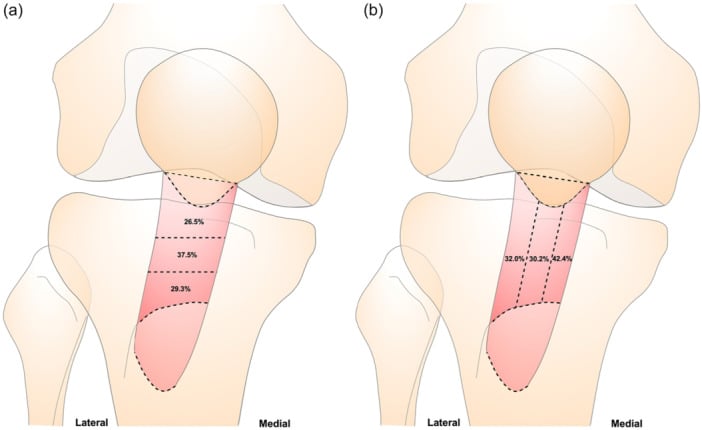
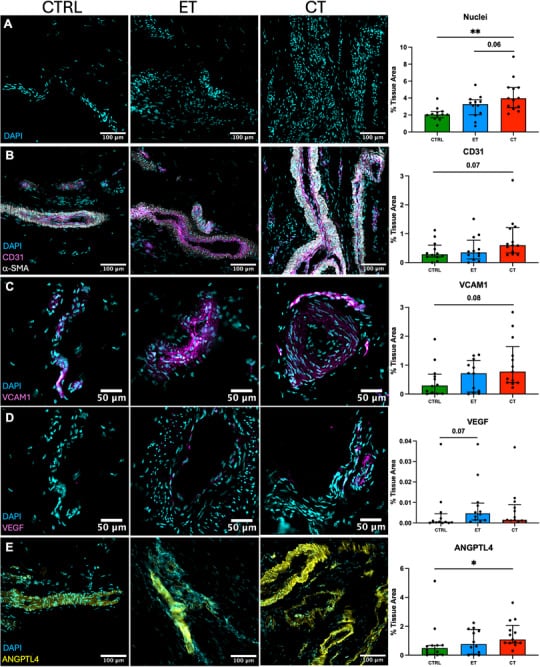
Tendinosis, not tendinitis. The condition was historically called tendinitis, but it is a degenerative process. Histology shows four features:
- Angiofibroblastic hyperplasia - neovascularisation with nerve ingrowth
- Mucoid degeneration - increased ground substance
- Collagen disorganisation - loss of the parallel type I collagen bundles
- Absence of inflammatory cells - no neutrophils or macrophages
If inflammation is absent, why does it hurt? Pain is driven by neovascularisation accompanying neoinnervation (sensory nerve ingrowth) into the degenerative area. Sclerosing therapy targets these neovessels.
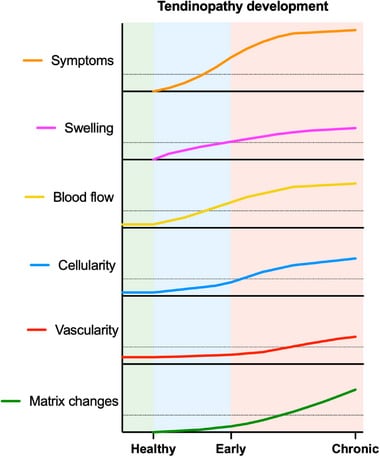
The continuum model (Cook and Purdam). Rather than a binary "inflamed versus degenerate" view, tendon pathology is best understood as a continuum, which guides load-based rehabilitation.
- Tendon state
- Non-inflammatory cell/matrix response to acute overload
- Reversibility
- Reversible
- Management focus
- Reduce load, relative rest, isometrics
- Tendon state
- Greater matrix breakdown, increased cells and vessels
- Reversibility
- Potentially reversible
- Management focus
- Load modification, progressive loading
- Tendon state
- Areas of cell death, disorganised matrix, neovessels
- Reversibility
- Largely irreversible
- Management focus
- Strengthen surrounding intact tissue ("treat the doughnut, not the hole")
In a degenerate tendon, the focal abnormal region (the "hole") will not heal back to normal. Rehabilitation works by loading and strengthening the surrounding intact tendon (the "doughnut") so the tendon-muscle unit tolerates load - which explains why imaging change lags clinical recovery.
The Extensor-Mechanism Tendinopathy Spectrum (by Location)
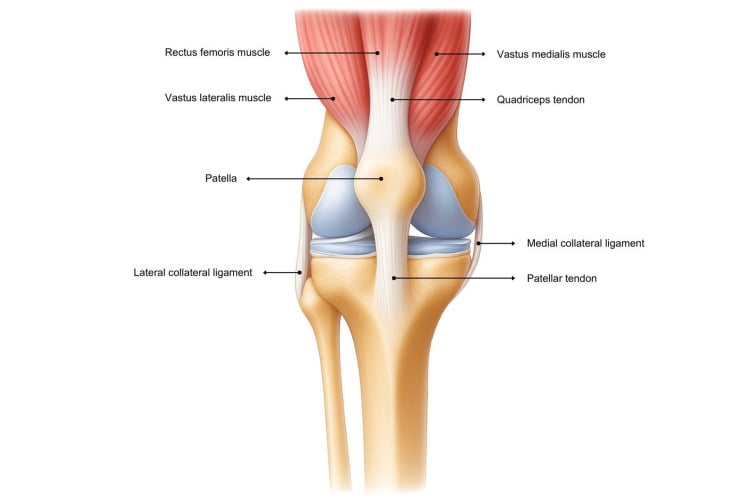
"Jumper's knee" is an umbrella term. The same overload disorder can strike anywhere along the extensor mechanism, and the examiner will expect you to localise it by the site of maximal tenderness.
- Tender point
- INFERIOR pole of patella
- Notes
- The classic 'jumper's knee' and commonest site (about two-thirds of cases) - the focus of this topic
- Tender point
- Tibial tubercle insertion
- Notes
- Much less common in adults; the adolescent traction equivalent is Osgood-Schlatter at the same site
- Tender point
- SUPERIOR pole of patella
- Notes
- Seen in weightlifters, volleyball and basketball; tenderness is ABOVE the patella, not below
The pathology (degenerative tendinosis), the imaging (ultrasound and MRI) and the loading-based rehabilitation are the same wherever it sits. The practical point is to palpate the superior pole, inferior pole and tubercle separately, so that you label the correct tendon and watch the right spot on imaging.
Classification Systems
Blazina's clinical staging is the most commonly used system in practice. It grades severity and guides treatment.
- Symptoms
- Pain only after activity
- Function
- No functional impairment
- Treatment
- Ice, NSAIDs, eccentric rehab
- Symptoms
- Pain during and after activity
- Function
- Can still compete/perform
- Treatment
- Activity mod + intense rehab
- Symptoms
- Pain during and after
- Function
- Unable to compete at level
- Treatment
- Prolonged rest, consider surgery
- Symptoms
- Complete tendon rupture
- Function
- Loss of extension
- Treatment
- Surgical repair
Progression from Stage 2 to Stage 3 is the critical tipping point. Once performance is affected (Stage 3), surgical consideration becomes more relevant if rehab fails.
Clinical Presentation and Assessment
History. Anterior knee pain localised to the inferior patellar pole, aggravated by jumping, landing and deceleration, which are the eccentric loads. Ask about a recent increase in training volume. Pain with prolonged sitting (the "movie sign") can overlap with patellofemoral pain syndrome.
- Finding
- Tenderness at inferior pole of patella
- Significance
- Classic site (proximal insertion)
- Finding
- Tenderness in extension, disappears in flexion
- Significance
- Differentiates from diffuse PFPS
- Finding
- Pain on single-leg decline squat
- Significance
- Loading test for tendinopathy
- Finding
- VMO wasting
- Significance
- Chronic inhibition
- Finding
- Reduced flexibility
- Significance
- Predisposing factor
Bassett's sign. In full extension the patellar tendon is lax and the inferior (distal) pole can be palpated. At 90 degrees of flexion the tendon tightens like a trampoline, and the tension makes the posterior aspect of the proximal tendon impalpable. Tenderness in extension that disappears in flexion is a positive sign, and it distinguishes patellar tendinitis from other anterior knee pain.
Always examine the hip (restriction, FAI) and ankle (dorsiflexion restriction). Stiffness above or below forces the knee to absorb more kinetic energy during landing, overloading the tendon.
Differential diagnosis. Rule out Sinding-Larsen-Johansson apophysitis in adolescents, patellofemoral pain syndrome and Hoffa's fat pad impingement. Location and patient age are the key discriminators.
- Location
- Inferior pole patella
- Key Feature
- Pain with jumping/eccentric load
- Management
- Eccentric rehab
- Location
- Retropatellar/diffuse
- Key Feature
- Pain with stairs/sitting (movie sign)
- Management
- VMO strength, tracking
- Location
- Tibial tubercle
- Key Feature
- Adolescent, prominent tubercle
- Management
- Rest, self-limiting
- Location
- Inferior pole patella
- Key Feature
- Adolescent apophysitis
- Management
- Rest, self-limiting
- Location
- Infrapatellar medial/lateral
- Key Feature
- Pain with full extension (impingement)
- Management
- Extension block taping
Investigations
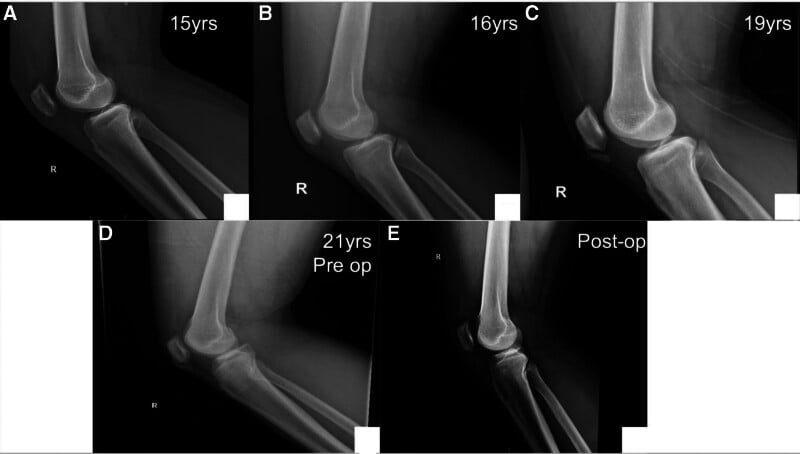
Radiographs are usually normal and miss soft-tissue pathology, but they rule out bony causes. They may show:
- An elongated inferior patellar pole (impingement theory)
- Intratendinous calcification (chronic)
- Osgood-Schlatter or Sinding-Larsen-Johansson sequelae
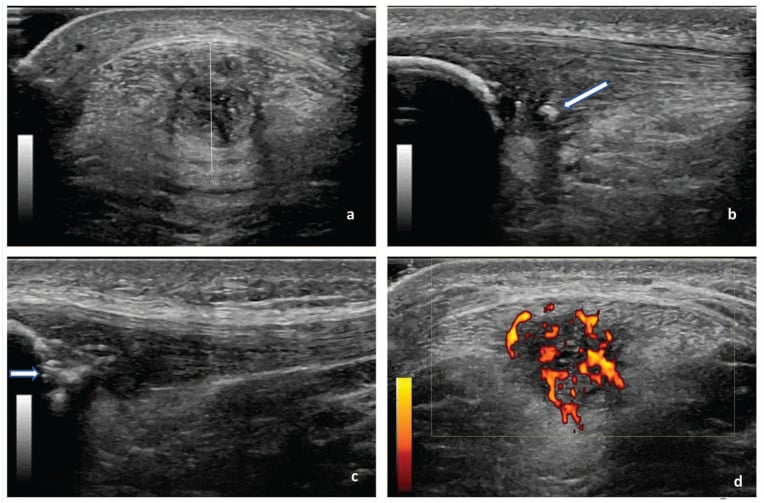
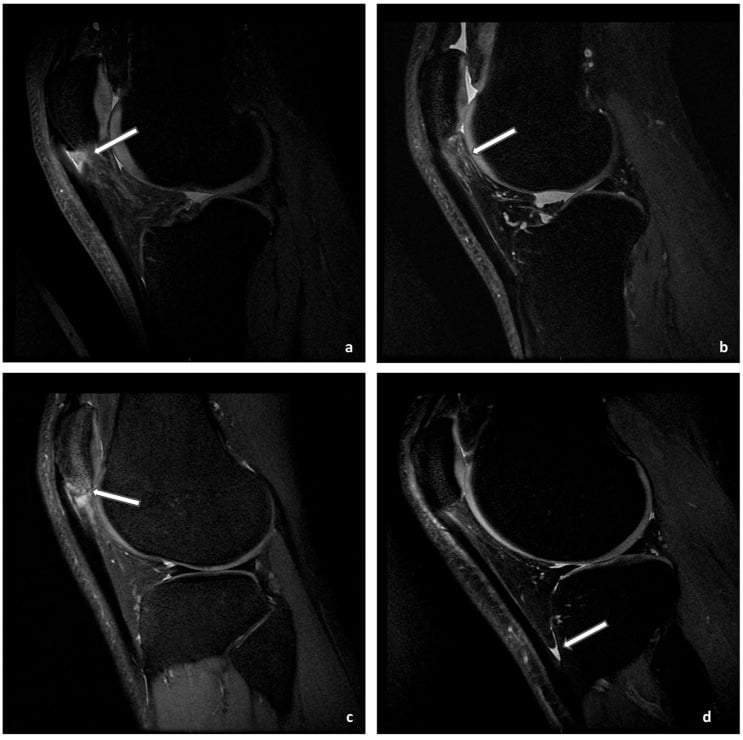
Ultrasound is the first-line imaging modality. Assess thickness, echotexture, calcification, cortical change and Doppler flow systematically. The typical findings are tendon thickening and a hypoechoic area of focal degeneration. It is dynamic, cheap and allows bilateral comparison, but it is operator dependent.
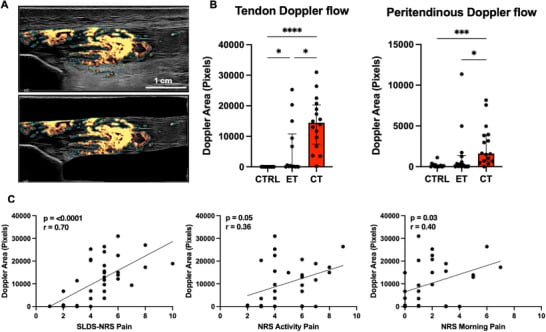
Doppler flow shows neovascularisation. It is the key marker of active neo-neurovascularisation and correlates with pain.
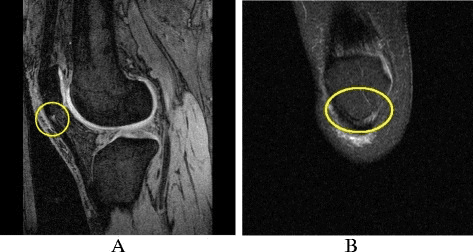
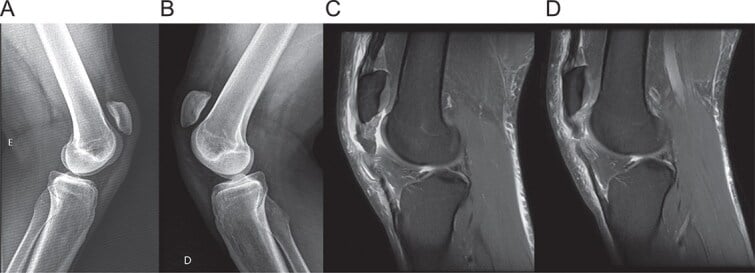
MRI has high sensitivity (95%), showing increased signal on T2/STIR in the proximal posterior tendon. It defines the anatomy and rules out other pathology (meniscus, cartilage, bone oedema), but it is expensive and static, with a high false-positive rate. Signal abnormalities can be present in asymptomatic athletes, the "imaging-clinical mismatch": treat the patient, not the scan.
Management
Progressive loading is the treatment. Injections are adjuncts, and surgery is the last resort after failed eccentric rehabilitation.
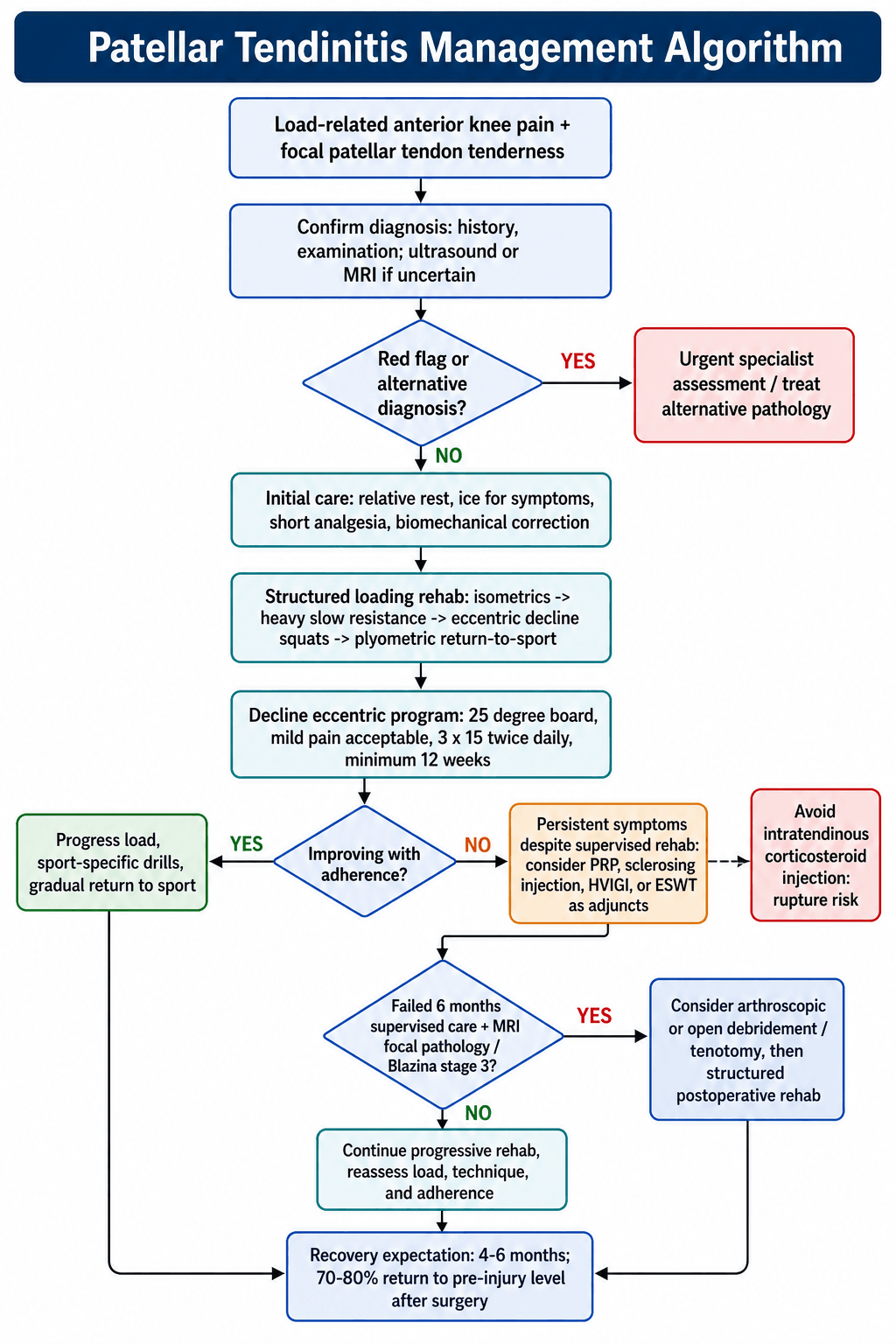
First steps (stages 1-2). Relative rest from aggravating activities such as jumping, ice for symptom control, and a short course of NSAIDs for analgesia rather than healing. Correct the biomechanics with orthotics or technique modification.
The rehabilitation protocol. This is the gold standard, and eccentric loading is the key to remodelling. Educate the patient about the long recovery timeframe, 3-6 months. The progression runs:
- Isometric loading (e.g. Spanish squat hold) - analgesic effect
- Isotonic loading - slow heavy resistance
- Eccentric loading - decline board squats
- Functional and plyometric work - return-to-sport progression
The decline board. Single-leg squats on a 25-degree board, 3 sets of 15, twice daily, for a minimum of 12 weeks. The protocol is "pain allowed": mild pain during the exercise is acceptable. Adherence to the eccentric programme is the single most important factor in conservative success.
The 25-degree decline board increases the knee extension moment and isolates the patellar tendon by minimising calf/ankle-dorsiflexion and hip contribution. In Purdam's pilot, decline-board eccentrics dropped mean VAS from 74 to 29 over 12 weeks while flat-foot squats barely changed - the slope, not the eccentric mode alone, drives the benefit.
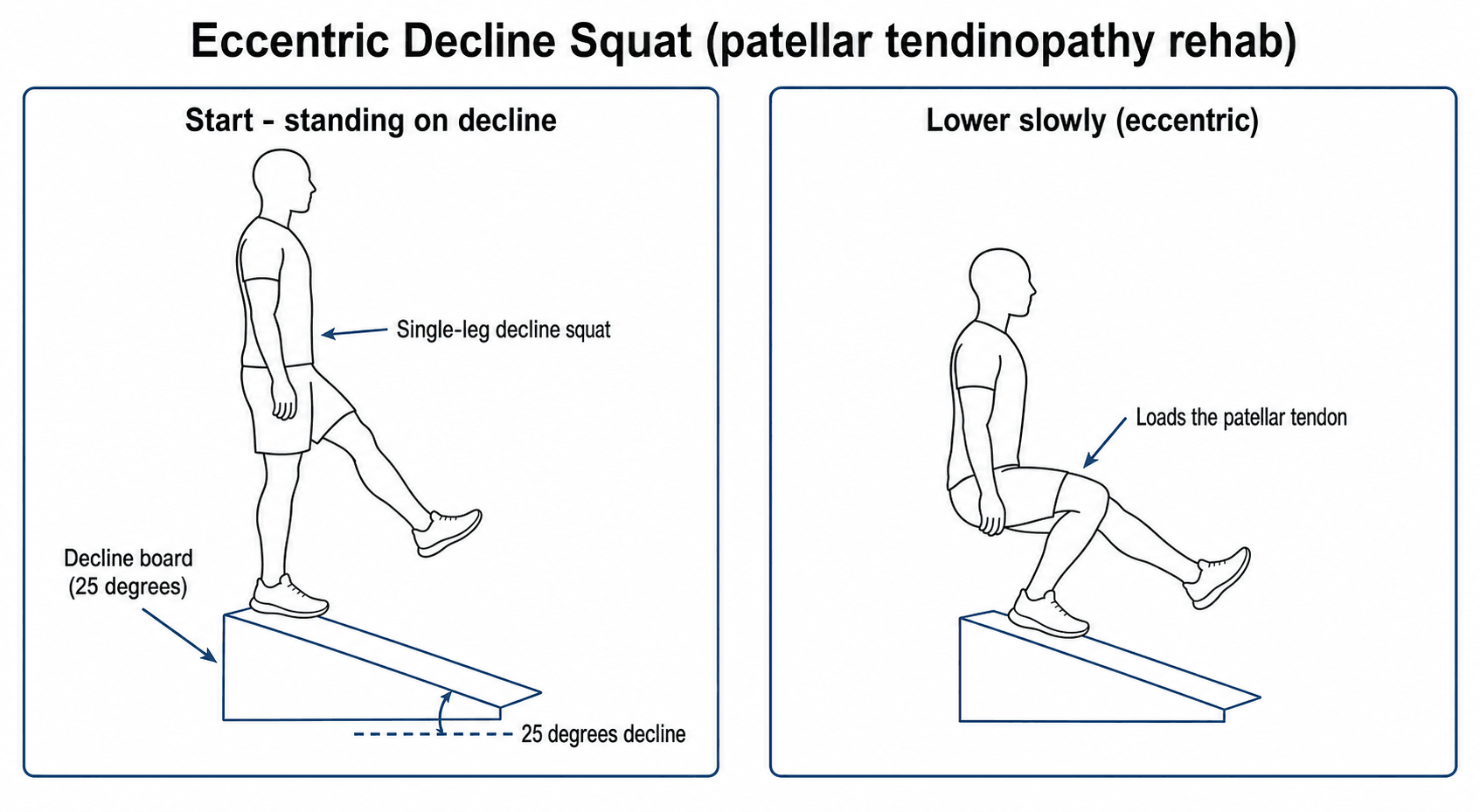
How much pain is allowed. Loading is governed by a pain-monitoring model, not pain avoidance. Pain during the exercise is acceptable up to about 5 out of 10 on a VAS, provided it settles back to baseline by the next morning and morning stiffness is not creeping up week to week. If pain exceeds that ceiling or lingers beyond 24 hours, step the load down a level.
Monitoring. Day to day, follow the single-leg decline-squat pain score and the trend in morning symptoms; the VISA-P tracks progress over weeks. Complete rest is the wrong advice: it de-loads and weakens the tendon, which needs progressive, tolerable load to remodel.
Surgical Technique
Set-up. Supine, with a tourniquet and the standard anterolateral and anteromedial portals, and the knee flexed to 90 degrees.
Steps.
- Diagnostic arthroscopy - rule out other pathology (plica, meniscal tear, chondromalacia)
- Visualisation - view the retropatellar fat pad and the posterior aspect of the patellar tendon
- Fat pad resection - use the shaver to resect the retropatellar fat pad and visualise the proximal tendon insertion
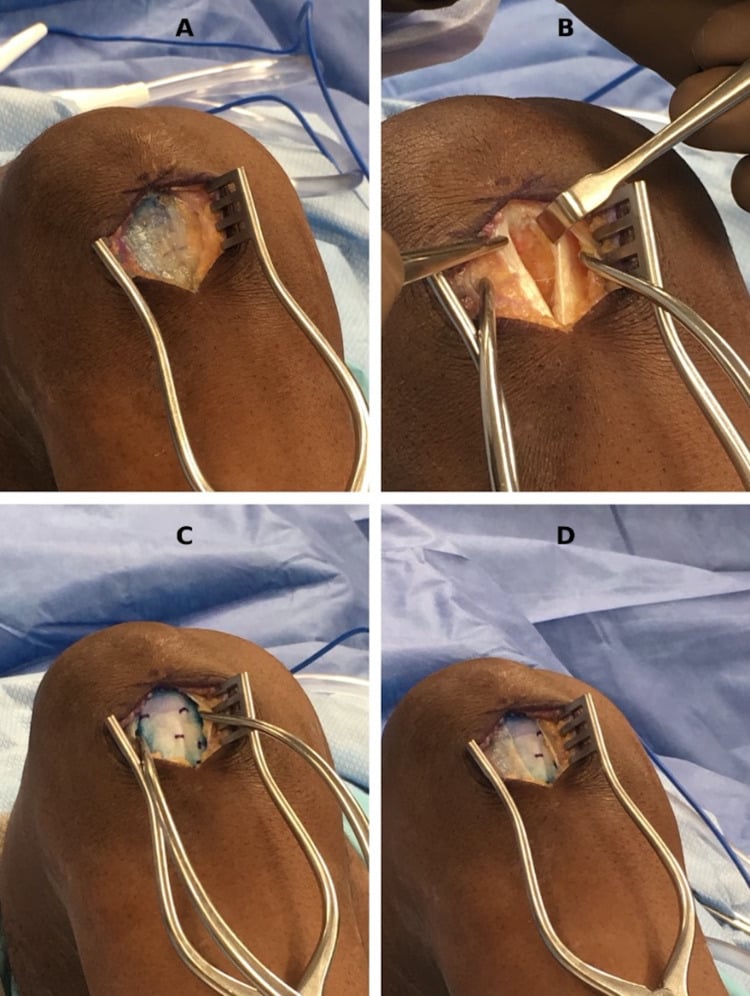
- Debridement - identify the "boggy" degenerate area at the inferior pole (proximal posterior tendon) and resect the focal degenerative tissue
- Osteoplasty - some surgeons resect the bony beak of the inferior pole
Why arthroscopy. The incisions are smaller, rehabilitation is faster and intra-articular pathology can be addressed. It visualises the posterior tendon, the site of pathology, without disrupting the anterior fibres. Arthroscopy is increasingly preferred for its diagnostic utility and lower morbidity.
Complications
- Risk Factors
- Steroid injections, aggressive early load
- Management
- Surgical repair (quad/hamstring augmentation)
- Risk Factors
- Inadequate resection, wrong diagnosis
- Management
- Revision surgery vs salvage
- Risk Factors
- Damage to infrapatellar branch of saphenous nerve
- Management
- Observation (often permanent)
- Risk Factors
- Open surgery
- Management
- Antibiotics +/- debridement
Tendon rupture is the most devastating complication. It is rare in virgin cases, and the risk increases with multiple steroid injections. Reconstruction is complex and often needs augmentation because of poor tissue quality.
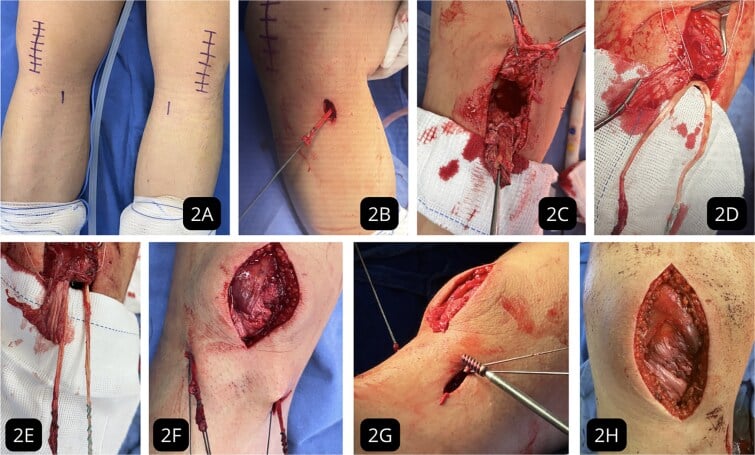
The infrapatellar branch of the saphenous nerve runs transversely across the proximal tibia and tendon. A transverse incision risks it and leaves lateral numbness, so longitudinal incisions are safer.
Postoperative Care and Rehabilitation
- Goal: Wound healing, pain control
- WBAT with crutches if needed
- ROM as tolerated
- Isometric quads
- Goal: Normal gait, full ROM
- Closed chain strengthening
- Cycling
- Proprioception
- Goal: Hypertrophy and strength
- Start eccentric loading programme
- Increase resistance
- Single leg squats
- Goal: Return to sport
- Plyometrics initiation
- Sport-specific drills
- Return to play when strength over 90% contra-lateral side
Patients must be counselled that surgery is NOT a quick fix. Biology of tendon healing combined with need for strength recovery means return to sport typically takes 4-6 months.
Outcomes and Prognosis
Conservative treatment succeeds in 60-80% with a proper eccentric programme. After surgery, 70-80% return to their pre-injury level, and 70-90% have good or excellent results.
Return to play. 50-60% return to their previous level of sport. Many return to sport, but at a lower level or with residual symptoms.
Refractory cases. Consider other diagnoses (Hoffa's fat pad, plica) and look for biomechanical contributors at the hip and ankle.
Guidelines, Registries & Global Practice
- Patellar tendinopathy is fundamentally a load-related overuse disorder, so prevalence tracks explosive leg-extensor sport worldwide rather than any single region. In a cross-sectional study of 613 elite Norwegian athletes, overall current prevalence was 14.2%, peaking at 44.6% in volleyball and 31.9% in basketball, with zero cases in cycling and orienteering.
- Symptoms are typically chronic and performance-limiting: mean symptom duration was 32 months and mean VISA score 64 in affected athletes.
- Men are affected roughly twice as often as women (13.5% versus 5.6% in the same elite cohort), consistent with greater jump height and explosive loading.
- The VISA-P (Victorian Institute of Sport Assessment - Patella) is the validated, internationally adopted patient-reported outcome (8 items, 0-100). It was developed and validated with excellent reliability (r greater than 0.95) and is the comparator used in essentially all modern trials. Cross-culturally adapted versions exist in many languages, making it the common currency for comparing studies across countries.
- Position on patellar tendinopathy
- Strong evidence for eccentric training; moderate for heavy slow resistance; only limited evidence for surgery, sclerosing and shockwave
- Evidence level
- Strong (eccentrics) / Limited (surgery, injections)
- Position on patellar tendinopathy
- Progressive tendon loading (eccentric or heavy slow resistance) first line; load management rather than complete rest; isometrics for in-season analgesia
- Evidence level
- Moderate-Strong
- Position on patellar tendinopathy
- Activity/load modification, structured physiotherapy-led loading, analgesia; corticosteroid injection discouraged for load-bearing tendons
- Evidence level
- Consensus / Low-Moderate
- Position on patellar tendinopathy
- Open tenotomy offers no advantage over eccentric training at 12 months; reserve surgery for failure of at least 3 to 6 months of structured loading
- Evidence level
- Level I (single RCT)
Practice Variation:
- There is no joint-registry equivalent for tendinopathy (registries cover arthroplasty/implants), so the evidence base is trial- and consensus-driven rather than registry-driven.
- Practice differs mainly in the interventional middle ground: PRP, sclerosing/high-volume injection and extracorporeal shockwave are used more readily in some sports-medicine systems (often physician-led, before any surgical referral), whereas other systems move from supervised loading straight toward surgical opinion. The high-level evidence for these adjuncts remains limited, so their use reflects local resources and clinician preference rather than strong guideline mandate.
- The one near-universal agreement across all guidance is that structured progressive loading is first line and intratendinous corticosteroid is avoided because of rupture risk and inferior long-term outcomes.
MCQ Practice Points
Q: What is the primary histological finding in patellar tendinopathy? A: Angiofibroblastic hyperplasia and mucoid degeneration, with a distinct absence of inflammatory cells (tendinosis, not tendinitis).
Q: What is Bassett's Sign and what does it indicate? A: Tenderness at the inferior pole of the patella in full extension that disappears in 90 degrees of flexion. It is pathognomonic for patellar tendinopathy.
Q: Why are corticosteroid injections contraindicated in the patellar tendon? A: They inhibit collagen synthesis and cause necrosis, leading to a significantly increased risk of acute tendon rupture.
Q: What are the characteristic ultrasound findings? A: Thickening of the tendon, hypoechoic areas (focal degeneration), and Doppler flow (neovascularization) which correlates with pain.
Q: What is the gold standard rehabilitation protocol? A: Eccentric strengthening, specifically using a 25-degree decline board to isolate the patellar tendon mechanism.
Q: What defines Stage 3 in the Blazina classification? A: Pain during and after activity that causes a decrease in sports performance. This is often the tipping point for considering surgery.
Clinical Decision Scenarios
Practise clinical reasoning and management decisions out loud
“A 24-year-old professional basketball player presents with 6 months of anterior knee pain. It warms up during play but hurts significantly afterwards. He is struggling to dunk. How do you assess him?”
“This patient has failed 6 months of supervised eccentric rehab and shockwave therapy. MRI shows focal mucoid degeneration at the proximal posterior tendon. Discuss surgical options.”
“Why do we prescribe decline board squats specifically? What is the biomechanical rationale?”
Key Facts
- Degenerative process (tendinosis), NOT inflammatory
- Inferior pole of patella is classic site
- Bassett's sign: Tender extension, non-tender flexion
- Decline board eccentric squats = Gold Standard rehab
Must Know
- NO STEROIDS (rupture risk)
- VISA-P score is key monitoring tool
- Surgery only after 6 months failed rehab
- Return to sport takes 4-6 months post-op
Imaging
- Ultrasound: Hypoechoic, thick, Doppler flow
- MRI: T2 high signal posterior proximal tendon
- X-ray: Usually normal (rule out other causes)
- Doppler flow correlates with active pain
Surgical Options
- Arthroscopic debridement (posterior tendon)
- Open debridement
- Tenotomy
- Inferior pole osteoplasty (if impingement)
Evidence Base
Purdam et al. - Eccentric Decline Squat Pilot Study
- Non-randomised pilot in 17 patients (22 tendons) with chronic patellar tendinopathy (decline group: 8 patients/12 tendons; flat group: 9 patients/10 tendons).
- Decline-board (25 degree) eccentric squats reduced mean VAS from 74.2 to 28.5 over 12 weeks (p=0.004); flat-foot squats only fell 79.0 to 72.3 (p=0.144).
- Six decline-group patients (nine tendons) returned to sport versus only one athlete in the flat-squat group.
Kongsgaard et al. - Corticosteroid vs Eccentric vs Heavy Slow Resistance
- RCT of 39 men: peritendinous corticosteroid (CORT), eccentric decline squats (ECC) and heavy slow resistance (HSR), 12 weeks.
- All groups improved at 12 weeks, but CORT gains deteriorated by 6 months while ECC and HSR were maintained.
- HSR produced the highest treatment satisfaction and elevated collagen network turnover; CORT and HSR reduced tendon swelling and vascularisation on ultrasound.
Bahr et al. - Open Tenotomy vs Eccentric Training (RCT)
- Randomised controlled trial of 35 patients (40 knees) with grade-IIIB patellar tendinopathy: open patellar tenotomy versus eccentric decline-squat training.
- No difference in VISA score between groups at 12 months; both improved (mean VISA 30 to 70).
- Five of 20 eccentric-training knees required secondary surgery at 3 to 6 months.
Larsson et al. - Treatment of Patellar Tendinopathy (Systematic Review of RCTs)
- Systematic review of 13 RCTs of treatments for patellar tendinopathy.
- Strong evidence for eccentric training; moderate evidence for heavy slow resistance as an alternative.
- Only limited evidence for surgery, sclerosing injections and shockwave; low-intensity pulsed ultrasound was ineffective.
Dragoo et al. - Leukocyte-Rich PRP vs Dry Needling (RCT)
- Double-blind RCT of 23 patients who had failed nonoperative care: single leukocyte-rich PRP injection plus eccentric exercise versus dry needling plus eccentric exercise.
- PRP improved VISA more than dry needling at 12 weeks (25.4 vs 5.2 points, p=0.02).
- By 26 weeks the groups were equivalent - the early PRP advantage dissipated over time.
Lian et al. - Prevalence of Jumper's Knee in Elite Athletes
- Cross-sectional study of 613 elite Norwegian athletes across 9 sports.
- Overall current prevalence 14.2%, ranging 0% (cycling, orienteering) to 44.6% in volleyball and 31.9% in basketball.
- Prevalence higher in men (13.5%) than women (5.6%); mean symptom duration 32 months.
Cook & Purdam - Tendon Pathology Continuum Model
- Proposes a continuum of tendon pathology: reactive tendinopathy, tendon disrepair, and degenerative tendinopathy.
- Reactive and early disrepair are potentially reversible with load modification; degenerative tendon shows irreversible matrix and cell change.
- Reframes management around staging tendon along the continuum rather than a binary 'inflamed vs degenerate' view.
Visentini et al. - Development of the VISA Score
- Original development and validation of the Victorian Institute of Sport Assessment (VISA) questionnaire for jumper's knee.
- Eight-item, 0-100 score with excellent test-retest and inter-tester reliability (r greater than 0.95).
- Mean scores: 95 in asymptomatic controls, 55 in clinic patients, 22 pre-operatively, recovering to 75 by 12 months post-surgery.