Posterior Tibial Avulsion | Posterior Approach | Screw or Suture Fixation
- PCL tibial avulsion is a repairable insertion injury when fragment and ligament remain viable, but prognosis depends on associated injury and reduction
- Posterior approaches and arthroscopic tunnels have distinct neurovascular risks; define vessel variants and safe trajectories
- No validated three-week or six-week boundary determines fixation versus reconstruction
- Fixation follows fragment geometry and bone quality, not a universal one-centimetre screw/suture cut-off
- MRI and CT complement radiographs by defining soft-tissue injury, comminution and operative anatomy
- “Do not assume avulsion always outperforms midsubstance injury; compare associated damage and chronicity
- “Use posteromedial, direct posterior or arthroscopic access according to fragment and surgeon expertise
- “Protect the popliteal neurovascular bundle and account for aberrant anterior tibial artery anatomy
- “Screw, suture, bridge and hybrid constructs all have indications; comparative evidence is limited
Overview and Epidemiology
A PCL tibial avulsion detaches the ligament-bone unit from its posterior tibial insertion. A viable fragment may be reduced and fixed, restoring the native ligament rather than replacing it, but management and outcome depend on fragment geometry, chronicity, associated injury and neurovascular safety.
Mechanism. The classic is the dashboard injury: in a motor vehicle accident the knee strikes the dashboard, driving a posterior force onto the proximal tibia of the flexed knee. The other routes to the same lesion:
- Hyperflexion or direct impact
- High-energy trauma, including multiligament and tibial-plateau injuries
- Paediatric bone-ligament failure patterns
Who. Frequency varies by geography, mechanism and referral population, and the injury is often part of high-energy or multiligament trauma. Age, sex and associated-injury percentages come from small series and should not be treated as universal.
A bony fragment offers the possibility of native insertion healing. It does not guarantee an easy reduction, an isolated injury or a superior outcome: results reflect associated ligament, meniscal, chondral and vascular injury as well as union. Define associated damage and fragment viability first.
Anatomy and Pathophysiology
The ligament. The PCL arises from the lateral surface of the medial femoral condyle and inserts in the posterior intercondylar area of the tibia, below the joint surface. Its anterolateral and posteromedial bundles both contribute across flexion. The size and thickness of the avulsed fragment vary, and the attachment may carry periosteal or comminuted extensions.
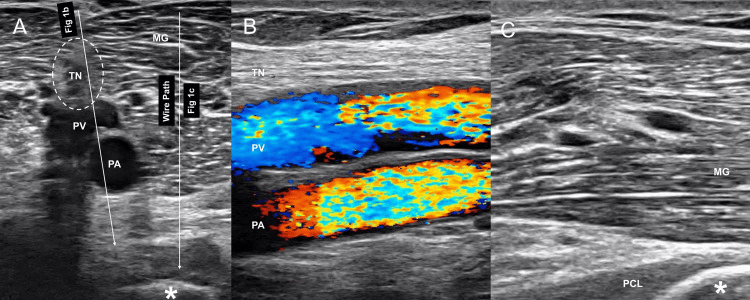
What lies behind it. The popliteal vessels and tibial nerve lie posterior to the insertion, with the popliteus and posterior capsule intervening. The anterior tibial artery may take a high or aberrant course close to posterior tibial drilling. Direct posterior and posteromedial approaches, guidewires and tibial tunnels all approach the popliteal bundle.
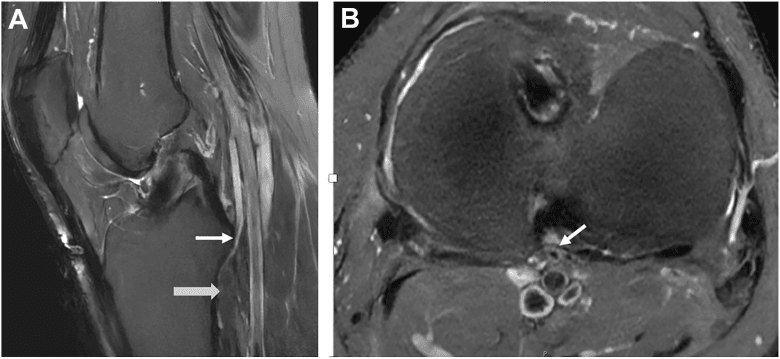
How it fails. Failure may occur through bone, through the bone-ligament interface or through the ligament itself. With time a fragment may scar, resorb or remain reducible. Fixation aims to restore articular contour, PCL length and tension, and posterior stability, restoring the native insertion without overconstraint and without breaking up the fragment or penetrating posteriorly.
Choose approach, retractor position, guidewire and screw/tunnel trajectory together. Review MRI/CT for vessel variants and never rely on a generic distance from the posterior cortex.
Classification Systems
Describe the injury rather than force it into a type. Fragment geometry, displacement and chronicity each inform the treatment, and none of them dictates it on its own.
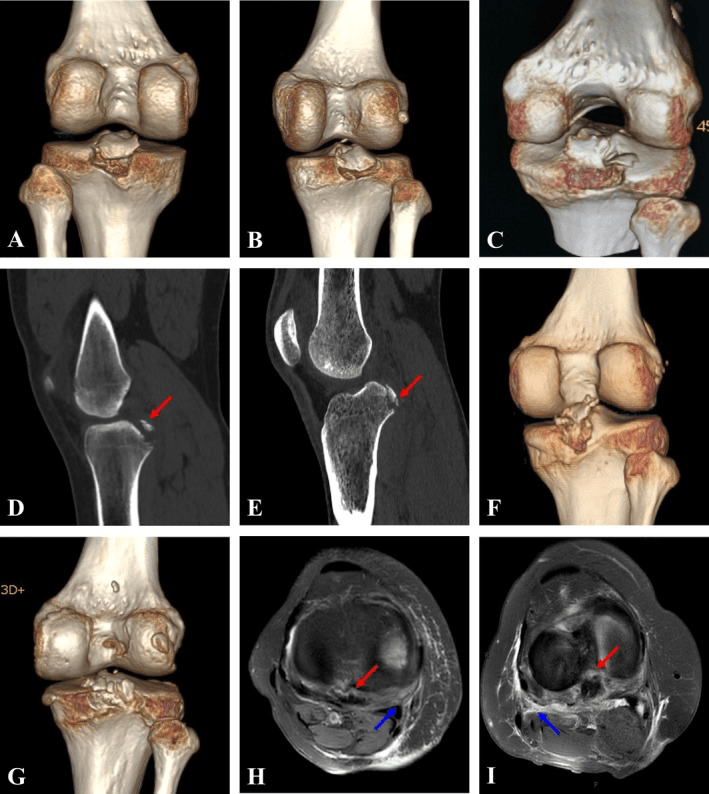
Single robust fragment. May accept one or more screws, suture or hybrid fixation, but compression must not split thin bone or violate the joint.
Small or thin fragment. A suture bridge, anchors or transosseous capture may distribute the force where a screw would not.
Comminuted bone-ligament complex. Capture the attached tissue and fragments together, and reconstruct only if native repair is not feasible.
Clinical Assessment
History. Expect immediate pain and swelling, inability to bear weight, posterior knee pain and a knee that gives way. The classic mechanism is the dashboard blow described above.
Examination. The knee carries an effusion (haemarthrosis) and is held in slight flexion, and the gait is antalgic. The posterior knee is tender, and both flexion and extension are limited by pain and effusion. Normally the tibia steps off 1 cm anterior to the femoral condyle; PCL injury causes posterior translation, and the step-off becomes abnormal.
The ligament tests.
- Posterior drawer - posterior translation; the most sensitive test. Assess the amount of translation and the quality of the endpoint
- Posterior sag sign - the tibia sags posteriorly
- Quadriceps active test - the tibia reduces with quadriceps contraction
- Dial test - may be positive if the PLC is injured
Associated injuries. Reported rates are 20-30% for posterolateral corner injury, 10-15% for ACL injury and 10-20% for meniscal tears, figures to hold with the caution above. Bone bruises of the anterior tibia and anterior femur form a kissing-contusion pattern.
- Key Distinguishing Feature
- Posterior drawer/sag with bony fragment at posterior tibial insertion
- Confirming Investigation
- Lateral radiograph + CT (fragment, displacement)
- Key Distinguishing Feature
- Posterior sag/drawer but no bony fragment
- Confirming Investigation
- MRI (discontinuous PCL fibres, no avulsed bone)
- Key Distinguishing Feature
- Increased external rotation (dial test) at 30 degrees, varus laxity
- Confirming Investigation
- MRI; stress radiographs; examine before attributing all laxity to PCL
- Key Distinguishing Feature
- Lateral capsular/anterolateral fragment, not posterior insertion
- Confirming Investigation
- AP radiograph + CT
- Key Distinguishing Feature
- Gross instability, dimple sign, vascular compromise
- Confirming Investigation
- Urgent ABI/CT angiography - exclude before elective fixation
- Key Distinguishing Feature
- Tibial spine/physeal avulsion rather than PCL insertion
- Confirming Investigation
- Radiograph + MRI to define physis
Investigations
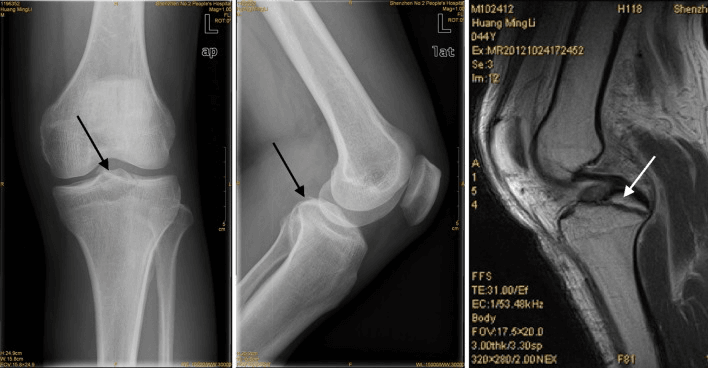
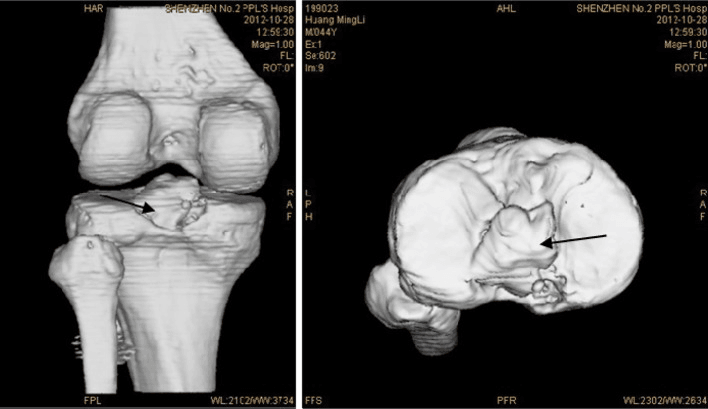
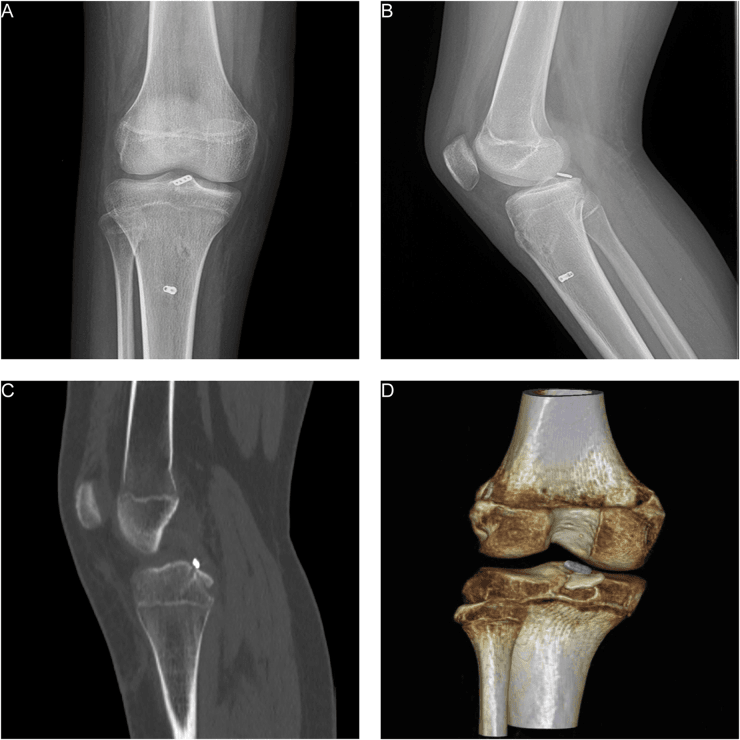
Radiographs. AP and lateral views of the knee. The lateral is the critical view: it shows the fragment on the posterior tibia, its size and its posterior displacement, and an abnormal posterior tibial step-off. Look also for associated tibial plateau and femoral condyle fractures.
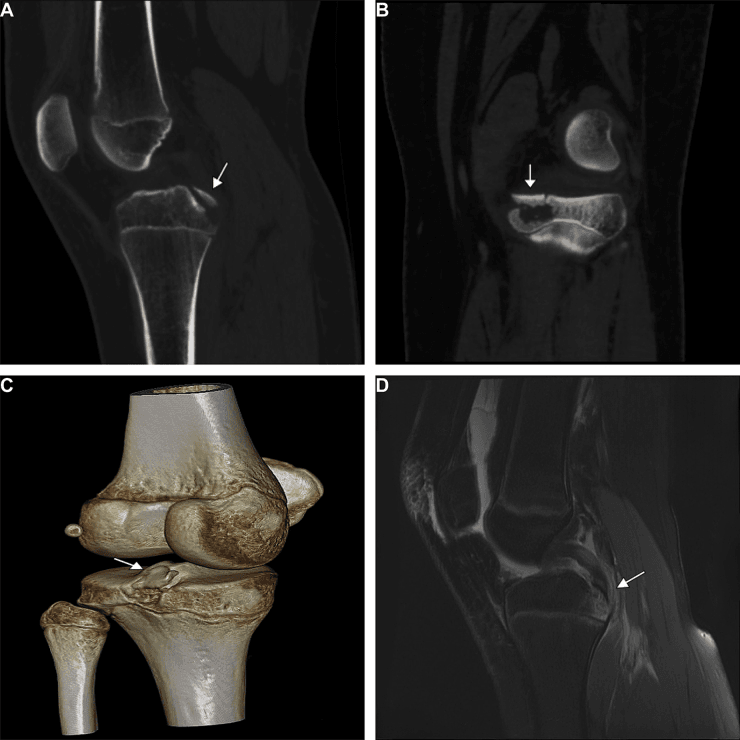
CT. Essential for surgical planning. It measures fragment size and displacement, shows comminution and associated fractures, and plans the fixation strategy. Three-dimensional reconstruction helps with complex comminution, fragment rotation and preoperative planning.
MRI. Not routine, but indicated if associated injuries are suspected: PLC, ACL and meniscal tears and cartilage injury. It also shows the PCL fibres, which are usually intact and attached to the fragment, and the fragment's relation to the tibia.
Associated Bony Avulsion Signs
The posterior tibial fragment is the diagnostic lesion, but two secondary avulsion signs on plain films flag the concomitant injuries that change the operation. Both are easily confused with the classic (lateral, ACL-associated) Segond fracture listed in the differential above, so they are worth learning as a set.
Reverse Segond fracture. A small cortical avulsion off the medial tibial plateau margin, at the attachment of the deep medial collateral ligament and medial capsule: the mirror image of the classic lateral Segond fleck. It is strongly associated with PCL injury and a medial meniscus tear, whereas the lateral Segond signals ACL injury. The mechanism is valgus with external rotation, distinct from the dashboard mechanism of the isolated PCL fragment but often part of the same high-energy event. A medial-margin fleck on the AP film should trigger a deliberate search for the posterior tibial avulsion and MRI assessment of the medial meniscus.
Arcuate (fibular styloid) sign. An avulsion fleck off the fibular styloid, at the arcuate-complex insertion, signals a posterolateral corner injury, which co-exists with PCL injury in a meaningful minority of cases. Full PLC evaluation and reconstruction belong to the dedicated posterolateral-corner-injuries topic. The point here is that a tiny fibular-head fleck alongside a posterior tibial fragment means this is not an isolated PCL avulsion, and combined instability must be looked for.
Inspect the medial plateau margin and the fibular styloid before assuming the lesion is isolated. Either fleck converts an apparently isolated PCL bony avulsion into a combined injury that alters the surgical plan.
Management Algorithm
Assess first. Determine fragment size, displacement and timing, look for associated PLC, ACL and meniscal injury, and plan the approach. A combined injury, whether PLC, ACL, meniscus, plateau or vascular, is treated as a whole knee in a planned sequence.
- Timing
- Recent or chronic if reducible
- Fixation Method
- Screw, suture or hybrid fixation
- Outcome
- Compression without fragment damage
- Timing
- Repairability assessed
- Fixation Method
- Suture bridge, anchors or transosseous fixation
- Outcome
- Capture bone-ligament complex
- Timing
- Variable chronicity
- Fixation Method
- Suture/hybrid fixation or reconstruction if irreparable
- Outcome
- Do not force one screw
- Timing
- Any timing
- Fixation Method
- Sequence all ligament, fracture and vascular pathology
- Outcome
- Associated injury drives prognosis
Non-operative treatment. Rarely indicated: minimal displacement (under 2 mm), a low-demand patient, or a medical contraindication to surgery. Outcomes are poor compared with surgical fixation, and the usual result is persistent instability. The protocol:
- Extension brace for 6-8 weeks
- Non-weight-bearing initially
- Progressive weight bearing and range of motion
- Quadriceps strengthening
Operative indications. The 2 mm figure used here is conventional rather than validated (see Classification).
- Absolute: displacement over 2 mm, symptomatic instability, a high-demand patient
- Relative: minimal displacement with symptoms, associated injuries requiring surgery
Timing. Early fixation, within about 3 weeks, is conventional, and a fragment presenting beyond about 6 weeks may need reconstruction instead. No cited series quantifies either cut-off.
Surgical Technique
Screw or suture. Size is often quoted as the dividing line: a screw for a single fragment over 1 cm in good bone, suture anchors for one under 1 cm, comminuted or in poor bone. It is not a universal cut-off. A small or thin fragment may split or be penetrated by a screw, and fragment thickness, comminution, bone quality and PCL attachment decide between screw, suture, bridge or hybrid fixation.
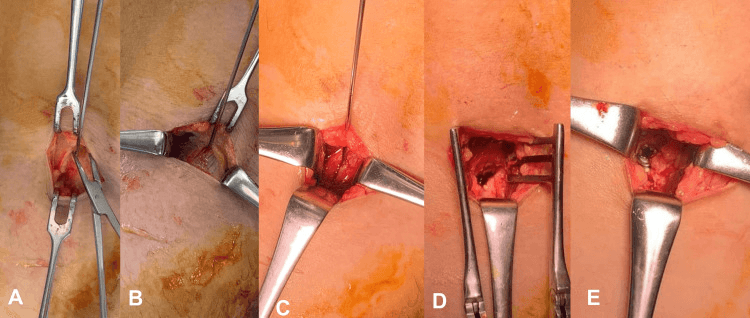
Positioning. Prone on a standard operating table, with a thigh tourniquet (which may be deflated for exposure), the contralateral leg abducted and the image intensifier in position.
Incision. A posterior midline or posteromedial incision of 8-10 cm, raising full-thickness flaps. The named approaches and the safe interval are set out in the next section.
Exposure. With the popliteal artery and tibial nerve identified and protected (see the alert below), retract the bundle medially or laterally, then expose the posterior tibia and the avulsed fragment.
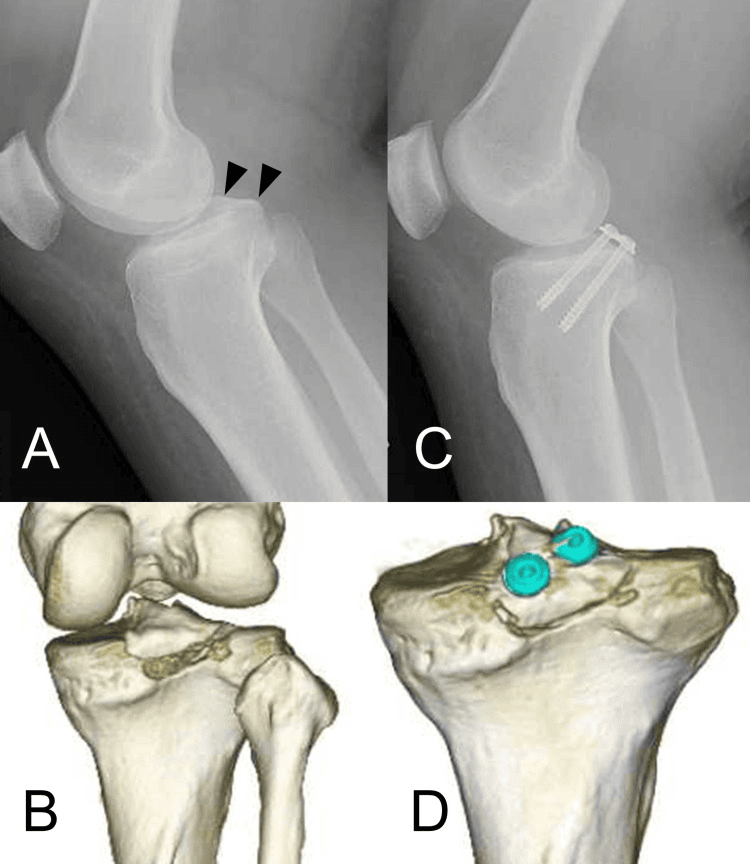
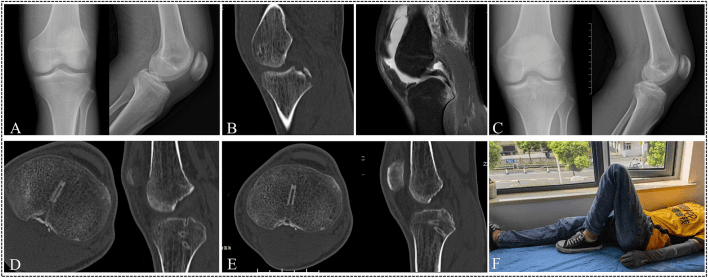
The popliteal artery is at risk in the posterior approach. Identify and protect the neurovascular bundle before any dissection, retract with vessel loops and avoid excessive retraction. The artery is vulnerable to injury with posterior displacement.
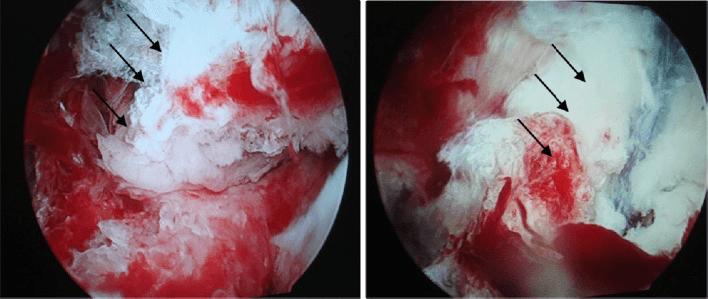
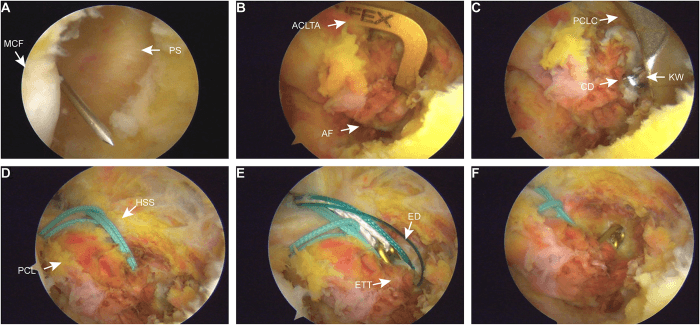
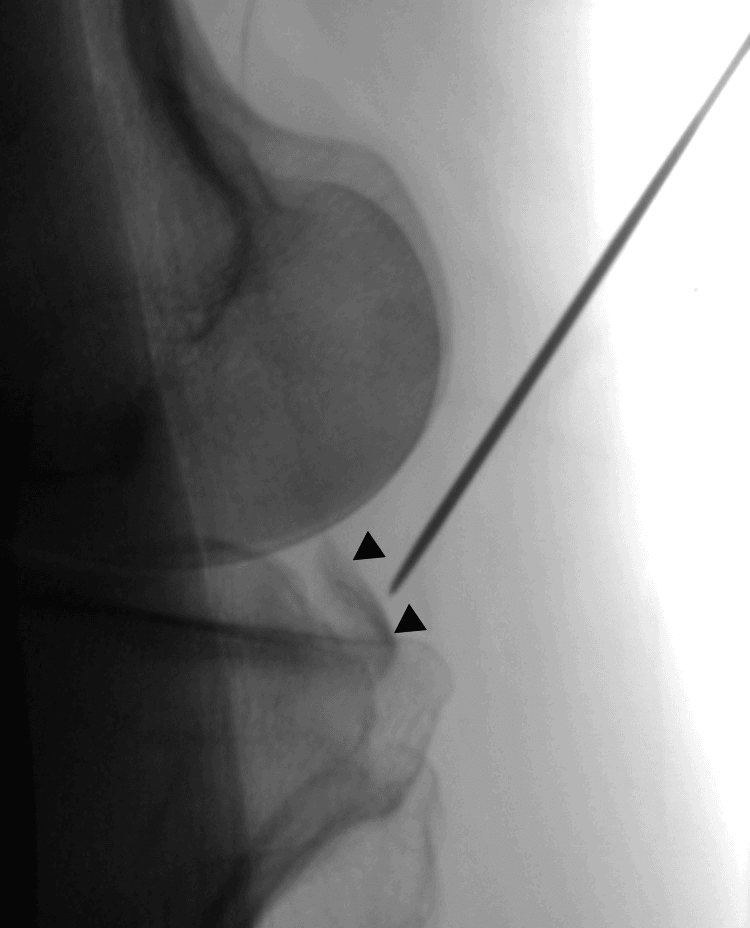
Arthroscopic fixation. Open and arthroscopic routes both work in selected hands, and posteromedial, direct posterior or arthroscopic access is chosen according to the fragment and the surgeon's expertise. Arthroscopic tunnels carry their own neurovascular risk, distinct from that of the open approaches, so vessel variants and a safe trajectory are defined before drilling.
Named Posterior Approaches & the Safe Interval
The guidelines table below names the "Burks / Trickey" open posterior approach, but the operative point examiners are really testing is how the popliteal neurovascular bundle is kept out of harm's way. That is a matter of which interval you choose, not just where the skin incision runs.
The approaches by name.
- Trickey posterior (midline). A lazy-S popliteal incision giving direct access to the posterior capsule. Because it crosses the popliteal fossa it requires formal identification and mobilisation of the popliteal vessels and tibial nerve, so it is generally reserved for combined injuries needing wide exposure.
- Burks–Schaffer posteromedial. A more medial incision that uses the interval between the medial head of gastrocnemius and semimembranosus, avoiding the midline popliteal dissection.
- Lobenhoffer / posteromedial inverted-L. A widely used modern variant giving the same posteromedial window onto the PCL facet of the posterior tibia.
The safe interval. The posteromedial approaches share one protective manoeuvre: develop the plane medial to the medial head of gastrocnemius, then retract that muscle belly laterally. The retracted muscle then sits as a muscular shield between the operative field and the popliteal artery, vein and tibial nerve, so the fragment can be reduced and fixed without dissecting directly onto the vessels. That is why a posteromedial route is generally preferred over a midline popliteal dissection for the isolated tibial avulsion.
Complications
- Incidence
- Less than 5%
- Risk Factors
- Inadequate exposure, excessive retraction
- Prevention/Management
- Identify vessels first, protect with vessel loops
- Incidence
- 5-10%
- Risk Factors
- Inadequate fixation, poor reduction
- Prevention/Management
- Secure fixation, good bone apposition
- Incidence
- 10-15%
- Risk Factors
- Malreduction, inadequate fixation
- Prevention/Management
- Anatomic reduction, secure fixation
- Incidence
- 5-10%
- Risk Factors
- Prolonged immobilisation
- Prevention/Management
- Early ROM (2-4 weeks)
- Incidence
- 5-10%
- Risk Factors
- Prominent hardware
- Prevention/Management
- Countersink screws, use suture anchors if prominent
The killer curve is not a concern here: this is an avulsion fixation, not a reconstruction.
Neurovascular injury. Direct injury adds to the causes in the table, and avoiding excessive retraction to the prevention. An arterial injury needs immediate vascular surgical consultation.
Nonunion. Devascularisation of the fragment adds to inadequate fixation and poor reduction, and proper timing joins secure fixation and good apposition in prevention. Management is revision fixation, with bone graft if needed.
Residual laxity. Fragment resorption is a further cause. The laxity is usually asymptomatic and does not affect function; if it is symptomatic, revise the fixation, or reconstruct the PCL if needed.
Stiffness. The table gives 5-10%, with prolonged immobilisation as the risk factor and early motion at 2-4 weeks as the prevention. In the Hooper systematic review arthrofibrosis was the commonest complication after both open and arthroscopic fixation, reported at up to 35% arthroscopic and up to 25% open. Those ranges span zero, so the primary studies disagree rather than give a usable rate.
Postoperative Care
The knee is kept in a hinged brace locked in extension for 4-6 weeks, non-weight-bearing for the first 4-6 weeks, with passive motion through the unlocked brace from 2-4 weeks. Quadriceps sets and straight-leg raises start immediately.
- Weeks 0-2 - brace locked in extension, non-weight-bearing, quadriceps sets and straight-leg raises, ice and elevation
- Weeks 2-4 - brace unlocked for passive motion 0-90 degrees, still non-weight-bearing, stationary bike when range allows, quadriceps strengthening
- Weeks 4-6 - progressive weight bearing from partial to full, full passive range, quadriceps strengthening, balance and proprioception
- Weeks 6-12 - full weight bearing, progressive strengthening and sport-specific training, working towards the return-to-sport criteria below
Outcomes and Prognosis
After fixation. Union is the rule in the cited series, with mean Lysholm scores of 93-95, though no verified percentage exists. 80-85% return to their pre-injury level, and complications (nonunion, residual laxity, stiffness) run at 10-15%.
By timing. Early fixation gives the results above. Subacute fixation at 3-6 weeks gives 75-85% good results. Chronic cases beyond 6 weeks may need reconstruction, and their outcome is less predictable, with no verified success rate.
What predicts the result. Early fixation (within 3 weeks), anatomic reduction, secure fixation and complete rehabilitation favour a good outcome. Delayed fixation (over 6 weeks), malreduction, inadequate fixation and incomplete rehabilitation count against it.
Arthritis. The risk is low with proper treatment, under 5% at 10 years, and higher with malreduction or persistent instability. Proper reduction and fixation minimise it.
Prevention and Return to Sport
Prevention. Seatbelt use prevents the dashboard injury; airbag deployment, safe driving and protective equipment in sport do the rest of the primary work. After injury, the secondary measures are complete rehabilitation before return to sport, continued strength and conditioning, and a gradual return to activity.
Return to sport. Usually at 6-9 months after surgery, depending on the sport and level. Age, sport level, rehabilitation compliance and timing of fixation all affect it. The criteria:
- Full range of motion, equal to the other knee
- Quadriceps strength over 90% of the contralateral side
- No effusion
- No instability, with a negative posterior drawer
- Single-leg hop over 90% of the contralateral side
- Agility testing passed and sport-specific drills completed
Guidelines, Registries & Global Practice
Global Epidemiology
- PCL injuries account for roughly 3-20% of acute knee ligament injuries; isolated bony tibial avulsions are a small subset.
- In pooled series, motor vehicle and motorcycle trauma cause the majority of tibial-sided avulsions (around 68% in the largest systematic review, with motorcycle crashes dominant in many Asian cohorts).
- High-energy mechanisms drive a male predominance and a 20-40 year peak. In limited-resource and high-motorcycle-density regions the absolute burden is higher.
Side-by-Side Guidance
- Position on Operative Fixation
- Surgical fixation for displaced bony avulsions; repair favoured over reconstruction when fragment adequate
- Approach Emphasis
- Arthroscopic or open, surgeon-dependent
- Position on Operative Fixation
- Reduce and fix displaced fragments; protect neurovascular structures
- Approach Emphasis
- Open posterior or arthroscopic in specialist centres
- Position on Operative Fixation
- Anatomic reduction and stable fixation (lag screw for large fragment) with early protected motion
- Approach Emphasis
- Open posterior (Burks/Trickey) approach detailed
- Position on Operative Fixation
- No single mandated technique; emphasis on stability and addressing concomitant injury
- Approach Emphasis
- Arthroscopic suture-button techniques increasingly favoured
There is no high-level guideline mandating a single technique. Consensus across societies is: displaced fragments should be reduced and stably fixed, repair is preferred over reconstruction when a fixable fragment exists, and concomitant ligament/meniscal injury must be addressed.
Registry & Resource Notes
- No dedicated arthroplasty-style registry tracks PCL avulsion fixation; evidence is limited to Level II RCTs and Level IV series/systematic reviews.
- High-resource settings: increasing use of arthroscopic suture-button/suture-bridge fixation to avoid open popliteal dissection, despite longer operative time and higher cost (Sundararajan RCT).
- Limited-resource settings: open posterior screw or staple fixation remains the workhorse - faster, cheaper, and not dependent on advanced arthroscopic instrumentation.
A high-yield global viva topic. Be ready to discuss: bony avulsion is repairable (favour fixation over reconstruction), the dashboard/high-energy mechanism, prone open posterior versus arthroscopic fixation (equivalent functional outcomes - Hooper, Sundararajan, Song), the popliteal artery at risk, and screw-for-large versus suture-for-small/comminuted fragment selection. Arthrofibrosis is the commonest complication.
Related pages: PCL Injuries for the midsubstance ligamentous tear this must be separated from - the whole reason a bony avulsion is worth identifying is that it can be repaired rather than reconstructed; Posterolateral Corner Injuries for the combined pattern that turns an isolated PCL problem into a rotational one and changes the operation, and for the dial test that detects it; Knee Dislocation Management for the multiligament context in which many of these fragments are found, and the vascular assessment it mandates; Vascular Injury in Fracture-Dislocation for the popliteal artery that governs every posterior approach here; Tibial Spine Fractures for the exact mirror injury at the other cruciate insertion, where the same repair-not-reconstruct logic applies; Tibial Plateau Fractures for the posteromedial approaches and fragment-specific fixation this shares; Physeal Injuries and the Salter-Harris Classification for the immature knee, in which the equivalent injury takes the physis rather than the ligament; and ACL Injuries for the contrasting cruciate, where midsubstance rupture is the rule and avulsion the exception.
Controversies & Areas of Uncertainty
The biggest live debate. A Level II RCT (Sundararajan 2020) and two systematic reviews (Hooper 2017, Song 2018) show equivalent functional outcomes. Arthroscopy avoids open popliteal dissection but is longer, costlier, and carried the only popliteal artery injury and both non-unions in the RCT. No clear winner - surgeon expertise and fragment morphology decide.
Lag screw (large solid fragment), suture/suture-bridge or suture-button (small/comminuted), and staple have all shown good results. Biomechanically, suture fixation is equivalent to a screw at time zero (Sasaki 2007). No construct is proven superior in clinical trials.
Early anatomic fixation is widely advocated, but the precise window is not defined by high-level evidence. Chronic/malunited fragments may need takedown, bone grafting or reconstruction; the threshold for abandoning fixation in favour of reconstruction is opinion-based.
Whether minimally/non-displaced bony avulsions can be managed non-operatively (brace in extension) versus prophylactic fixation is unresolved - reasonable conservative trials exist, but displacement and instability lower the threshold to operate.
MCQ Practice Points
Q: Why do PCL avulsion fractures have better prognosis than midsubstance PCL tears? A: Bony healing is faster and more reliable - in the cited fixation series, union was the rule with mean Lysholm scores of 93-95. Bony healing is more predictable than ligament reconstruction.
Q: What is the optimal timing for PCL avulsion fracture fixation? A: Early fixation is conventional teaching (within about 3 weeks) - delayed presentation (beyond about 6 weeks) may require reconstruction instead of fixation. No cited series quantifies these cut-offs.
Q: What is the surgical approach for PCL avulsion fracture fixation? A: Posterior approach with patient prone - Popliteal artery and tibial nerve at risk. Must identify and protect neurovascular bundle before any dissection. Use vessel loops to retract.
Q: What fixation method is used for large PCL avulsion fragments (over 1cm)? A: Screw fixation - Provides compression across fracture. For small fragments (under 1cm) or comminuted, use suture anchors. Both achieve excellent outcomes (union the rule; mean Lysholm 93-95 in cited series).
Q: What structure is at risk during posterior approach for PCL avulsion fracture? A: Popliteal artery - Lies directly posterior to the tibia, separated by only the popliteus muscle. Must identify and protect before any dissection. Injury risk is less than 5% with proper technique.
Q: What are the outcomes of PCL avulsion fracture fixation? A: Union is the rule with proper technique and timing - the cited series report mean Lysholm scores of 93-95, better than midsubstance PCL reconstruction. Bony healing is faster and more reliable than ligament reconstruction.
Exam Viva Scenarios
Practise clinical reasoning and management decisions out loud
“A 30-year-old man presents to ED after a motor vehicle accident. He was the driver and his knee struck the dashboard. He has a swollen, painful knee and cannot bear weight. Examination shows positive posterior drawer test and posterior sag sign. X-ray shows a PCL avulsion fracture with a 1.5cm fragment displaced posteriorly.”
“A 35-year-old athlete presents 2 weeks after a high-energy knee injury. He has persistent instability and cannot return to sport. Examination shows positive posterior drawer and posterior sag. CT scan shows a comminuted PCL avulsion fracture with multiple small fragments (largest 8mm).”
“An examiner shows you a lateral radiograph and a CT of a displaced single-fragment PCL tibial avulsion in a 28-year-old motorcyclist. MRI shows an associated lateral meniscal tear. The examiner asks: 'Would you fix this open or arthroscopically, and what does the evidence say?'”
Key Anatomy
- PCL insertion: Posterior tibia, 1-1.5cm below joint line
- Popliteal artery: Directly posterior to tibia, separated by popliteus muscle
- PCL function: Primary restraint to posterior tibial translation (95% at 90° flexion)
- Two bundles: Anterolateral (AL) and posteromedial (PM)
Classification
- By fragment size: Large (over 1cm) = screw, Small (under 1cm) = suture anchors
- By displacement: Minimal (under 2mm), Moderate (2-5mm), Severe (over 5mm)
- By timing: Acute (under 3 weeks), Subacute (3-6 weeks), Chronic (over 6 weeks)
- Comminuted: Multiple fragments - use suture anchors (2-3), not screw fixation
Treatment Algorithm
- Acute (early): Surgical fixation (screw or suture anchors) - union the rule, mean Lysholm 93-95 in cited series
- Subacute (3-6 weeks): Attempt fixation if mobile - 75-85% good results
- Chronic (over 6 weeks): May need reconstruction - 60-80% good results
- Timing is critical - earlier fixation has better outcomes
Surgical Pearls
- Posterior approach with patient prone
- Identify popliteal artery and tibial nerve first (critical for safety)
- Screw fixation for large fragments (compression), suture anchors for small
- Optimal timing within 3 weeks for best outcomes
Complications
- Neurovascular injury: Less than 5% (prevent by identifying vessels first)
- Nonunion: 5-10% (prevent with secure fixation, good apposition)
- Residual laxity: 10-15% (prevent with anatomic reduction)
- Stiffness: 5-10% (prevent with early ROM at 2-4 weeks)
Evidence Base
Open vs Arthroscopic Fixation - Systematic Review (637 patients)
- MVA caused 68.4% of injuries (motorcycle 59% of those) - confirms dashboard/high-energy mechanism
- Open and arthroscopic fixation give comparable validated outcome scores
- Arthrofibrosis is the most common complication for both approaches
ARIF vs ORIF - Randomised Controlled Trial
- Functional outcomes equivalent between open screw and arthroscopic suture fixation
- ORIF was faster, cheaper and had fewer complications in this trial
- The single popliteal artery injury occurred during the arthroscopic technique
Open vs Arthroscopic - Pooled Systematic Review (308 patients)
- Both approaches achieve good clinical outcomes and radiological union
- Residual side-to-side laxity 0-5 mm in both groups
- No clear superiority of one fixation strategy over the other
All-Arthroscopic High-Strength Suture Fixation
- Arthroscopic suture fixation suitable for small or comminuted fragments not amenable to a screw
- Large Lysholm/IKDC gains with restoration of posterior stability (KT-3000 1.1 mm)
- Avoids open popliteal dissection and a second hardware-removal procedure
Open Screw vs Arthroscopic Suture - Cadaveric Biomechanics
- Arthroscopic suture fixation is biomechanically equivalent to open screw fixation at time zero
- No difference in posterior displacement or construct stiffness
- Provides rationale for suture techniques that avoid popliteal fossa exposure
Open Staple Fixation - Stress Radiograph Outcomes
- Staple fixation is a simple, reliable alternative for the bony avulsion fragment
- Stress radiography confirmed restoration of posterior stability vs contralateral knee
- All fractures united without implant migration