The Physis (Growth Plate)
- Putting growth in the wrong zone. Longitudinal growth is the proliferative zone (column formation + cell enlargement in hypertrophy); the hypertrophic zone is where fractures fail, NOT where growth happens.
- Saying the proliferative zone fails. The hypertrophic zone is the weakest (largest cells, least matrix, mineralising) and the Salter-Harris plane — examiners will push you on which zone and why.
- Forgetting why most physeal fractures spare growth. The germinal reserve/proliferative zones sit on the epiphyseal side and keep their epiphyseal blood supply — so growth arrest follows only germinal-zone/blood-supply injury (crush / SH-V) or a physeal bar.
- Confusing the rim structures. Groove of Ranvier = width (latitudinal) growth; ring of LaCroix = mechanical support — do not swap them.
- Naming the wrong closer. Oestrogen drives physeal closure in both sexes (not testosterone) — precocious puberty → early closure/short stature.
- PTHrP vs Ihh direction. PTHrP keeps cells proliferating / delays hypertrophy; Ihh (from pre/hypertrophic cells) stimulates PTHrP — a negative-feedback loop.
Overview & development
The physis develops from cartilage-committed mesenchymal cells expressing the SOX family of genes and is the site of endochondral ossification — the orderly conversion of a cartilage template into bone that drives longitudinal growth. Its multilayered structure is built by chondrocyte proliferation and hypertrophy, with synthesis of an extracellular matrix rich in collagens (mainly types II, IX, X and XI) and proteoglycans (aggrecan, decorin). Disturbances of physeal development and physiology produce the skeletal dysplasias.
The hypertrophic zone has the largest cells, the least extracellular matrix per unit volume, and a partially mineralised, transitional structure — mechanically the weakest layer, so shear/avulsion forces propagate through it (the Salter-Harris plane). But the germinal reserve and proliferative zones lie on the epiphyseal side of that plane and keep their epiphyseal blood supply, so most physeal fractures heal without growth disturbance. Growth arrest follows only when the germinal layers or their blood supply are damaged (crush / SH-V, or a bony bar across the plate).
The physes do not contribute equally — which is why some fractures remodel well and why epiphysiodesis timing matters:
- Lower limb — growth is "around the knee": the distal femoral physis is the fastest (about 9 to 10 mm per year, roughly 70% of femoral and about 38% of lower-limb growth) and the proximal tibial physis next (about 6 mm per year, roughly 55 to 60% of tibial / about 27% of lower-limb growth) — together the knee physes give about 65% of lower-limb length.
- Upper limb — growth is "away from the elbow": roughly 80% of humeral growth is at the proximal humerus and about 80% of forearm growth at the distal radius/ulna, so the elbow physes contribute little — which is why elbow fractures remodel poorly and need accurate reduction.
- Maturity & remaining-growth estimation: physes close at roughly age 14 in girls and 16 in boys (better judged by bone age — Greulich-Pyle / Sanders); remaining growth for epiphysiodesis timing is estimated with the Menelaus rule of thumb (about 10 mm/yr distal femur, 6 mm/yr proximal tibia; girls grow to 14, boys to 16), the Green-Anderson growth-remaining charts, the Moseley straight-line graph, or the Paley multiplier.
Concepts: histology & the four zones
The physis is read from the epiphyseal side to the metaphyseal side:
- Cells / activity
- Stem-like chondrocytes; matrix synthesis/storage
- Key features
- Low oxygen, scattered cells; the germinal source
- Clinical link
- Source layer; damage here harms future growth
- Cells / activity
- Rapidly dividing flattened cells in columns
- Key features
- Highest oxygen/glycogen; site of LONGITUDINAL growth
- Clinical link
- Fed by epiphyseal vessels; arrest if supply lost
- Cells / activity
- Enlarging cells → apoptosis (maturation/degeneration/provisional calcification)
- Key features
- Most cell volume, least matrix; mineralisation begins
- Clinical link
- WEAKEST zone — Salter-Harris fracture plane
- Cells / activity
- Matrix mineralises; vessels invade; osteoblasts form bone
- Key features
- Primary spongiosa; metaphyseal ingrowth vessels
- Clinical link
- Site of new bone; rickets widens this region
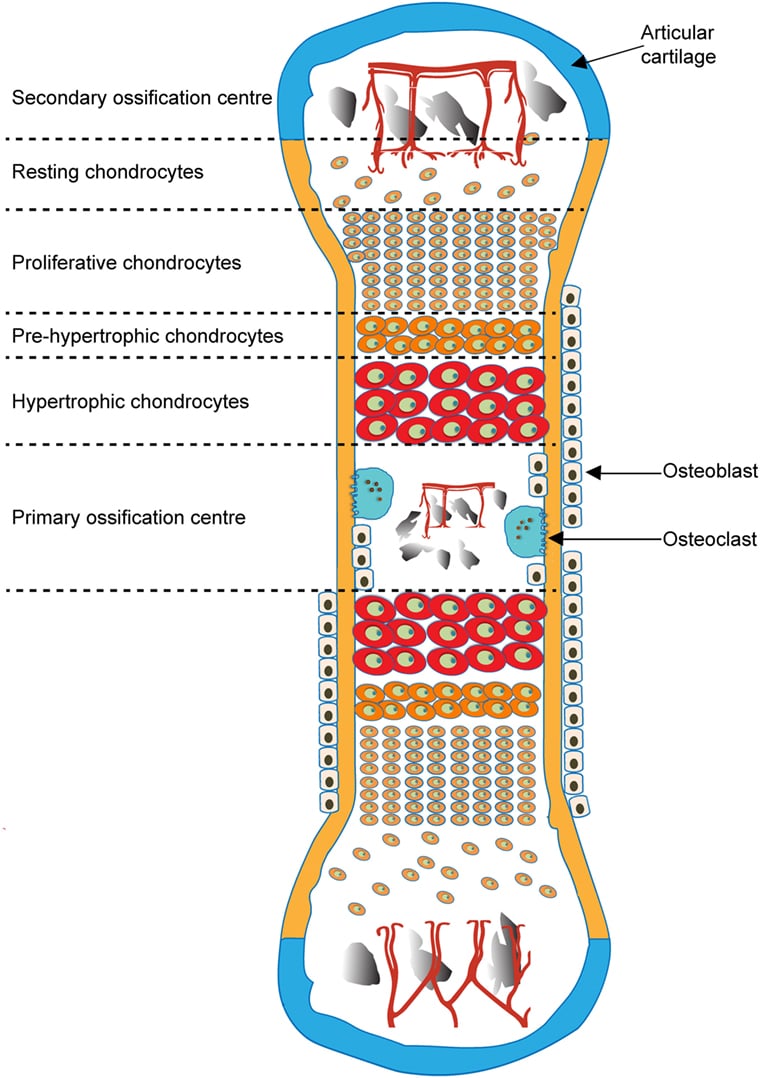
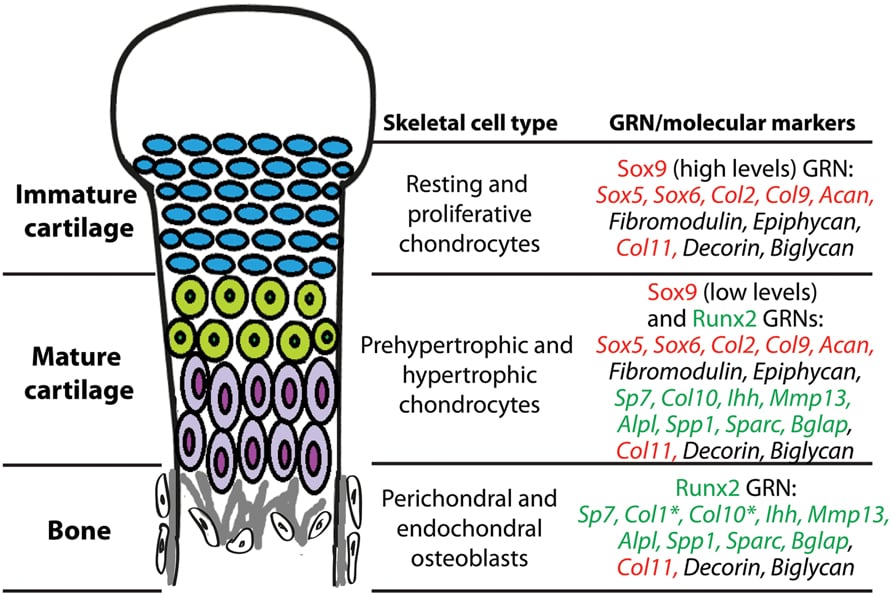
The resting and proliferative zones lay down a type II / IX / XI collagen and aggrecan-rich matrix. In the hypertrophic zone, terminally differentiated chondrocytes switch to type X collagen, release alkaline phosphatase, calcium and matrix vesicles, and the matrix mineralises (provisional calcification) before the cells undergo apoptosis and metaphyseal vessels bring in osteoblasts to form the primary spongiosa.
Blood supply & surrounding structures
- Epiphyseal vessels supply the reserve and proliferative zones. Their disruption is catastrophic for growth because it starves the dividing cells → growth arrest.
- Metaphyseal vessels supply the zone of provisional calcification / ossification front and remove debris; loss impairs ossification but the germinal cells survive.
- Perichondral ring of LaCroix — a fibrous collar around the physis providing mechanical support and limiting shear.
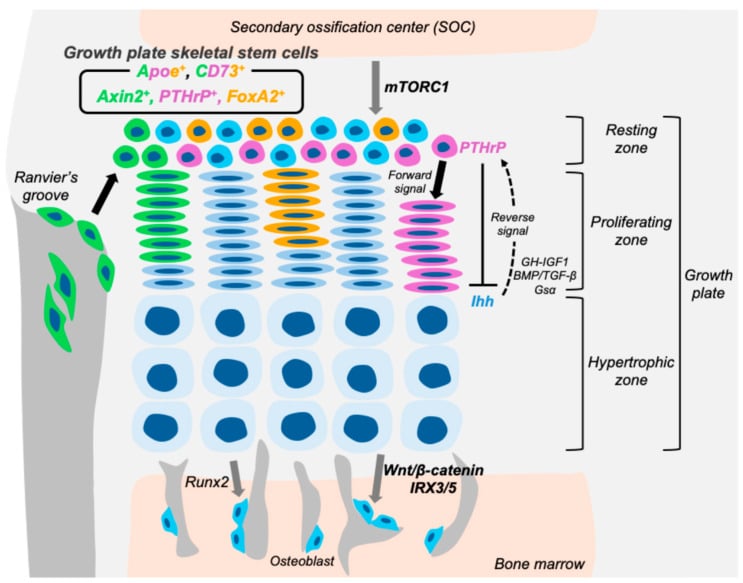
- Groove of Ranvier — a wedge of cells at the periphery that adds chondrocytes peripherally, driving latitudinal (appositional / width) growth of the physis.
Longitudinal growth comes from proliferative-zone column formation plus hypertrophic cell enlargement; latitudinal (width) growth comes from the groove of Ranvier at the periphery. Examiners like the pairing: proliferative zone = length, groove of Ranvier = width, ring of LaCroix = support.
Molecular & endocrine regulation
The pace of chondrocyte maturation is set by a negative-feedback loop. As proliferating chondrocytes begin to mature, they secrete Indian hedgehog (Ihh), which (directly and via the perichondrium) stimulates production of parathyroid hormone-related protein (PTHrP) near the ends of the bone. PTHrP acts on its receptor to keep chondrocytes proliferating and delay their hypertrophic differentiation. As cells move away from the PTHrP source they escape its influence, hypertrophy, and release more Ihh — closing the loop. This PTHrP-Ihh axis tightly controls the proportion of proliferating versus hypertrophic cells and therefore the rate of growth.
- Effect on the growth plate
- Keeps chondrocytes proliferating; delays hypertrophy (with Ihh, the master local loop)
- Effect on the growth plate
- From prehypertrophic cells; stimulates PTHrP and proliferation; couples to osteoblast formation
- Effect on the growth plate
- Stimulates proliferative-zone chondrocytes (GH acts partly directly, partly via IGF-1)
- Effect on the growth plate
- Drives chondrocyte hypertrophy and ossification; deficiency delays bone age
- Effect on the growth plate
- Accelerate maturation and ultimately cause physeal CLOSURE (oestrogen is the key closer in both sexes)
- Effect on the growth plate
- Regulate chondrocyte differentiation and the cartilage-to-bone transition
- Effect on the growth plate
- Vitamin D needed for mineralisation; glucocorticoids suppress growth
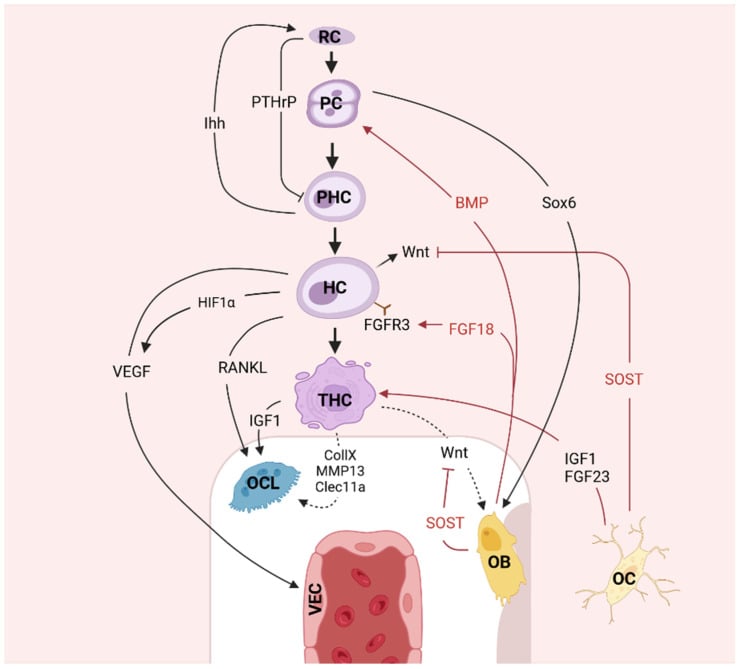
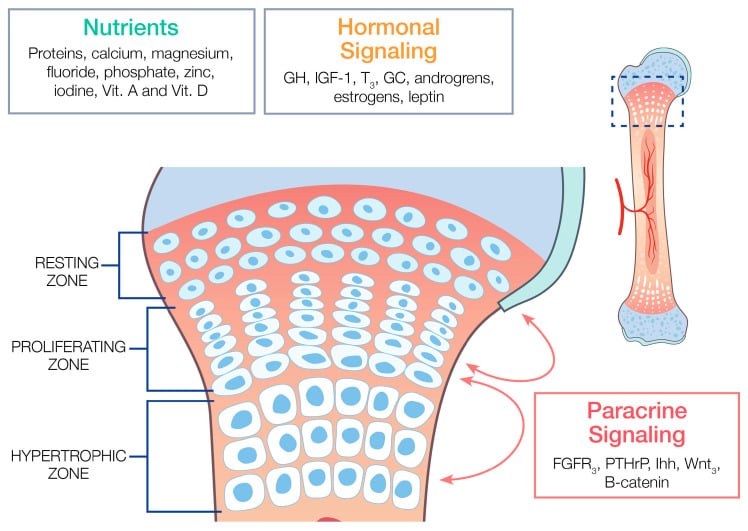
Because these pathways converge on the physis, their disturbance produces recognisable disease: rickets (defective mineralisation) widens the hypertrophic zone and frays the metaphysis; achondroplasia results from an activating FGFR3 mutation that inhibits proliferation; oestrogen ultimately drives physeal closure (precocious puberty → early closure/short stature; deficiency → tall stature); and growth-hormone excess/deficiency alters longitudinal growth.
Clinical significance
Physeal (Salter-Harris) fractures run through the hypertrophic zone; most heal without sequelae, but injury to the germinal zones or a physeal bar causes growth arrest, angular deformity or limb-length discrepancy.
The physis is the seat of skeletal dysplasias, the route of haematogenous osteomyelitis (metaphyseal sluggish flow), and the target of guided-growth surgery (e.g. tension-band plating / epiphysiodesis) that deliberately modulates the plate to correct deformity or length.
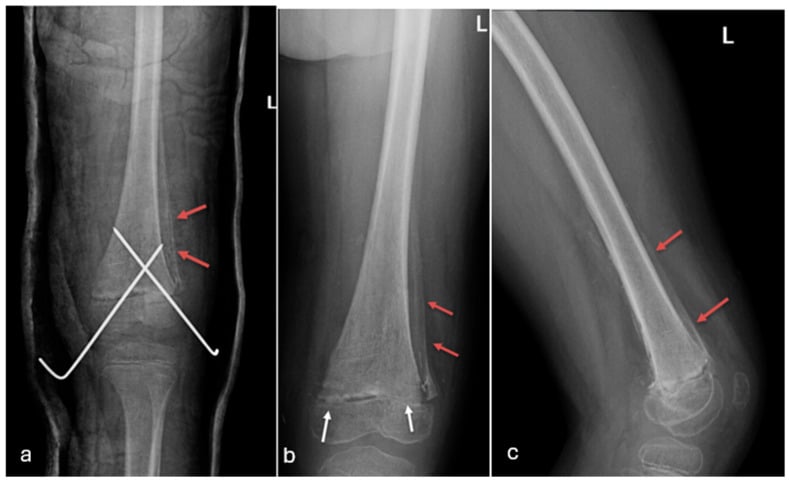
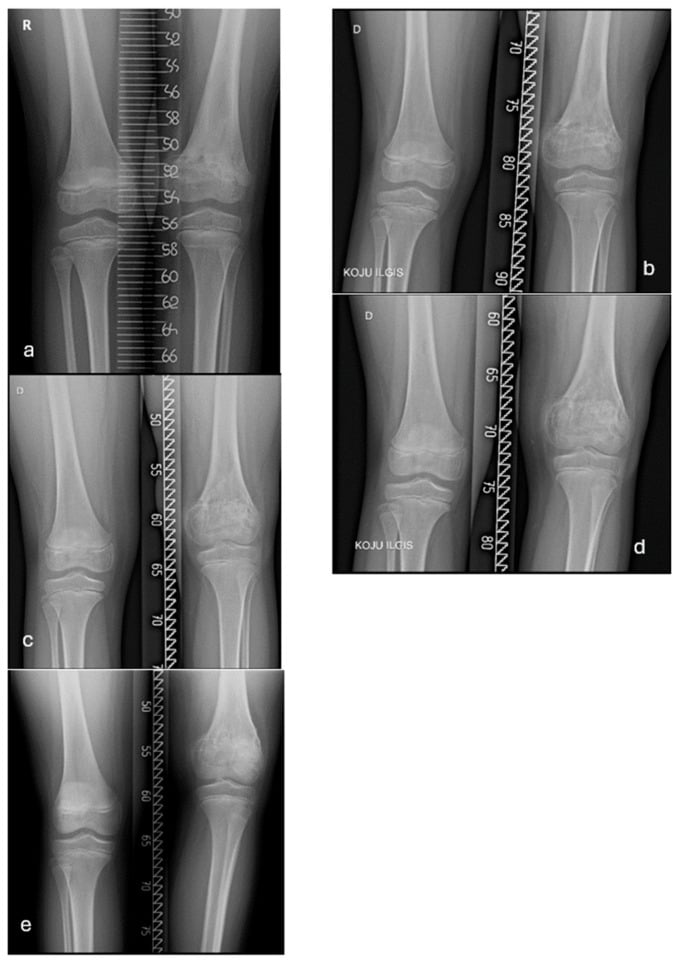
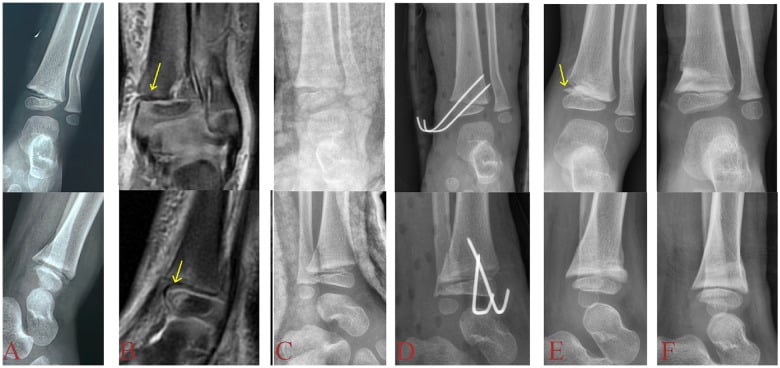
The physis is mechanosensitive. By the Hueter-Volkmann law, increased compression across the plate slows longitudinal growth, while reduced compression (or tension/distraction) accelerates it:
- Guided growth exploits this: a tension-band plate or staple that tethers one side of the physis (a hemiepiphysiodesis) slows that side while the other keeps growing, gradually correcting an angular deformity (e.g. genu valgum/varum). It is reversible — remove the implant and growth resumes — unlike a complete (permanent) epiphysiodesis, which is used to equalise limb length.
- The same principle in reverse explains deformity: pathological compression of part of the plate (e.g. the medial proximal tibia in Blount disease / tibia vara) or an asymmetric physeal bar tethering one region produces progressive angular deformity.
Mnemonics & memory aids
RPHCThe four zones, in order
Hook:'Real Patients Have Cartilage' — Reserve, Proliferative, Hypertrophic, Calcification, top (epiphysis) to bottom (metaphysis).
RANVIERPeriphery & blood supply
Hook:Groove of RANVIER grows the physis wider; ring of LaCroix holds it together.
GO TPSWhat controls the pace of growth
Hook:GO TPS — systemic GH/Oestrogen/Thyroid + local PTHrP-Ihh + Steroids/vitamin D set how fast and how long the physis grows.
Viva practice
Exam viva
Practise clinical reasoning and management decisions out loud
“Describe the histological zones of the growth plate from the epiphysis to the metaphysis, and tell me which zone fails in a physeal fracture and why.”
“How is chondrocyte proliferation and maturation regulated at the growth plate, and how does the periphery of the physis grow?”
Exam cheat sheet
Zones (epiphysis → metaphysis)
- Reserve (resting): germinal, matrix storage, low O2
- Proliferative: dividing columns = LONGITUDINAL growth; high O2/glycogen
- Hypertrophic: cells enlarge/mineralise/apoptose; WEAKEST = Salter-Harris plane
- Provisional calcification / chondro-osseous junction: vessel invasion, primary spongiosa
Blood supply & periphery
- Epiphyseal vessels → reserve/proliferative (loss = growth arrest)
- Metaphyseal vessels → ossification front
- Groove of Ranvier = width (latitudinal) growth; Ring of LaCroix = mechanical support
Regulation
- PTHrP-Ihh feedback loop = master local control (PTHrP delays hypertrophy)
- GH/IGF-1 (proliferation), thyroid (hypertrophy), oestrogen (closes the plate in both sexes)
- BMP/TGF-beta, Wnt/beta-catenin, vitamin D modulate differentiation/mineralisation
Clinical links
- Physeal fractures through the hypertrophic zone; growth arrest if germinal zones/bar
- Rickets widens the hypertrophic/calcification zone; achondroplasia = FGFR3
- Guided growth (tension-band plate / epiphysiodesis) modulates the plate
Evidence Base
Developmental regulation of the growth plate
- Landmark review of endochondral bone formation - the single process generating almost the entire skeleton - and the signalling pathways and transcription factors that control it.
- Synthesises the PTHrP-Indian hedgehog feedback loop, FGF (FGFR3), BMP and Wnt signalling and the master transcription factors (e.g. Sox9, Runx2) governing chondrocyte proliferation and hypertrophy.
- Frames how disturbance of these pathways produces the skeletal dysplasias (e.g. FGFR3 in achondroplasia).
Morphology and physiology of the epiphyseal growth plate
- Describes the multilayer growth plate: resting (protein synthesis/germinal), proliferative (rapid duplication), transformation/hypertrophic and degenerative zones with intensive mineralisation and chondrocyte apoptosis.
- Matrix is composed of collagens (mainly II, IX, X, XI) and proteoglycans (aggrecan, decorin); regulation involves growth/thyroid/sex hormones, beta-catenin, BMPs, IGF, TGF-beta and vitamin D.
- Identifies PTHrP (from the perichondrium) as the most significant factor, stimulating proliferation and delaying hypertrophy, with an Indian hedgehog (Ihh) feedback loop; disturbances cause skeletal dysplasia.
Imaging findings of metabolic bone disease
- Impaired chondrocyte development and failure to mineralise growth-plate cartilage in rickets lead to WIDENED growth plates and frayed metaphyses at sites of greatest growth.
- Thyroid hormone regulates endochondral bone formation; untreated congenital hypothyroidism delays bone age and produces irregular/fragmented epiphyses.
- Illustrates how systemic metabolic derangements manifest specifically at the physis and metaphysis.
The developmental signalling framework (PTHrP-Ihh, FGFR3, BMP/Wnt, Sox9/Runx2) is the classic synthesis of Kronenberg 2003 (DOI); the zonal structure, matrix composition and the PTHrP-Ihh regulatory loop are detailed by Burdan et al. 2009 (DOI); and the physeal manifestations of metabolic bone disease (rickets, hypothyroidism) by Chang et al. 2016 (DOI). The classic descriptions of the perichondral ring of LaCroix, the groove of Ranvier and the dual epiphyseal/metaphyseal blood supply are standard physeal anatomy used in these and related works.