X-Ray Physics for Orthopaedic Surgeons
Air (black, -1000 HU): No absorption
Fat (dark grey, -100 HU): Low absorption
Soft tissue/water (grey, 0-80 HU): Moderate absorption
Bone (white, +400-1000 HU): High absorption via photoelectric effect
Metal (bright white, +3000 HU): Near-complete absorption
Key: Differential absorption between tissues creates image contrast — this is the fundamental principle of radiographic imaging
- X-rays are produced when high-energy electrons strike a tungsten anode, generating Bremsstrahlung (80-90%) and Characteristic radiation (10-20%).
- kVp controls beam penetration (quality): higher kVp = more penetrating beam but lower contrast.
- mAs controls photon quantity (exposure): higher mAs = more photons, higher dose, darker image.
- Inverse Square Law: Intensity is proportional to 1/distance squared. Doubling distance quarters dose.
- Bone appears white (radiopaque) due to high atomic number calcium absorbing more X-rays via the photoelectric effect.
- “Bremsstrahlung = 'braking radiation' = electron deceleration near nucleus = continuous energy spectrum.
- “Photoelectric effect dominates at lower kVp and high Z materials — responsible for bone vs soft tissue contrast.
- “Compton scatter dominates at higher kVp — creates image fog and is the main source of staff radiation exposure.
- “Lead apron attenuates approximately 95% of scatter radiation at diagnostic energies.
- “Paediatric patients require LOWER dose settings due to increased radiosensitivity and longer remaining lifespan.
Overview
Plain radiography remains the first-line imaging modality in orthopaedic practice. Despite the proliferation of advanced cross-sectional imaging, it is the starting point for the vast majority of orthopaedic consultations and the gold standard for fracture diagnosis, alignment assessment, arthritis grading and implant surveillance.
Why it stays first. Acquisition takes seconds, the cost is low globally, and it is universally available in emergency departments and clinics. It gives excellent cortical bone detail with high spatial resolution, and weight-bearing views provide functional information.
What it cannot do.
- It superimposes three-dimensional anatomy onto a two-dimensional projection
- Its soft-tissue contrast is limited, so ligaments, tendons and cartilage cannot be reliably evaluated
- It is projection-dependent, which is why every study needs two views (see the two-view minimum below)
- Its sensitivity for occult fractures is low, with 10-20% of scaphoid fractures initially radiograph-negative
- It uses ionising radiation, though the dose is low for extremity imaging
Three linked factors. The clinical value of a radiograph depends on the physics of image generation (what creates the image), the technical parameters chosen (diagnostic quality with minimum dose) and the reader's interpretive framework (systematic review to avoid missed pathology). All three are examined at fellowship level.
What is examined. Plain radiography physics is commonly examined in both written and viva formats: kVp versus mAs, the two mechanisms of X-ray production, the photoelectric effect versus Compton scatter, and the inverse square law. Practical questions often focus on why you choose specific views, how to optimise dose in pregnancy, and systematic interpretation to avoid missed fractures.
X-Ray Production Physics
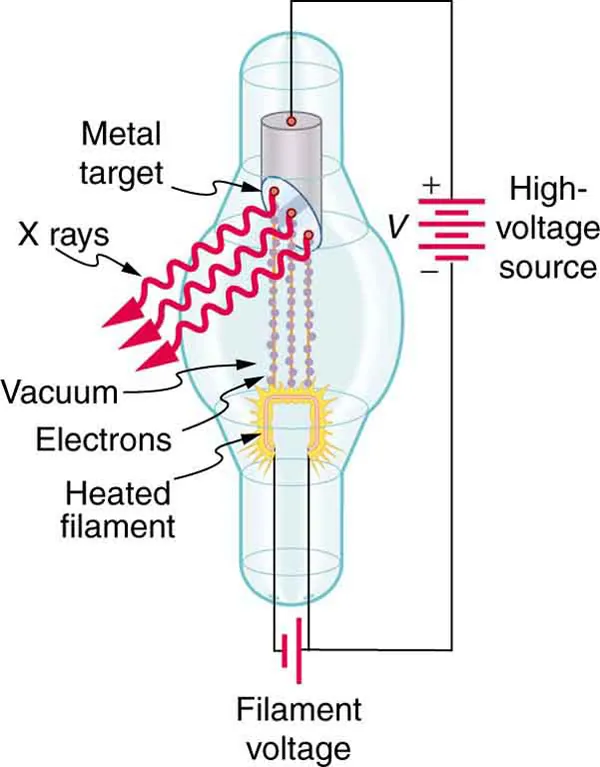
X-rays are electromagnetic radiation with wavelengths between 0.01 and 10 nanometres, which places them between ultraviolet light and gamma rays on the electromagnetic spectrum. In medical imaging they are produced artificially in an X-ray tube, where high-energy electrons interact with a metal target.
X-Ray Tube Components
The tube. A vacuum-sealed glass or metal envelope holds two electrodes. The cathode is a coiled tungsten filament that emits electrons when heated to high temperatures, by thermionic emission. The anode is a large rotating tungsten disc that serves as the electron target, chosen for tungsten's high atomic number of 74 and extremely high melting point of 3422 degrees Celsius.
Acceleration. A high potential difference, measured in kilovolts peak (kVp), is applied across the tube and accelerates the cathode electrons toward the anode at tremendous speed. The X-ray photons they generate exit through a window in the tube housing and form the imaging beam.
Inefficiency. When the electrons strike the anode, their kinetic energy becomes heat (over 99%) and X-ray photons (less than 1%). That extreme inefficiency is why anode rotation and heat dissipation are critical engineering challenges.
Two Mechanisms of X-Ray Production
Bremsstrahlung is German for "braking radiation", and in a viva it is worth explaining in full. When a fast-moving electron passes close to a tungsten nucleus, the strong electrostatic attraction decelerates it, and the kinetic energy lost is emitted as an X-ray photon. Because the electron can pass at varying distances from the nucleus, losing different amounts of energy each time, a continuous spectrum of X-ray energies is produced.
- Bremsstrahlung (Braking)
- Electron decelerates near the nucleus of a target atom, losing energy as an X-ray photon
- Characteristic
- Electron ejects an inner-shell electron from the target atom; outer-shell electron fills the vacancy, emitting a photon of specific energy
- Bremsstrahlung (Braking)
- Continuous spectrum — photons of all energies from zero up to the maximum keV (which equals the kVp)
- Characteristic
- Discrete line spectrum — photons at specific energies determined by the binding energy differences between electron shells
- Bremsstrahlung (Braking)
- 80-90% of the useful X-ray beam
- Characteristic
- 10-20% of the useful X-ray beam
- Bremsstrahlung (Braking)
- Atomic number of the target and the kinetic energy of the incident electron
- Characteristic
- Binding energies of the target atom electron shells (K-shell, L-shell)
- Bremsstrahlung (Braking)
- Provides the majority of imaging photons across the diagnostic energy range
- Characteristic
- Contributes discrete peaks to the energy spectrum; tungsten K-edge characteristic X-rays have energies of 59 and 67 keV
Filtration, Half-Value Layer and Beam Hardening
Soft photons. The raw Bremsstrahlung beam contains a large number of low-energy ("soft") photons that are too weak to pass through the patient and reach the detector. They contribute nothing to the image and are entirely absorbed in superficial tissue, adding only skin dose. Filtration removes them, and it is a high-yield but frequently overlooked exam topic.
- What it is
- Filtration by the tube components themselves (glass envelope, oil, exit window), typically about 0.5-1.0 mm aluminium equivalent
- Clinical relevance
- Always present; the baseline removal of the very softest photons
- What it is
- Thin aluminium sheets (commonly bringing total filtration to about 2.5 mm Al equivalent at diagnostic energies) deliberately placed in the beam
- Clinical relevance
- Mandated by regulation; preferentially absorbs low-energy photons, reducing patient skin dose with little effect on the image
- What it is
- Because soft photons are removed, the remaining beam has a higher mean energy (it is 'harder') even though the maximum energy is unchanged
- Clinical relevance
- Explains why filtration raises mean beam energy and lowers dose; also the cause of the beam-hardening artefact in CT
- What it is
- The thickness of a stated material (usually aluminium) that reduces beam intensity by one half
- Clinical relevance
- The practical measure of beam quality/penetration; a higher HVL means a more penetrating (harder) beam
The viva question. "How do you reduce patient dose without changing the image?" One correct answer is adequate beam filtration: aluminium filters remove the low-energy photons that would only be absorbed in the skin, cutting skin dose while barely affecting the image-forming photons. Beam quality, quantified by the HVL, is increased by both higher kVp and greater filtration. Do not confuse HVL, a measure of penetration, with mAs, a measure of quantity.
Technical Parameters
The two most important operator-controlled parameters are kilovoltage peak (kVp) and milliampere-seconds (mAs). Their effects on the X-ray beam are distinct, and understanding the difference is fundamental.
kVp: Penetration
kVp controls beam quality, the penetrating ability of the beam. Higher kVp accelerates electrons to greater speed before they strike the anode, producing higher-energy, shorter-wavelength photons that penetrate tissue more easily. The cost is contrast: more photons pass through both bone and soft tissue without being absorbed, and the image becomes more uniformly grey.
- Typical kVp
- 50-55
- Rationale
- Thin structures need low kVp for maximum contrast
- Typical kVp
- 55-65
- Rationale
- Moderate soft tissue with fine bony detail required
- Typical kVp
- 60-70
- Rationale
- Larger joints need moderate penetration
- Typical kVp
- 70-80
- Rationale
- Thick soft tissue envelope requires higher penetration
- Typical kVp
- 75-85
- Rationale
- Dense overlapping structures need good penetration
- Typical kVp
- 80-90
- Rationale
- Large body habitus and dense bone
- Typical kVp
- 110-120
- Rationale
- High kVp reduces rib contrast to visualise lungs
The 15% rule. Increasing kVp by 15% has the same effect on image density as doubling the mAs, but with different contrast behaviour. This is the answer expected in an exam.
mAs: Quantity
mAs controls beam quantity, the number of X-ray photons produced. It is the product of tube current (mA) and exposure time in seconds. A higher mA means a hotter cathode filament releasing more electrons per second, and a longer exposure lets electrons flow for longer; both increase the total number of photons and produce a darker, more exposed image. By the reciprocity law, 100 mA for 0.1 s (10 mAs) gives an identical exposure to 200 mA for 0.05 s (10 mAs).
Dose and noise. Doubling mAs doubles patient dose, a directly proportional relationship, but mAs does not change beam energy or penetration, only the number of photons. It primarily affects image noise: insufficient mAs produces a grainy image (quantum mottle).
Automatic exposure control. In digital radiography the AEC system adjusts mAs in real time from the detector signal, which makes manual mAs selection less common. Understanding the principle remains essential, and it is foundational to radiation dose discussions.
Image Formation and Contrast
Radiographic contrast arises from the differential absorption of X-ray photons as they pass through tissues of different composition and density. Two physical interactions dominate at diagnostic X-ray energies.
Photoelectric Effect
Complete absorption. The photoelectric effect is the complete absorption of an incoming X-ray photon by an inner-shell electron. The photon's energy is transferred entirely to the electron, which is ejected as a photoelectron, and an outer-shell electron fills the vacancy, sometimes releasing a characteristic X-ray. All the energy is deposited locally in the patient, and because the photon is fully absorbed it contributes nothing to staff radiation.
Why bone is white. The probability of the photoelectric effect is proportional to Z³/E³, the cube of the atomic number divided by the cube of the photon energy. High-Z material therefore absorbs dramatically more: calcium (Z = 20) in bone against soft tissue with a water-equivalent Z of approximately 7.4. Lower kVp increases photoelectric absorption and so produces higher contrast.
Where it dominates. The photoelectric effect dominates at low kVp and in high-Z material such as bone and contrast agents. It is responsible for the excellent bone-versus-soft-tissue contrast of plain radiography.
Compton Scatter
Partial absorption. Compton scatter occurs when an X-ray photon interacts with a loosely bound outer-shell electron, transferring part of its energy and changing direction. The scattered photon continues in a different direction with reduced energy, so only part of the energy is deposited in the patient.
Where it dominates. Compton scatter dominates at higher kVp (above approximately 30 keV in soft tissue). It is independent of atomic number, depending only on electron density, which is relatively uniform across soft tissues.
Why it matters. Scattered photons that reach the detector carry no useful spatial information, so they create image fog and reduce contrast. They also travel in all directions, including toward staff, which makes Compton scatter the main source of occupational radiation dose.
Controlling Scatter
Several practical measures reduce the degradation of image quality by Compton scatter.
- Collimation limits the X-ray field to the region of interest, which reduces the volume of tissue generating scatter and also reduces patient dose.
- An anti-scatter grid of thin lead strips between patient and detector absorbs obliquely travelling scattered photons while primary beam photons, travelling in a straight line, pass through. Grids improve contrast but require an increase in mAs (typically 2-4 times), increasing patient dose.
- The air gap technique increases the distance between patient and detector so that scattered photons diverge and miss the detector. It is used occasionally for lateral cervical spine and chest imaging.
Systematic Interpretation
A systematic approach to radiograph interpretation is the single most important habit for avoiding missed pathology. Studies consistently show that an unsystematic "gestalt" approach leads to satisfaction of search errors: the discovery of one obvious abnormality causes the reader to stop looking for others. Satisfaction of search is the most dangerous error in radiograph interpretation.
The ABCS Approach
- What to Assess
- Overall bone axis, joint congruity, angular deformity, subluxation, rotational malalignment
- Common Findings
- Fracture displacement, joint dislocation, scoliosis, valgus or varus deformity
- What to Assess
- Cortical integrity (fracture lines), trabecular pattern, bone density (osteopenia), focal lytic or sclerotic lesions, periosteal reaction, bone size and shape
- Common Findings
- Fractures, tumours, infections (Brodie abscess), metabolic bone disease, Paget disease
- What to Assess
- Joint space width and symmetry, subchondral sclerosis, osteophytes, erosions, ankylosis, loose bodies, chondrocalcinosis
- Common Findings
- Osteoarthritis (asymmetric joint space narrowing), inflammatory arthritis (erosions), CPPD (chondrocalcinosis)
- What to Assess
- Swelling, effusion (fat pad signs), calcification, foreign bodies, gas (surgical emphysema), muscle wasting, soft tissue mass
- Common Findings
- Lipohaemarthrosis (fat-fluid level on horizontal beam), posterior fat pad sign (elbow), quadriceps or Achilles calcification
The Two-View Minimum
Two views at 90 degrees. Every long bone and joint requires a minimum of two views at 90 degrees to each other, because a fracture that is invisible on an AP view may be obvious on a lateral. The classic example is the lateral condyle fracture in children, which can appear as a subtle fleck on the AP view but shows a large displaced fragment on the lateral.
A single-view radiograph is an incomplete study. It should prompt a request for the orthogonal view before clinical decisions are made.
View Selection by Region
Knowing which views to request, and why, is a significant advantage in the viva.
- Standard Views
- PA, True Lateral, Oblique
- Key Additional Views
- Scaphoid views (4 projections), Carpal tunnel, Roberts (thumb CMC)
- Standard Views
- AP (full extension), True Lateral (90 degrees flexion)
- Key Additional Views
- Radial head views, Obliques, Greenspan view (coronoid)
- Standard Views
- AP (internal and external rotation), Axillary lateral
- Key Additional Views
- Scapular Y (outlet), West Point (anterior glenoid), Stryker notch (Hill-Sachs)
- Standard Views
- AP, Lateral, Open mouth (odontoid peg)
- Key Additional Views
- Flexion/Extension (instability), Swimmer (C7-T1 junction)
- Standard Views
- AP, Lateral
- Key Additional Views
- Cone-down lateral (pars), Obliques (scotty dog)
- Standard Views
- AP (standing if for arthritis)
- Key Additional Views
- Inlet, Outlet (pelvic ring), Judet obliques (acetabulum)
- Standard Views
- AP Pelvis, Lateral (cross-table or frog)
- Key Additional Views
- Dunn view (45 degrees for cam morphology), False profile (anterior coverage)
- Standard Views
- AP (weight-bearing), True Lateral
- Key Additional Views
- Rosenberg (45 degrees PA flexion weight-bearing), Sunrise/Merchant (patellofemoral), Long-leg alignment
- Standard Views
- AP, Mortise (15-20 degrees internal rotation), Lateral
- Key Additional Views
- Weight-bearing AP (syndesmosis), Stress views (talar tilt, anterior drawer if ligament injury suspected)
- Standard Views
- AP (weight-bearing), Lateral (weight-bearing), Oblique
- Key Additional Views
- Sesamoid axial, Harris heel view (calcaneus), Meary angle assessment
Differential of a Linear Lucency: Fracture vs Mimics
Fracture or mimic. Over-calling or under-calling a lucent line is a common interpretive trap. A true fracture line is typically non-corticated, does not respect anatomy, and is supported by a soft-tissue sign; a benign channel or accessory centre has smooth sclerotic (corticated) margins.
- Distinguishing Features
- Lucency does not follow a known anatomical structure; cortical break/step; often with soft-tissue swelling or effusion
- Resolves the Problem
- Orthogonal view, clinical correlation, repeat film at 10-14 days or CT/MRI
- Distinguishing Features
- Smooth corticated (sclerotic) margins, oblique constant course, no cortical break
- Resolves the Problem
- Recognise typical site (e.g. distal femur, tibia); corticated margin confirms benign
- Distinguishing Features
- Symmetrical, smooth, sclerotic margins, expected location and age; CRITOE sequence at elbow
- Resolves the Problem
- Contralateral comparison view, knowledge of ossification timetable
- Distinguishing Features
- Apparent lucency where two bone edges overlap; not reproducible on other projection
- Resolves the Problem
- Repeat or orthogonal view — line disappears as it is an optical artefact
- Distinguishing Features
- Linear, geometric, extends beyond bone into soft tissue or background
- Resolves the Problem
- Repeat exposure; check grid alignment and processing
- Distinguishing Features
- Smooth corticated cleft, typical location (superolateral patella), often bilateral
- Resolves the Problem
- Corticated margins and bilaterality distinguish from acute fracture
Specific Radiographic Signs
Certain radiographic signs are pathognomonic or highly suggestive of specific diagnoses, and they are commonly tested at fellowship level.
Fat Pad Signs
Fat pads are radiolucent structures that become visible or displaced when the adjacent joint develops an effusion, so recognising them gives indirect evidence of occult pathology. These signs are frequently used as viva image stations.
The elbow. The posterior fat pad is normally hidden within the olecranon fossa; an effusion pushes it posteriorly, creating a visible lucent triangle behind the distal humerus on the lateral view. The anterior fat pad is normally a thin lucent stripe, and when it is elevated and sail-shaped (the sail sign) it indicates an intra-articular effusion.
Elbow trauma with no visible fracture. A positive fat pad sign indicates an occult fracture, most commonly a radial head fracture in adults. It warrants further evaluation, or immobilisation and follow-up imaging.
Knee lipohaemarthrosis. A horizontal-beam lateral radiograph of the knee may show a fat-fluid level within the suprapatellar pouch. It occurs when an intra-articular fracture releases marrow fat into the joint, where the fat layers above the blood because of its lower density. The sign indicates an occult intra-articular fracture, most commonly of the tibial plateau, even when no fracture line is visible on standard views.
Key Alignment Lines
These lines are essential viva knowledge.
- Shenton line. A smooth continuous arc runs from the inferior border of the superior pubic ramus along the medial border of the femoral neck. Disruption of the arc indicates hip pathology: dislocation, fracture or developmental dysplasia.
- Anterior humeral line. Drawn along the anterior cortex of the humerus on the lateral elbow view, it should pass through the middle third of the capitellum. If it passes through the anterior third, consider a posteriorly displaced supracondylar fracture.
- Radiocapitellar line. Drawn along the long axis of the proximal radius, it should pass through the centre of the capitellum on all views. Failure indicates radial head dislocation (Monteggia equivalent).
- Böhler angle. The angle formed between the posterior facet and anterior process of the calcaneus on the lateral view is normally 20-40 degrees. Flattening to less than 20 degrees suggests a calcaneal compression fracture.
Radiation Safety in Practice
Every orthopaedic surgeon who requests or supervises radiographic examinations has a legal and ethical obligation to understand radiation safety. The guiding framework is the ALARA principle: as low as reasonably achievable.
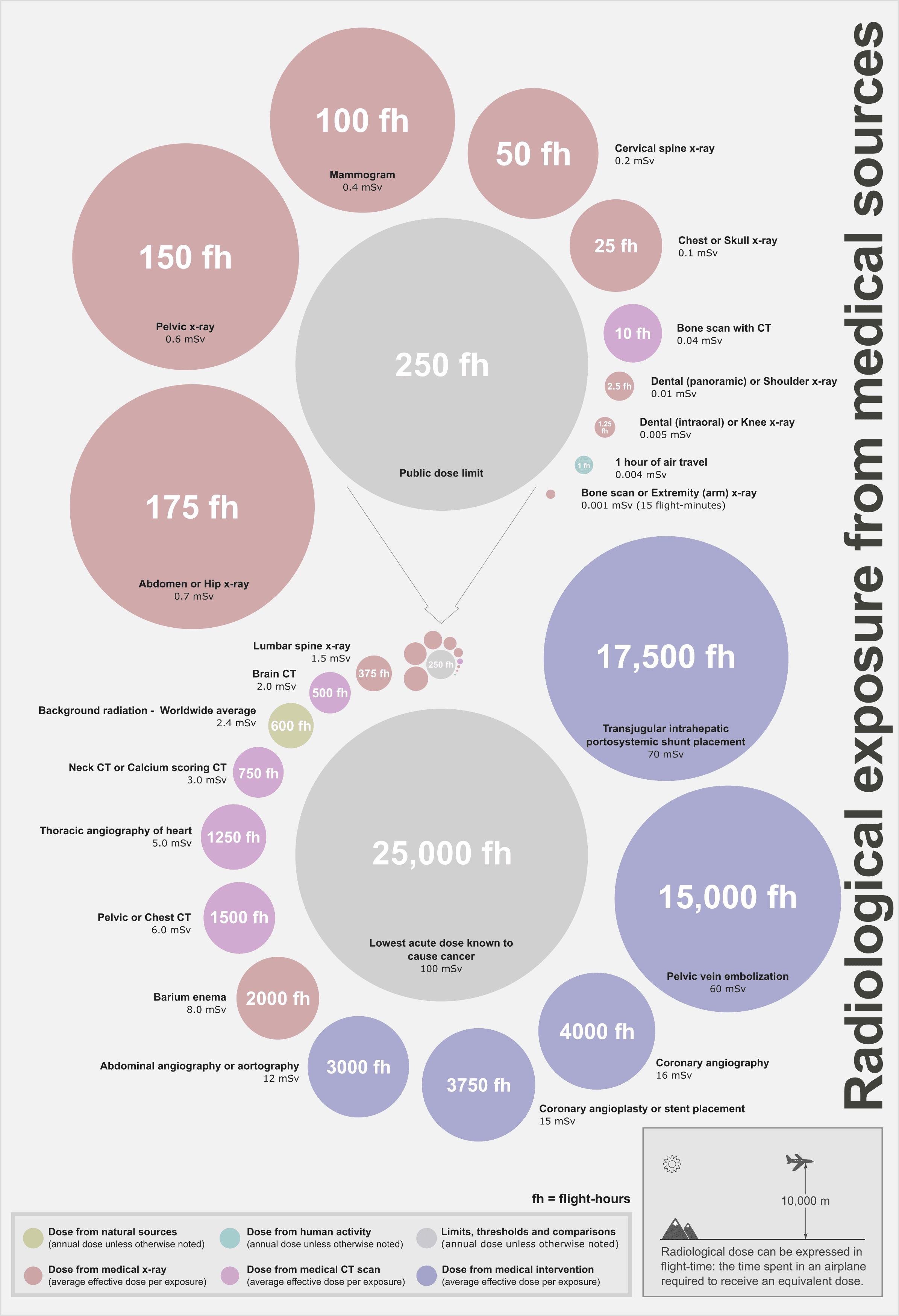
Dose Reference Values
- Effective Dose (mSv)
- 0.001-0.01
- Equivalent Natural Background
- A few hours
- Context
- Negligible dose — safe in virtually all circumstances including pregnancy
- Effective Dose (mSv)
- 0.02
- Equivalent Natural Background
- 2-3 days
- Context
- Very low dose — the standard reference examination for dose comparison
- Effective Dose (mSv)
- 0.01-0.05
- Equivalent Natural Background
- 1-5 days
- Context
- Low dose — no specific precautions needed
- Effective Dose (mSv)
- 0.3-0.7
- Equivalent Natural Background
- 1-4 months
- Context
- Moderate dose - collimation and exposure factors control this dose, not a lead flap (see gonadal shielding below)
- Effective Dose (mSv)
- 1.0-1.5
- Equivalent Natural Background
- 5-8 months
- Context
- Higher dose — justify indication and minimise repeat exposures
- Effective Dose (mSv)
- 6-20
- Equivalent Natural Background
- 2-7 years
- Context
- High dose — always require clear clinical justification
Protection Principles
The three principles of protection are time, distance and shielding.
- Time. Minimise exposure duration. In fluoroscopy, use pulsed rather than continuous mode, use last-image-hold to review without ongoing radiation, and plan the procedure to minimise screening time; in plain radiography, avoid unnecessary repeat exposures by ensuring correct positioning before exposure.
- Distance. By the inverse square law, doubling the distance from the radiation source reduces dose to one-quarter, so standing 2 metres from a fluoroscopy source instead of 1 metre reduces your exposure by 75%. In theatre, stand as far from the C-arm as practically possible during screening.
- Shielding. A lead apron (minimum 0.25 mm Pb equivalent, preferably 0.5 mm for wrap-around) is mandatory during fluoroscopy. A thyroid shield is strongly recommended, and lead glasses (0.75 mm Pb equivalent) should be worn by high-volume fluoroscopy users.
Gonadal Shielding
The guidance has reversed, and this is now a viva discriminator. Both the American Association of Physicists in Medicine (2019) and the British Institute of Radiology (2020) issued position statements recommending that routine gonadal contact shielding be discontinued. Three reasons converged.
- Mispositioning. Shields are frequently mispositioned: a meta-analysis of 2,187 paediatric pelvic radiographs found them significantly more often placed inaccurately in girls than boys. A misplaced shield obscures the very anatomy being imaged and buys a repeat exposure.
- Automatic exposure control. A shield entering the field makes the AEC increase output, raising rather than lowering dose.
- No demonstrated hereditary risk. The hereditary risk that motivated the practice in the early 1900s has never been demonstrated in humans, and the gonadal tissue weighting factor has been revised sharply downwards as doses fell.
What to say instead. The evidence is strongest for stopping in girls; some centres retain shielding selectively in boys or for reassurance, and that is defensible only with training and audit. Say that dose is controlled by collimation, exposure factors and avoiding the repeat: shielding was never the primary protective measure.
Image Quality Optimisation
Diagnostic image quality is a balance between four parameters, all of which can be optimised by understanding the underlying physics.
- Definition
- Ability to distinguish adjacent structures of different density
- Optimised By
- Lower kVp (increases photoelectric absorption), collimation (reduces scatter), grid use
- Degraded By
- Higher kVp (more Compton scatter), large field size, patient obesity
- Definition
- Ability to resolve fine structural detail
- Optimised By
- Small focal spot, short exposure time (reduces motion blur), short object-to-detector distance (OID)
- Degraded By
- Large focal spot, patient motion, magnification (long OID)
- Definition
- Random statistical fluctuation creating a grainy appearance
- Optimised By
- Adequate mAs (sufficient photon count), slower detector readout
- Degraded By
- Low mAs (insufficient photons), fast detector readout, high receptor sensitivity settings
- Definition
- Magnification or shape change of the imaged structure
- Optimised By
- Long source-to-image distance (SID, standard 100cm), short OID, perpendicular beam alignment
- Degraded By
- Short SID, long OID, angled beam (unless intentionally used for specific views)
Digital vs Film Radiography
Modern digital systems, computed radiography using phosphor plates or direct digital radiography using flat-panel detectors, have largely replaced film-screen systems. They offer a wider dynamic range that is more forgiving of exposure errors, post-processing capability (window/level adjustment, edge enhancement), immediate image availability, and electronic storage and retrieval.
Dose creep. The wider dynamic range can mask overexposure, because the image remains diagnostic even at unnecessarily high doses. The result may be dose creep, a gradual increase in exposure settings, and quality assurance programmes must monitor exposure indices to prevent it.
Anode Geometry: the Heel Effect and the Line-Focus Principle
Two consequences of the angled anode are classic physics-viva material and are not captured by the kVp/mAs framework above.
- Mechanism
- X-rays produced within the angled anode are partly self-absorbed by the anode material itself, so beam intensity is greater on the cathode side of the field and weaker on the anode side
- Practical exploitation
- Position the thicker/denser part of the anatomy toward the cathode (more intense) end and the thinner part toward the anode end to even out exposure (e.g. thicker thigh toward cathode for a femur). More pronounced with large fields, short SID and small anode angles
- Mechanism
- The anode is steeply angled so that a relatively large actual focal spot (good for spreading heat) projects as a small effective focal spot toward the patient (good for sharpness)
- Practical exploitation
- Allows high tube heat loading while keeping geometric unsharpness low; a smaller effective focal spot improves spatial resolution at the cost of heat capacity
- Mechanism
- A finite focal spot casts a penumbra at edges; blur worsens with a larger focal spot, longer object-to-detector distance and shorter source-to-image distance
- Practical exploitation
- Use a small focal spot, keep the part close to the detector and the tube far away (standard 100 cm SID) to minimise geometric unsharpness and magnification
In the viva. If asked why one end of a femur or thoracic-spine film is darker than the other, and how you would use that, name the anode heel effect and place the thicker body part toward the cathode so the final image has more uniform density. Pair it with the line-focus principle: the angled anode gives a small effective focal spot (a sharp image) from a large actual focal spot (good heat dissipation).
Guidelines, Registries & Global Practice
Plain radiography is the highest-volume diagnostic imaging examination worldwide, and medical exposure is now the largest man-made source of population radiation dose. The governing principles — justification, optimisation and dose limitation — are internationally harmonised through the International Commission on Radiological Protection (ICRP), with diagnostic reference levels (DRLs) operationalised regionally. The framework is the same on every continent; only the numerical DRLs and the regulator differ.
Global Regulatory and Guideline Landscape
- Role
- Source framework for all national rules
- Key Position
- Justification, optimisation (ALARA), dose limitation; publishes DRLs concept
- Basis
- Consensus, expert
- Role
- Adopted by member states into national law
- Key Position
- Mandates DRLs, QA programmes and patient dose recording
- Basis
- Consensus, expert
- Role
- Evidence-based ordering guidance
- Key Position
- Radiograph first-line for most acute musculoskeletal trauma; advanced imaging for occult/complex injury
- Basis
- Systematic review
- Role
- Referral guidelines and dose governance
- Key Position
- Two orthogonal views standard; clinical decision rules to limit unnecessary radiographs
- Basis
- Guideline
- Role
- DRLs and dose-optimisation campaign
- Key Position
- Paediatric and adult DRLs; promotes digital optimisation over film
- Basis
- Consensus, expert
- Role
- Regional DRLs and requesting standards
- Key Position
- Regional DRLs broadly aligned with international values; standardised justified requesting
- Basis
- Survey, guideline
Clinical Decision Rules — the Global Standard for Justification
The single most exam-relevant point is that radiographs should be justified, not reflexive. Validated decision rules reduce unnecessary radiography by 25-40% while maintaining near-100% sensitivity for clinically important fractures, and are recommended across the ACR, NICE/RCR and European frameworks.
- Ottawa Ankle and Foot Rules — image only if there is bony tenderness at the posterior malleolar edges, the navicular or base of the fifth metatarsal, or inability to weight-bear; validated at 100% sensitivity for ankle and midfoot fracture.
- Ottawa Knee Rule — image only with age 55 years or older, isolated patellar tenderness, fibular head tenderness, inability to flex to 90 degrees, or inability to weight-bear.
- Canadian C-spine Rule / NEXUS — identify which alert, stable trauma patients can be cleared clinically without cervical radiography.
Occupational Dose Governance (Globally Harmonised)
Orthopaedic and trauma surgeons receive among the highest occupational radiation exposures of any non-radiology specialty because of intra-operative fluoroscopy. The ICRP occupational effective-dose limit — adopted near-identically by national regulators worldwide — is 20 mSv per year averaged over five years, with no single year exceeding 50 mSv, and a 20 mSv equivalent-dose limit to the lens of the eye. Personal dosimetry (thermoluminescent or optically stimulated luminescence badges, worn at collar level outside the apron) is mandatory for regularly exposed staff in every jurisdiction.
Practice Variation
In high-resource settings the debate centres on optimisation: pulsed and low-dose fluoroscopy, dose-creep surveillance on digital systems, and reducing repeat exposures. In limited-resource settings the constraints differ — film-screen systems may persist, automatic exposure control may be unavailable, and access to cross-sectional imaging for occult fractures is restricted, increasing reliance on serial radiographs and clinical follow-up. The principle of justified, optimised, two-view radiography is universal; the technology available to deliver it is not.
Special Considerations
Paediatric Radiography
Children are more radiosensitive than adults because of their rapidly dividing cells and the longer remaining lifespan over which stochastic effects (cancer) can develop. The ALARA principle is therefore even more important in paediatric imaging.
- Dose reduction. Use lower kVp and mAs settings. Modern protocols reduce paediatric extremity doses by 30-50% compared with adult settings.
- Gonadal shielding. Routine contact shielding is no longer recommended, as set out under radiation safety above.
- Immobilisation without restraint. Use positioning aids rather than manual holding by staff or parents where possible. If a parent must assist, they must wear full protective equipment, and the exposed parent should ideally not be pregnant.
- Comparison views. A contralateral comparison radiograph may be justified when the normal appearance of ossification centres makes it difficult to distinguish a fracture from a developing physis. Routine comparison views should not be performed unless clinically indicated, because each additional radiograph adds dose.
- Growth plate awareness. Open physes can mimic fracture lines, and knowledge of the age-dependent ossification centres (CRITOE for the elbow) is essential to avoid misdiagnosis.
Imaging in Pregnancy
Risk depends on dose and gestational age. The highest-risk period for teratogenesis is organogenesis (2-8 weeks); beyond 15 weeks, the threshold for major malformation is well above any diagnostic imaging dose. The stochastic risk of future cancer is estimated at approximately 1 in 10,000 per mGy of fetal dose, and fetal dose should be kept below 1 mGy throughout pregnancy.
Extremity radiographs are safe. The fetal dose from a hand, wrist, ankle or knee radiograph is effectively zero, and the fetal risk negligible, because the beam is directed far from the uterus.
Pelvic and abdominal imaging. It requires careful justification and optimisation. A single AP pelvis radiograph delivers approximately 1 mGy to the uterus, well below the 100 mGy threshold for deterministic effects, but repeated exposures and CT scanning can accumulate meaningful doses.
Alternatives. MRI is preferred for non-urgent indications: it does not use ionising radiation and is considered safe in the second and third trimesters (avoid gadolinium if possible). Ultrasound is first-line for many soft-tissue and periarticular questions.
Abdominal lead shielding does NOT fully protect the fetus. It does not protect from internal scatter within the patient's body, which accounts for most of the fetal dose during torso imaging, and the only reliable dose reduction is to reduce the primary beam parameters and field size. Field collimation and technique optimisation are more effective dose reduction strategies than shielding.
Never withhold clinically essential imaging in pregnancy, but always document the risk-benefit discussion.
Common Artefacts
Recognising radiographic artefacts prevents misdiagnosis and unnecessary further investigation, and it matters in quality assurance discussions.
- Cause
- Patient or tube movement during exposure
- Appearance
- Blurred cortical margins, loss of fine detail
- Solution
- Shorter exposure time, immobilisation, repeat if non-diagnostic
- Cause
- Misaligned anti-scatter grid
- Appearance
- Peripheral darkening or banding pattern
- Solution
- Correct grid alignment, ensure grid is centred to beam
- Cause
- Compton scatter photons reaching detector
- Appearance
- Overall greying with reduced contrast
- Solution
- Collimation, grid use, lower kVp if appropriate
- Cause
- Two exposures on the same detector
- Appearance
- Superimposed anatomy creating confusing appearance
- Solution
- Digital systems prevent this; check for processing errors
- Cause
- Jewellery, clothing snaps, surgical implants
- Appearance
- Bright white opacity obscuring underlying anatomy
- Solution
- Remove external objects; for implants, use adjusted technique and additional views
- Cause
- Insufficient mAs (too few photons)
- Appearance
- Grainy, speckled appearance with poor signal-to-noise ratio
- Solution
- Increase mAs (with corresponding dose increase)
Controversies & Areas of Uncertainty
Radiographic physics is settled. What to do with it is not, and three of these have changed within the working lifetime of current consultants.
Patient contact shielding. Routine gonadal shielding was near-universal for a century before the reversal described under radiation safety. The residual debate is whether to retain it selectively in boys, or for patient reassurance, and how to explain the change to families who expect a lead apron. It stays unresolved because the harm of a misplaced shield is measurable while the benefit was always theoretical, and abandoning a visible safety ritual is a communication problem as much as a physics one.
Dose creep in digital radiography. Film was self-policing: overexpose it and the image went black. On a digital detector an overexposed image looks excellent, the extra dose simply producing a cleaner picture, and the result is a documented tendency for departmental doses to drift upward over time. The exposure index exists to detect it, but it is vendor-specific, inconsistently monitored and invisible to the clinician requesting the film, so the person who could notice has no feedback loop.
The linear no-threshold model at radiographic doses. Every dose figure quoted here is interpreted through the LNT assumption, that risk is proportional to dose with no safe threshold. It is a deliberately conservative protection convention extrapolated from high-dose data, not a measured effect at the microsievert level of an extremity radiograph. At these doses the predicted excess is far below the statistical noise around a lifetime cancer incidence of roughly 40%, so no study can settle it. Quote risks with the model named, and neither claim "there is no risk" nor imply a measured one.
How many views, and when. The two-view minimum is a sound rule that is nonetheless applied unevenly: additional obliques and stress views are ordered by habit as often as by question, and each carries dose and cost for a variable yield. The value of an extra view depends on the specific fracture being excluded and on who is reading it, so blanket protocols either over-image the simple case or under-image the subtle one. The defensible position is to name the question each view answers before requesting it.
Clinical Decision Scenarios
Practise clinical reasoning and management decisions out loud
“You are shown a radiograph of a patient's elbow after a fall. The AP view appears normal but the lateral view shows an elevated anterior fat pad (sail sign) and a visible posterior fat pad.”
“A 28-year-old woman requires a pelvic radiograph following a road traffic collision. She tells you she might be pregnant.”
“An examiner asks you to explain the physics of X-ray production and describe why bone appears white on a radiograph.”
X-Ray Physics
- kVp = beam quality (penetration); mAs = beam quantity (number of photons)
- Bremsstrahlung (80-90%) = continuous spectrum; Characteristic (10-20%) = discrete peaks
- Inverse Square Law: Intensity proportional to 1/d squared — double distance = quarter dose
- Photoelectric effect proportional to Z cubed — creates bone vs soft tissue contrast
- Over 99% of electron kinetic energy becomes heat; less than 1% produces X-rays
ABCS Systematic Interpretation
- A = Alignment (joint congruity, angular deformity, subluxation)
- B = Bone (cortex, trabeculae, density, lesions, periosteal reaction)
- C = Cartilage and Joints (joint space, subchondral sclerosis, osteophytes, erosions)
- S = Soft tissues (swelling, effusion, calcification, foreign bodies, gas)
Radiation Safety (ALARA)
- Three principles: Time, Distance, Shielding
- Extremity radiograph 0.001-0.01 mSv; Pelvis 0.3-0.7 mSv; CT 6-20 mSv
- Pregnancy: fetal deterministic threshold approximately 100 mGy
- Lead apron attenuates approximately 95% of scatter at diagnostic energies
- 15% increase in kVp has the same density effect as doubling mAs
Key Radiographic Signs
- Posterior fat pad sign (elbow) = occult fracture until proven otherwise
- Lipohemarthrosis (knee) = intra-articular fracture releasing marrow fat
- Shenton line disruption = hip pathology (fracture, dislocation, DDH)
- Anterior humeral line should pass through middle third of capitellum
- Radiocapitellar line must pass through capitellum on ALL views
Standard Views
- Minimum 2 views at 90 degrees for every long bone and joint
- Elbow: AP in extension, lateral at 90 degrees flexion
- Shoulder: AP (IR/ER) plus axillary lateral
- Knee: Weight-bearing AP, true lateral, Rosenberg for posterior condyles
- Ankle: AP, Mortise (15-20 degrees IR), Lateral
Evidence Base
ICRP Publication 135: Diagnostic Reference Levels in Medical Imaging
- Established international diagnostic reference levels (DRLs) for common radiographic examinations across all anatomical regions.
- DRLs are not dose limits but investigation levels — facilities consistently exceeding them should review and optimise their protocols.
- Plain radiography delivers the lowest effective doses among ionising imaging modalities, supporting its role as the first-line investigation.
ARPANSA Diagnostic Reference Levels for Medical Imaging
- Regional Australia-New Zealand diagnostic reference levels cover common radiographic procedures including chest, pelvis, lumbar spine, and extremity examinations.
- These DRLs are broadly consistent with international benchmarks while reflecting regional equipment profiles and practice patterns.
- Recommends regular dose audits with comparison to DRLs as part of quality assurance programmes.
European Guidelines on Diagnostic Reference Levels
- European DRLs for paediatric and adult radiographic examinations with specific recommendations for dose-sensitive populations.
- Emphasises the importance of DRLs as a quality improvement tool, not a regulatory limit.
- Highlights the significant dose reductions achievable through modern digital radiography compared to film-screen systems.
Guidelines provide the regulatory framework for safe radiographic practice.