Paediatric | O'Brien Classification | Reduction Techniques
- Less than 30° angulation = no reduction needed in children under 10 years
- Less than 45° angulation = acceptable in children over 10 years
- Closed reduction first: Patterson supination-valgus manoeuvre, Israeli technique (thumb pressure)
- Percutaneous K-wire joystick reduction when closed reduction fails
- Avoid open reduction if possible - high rate of stiffness and AVN
- “Radial head does not ossify until age 3-5; neck fractures are more common in children
- “Posterior interosseous nerve (PIN) at risk - assess finger and thumb extension
- “Open reduction associated with higher complication rates
- “Metaizeau technique: ESIN reduction without opening
Overview and Epidemiology
Radial neck fractures make up 5-10% of paediatric elbow fractures. The peak age is 9-10 years, boys and girls are affected equally, and the usual story is a fall in the playground or at sport. This page is the radial-neck deep-dive; the olecranon fractures, elbow dislocations and medial-epicondyle injuries that accompany it are covered on the companion Pediatric Elbow Injuries page, and the two are read together.
Why the neck and not the head. In a child the radial head is largely cartilaginous, and the physis and neck are weaker than the annular ligament. The force that fractures the head in an adult therefore breaks the neck in a child. The ossification centre of the radial head appears at 3-5 years.
Mechanism. A fall on the outstretched hand with the elbow extended, delivering a valgus force with an axial load.
Associated injuries. 50% of these children have another elbow injury, and around 10% have an elbow dislocation. A Monteggia variant may carry a radial neck injury.
- Elbow dislocation
- Olecranon fractures
- Ulna fractures (Monteggia variant)
- Medial epicondyle fractures
- Capitellum injuries
Anatomy and Biomechanics
The radiocapitellar joint. The radial head articulates with the capitellum, and the joint allows both flexion-extension and rotation. The annular ligament stabilises the radial head; its disruption allows dislocation. In forearm rotation the radius turns around the ulna, and an angulated neck limits pronation and supination.
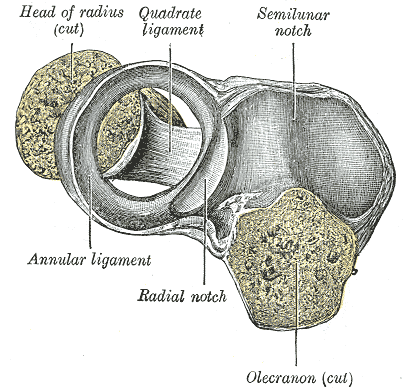
Blood supply. The radial head is fed mainly by periosteal vessels around the neck; intramedullary flow is minimal. Disrupting those vessels during open reduction can cause avascular necrosis, and stripping the annular ligament is how that supply is lost, so any operation preserves the soft tissues and the ligament.
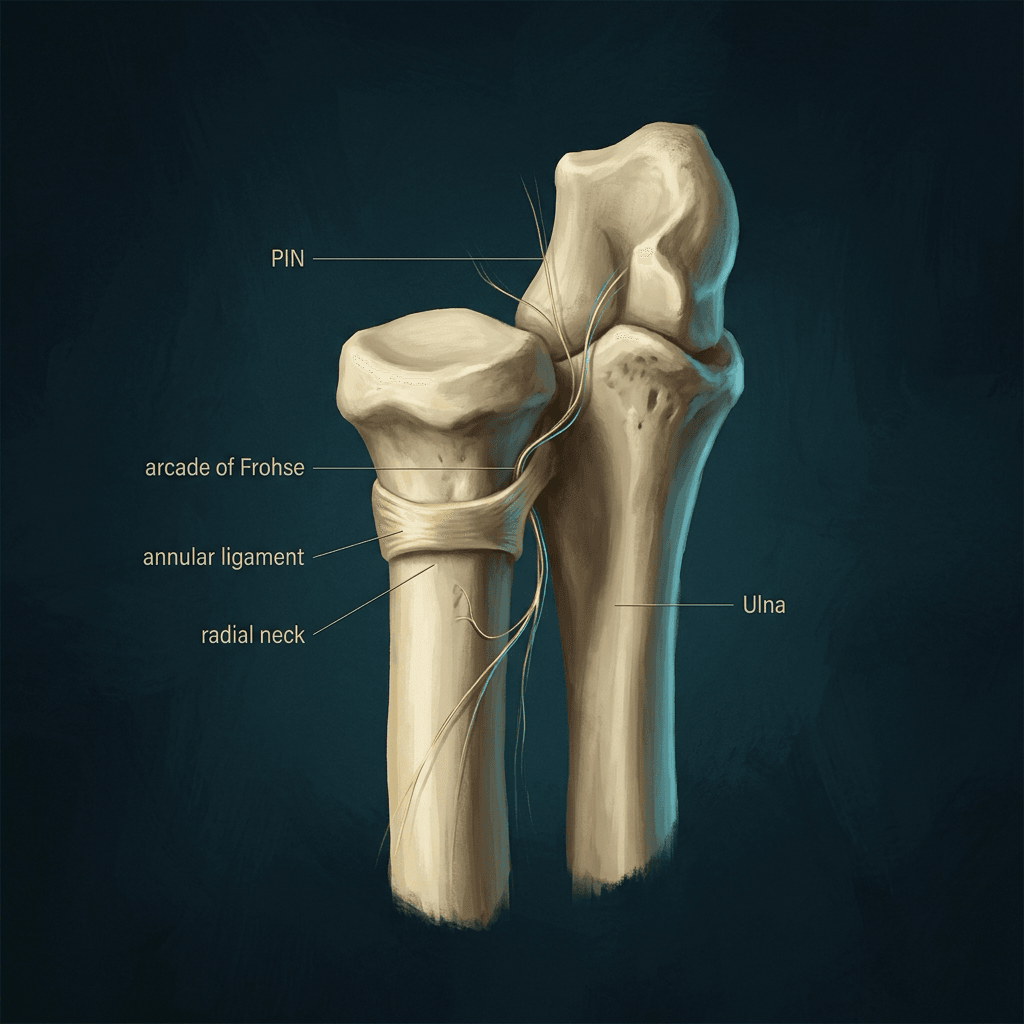
The posterior interosseous nerve. The PIN is the deep branch of the radial nerve. It runs anteriorly around the radial neck and enters supinator at the arcade of Frohse, which puts it at risk both from the injury and from percutaneous and open procedures. It is purely motor, supplying the finger extensors (EDC, EIP) and the thumb extensors (EPL, EPB).
Classification Systems
Two systems are in use. O'Brien grades angulation alone, measured against the shaft axis on the lateral radiograph (see Investigations). Judet combines angulation with translation and is used for prognosis; O'Brien is the angulation number, Judet is what you operate on. Judet IV is the head off the neck, divided into IVa, where the head still contacts the metaphysis, and IVb, where it is free. Judet III-IV fractures are the ones that climb the closed, percutaneous, Metaizeau ladder. An O'Brien type IV is a completely displaced head at 90°, which describes displacement; it is not a comminuted head.
Read the treatment column alongside Management: open reduction is reached when closed, percutaneous and intramedullary techniques have failed, or for the other indications listed there.
- Angulation
- Less than 30°
- Treatment
- Non-operative
- Angulation
- 30-60°
- Treatment
- Closed reduction
- Angulation
- Greater than 60°
- Treatment
- Percutaneous or open reduction
- Angulation
- 90° (complete displacement)
- Treatment
- Usually requires open reduction
- Description
- Angulation less than 30°
- Displacement
- None
- Description
- 30-60° angulation
- Displacement
- Less than 50% displacement
- Description
- Greater than 60° angulation
- Displacement
- 50-100% displacement
- Description
- Complete displacement
- Displacement
- Dissociation
Physeal Pattern and Growth Disturbance
O'Brien and Judet describe the deformity, but the examiner also expects the physeal anatomy of the injury and what a growth disturbance would cause.
The fracture pattern. Most injuries are either a physeal separation through the proximal radial physis, Salter-Harris type I or, more often, type II, or a purely metaphyseal (subcapital) neck fracture just distal to it.
Growth. The proximal radial physis contributes only about 20-25% of the radius's length; the distal physis does the bulk. Pure longitudinal growth loss from a proximal injury is therefore usually modest.
Remodelling. Children remodel these fractures well, helped by the physis's contribution to growth and a robust blood supply, and the correction comes largely from the physis re-orienting the tilted head. Because remodelling depends on remaining growth, the younger child remodels best and the older child less, which is why the acceptable angle tightens with age and why modest residual angulation is accepted in young children. That, alongside the case against excision below, is why a conservative, head-preserving strategy is favoured.
Premature physeal arrest. Severe injury or open reduction can close the proximal radial physis early. The result is radial head and neck deformity, relative radial shortening with positive ulnar variance, and altered radiocapitellar congruity.
Clinical Assessment
History. A fall on the outstretched hand with a valgus mechanism, followed by lateral elbow pain and difficulty rotating the forearm. Ask whether the elbow dislocated.
Examination. Tenderness is lateral, with swelling over the radiocapitellar region and limited pronation and supination. Test elbow stability and PIN function, and look for the associated injuries listed above.
Test before and after any intervention. Ask the child to extend the fingers at the MCP joints and the thumb at the IP joint, and compare with the other side. PIN injury presents as weak or absent extension, and is usually a neurapraxia with complete recovery.
Investigations
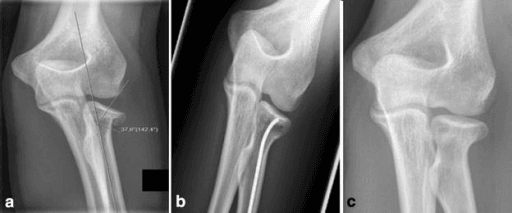
Radiographs. AP and lateral views of the elbow. Angulation is measured on a true lateral, not a rotated film:
- Draw a line through the axis of the radial shaft
- Draw a line through the centre of the radial head, perpendicular to its articular surface
- The angle between them is the angulation; normally the two lines are nearly collinear, less than 15°
That number, not an impression that the head "looks a bit off", sets the classification and the treatment, and puts the child on the 30° or the 45° pathway. Check the same films for an elbow dislocation, an ulna fracture or an olecranon fracture.
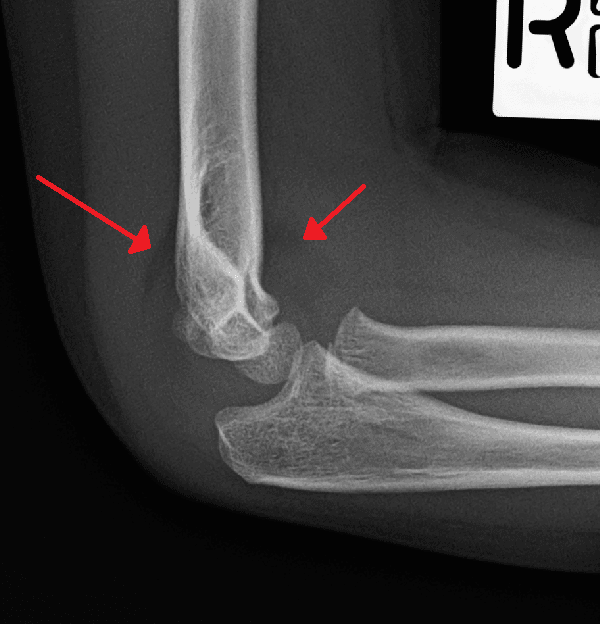
The fat pads. A visible posterior fat pad after trauma is an intra-articular fracture until proven otherwise; if the supracondylar region is clean, look at the radial neck. The sail sign is the anterior pad lifted by the same effusion and is not a diagnosis on its own.
Differential Diagnosis
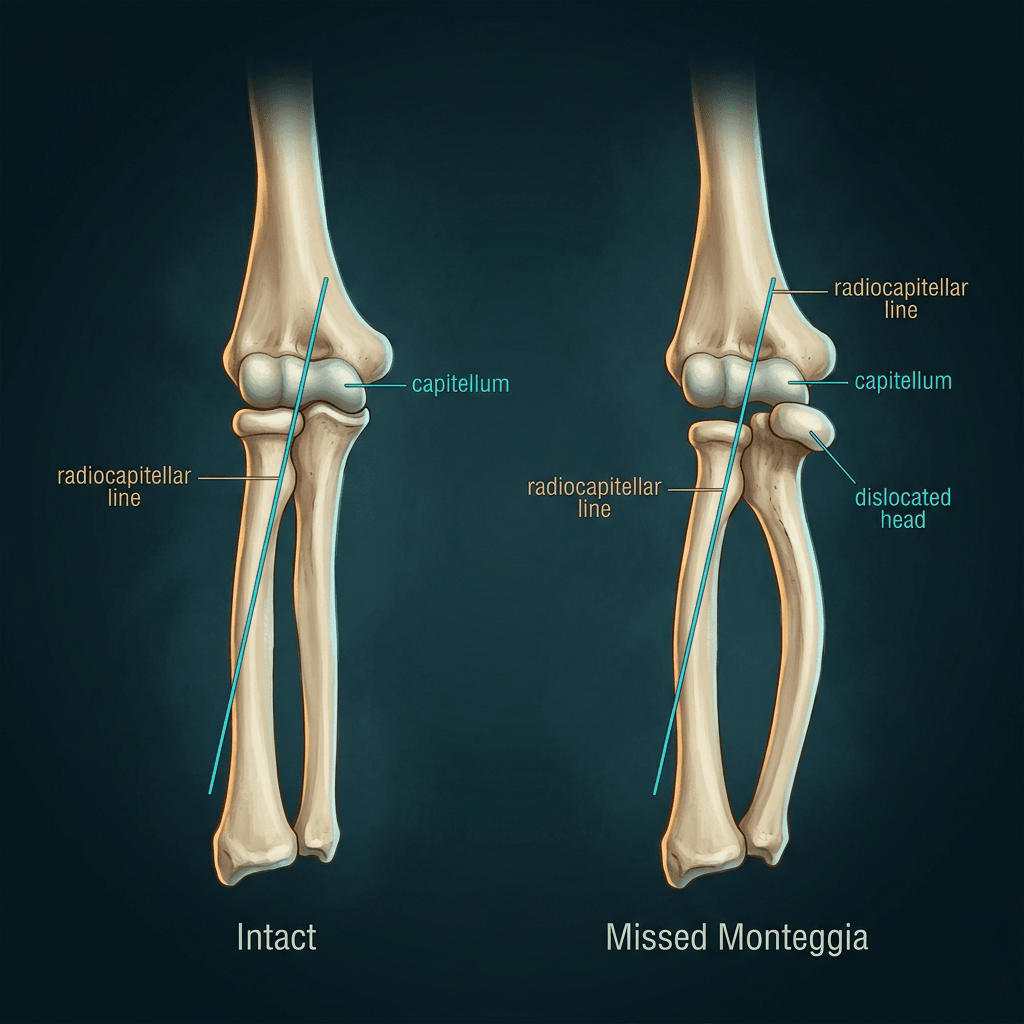
The painful, swollen, rotation-restricted child's elbow has several mimics. On plain film the radiocapitellar line and the radial neck angle on a true lateral separate them.
- Key clinical clue
- Lateral tenderness, painful pronation/supination
- Radiographic discriminator
- Angulation/translation of head on neck; radiocapitellar line intact through head
- Why it matters
- Remodels well; reduction only if over threshold
- Key clinical clue
- Toddler, axial traction history, arm held pronated, no swelling
- Radiographic discriminator
- Normal radiographs (often reduced by positioning for the film)
- Why it matters
- No fracture; supination-flexion manoeuvre cures it, do not over-investigate
- Key clinical clue
- Ulnar deformity or tenderness with elbow injury
- Radiographic discriminator
- Radiocapitellar line does NOT pass through capitellum; ulna bowed or fractured
- Why it matters
- Missed dislocation if you fixate on the radius; reduce the ulna first
- Key clinical clue
- Lateral tenderness, fat pad sign
- Radiographic discriminator
- Metaphyseal fragment lateral distal humerus, NOT radial neck
- Why it matters
- Intra-articular, Salter-Harris IV, often needs fixation; high non-union risk if missed
- Key clinical clue
- Mechanical block, effusion in older child
- Radiographic discriminator
- Defect or loose body at capitellum; radial head intact
- Why it matters
- Different operative plan; MRI often needed
- Key clinical clue
- Painless, chronic, often bilateral, found incidentally
- Radiographic discriminator
- Dome-shaped/hypoplastic radial head, convex articular surface, no acute fracture line
- Why it matters
- Do not attempt acute reduction of a chronic/congenital head
Trace the radiocapitellar line on every paediatric elbow film: a line through the centre of the radial neck must point at the capitellum in all views. If it does not, you are looking at a Monteggia-equivalent, not an isolated radial neck fracture. Second, a normal-looking film in a toddler with a classic traction history is a pulled elbow, not an occult fracture.
Management
Avoid open reduction if possible. Escalate one step at a time: closed reduction, then percutaneous K-wire reduction, then intramedullary reduction (Metaizeau), and open reduction only as the last resort. The reasons are under Complications.
What is acceptable. In a child under 10 years, angulation of less than 30° needs no reduction; over 10 years, and in adolescents, less than 45° is accepted. The difference is the remodelling capacity described above. Both numbers are conventions rather than trial-derived values, and the evidence behind them is discussed in the Evidence Base and Controversies sections.
Above the threshold, the angle sets the first step. The table applies the under-10 threshold; in a child over 10 the 30-45° row lies within the accepted range.
- Classification
- O'Brien Type I
- Management
- Non-operative - cast
- Classification
- O'Brien Type II
- Management
- Closed reduction attempted
- Classification
- O'Brien Type II
- Management
- Closed or percutaneous reduction
- Classification
- O'Brien Type III-IV
- Management
- Percutaneous/Metaizeau/consider open
Non-operative. For angulation within the threshold and a stable elbow: an above-elbow cast or splint for 2-3 weeks, early range-of-motion exercises after that, and full activity at 6 weeks. These fractures remodel well.
Closed reduction. In outline: flex the elbow, valgus the forearm, supinate, and put a thumb on the head. Under sedation, the Patterson manoeuvre applies valgus stress while supinating the forearm, with direct thumb pressure over the radial head. The Israeli technique relies on direct thumb pressure over the radial head while reducing. If the head comes down to less than 30° in a young child or 45° in an older one, stop there. An above-elbow cast follows for 3-4 weeks, with a radiograph to confirm the reduction is maintained.
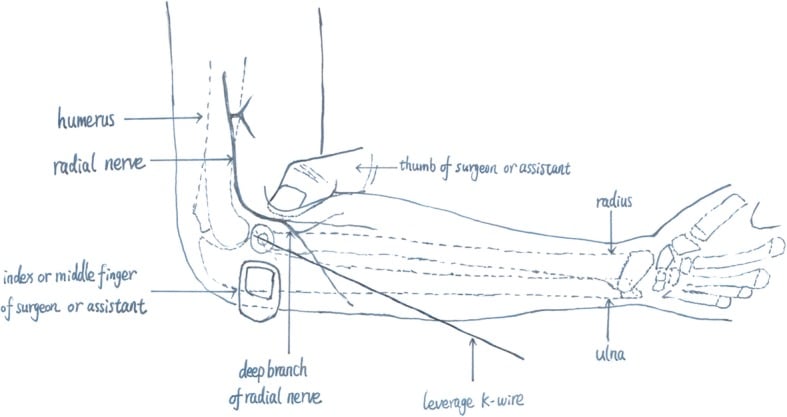
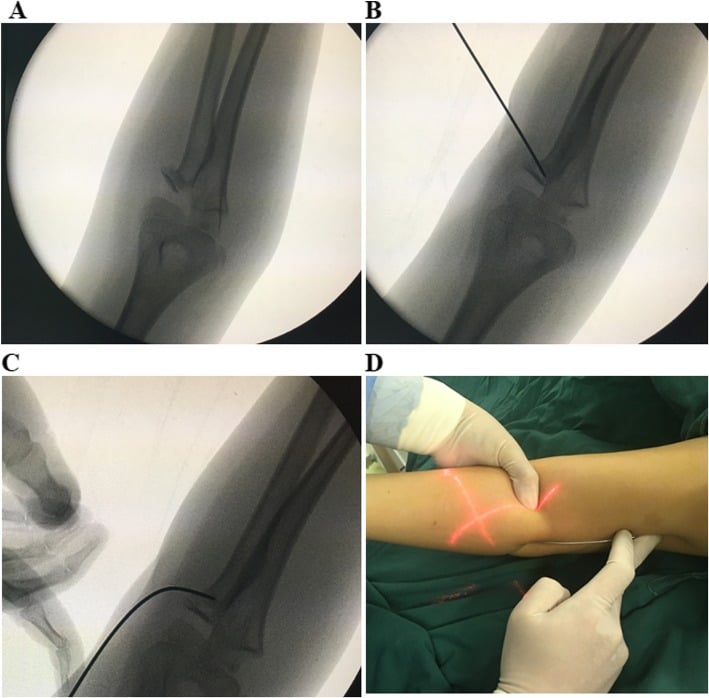
Percutaneous K-wire reduction. Indicated after a failed closed reduction, for angulation of 30-60°. A K-wire at the fracture site is used as a joystick to reduce the angulated head (technique below).
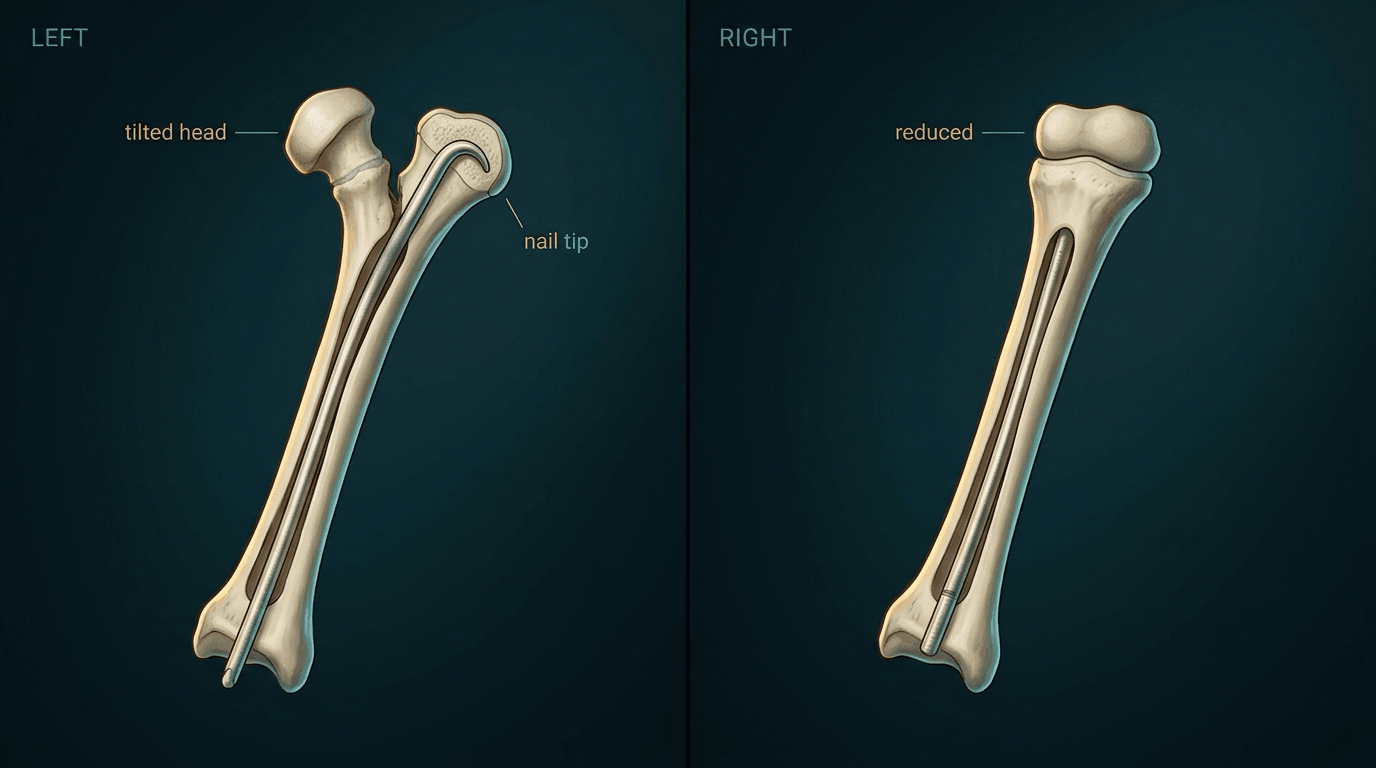
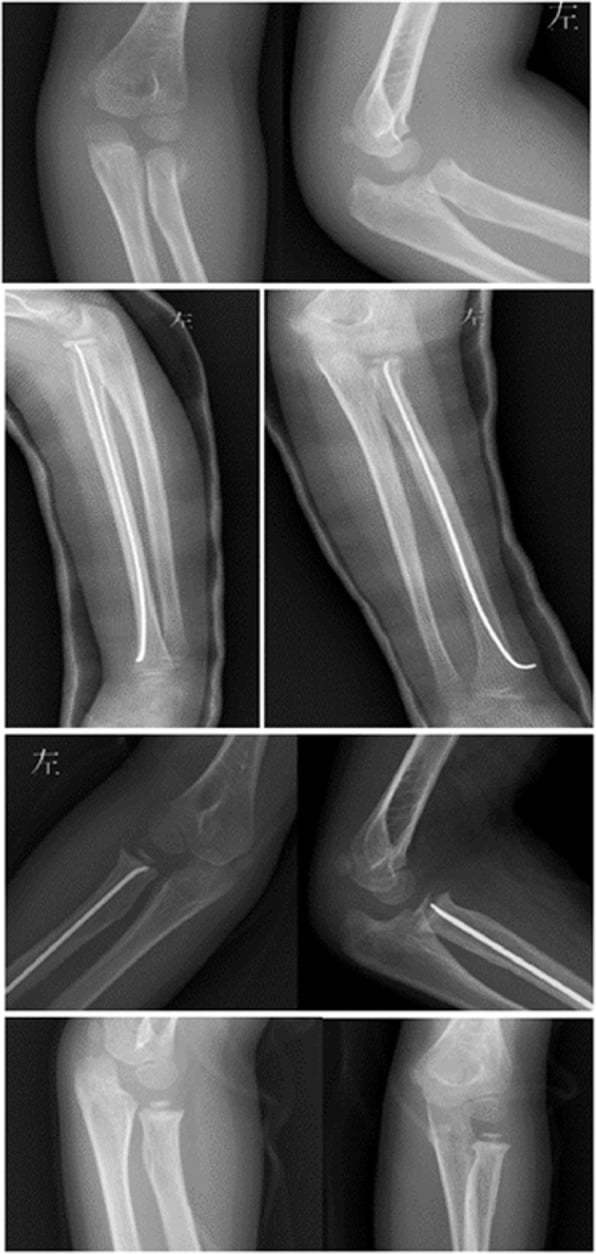
Intramedullary reduction (Metaizeau). Its indications are significant angulation, over 60°, and failed percutaneous reduction. A flexible nail passed up from the distal radius, avoiding the physis, is advanced to the radial head and reduces it by lever action, achieving reduction without opening.
Open reduction. Reserved for failure of all closed techniques, an incarcerated fragment, or associated injuries that need surgery in their own right.
Surgical Technique Considerations
Percutaneous K-wire reduction. The child lies supine under sedation or general anaesthesia, with fluoroscopy. A 1.5-2mm K-wire goes in from the lateral side into the fracture site beside the tilted radial head and is used as a joystick, levering the head back into position under gentle supination. The wire may be left for stability or removed; an above-elbow cast follows, and the wire is removed at 2-3 weeks.
Metaizeau intramedullary reduction. A pre-bent elastic nail goes in from the distal radius and its tip is engaged in the tilted epiphysis. Rotating the nail about 180° swings the head onto the neck, so the nail is both the reducer and the splint. A percutaneous K-wire joystick may help the head onto the nail, and that is still not an open reduction. Leave the nail until the neck has united: pulling it early is how the head tilts back.
Open reduction. The Kocher approach (posterolateral), between ECU and anconeus, is the most common. Identify the radial head, preserve the annular ligament if intact, minimise soft-tissue stripping to keep the periosteal blood supply, and fix, usually with K-wires or a small fragment screw if the fragment is large enough.
The PIN runs around the anterior radial neck. Place the percutaneous wire from lateral and avoid anterior penetration; in open surgery avoid excessive anterior retraction. An anterior K-wire, or a retractor levered on the neck, is how a neurapraxia becomes an iatrogenic lesion.
Complications
- Incidence
- 20-50%
- Management
- Usually pronation/supination. Most improve with time.
- Incidence
- 5-15%
- Management
- Mostly neurapraxia and mostly recovers. The lower figures come from mixed series; the largest operative cohort on this page reported 14.9% after surgery (Yang, 101 children), so quote the higher end when consenting for an operation.
- Incidence
- 4-10%
- Management
- Related to open reduction - the same series reported 4.0% overall. Often radiographic and better tolerated than in adults; many remodel or stay asymptomatic. Do NOT excise the head in a growing child (see Radial Head Excision).
- Incidence
- Rare
- Management
- Cross-union, most often after open reduction. Excision of the synostosis mass is a different operation from radial head excision - resect the cross-union and interpose, but preserve the radial head in the immature elbow.
- Incidence
- Variable
- Management
- Accept some angulation. Remodelling helps.
- Incidence
- Rare
- Management
- May limit motion. Excise if mature and symptomatic.
Why open reduction is the last resort. Open reduction has 2-3x the complication rate of closed methods. Stiffness reaches up to 50% after open reduction against 10-20% after closed, and AVN and radioulnar synostosis occur almost exclusively after open procedures. Post-traumatic radiohumeral arthritis is a further complication of open reduction.
Postoperative Care
Post-Treatment Protocol
Above-elbow cast or splint. Elbow at 90°. Neutral forearm rotation. Non-weight bearing.
Remove cast. Begin active ROM - focus on pronation/supination. Avoid passive stretching.
Progressive strengthening. Return to light activities. Avoid contact sports.
Full return to sports. Monitor for late stiffness. Some ROM loss may persist but often not functional.
Outcomes and Prognosis
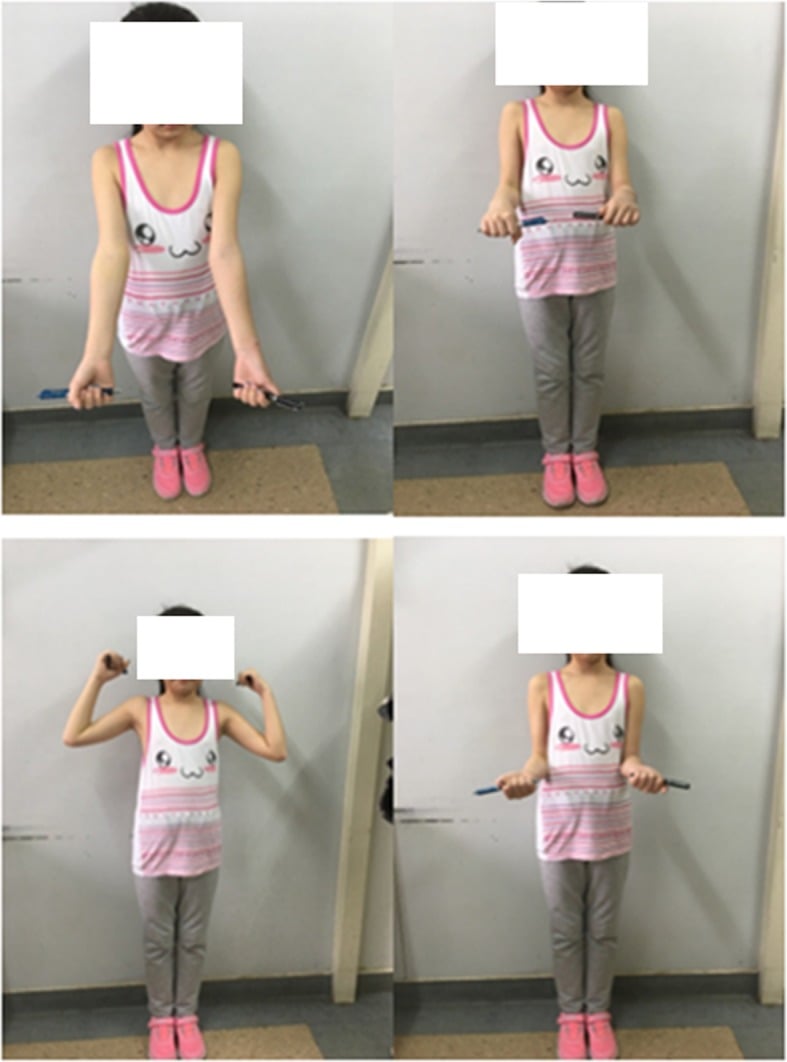
By treatment. A fracture of less than 30° treated non-operatively has an excellent prognosis, with full range of motion expected and complete remodelling. After a successful closed reduction the outcome is good; some minor loss of motion is common but rarely functional. Percutaneous and Metaizeau reductions give intermediate results, better than open reduction, which carries the higher complication rate and the risk of AVN.
Guidelines, Registries & Global Practice
Across AAOS, BOA/BSCOS (UK), AO Foundation and EFORT/European paediatric practice, the philosophy is identical and evidence-consistent: accept and remodel modest angulation, reduce closed when over threshold, escalate to intramedullary (Métaizeau/ESIN) for severe displacement, and treat open reduction as a last resort. There is no formal single-society guideline document specific to this fracture, so practice rests on the technique and outcome literature rather than a named protocol.
- Acceptable angulation
- ~30° young, up to ~45° adolescent
- Preferred operative escalation
- Closed → percutaneous joystick → ESIN; open last
- Emphasis
- Remodelling potential, avoid arthrotomy stiffness
- Acceptable angulation
- Conservative bias for moderate angulation
- Preferred operative escalation
- ESIN (Métaizeau) for severe displacement
- Emphasis
- Minimally invasive, day-case where possible
- Acceptable angulation
- Threshold ~30-45° by age
- Preferred operative escalation
- Intramedullary reduction/stabilisation favoured
- Emphasis
- Soft-tissue and vascular preservation
- Acceptable angulation
- Up to ~50° may remodel in young
- Preferred operative escalation
- Métaizeau ESIN as standard for displaced
- Emphasis
- Originator-driven technique adoption
- Roughly 5-10% of paediatric elbow fractures and about 1% of all paediatric fractures
- Peak age 9-10 years; near-equal sex distribution
- Mechanism is consistent worldwide: fall on an outstretched hand with a valgus, axially loaded extended elbow
- Associated injuries in up to ~50% (elbow dislocation ~10%, olecranon, medial epicondyle, ulna)
- No dedicated arthroplasty/implant registry captures this paediatric fracture (registries focus on adult joint replacement)
- Evidence base is retrospective series plus one systematic review/meta-analysis, not registry or trial data
- This evidence gap is itself an exam discussion point: management is consensus- and technique-driven
- Image intensifier and elastic nails readily available, enabling closed Métaizeau/ESIN as the default for severe displacement
- Paediatric anaesthesia and day-surgery pathways support early closed intervention
- Ready access to nerve conduction studies for non-recovering PIN palsy
- Without fluoroscopy or elastic nails, more reliance on closed manipulation and casting, with open reduction used earlier when closed fails
- Strong remodelling potential makes a conservative-first strategy both pragmatic and evidence-supported where implants are scarce
- Threshold for acceptance of residual angulation may be pushed higher when surgical capacity is limited
Special Considerations
With elbow dislocation. Reduce the dislocation first, then assess the position of the radial head. Fixation may be needed if the head is unstable once the dislocation is reduced.
Monteggia-like injuries. An ulna fracture with a radial head or neck injury. Assess the PRUJ and radiocapitellar alignment on every forearm radiograph. Anatomic reduction of the ulna usually reduces the radial head; direct reduction may be needed if it stays displaced.
Radial Head Excision: Contraindicated in Children
In the skeletally immature child, excising the radial head is contraindicated, or at most a true last resort, whereas in adults it is an accepted option for an unreconstructable head. That contrast is a classic adult-versus-child examiner discriminator, and the rule is to preserve the child's radial head whenever possible.
- Mechanism
- Loss of the radiocapitellar buttress lets the radius migrate proximally
- Mechanism
- Valgus drift of the elbow stretches the ulnar nerve over time
- Mechanism
- Relative radial shortening makes the ulna ride long at the wrist and overload the DRUJ
- Mechanism
- The radial head normally stabilises the PRUJ, so excision destabilises the whole forearm unit
If the head is genuinely unreconstructable, with severe avascular necrosis or fragmentation, delay any excision until skeletal maturity if at all possible.
Controversies and Areas of Uncertainty
The classic teaching of 30° (young) / 45° (older) is a convention, not trial-derived. Vocke and Von Laer documented spontaneous correction of angulation up to 50° in conservatively treated children, prompting some surgeons to accept higher residual angulation in patients with substantial remodelling potential. There is no consensus threshold and no randomised data to anchor it.
Most thresholds quote angulation, but translation (the Judet axis) may matter as much. A markedly translated but only moderately angulated head can still impede rotation. Decisions should integrate both, plus the child's age and remaining growth.
With ESIN/Métaizeau there is no agreement on retention time. Leaving the nail stabilises the epiphysis against secondary displacement, but adds a second anaesthetic for removal and a small risk of nail-end skin irritation. Practice ranges from a few weeks to several months.
Post-intervention nerve palsy rates (up to ~15% in operative series) blur injury-related and treatment-related causes. Whether percutaneous joystick or lateral elastic nailing genuinely raises iatrogenic PIN risk over the injury itself is unresolved, which is why baseline neurological documentation is mandatory.
MCQ Practice Points
Q: What angulation threshold is acceptable for non-operative management in a 7-year-old? A: Less than 30°. Younger children have greater remodeling potential. Older children (over 10) = 45° threshold.
Q: Which nerve is at risk in radial neck fractures? A: Posterior interosseous nerve (PIN). Motor branch of radial nerve. Test finger and thumb extension.
Q: How is a K-wire used to reduce a radial neck fracture percutaneously? A: As a joystick. Percutaneous K-wire inserted adjacent to radial head, used to lever head into position.
Q: Why should open reduction be avoided in radial neck fractures? A: Higher complication rates. Stiffness (up to 50%), AVN, and radioulnar synostosis all more common with open reduction.
Q: What is O'Brien Type III radial neck fracture? A: Greater than 60° angulation. Usually requires percutaneous or open reduction.
Q: What is the Metaizeau technique? A: ESIN reduction. Flexible nail inserted through distal radius, used to lever radial head from below without opening.
Exam Viva Scenarios
Practise clinical reasoning and management decisions out loud
“A 9-year-old girl falls on an outstretched hand. X-ray shows a radial neck fracture with 40° angulation. Finger and thumb extension are normal. How would you manage this?”
“An 8-year-old boy has a radial neck fracture with 70° angulation and moderate translation. Closed reduction under sedation failed to improve angulation beyond 50°. What are your next steps?”
“You perform closed reduction of a radial neck fracture. Post-reduction, the child cannot extend their fingers at the MCPs or their thumb at the IP joint. What is your assessment and management?”
Angulation Thresholds
- Less than 30° = non-operative (under 10 years)
- Less than 45° = non-operative (over 10 years)
- Greater than 30-45° = reduction indicated
- Greater than 60° = percutaneous or ESIN/open
O'Brien Classification
- Type I: less than 30° (non-operative)
- Type II: 30-60° (closed reduction)
- Type III: greater than 60° (perc/open)
- Type IV: 90°/complete (usually open)
Reduction Escalation
- Closed first (Patterson supination-valgus)
- Then percutaneous K-wire joystick
- Then Metaizeau ESIN
- Open reduction LAST resort
Avoid Open Because
- Stiffness up to 50%
- AVN of radial head
- Radioulnar synostosis
- Higher overall complication rate
PIN Injury
- 5-10% incidence
- Test finger/thumb extension
- Usually neurapraxia
- Recovery expected 3-6 months
Evidence Base and Key Studies
There are no randomised controlled trials in paediatric radial neck fractures. The literature is built on retrospective series, a systematic review/meta-analysis, and the original technique-describing papers. The consistent signal across all of them: closed/intramedullary reduction outperforms open reduction, and open surgery is the strongest independent predictor of a poor functional result. O'Brien (1965) and Judet (1962) are the classic classification papers and predate PubMed indexing — they are cited here as historical primary sources without a PMID.
Conservative Treatment: Long-Term Results and Remodeling
- 38 children with displaced radial neck fractures reviewed 2-20 years after injury
- Radial head deformity present in 83%, but functional disorder in only 11% (4 children)
- All conservatively treated fractures with angulation up to 50° corrected spontaneously
- Functional problems clustered in children treated with open reduction or with secondary growth disturbance (one radioulnar synostosis)
Centromedullary (ESIN/Metaizeau) Pinning — Technique by the Originator
- Describes the leverage/derotation manoeuvre using a single retrograde elastic nail to reduce and stabilise the displaced epiphysis
- Achieves complete reduction without opening the radiocapitellar joint
- The nail is left in situ to stabilise the epiphysis and prevent secondary displacement
- Reported very low complication rate vs open reduction (AVN, intra-articular calcification, stiffness)