Classic Signs, Named Fractures & Pattern Recognition
Shoulder: Lightbulb sign, Hill-Sachs, Bankart
Elbow: Posterior fat pad, sail sign, radiocapitellar line disruption
Wrist: Terry Thomas (SL dissociation), signet ring (scaphoid rotation), DISI/VISI
Hip/Pelvis: Shenton line, lightbulb sign (femur), Klein line
Knee: Segond, lipohaemarthrosis, deep lateral notch
Foot/Ankle: Boehler angle, Lisfranc fleck, fibular length
Key: Each sign has an anatomical basis — understanding the mechanism helps you recognise and interpret it
- Pattern recognition of classic radiological signs accelerates diagnosis and prevents missed injuries.
- Many eponymous signs are pathognomonic for specific injuries and appear in virtually every fellowship exam.
- The posterior fat pad sign, Segond fracture and lipohaemarthrosis are among the most commonly tested trauma signs.
- Every named sign has an underlying anatomical or pathological basis — understanding WHY the sign occurs is as important as recognising it.
- Associated injuries MUST be sought when a classic sign is identified — isolated findings are rare in high-energy trauma.
- “Segond fracture: lateral tibial plateau avulsion from the anterolateral ligament/capsular attachment during pivot shift = ACL tear in adults (association approaching 100%).
- “Boehler angle: measured on lateral calcaneal radiograph. Normal 25-40 degrees. Less than 20 degrees = calcaneal fracture with subtalar joint involvement.
- “Terry Thomas sign: widened scapholunate gap more than 3mm on PA wrist radiograph = scapholunate ligament dissociation.
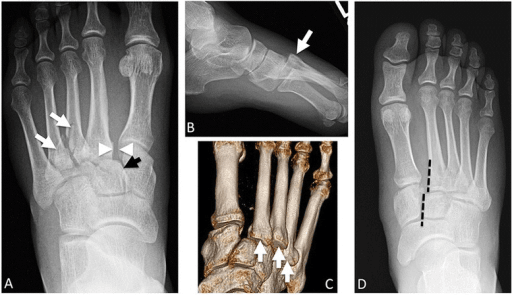
- “Fleck sign: small avulsion fragment between 1st and 2nd metatarsal bases = Lisfranc ligament rupture (easily missed).
- “Double density sign (shoulder): humeral head overlapping glenoid on AP = posterior dislocation.
Radiological signs in trauma are among the most tested topics in fellowship examinations. You will be shown radiographs and asked to identify a sign, explain its anatomical basis, describe the associated injuries and outline management. The most commonly tested are the posterior fat pad sign, Segond fracture, Boehler angle, Terry Thomas sign, Lisfranc fleck sign and lipohaemarthrosis, and you must know both the sign and its clinical significance.
Overview
Radiological signs in trauma are pattern-recognition tools that accelerate diagnosis and prevent missed injuries. Each eponymous sign has a specific anatomical and pathological basis that explains why it appears, and understanding that mechanism is what lets you both recognise the sign and predict the injuries that come with it.
Why named signs earn their place. Musculoskeletal trauma radiographs are often read under time pressure, in the emergency department or during trauma assessment. A named sign gives a mental framework for:
- Rapid identification of a specific injury pattern
- Prediction of associated injuries that may not be immediately visible
- Guiding further imaging (CT, MRI) once the sign is identified
- A structured viva answer
Systematic Approach
Three questions for every sign. What does it look like, why does it occur (the anatomical mechanism), and which injuries is it associated with?
The principle of associated injuries. When a classic trauma sign is identified, always look for associated injuries. Each association is given with its sign below.
Detailed Sign Analysis
Shoulder
The lightbulb sign. In a posterior dislocation the humerus is locked in internal rotation, so on the AP radiograph the humeral head appears abnormally rounded and symmetric. The normal external-rotation profile, with the greater tuberosity visible laterally, is lost, and the head takes on a dome shape.
Why it is missed. The AP view looks deceptively near-normal, and the lightbulb sign is what raises the suspicion of a posterior dislocation on it. Posterior dislocations are the most commonly missed dislocation in emergency medicine. The sign is an instruction to obtain an axillary lateral, which is essential to confirm the diagnosis and clearly shows the humeral head lying posterior to the glenoid.
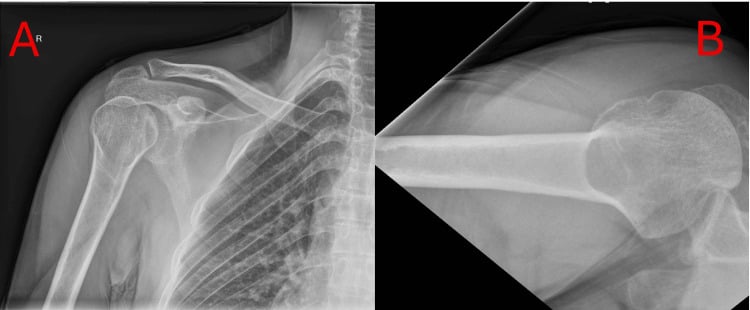
Hill-Sachs and bony Bankart lesions. Together they mark an anterior shoulder dislocation. The Hill-Sachs lesion is a compression defect of the posterolateral humeral head, seen on the AP in internal rotation. The bony Bankart is a fracture of the anterior glenoid rim, seen on the axillary or West Point view.
Elbow
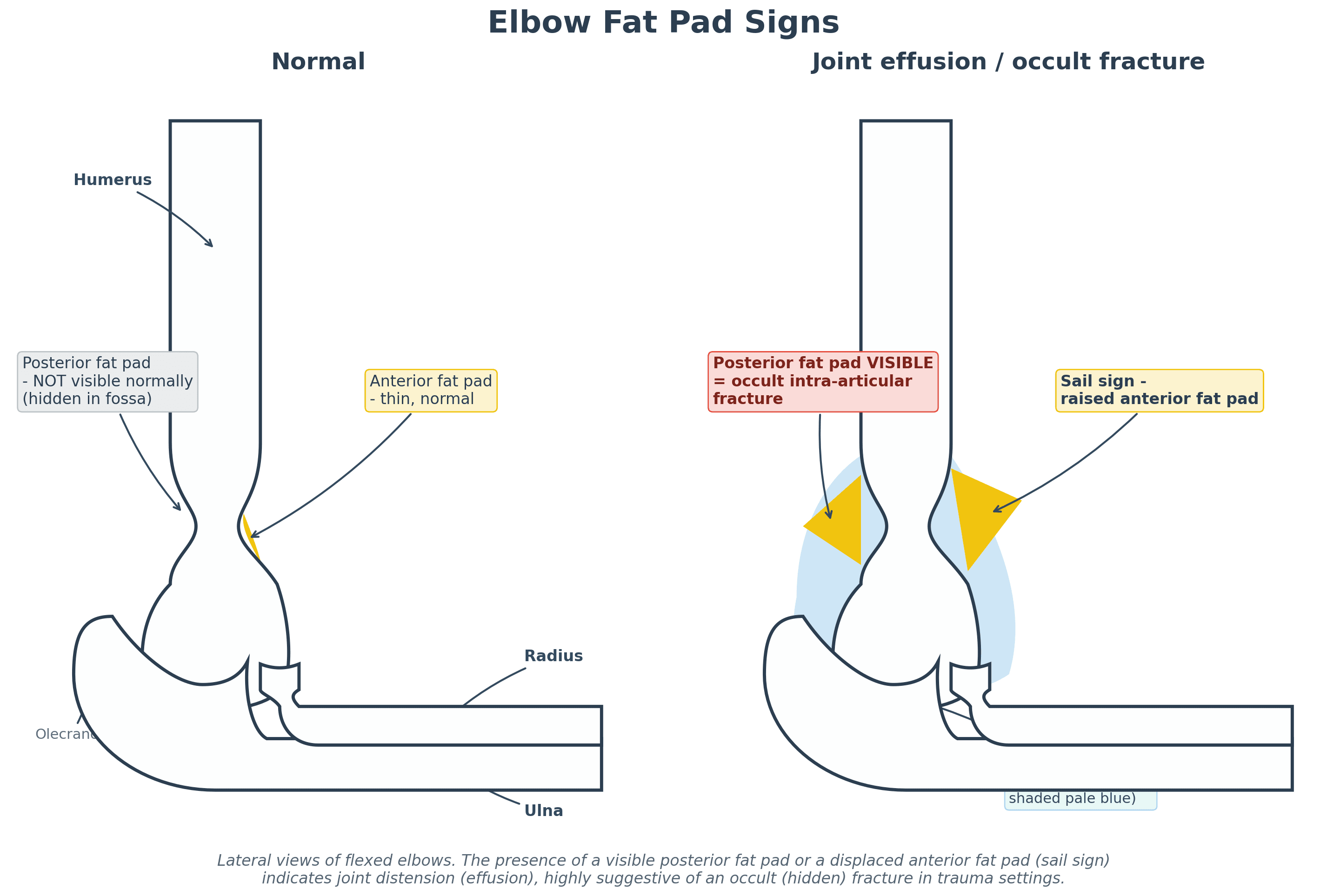
Two fat pads, two meanings. On a true lateral with the elbow flexed to 90 degrees, the two fat pads behave differently and must not be lumped together. The anterior fat pad sits in the coronoid fossa and is normally visible as a thin lucency hugging the cortex; a joint effusion lifts it into a raised triangle, the sail sign.
The posterior fat pad. It lies deep in the olecranon fossa and is never visible normally, so any visible posterior fat pad means it has been pushed out by an effusion or haemarthrosis. That is an occult intra-articular fracture until proven otherwise: the radial head in adults, a supracondylar fracture in children. The sail sign is suggestive; the visible posterior fat pad is the more reliable red flag.
How often there is a fracture. In adults with a post-traumatic effusion and no visible fracture, MRI found an occult fracture in 75%, and 86.6% of those were of the radial head. A quarter had no fracture, so the sign justifies treating and reviewing, not immobilising forever.
The false negative. A false negative occurs if the film is not a true lateral or the elbow is not flexed to 90 degrees.
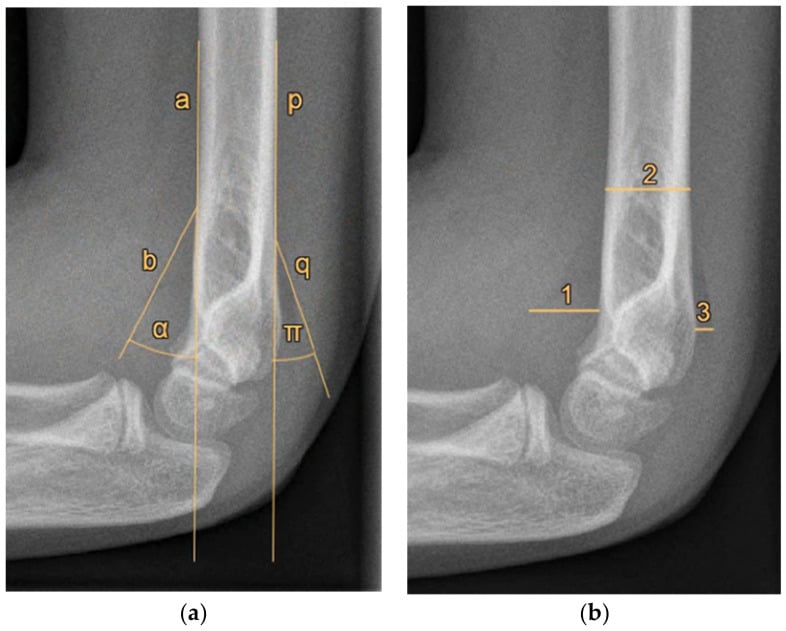
The anterior humeral line. On a true lateral, a line along the anterior humeral cortex should bisect the middle third of the capitellum. An abnormal line indicates a supracondylar fracture.
The radiocapitellar line. A line through the centre of the radial shaft must bisect the capitellum on every view. If it misses the capitellum on any view the radial head is dislocated, and that is the key to diagnosing a Monteggia fracture-dislocation: an ulnar fracture with radial head dislocation.
Wrist
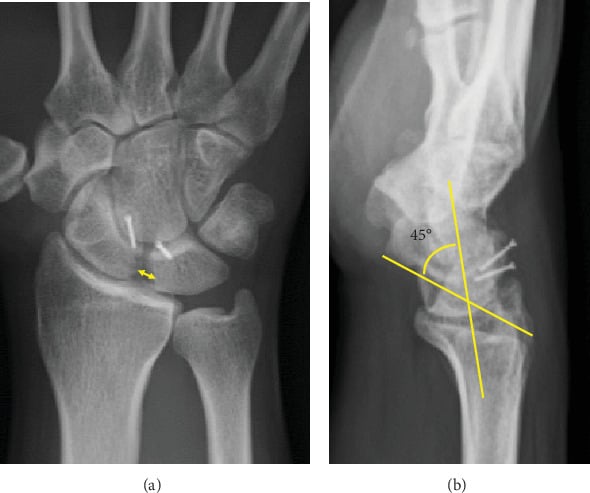
The Terry Thomas sign. A scapholunate gap of more than 3mm on the PA wrist radiograph, measured at the mid-point of the gap, indicates rupture of the scapholunate interosseous ligament (SLIL). It is pathognomonic for scapholunate dissociation, and is named after the British comedian with a gap between his front teeth.
The signet ring sign. When the SL ligament is disrupted the scaphoid flexes. On the PA view it is then seen end-on as a rounded circle, like a signet ring viewed from above, and loses its normal elongated oval outline.
The lateral view: DISI and VISI. The direction the lunate tilts names the pattern: in DISI it points dorsally, in VISI ventrally.
- DISI (dorsal intercalated segment instability): the lunate extends and the SL angle is more than 70 degrees. It is caused by scapholunate ligament disruption and is the most common carpal instability.
- VISI (volar intercalated segment instability): the lunate flexes and the SL angle is less than 30 degrees. It is caused by lunotriquetral ligament disruption and is less common.
Natural history. Left untreated, scapholunate dissociation progresses to SLAC (scapholunate advanced collapse) wrist, a predictable pattern of radiocarpal arthritis.
Pelvis and hip
Shenton's line. The normal smooth arc runs along the inferior pubic ramus and the medial femoral neck. A break in it indicates a neck of femur fracture or hip dislocation, so trace it on both sides of the AP pelvis.
Knee
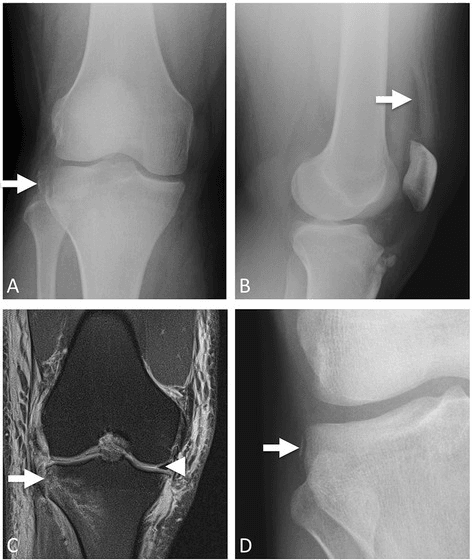
The Segond fracture. A small, thin cortical avulsion from the anterolateral margin of the lateral tibial plateau, a flake of bone just below the articular surface, seen on the AP knee radiograph. It is caused by traction on the anterolateral ligament and lateral capsule during a pivot-shift mechanism, and the fragment is subtle.
What it means. In an adult, treat a Segond fracture as an ACL tear until proven otherwise: the association approaches 100% in reported series, and the fracture is described as pathognomonic. In the skeletally immature a Segond-type avulsion can occur with an intact ACL, so MRI defines the injury.
What comes with it. Meniscal tears in about 75%, particularly of the lateral meniscus, and MCL injury.
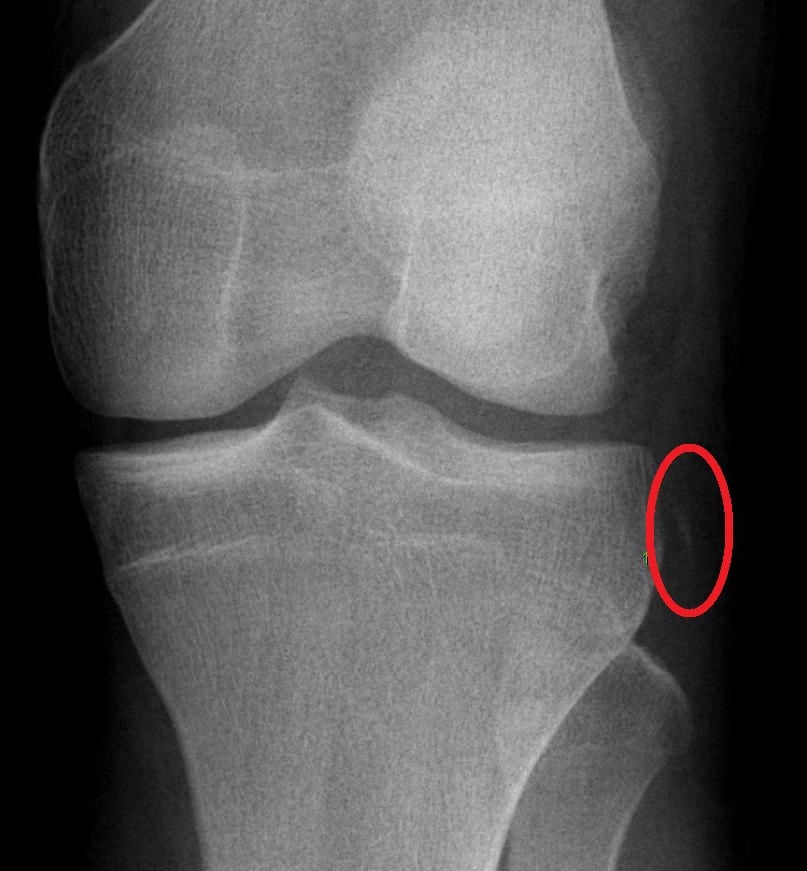
Does the fragment need fixing? Rarely. It is treated as a marker injury, and management is directed at the ACL and the associated meniscal and anterolateral structures. The contested question is whether ALL reconstruction or lateral extra-articular tenodesis should be added to ACL reconstruction in high pivot-shift knees, revisions and young pivoting athletes; the evidence, including the ALL anatomical and clinical literature, increasingly supports lateral augmentation in selected patients, but routine use remains debated.
Lipohaemarthrosis. Bone marrow fat leaks through an intra-articular fracture into the joint and floats on the blood, giving a fat-fluid level on a horizontal-beam lateral. It means an intra-articular fracture, most commonly of the tibial plateau but also the distal femur or patella, and the fracture needs CT for characterisation.
Ankle and foot
The medial clear space. On the ankle mortise view, a medial clear space of more than 4mm, or more than the superior tibial-talar space, means deltoid ligament disruption and an unstable ankle injury.
The Maisonneuve fracture. A high fibular fracture in the proximal third, with disruption of the interosseous membrane and syndesmosis and a medial ankle injury, either deltoid ligament rupture or a medial malleolus fracture. The mechanism is external rotation of the ankle, the force propagating proximally through the interosseous membrane. It is missed when the fibula is not included in the radiograph series.
Boehler's angle. Measured on the lateral calcaneal radiograph between two lines: one from the highest point of the posterior tuberosity to the highest point of the posterior subtalar facet, the other from the posterior facet to the highest point of the anterior process. Normal is 25-40 degrees.
Reading the number. A compression fracture of the calcaneal body flattens the angle between the posterior tuberosity and the posterior facet. Less than 20 degrees indicates a displaced calcaneal fracture involving the subtalar joint, and less than 0 degrees (a negative angle) indicates severe comminution.
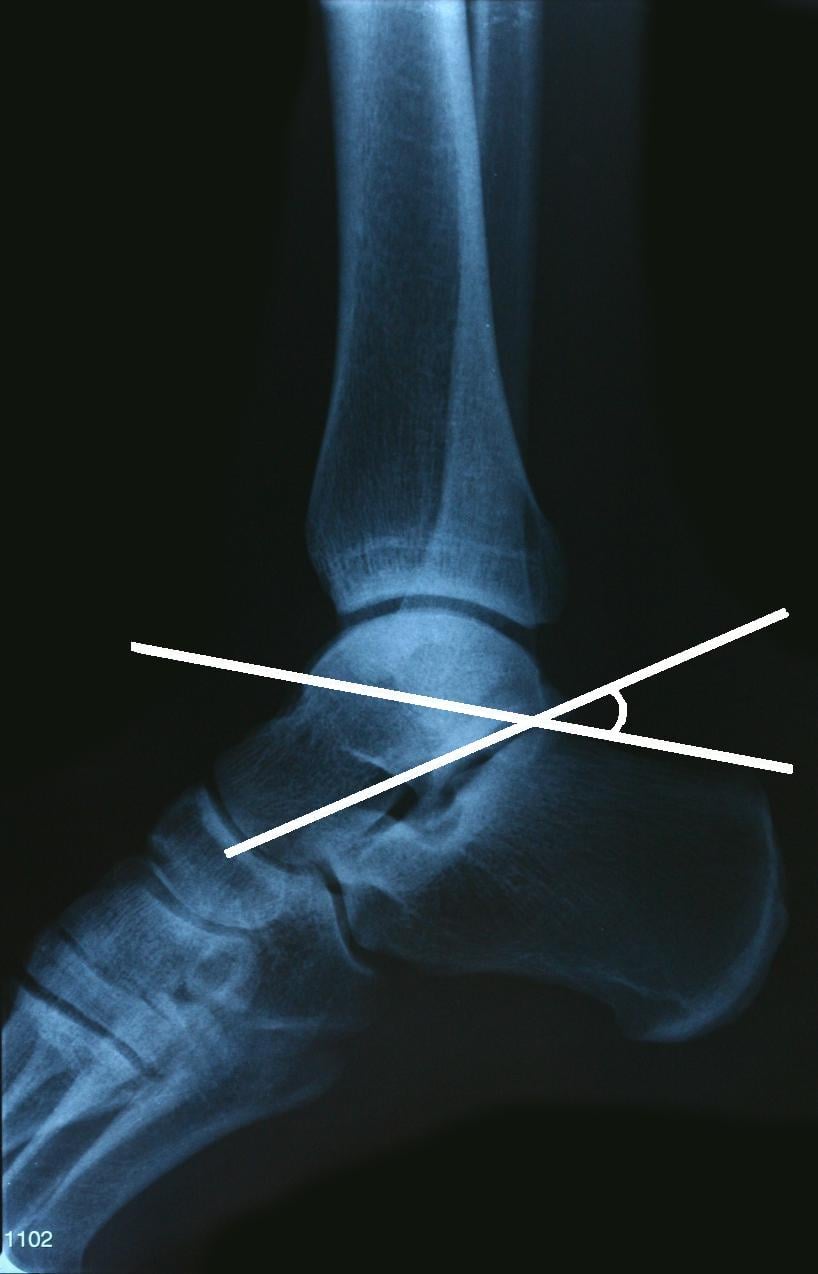
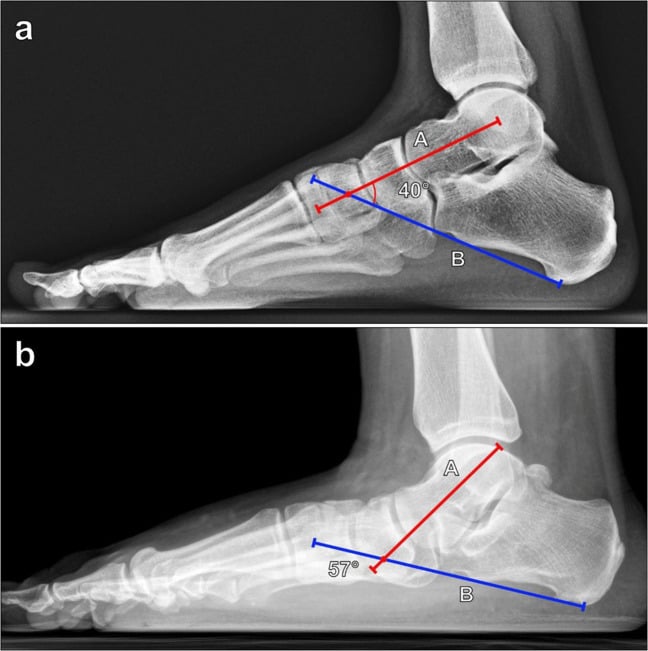
Does the angle decide the operation? Not on its own. In the landmark Buckley RCT of 424 patients, operative and nonoperative outcomes were equivalent overall, with a real surgical benefit in defined subgroups. A post-reduction articular step-off of 2mm or less predicted significantly better function. Boehler's angle also serves as a guide to the adequacy of reduction, its restoration correlating with better functional outcomes, so the real question is whether you can achieve an anatomical reduction.
Where the calcaneal debate has moved. Toward minimally invasive, percutaneous and sinus tarsi approaches, to reduce the high wound-complication rate of the extensile lateral approach, and toward primary subtalar arthrodesis for Sanders IV. There is still no universal consensus on which displaced fracture mandates surgery.
The Lisfranc fleck sign. A small avulsion fragment between the bases of the first and second metatarsals on the AP or oblique foot radiograph. It is avulsion of the Lisfranc ligament, the strong oblique ligament connecting the medial cuneiform to the base of the second metatarsal, from either of its attachments, and it means tarsometatarsal joint disruption.
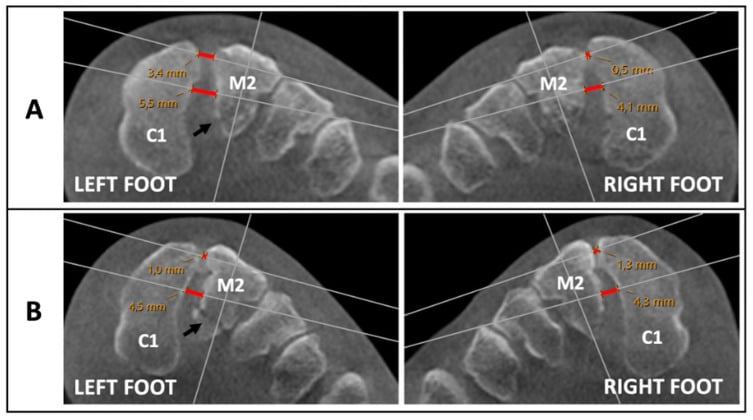
Why it is missed. The sign can be extremely subtle, and it is one of the most commonly missed fracture signs in emergency departments. When it is seen, obtain weight-bearing comparison views of both feet, or stress views, to assess tarsometatarsal stability. Even 2mm of diastasis between the first and second metatarsal bases is abnormal. Weight-bearing CT assesses subtle instability: measuring the C1-M2 diastasis under load reveals subtle displacement.
Why reduction matters. Reduction quality is the main determinant of outcome, and only about half of these injuries reach an excellent or good result. More than 2mm of residual displacement after closed reduction mandates open reduction and fixation.
Mimics and look-alikes
Several normal variants and non-traumatic findings imitate the classic trauma signs. The examiner's favourite follow-up is "what else could this be?", and knowing the mimics prevents both over-call and missed injury.
- True traumatic cause
- Occult intra-articular fracture (radial head, supracondylar)
- Mimic to exclude
- Septic or inflammatory effusion; technically non-true-lateral film
- Discriminator
- Trauma history + true lateral with overlapping condyles; aspirate if sepsis suspected
- True traumatic cause
- Anterolateral ligament/capsular avulsion = ACL injury
- Mimic to exclude
- Reverse Segond (medial avulsion, PCL/medial injury); arcuate avulsion (fibular head, posterolateral corner)
- Discriminator
- Location: Segond is lateral tibia; reverse Segond is medial tibia; arcuate is fibular styloid
- True traumatic cause
- Intra-articular fracture leaking marrow fat
- Mimic to exclude
- None benign — always implies fracture, but level only seen on horizontal-beam film
- Discriminator
- Requires cross-table/horizontal beam; absence on AP does not exclude fracture
- True traumatic cause
- Posterior dislocation (locked internal rotation)
- Mimic to exclude
- Normal internally rotated arm; poor positioning
- Discriminator
- Trough line, rim sign, over 6 mm joint widening; confirm with axillary/scapular-Y
- True traumatic cause
- Lisfranc ligament avulsion (fleck sign)
- Mimic to exclude
- Normal physis in children; os intermetatarseum accessory ossicle
- Discriminator
- Smooth corticated ossicle vs jagged avulsion; compare contralateral and weight-bear
- True traumatic cause
- SL ligament rupture (Terry Thomas)
- Mimic to exclude
- Normal in young children; clenched-fist artefact; ulnar-deviation positioning
- Discriminator
- Need over 3 mm on neutral PA, ideally with contralateral comparison; correlate with DISI on lateral
Avulsion Fractures as Markers of Injury
A small flake of bone pulled off at a tendon or ligament attachment is a signpost injury: the fleck tells you which soft-tissue structure has failed. Beyond the knee avulsions (Segond, reverse Segond, arcuate), the pelvic and proximal-femoral apophyseal avulsions are high-yield.
- Muscle/structure pulled off
- Sartorius (and tensor fasciae latae)
- Typical setting
- Sprinting adolescent athlete
- Muscle/structure pulled off
- Rectus femoris (straight head)
- Typical setting
- Kicking sports in adolescents
- Muscle/structure pulled off
- Hamstrings
- Typical setting
- Hurdling/water-skiing; can become chronic painful non-union
- Muscle/structure pulled off
- Abdominal wall muscles
- Typical setting
- Adolescent sudden trunk twist
- Muscle/structure pulled off
- Iliopsoas
- Typical setting
- Adolescent apophyseal avulsion (see pearl for the adult caveat)
Apophyseal avulsions are normal sporting injuries in skeletally immature athletes. But an isolated avulsion of the lesser trochanter in a skeletally mature adult - especially without significant trauma - is pathological (metastasis or marrow-replacing tumour) until proven otherwise, because the iliopsoas should not be able to pull off normal adult bone. This finding mandates a search for an underlying lytic lesion (further imaging, and a primary-tumour/metastasis work-up). It is a classic, easily-dropped exam mark.
Guidelines, Registries & Global Practice
Recognition of classic radiological trauma signs is a core competency in every major orthopaedic and emergency-medicine training curriculum worldwide. Missed injuries on trauma radiographs are a leading source of medicolegal claims internationally, which is why structured "search pattern" reading and named-sign checklists are emphasised across systems.
Global Epidemiology
- Missed diagnoses are common and systematic. Posterior shoulder dislocation is misdiagnosed in over 60% of cases at first presentation; Lisfranc injuries and the Segond fracture are repeatedly cited among the most frequently overlooked findings on initial radiographs.
- Mechanism-driven incidence: Segond/ACL injuries cluster in young pivoting athletes; calcaneal and thoracolumbar burst fractures cluster in fall-from-height and road-trauma populations; posterior shoulder dislocation is over-represented in seizure, electrocution and high-energy direct trauma.
Side-by-Side Guidance
- Position relevant to named signs
- Advocate CT for articular fractures (tibial plateau, calcaneus, pilon) once a sign or effusion is seen; Sanders CT classification guides calcaneal management
- Position relevant to named signs
- BOAST standards mandate adequate orthogonal views and senior review; open-fracture and spinal-clearance standards stress not relying on a single inadequate film
- Position relevant to named signs
- Promotes systematic ABCs search pattern (Adequacy, Bone, Cartilage/joints, Soft tissue) and CT for intra-articular extension and pre-operative planning
- Position relevant to named signs
- Trauma imaging guidance favours CT in significant blunt/polytrauma and supports MRI for occult injury where radiographs are equivocal
- Position relevant to named signs
- Appropriateness criteria endorse weight-bearing/stress views for suspected Lisfranc and syndesmotic injury and MRI for radiographically occult fracture
Registry & Practice Variation
- Registry relevance: Implant registries (NJR, AJRR, AOANJRR, Swedish/Norwegian/NZJR) do not catalogue radiological signs directly, but the downstream conditions they track — post-traumatic OA, SLAC-wrist salvage, post-calcaneal arthrodesis, post-traumatic knee arthroplasty — quantify the long-term cost of injuries first announced by these signs (e.g. an unrecognised Segond/ACL injury or a malreduced calcaneus).
- High-resource settings: Ready access to CT and MRI means a positive sign (effusion, fleck, lipohaemarthrosis) is promptly characterised with cross-sectional imaging; weight-bearing and stress views for Lisfranc/syndesmosis are routine.
- Limited-resource settings: Plain radiography may be the only modality available, which raises rather than lowers the value of named-sign recognition; contralateral comparison views, stress views and clinical correlation become the principal tools, and a positive sign is treated as the injury until proven otherwise.
Controversies & Areas of Uncertainty
How far to chase an occult injury. A positive fat pad sign, a lipohaemarthrosis or a subtle Lisfranc fleck reliably implies a fracture, but how aggressively to pursue CT or MRI varies. MRI detects far more bone and soft-tissue injury than radiographs, as the elbow fat pad data show, yet in several series the extra findings did not change management. Routine advanced imaging for every positive sign is therefore not universally accepted.
How reliable the numbers are. Several "objective" signs depend on technique and reader. Boehler's angle, the scapholunate gap and the medial clear space all vary with projection, rotation and weight-bearing, and inter-observer agreement is imperfect, so contralateral comparison views and clinical examination remain essential rather than a single threshold number.
Clinical Decision Scenarios
Practise clinical reasoning and management decisions out loud
“An examiner shows you a lateral calcaneal radiograph and asks you to measure the Boehler angle. The angle is 10 degrees.”
“A 19-year-old rugby player has an acute knee injury. The AP knee radiograph shows a small avulsion fragment from the lateral tibial plateau.”
“An examiner shows you an AP wrist radiograph and asks you to identify and explain the significance of a widened gap between the scaphoid and lunate.”
“A 34-year-old man presents after a seizure with a painful shoulder held in internal rotation. He cannot externally rotate the arm. The AP radiograph shows a humeral head that looks abnormally rounded and symmetric, overlapping the glenoid.”
“A 28-year-old sustains a midfoot crush injury. The non-weight-bearing AP foot radiograph shows a tiny bony fleck between the bases of the first and second metatarsals and you are unsure whether the joint is aligned.”
Upper Limb Signs
- Lightbulb sign: rounded humeral head on AP = posterior dislocation (need axillary view)
- Posterior fat pad (elbow): always abnormal = occult fracture in trauma
- Anterior humeral line: middle third of capitellum = normal (supracondylar fracture check)
- Terry Thomas: SL gap more than 3mm = SL dissociation, DISI pattern
- Signet ring: scaphoid flexed, viewed end-on = associated with SL dissociation
Lower Limb Signs
- Segond fracture: lateral tibial plateau avulsion = PATHOGNOMONIC for ACL tear (association approaching 100%)
- Lipohaemarthrosis: fat-fluid level = intra-articular fracture (most common: tibial plateau)
- Boehler angle: normal 25-40 degrees, less than 20 = displaced calcaneal fracture
- Lisfranc fleck: avulsion between 1st-2nd MT bases = Lisfranc ligament injury (easily missed)
- Medial clear space more than 4mm = deltoid rupture = unstable ankle
Associations to Remember
- Segond in an adult = ACL tear until proven otherwise (association approaching 100%); meniscal tear in ~75%. Paediatric Segond can have an intact ACL
- Calcaneal fracture: bilateral (10%), lumbar spine (10%), wrist fractures
- Monteggia: ulnar fracture + radial head dislocation (check radiocapitellar line)
- Maisonneuve: proximal fibula fracture + syndesmotic disruption + medial ankle
- Posterior dislocation: missed in up to 60% — lightbulb sign is the clue
Evidence Base
Segond Fracture: Lateral Capsular Ligament Avulsion
- The Segond fragment is a small avulsion from the directly lateral surface of the lateral tibial condyle, produced by excessive tension on the lateral capsular ligament.
- The fragment is remarkably constant: elliptical (about 10 x 3 mm), separated by a longitudinal fracture line, lying roughly 4 mm distal to the subarticular cortex.
- A knee haemarthrosis is consistently visible, and the fracture carries a strong association with anterior cruciate ligament rupture.
Anatomy of the Anterolateral Ligament (Segond Substrate)
- The anterolateral ligament (ALL) was identified as a discrete, well-defined structure in 40 of 41 cadaveric knees (97%), distinct from the joint capsule and iliotibial band.
- It originated at the lateral femoral epicondyle and inserted on the anterolateral tibia midway between Gerdy tubercle and the fibular head — the exact site of the Segond fracture.
- By its location it is hypothesised to control internal tibial rotation and modulate the pivot shift, providing the anatomical basis for the Segond fracture.
Lisfranc Fracture-Dislocation: Outcome Depends on Reduction
- Seventy-two patients with 76 tarsometatarsal fracture-dislocations were evaluated, 81 per cent of them polytrauma; after eight early amputations and losses to follow-up, 52 patients with 55 injuries were analysed at a mean of 4.2 years. Only 27 feet (49 per cent of those 55) achieved an excellent or good result, with the quality of initial reduction the major determinant of outcome.
- Open reduction and Kirschner-wire internal fixation yielded the best results; direct crush injuries did poorly (1 of 8 good or excellent).
- More than 2 mm of residual displacement or a talometatarsal angle over 15 degrees after closed reduction mandated open reduction.
Operative vs Nonoperative Displaced Intra-articular Calcaneal Fractures
- Landmark multicentre RCT (424 patients, 471 fractures): without stratification, overall functional outcomes (SF-36, VAS) were equivalent between operative and nonoperative care.
- After excluding Workers' Compensation patients, defined subgroups did significantly better with surgery — younger patients, women, comminuted fractures, and those with a moderately low Bohler angle (0-14 degrees).
- Anatomical reduction or a post-reduction step-off of 2 mm or less predicted significantly higher functional scores after surgery.
Elbow Fat Pad Sign and Radiographically Occult Fracture (MRI)
- In 20 adults with a post-traumatic elbow effusion but no visible fracture, MRI revealed a radiographically occult fracture in 75%.
- Most occult fractures were in the radial head (86.6%), with lateral epicondyle and olecranon each accounting for 6.7%; 90% showed bone marrow oedema.
- Effusion size (anterior or posterior fat pad displacement) did NOT correlate with the likelihood of an underlying fracture.
The Often Overlooked Posterior Shoulder Dislocation
- More than 60% of posterior shoulder dislocations are misdiagnosed at initial presentation, with correct diagnosis often delayed for months or years.
- Triggers (seizure, electric shock, fall onto a flexed adducted arm) plus loss of external rotation and abduction should raise suspicion.
- A radiographic trauma series in the scapular plane (with CT if needed) is required to exclude posterior dislocation.