Aseptic Loosening | Infection | Instability | Bone Loss Management
- Infection is the most common indication for revision shoulder arthroplasty (40-50% of cases)
- Glenoid bone loss requires classification (Sirveaux E0-E4) and often augmentation or bone grafting
- Reverse shoulder arthroplasty is the preferred option for most revisions and the dominant revision construct across major registries, because it tolerates rotator cuff deficiency and bone loss
- Two-stage revision is mandatory for chronic (over 4 weeks) infection: 6 weeks of IV antibiotics with a spacer in place, reimplantation at 6-12 weeks
- “Failed hemiarthroplasty with intact rotator cuff can be converted to anatomic TSA
- “Sirveaux E3-E4 glenoid bone loss requires augmented baseplate or bone grafting
- “Humeral bone loss managed with longer stems, impaction grafting, or structural allografts
- “Subscapularis failure predisposes to instability - consider lesser tuberosity osteotomy for repair
Overview and Epidemiology
Revision shoulder arthroplasty is a challenging surgical problem of increasing frequency, as primary shoulder replacement, particularly reverse arthroplasty, expands worldwide. Infection is a proportionally larger driver of revision in the shoulder than in the hip or knee, because of indolent Cutibacterium acnes.
Indications. Each mode of failure has its own causes, and each is often answered by conversion to a reverse prosthesis:
- Infection - deep prosthetic joint infection, the most common indication
- Aseptic loosening - progressive loosening without infection, most common in the glenoid component
- Instability - recurrent dislocation from component malposition, soft-tissue insufficiency or bone loss
- Periprosthetic fracture - a glenoid or humeral fracture requiring component revision
- Stiffness and pain - severe capsular contracture, component malposition, or unexplained pain requiring revision
Who. Patients are a mean of 65-75 years old at revision, older than at the primary, and 60-65% are women, mirroring primary arthroplasty. The mean interval from the index procedure is 5-8 years, and 10-15% need a further revision within 5 years.
Why the second operation is harder. Function is lower and complications higher than after primary arthroplasty, and glenoid bone loss worsens with each revision. A revision costs 2-3 times as much as the primary procedure, and registry data consistently show that it is less durable.
Anatomy and Biomechanical Considerations
The structures at risk. Scar tissue, altered anatomy and bone loss all raise the risk to neurovascular structures at revision, the axillary nerve in particular.
- Location/Relevance
- Exits quadrilateral space, on average 5-7mm from inferior glenoid rim
- Risk During Revision
- Inferior capsular release, glenoid exposure, inferior retraction
- Protection Strategy
- Blunt dissection, limit inferior retraction, palpate nerve
- Location/Relevance
- Enters coracobrachialis 5-8cm distal to coracoid
- Risk During Revision
- Vigorous or excessive inferior/medial retraction
- Protection Strategy
- Place retractors carefully, avoid prolonged tension
- Location/Relevance
- Runs in deltopectoral interval, often scarred to it
- Risk During Revision
- Scar tissue can cause avulsion and haematoma
- Protection Strategy
- Identify early, dissect carefully, ligate if necessary, control bleeding
- Location/Relevance
- Medial to glenoid, superior to subscapularis
- Risk During Revision
- Superior-medial glenoid exposure for bone grafting
- Protection Strategy
- Subperiosteal dissection, avoid medial drilling
Biomechanics of Revision Shoulder Arthroplasty
The glenoid. Medialisation costs the deltoid lever arm 2-3% for each 1mm of medial shift. Increased retroversion causes posterior subluxation and eccentric loading, and superior tilt greater than 10 degrees increases shear forces and the risk of failure. In the revision setting a minimum of 4 screws is required for stable baseplate fixation.
The humerus. Fixation has to be gained beyond the zone of bone loss, which calls for longer stems (150-200mm). Cemented stems are recommended for poor bone quality or cortical thinning. Impaction grafting restores bone stock for a potential future revision, and stress shielding is minimised with modular stems and anatomic reaming.
Classification Systems
Revision planning classifies the glenoid, the humerus and any infection.
Sirveaux Classification (Glenoid Bone Loss in Failed RSA)
- Description
- No bone loss - intact glenoid surface
- Bone Loss
- 0%
- Management
- Standard glenoid baseplate, no augmentation
- Description
- Round erosion - central defect less than 50% width
- Bone Loss
- Under 25%
- Management
- Standard baseplate with central screw or BIO-RSA
- Description
- Oblique erosion - eccentric biconcave pattern
- Bone Loss
- 25-40%
- Management
- Eccentric reaming or small augmented baseplate
- Description
- Deep central erosion greater than 50% width
- Bone Loss
- 40-60%
- Management
- Augmented baseplate or structural bone graft required
- Description
- Extensive superior and medial bone loss
- Bone Loss
- Over 60%
- Management
- Structural allograft, BIO-RSA, or custom implants
E3 or E4. The distinction is critical. E3 has deep central erosion but an intact superior and medial glenoid cortex, and can be managed with an augmented baseplate or bone graft impaction. E4 has extensive superior and medial loss with loss of structural integrity, and requires a structural allograft (scapular spine bone graft, iliac crest strut graft) or BIO-RSA; without structural grafting it has significantly higher failure rates.
Clinical Assessment
History. Onset and the character of the pain point to the cause. An acute onset suggests infection and a gradual one aseptic loosening; rest pain suggests loosening or infection, and pain with activity suggests instability. Then establish:
- Prior surgery - the number of revisions, previous infections and complications
- Functional loss - what the patient can no longer do (overhead activities, lifting)
- Systemic symptoms - fevers, night sweats and weight loss are infection red flags
- Current antibiotics - recent use may mask infection
Examination. Subscapularis integrity, deltoid function and the axillary nerve are critical to the outcome.
- Look - scars, drainage, erythema, muscle atrophy (deltoid, supraspinatus)
- Feel - warmth, effusion, component prominence, crepitus
- Move - active and passive range, distinguishing true range from scapulothoracic compensation
- Strength - deltoid and rotator cuff (external rotation; belly press for subscapularis)
- Stability - anterior and posterior load-shift test, sulcus sign for inferior laxity
- Neurovascular - axillary nerve (deltoid), musculocutaneous nerve (biceps), radial pulse
Infection can present insidiously in revision shoulder arthroplasty. The red flags are progressive pain without mechanical symptoms, persistent drainage beyond 3 weeks postoperatively, elevated inflammatory markers, a persistent shoulder effusion, and radiographic periosteal reaction or progressive osteolysis. Low-grade Cutibacterium infection may present with only pain and stiffness and no systemic symptoms. Always aspirate a suspicious shoulder before revision surgery.
Differential Diagnosis
- Clinical Features
- Gradual onset pain, mechanical symptoms, normal inflammatory markers
- Key Investigations
- Serial radiographs showing progressive radiolucency
- Treatment
- Revision to RSA in most cases
- Clinical Features
- Pain, stiffness, elevated CRP/ESR, possible drainage
- Key Investigations
- Aspiration with extended 14-day cultures, CRP greater than 10
- Treatment
- Two-stage revision with spacer
- Clinical Features
- Clunking, apprehension, recurrent dislocation
- Key Investigations
- CT showing component malposition or glenoid bone loss
- Treatment
- Revision to RSA with increased offset
- Clinical Features
- Acute onset pain and loss of function after fall or minor trauma
- Key Investigations
- Radiographs or CT showing fracture around components
- Treatment
- Revision with fracture fixation if unstable
Investigations
Radiographs. A true AP (Grashey), an axillary lateral and a scapular Y. Look for:
- Component position (version, height, tilt)
- Radiolucency greater than 2mm (glenoid or humeral loosening), humeral stem subsidence or loosening lines
- Baseplate screw breakage or hardware migration
- Glenoid notching (Sirveaux grades in RSA)
- Periprosthetic fracture and heterotopic ossification
Measure glenoid version (normal 5 degrees of retroversion), superior tilt (less than 10 degrees is acceptable) and humeral offset. Document the existing implant's type, size and position for surgical planning.
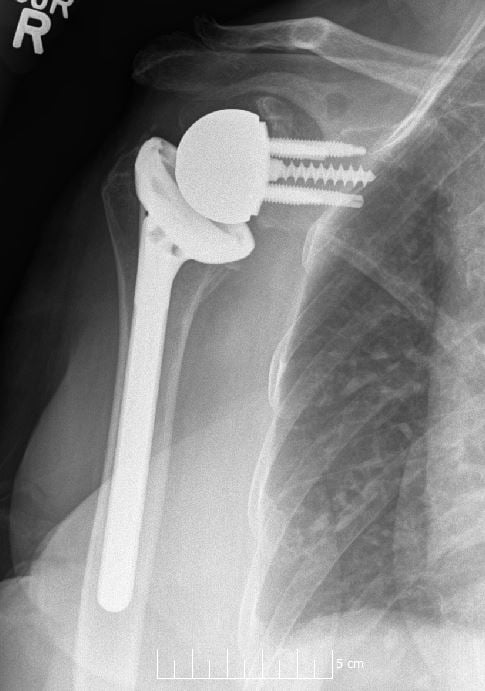
CT. The gold standard for bone stock, with 3D reconstructions, and mandatory for revision planning. Its sensitivity is 95% for glenoid loosening and 90% for quantifying bone loss. It is used to:
- Quantify glenoid bone loss (Sirveaux), including central or peripheral defects
- Measure glenoid version, inclination and medialisation
- Assess humeral bone stock and canal dimensions
- Check baseplate fixation and screw trajectories
- Plan bone graft and augmented implants
- Identify occult fractures
The infection screen. Mandatory before every revision. Aspirate off antibiotics for 2 weeks, and hold cultures for a minimum of 14 days for Cutibacterium acnes: standard 5-day cultures miss 20-30% of shoulder infections. The thresholds:
- CRP greater than 10 mg/L after 3 months suggests infection (sensitivity 85%)
- ESR greater than 30 mm/hr after 3 months (sensitivity 70%, less specific than CRP)
- Synovial fluid WBC greater than 3000, PMN greater than 80% suggests infection
- Frozen section greater than 5 PMN per high-power field gives intraoperative confirmation
MRI. For selected cases only. Metal artefact from the prosthesis limits resolution, metal artefact reduction sequence (MARS) protocols improve it, and CT is usually more helpful for bone. MRI is used to:
- Assess the rotator cuff when its status is unclear or conversion to anatomic TSA is being considered
- Assess subscapularis integrity for surgical planning
- Evaluate soft-tissue masses (infection, tumour)
Management Algorithm
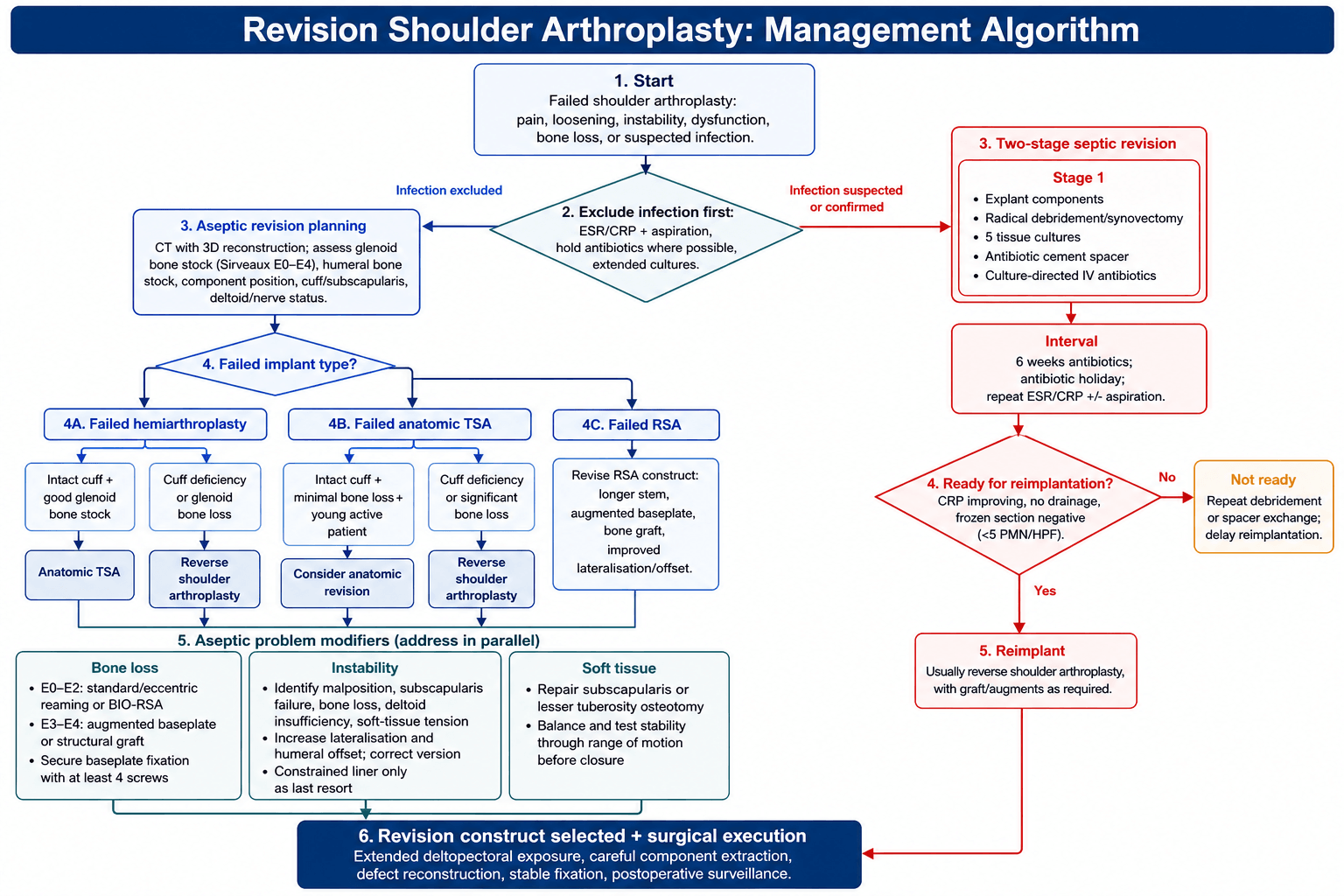
Exclude infection first. Every revision starts with the infection screen described under Investigations. Positive cultures or a high clinical suspicion send the patient down the septic pathway; negative results allow aseptic planning.
Plan from the CT. Classify glenoid loss (Sirveaux E0-E4) and humeral bone stock (Morrey) preoperatively, and plan augmented baseplates for E3-E4, bone grafting and humeral stem length from them.
Aseptic Revision Shoulder Arthroplasty Algorithm
Goal. Restore shoulder function with durable fixation despite bone loss and soft-tissue compromise.
Default to reverse. Choose reverse shoulder arthroplasty for most revision cases. It compensates for rotator cuff deficiency, which is common after failed TSA; it accommodates glenoid bone loss better than an anatomic TSA, because medialisation is less detrimental; and it is the dominant revision construct across the major joint registries. If in doubt, choose RSA.
When anatomic is possible. Convert a failed hemiarthroplasty to anatomic TSA only if all of these hold:
- Intact rotator cuff, confirmed on MRI or intraoperatively
- Adequate glenoid bone stock (Sirveaux E0-E1)
- No component malposition requiring excessive bone removal
Revising a failed anatomic TSA to another anatomic TSA is considered only with an intact cuff, minimal bone loss and a young, active patient.
- Key Features
- Intact rotator cuff, good bone stock, no infection
- Revision Strategy
- Convert to anatomic TSA; convert to RSA if cuff deficiency or moderate bone loss
- Key Pearl
- Glenoid bone must be adequate - check for medialisation
- Key Features
- Aseptic loosening, glenoid erosion, cuff intact
- Revision Strategy
- Revise to RSA or anatomic depending on bone/cuff
- Key Pearl
- Assess glenoid bone loss with CT - Sirveaux grade
- Key Features
- Aseptic loosening, instability, or fracture
- Revision Strategy
- Revise to RSA with longer stem, augmented baseplate or bone grafting; increased lateralisation and offset for instability
- Key Pearl
- Manage bone loss - allograft, augmented baseplate, BIO-RSA
- Key Features
- Positive aspiration, elevated inflammatory markers
- Revision Strategy
- Two-stage revision with antibiotic spacer
- Key Pearl
- Minimum 6 weeks antibiotics, normalise CRP before reimplantation
The operation itself, from extended deltopectoral exposure and careful extraction to defect reconstruction, baseplate fixation and subscapularis management, is set out under Surgical Technique.
Surgical Technique
Preoperative Planning and Consent
Consent. The discussion should cover:
- Infection, nerve injury (axillary most commonly) and instability, at the rates given under Complications
- The possible need for bone grafting, from iliac crest or allograft, if bone loss is severe
- The need for re-revision (see Overview)
- Stiffness and persistent pain: 20% have persistent pain despite revision
- Medical risks: DVT/PE (1-2%) and anaesthetic complications
Revision shoulder arthroplasty often turns up unexpected intraoperative findings. Confirm every implant is in theatre before incision: delays for missing components increase infection risk and operative time. Always have available:
- A revision RSA system with multiple glenoid baseplate sizes and augmented options
- Humeral stems in standard, long (150-200mm) and extra-long lengths
- Structural allograft (femoral head, distal femur), bone graft substitutes (cancellous chips, demineralised bone matrix) and iliac crest instruments on standby
- Antibiotic-laden cement for humeral fixation
- High-speed burr, reciprocating saw, thin flexible osteotomes, explantation instruments and a Gigli saw
- A C-arm positioned for AP and axillary views
- Culture bottles and specimen containers for tissue samples
Complications
- Incidence
- 5-10% in aseptic revision, 10-20% in septic two-stage
- Risk Factors
- Previous infection, multiple revisions, immunosuppression, diabetes
- Management
- Two-stage revision with antibiotic spacer, 6 weeks IV antibiotics
- Incidence
- 10-15% recurrent dislocation
- Risk Factors
- Subscapularis failure, component malposition, inadequate soft tissue tension
- Management
- Revise to RSA with increased offset, thicker polyethylene, subscapularis repair
- Incidence
- 5-10% at 5 years
- Risk Factors
- Poor bone stock, inadequate fixation, infection
- Management
- Re-revision with bone grafting, augmented baseplate, or structural allograft
- Incidence
- 3-5% intraoperative, 2-3% postoperative
- Risk Factors
- Osteoporosis, aggressive component extraction, cortical perforation
- Management
- Intraop: cerclage wiring, longer stem. Postop: ORIF vs revision depending on fracture pattern and implant stability
- Incidence
- 3-5% (axillary most common)
- Risk Factors
- Excessive retraction, prolonged operative time, traction injury
- Management
- Observation (most recover spontaneously), EMG at 3 months, nerve exploration if no recovery at 6 months
- Incidence
- 15-20% significant ROM limitation
- Risk Factors
- Overtensioned soft tissues, capsular scarring, heterotopic ossification
- Management
- Intensive physiotherapy, consider manipulation under anaesthesia if severe and early (within 3 months)
- Incidence
- 20-30% in RSA
- Risk Factors
- Inferior glenosphere position, small glenosphere size, medialised centre of rotation
- Management
- Usually asymptomatic. If symptomatic loosening, revise with lateralised glenosphere
Early infection, within 4 weeks, may be salvageable with DAIR (debridement, antibiotics and implant retention) if it is recognised immediately. The red flags are persistent drainage beyond 72 hours, fever, purulent drainage and an elevated WBC. The protocol:
- Return to theatre immediately, within 24-48 hours of symptom onset
- Aggressive debridement and synovectomy
- Polyethylene exchange
- Cultures before antibiotics
- 6 weeks of IV antibiotics based on the cultures
Recognised beyond 4 weeks, the infection requires two-stage revision: DAIR fails in chronic infection, with a success rate under 20%.
Complication Prevention Strategies
Preventing infection.
- Optimise beforehand: control diabetes (HbA1c under 7%) and discontinue immunosuppression if possible
- Cefazolin 2g (3g if over 120kg) within 1 hour of incision, continued for 24 hours postoperatively in revision cases (1g every 8 hours)
- Minimise operative time: longer surgery carries a higher infection risk
- Meticulous haemostasis: haematoma is an infection risk
- Multiple-layer wound closure, avoiding tension
Postoperative Care and Rehabilitation
Day 0-1. The arm rests in the abduction sling.
- Drain, if placed, removed when output is under 30mL per 8 hours
- Analgesia: regional block (interscalene catheter for 2-3 days) and oral opioids
- DVT prophylaxis: mechanical (sequential compression devices), with enoxaparin 40mg daily if bleeding risk is low
- Out of bed to a chair on day 0-1, and discharge usually on day 1-2 for uncomplicated cases
Weeks 1-6: passive motion only. The sling is worn full-time, removed only for exercises and hygiene, and there is no active internal rotation, to protect the subscapularis repair. Therapist-assisted passive motion reaches forward elevation to 120 degrees, abduction to 90 degrees and external rotation to 30 degrees, with pendulum exercises three times daily, grip strengthening, and elbow, wrist and hand range to prevent stiffness. Review at week 2 (wound check, staples out) and week 6 (radiographs to assess healing, progress physiotherapy).
Weeks 6-12: active motion. Wean the sling at 6 weeks if radiographs are satisfactory and examination is reassuring. Progress to active-assisted range (pulleys, cane-assisted elevation) if radiographs show a healed osteotomy or examination shows an intact belly press; if the belly press is weak, continue protection and reassess at 8 weeks. Then begin active, deltoid-driven elevation and abduction at week 8 and light internal rotation (hand to belly, hand to opposite shoulder) at weeks 8-10. Forceful internal rotation stays off while subscapularis is still healing, and resisted internal rotation to strengthen it begins at 10-12 weeks. The targets by week 12, reviewed with radiographs, are active forward elevation to 140 degrees, abduction to 100 degrees and external rotation to 45 degrees.
Weeks 12-24: strengthening. Resistance-band exercises for deltoid and rotator cuff (avoiding heavy internal rotation), scapular stabilisation (rows, scapular squeezes) and functional activities such as reaching and lifting light objects, with a gradual return to daily living and a home programme continued indefinitely. The goals are functional strength, forward elevation of 150-160 degrees, abduction of 120-140 degrees and functional internal rotation, though typical final range after revision RSA is lower (see Outcomes). Follow-up is at 6 months, 1 year and then yearly with radiographs.
Long term. Annual clinical review of pain, function, range and strength, with AP and axillary radiographs for component position, lucencies and scapular notching, watching for late infection, loosening, instability and progressive notching. Patients should avoid heavy overhead lifting (over 10kg), contact sports and high-impact activity, report new pain, clicking or instability immediately, and maintain range with home exercises.
The first 6 weeks decide subscapularis healing and long-term stability, and the patient must understand the rules:
- No active internal rotation: no reaching behind the back, no pulling a shirt on, no forceful activity
- The sling is worn full-time, off only for hygiene and pendulum exercises
- Passive forward elevation, abduction and external rotation are safe and necessary: stiffness is preventable, but subscapularis failure is catastrophic
Returning to internal rotation before 6 weeks results in a 60-80% subscapularis failure rate, and early repair failure leaves permanent anterior instability and a poor outcome.
Outcomes and Prognosis
- Survivorship at 5 Years
- 85-90%
- Typical Outcomes
- Good pain relief, functional ROM (140 degrees FE average), return to light ADLs
- Notes
- Outcomes inferior to primary RSA but acceptable for most patients
- Survivorship at 5 Years
- 75-85%
- Typical Outcomes
- Good outcomes if intact cuff and good bone stock, but higher revision rate than RSA
- Notes
- Only recommended for select cases with excellent bone and cuff
- Survivorship at 5 Years
- 70-80%
- Typical Outcomes
- Infection eradication 85-90%, but 15-20% reinfection. Function similar to aseptic if successful
- Notes
- Reinfection requires prolonged antibiotics or resection arthroplasty
- Survivorship at 5 Years
- 70-75%
- Typical Outcomes
- 50-60% achieve stable shoulder, but 15-20% recurrent instability despite revision
- Notes
- Multiple revisions for instability have poor outcomes
- Survivorship at 5 Years
- 60-70%
- Typical Outcomes
- Diminishing returns with each revision. Consider resection arthroplasty if multiple failures
- Notes
- Patient selection critical - counsel realistic expectations
- Multiple prior revisions: each revision decreases the success rate by 15-20%
- Severe glenoid bone loss: Sirveaux E4 has 2-3 times the failure rate of E0-E2
- Infection as the indication: septic revisions have a 15-20% reinfection rate, against a 5-10% infection rate in aseptic revisions
- Neurological injury: axillary nerve injury gives poor function despite a stable implant
- Poor soft-tissue envelope: deltoid insufficiency, irreparable subscapularis
- Patient factors: diabetes, smoking, immunosuppression, age over 80
The best outcomes follow a single aseptic revision to RSA with intact soft tissues and moderate bone loss (E1-E2).
Functional Outcomes
Range of motion. After revision RSA, expect forward elevation of 120-140 degrees (150-160 after a primary), abduction of 100-120 degrees (130-150), external rotation of 30-40 degrees (40-50), and limited internal rotation, to the belly rather than the low back. Most patients can perform overhead daily activities such as eating, hygiene and dressing, but are limited for heavy lifting and overhead work.
Pain and satisfaction. Significant pain improvement is achieved by 80-85% (VAS 7-8 to VAS 2-3), and 70-75% are satisfied or very satisfied, against 85-90% after a primary. Light recreational activities such as golf or swimming are resumed by 60-70%, and 50-60% of patients below retirement age return to work. Patients must understand that revision outcomes are inferior to those of primary arthroplasty.
Salvage: Resection Arthroplasty and Chronic Suppression
When reconstruction is impossible or has repeatedly failed, because of uneradicable infection, catastrophic bone loss, an irreparable soft-tissue envelope or a very poor host, the salvage endpoints each trade function for pain relief or infection control. Counsel accordingly.
Resection (excision) arthroplasty. All prosthetic components and cement are removed with no reimplantation, leaving a flail but pain-relieved shoulder. It is indicated for persistent or uneradicable prosthetic infection, multiple failed two-stage attempts, massive bone loss precluding fixation, or a patient unfit for further reconstruction. It delivers reliable pain relief and infection control at the cost of a weak, largely non-functional shoulder: active elevation typically reaches only a flail or girdle level, and the limb is used for assist and trunk-level tasks. It is a definitive endpoint, not a bridge.
Chronic suppressive antibiotics. Long-term oral antibiotics suppress, but do not cure, infection around a retained implant in a patient who cannot undergo or declines further surgery. This requires a susceptible organism, a tolerable agent and ongoing monitoring, and accepts persistent low-grade infection.
Other salvage. Glenohumeral arthrodesis is rarely chosen but can give a stable, pain-free shoulder driven by scapulothoracic motion in a younger, high-demand patient with deltoid loss (developed in the shoulder-arthrodesis topic). Permanent retention of an antibiotic spacer is an occasional compromise.
Guidelines, Registries & Global Practice
Global Epidemiology
- Rising volume: As primary shoulder arthroplasty (especially reverse) expands worldwide, the absolute number of revisions is increasing across all registry nations
- Construct shift: Reverse shoulder arthroplasty is now the dominant primary and revision construct in high-income registries (AOANJRR, NJR, AJRR)
- Leading diagnoses: Infection, instability and aseptic loosening dominate revision indications; periprosthetic fracture is less common
- Shoulder-specific feature: Indolent Cutibacterium acnes makes infection a proportionally larger driver of revision than in hip or knee arthroplasty
- Second time is harder: Across registries, revision arthroplasty carries a higher re-revision rate than primary arthroplasty
- Bone loss accrues: Glenoid and humeral bone stock diminish with each revision, narrowing reconstructive options
- Volume effect: Outcomes are generally better in higher-volume shoulder units, supporting referral of complex revisions
- Use registry figures as directional evidence; exact percentages vary by report year and country
Major Guidelines and Consensus, Side by Side
- Relevant Position
- Shoulder PJI defined by major/minor criteria; extended cultures (held 14-21 days) for Cutibacterium; multiple deep tissue samples; two-stage favoured for virulent organisms
- Evidence Basis
- Delphi consensus, expert + literature based
- Relevant Position
- Appropriate-use and clinical guidance support reverse arthroplasty for cuff-deficient and bone-deficient shoulders; emphasise infection workup before aseptic revision
- Evidence Basis
- Guideline / appropriate-use criteria
- Relevant Position
- Recommend pre-revision infection screening and management of complex revisions in specialist shoulder units with appropriate implant inventory
- Evidence Basis
- Society guidance / standards of care
- Relevant Position
- Endorse staged management of established PJI and reverse arthroplasty as the workhorse revision construct for bone loss and cuff failure
- Evidence Basis
- Consensus / narrative guidance
- Relevant Position
- Principles-based guidance for periprosthetic fracture and component extraction (bypass defects, cerclage, stable fixation)
- Evidence Basis
- Educational consensus
The clearest area of genuine divergence is single-stage versus two-stage revision for infection. European centres (notably the ENDO-Klinik single-stage tradition) report excellent results with single-stage exchange for sensitive, low-virulence organisms, whereas many North American and Australasian units default to two-stage for established chronic infection. The Belay 2020 meta-analysis (PMID 32565412) found comparable reinfection rates, reframing this as an organism- and host-driven decision rather than a fixed doctrine.
Key documentation requirements for revision cases:
Preoperative Counseling (document in medical record):
- Realistic outcome expectations (outcomes inferior to primary by 30-40%)
- Infection risk specific to revision setting (5-10% aseptic, 10-20% septic two-stage)
- Need for bone grafting if severe bone loss discovered intraoperatively
- Possibility of re-revision (10-15% at 5 years)
- Alternative treatment options (non-operative management, arthrodesis, resection arthroplasty)
- Two-stage process for infected cases with prolonged treatment timeline
Intraoperative Documentation:
- Indication for revision (aseptic loosening, infection, instability, fracture)
- Infection workup results (cultures, inflammatory markers, aspiration)
- Bone stock assessment and classification (Sirveaux grade for glenoid)
- Implant choices and rationale (RSA vs anatomic TSA, augmented components, bone grafting)
- Tissue samples sent for culture and pathology
- Subscapularis management technique
- Complications encountered (fracture, nerve injury, bleeding)
Postoperative Care:
- Clear rehabilitation protocol with subscapularis protection guidelines
- Antibiotic regimen for infection cases with infectious disease consultation
- Follow-up plan with inflammatory marker monitoring
- Radiographic surveillance for loosening or complications
Common Litigation Issues:
- Failure to exclude infection before aseptic revision (results in persistent infection)
- Inadequate bone stock assessment leading to early failure
- Subscapularis repair failure from inadequate protection or technique
- Nerve injury from excessive retraction or direct trauma
- Inadequate informed consent regarding realistic outcomes
Risk Management: Document detailed preoperative discussion, obtain infectious disease consultation for septic cases, ensure adequate radiographic assessment (CT for bone stock), clear postoperative instructions, and close follow-up with inflammatory marker monitoring.
Service Organisation (Globally Applicable)
- Triage by urgency: Symptomatic infection should be expedited, whereas elective aseptic revision can follow standard waiting pathways
- Multidisciplinary working: Complex revisions benefit from combined orthopaedic, infectious-disease and musculoskeletal-radiology input
- Resource planning: Revision cases need longer theatre time and a full inventory of augments, long stems and graft - confirm availability before listing
- Rehabilitation: Subscapularis-protective physiotherapy for 6 weeks then progressive strengthening is the common thread across health systems
- Realistic expectations: Outcomes are inferior to primary arthroplasty and re-revision risk is higher
- Procedure-specific risk: Infection, instability, nerve injury, periprosthetic fracture and the possibility of intraoperative graft requirement
- Two-stage timeline: For infection, counsel on the prolonged staged pathway and need for suppressive antibiotics
- Salvage options: Resection arthroplasty or chronic suppression where reconstruction fails or is not feasible
MCQ Practice Points
Q: What is the Sirveaux classification for glenoid bone loss in failed reverse shoulder arthroplasty, and what is the threshold for requiring augmented baseplate or bone grafting? A: The Sirveaux classification grades glenoid bone loss from E0 (no loss) to E4 (extensive superior and medial loss). E0-E2 can be managed with standard glenoid baseplate or eccentric reaming. E3 (deep central erosion greater than 50% width) and E4 (extensive bone loss) require augmented baseplate or structural bone grafting. E3 can often be managed with augmented baseplate alone, while E4 typically requires structural allograft (scapular spine bone graft or BIO-RSA technique).
Q: Why are extended 14-day cultures required for suspected shoulder prosthetic joint infection, and what is the most common organism? A: Cutibacterium acnes (formerly Propionibacterium) is the most common organism in shoulder prosthetic joint infection (30-40% of cases) and is a slow-growing anaerobe requiring 14 days of culture incubation for detection. Standard 5-day cultures miss 20-30% of shoulder infections. Cutibacterium is low-virulence and can cause indolent infection with minimal systemic symptoms, making extended cultures essential even when clinical suspicion is low.
Q: What factors favor conversion to reverse shoulder arthroplasty vs anatomic total shoulder arthroplasty when revising a failed hemiarthroplasty? A: Favor reverse shoulder arthroplasty (most common choice): (1) Rotator cuff deficiency or massive cuff tear, (2) Moderate to severe glenoid bone loss (Sirveaux E2-E4), (3) Patient age over 70 years, (4) Low functional demands, (5) Deltoid function intact. Favor anatomic TSA (uncommon): (1) Intact rotator cuff confirmed on MRI or intraoperatively, (2) Minimal glenoid bone loss (E0-E1), (3) Younger patient (under 60 years), (4) High functional demands, (5) Adequate glenoid bone stock after component removal. Default to RSA if uncertain - more forgiving of bone loss and cuff deficiency.
Q: What are the key steps and success rates for two-stage revision of infected shoulder arthroplasty? A: Two-stage revision protocol: (1) Stage 1 - Complete removal of all components and cement, synovectomy, debridement of infected tissue, minimum 5 tissue cultures (14-day hold), antibiotic-impregnated cement spacer (vancomycin 4g and tobramycin 2.4g per 40g cement), followed by 6 weeks IV antibiotics. (2) Antibiotic holiday - Hold antibiotics for minimum 2 weeks, repeat CRP and ESR (goal: CRP less than 10 mg/L, ESR less than 30 mm/hr). (3) Stage 2 - Reimplantation if inflammatory markers normalized, obtain fresh tissue cultures and frozen section (less than 5 PMN per HPF required to proceed), followed by 3-6 months oral suppressive antibiotics. Success rate: 85-90% infection eradication, but 10-15% reinfection risk. Functional outcomes similar to aseptic revision if infection cleared.
Q: What are the options for subscapularis management in revision shoulder arthroplasty, and which has the best healing rate? A: Subscapularis options: (1) Direct tendon repair - If subscapularis intact and good tissue quality, repair with transosseous sutures or suture anchors (success rate 50-60% in revision). (2) Lesser tuberosity osteotomy - If poor tissue quality or previous repair failed, perform 10-15mm thick osteotomy with two screw fixation (success rate 80-90% with bone-to-bone healing). (3) Accept insufficiency - If subscapularis irreparable, proceed without repair and compensate with increased component constraint or glenosphere lateralization (higher anterior instability risk). Lesser tuberosity osteotomy is preferred in revision setting due to superior healing and allows bone-to-bone contact. Protection for 6 weeks with no active internal rotation is mandatory for either repair technique.
Q: What do the major arthroplasty registries (AOANJRR, NJR, AJRR) tell us about revision shoulder arthroplasty? A: Consistent themes across registries are: (1) Reverse shoulder arthroplasty is now the dominant construct for both primary and revision shoulder replacement, reflecting its tolerance of cuff deficiency and glenoid bone loss. (2) Revision arthroplasty carries a higher re-revision rate than primary arthroplasty - the second procedure is less durable than the first. (3) Infection, instability and aseptic loosening are the leading revision diagnoses, with infection disproportionately important in the shoulder compared with the hip or knee because of indolent Cutibacterium acnes. Use registries as directional evidence rather than memorising single-year percentages, which vary by report and country.
Exam Viva Scenarios
Practise clinical reasoning and management decisions out loud
“A 62-year-old woman presents with progressive shoulder pain 5 years after hemiarthroplasty for fracture sequelae. She has painful limited ROM. Radiographs show glenoid erosion with medialization. CRP 5 mg/L, ESR 15 mm/hr. Aspiration shows no growth on 5-day cultures. What is your assessment and management?”
“A 68-year-old man had reverse shoulder arthroplasty 2 years ago for cuff tear arthropathy. He now has recurrent anterior dislocations (3 episodes in 6 months). Radiographs show well-fixed components with 32mm glenosphere, standard polyethylene insert, and neutral glenoid version. Belly press test is weak. Walk me through your revision planning and surgical technique.”
“A 71-year-old diabetic woman presents 8 months after reverse shoulder arthroplasty with persistent pain, no improvement in function, and occasional drainage from the incision. CRP 25 mg/L, ESR 45 mm/hr. Aspiration grows Staphylococcus epidermidis (2 of 3 bottles). She is devastated and asks if you can just give antibiotics. How do you manage this case and what is your counseling?”
Key Indications
- Infection = most common indication (40-50% of revisions) - requires two-stage with 6-week antibiotics
- Aseptic loosening = 20-30% - progressive pain and radiolucency, revise to RSA
- Instability = 15-20% - subscapularis failure or malposition, increase offset and repair
- Periprosthetic fracture = 10-15% - revise if unstable, ORIF if stable implant
Glenoid Bone Loss Classification
- Sirveaux E0 = no bone loss - standard baseplate
- Sirveaux E1 = round erosion under 50% - standard or BIO-RSA
- Sirveaux E2 = oblique erosion - eccentric reaming or small augment
- Sirveaux E3 = deep central erosion over 50% - augmented baseplate required
- Sirveaux E4 = extensive superior/medial loss - structural bone graft + BIO-RSA
Surgical Pearls
- Extended 14-day cultures mandatory for Cutibacterium acnes (30-40% of infections)
- Default to RSA for most revisions - more forgiving of bone loss and cuff deficiency
- Lesser tuberosity osteotomy for failed subscapularis (80-90% healing vs 50-60% for tendon repair)
- Cemented humeral stems preferred in revision (better fixation in compromised bone)
- Minimum 4 screws for glenoid baseplate fixation (preferably 6 for revision)
- Bypass bone loss by 2 cortical diameters with humeral stem (8-10cm minimum)
Two-Stage Infection Protocol
- Stage 1 = explantation, debridement, antibiotic spacer (vancomycin 4g + tobramycin 2.4g per 40g cement)
- 6 weeks IV antibiotics based on cultures, then 2-week antibiotic holiday
- Stage 2 = reimplant if CRP less than 10 mg/L and ESR less than 30 mm/hr off antibiotics
- Frozen section less than 5 PMN per HPF required to proceed with reimplantation
- 85-90% infection eradication rate, 10-15% reinfection risk despite protocol
Complications
- Infection = 5-10% in aseptic revision, 10-20% in septic two-stage
- Instability = 10-15% recurrent dislocation - manage with larger glenosphere, thicker poly, subscap repair
- Re-revision risk is higher than after primary arthroplasty across registries - counsel patients that the second procedure is less durable
- Nerve injury = 3-5% (axillary most common) - observation, most recover spontaneously
- Periprosthetic fracture = 3-5% intraop - cerclage wiring and longer stem
Key Evidence and Registry Data
- Sirveaux 2004 (JBJS Br): landmark Grammont RSA series, Constant 22.6 to 65.6, origin of the notching grade applied to glenoid bone loss
- Boileau 2009 (JSES): RSA after failed cuff surgery, active elevation 56 to 123 degrees but inferior to primary RSA, 12% complications
- Belay 2020 (JSES): single- and two-stage shoulder PJI revision have comparable reinfection (6.3% vs 10.1%); single-stage effective for low-virulence C acnes
- Hernandez/Wagner 2017 (CORR): revision to RSA for instability, dislocation-free survival 87% and 79% at 2 and 5 years
- Wagner 2015 (CORR): intraoperative humeral fracture in 16% of revision RSA, higher in women, prior instability or prior hemiarthroplasty
- Registries (AOANJRR, NJR, AJRR): RSA is the dominant revision construct and revision arthroplasty carries higher re-revision rates than primary
Evidence Base and Key Trials
Reverse Shoulder Arthroplasty After Failed Rotator Cuff Surgery
- Retrospective multicentre study of 42 reverse shoulder arthroplasties in 40 patients with cuff-deficient shoulders after failed prior cuff surgery (mean age 71 years, mean follow-up 50 months)
- In pseudoparalytic shoulders, active anterior elevation improved from 56 to 123 degrees with only 7% dissatisfied
- In painful shoulders that retained active elevation of 90 degrees or more, elevation fell from 146 to 122 degrees and 27% were dissatisfied
- Five complications (12%) occurred and 2 patients (5%) underwent re-operation
- Authors conclude results are inferior to primary RSA and caution against RSA when good active elevation is preserved
Single-Stage Versus Two-Stage Revision for Shoulder Periprosthetic Joint Infection: Systematic Review and Meta-analysis
- Systematic review and meta-analysis of 43 studies (13 single-stage, 30 two-stage) for shoulder periprosthetic joint infection
- Cutibacterium acnes was the most common organism, isolated in 48.7% of single-stage and 33.7% of two-stage cases
- Methicillin-resistant Staphylococcus aureus was less common in single-stage (2.5%) than two-stage (9.7%), reflecting case-mix bias toward more virulent organisms in two-stage cohorts
- Pooled reinfection incidence was 5% overall (6.3% single-stage versus 10.1% two-stage; difference not statistically significant)
- Authors conclude single-stage revision is effective for low-virulence, sensitive organisms such as C acnes, with low recurrence