Pollicization & Toe-to-Hand Transfer
- The thumb provides roughly 40% of hand function through opposition, pinch and grasp - restoring an opposable, sensate, stable post is the goal of all thumb reconstruction.
- Congenital thumb hypoplasia is graded by the Blauth (modified Blauth) classification, types I-V, and is strongly associated with radial longitudinal deficiency and syndromes (VACTERL, Holt-Oram, Fanconi anaemia, TAR) - which must be screened for.
- The PIVOTAL decision is the stability of the CARPOMETACARPAL (CMC) joint: a stable CMC (types I, II, IIIA) is RECONSTRUCTED; an unstable/absent CMC (type IIIB and above) means the deficient thumb is ABLATED and the index finger POLLICIZED.
- Pollicization transposes the index finger onto the thumb position - shortening and rotating it, repositioning its neurovascular bundles and rebalancing the intrinsics - to create an opposable thumb; it gives good function and excellent appearance.
- TOE-TO-HAND (toe-to-thumb) transfer is a microvascular free transfer used chiefly for TRAUMATIC thumb amputation (and for selected congenital cases needing a fifth digit) - it restores a sensate thumb with pinch, grasp and opposition at low donor-foot morbidity.
- Timing for congenital pollicization is typically early childhood (around the first 1-2 years), and a full syndromic/anomaly workup precedes surgery.
- “The whole reconstruct-versus-pollicize decision hinges on ONE thing: is the CMC joint (the metacarpal base) stable? Stable = reconstruct (IIIA); unstable = pollicize (IIIB).
- “A 'floating thumb' (pouce flottant, type IV) is pollicized, not reconstructed - there is nothing stable to build on.
- “Toe-to-hand transfer is the workhorse for traumatic thumb loss; pollicization is the workhorse for the high-grade congenitally deficient thumb.
There is a sound basal joint to build on, so the thumb is RECONSTRUCTED: opponensplasty for opposition, first web-space release/deepening, UCL (and collateral) stabilisation of the MCP joint, and correction of extrinsic tendon anomalies (e.g. EIP transfer).
There is no stable base, so building up the thumb fails. The deficient thumb is ABLATED and the index finger is POLLICIZED to create an opposable, stable, sensate thumb. (Toe-to-hand transfer is an alternative when a five-digit hand is specifically desired.)
Why the Thumb Matters
The thumb is responsible for roughly 40% of hand function. Its unique value is opposition - the combination of abduction, flexion and pronation at the CMC joint that lets the pulp meet the other digits for pinch and grasp. An effective thumb (native or reconstructed) must be mobile (especially an opposable CMC), stable (a basal joint and a competent MCP UCL for key pinch), sensate, of adequate length, and positioned with a wide first web space. Every reconstructive technique is judged against these requirements.
Classification
The Blauth classification (with the widely used modified Blauth subdivision of type III) grades congenital thumb hypoplasia and directs treatment. The decisive feature dividing the spectrum into "reconstruct" versus "pollicize" is the stability of the carpometacarpal (CMC) joint.
| 0 | 1 | 2 | 3 |
|---|---|---|---|
| I | Minor generalised hypoplasia, all structures present | Stable | Usually none |
| II | Thenar hypoplasia, narrow first web, MCP UCL laxity | Stable | Reconstruct (opponensplasty, web release, UCL) |
| IIIA | Severe hypoplasia + extrinsic tendon/skeletal deficiency | STABLE | Reconstruct |
| IIIB | As IIIA but deficient metacarpal base | UNSTABLE/absent | Ablate + pollicize |
| IV | 'Floating thumb' (pouce flottant) on a pedicle | Absent | Pollicize |
| V | Complete absence (aplasia) | Absent | Pollicize (or toe-to-hand) |
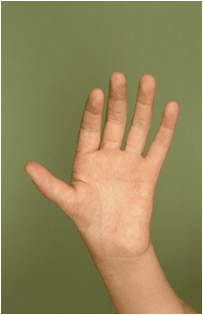
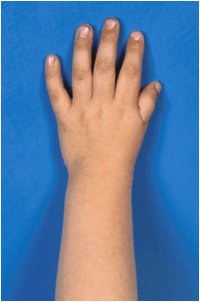
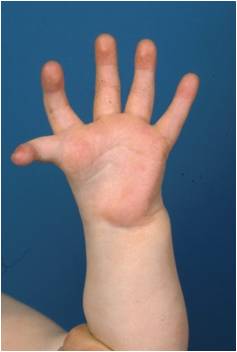
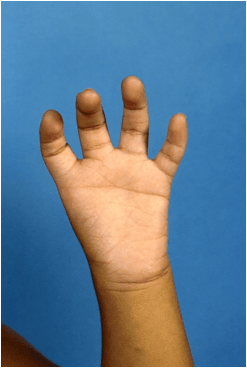
Thumb hypoplasia sits on the spectrum of radial longitudinal deficiency and is frequently syndromic. Before reconstruction, screen for VACTERL, Holt-Oram syndrome (cardiac), Fanconi anaemia (haematological - potentially fatal if missed; warrants chromosomal breakage testing) and TAR (thrombocytopenia-absent radius). A paediatric and cardiac/haematology workup is part of the assessment.
Reconstruction of the Stable Thumb (Types II-IIIA)
When the CMC joint is stable, the deficient thumb is rebuilt rather than replaced. The components are addressed individually:
Opponensplasty - commonly an abductor digiti minimi (Huber) transfer in children (which also adds thenar bulk) or an FDS opponensplasty - to provide the missing intrinsic opposition.
First web-space release/deepening (Z-plasty or local flaps) to allow the thumb to abduct and oppose rather than lie adducted in the plane of the palm.
Ulnar collateral ligament reconstruction/stabilisation of the MCP joint to provide a competent post for key pinch (UCL laxity is characteristic of type II).
Address extrinsic tendon abnormalities (e.g. the pollex abductus/aberrant FPL-EPL interconnections); an EIP transfer can restore extension/abduction where extrinsics are deficient (type IIIA).
Pollicization (Types IIIB-V)
When there is no stable basal joint, the deficient thumb is ablated and the index finger is transposed onto the thumb position ("pollicization"). The index is shortened (by removing/recessing the metacarpal), rotated (~120-160 degrees) and pronated, and angled into palmar abduction, while its neurovascular bundles are preserved and the intrinsic muscles are rebalanced so the index intrinsics act as the new thenar muscles (first dorsal interosseous becomes abductor, first palmar interosseous becomes adductor). The result is an opposable, sensate, stable thumb made from a finger the brain already controls.
- Ablate the vestigial/floating thumb and any unstable metacarpal remnant.
- Preserve the index neurovascular bundles; the digital nerves and vessels are mobilised, not divided.
- Shorten by resecting the index metacarpal (retaining the metacarpal head to act as the new trapezium / CMC), and set the new thumb in pronation and palmar abduction.
- Rebalance the intrinsics to power opposition (abduction) and adduction.
- Aim for an appropriately shorter new thumb that reaches the proximal phalanx of the long finger.
Toe-to-Hand (Toe-to-Thumb) Transfer
Toe-to-hand transfer is a microvascular free tissue transfer that moves a toe (great toe, second toe, or a combined/trimmed toe) to the hand to recreate a thumb. Its principal role is TRAUMATIC thumb amputation (where the other digits are intact and should not be sacrificed by pollicization), and it is also used in selected congenital cases - especially bilateral deficiency or where a five-digit hand is desired - to add a digit rather than transpose an existing one.
A sensate thumb with pinch, grasp and opposition, of adequate length, with minimal donor-foot morbidity when the transfer and donor closure are done well. In children, it provides a stable, growing first digit.
Requires microsurgical revascularisation and a suitable recipient artery, vein and nerves; donor choice balances hand appearance/function against foot donor-site considerations. Great-toe transfer gives bulk/strength; second-toe transfer preserves great-toe push-off.
Complications
- Vascular compromise of the transposed digit (NV bundle injury)
- Malposition/malrotation (inadequate pronation/abduction) limiting opposition
- Stiffness, weak pinch, or an unstable new CMC
- Suboptimal results where there is associated radial deficiency
- Microvascular failure / flap loss (anastomotic thrombosis)
- Donor-foot morbidity (gait, push-off, wound issues)
- Cold intolerance, reduced sensation, or insufficient length/mobility
- Need for secondary tenolysis/revision
Evidence & Key Studies
Methods for congenital thumb hypoplasia reconstruction - 10 years of surgical treatment
- Used a grade-directed algorithm: extensor indicis proprius tendon transfer for hypoplasia grades II and IIIa (stable CMC), and pollicization or second-toe-to-hand transfer with MTP arthrodesis for grades IIIb-V.
- DASH scores: 9.35 for second-toe-to-hand transfer, 19.8 for pollicization, 14.54 for EIP transfer.
- Confirms the IIIb threshold as the reconstruct-versus-replace pivot, and that toe-to-hand transfer can give function comparable to pollicization while creating a five-digit hand.
The results of pollicization for congenital thumb hypoplasia
- 42 hands assessed a mean 5.7 years post-pollicization; 72% excellent/good for function and 94% for appearance by patient/parent assessment.
- Associated forearm/wrist (radial) anomalies significantly compromised functional results but were NOT a contraindication to pollicization.
- CMC joint motion was near-normal in both groups; strength and timed-test gains over time were consistent with age-related improvement.
Long-term outcomes after toe-to-thumb transfers for burn reconstruction in children
- Paediatric toe-to-thumb transfers (mean follow-up 104 months) restored opposition (modified Kapandji scores 3-5) with no donor-foot morbidity.
- Concludes toe-to-thumb transfer should be considered the standard of care for thumb reconstruction in children after severe hand burns.
- Restores sensation, pinch, grasp and opposition with minimal donor-site morbidity.
According to PubMed, the grade-directed algorithm above (reconstruct types I-IIIA, pollicize/transfer for IIIB-V) and the reported outcomes reflect the cited studies. The Blauth/modified Blauth classification and the CMC-stability pivot are the standard framework these series apply.
Clinical Decision Scenarios
Practise clinical reasoning and management decisions out loud
“A 14-month-old child is referred with a small, deficient right thumb. How do you assess and classify the deformity, and what determines whether you reconstruct or pollicize?”
“A 30-year-old loses his dominant thumb at the MCP level in a saw injury; the replant is not salvageable and the other digits are intact. Months later he wants a functional thumb. What reconstruction would you offer and why not pollicization?”
Mnemonics & Memory Aids
STABLE
Hook:One word decides it all - is the basal joint STABLE? Stable = build it; unstable = pollicize.
POLLEX
Hook:Pollicization makes a POLLEX (Latin for thumb) out of the index finger.
Principles
- The thumb = ~40% of hand function; aim for a mobile, stable, sensate, well-positioned opposable post
- Congenital deficiency graded by Blauth/modified Blauth (I-V)
- Screen for syndromes: VACTERL, Holt-Oram, Fanconi anaemia (breakage testing), TAR
The pivot
- CMC (metacarpal base) stability decides strategy
- Stable (I, II, IIIA) -> RECONSTRUCT (opponensplasty, first web release, UCL, tendon correction)
- Unstable/absent (IIIB, IV floating thumb, V aplasia) -> ABLATE + POLLICIZE
Pollicization
- Transpose index: shorten (resect metacarpal, keep head as CMC), pronate/abduct, preserve NV bundles, rebalance intrinsics
- Early childhood; 72% good/excellent function, 94% appearance
- Radial anomalies worsen results but are not a contraindication
Toe-to-hand transfer
- Microvascular free transfer; workhorse for TRAUMATIC thumb loss (spares the fingers)
- Great toe = strength/bulk; second toe = preserves foot push-off
- Restores sensate pinch/grasp/opposition; risk = microvascular failure + donor-foot morbidity