Avulsion Injury | Extensor Mechanism | Ogden Classification
- Mechanism: eccentric quadriceps contraction pulling patellar tendon off tubercle
- Type III involves articular surface - MUST achieve anatomic reduction
- Compartment syndrome risk from anterior tibial recurrent artery disruption
- Usually adolescents but also occurs in adults with violent mechanism
- “Check for extensor lag - indicates complete avulsion
- “Lateral radiograph best for diagnosis
- “Monitor for compartment syndrome post-injury and post-op
- “Subtype A vs B: B has comminuted fragment - may need additional fixation
Tibial Tubercle Fractures
Overview
Tibial tubercle fractures are avulsion injuries. Forceful contraction of the quadriceps against resistance, most commonly in jumping or landing, pulls the patellar tendon off the tubercle. They are classically described in adolescent males aged 14-16 with an open tibial tubercle physis, but a sufficiently violent mechanism produces the same injury in adults.
What to recognise. The Ogden classification grades the fracture by how far it extends proximally, and whether it reaches the joint. The complication to recognise is anterior compartment syndrome, from injury to the anterior tibial recurrent artery near the tubercle, and it must be monitored for both at presentation and postoperatively.
Anatomy and Biomechanics
The apophysis. The tibial tubercle is a secondary ossification centre. It appears around age 10-12, fuses distally first and then proximally, and is completely fused by 17-18 years. It is vulnerable during that final fusion period.
The extensor mechanism. The patellar tendon inserts on the tubercle and transmits the force of the quadriceps. Stress on it is greatest during eccentric contraction.
The artery. The anterior tibial recurrent artery runs near the tubercle and is at risk in the injury. It is the source of the compartment syndrome.
Mechanism. A violent quadriceps contraction against a fixed or flexed knee places an eccentric load on the extensor mechanism, and the patellar tendon avulses the tubercle. A direct blow is a less common cause. The activities at risk:
- Jumping and landing sports: basketball, volleyball, high jump
- Sprinting
- Any deceleration injury, including a sudden stop or a missed step or landing
Classification Systems
Ogden's classification, his 1980 modification of Watson-Jones, grades the fracture by its proximal extent. Each type has an A subtype (single fragment) and a B subtype (comminuted). It is the standard system and guides surgical planning.
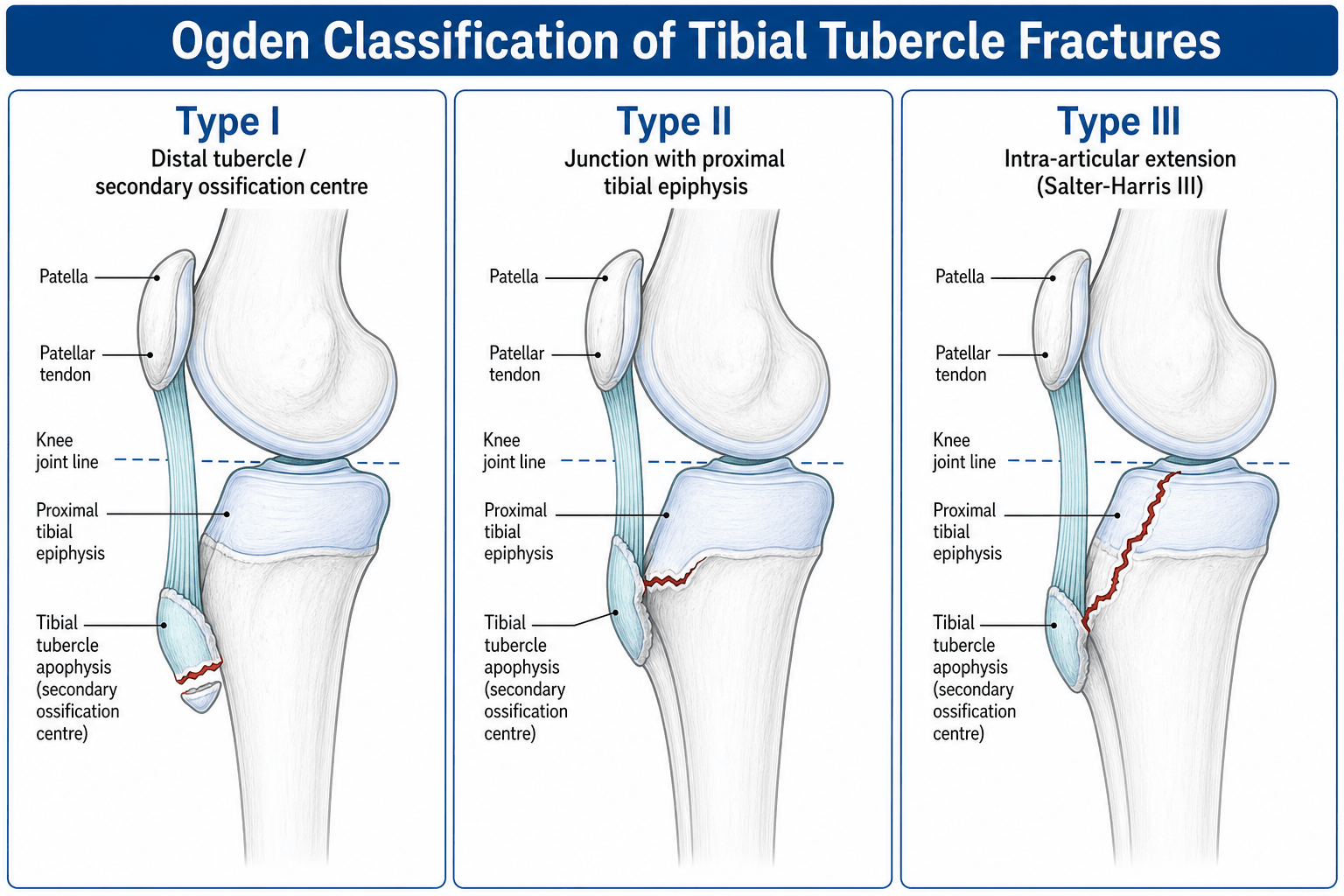
Type I - through the secondary ossification centre. The fracture is limited to the tubercle apophysis and does not extend to the main body of the tibia, the lowest-energy pattern. IA is a single fragment, often minimally displaced; IB is a comminuted apophysis.
Type II - at the junction of the ossification centres. The fracture extends to the junction with the main tibial physis, a more significant injury that is usually displaced. IIA is a single large fragment; IIB is comminuted at the junction.
Type III - into the joint. The fracture propagates into the tibial plateau, making it intra-articular and the most severe of Types I-III. IIIA is a single fragment with joint involvement; IIIB is comminuted articular involvement.
Type IV - posterior extension, a later addition. The fracture extends posterior to the physis and may involve the entire proximal tibia, after a high-energy mechanism.
Clinical Presentation
History. The mechanism described above, followed by sudden anterior knee pain and a felt "pop" or "snap". The patient cannot weight-bear, and with a complete tear cannot extend the knee.
Inspection and palpation. There is swelling and ecchymosis over the anterior proximal tibia, a palpable or visible defect at the tubercle, and a high-riding patella if the avulsion is complete. The tubercle is tender, there is a gap at the fracture site, and the avulsed fragment may be palpable.
The extensor mechanism. Three findings assess it:
- Finding
- Unable or weak
- Significance
- Complete avulsion
- Finding
- Loss of full extension
- Significance
- Extensor mechanism disruption
- Finding
- High (alta)
- Significance
- Tendon/tubercle avulsion
The anterior compartment. Assess it at presentation and check it again within 24-48 hours: pain out of proportion, a tense compartment, pain on passive toe flexion, and paraesthesia in the anterior leg or foot. If concerned, check the pressures or proceed to fasciotomy.
Investigations
Radiographs. AP and lateral views of the knee, compared with the contralateral knee if uncertain. The lateral is the best view: it shows the avulsed fragment, its anterior and superior displacement, the extent of the fracture line and any articular involvement. The AP may show the fracture, and is where rotation and an articular step are assessed. Ultrasound is also used for diagnosis, alongside radiographs.
The limit of the lateral view. The lateral can understate the injury. In Pandya's series of operatively treated fractures (see the Evidence section), a single lateral radiograph underestimated or missed the severity in 50%.
CT is indicated for Type III fractures to assess the joint, for complex or comminuted patterns, and for surgical planning. It shows the extent of the fracture, the articular step-off, comminution and fragment size.
MRI is not routine. It rules out associated soft-tissue injury and assesses the menisci and ligaments.
The patellar tendon transmits an enormous load, and the same eccentric force can disrupt the extensor mechanism at more than one level - so do not let the obvious tubercle fragment stop your assessment. Specifically look for: (1) a second-level extensor injury - a concurrent patellar tendon avulsion or intrasubstance tear, or an inferior-pole patellar (sleeve) avulsion - producing a "double-level" disruption, so examine and image both the tubercle and the patella; (2) intra-articular associated lesions in Ogden III - osteochondral fragments, meniscal tears and tibial spine / ACL avulsions - which is exactly why direct articular visualisation (arthrotomy, or arthroscopic assistance) is valuable when the fracture enters the joint; and (3) retinacular tears, which must be repaired to restore the extensor mechanism. MRI is the investigation when a soft-tissue or second-level injury is suspected. Missing the second injury leaves the patient with a persistent extensor lag despite a perfectly fixed tubercle.
Management
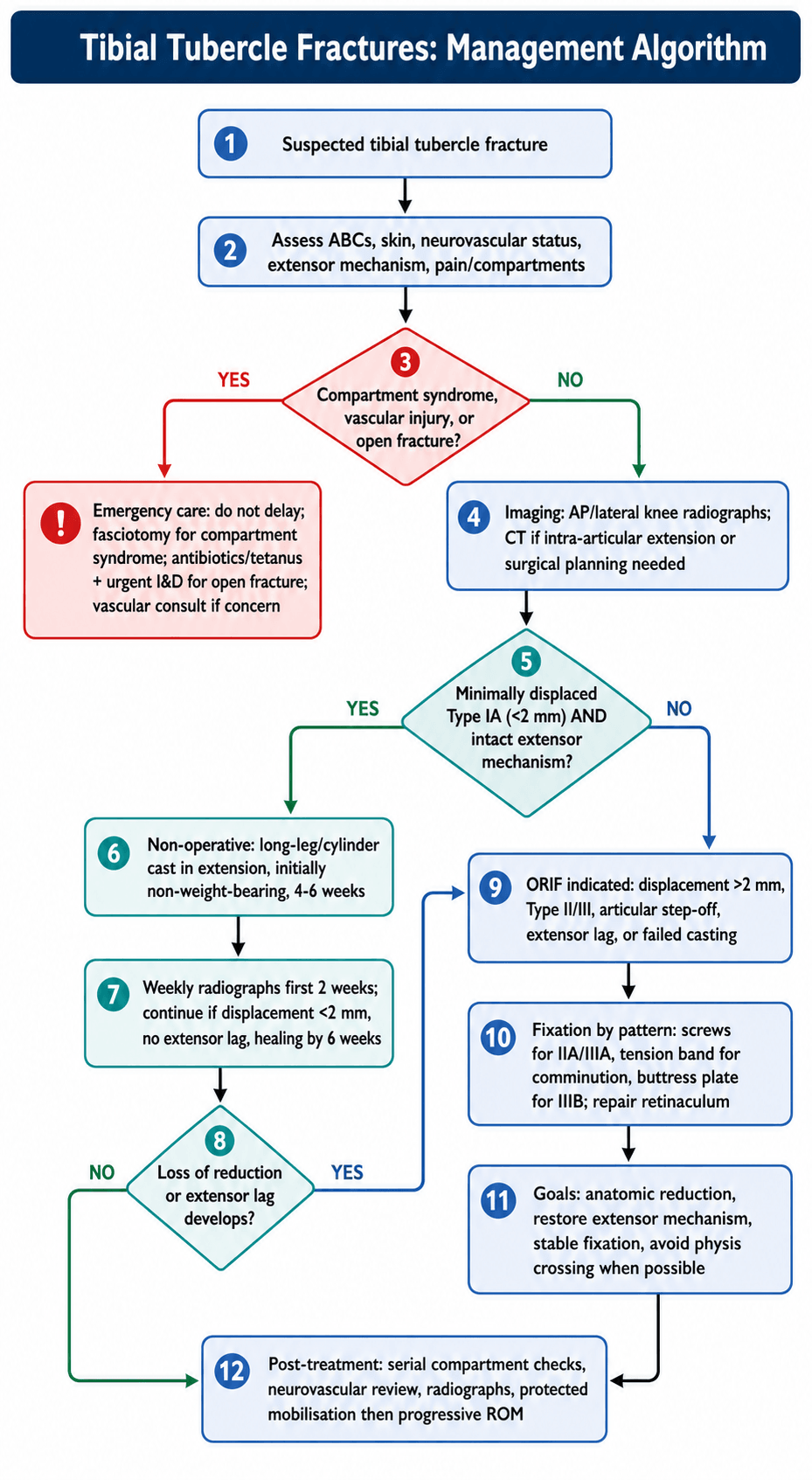
The decision. Treatment is ORIF with screws for displaced fractures; a cast is reserved for the minimally displaced Type IA with an intact extensor mechanism. Compartment syndrome, vascular injury and an open fracture take precedence over the fracture pattern, as the algorithm shows.
- Fracture Pattern
- Minimally displaced, small fragment
- Management
- Long leg cast, close follow-up
- Fracture Pattern
- Comminuted secondary centre
- Management
- ORIF: tension band wiring (alternative: screws + washers)
- Fracture Pattern
- Displaced, junction fracture
- Management
- ORIF: 2 cannulated screws (alternative: single screw)
- Fracture Pattern
- Comminuted junction
- Management
- ORIF: tension band (alternative: screws + washer), may need additional fixation
- Fracture Pattern
- Extends into joint, large fragment
- Management
- ORIF with anatomic articular reduction: cannulated screws (alternative: plate fixation)
- Fracture Pattern
- Comminuted into joint
- Management
- ORIF: buttress plate (alternative: screws + sutures)
- Fracture Pattern
- Complete avulsion
- Management
- Urgent surgical repair
- Fracture Pattern
- Any type
- Management
- Emergent fasciotomy
Who. A Type IA fracture with minimal displacement (under 2mm), an intact extensor mechanism and a compliant patient.
The cast. A long leg or cylinder cast with the knee in extension for 4-6 weeks, non-weight-bearing initially.
Follow-up. Radiographs weekly for the first 2 weeks, looking for loss of reduction; if displacement occurs, proceed to ORIF. Casting has succeeded if displacement stays under 2mm, no extensor lag develops and healing is evident by 6 weeks.
Surgical Technique
Setup. Supine on a radiolucent table with a bump under the ipsilateral hip, a tourniquet on the proximal thigh and an image intensifier available.
Approach. An anterior midline or anterolateral incision, 8-10 cm long and centred over the tibial tubercle. Protect the infrapatellar branch of the saphenous nerve, and develop the plane on either side of the patellar tendon.
Complications
Compartment syndrome. The incidence was historically quoted as high, 10-20%, from early case reports. Contemporary data are reassuring:
- 3.57% in a systematic review (Pretell-Mazzini 2016)
- 0.46% in a 25,483-patient database (Milner 2025)
- 0.4% in a population study (Koivisto 2022)
- Nearly 10% in a high-energy operative cohort (Pandya 2012)
The true risk is therefore low but non-trivial, and it remains a feared, treatable emergency. The anterior tibial recurrent artery, injured in the fracture or its reduction, bleeds into the anterior compartment, and the syndrome can follow either the injury or the operation. Clinical vigilance remains mandatory: serial examinations, a low threshold for pressure measurement, and emergent fasciotomy if it is confirmed.
Growth disturbance. More common if the physis is damaged, with an incidence of 5-10% overall. Recurvatum deformity is the most common form, usually mild (under 5 degrees) and rarely requiring corrective osteotomy. Leg length discrepancy is rare (under 5%), usually under 1cm, and does not typically require treatment.
Loss of flexion. Extensor mechanism adhesions usually respond to therapy, but may need manipulation under anaesthesia.
Nonunion and malunion. Nonunion is rare (under 2%) with adequate fixation and malunion uncommon with anatomic reduction; either may need revision surgery.
Refracture. A risk if the return to sport is too early, and uncommon with proper rehabilitation.
Prominence. Hardware irritation or a bony prominence may need hardware removal, and the prominence may persist at 5 years.
Timing. The complications to monitor for fall into three windows:
- Early (0-2 weeks): compartment syndrome, wound infection, loss of fixation
- Intermediate (2-12 weeks): stiffness, nonunion, hardware irritation
- Late (over 3 months): malunion, growth disturbance in adolescents, persistent prominence
Postoperative Care
The first 48 hours. Neurovascular checks every 2-4 hours, with surveillance of the anterior compartment: pain out of proportion triggers immediate assessment, and the threshold for pressure measurement is low. The knee is held in full extension in an immobiliser or cylinder cast, with elevation and ice. The patient starts non-weight-bearing, toe-touch weight-bearing with crutches, and begins upper extremity strengthening.
Weeks 0-2. Change the dressing at 2-3 days and remove sutures or staples at 14 days, watching for infection. If fixation is stable, begin passive ROM with gentle heel slides on day 2-3, limiting flexion to 30 degrees in the first week and progressing to 60 degrees by 2 weeks, and avoid active extension initially. Analgesia is multimodal with ice and elevation. NSAIDs are avoided for the first 6 weeks for the sake of fracture healing, a common practice that rests on mixed evidence.
Weeks 2-6. The protocol advances on four fronts:
- Weight-bearing: partial (50%) in weeks 2-4, as tolerated in weeks 4-6, weaning from crutches when comfortable
- Range of motion: active assisted, flexion progressed by 15 degrees a week to a goal of 90 degrees by 6 weeks, with active quadriceps exercises added at week 4
- Strengthening: quadriceps sets from week 2, straight leg raises at week 4, closed kinetic chain exercises at week 6
- Radiographs: at 2 weeks for fixation and early healing, 6 weeks to assess union, 12 weeks to confirm healing
Weeks 6-12. Advance to full weight-bearing, aiming for full ROM by 12 weeks, with progressive resistance, proprioception and balance exercises. Return to activity is staged: stationary bike at week 8, light jogging at week 12 if healed, sport-specific drills at week 16, and full return to sport at 4-6 months.
Criteria for progression. Each advance has its conditions:
- Weight-bearing: radiographic evidence of healing, minimal pain with protected weight-bearing, no increase in swelling
- Range of motion: no increase in effusion, comfortable with the current range, fixation intact on radiographs
- Return to sport: full ROM compared with the contralateral knee, quadriceps strength and hop testing each over 90% of the opposite side, pain-free running and jumping, and complete radiographic union
Outcomes/Prognosis
Overall. Results are excellent. In Pretell-Mazzini's systematic review (2016, PMID 25887827), return to pre-injury activity and full knee ROM each reached about 98% regardless of fracture type, and union was achieved in about 99%. Mean return to sport was around 4-6 months in the reported cohorts. The overall complication rate of about 28% was dominated by symptomatic implants requiring removal, the commonest reoperation.
By Ogden type.
- Type I: best prognosis, union 98-100%, minimal risk of growth disturbance, and rare complications if treated appropriately
- Type II: excellent outcomes with ORIF, union 95-98%, a low complication rate and full ROM expected
- Type III: good outcomes with anatomic reduction, but mild post-traumatic arthritis may develop (5-10%) and rehabilitation takes longer
Prognostic factors. Early diagnosis and treatment (within 7 days), an anatomic reduction, stable fixation that allows early motion, good compliance with rehabilitation and a non-articular (Type I or II) fracture predict a good result. Delayed diagnosis (over 2 weeks), an articular step-off over 2mm, compartment syndrome, infection and loss of fixation requiring revision predict a poor one.
Recovery.
- Motion: 95% achieve full ROM by 6 months; early stiffness is common but resolves with therapy, and an extension deficit is rare (under 5%) with proper treatment
- Strength: quadriceps strength returns to 90% by 4 months and fully by 6-8 months, with symmetric strength on isokinetic testing at 1 year
- Union: typically evident by 8-12 weeks
- Activity: light activities at 6-8 weeks, full weight-bearing at 8-12 weeks, running at 3-4 months, full sport participation at 4-6 months, and contact sports no sooner than 6 months
Return to sport. An accelerated return (3-4 months) is favoured by a Type I fracture, no or minimal displacement, excellent fixation, early mobilisation and good compliance with rehabilitation. A Type III articular fracture, a comminuted pattern, compartment syndrome requiring fasciotomy, postoperative stiffness or loss of fixation delays it to 6 months or more.
Long term. At 5 years there is no pain in 95% of patients, with full return to the pre-injury activity level and no difference in outcomes between adolescents and adults. At 10 years or more, mild post-traumatic arthritis is present in 10% of Type III fractures and is usually asymptomatic; there is no increased risk of patellofemoral problems, and an ossicle at the fracture site is an occasional finding.
Satisfaction. Over 90% of patients are satisfied at 1 year, and most would undergo the same treatment again. The desired activity level is achieved, with minimal long-term disability.
Guidelines, Registries & Global Practice
Guidelines, Registries & Global Practice
Tibial tubercle fractures are uncommon worldwide and there is no dedicated AAOS, NICE, BOA-BOAST or EFORT clinical practice guideline specific to them. Management is therefore consensus- and evidence-based rather than guideline-mandated, and the principles below are consistent across high-income health systems.
Global Epidemiology
- Figure
- ~21 per 100,000 per year
- Source (PubMed)
- Koivisto 2022 (PMID 36268729)
- Figure
- 15 years (mid-adolescence)
- Source (PubMed)
- Koivisto 2022; Pretell-Mazzini 2016
- Figure
- Strong male predominance
- Source (PubMed)
- Ogden 1980; Cole 2020
- Figure
- Type III (intra-articular), ~50%
- Source (PubMed)
- Pretell-Mazzini 2016 (PMID 25887827)
- Figure
- Over-represented vs general population
- Source (PubMed)
- Ogden 1980 (PMID 7358751)
- Figure
- ~99%
- Source (PubMed)
- Pretell-Mazzini 2016
Mechanism is near-universal: eccentric quadriceps loading during jumping or sprinting at the end of physeal closure, when the tubercle apophysis is mechanically vulnerable (Cole 2020, PMID 32304501).
Where Guidance Converges (Global Standard of Care)
- Accepted position
- Ogden (modified Watson-Jones) is the working standard; CT-based schemes (Pandya) add intra-articular detail
- Evidence level
- IV-III
- Accepted position
- Lateral radiograph for screening; CT for suspected intra-articular/physeal extension (lateral view alone underestimates 50%)
- Evidence level
- III (Pandya, PMID 23147615)
- Accepted position
- Reserved for minimally displaced (under 2 mm) extra-articular fractures with intact extensor mechanism
- Evidence level
- IV
- Accepted position
- Displaced, intra-articular, or extensor-mechanism-disrupting fractures - ORIF (screws +/- tension band/plate)
- Evidence level
- III-IV
- Accepted position
- Restore extensor mechanism and articular congruity; stable fixation for early motion
- Evidence level
- III (Cole 2020)
- Accepted position
- Recognised emergency; vigilance 24-48 h despite low absolute risk
- Evidence level
- IV (Pape, PMID 8403649)
Registry Evidence
This is a paediatric/adolescent trauma entity, not an arthroplasty or implant-survival topic, so the national joint registries (NJR, AJRR, AOANJRR, SHAR, NZJR) do not capture it. The best population-level denominators come instead from dedicated paediatric fracture databases: the Finnish Kids' Fracture Tool (Koivisto 2022, incidence and 0.4% compartment-syndrome rate) and large US administrative cohorts (Milner 2025, 25,483 patients, 0.46% compartment-syndrome rate, PMID 39482931). These have been pivotal in revising the historical 10-20% compartment-syndrome teaching downwards.
Practice Variation
- Imaging thresholds: centres with ready CT access image intra-articular patterns routinely (Pandya approach); resource-limited settings rely on the lateral radiograph and intra-operative assessment.
- Fixation choice: cannulated screws for large single fragments versus tension-band/suture-augmented constructs for comminuted apophyseal fragments - surgeon and resource dependent, with no high-level comparative trial.
- Physeal-sparing concern: emphasised in skeletally immature patients, though most injuries occur peri-closure so growth disturbance is uncommon.
- NSAID avoidance in early fracture healing remains common practice but rests on mixed evidence and varies between units.
- Antibiotic prophylaxis for the rare open fracture follows local trauma protocols (e.g. first-generation cephalosporin for low-grade open injury) rather than a tubercle-specific guideline.
Long-Term Follow-Up
Skeletally immature patients are followed to maturity to detect genu recurvatum or limb-length discrepancy from proximal tibial physeal injury, both uncommon with isolated tubercle fractures. Skeletally mature patients need shorter follow-up centred on union, return to activity, and symptomatic-hardware assessment (the commonest reason for reoperation; Pretell-Mazzini 2016).
Viva Scenarios
Viva Scenarios
Clinical Decision Scenarios
Practise clinical reasoning and management decisions out loud
“A 15-year-old male basketball player lands awkwardly and presents with severe anterior knee pain. He cannot actively extend his knee. Examination shows significant swelling anterior proximal tibia, palpable defect at tibial tubercle, unable to perform straight leg raise, high-riding patella. Neurovascularly intact. Anterior compartment soft.”
“You are asked to describe the Ogden classification for tibial tubercle fractures and explain how it guides your management.”
“6 hours after ORIF of a tibial tubercle fracture, the patient complains of severe anterior leg pain. Examination shows anterior compartment tense and tender, severe pain with passive toe flexion, paresthesia in first web space, foot cool compared to other side.”
MCQ Practice Points
MCQ Practice Points
Q: What is the Ogden classification for tibial tubercle fractures? A: Type I = fracture through secondary ossification center only, Type II = fracture at junction with main ossification center, Type III = fracture extends to articular surface (intra-articular). Each has subtypes A (single fragment) and B (comminuted). Type III MUST have anatomic reduction because it involves the joint surface. This is THE standard classification system.
Q: What is the compartment syndrome risk with tibial tubercle fractures and why? A: Anterior compartment syndrome from anterior tibial recurrent artery injury. The "10-20%" figure comes from early case reports; contemporary large series and population data show roughly 0.4-4% (Pretell-Mazzini 3.57%, Milner 0.46%, Koivisto 0.4%), with up to ~10% in high-energy operative cohorts (Pandya). The point examiners want: the mechanism (anterior tibial recurrent artery) and that it is a treatable emergency. Monitor closely for 24-48 hours post-injury and post-operatively, low threshold for fasciotomy. Pain out of proportion is the earliest and most reliable sign.
Q: What finding indicates complete extensor mechanism disruption and absolute need for surgery? A: Extensor lag (inability to actively extend the knee) or inability to perform straight leg raise indicates complete extensor mechanism disruption and is an absolute indication for ORIF. High-riding patella (patella alta) is another sign of complete disruption. These patients need urgent surgical repair.
Q: What is the displacement threshold for surgical treatment of tibial tubercle fractures? A: 2mm is the magic number. Displacement over 2mm is the threshold for surgical treatment. Type IA fractures with displacement under 2mm may be treated conservatively with casting, but require close weekly radiographic follow-up for the first 2 weeks to ensure no loss of reduction.
Q: What is the best radiographic view for diagnosing tibial tubercle fractures? A: The lateral knee radiograph is the best view for diagnosis and classification. AP views may miss the fracture or underestimate displacement. Always order both AP and lateral views, but the lateral is key for decision-making and surgical planning.
Q: What growth considerations are important when treating adolescent tibial tubercle fractures? A: These fractures occur during the vulnerable period of tibial tubercle fusion (ages 14-16). Avoid crossing the physis with fixation if possible by placing screws parallel to the physis. Growth disturbance (recurvatum deformity) occurs in 5-10% but is usually mild. Monitor until skeletal maturity (approximately 18 years).
High-Yield Facts for Exam
- Ogden Type I = secondary ossification center only
- Ogden Type II = junction of ossification centers
- Ogden Type III = extends to articular surface (intra-articular)
- Each type has subtype A (single fragment) and B (comminuted)
- Watson-Jones classification is historical; Ogden is standard
- Eccentric quadriceps contraction during jumping/landing
- Patellar tendon avulses tibial tubercle
- Peak age: 14-16 years (adolescent males)
- Can occur in adults with violent mechanism
- Compartment syndrome risk roughly 0.4-4% in large/population series (the classic "10-20%" derives from early case reports); higher in high-energy injuries
- Caused by anterior tibial recurrent artery injury
- Monitor closely first 24-48 hours post-injury and post-op
- Low threshold for fasciotomy
- Lateral radiograph best for diagnosis
- Extensor lag indicates complete avulsion
- High-riding patella (patella alta) suggests extensor mechanism disruption
- CT scan for Type III to assess articular involvement
- Type IA with displacement under 2mm: may trial casting
- Type II and III: usually require ORIF
- Type III requires anatomic articular reduction
- Cannulated screws for large single fragments
- Tension band wiring for comminuted patterns
- Early passive ROM if fixation stable
- Protected weight-bearing 2-6 weeks
- Return to sport: 4-6 months
- Avoid crossing physis in adolescents
- Excellent outcomes in over 95% with ORIF
- Full return to sport expected in 90%
- Growth disturbance uncommon (5-10%)
- Long-term complications rare
Common Exam Scenarios
15-year-old basketball player unable to extend knee after landing
- Answer: Tibial tubercle avulsion with complete extensor mechanism disruption, requires ORIF
Post-op day 1, severe anterior leg pain out of proportion
- Answer: Compartment syndrome, emergent fasciotomy indicated
Lateral XR shows fracture extending to tibial plateau
- Answer: Ogden Type III, requires anatomic articular reduction
Type IA fracture with 1mm displacement
- Answer: May trial non-operative management with casting
Comminuted tubercle fracture in 15-year-old
- Answer: Ogden Type IB or IIB, tension band wiring appropriate
Key Differentials
- Tubercle avulsion: bony fragment on XR
- Tendon rupture: no bony fragment, soft tissue injury
- Acute fracture: acute traumatic event, displacement
- Osgood-Schlatter: chronic apophysitis, no acute trauma
- Type III: fracture line from tubercle to joint
- Physeal fracture: through proximal tibial physis (Salter-Harris pattern)
Must-Know Numbers
- Peak age: 14-16 years
- Compartment syndrome risk: roughly 0.4-4% (large/population series; classic teaching of 10-20% is from early case reports)
- Displacement threshold for surgery: over 2mm
- Union rate with ORIF: over 95%
- Return to sport: 4-6 months
- Growth disturbance risk: 5-10%
Exam Traps to Avoid
Assuming all tibial tubercle fractures are in adolescents
- Reality: Can occur in adults with violent mechanism
Missing compartment syndrome
- Key: High index of suspicion, monitor closely
Not recognizing need for anatomic reduction in Type III
- Key: Articular involvement requires perfect reduction
Crossing physis with fixation in adolescents
- Key: Place screws parallel to physis when possible
Assuming conservative treatment always fails
- Reality: Type IA with minimal displacement may heal with casting
Exam Cheat Sheet
Exam Day Cheat Sheet
Mechanism
- Eccentric quadriceps contraction
- Jumping/landing activities
- Patellar tendon avulses tubercle
- Usually adolescent males (14-16)
Ogden Classification
- Type I: Secondary ossification center only
- Type II: Junction of ossification centers
- Type III: Extends to articular surface
- Subtypes: A (single), B (comminuted)
Clinical Assessment
- Extensor lag = complete avulsion
- High-riding patella
- Lateral XR best for diagnosis
- Monitor for compartment syndrome
Management
- Type IA minimally displaced: may cast
- Type II/III: ORIF indicated
- Cannulated screws or tension band
- Anatomic reduction for Type III
Compartment Syndrome
- Roughly 0.4-4% (large series)
- Anterior tibial recurrent artery
- Monitor 24-48 hours post-injury/surgery
- Low threshold for fasciotomy
Return to Sport
- 4-6 months typically
- Must have full strength
- Pain-free range of motion
- Excellent prognosis with ORIF
Evidence
Evidence Base
Ogden Classification (Defining Paper)
- Review of 15 physeal tibial tuberosity fractures in 14 adolescents that produced the modified classification (Types I-III, with A/B subtypes for comminution) emphasising intra-articular extension. Primary surgical indications were anterosuperior fragment displacement and fracture extension through the proximal tibial ossification centre into the joint. An increased incidence of pre-existing Osgood-Schlatter disease was noted, and complications were rare.
Compartment Syndrome First Described in This Fracture
- Case series of adolescent boys who developed anterior compartment syndrome after tibial tubercle avulsion. The authors implicated injury to branches of the anterior tibial recurrent artery near the tubercle and argued that soft-tissue injury is more extensive than usually appreciated, establishing compartment syndrome as a recognised complication of this fracture.