Radial Distal Row | Body vs Ridge Pattern | CMC Joint Implications
- Two distinct patterns: Body fractures (articular) vs ridge fractures (extra-articular)
- Body fractures involve thumb CMC joint - articular reduction critical
- Ridge fractures are FCR insertion avulsions - usually conservative
- Bennett's variant: Trapezium body fracture may resemble Bennett's mechanism
- CT essential for body fracture surgical planning
- “Ridge fractures most common - in FCR groove, usually conservative
- “Body fractures involve CMC joint - need anatomic reduction
- “Carpal tunnel view shows ridge fractures best
- “High rate of FCR tendon irritation with ridge fractures
Overview and Epidemiology
Trapezium fractures are fractures of the trapezium, the carpal bone on the radial side of the distal row. They account for 3-5% of all carpal fractures, and the trapezium is the second most commonly fractured bone of the distal row, after the hamate. The patients are young to middle-aged adults, with a male predominance.
Two patterns. Two injuries share the name, and treatment depends on which one is in front of you.
- Ridge fractures are the more common: an extra-articular avulsion of the volar trapezial ridge at the FCR attachment, usually treated conservatively
- Body fractures are less common but more significant: they run through the body into the articular surface of the thumb CMC joint, need anatomic reduction and carry a higher complication rate
Why the joint matters. The trapezium articulates with the thumb metacarpal at the CMC joint, the most mobile and most important joint of the thumb, which allows opposition, flexion, extension and abduction. Injury here costs grip and pinch strength, and a body fracture deserves the same respect as a Bennett's fracture.
Anatomy/Biomechanics
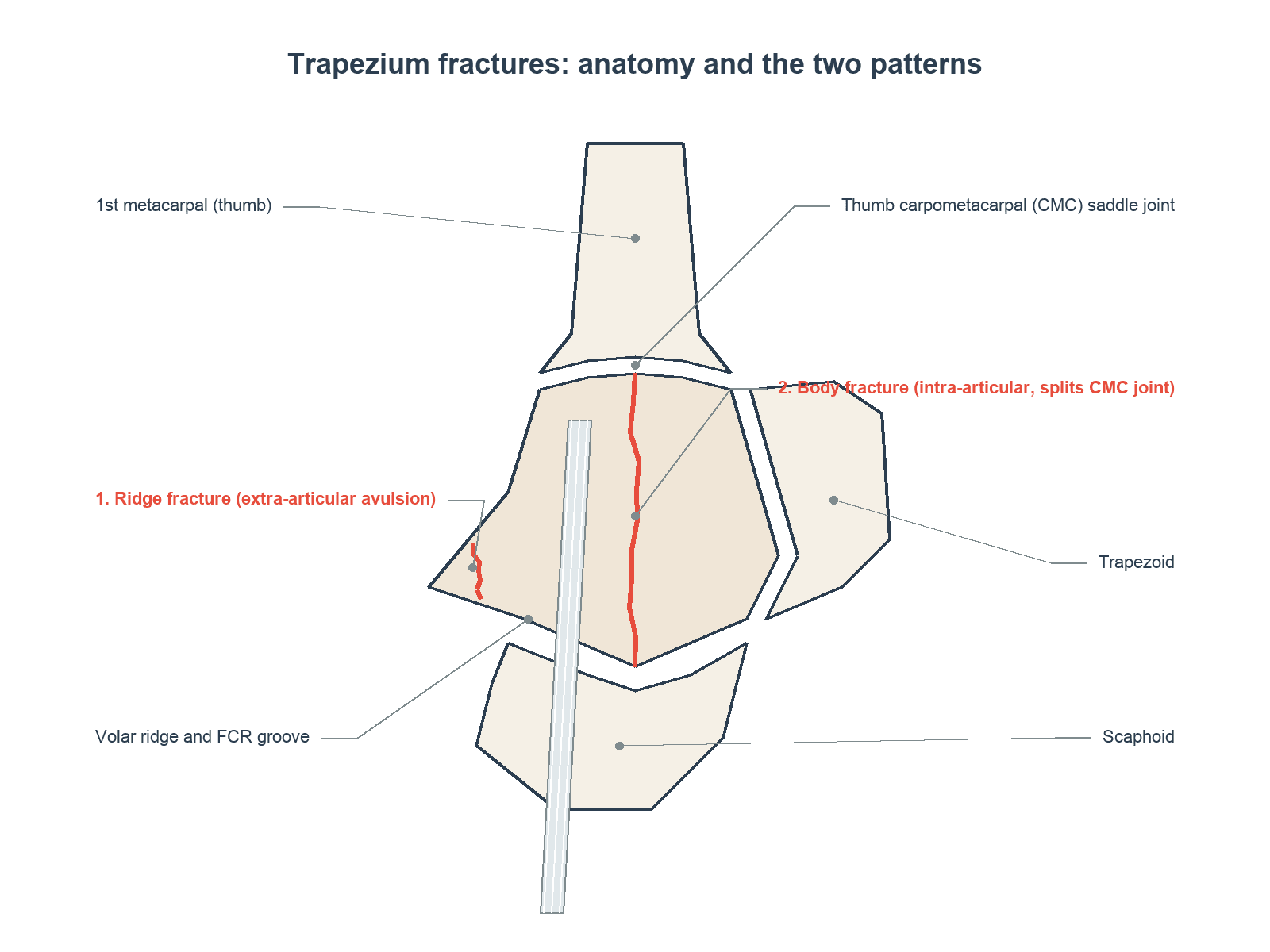
Shape and joints. The bulk of the bone is the body, which carries the articular surfaces. Distally it forms a saddle joint with the first metacarpal that allows multiplanar thumb motion; medially it articulates with the trapezoid and proximally with the scaphoid.
The volar ridge. A prominent projection on the palmar surface. It forms the radial border of the groove through which the flexor carpi radialis (FCR) passes, and it gives attachment to the transverse carpal ligament and the FCR sheath.
The FCR tendon passes through a groove bounded by the volar ridge. A ridge fracture disturbs its glide, and the fragment can cause irritation, tenosynovitis from chronic irritation, or even rupture. Always assess FCR function and consider this in management.
Blood supply. Multiple small vessels enter through the non-articular dorsal and volar surfaces, with no single dominant vessel and adequate anastomoses. The trapezium has good healing potential and a lower AVN risk than the scaphoid or lunate. The tip of the volar ridge is the exception (see the Palmer classification below).
Load. The CMC is a biaxial saddle joint that allows opposition and circumduction. Forces from the thumb concentrate on the trapezium, with high stress during pinch and grip, and the joint is predisposed to arthritic change.
Classification Systems
Anatomical classification. Location and articular involvement guide treatment.
- Pattern
- Vertical body
- Features
- Sagittal split involving the CMC articular surface; mechanism similar to Bennett's fracture
- Treatment
- ORIF if displaced
- Pattern
- Horizontal body
- Features
- Coronal split that may involve the scaphotrapeziotrapezoid joint; less common than vertical
- Treatment
- ORIF if displaced
- Pattern
- Dorsal ridge
- Features
- Small dorsal avulsion at a ligament attachment
- Treatment
- Conservative
- Pattern
- Volar ridge
- Features
- Most common pattern overall; extra-articular avulsion in the FCR groove
- Treatment
- Conservative, excision if symptomatic
- Pattern
- Comminuted body
- Features
- Entire body involved, multiple fragments, high energy, articular involvement, poor prognosis
- Treatment
- Complex reconstruction or fusion
Walker classification. A practical scheme that separates the extra-articular injuries, with a good prognosis, from the articular ones, which are more complex.
- Type A, ridge - volar avulsion (most common) or dorsal avulsion (rare), extra-articular; conservative for most
- Type B, body - B1 vertical split with the CMC involved, B2 horizontal split, B3 comminuted; ORIF for displaced fractures, fusion for comminuted
- Type C, associated injuries - a trapezium fracture with a first metacarpal base fracture, a Bennett's or Rolando's variant, or another complex pattern; address every component
Mechanism helps predict the pattern. Ridge fractures are low-energy avulsions: FCR traction during forceful wrist flexion, with the pull of the transverse carpal ligament, produces an extra-articular fracture. Body fractures come from an axial load through the thumb metacarpal, similar to the Bennett's mechanism, which splits the trapezium into the joint.
Direct and combined injuries. A direct blow to the base of the thumb gives a variable, high-energy pattern that may be comminuted. Combined mechanisms, with several force vectors, produce complex patterns, often with associated injuries, and carry the worst prognosis.
Trapezial ridge fractures have their own named scheme (Palmer, 1981) that predicts healing and explains the heal-versus-excise behaviour. Type I is a fracture at the base of the ridge (where it joins the trapezial body) — better vascularised, it generally unites with cast immobilisation. Type II is an avulsion of the tip of the ridge — distal, poorly vascularised and pulled by the transverse carpal ligament, so it is prone to non-union and, if symptomatic, is best treated by fragment excision rather than prolonged immobilisation. Both can irritate the adjacent FCR, but the Type II tip avulsion is the classic cause of the symptomatic non-union that comes to excision.
Know the provenance, because it is unusually thin for something taught as a rule: Palmer's paper reports THREE patients. All three fell on a dorsiflexed wrist, all were diagnosed only once a carpal tunnel view was obtained, the Type I healed in cast and the Type II avulsions did not. The mechanism is sound and the pattern has held up in later case reports, but there is no series behind it - which is also why any percentage attached to non-union in this injury is a convention rather than a measured rate.
Clinical Assessment
History. The mechanism points towards the pattern:
- A fall on the outstretched hand with the thumb abducted
- A direct blow to the thenar eminence
- An axial load from a punch or a fall onto the thumb
- Forceful wrist flexion, avulsing the ridge
Establish the exact mechanism and thumb position, the energy of injury, the immediate symptoms, hand dominance and occupation, and any prior thumb or wrist pathology.
Inspection and palpation. Look for swelling over the thenar eminence and bruising at the thumb base, comparing with the other hand. Tenderness directly over the trapezium at the thenar eminence, or at the volar wrist crease over the ridge, localises the injury; palpate along the FCR for tenosynovitis. The anatomic snuffbox may be tender too, which overlaps with the scaphoid.
Movement and stability. Pain limits CMC motion, and opposition is particularly affected. Stress the CMC joint for stability once analgesia is adequate, comparing with the opposite side.
Neurovascular status. Usually preserved, but the thenar branch of the median nerve may be at risk. Document a baseline.
Special tests.
- Grind test - axial load with rotation at the CMC; pain suggests CMC pathology, and it may be positive with both fracture and arthritis
- FCR provocation - resisted wrist flexion; pain suggests FCR involvement, which matters in ridge fractures
- Pinch strength - markedly reduced with trapezium injury; compare with the other side and record it as the baseline for recovery
Differential diagnosis. Radial-sided wrist and thumb-base pain after trauma has several mimics. The trapezium sits at the crossroads of the scaphoid, the thumb metacarpal base, the scaphotrapeziotrapezoid (STT) joint and the FCR tunnel, so each must be actively excluded, and the examination helps separate a ridge fracture from a body fracture.
- Distinguishing features
- Snuffbox and scaphoid tubercle tenderness, FOOSH mechanism
- Key test / discriminator
- Scaphoid-series radiographs; MRI/CT if occult
- Distinguishing features
- Pain and deformity at the metacarpal base, not the trapezium
- Key test / discriminator
- PA/lateral thumb views show metacarpal base fracture-subluxation
- Distinguishing features
- Gross instability of thumb base; may coexist with body fracture
- Key test / discriminator
- Stress views; reduce and reassess stability (see Roger et al.)
- Distinguishing features
- Older patient, chronic pain, positive grind test, no acute trauma
- Key test / discriminator
- Radiographs show joint-space loss/osteophytes, not a fracture line
- Distinguishing features
- Volar pain with resisted wrist flexion, no fracture
- Key test / discriminator
- Tenderness along FCR; ultrasound; may follow ridge malunion
- Distinguishing features
- Pain just distal to scaphoid, insidious onset
- Key test / discriminator
- Radiographs show STT joint degeneration
- Distinguishing features
- Volar ridge tenderness (extra-articular) vs dorsal CMC tenderness (intra-articular)
- Key test / discriminator
- Carpal tunnel (Gaynor-Hart) view for ridge; CT for body
Investigations
Radiographs. Start with the standard views:
- PA - may show a body fracture
- Lateral - displacement
- Oblique - an additional perspective
They are available and quick, and their primary role is the body fracture.
On the films, look for a ridge fragment on the carpal tunnel view, a body fracture line on the PA or oblique, CMC joint congruity, and an associated thumb metacarpal injury.
The carpal tunnel view. Standard PA and lateral views may miss a ridge fracture, and without the carpal tunnel (Gaynor-Hart) view it is easily missed. The wrist is hyperextended and the beam angled at 25 degrees, which shows the volar ridge clearly. It needs a specific technique and must be requested specifically whenever a ridge fracture is suspected.
The Betts view. Hyperpronation isolates the trapezium from the overlapping bones. It is good for assessing a body fracture and complements the carpal tunnel view.
CT. Essential for ORIF. It plans surgery for a body fracture by showing the fracture orientation (vertical or horizontal), the articular step-off or gap, fragment size and displacement, comminution and associated injuries, and it detects occult fractures.
MRI. Rarely needed acutely. It assesses the soft tissues and detects occult fractures, showing bone marrow oedema, FCR tenosynovitis and ligament integrity.
Management Algorithm
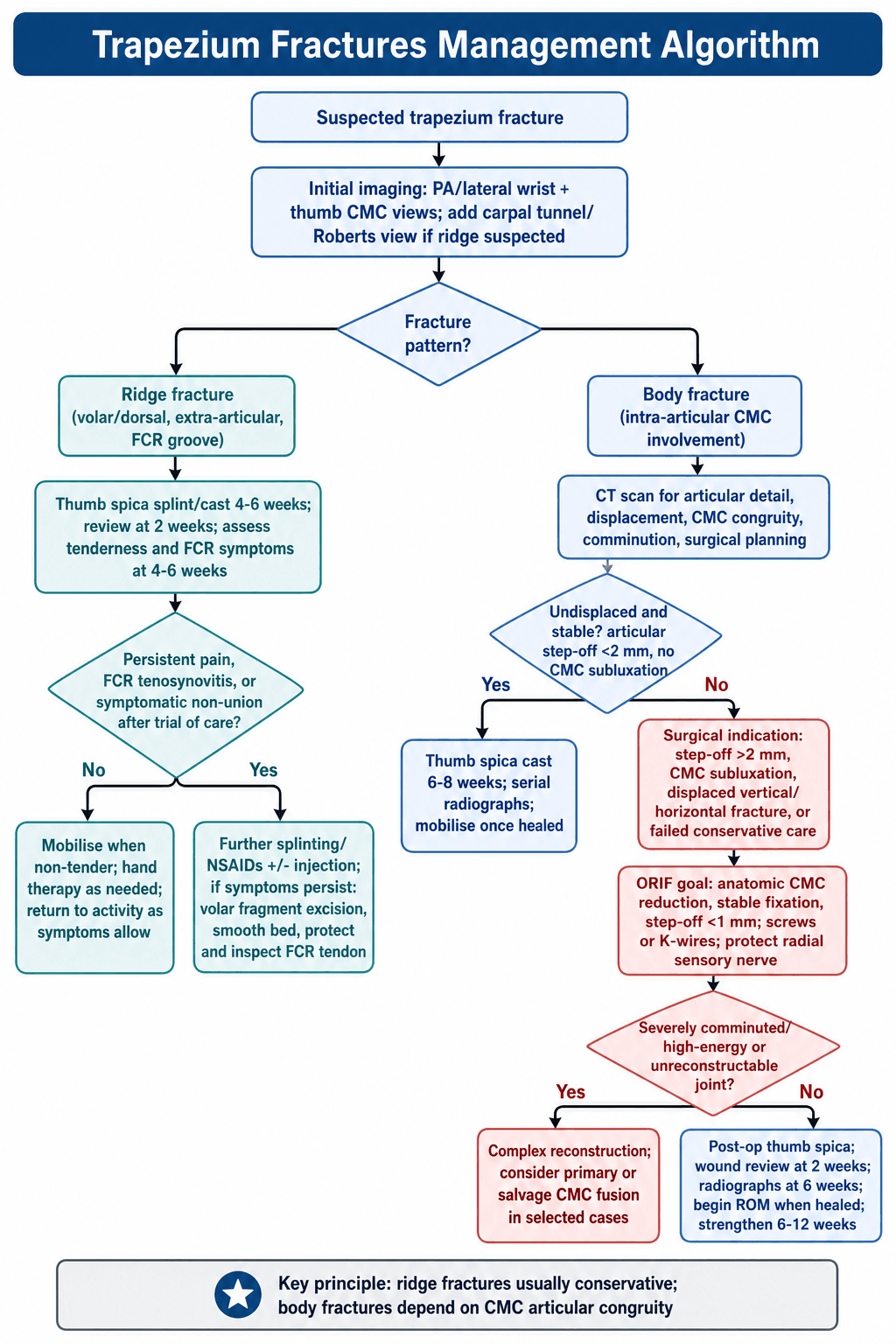
Ridge fractures. Extra-articular, with a generally excellent prognosis in a thumb spica splint or cast for 4-6 weeks, the thumb in a functional position. A removable splint may be used if the patient is compliant, and mobilisation begins once the ridge is non-tender (protocol under Postoperative Care).
Symptomatic ridge non-union. Occurs in a minority, with persistent thenar pain, FCR tenosynovitis symptoms, pain on wrist flexion and extension, and tenderness over the volar ridge. Treatment is stepwise:
- A trial of splinting and anti-inflammatories
- A steroid injection, which may give temporary relief
- Fragment excision if symptoms persist
Undisplaced body fractures. Cast when the fracture is undisplaced (step-off under 2mm), the patient is low-demand, or surgery is medically contraindicated. A thumb spica cast for 6-8 weeks, with serial radiographs to catch displacement, and mobilisation once healed.
Displaced body fractures. The indications for surgery:
- Articular step-off over 2mm
- CMC joint subluxation
- A displaced vertical or horizontal body fracture
- Failed conservative treatment
The goals are anatomic CMC articular reduction, stable fixation, early mobilisation when possible, and prevention of post-traumatic CMC arthritis.
Which approach. The dorsal approach, between EPB and EPL, is the common one: it gives good visualisation of the CMC joint and access for screws or K-wires. A volar approach through the thenar muscles is used for volar fragments and protects the radial artery.
Surgical Technique
Planning and set-up. CT characterises the fracture, decides the approach and sizes the fragments, which chooses between screws and K-wires. The patient lies supine with an arm table, the hand supinated or neutral depending on the approach, a tourniquet on the forearm or upper arm and fluoroscopy available.
Dorsal exposure. A longitudinal incision of 3-4 cm over the dorsal thumb base, between EPB and EPL, starting at the first metacarpal base and extending proximally.
- Identify and protect the radial sensory nerve branches
- Retract EPB and EPL
- Incise the CMC capsule longitudinally
- Expose the trapezium and its articular surface
Reduction. Look directly at the articular surface, assess the pattern and identify every fragment, then manipulate them into anatomic position with a dental pick or small elevator. Confirm congruity visually and on fluoroscopy, and hold the reduction with provisional K-wires.
The target. A step-off under 1mm, the saddle contour of the CMC restored, and a stable reduction. The 2mm figure is the threshold for operating; once you operate, the standard is under 1mm.
Fixation.
- Headless compression screw, 2.0-2.4mm - for larger fragments; drill, measure and tap if needed, insert perpendicular to the fracture line, countersink beneath the cartilage and check on fluoroscopy
- K-wires, 1.1-1.25mm - for smaller fragments or comminution; multiple wires crossing the fracture in different planes, spanning the CMC joint temporarily if needed, and planned for removal at 6 weeks
- Plate - rarely needed, for severely comminuted patterns
Closure. Repair the CMC capsule, close the subcutaneous layer and the skin, and apply a thumb spica splint.
Complications
Ridge fractures. The problems come from the FCR and from failure to unite.
- FCR tenosynovitis - common with symptomatic non-union, as the fragment irritates the tendon; early treatment prevents it, and excision with debridement treats it
- FCR rupture - rare, from chronic irritation by the fragment, usually in untreated symptomatic cases; fragment excision, with tendon repair if possible
- Symptomatic non-union - conventionally quoted at 10-20% of ridge fractures, though no series exists to measure it (see the caveat under the Palmer classification); non-union may be asymptomatic, and excision is for the symptomatic
Body fractures. The problems come from the joint surface.
- Malunion - CMC articular incongruity that leads to early arthritis; anatomic reduction prevents it, and it may need osteotomy or fusion
- Post-traumatic CMC arthritis - the most significant long-term complication, related to residual step-off, with progressive thumb-base pain; treated by CMC arthroplasty or fusion
- Non-union - uncommon with proper treatment; adequate immobilisation or fixation prevents it, and it may require bone grafting, with internal fixation considered
- Stiffness - the CMC joint may stiffen; early mobilisation when stable prevents it, and hand therapy and patience treat it
Surgical complications.
- Radial sensory nerve injury - a risk of the dorsal approach, prevented by careful identification; it usually recovers, and may need neurolysis
- Hardware problems - joint penetration or prominent hardware, treated by removal when healed
- Infection - rare, managed on standard principles
Post-traumatic trapeziometacarpal (CMC) arthritis is the feared long-term consequence of a malreduced body fracture, and the salvage options mirror those for primary thumb-base osteoarthritis, with the choice driven by age and demand. Trapeziectomy, with or without ligament reconstruction and tendon interposition (LRTI) — typically using an FCR or APL slip — is the workhorse for older, lower-demand patients: it reliably relieves pain and preserves mobility at the cost of some pinch strength and metacarpal subsidence. CMC arthrodesis (fusion) is preferred for the young, high-demand manual worker because it preserves pinch and grip strength and durability, accepting loss of thumb-base mobility plus a risk of nonunion and adjacent scaphotrapeziotrapezoid (STT) arthritis. Implant/prosthetic arthroplasty is used selectively. Localised trapeziometacarpal arthritis can be addressed in isolation, whereas pan-trapezial (including STT) degeneration favours trapeziectomy over fusion.
Postoperative Care
Ridge fractures in a cast. A thumb spica splint or cast for weeks 0-4, with finger motion encouraged and ice and elevation for swelling, and a clinical review at 2 weeks. At 4-6 weeks assess tenderness and mobility; if the ridge is non-tender, begin mobilisation and wean the splint. From 6 weeks, progressive motion and strengthening, return to activities as tolerated, and a watch for late FCR symptoms.
Undisplaced body fractures in a cast. A thumb spica cast for weeks 0-6, with radiographs at weeks 2 and 4 and finger exercises throughout. At 6-8 weeks, if healed, move to a splint and begin gentle thumb motion and progressive activity.
After ORIF of a body fracture. Rehabilitation is longer than for a ridge fracture because the CMC joint is involved.
- Protocol
- Thumb spica splint; elevation and ice; immediate finger motion
- Protocol
- Thumb spica cast; monitor the wound; continue finger exercises
- Protocol
- Radiographs to assess healing; K-wire removal if used; if healed, removable splint and gentle thumb motion
- Protocol
- Progressive motion; light strengthening; hand therapy guidance
- Protocol
- Full activities as tolerated; progressive grip strengthening; sport at 3-4 months
After ridge excision. A light splint for comfort, suture removal at 10-14 days, and motion from 1-2 weeks. Progressive activity and strengthening follow from 2 weeks, with full activities by 4-6 weeks; patients are usually fully recovered by 6 weeks and back to work and sport.
Follow-up.
- Week 2
- Clinical
- Week 6
- If symptomatic
- Week 12
- As needed
- Month 6
- -
- Week 2
- X-ray
- Week 6
- X-ray, ROM
- Week 12
- Function
- Month 6
- As needed
- Week 2
- Wound
- Week 6
- X-ray, ROM, K-wire removal
- Week 12
- Function
- Month 6
- Final
- Week 2
- Sutures
- Week 6
- Final review
- Week 12
- -
- Month 6
- -
Outcomes and Prognosis
Ridge fractures. Over 90% heal with casting, and function is excellent in most. Symptomatic non-union is conventionally quoted at 10-20%, but this is an estimate rather than a measured rate: the literature on this injury is case reports, and Palmer's classification itself rests on three patients. After fragment excision over 95% are satisfied with their pain relief, patients return to their previous activities, and FCR problems resolve.
Body fractures in a cast. Outcomes are good when the fracture is truly undisplaced, but there is a risk of secondary displacement, so close monitoring is essential.
Body fractures after ORIF. The articular reduction determines the outcome. A step-off under 1mm gives good outcomes and one over 2mm a higher arthritis rate, and range of motion recovers to 80-90% of the other side. Anatomic reduction lowers the arthritis rate; malreduction leads to progressive CMC osteoarthritis that may require later CMC arthroplasty.
Prognostic factors.
- Unfavourable
- Displaced body fracture
- Unfavourable
- Comminuted pattern
- Unfavourable
- Delayed treatment
- Unfavourable
- Articular incongruity
- Unfavourable
- Associated injuries
Return to activity.
- Ridge fracture
- 2-4 weeks
- Body fracture
- 4-6 weeks
- Ridge fracture
- 4-6 weeks
- Body fracture
- 8-12 weeks
- Ridge fracture
- 6-8 weeks
- Body fracture
- 12-16 weeks
- Ridge fracture
- 6-8 weeks
- Body fracture
- Contact sports 4-6 months
Guidelines, Registries & Global Practice
Global Epidemiology
Trapezium fractures are uncommon, comprising roughly 3-5% of carpal fractures, and non-scaphoid carpal fractures as a whole are rare. In the population-based Australian Geelong/Barwon cohort, the incidence of non-scaphoid carpal fractures was 15.9 per 100,000 person-years in males and 4.5 per 100,000 person-years in females, with a male predominance, a peak in young adulthood (20-29 years), and most fractures resulting from a fall (Holloway et al., Arch Osteoporos 2015, PMID 25910867). Contemporary hand-surgery reviews emphasise that these injuries are frequently associated with other carpal or metacarpal injuries and are easily missed on standard radiographs (Suh, Ek, Wolfe, J Hand Surg Am 2014, PMID 24679911).
- Figure
- approximately 3-5%
- Source
- Carpal fracture reviews
- Figure
- 15.9 / 100,000 / year
- Source
- Holloway 2015 (Australia)
- Figure
- 4.5 / 100,000 / year
- Source
- Holloway 2015 (Australia)
- Figure
- Fall (greater than 87% of carpal fractures)
- Source
- Holloway 2015 (Australia)
- Figure
- Male predominance, peak 20-29 years
- Source
- Holloway 2015 (Australia)
Guideline & Society Positions
No fracture-specific society guideline (AAOS, NICE, BOA/BSSH, AO, EFORT) is dedicated to the trapezium given its rarity; practice is driven by general carpal-fracture principles and hand-surgery consensus. The table below summarises the converging guidance and its evidence basis.
- Position relevant to trapezium fractures
- Undisplaced fractures: cast immobilisation; displaced intra-articular body fractures: anatomic ORIF (screws/K-wires) to restore CMC congruity
- Evidence level
- Expert consensus
- Position relevant to trapezium fractures
- Image beyond standard views when clinically suspected; treat extra-articular ridge fractures conservatively, refer displaced articular fractures
- Evidence level
- Expert consensus / low
- Position relevant to trapezium fractures
- No trapezium-specific recommendation; supports specialist referral for intra-articular hand/wrist fractures and shared decision-making
- Evidence level
- Guideline (indirect)
- Position relevant to trapezium fractures
- No dedicated guideline; texts endorse conservative care for ridge fractures and ORIF for displaced body fractures with CMC involvement
- Evidence level
- Expert consensus
- Position relevant to trapezium fractures
- Aligns with AO principles; emphasises CT for articular planning and FCR assessment for ridge fractures
- Evidence level
- Expert consensus
Registry Evidence
No national fracture registry tracks trapezium fractures specifically. Indirect registry-adjacent signals come from arthroplasty literature: trapezium fracture is a recognised complication of certain CMC implants (for example, implant subsidence into the trapezium), reinforcing that the bone is mechanically loaded and that articular integrity matters. The Australian Orthopaedic Association National Joint Replacement Registry (AOANJRR) does not separately report trapezium fracture but documents thumb-base arthroplasty activity, the downstream burden that post-traumatic CMC arthritis can contribute to.
Practice Variation
- Imaging access: dedicated carpal tunnel (Gaynor-Hart) views and early CT are routine in well-resourced systems but variably available elsewhere, driving differences in detection of ridge and occult body fractures.
- Fixation choice: headless compression screws are preferred where fragment size permits; K-wires remain widely used for small fragments or in lower-resource settings.
- Rehabilitation: structured hand-therapy pathways (well established in high-income settings such as Australia, the UK, and North America) shorten time to return of function; access varies internationally.
- Imaging request practices: dedicated carpal tunnel (Gaynor-Hart) views must be specifically requested; targeted education of emergency and primary-care clinicians reduces missed ridge fractures.
Viva Scenarios
Clinical Decision Scenarios
Practise clinical reasoning and management decisions out loud
“A 30-year-old man presents after falling during boxing with pain over the thenar eminence. Standard PA and lateral radiographs are reported as normal. What do you do next?”
“CT confirms a vertical body fracture of the trapezium with 3mm of articular step-off at the CMC joint. How do you manage this injury?”
“A patient presents 4 months after a trapezium ridge fracture. Despite casting, they have persistent volar wrist pain that worsens with gripping. X-rays confirm non-union. How do you manage this?”
MCQ Practice Points
Q: What is the most common trapezium fracture pattern? A: Volar ridge fractures are the most common pattern, occurring in the FCR groove. Body fractures involving the CMC joint are less common but more clinically significant.
Q: Which radiographic view is essential for diagnosing trapezium ridge fractures? A: The carpal tunnel (Gaynor-Hart) view is essential. Obtained with wrist hyperextended and beam angled 25 degrees, it demonstrates the volar ridge that is obscured on standard PA and lateral views.
Q: Why is the FCR tendon at risk with trapezium ridge fractures? A: The FCR tendon passes through a groove bounded by the volar ridge. Ridge fractures can cause FCR tenosynovitis or rupture, and this relationship must be considered in management.
Q: What articular step-off threshold indicates ORIF for trapezium body fractures? A: Articular step-off greater than 2mm is the threshold for surgical intervention. Malreduction predicts post-traumatic CMC arthritis.
Q: What proportion of trapezium ridge fractures develop symptomatic non-union? A: The conventionally quoted figure is 10-20%, and the honest answer names its weakness: there is no series behind it. The literature on trapezial ridge fractures is case reports, and Palmer's classification derives from three patients. What is reliably reproduced is the pattern rather than the percentage - Type I base fractures generally unite with immobilisation and Type II tip avulsions generally do not. Symptomatic non-union is effectively treated with fragment excision.
Q: What is the definitive treatment for symptomatic trapezium ridge non-union? A: Fragment excision through a volar approach. This is a straightforward procedure with excellent outcomes in over 95% of cases.
Understanding these key concepts will help with exam success.
Key Concepts
- 3-5% of all carpal fractures
- Two patterns: Ridge (common) vs Body (CMC involved)
- Ridge = extra-articular, FCR groove
- Body = intra-articular, CMC joint
- Carpal tunnel view essential for ridge
Ridge Fracture Management
- Conservative: Thumb spica 4-6 weeks
- Most heal with immobilization
- 10-20% symptomatic non-union (convention, no measured series)
- Fragment excision if symptomatic
- Excellent prognosis
Body Fracture Management
- Undisplaced: Cast 6-8 weeks
- Displaced (over 2mm step-off): ORIF
- Anatomic CMC reduction essential
- Headless screws or K-wires
- Malreduction = CMC arthritis
Imaging Strategy
- Standard PA/Lat: May miss ridge fractures
- Carpal tunnel (Gaynor-Hart) view: Essential for ridge
- Betts view: Isolates trapezium
- CT: Body fracture surgical planning
Surgical Pearls
- Dorsal approach for body ORIF
- Volar approach for ridge excision
- Protect radial sensory nerve (dorsal)
- Assess FCR at surgery (volar)
Complications
- Ridge: FCR tenosynovitis, non-union
- Body: CMC arthritis from malreduction
- Body arthritis may need arthroplasty/fusion
- Ridge excision: over 95% success
Evidence Base
Suh N, Ek ET, Wolfe SW. Carpal fractures
- Non-scaphoid carpal fractures are rare and frequently associated with concomitant carpal or metacarpal injury
- Trapezium fractures divide into intra-articular body and extra-articular ridge patterns
- Standard radiographs frequently miss these fractures; dedicated views and CT improve detection
- Anatomic restoration of the carpometacarpal articular surface is the priority for body fractures
Cordrey LJ, Ferrer-Torells M. Management of fractures of the greater multangular. Report of five cases
- Early descriptive series establishing the trapezium (greater multangular) body fracture pattern
- Body fractures involve the carpometacarpal articular surface
- Displaced articular fractures benefit from reduction to restore joint congruity
- Malreduction predisposes to symptomatic carpometacarpal degeneration
Soejima O, Iida H, Naito M. Flexor carpi radialis tendinitis caused by malunited trapezial ridge fracture in a professional baseball player
- Malunited volar trapezial ridge fracture produced chronic flexor carpi radialis (FCR) tendinitis
- Symptoms localised to the volar wrist over the FCR with activity-related pain
- Excision of the malunited ridge fragment relieved symptoms
- Confirms the mechanistic link between the volar ridge and FCR irritation
Yeager K, Heifner J, Rubio F, et al. Flexor carpi radialis tendon insertion onto the trapezial ridge: an anatomic description
- FCR insertion onto the trapezium present in all 42 cadaveric wrists
- Mean fibrous insertion length 11.8 mm (SD 4.14 mm)
- Confirms an intimate FCR–trapezial ridge relationship
- Explains FCR vulnerability in ridge fractures and in volar approaches/CMC arthroplasty
Roger J, Mathieu L, Mottier F, et al. Trapeziometacarpal joint dislocation complicated by a trapezium fracture: a case report and literature review
- Combined trapeziometacarpal dislocation with trapezium fracture is rare (about 15 reported cases)
- Closed reduction may leave residual dorsal instability
- Open anatomic reduction with internal screw fixation restored joint stability
- Small fragments may require supplementary ligament reconstruction (e.g. FCR strip)
Holloway KL, Moloney DJ, Brennan-Olsen SL, et al. Carpal and scaphoid fracture incidence in south-eastern Australia: an epidemiologic study
- Population-based carpal fracture incidence in the Barwon region, Victoria, Australia
- Non-scaphoid carpal fracture incidence 15.9/100,000/year (males) and 4.5/100,000/year (females)
- Male predominance with a peak at 20–29 years; most fractures resulted from a fall
- Confirms that non-scaphoid carpal fractures (including trapezium) are uncommon
Palmer AK. Trapezial ridge fractures. J Hand Surg Am 1981;6:561-4
- Three patients with palmar trapezial ridge fractures, all sustained by a fall on the dorsiflexed wrist
- All presented with pain and tenderness over the base of the thenar eminence and thenar pain on resisted wrist flexion - the examination finding that should prompt the extra view
- The fracture was demonstrated ONLY on the carpal tunnel radiographic view in every case
- A Type I fracture at the BASE of the ridge healed with immobilisation; Type II avulsions of the TIP did not heal with immobilisation
Botte MJ, von Schroeder HP, Gellman H, Cohen MS. Fracture of the trapezial ridge
- Case report documenting the natural history of a missed trapezial ridge fracture, and the anatomy that matters - the ridge is the attachment for part of the transverse carpal ligament
- Standard anteroposterior, lateral and oblique radiographs did not show the fracture and the diagnosis was repeatedly missed
- The carpal tunnel view obtained SEVEN WEEKS after injury showed the fracture; cast immobilisation started at that point failed to achieve union
- The delay and subsequent non-union produced chronic discomfort and weakness of pinch and grasp
The evidence supports distinct management approaches for ridge and body fractures, anchored by a contemporary reference review, the classic body-fracture series, anatomic and clinical data linking the volar ridge to the FCR, and population-based epidemiology from the Geelong/Barwon cohort.