Rare Carpal Fracture | Second Metacarpal Articulation
- Least commonly fractured carpal bone: quoted at under 1%, but that figure comes from plain-film-era series and is probably an underestimate - the injury is routinely invisible on radiographs.
- Location: Distal carpal row. Articulates with Trapezium, Capitate, Scaphoid, and 2nd MC.
- Protection: The trapezoid is well-protected (recessed in the distal row, keystone of 2nd CMC).
- Mechanism: Axial load through 2nd metacarpal (punch, fall on flexed wrist).
- Treatment: Non-displaced = Cast. Displaced/Dislocated = ORIF.
- “Trapezoid is the least commonly fractured carpal bone - but the 'under 1%' figure predates routine CT and its own literature says the injury was being missed.
- “Look for associated injuries (2nd CMC dislocation, scaphoid fracture).
- “CT is essential for diagnosis and surgical planning.
- “Most non-displaced fractures can be managed with immobilisation.
Overview and Epidemiology
What it is. A trapezoid fracture is a break of the trapezoid, the second bone of the distal carpal row and the smallest bone of that row (the pisiform is the smallest carpal bone overall). It is conventionally described as the least commonly fractured carpal bone, quoted at under 1% of carpal fractures.
Why that figure carries an asterisk. The incidence is very low in every published series, but the classical figures come from the plain-radiograph era. The denominators usually cited are unselected hand-fracture audits from the 1990s in which the trapezoid essentially never appeared, yet trapezoid fractures are routinely invisible on plain films because of carpal overlap. An injury that the imaging of the day could not see will be counted as absent, not as missed.
What the authors themselves say. Nijs and colleagues, reporting two occult undisplaced fractures found only on cross-sectional imaging, concluded that the lesion "has often been missed in the past and modern diagnostic tools will make its diagnosis far more frequent." Treat "under 1%" as the best available estimate from an era that could not reliably detect the injury, not as a measured biological rate.
More dislocations than fractures. In the published literature, dislocations of the trapezoid outnumber fractures. Nijs counted around 30 reported dislocations and noted that fractures were rarer still, the reverse of what happens at almost every other site. It is a consequence of the same detection problem: a displaced bone is visible on a plain film, and a crack in a recessed bone is not.
- Frequency
- ~70%
- Key Associated Injury
- Distal Radius, Perilunate
- Frequency
- ~15%
- Key Associated Injury
- Perilunate, Lunate
- Frequency
- ~3%
- Key Associated Injury
- Kienböck's (if AVN)
- Frequency
- ~3%
- Key Associated Injury
- Thumb CMC, Bennett's
- Frequency
- ~2%
- Key Associated Injury
- Scaphocapitate Syndrome
- Frequency
- ~2%
- Key Associated Injury
- Hook fracture, Boxer's
- Frequency
- ~1%
- Key Associated Injury
- FCU tendon injury
- Frequency
- less than 1%
- Key Associated Injury
- 2nd CMC Dislocation
Why it is rare. The trapezoid is recessed within the distal carpal row and protected by the bones around it. Strong ligamentous attachments hold it, and it is the keystone of the rigid second carpometacarpal (CMC) joint.
Anatomy and Pathophysiology
The bone. The trapezoid sits in the distal carpal row between the trapezium radially and the capitate ulnarly. It is wedge-shaped, broad dorsally and narrowing to an apex palmarly, and it articulates on four sides:
- Proximal: the scaphoid, and through it, indirectly, the radius
- Distal: the base of the second metacarpal, the key articulation
- Radial: the trapezium
- Ulnar: the capitate
The fixed pillar. The second and third CMC joints, of the index and middle rays, are essentially immobile and form the fixed central pillar of the hand. Around that rigid unit move the thumb, whose first CMC is a saddle joint, and the ulnar rays, the fourth with about 10-15° and the fifth about 20-30° of flexion-extension, for grip and cupping. The second CMC is the most stable CMC joint of all.
The keystone. Recessed and mortised between the trapezium, capitate, scaphoid and second metacarpal, the trapezoid locks the index ray into the carpus and gives it the rigid, stable base needed for precision and power grip. A trapezoid fracture or a second-CMC fracture-dislocation destabilises this fixed pillar, threatening grip strength and risking second-CMC arthrosis. That is why displaced injuries are anatomically reduced and the CMC stabilised.
Blood supply. Vessels enter from both the dorsal and the palmar surfaces, and AVN is rare.
Mechanism. Axial load through the second metacarpal, from a punch or a fall on the flexed wrist, compresses the trapezoid against the scaphoid and can fracture it.
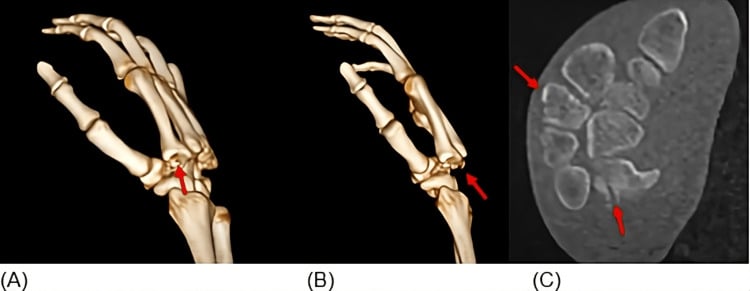
Why it dislocates dorsally. The palmar (volar) intercarpal ligaments are stronger than the dorsal ones. An axial force on the index metacarpal, resisted by those palmar ligaments, levers the wedge dorsally out of its mortise and tears the weaker dorsal capsule, so dorsal dislocation is the usual pattern reported in the trapezoid-dislocation literature. A palmar dislocation is much less common: it needs higher energy, because the strong palmar ligaments must fail, and it is typically seen in polytrauma.
She Looks Too Pretty; Try To Catch HerCarpal Bones
Hook:Carpal bone order: Proximal then Distal.
Classification
Fracture pattern. The working description is by displacement and by what came with the fracture, and CT is necessary to classify it accurately.
- Non-displaced - no significant articular step-off
- Displaced - significant displacement or articular incongruity
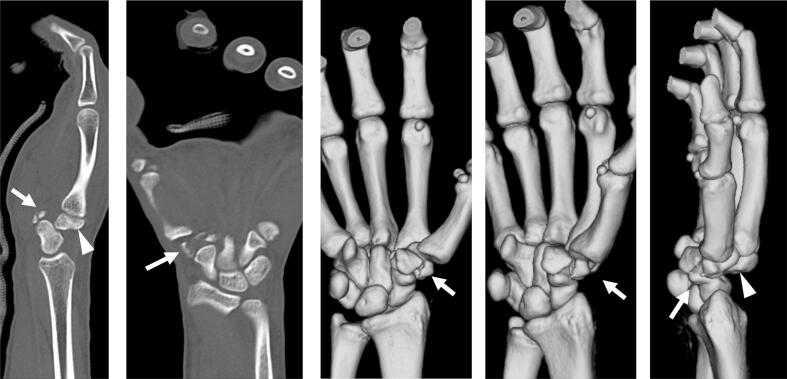
- With dislocation - an associated second CMC or intercarpal dislocation
- Comminuted - multiple fragments, often from high energy
Associated injuries. The second CMC fracture-dislocation is the most common association, and the entire carpus is always assessed. The others to look for:
- Perilunate injury, as a greater arc injury
- Scaphoid fracture, from the same axial load
- Multiple carpal fractures, with high energy
Clinical Assessment
History. Ask about the mechanism: a punch, a fall on the flexed wrist, or another axial load. The pain is in the dorsal wrist, over the base of the second metacarpal.
Examination. The trapezoid is tender dorsally, between the bases of the first and second metacarpals, with dorsal wrist swelling and pain on axial loading of the second metacarpal. Wrist flexion and extension are painful, and neurovascular status is usually intact.
Keep it in the differential. Because the injury is rare it may be overlooked. Maintain a high suspicion in anyone with dorsal wrist pain after an axial load.
Investigations
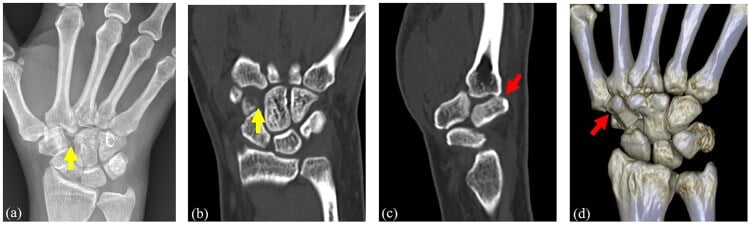
Radiographs. PA, lateral and oblique views may show the fracture, but it is often missed because the carpal bones overlap. What there is to see is a subtle cortical irregularity, overlapped by the scaphoid and capitate.
CT is essential for diagnosis: if the injury is suspected, get one. It clearly delineates the fracture, defines the pattern and displacement, shows articular involvement and is the planning study for surgery.
MRI is rarely needed. It is kept for the occult fracture or for soft-tissue assessment.
Differential Diagnosis
The trapezoid fracture presents as dorsal wrist pain at the index-ray base after axial load — overlapping with several commoner injuries. CT is the discriminator.
- Distinguishing Feature
- Tenderness at 2nd MC base; pain on axial load of index ray; often missed on plain film
- Best Test
- CT
- Distinguishing Feature
- Dorsal prominence of index MC base; cascade-line disruption; commonly coexists
- Best Test
- Lateral/oblique radiograph + CT
- Distinguishing Feature
- Anatomical snuffbox and scaphoid tubercle tenderness; radial-sided
- Best Test
- Scaphoid views; CT/MRI if occult
- Distinguishing Feature
- Thumb-base tenderness; pain on thumb axial load (Bennett-type force)
- Best Test
- CT; carpal tunnel/Bett view
- Distinguishing Feature
- Diffuse tenderness, no bony point tenderness; normal CT
- Best Test
- Clinical + negative CT
Management Algorithm
The decision. Displacement and the second CMC decide it. A non-displaced fracture is treated in a cast; a displaced fracture, or one with a dislocation, is reduced and fixed.
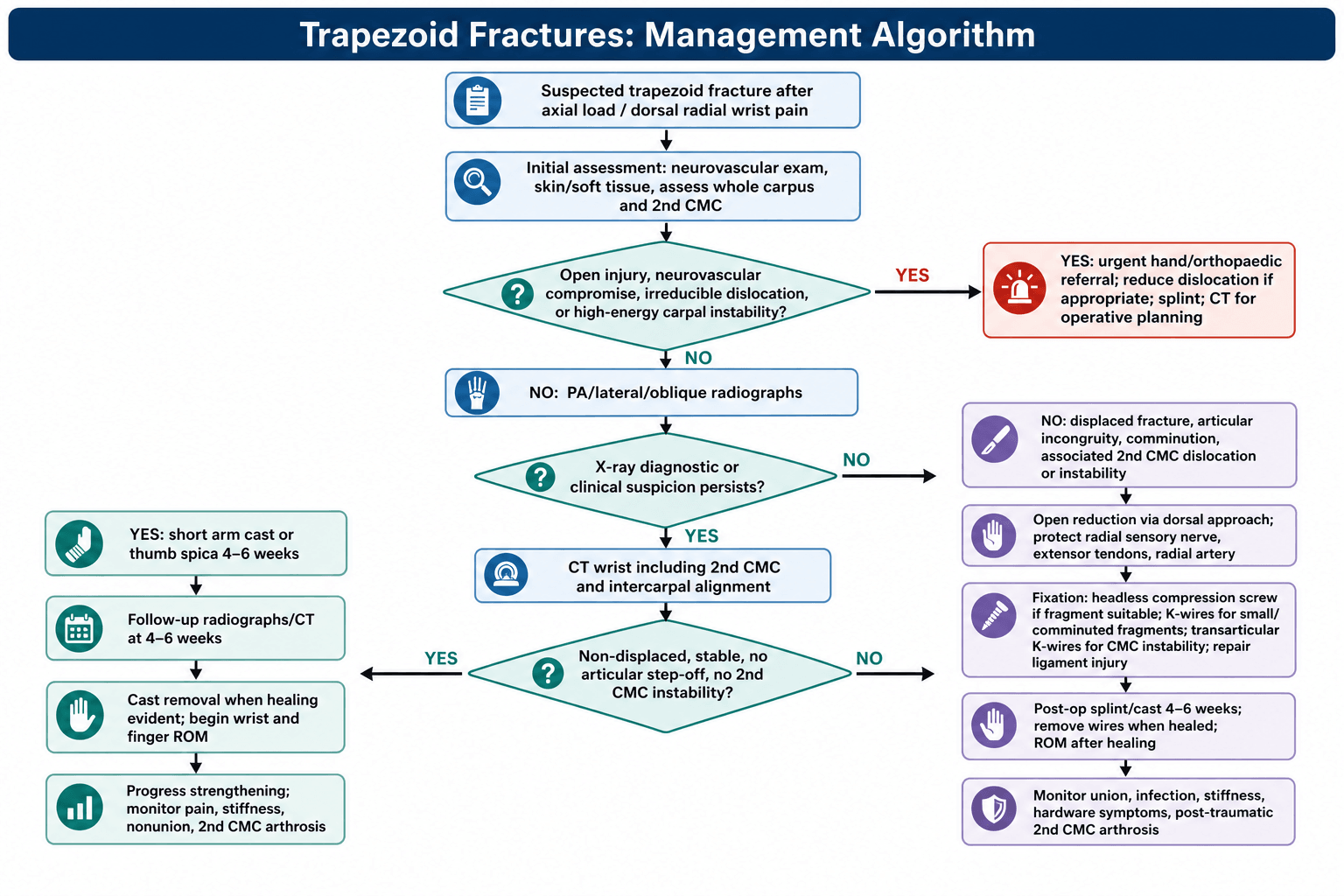
Non-displaced fractures. A short arm cast or thumb spica for 4-6 weeks, with repeat radiographs or CT at 4-6 weeks to confirm healing and range-of-motion exercises once the cast is off. Most non-displaced fractures heal well.
Operative indications. Surgery is indicated for:
- Displaced fracture
- Articular incongruity
- Associated dislocation
Surgical Technique
Approach. A dorsal longitudinal incision centred over the base of the second metacarpal, with a capsulotomy between the second and third extensor compartments. The structures at risk:
- Radial artery, in the anatomical snuffbox
- Extensor tendons: EPL, ECRL and ECRB
- Superficial branch of the radial nerve
Reduction. Three steps, in order:
- Expose the trapezoid through the capsulotomy
- Reduce it with a joystick, a K-wire in the fragment or the metacarpal
- Assess articular congruity under direct vision
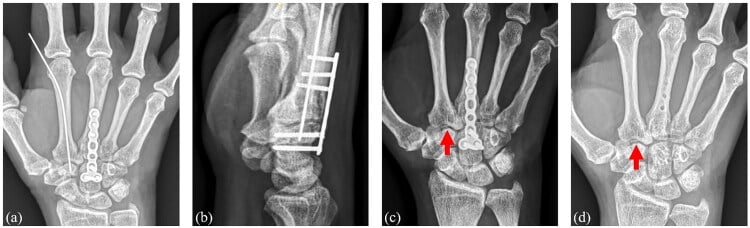
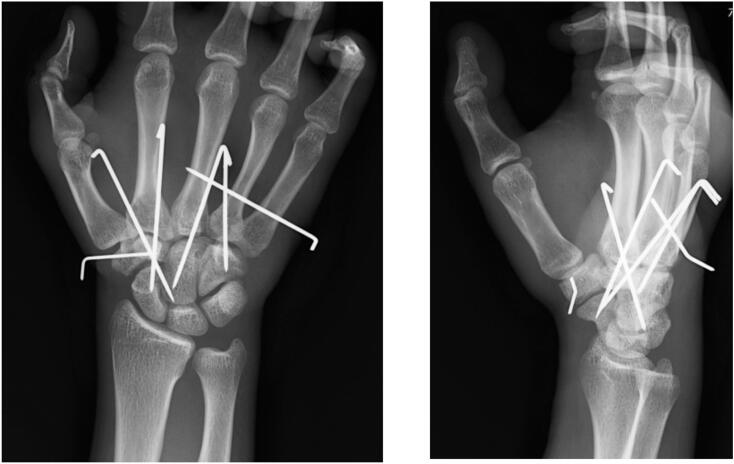
Fixation. Headless compression screws are preferred when the fragment is large enough, K-wires are used for comminuted or small fragments, and transarticular K-wires are added if the CMC is unstable. Any ligamentous injury is repaired, and the reduction is confirmed with fluoroscopy before closure.
With a second CMC dislocation. Reduce the CMC joint under fluoroscopy and confirm articular congruity, then hold it with transarticular K-wires from the second metacarpal to the carpus, with or without a headless screw for a large trapezoid fragment. The capsule and intercarpal ligaments are repaired.
Complications and Outcomes
Outcome. Non-displaced fractures have a good prognosis with immobilisation. Articular fractures may lead to second-CMC arthrosis, and displaced or dislocated injuries carry that risk if they are not anatomically reduced.
- Risk Factor
- Articular fracture
- Management
- Fusion (CMC) / Excision
- Risk Factor
- Inadequate reduction
- Management
- Osteotomy / Accept
- Risk Factor
- Prolonged immobilisation
- Management
- Physiotherapy
- Risk Factor
- Rare (good blood supply)
- Management
- Bone graft / Fixation
Postoperative Care and Rehabilitation
After a cast. Range-of-motion exercises begin at 4-6 weeks, when the cast comes off, and strengthening at 6-8 weeks.
After fixation. A splint for the first 2 weeks, then a cast or removable splint, for 4-6 weeks of immobilisation in all. Range of motion begins once healing is confirmed, at 4-6 weeks. K-wires, if used, come out at 6-8 weeks, and strengthening follows at 8-12 weeks.
Guidelines, Registries & Global Practice
There are no condition-specific society guidelines or arthroplasty-registry data for trapezoid fractures given their rarity; practice is governed by general carpal-injury and hand-trauma principles.
Global epidemiology
- Carpal bones contribute roughly 18% of hand fractures, of which the scaphoid dominates (~60% of carpal fractures); the trapezoid is consistently the least frequently fractured carpal bone (classically under 1%).
- Reported cases cluster in young men after high-energy axial mechanisms (punch injury, falls on the flexed wrist, motor-vehicle trauma).
Side-by-side guideline principles
- Relevant Principle
- Clinically suspected carpal injury with normal radiographs should be immobilised and re-imaged or progressed to advanced imaging rather than discharged.
- Relevant Principle
- Cross-sectional imaging (CT) for occult or complex carpal fractures and pre-operative planning; anatomic reduction of displaced intra-articular carpal fractures.
- Relevant Principle
- Articular congruity and stable fixation of displaced carpal fractures; transarticular K-wires for associated CMC instability.
- Relevant Principle
- Low threshold for CT in high-energy wrist trauma and polytrauma to avoid missed carpal injuries among distracting fractures.
High- vs limited-resource practice variation
- Well-resourced settings: Ready CT access enables early detection and ORIF of displaced fractures and associated 2nd CMC dislocations; this is the main reason reported incidence is rising.
- Limited-resource settings: Reliance on plain radiographs means occult and undisplaced trapezoid fractures are frequently missed; immobilisation of the clinically suspicious wrist with delayed re-imaging is a reasonable strategy where CT is unavailable.
- Referral: Displaced fractures and fracture-dislocations warrant referral to a hand/upper-limb surgeon wherever the resource pathway allows.
Related pages: Metacarpal Fractures matters more here than the carpal pages do - the trapezoid is injured by axial load transmitted down the index ray, and the associated second-CMC fracture-dislocation is the injury you are actually looking for. Perilunate Dislocations is the other carpal injury defined by being missed on the initial films, and it teaches the same discipline of reading the carpal arcs rather than hunting a fracture line. Scaphoid Fractures is the opposite end of the same frequency table and the reason a suspicious wrist gets imaged at all. Trapezium Fractures, Capitate Fractures, Hamate Fractures, Lunate Fractures and Pisiform Fractures complete the rest of that table - and each is subject to the same caveat about plain-film-era denominators. Systematic Approach to Wrist and Hand Imaging is where the carpal cascade lines and the 'missing carpal sign' belong, and Carpal Instability (DISI and VISI) covers the ligamentous consequences if the distal row is disrupted. Radial-Sided Wrist Pain is the presenting complaint under which an undisplaced trapezoid fracture will usually hide.
Controversies & Areas of Uncertainty
The literature on trapezoid fractures is limited to case reports and small series, so several questions remain unresolved:
- Imaging threshold: There is no consensus on which patients with a "normal" radiograph warrant CT. Most authorities favour a low threshold for cross-sectional imaging given how often the injury is missed, but the cost-effectiveness of routine CT after axial index-ray trauma is undefined.
- Screw vs K-wire fixation: No comparative data exist for displaced fragments. Headless compression screws are preferred for fragments large enough to accept them; K-wires are used for comminuted or small fragments. Choice remains surgeon preference.
- Management of the associated 2nd CMC instability: Whether transarticular K-wiring alone, ligament repair, or temporary CMC fixation gives the best long-term result is unknown — the rarity of the injury precludes trials.
- True incidence: Historical "less than 1%" figures predate routine CT. The real incidence of occult, undisplaced trapezoid fractures is probably higher than classically reported, as several authors have argued.
- Late presentation: Optimal treatment of a missed/chronic trapezoid fracture or dislocation (delayed ORIF vs excision vs limited fusion) is not established.
Viva Scenarios
Clinical Decision Scenarios
Practise clinical reasoning and management decisions out loud
“What is your next step?”
“Answer the question.”
“Provide the ranking.”
MCQ Practice Points
Q: What is the rarest carpal bone to fracture? A: Trapezoid - conventionally under 1% of carpal fractures, and that is the answer to give. The better candidate adds the caveat: these proportions come from plain-radiograph-era series, and the trapezoid fracture is the carpal injury most likely to be invisible on radiographs, so the figure measures detection as much as occurrence. The literature it comes from also contains more reported trapezoid dislocations than fractures, which is the reverse of every other carpal bone and points the same way.
Q: Where is the trapezoid located? A: Distal carpal row. Between the trapezium (radial) and capitate (ulnar). Articulates with the 2nd metacarpal distally.
Q: What is the typical mechanism for trapezoid fracture? A: Axial load through the 2nd metacarpal (e.g., punch injury, fall on flexed wrist).
Q: What is the most common associated injury with trapezoid fractures? A: 2nd CMC (carpometacarpal) fracture-dislocation.
Q: What imaging is best for trapezoid fractures? A: CT scan. X-rays often miss trapezoid fractures due to overlapping bones.
Key Facts
- Rarest carpal fracture
- less than 1% of carpal fractures
- Distal row (2nd CMC)
- Punch mechanism
Diagnosis
- X-ray often negative (overlap)
- CT is essential for diagnosis
- Tenderness at 2nd MC base
- Pain with axial load of index finger
Treatment
- Non-displaced: Short arm cast 4-6 weeks
- Displaced: ORIF via dorsal approach
- Fixation: Headless screws or K-wires
- Post-op: Cast 4-6 weeks, ROM after healing
Associated
- 2nd CMC dislocation (most common)
- Perilunate injuries (greater arc)
- Scaphoid fractures (high-energy)
- Multiple carpal fractures (assess entire carpus)
Evidence Base
Relative Incidence of Carpal Fractures
- Prospective audit of 1,000 consecutive hand fractures in Bergen, Norway over ~10 months.
- Carpal bones accounted for 18% of all hand fractures; the scaphoid alone made up 10.6% of the total series.
- The trapezoid did not feature among the fracture sites reported, which is the basis for the conventional claim that it is the least commonly fractured carpal bone.
Occult Undisplaced Trapezoid Fracture
- Two cases of isolated, undisplaced trapezoid fracture diagnosed with CT/MRI after negative or equivocal radiographs.
- Authors argue the lesion has historically been under-diagnosed and that modern cross-sectional imaging makes detection more frequent.
- Both undisplaced fractures healed with immobilisation alone.
First True Isolated Trapezoid Fracture
- First reported isolated trapezoid fracture with NO accompanying dislocation or associated metacarpal, carpal or distal radius injury.
- Managed non-operatively with a favourable clinical outcome.
- Reviews presentation, diagnostic workup and treatment of trapezoid fractures generally.
Trapezoid Dislocation — Missed on Plain Films
- Isolated trapezoid dislocation following high-speed motor-vehicle trauma.
- Highlights that these injuries are commonly missed on standard radiographs.
- Management invariably required open reduction and internal fixation.
Palmar Trapezoid Dislocation in Polytrauma
- Rare palmar trapezoid dislocation with associated distal radius fracture in a major-trauma patient.
- Distracting injuries risk misdiagnosis or delayed diagnosis of the carpal component.
- ORIF performed after stabilisation of major injuries yielded satisfactory hand and wrist function.
2nd CMC Fracture-Dislocation with Trapezoid Fracture
- Dorsal 2nd CMC dislocation with trapezoid fracture plus a Rolando fracture after a road-traffic crash.
- Treated by closed reduction with percutaneous K-wires then CT-guided open trapezoid reduction and K-wire fixation.
- Literature review of 71 cases of injuries involving 2nd CMC dislocation; good pain-free outcome at 1 year.