Friction | Lubrication | Wear Mechanisms | Osteolysis
- Tribology = study of friction, lubrication, and wear at interacting surfaces under load
- Native cartilage friction coefficient 0.02 (lowest in nature) via boundary and fluid film lubrication
- Wear particles of about 0.1-10 microns can be phagocytosed, but the most bioactive band is 0.2-0.8 microns - and the biological response tracks the volume of particles within that band rather than total wear volume
- Linear wear rate modern XLPE under 0.05mm/year (conventional PE 0.1-0.2mm/year)
- Third-body wear from PMMA, metal, or bone debris significantly accelerates PE wear
- “Stribeck curve describes friction vs lubrication: boundary, mixed, fluid film regimes
- “Highly crosslinked polyethylene (XLPE) reduces wear 90% vs conventional PE
- “Particle size: 0.1-10 microns is the phagocytosable range; 0.2-0.8 microns is the critical size for maximal macrophage activation - do not quote the wide range as though it were the critical one
- “Cup inclination greater than 45° increases edge loading and wear (Lewinnek safe zone 30-50°)
Overview
Tribology is the science of interacting surfaces in relative motion under load. It covers friction, the resistance to motion between surfaces; lubrication, the fluid or boundary layer that reduces friction; and wear, the progressive loss of material from a surface. In orthopaedics it underpins joint replacement design, bearing surface selection and the prediction of implant longevity.
Why it matters. Wear particles cause particle-induced osteolysis, the most common cause of aseptic loosening.
The benchmark. Native articular cartilage achieves a friction coefficient of 0.02, the lowest in nature. It does so through:
- Hyaluronic acid boundary lubrication
- Fluid-film formation under load (weeping lubrication)
- The biphasic properties of its water-collagen matrix
Arthroplasty bearings cannot replicate this and run at 0.05-0.15.
Friction and Lubrication
The Stribeck curve. It describes friction as a function of speed, viscosity and load, and it divides lubrication into three regimes.
- Friction Coefficient
- 0.1-0.3
- Characteristics
- Surface contact, molecular film, high wear
- Implant Example
- Start-up, edge loading
- Friction Coefficient
- 0.05-0.15
- Characteristics
- Partial surface contact, some fluid film
- Implant Example
- Most THA/TKA bearings during gait
- Friction Coefficient
- Under 0.01
- Characteristics
- No surface contact, full fluid separation
- Implant Example
- Native cartilage, ideal bearing
Where implants sit. Most arthroplasty bearings run in mixed lubrication during normal gait. Boundary lubrication occurs at start-up or with the edge loading of malpositioned components, and it increases wear.
Regimes and mechanisms. The Stribeck regimes describe the friction state. The mechanisms that generate a fluid film are a separate, examinable layer.
- How it works
- A molecular adsorbed layer (e.g. hyaluronate/lubricin, glycoprotein) coats the surfaces; load carried by asperity contact
- Relevance
- Dominant at start-up and in metal-on-PE bearings
- How it works
- Relative motion drags viscous fluid into a converging wedge, generating pressure that separates rigid surfaces
- Relevance
- Idealised; pure form rare in joints
- How it works
- The bearing surfaces ELASTICALLY deform under load, enlarging the contact area and trapping a fluid film
- Relevance
- How smooth, conforming hard-on-hard bearings (ceramic/metal) approach fluid-film separation
- How it works
- Cartilage exudes interstitial fluid under load (weeping), fluid is squeezed into a film as surfaces approach (squeeze-film), and water passes leaving concentrated lubricant (boosted)
- Relevance
- Explain the near-frictionless behaviour of native cartilage
The lambda ratio. Whether a bearing achieves fluid-film separation is captured by the lambda ratio: the minimum lubricant film thickness divided by the composite surface roughness of the two surfaces.
- Greater than 3: full fluid film; the surfaces never touch and wear is minimal
- 1-3: mixed
- Less than 1: boundary; asperity contact and high wear
Hard-on-hard versus hard-on-soft. This is why ceramic-on-ceramic and metal-on-metal bearings, with very smooth surfaces, large diameters and low clearance, can run in or near fluid-film or elastohydrodynamic lubrication. Metal-on-polyethylene, rougher and with a more deformable polyethylene, stays in the boundary or mixed range. Optimising film thickness (large head, low clearance, smooth surfaces) and minimising roughness both raise lambda.
Wear Mechanisms
Archard's equation. Before the individual mechanisms, it is worth having the relationship that governs all of them. The volume of material removed is
V = k x L x s / H
where V is wear volume, L the applied load, s the sliding distance, H the hardness of the softer surface and k a dimensionless wear coefficient specific to the material pairing and lubrication conditions.
Four terms, four clinical levers.
- Load is patient weight and activity intensity. It is linear, so it matters less than people assume relative to sliding distance.
- Sliding distance is the one that dominates in practice. It scales with head radius and with the number of cycles, which is why a young active patient walking several million cycles a year wears a bearing out faster than a heavy sedentary one, and why a larger head sweeps more polyethylene per step.
- Hardness of the softer surface explains why the femoral head's surface finish matters so much: a scratched hard head raises the effective abrasiveness against unchanged polyethylene.
- k is the term materials science actually changed. Cross-linking polyethylene did not alter the patient's load or step count; it altered k.
The linear-versus-volumetric paradox. Sliding distance is the mechanism behind it: a bigger head penetrates the liner more slowly in millimetres while removing more polyethylene in cubic millimetres. The equation also makes plain why no design change can abolish wear in an active patient, since s keeps accumulating for as long as the patient walks.
Three primary mechanisms. Wear is adhesive, abrasive or fatigue. Corrosive wear, the electrochemical degradation seen as taper and fretting corrosion, is classified alongside them.
Adhesive wear. Asperities, the microscopic peaks on one surface, cold-weld to the opposite surface under pressure. Relative motion then breaks the bonds and material from one surface adheres to the other; metal transfer to polyethylene gives the polished appearance. On the liner it shows as:
- Polishing: a smooth, shiny polyethylene surface
- Burnishing: layers of transferred metal
- Scratching: transferred metal particles scratching the polyethylene
Prevention is a smooth, polished femoral head.
Abrasive wear. Hard particles plough through a softer surface and remove material. In two-body abrasion the hard surface does the ploughing; in three-body abrasion free particles are trapped between the surfaces.
- Mechanism
- Hard surface (femoral head) ploughs soft (PE)
- Particles
- Surface asperities or embedded particles
- Prevention
- Polished femoral heads, avoid scratches
- Mechanism
- Free particles trapped between surfaces
- Particles
- PMMA, metal debris, bone fragments
- Prevention
- Meticulous lavage, avoid PMMA on bearing
Third-body wear. This is the most clinically significant form. The trapped particles act as abrasives and accelerate wear 10-100 fold. They come from:
- PMMA cement, hardness 100-200 MPa and harder than polyethylene
- Metal debris from taper junctions, screws and instrumentation
- Bone fragments entrapped during impaction or reaming
Fatigue wear. Cyclic loading concentrates stress below the surface, where microcracks initiate and then grow with continued cycling until the surface layer separates as large debris. On the liner it appears as pitting (small craters), delamination (sheet-like debris) and surface or subsurface cracking. The risk factors are thin polyethylene (under 6mm), high stress and gamma sterilisation in air.
Sterilisation and oxidation. Conventional polyethylene sterilised with gamma radiation in air developed oxidation, which reduced its fatigue resistance. Gamma in air is worse than XLPE or inert gas, and modern XLPE or gas sterilisation prevents the oxidation.
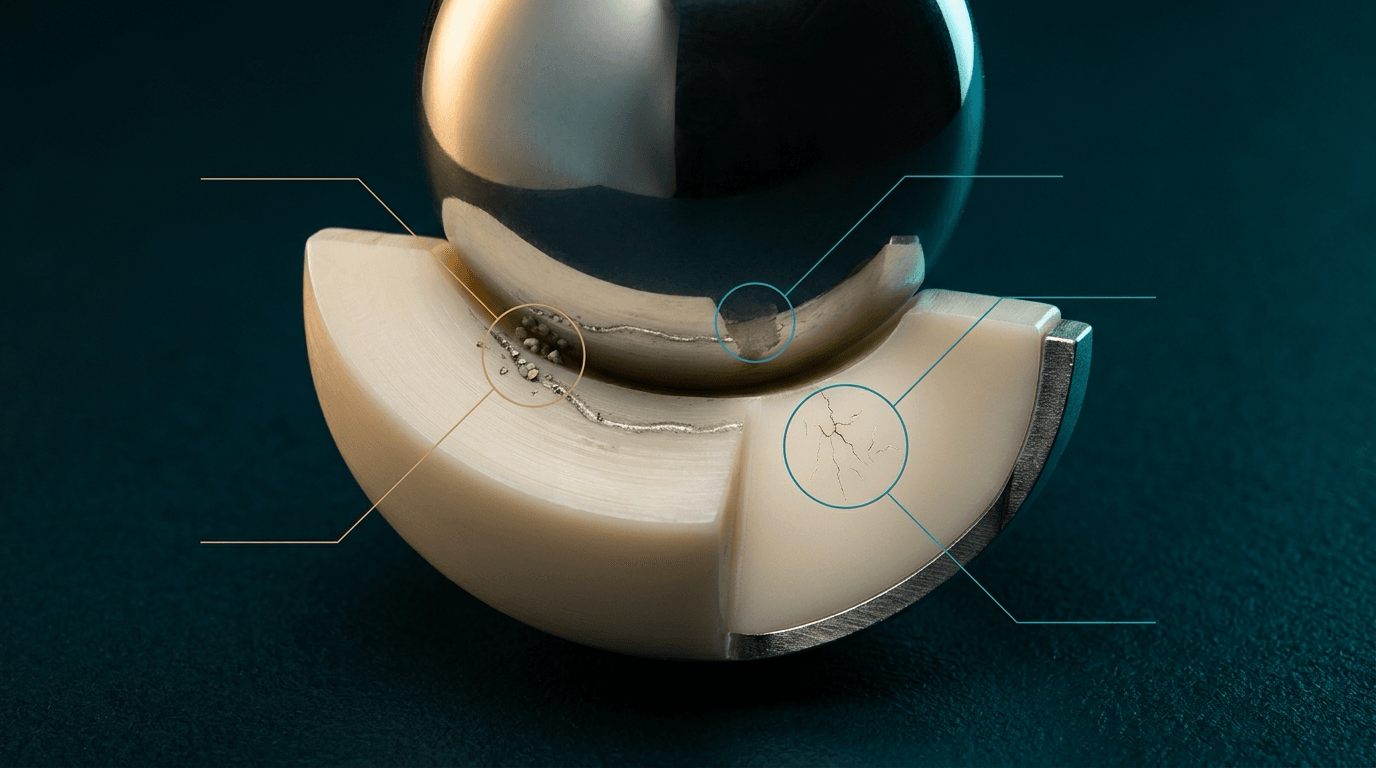
Mechanism versus mode. A classic exam trap is to confuse wear mechanisms (adhesive, abrasive, fatigue: how material is lost) with the McKellop wear modes (which surfaces are articulating). A complete answer names both.
- Which surfaces articulate
- The two PRIMARY bearing surfaces, as intended
- Clinical example
- Normal femoral head on acetabular liner
- Which surfaces articulate
- A primary bearing surface against a SECONDARY (non-bearing) surface
- Clinical example
- Femoral head articulating against the metal acetabular shell after the liner has worn through, or against the cup rim
- Which surfaces articulate
- The two primary surfaces WITH interposed third-body particles
- Clinical example
- PMMA, bone or metal debris trapped between head and liner (third-body abrasive wear)
- Which surfaces articulate
- Two SECONDARY (non-bearing) surfaces rubbing
- Clinical example
- Backside wear of the liner against the shell, taper/trunnion fretting, screw-shell or stem-cement micromotion
Mechanisms and modes are orthogonal: a Mode 3 situation (third bodies between the bearing surfaces) produces abrasive wear, while Mode 4 backside/taper motion produces fretting and corrosive (tribocorrosion) wear. Naming both axes - "this is Mode 4 backside wear generating abrasive and fretting-corrosive debris" - is what distinguishes a strong basic-science answer.
Wear Particles and Osteolysis
Two ranges, often merged. Particles of roughly 0.1-10 microns are phagocytosable: that is the range a macrophage can ingest. The most biologically reactive subset is far narrower, about 0.2-0.8 microns, and the wide range should not be quoted as though it were the critical one.
Volume within the band. The central principle of wear biology is that the biological response is determined by how much of the wear volume falls within the critical size range, rather than by the wear volume itself. A bearing therefore cannot be judged on wear rate alone, and pre-clinical testing of a new material must characterise the particles it produces, not merely how much it produces.
The cascade.
- Phagocytosis: macrophages ingest particles in the phagocytosable range
- Activation: frustrated phagocytosis, because the macrophage cannot digest polyethylene
- Cytokine release: TNF-alpha, IL-1, IL-6 and prostaglandins
- Osteoclast activation through the RANKL pathway
- Bone resorption: periprosthetic osteolysis and aseptic loosening
Clinical osteolysis risk increases above 0.1-0.2mm of linear wear per year. Conventional polyethylene wears at 0.1-0.2mm/year (high risk) and XLPE at under 0.05mm/year (low risk), which is why XLPE has dramatically reduced osteolysis rates.
Highly Crosslinked Polyethylene
What cross-linking buys. XLPE achieves a 90% reduction in volumetric wear compared with conventional polyethylene, and with it less osteolysis. Data beyond 15 years are now available and show excellent survivorship.
How it is made.
- Irradiation with gamma or e-beam radiation at 50-100 kGy
- Cross-linking: covalent bonds form between the polyethylene chains
- Remelting: thermal treatment removes free radicals, which prevents oxidation
The result is a highly crosslinked, wear-resistant network. Vitamin E is added as an antioxidant for free-radical scavenging.
The price. Cross-linking reduces fracture toughness, with the potential for rim fracture, so the liner needs a minimum thickness of 6-8mm to avoid fatigue failure.
- Conventional PE
- 0.1-0.2 mm/year
- XLPE
- Under 0.05 mm/year
- Clinical Impact
- XLPE: 90% reduction in wear
- Conventional PE
- 10-30%
- XLPE
- Under 5%
- Clinical Impact
- XLPE: dramatic reduction in osteolysis
- Conventional PE
- Higher (less crosslinking)
- XLPE
- Lower (trade-off)
- Clinical Impact
- XLPE: requires minimum 6-8mm thickness
Factors Affecting Wear
Cup position. Cup inclination and anteversion significantly affect wear. The Lewinnek safe zone, inclination 30-50° (40° ideal) and anteversion 5-25° (15° ideal), minimises edge loading and impingement. Outside it, wear and dislocation risk increase.
Edge loading. Cup inclination over 45° causes edge contact, with high contact stress at the rim and accelerated wear. Stripe wear, a visible linear wear pattern, appears on the polyethylene liner, and the failures that follow are rim fracture, excessive wear and osteolysis.
Head size. A larger femoral head has competing effects on wear.
- Advantages
- Lower volumetric wear (less linear distance per cycle)
- Disadvantages
- Higher dislocation risk, lower ROM, higher linear wear
- Modern Practice
- Historical, rarely used
- Advantages
- Balanced wear and stability, most common
- Disadvantages
- Moderate volumetric wear
- Modern Practice
- Standard in most THA (32-36mm)
- Advantages
- Lower dislocation (higher head:neck ratio), greater ROM
- Disadvantages
- Higher volumetric wear, thinner PE (fatigue risk)
- Modern Practice
- XLPE enables large heads safely
With XLPE, larger heads (36-40mm) provide stability without prohibitive wear. Conventional polyethylene was limited to 28-32mm heads.
Surface finish. Femoral head roughness critically affects adhesive wear, and a high polish minimises it. The targets are Ra less than 0.05 microns for cobalt-chrome and less than 0.02 microns for ceramic, which is smoother than metal. Scratches on the head increase polyethylene wear exponentially, and they come from:
- Intraoperative handling with metal instruments
- PMMA contact during cementation
- Metal-on-metal taper debris transfer
Taper junctions. The head-neck junction undergoes fretting and corrosion, and tribocorrosion is that combined mechanical and electrochemical wear. A titanium trunnion with a cobalt-chrome head carries a risk of galvanic corrosion; matched materials or ceramic heads are preferred.
Bearing Couples
The families. Hard-on-soft bearings are metal-on-XLPE, the standard and most common with an excellent track record, and ceramic-on-XLPE, with lower wear and a combination of benefits. Hard-on-hard bearings are ceramic-on-ceramic, with the lowest wear but a risk of squeaking, and metal-on-metal, abandoned because of adverse reaction to metal debris (ARMD).
Wear rate hierarchy.
- Ceramic-on-ceramic: less than 0.001mm/year
- Metal-on-XLPE: less than 0.05mm/year
- Conventional metal-on-polyethylene: 0.1-0.2mm/year
Choosing a bearing. It is a trade-off between wear, fracture or noise risk, and cost. The table contrasts the realistic options.
- Wear behaviour
- Low (head penetration approximately 0.004 mm/year on RSA)
- Main risks
- PE oxidation if poorly stabilised; rim fracture if thin/malpositioned
- Best suited to
- Workhorse bearing for most patients, all ages
- Wear behaviour
- Very low (smoother, scratch-resistant head)
- Main risks
- Slightly higher cost; ceramic head fracture rare
- Best suited to
- Younger/active patients wanting lowest soft-bearing wear
- Wear behaviour
- Lowest of all (near-zero)
- Main risks
- Squeaking (approximately 7.5%), liner chipping/fracture (under 1%)
- Best suited to
- Young, very active patients in selected centres
- Wear behaviour
- Low volumetric but nanometre particles, high particle number
- Main risks
- ARMD, pseudotumour, systemic Co/Cr ions
- Best suited to
- Abandoned for routine use
- Wear behaviour
- High (0.1-0.2 mm/year linear wear)
- Main risks
- Osteolysis, aseptic loosening
- Best suited to
- Largely historical; cost-driven settings
By patient.
- Young, active: ceramic-on-ceramic for the lowest wear, or ceramic-on-XLPE as the alternative, with large heads (36mm) for stability
- Older, less active: metal-on-XLPE for its durability, with dual mobility if there is a risk of instability
- Avoid: metal-on-metal (ARMD) and conventional polyethylene (high wear)
Investigations
Radiographic wear. Serial radiographs measure femoral head penetration. Linear wear is migration of the head centre into the liner; volumetric wear is calculated from linear wear and head size. Osteolysis shows as expanding lucencies and scalloping.
Metal-on-metal concerns. Cobalt and chromium ion levels are measured, and a whole-blood cobalt greater than 7 ppb is a concern. Metal artefact reduction sequence (MARS) MRI images the soft tissues.
Simulator testing. Hip joint simulators follow the ISO 14242 standard protocol. Five million cycles represent approximately five years of use, bovine serum is the lubricant because it mimics synovial fluid, and both gravimetric (weight loss) and linear wear are measured.
Surface analysis.
- Profilometry: surface roughness (Ra)
- Electron microscopy: wear patterns and debris
- Retrieval analysis: study of explanted bearings
Management
Prevention. Wear reduction begins at the primary operation: XLPE, component position within the Lewinnek zone, a smooth femoral head, and the avoidance of third-body debris by lavage and protecting the head. The intraoperative detail is under Surgical Technique, and surveillance under Postoperative Care.
Revision for wear. The indications:
- Progressive osteolysis: expanding lucencies, impending fracture
- Linear wear over 2mm, with its increased osteolysis risk
- Symptoms: pain, instability, loosening
At revision. Remove all polyethylene debris by thorough debridement of granulation tissue, and fill osteolytic defects with bone graft, allograft or autograft. Replace conventional polyethylene with an XLPE liner, and exchange a scratched or worn femoral head.
What to expect. Removing the particles stops osteolysis progressing, and grafted defects incorporate over 6-12 months. Revision to XLPE has excellent 10-15 year survivorship.
Surgical Technique
Cup position. Aim for the Lewinnek ideals of 40° inclination and 15° anteversion, and avoid the edge loading of high inclination. Navigation and robotics improve accuracy.
Protecting the head.
- Never touch the articulating surface with metal instruments
- Use soft liner trays, never a metal surface
- Avoid PMMA contact, and protect the head during cement insertion
- Inspect for scratches before final reduction
Clearing third bodies. Use copious pulsatile lavage (greater than 3L), and remove all PMMA fragments and any bone debris from the acetabulum.
Seating the liner.
- Clean the locking mechanism
- Confirm full seating, with no gap
- Avoid a malpositioned or proud liner
- Test stability with a trial before the final components
Complications
Osteolysis. Progressive bone loss around the implant, which may lead to loosening and periprosthetic fracture. It is treated by revision with XLPE and bone grafting.
Aseptic loosening. The end stage of wear-induced osteolysis, presenting with pain, instability and radiographic loosening. Historically it was the leading cause of late revision; the current picture is under Outcomes.
Bearing-specific complications.
- Ceramic-on-ceramic: squeaking in 1-8%, usually benign; fracture in 0.02-0.1% with modern delta ceramic; stripe wear, an edge-loading pattern
- Metal-on-metal: ARMD, with pseudotumours, metallosis and elevated metal ions, the reason for its abandonment
- XLPE: rim fracture if thin (less than 6mm) or malpositioned; oxidation in older designs without remelting
The Delta ceramic-on-ceramic series in the evidence section recorded 3 liner fractures in 345 hips (0.9%), above the fracture range quoted here.
Postoperative Care
Routine surveillance. Review at 6 weeks and 1 year, then every 2-5 years, on serial AP pelvis radiographs. Compare head position over time to measure linear wear as head penetration, and watch for osteolysis as expanding lucencies. Concern begins at greater than 0.1mm/year for XLPE or greater than 0.2mm/year for conventional polyethylene, and where osteolysis appears, consider revision before bone loss becomes severe.
Enhanced monitoring is indicated for:
- Young, active patients
- Large head sizes
- Metal-on-metal bearings, with metal ions annually
- Symptoms of instability or pain
Activity. Low-impact activities are preferred. High-impact sports increase wear and are avoided, and weight management reduces load cycles.
Outcomes
Ceramic-on-ceramic. Near-zero wear, with 4.8% revision at 10 years in registry data.
Registries. Across the national joint registries (NJR, AOANJRR, AJRR, Nordic), ceramic-on-ceramic and ceramic-on-XLPE show excellent long-term survival and metal-on-XLPE shows comparable durability. Large-head metal-on-metal has the highest revision rates and has been abandoned.
Wear-related revision. With modern bearings osteolysis is now a small minority of revisions. The leading causes of revision today are infection, instability, periprosthetic fracture and loosening, not wear.
Guidelines, Registries & Global Practice
Global epidemiology. Total hip arthroplasty is one of the most successful operations in medicine ("the operation of the century"), with over 1 million procedures performed annually worldwide and demand rising with ageing populations. Historically, wear-induced osteolysis and aseptic loosening were the leading causes of late revision; since the widespread adoption of cross-linked polyethylene from the early 2000s, the proportion of revisions attributable to wear/osteolysis has fallen markedly, and instability, infection and periprosthetic fracture now dominate revision burden in national registries.
- Position on Bearings
- Ceramic-on-XLPE and metal-on-XLPE dominate; large-head MoM abandoned
- Key Signal
- Stemmed MoM and resurfacing show high cumulative revision; XLPE reduced wear revision
- Position on Bearings
- XLPE standard; ceramic heads increasingly favoured; MoM withdrawn
- Key Signal
- Conventional (non-crosslinked) PE has higher revision than XLPE; flagged early
- Position on Bearings
- Ceramic-on-XLPE rising in younger patients; MoM essentially eliminated
- Key Signal
- Consistent registry signal of XLPE durability across regions
- Position on Bearings
- Risk alerts and recall (e.g. ASR) for large-head MoM; structured MoM follow-up
- Key Signal
- Whole-blood Co/Cr surveillance, cross-sectional imaging if symptomatic
Convergent global guidance (AAOS / BOA / NICE / EFORT):
- XLPE is the default hard-on-soft bearing in primary THA
- Avoid large-diameter metal-on-metal bearings; resurfacing only in selected high-volume centres
- Optimise cup orientation to avoid edge loading
- Risk-stratified radiographic surveillance for wear and osteolysis
Where guidance differs by region (MoM follow-up):
- Whole-blood cobalt/chromium with a commonly cited concern threshold around 7 ppb (2-7 ppb thresholds vary by authority)
- Cross-sectional imaging (MARS MRI or ultrasound) for symptoms or rising ions
- Lower revision threshold for symptomatic ARMD / solid pseudotumour
Well-resourced settings:
- XLPE or ceramic-on-XLPE near-universal; vitamin E-doped PE growing
- Robotics/navigation to refine cup position
- RSA in research; routine serial radiographs clinically
Resource-constrained settings:
- Conventional (non-crosslinked) PE still used on cost grounds, accepting higher wear
- Cemented all-polyethylene cups remain cost-effective and durable in older patients
- Reliable serial radiographic follow-up may be limited
Exam viva point - global picture: Across NJR, AOANJRR, AJRR and Nordic registries the message is consistent: cross-linked polyethylene markedly reduced wear-related revision, large-head metal-on-metal has been abandoned for adverse reaction to metal debris, and modern delta ceramic-on-ceramic gives very low wear with squeaking as a usually benign issue. Frame answers around evidence (registry + RCT/meta-analysis) rather than any single country.
Controversies and Areas of Uncertainty
Remelted versus annealed XLPE. Remelting above the melt transition eliminates free radicals and oxidation but reduces mechanical strength. Annealing below the melt preserves strength but leaves residual radicals that risk late oxidation. The optimal balance, and the role of vitamin E-doped polyethylene, is still debated.
Critical particle size. Biological-activity work suggests the most osteolytic particles are 0.2-0.8 microns, but exact human thresholds remain uncertain and are model-dependent.
Is there a true safe zone? The Lewinnek zone is widely taught, but many dislocations occur within it. Spinopelvic mobility and functional, not just static radiographic, component position are increasingly emphasised over a single fixed target.
Large heads with XLPE. XLPE permits larger heads for stability, but whether 36mm and above increases long-term wear or trunnionosis and fretting at the head-neck taper is still being studied. RSA data to five years show no excess penetration with 36mm.
MCQ Practice Points
Q: What is the phagocytosable particle size range for polyethylene wear debris, and which band within it is most bioactive? A: 0.1-10 microns - This is the phagocytosable range for macrophages; the most bioactive band within it is about 0.2-0.8 microns. Smaller particles (under 0.1 microns) are cleared without activation. Larger particles (over 10 microns) cannot be phagocytosed.
Q: By what percentage does highly crosslinked polyethylene (XLPE) reduce wear compared to conventional polyethylene? A: 90% - XLPE achieves approximately 90% reduction in volumetric wear through increased crosslinking from high-dose radiation (50-100 kGy). Steady-state wear rate is under 0.05mm/year vs 0.1-0.2mm/year for conventional PE.
Q: What is the friction coefficient of native articular cartilage and what lubrication regime does it represent? A: 0.02 (fluid film lubrication) - Native cartilage has the lowest friction in nature due to hyaluronic acid boundary lubrication and fluid film formation. Arthroplasty bearings operate at 0.05-0.15 (mixed lubrication).
Exam Viva Scenarios
Practise clinical reasoning and management decisions out loud
“Examiner shows X-ray of THA with periprosthetic osteolysis and asks: Explain the biological mechanism of polyethylene wear particle-induced osteolysis.”
“Examiner asks: Describe the lubrication regimes in total joint arthroplasty and how they relate to wear. What is the Stribeck curve?”
“A 58-year-old man had a large-head metal-on-metal THA six years ago and now presents with new groin pain and a hip effusion. The examiner asks: How would you investigate and manage this patient, and why has metal-on-metal been largely abandoned?”
Wear Mechanisms
- Adhesive: material transfer (polishing, scratches)
- Abrasive: hard particles plough soft (third-body PMMA/metal debris)
- Fatigue: cyclic loading causes delamination (PE pitting)
- Third-body wear accelerates PE wear 10-100x
Lubrication Regimes
- Boundary: friction 0.1-0.3 (surface contact, high wear)
- Mixed: friction 0.05-0.15 (most THA/TKA during gait)
- Fluid film: friction under 0.01 (no contact, ideal)
- Native cartilage: friction 0.02 (lowest in nature)
Osteolysis
- Phagocytosable size: 0.1-10 microns; most bioactive 0.2-0.8 microns
- Frustrated phagocytosis releases TNF-alpha, IL-1, IL-6
- RANKL pathway activates osteoclasts
- Linear wear threshold: 0.1-0.2mm/year
XLPE Benefits
- 90% wear reduction vs conventional PE
- Irradiation: 50-100 kGy gamma or e-beam
- Steady-state wear: under 0.05mm/year
- Trade-off: reduced fracture toughness (minimum 6-8mm thickness)
Positioning Effects
- Lewinnek safe zone: 30-50° inclination, 5-25° anteversion
- Cup inclination over 45° causes edge loading
- Edge loading increases wear and rim fracture risk
- Ideal: 40° inclination, 15° anteversion
Wear Prevention
- Use XLPE (90% wear reduction)
- Optimal cup positioning (avoid edge loading)
- Polished femoral head (Ra under 0.05 microns)
- Prevent third-body debris (lavage, avoid PMMA on bearing)
Evidence Base
XLPE vs Conventional PE Wear: RSA Randomized Trial
- Prospective, randomized, blinded RSA study, 46 active patients, four cohorts (cup material x liner material)
- Steady-state head penetration (1-5 years): XLPE 0.004 mm/year vs conventional UHMWPE 0.04 mm/year
- XLPE penetration significantly lower at five years (penetration approximately one order of magnitude less)
- No significant difference in proximal migration between tantalum and titanium cups at 5 years
Wear Debris Biology: Particle Size Drives Osteolysis
- Authoritative review establishing that it is the concentration of debris within the critical size range, not total wear volume, that determines biological response
- Most biologically active (macrophage-stimulating) UHMWPE particles fall in the 0.2-0.8 micron range
- Frustrated phagocytosis of non-degradable polymer drives macrophage cytokine release (TNF-alpha, IL-1, IL-6)
- Pre-clinical testing of any new bearing must characterise particle size and biological reactivity, not just wear volume
Cross-linked vs Conventional PE: Meta-analysis of RCTs
- Systematic review and meta-analysis of 12 randomized controlled trials comparing cross-linked with conventional PE liners
- All trials showed significantly reduced radiological wear (linear, 3D linear, volumetric, and total) for cross-linked PE
- Pooled risk ratio for radiological osteolysis 0.40 (95% CI 0.27-0.58) favouring cross-linked PE, with I-squared of 0% - the included trials agreed completely, which is unusual and strengthens this particular estimate
- Follow-up was insufficient to demonstrate a difference in revision rates
Delta Ceramic-on-Ceramic Midterm Survivorship
- Prospective multicentre study of Delta (alumina matrix composite) ceramic-on-ceramic THA, 345 hips (28 mm and 36 mm)
- Kaplan-Meier survivorship 96.9% at 6 years (95% CI 94.0-98.4); 3 post-operative liner fractures (0.9%) in 345 hips (177 with 28 mm and 168 with 36 mm heads)
- THE BEARING WAS NOT THE MAIN REASON FOR REVISION: of 9 revisions, 4 were for stem loosening and 3 for deep infection, with only 2 for liner fracture - so this survivorship figure is dominated by problems the ceramic did not cause
- Squeaking reported by 7.5% of subjects; none required revision, only one reproducible in clinic
- Squeaking significantly more frequent with 36 mm than 28 mm bearings (P=0.013)
Metal-on-Metal: Wear Volume Drives ARMD
- Retrieval study of 85 ASR hips revised for adverse reaction to metal debris (ARMD)
- Total bearing wear volume correlated strongly with whole-blood chromium (rho 0.80) and cobalt (rho 0.84)
- The tissue correlations are far WEAKER than the ion ones and should not be quoted in the same breath: macrophage sheet thickness rho = 0.25 (p = 0.020) and necrosis rho = 0.35 (p less than 0.01), against 0.80 and 0.84 for the metal ions
- LYMPHOCYTE CUFF THICKNESS DID NOT CORRELATE with wear volume or with blood metal ions at all, correlating only with the grade of necrosis - so the lymphocyte-dominated ALVAL-type reaction is not simply a dose response to wear, which is why a patient with low ion levels can still have a destructive soft-tissue lesion
- Whole-blood metal ion levels are a useful surrogate for bearing wear and local tissue reaction
Vitamin E-doped vs Standard XLPE Liners (RCT)
- Multi-arm RCT (2x2 factorial), 116 patients, RSA head penetration at 5 years
- No significant difference in head penetration between vitamin E-doped PE and standard XLPE (-0.084 mm; 95% CI -0.173 to 0.005)
- No significant difference between 32 mm and 36 mm heads (-0.020 mm; 95% CI -0.110 to 0.071)
- No difference in acetabular component migration or patient-reported outcomes