Ligament | alignment | reducibility | cartilage | demand
- Pain is not instability. Link symptoms to ligament injury, carpal alignment, reducibility and cartilage status.
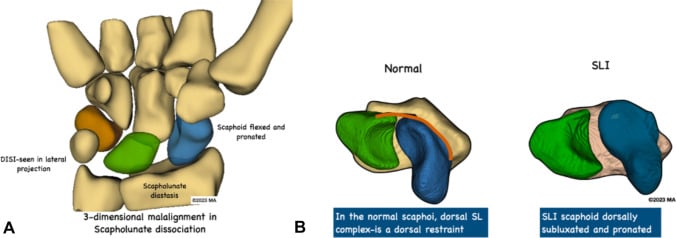
- Scapholunate injury tends to DISI. The scaphoid flexes; the lunate follows the triquetrum into extension.
- Lunotriquetral injury may produce VISI, but isolated LT instability is less common than combined ulnar-sided or midcarpal pathology.
- Neutral radiographs can be normal. Stress views, dynamic fluoroscopy, MRI arthrogram and arthroscopy may be needed.
- A chronic arthritic wrist is not a repair problem. It is a salvage procedure discussion.
- “The safe answer starts with stage: predynamic, dynamic, static reducible, static irreducible or arthritic.
- “Every management plan must state timing, reducibility, cartilage and patient demand.
- “Watson and LT ballottement tests are screening tests; they do not replace imaging and arthroscopy.
- “SLAC progression is the late consequence of untreated chronic scapholunate dissociation.
Overview and Epidemiology
What fails. Wrist ligament instability is failure of the soft-tissue stabilisers that keep the carpal bones aligned during load and motion. The most important intrinsic ligament injuries are scapholunate and lunotriquetral. A competent assessment also considers the dorsal intercarpal, dorsal radiocarpal and volar radiocarpal ligaments, the TFCC, distal radius alignment, scaphoid fracture or nonunion, distal radioulnar joint pathology and midcarpal instability.
Presentation. The typical patient presents after a fall on the outstretched hand, a twisting injury, high-energy trauma or a sports injury, or with persistent symptoms after a wrist sprain. Symptoms may be dorsal wrist pain, ulnar-sided pain, clicking, clunking, grip weakness, push-up pain, reduced load tolerance or late degenerative collapse.
Why it is missed. The injury is commonly missed because early radiographs may be normal and the symptoms can be attributed to a nonspecific sprain.
The decision. A widened scapholunate interval, a painful Watson test or a VISI posture is not enough to choose an operation. The surgeon has to decide whether the wrist is stable, dynamically unstable, statically malaligned, reducible, irreducible or arthritic, and these questions place it:
- Which ligament failed? SL, LT, an extrinsic ligament, the TFCC, the midcarpal joint or a combination. The answer decides whether the main pattern is DISI, VISI, ulnar-sided instability or mixed instability.
- Dynamic or static? Normal neutral films with a gap only on stress, or fixed malalignment at rest. Dynamic injury can be missed; static injury needs reducibility and cartilage assessment.
- Acute or chronic? Acute, subacute, chronic or arthritic: repairable ligament tissue or attenuated scar. Acute repair differs from chronic reconstruction or salvage.
- Is the carpus reducible? Does the alignment correct under fluoroscopy, traction or arthroscopy? Reducible deformity can be reconstructed; irreducible deformity often needs salvage.
- Is the cartilage preserved? Radioscaphoid, capitolunate, radiolunate and midcarpal. Cartilage loss makes ligament reconstruction inappropriate.
That staging determines whether the answer is observation, immobilisation, arthroscopic debridement, direct repair, pinning, capsulodesis, ligament reconstruction, limited fusion, proximal row carpectomy or wrist fusion.
Pathophysiology
The intercalated segment. The proximal carpal row has no direct tendon insertions and behaves as an intercalated segment between the radius and the distal carpal row. Its stability depends on carpal bone geometry, the intrinsic and extrinsic ligaments, the capsule and coordinated load transfer.
Causes and injury mechanisms
- Typical Injury Pattern
- Hyperextension, ulnar deviation and intercarpal supination load can tear the SL ligament or progress into a perilunate spectrum injury.
- Clinical Consequence
- Dorsal radial wrist pain, SL tenderness, dynamic widening or acute static dissociation.
- Typical Injury Pattern
- Perilunate fracture-dislocation, trans-scaphoid pattern, capitate fracture, distal radius fracture or combined intrinsic ligament injury.
- Clinical Consequence
- Do not stop at the ligament label; search for fracture, median nerve symptoms and carpal malalignment.
- Typical Injury Pattern
- Partial SL, LT, TFCC or midcarpal injury, often with normal initial radiographs.
- Clinical Consequence
- Persistent pain, clunking and load intolerance need stress views or arthroscopic staging.
- Typical Injury Pattern
- Distal radius malunion, scaphoid nonunion or carpal collapse changes load transfer.
- Clinical Consequence
- Instability may be secondary; treatment may require correction or salvage rather than isolated ligament repair.
- Typical Injury Pattern
- Capsuloligamentous attenuation and cartilage loss.
- Clinical Consequence
- Pain may come from arthritis rather than repairable instability.
Surgically relevant ligament anatomy
Intrinsic and extrinsic restraints. The scapholunate and lunotriquetral ligaments are intrinsic: they connect the proximal-row bones and control the immediate relationship between scaphoid, lunate and triquetrum. The dorsal and volar extrinsic ligaments become increasingly important in chronic instability and in reconstruction planning.
The scapholunate ligament. It has dorsal, proximal membranous and volar portions. The dorsal portion is the strongest and the most important restraint to abnormal scaphoid-lunate separation and rotation, and it is the repair target in acute SL injuries; poor tissue quality pushes treatment toward reconstruction. The volar and proximal components contribute to restraint but are weaker than the dorsal band, so MRI signal in these regions must be correlated with instability, not treated in isolation.
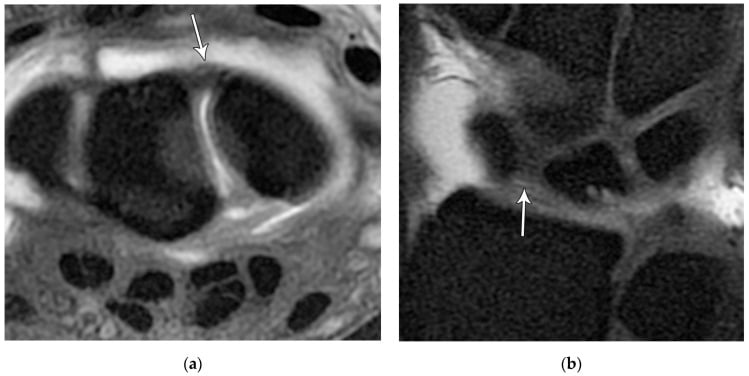
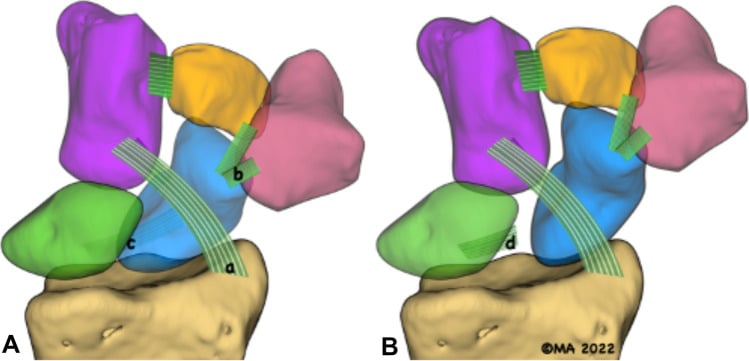
The secondary stabilisers. Chronic instability is more than a torn SL ligament: it is progressive failure of a stabilising complex, which includes the scaphotrapeziotrapezoid stabilisers and these ligaments:
- Dorsal intercarpal ligament - a secondary stabiliser that helps restrain scaphoid flexion and links the dorsal carpus. It is used or tensioned in capsulodesis and tenodesis for chronic reducible SL instability.
- Dorsal radiocarpal ligament - a dorsal extrinsic restraint to proximal-row malrotation and carpal translation. Injury or attenuation worsens chronic instability.
- Radioscaphocapitate ligament - a volar restraint and sling supporting the scaphoid waist region. Preserve the volar ligaments during salvage such as PRC; their disruption can destabilise the remaining wrist.
The lunate restraints. The long and short radiolunate ligaments are volar restraints stabilising the lunate against translation and excessive rotation. Radiolunate cartilage and stability decide whether motion-preserving salvage is possible.
How scapholunate failure produces DISI. When the scapholunate ligament fails, the scaphoid tends to flex and pronate, while the lunate remains linked to the triquetrum and extends. The result may be a dorsal intercalated segment instability (DISI) pattern.
The lunotriquetral ligament. It has dorsal, proximal and volar components, and the volar portion is usually the strongest; the ligament controls lunate-triquetrum motion. LT instability can produce ulnar-sided pain, painful clicking and sometimes volar intercalated segment instability (VISI); complete LT failure may produce VISI or painful ulnar-sided instability. Isolated LT instability is less common than scapholunate instability, and isolated LT disease is uncommon.
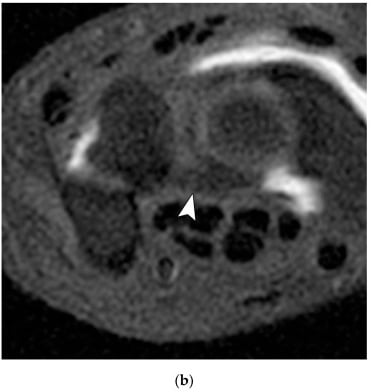
The ulnar side. The TFCC and ulnocarpal ligaments stabilise the ulnar wrist and the distal radioulnar joint. LT symptoms overlap with TFCC injury, ECU pathology, ulnar impaction and midcarpal instability; each must be separated from LT instability, and missing them leads to the wrong surgery.
Degenerative collapse
Scapholunate advanced collapse. Chronic scapholunate dissociation changes carpal load, and chronic malalignment overloads cartilage. The usual late pattern is SLAC: radioscaphoid arthritis begins first, then scaphocapitate and capitolunate degeneration may follow, while the radiolunate joint is often preserved until late. Once cartilage is lost, ligament reconstruction cannot restore a durable painless wrist, and treatment shifts from reconstruction to salvage.
Classification
- Definition
- Partial or complete ligament injury without radiographic instability.
- Typical Findings
- Pain, tenderness, normal PA/lateral and stress views; arthroscopy may show tear.
- Treatment Direction
- Immobilisation, therapy, arthroscopic debridement or pinning in selected symptomatic tears.
- Definition
- Instability appears only under load or stress.
- Typical Findings
- Clenched-fist SL widening, dynamic fluoroscopy abnormality, normal resting alignment.
- Treatment Direction
- Repair or reconstruction if symptomatic, high-demand and repairable.
- Definition
- Gap or malalignment visible on resting films but correctable.
- Typical Findings
- SL gap, DISI or VISI on neutral films; alignment reduces with fluoroscopy or traction.
- Treatment Direction
- Acute repair if early; chronic reconstruction or capsulodesis if cartilage preserved.
- Definition
- Fixed malalignment without reliable reduction.
- Typical Findings
- Fixed DISI/VISI, adaptive contracture, chronic deformity.
- Treatment Direction
- Limited fusion or salvage depending pain and cartilage.
- Definition
- Degenerative collapse.
- Typical Findings
- SLAC, SNAC or radiocarpal/midcarpal cartilage loss.
- Treatment Direction
- PRC, four-corner fusion, limited fusion, total wrist fusion or selected arthroplasty.
Where the instability sits: the Mayo classification
Beyond staging a single ligament, the Mayo (Larsen/Dobyns) classification sorts every pattern of carpal instability into four groups by where the instability sits:
- CID, carpal instability dissociative - failure within a carpal row, between bones of the same row: the scapholunate and lunotriquetral dissociations that dominate this topic
- CIND, carpal instability non-dissociative - failure between the rows with the intrinsic ligaments intact; classically midcarpal instability, in which the proximal and distal rows move abnormally as units
- CIC, carpal instability complex (combined) - features of both dissociative and non-dissociative patterns; the perilunate dislocation spectrum is the prototype
- CIA, carpal instability adaptive - the carpus is malaligned secondary to a problem outside the intrinsic ligaments, most often a distal radius malunion, where a dorsally tilted radius forces a compensatory carpal DISI
Why it earns its place. It forces the question "dissociative, non-dissociative, complex or adaptive?", which immediately separates an SL or LT repair problem from a midcarpal-rehabilitation problem, a perilunate emergency, or a malunion that needs corrective osteotomy rather than ligament surgery.
How it got there: Mayfield's progressive perilunar instability
The Mayo classification says where the instability sits; Mayfield's stages say how it got there, and they are the reason a scapholunate tear and a lunate dislocation belong on the same page rather than in different chapters. Loading the wrist in hyperextension, ulnar deviation and intercarpal supination tears the ligaments around the lunate in a reproducible order, travelling radial to ulnar:
- Stage I, scapholunate. The scapholunate interosseous ligament fails: scapholunate dissociation, with the lunate still held.
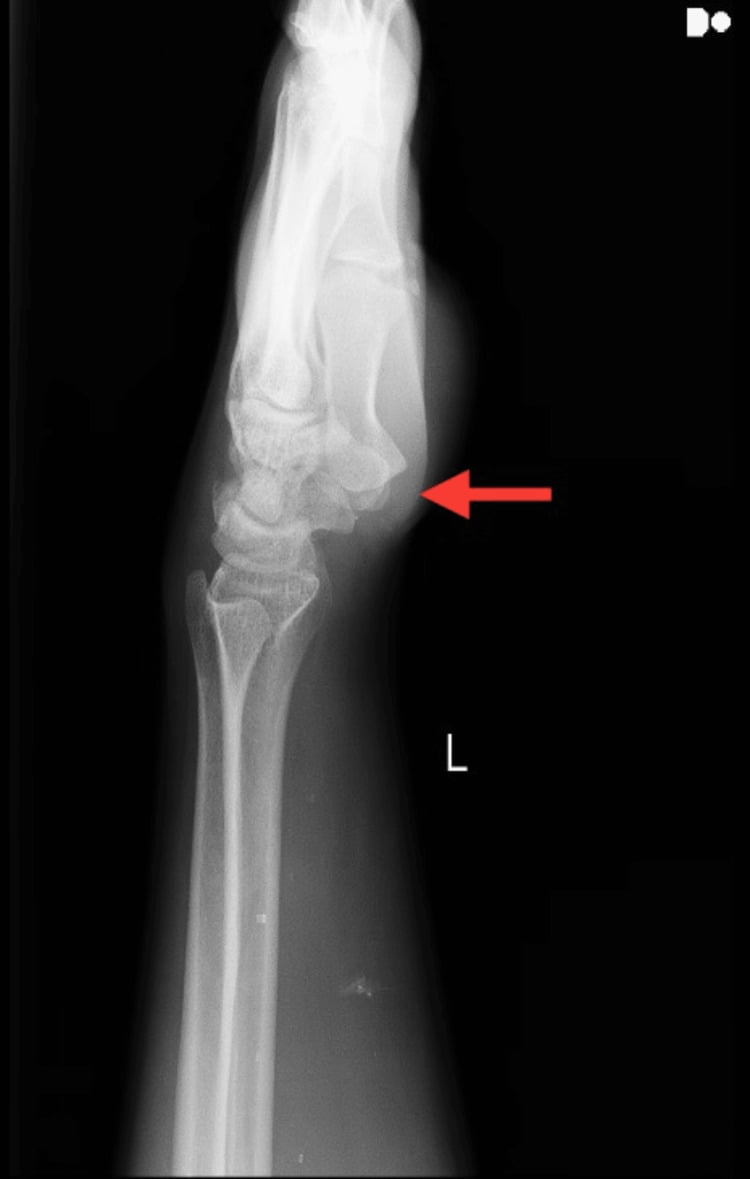
- Stage II, capitolunate. The failure passes through the space of Poirier, so the capitate dislocates dorsally off the lunate: perilunate dislocation.
- Stage III, lunotriquetral. The lunotriquetral ligament fails and the triquetrum separates. The whole carpus is now displaced around a lunate that is still in its fossa.
- Stage IV, lunate dislocation. The dorsal radiolunate ligament gives way last and the lunate itself is extruded volarly, rotating into the carpal tunnel, which is why acute median nerve compression belongs to stage IV.
A continuum. The injuries are one continuum, not separate diagnoses. A stage I scapholunate tear is the first station of the same journey that ends in a lunate dislocation, so an SL injury after high-energy trauma deserves a deliberate search for the greater- and lesser-arc injuries beyond it.
The lunate is the last bone to leave. In a perilunate dislocation the lunate stays put and everything else moves, which is exactly what the lateral radiograph shows and exactly what the terminology encodes.
Lesser and greater arcs. The lesser arc describes this purely ligamentous path around the lunate. When the same force travels through bone instead, most often the scaphoid, giving a trans-scaphoid perilunate fracture-dislocation, it is a greater arc injury; Gilula's arcs are the tool for spotting either on the posteroanterior film.
Clinical Presentation
History
What to ask. Ask for the mechanism and the functional problem, not just the pain site. These answers change management:
- A fall on the outstretched hand or high-energy wrist trauma? SL injury and perilunate spectrum injuries may follow extension and ulnar deviation loading, so the answer triggers careful PA, lateral, stress and fracture assessment.
- How long since injury? Tissue repairability decreases with chronic attenuation and capsular contracture, so repair is best early, before chronic attenuation and arthritis. Acute repair, chronic reconstruction and salvage are different decisions.
- Where is the pain? Dorsal central pain suggests SL; ulnar-sided pain suggests LT, TFCC, ECU or ulnar impaction. The site directs examination and imaging.
- Clicking, clunking or giving way? Mechanical symptoms suggest instability rather than isolated inflammation and argue for stress imaging or arthroscopy.
- What does the hand need to do? Manual work, sport, cane use and transfers increase load demands, which influences the operative threshold and the salvage choice.
Examination technique
Compare both wrists. Laxity, contralateral widening and old malunion can mislead interpretation. The sequence should be practical: look, feel, move, load, then stress specific ligament intervals.
- How To Do It
- Seat the patient facing you with forearms supported on a table. Expose both wrists and hands. Compare side-to-side throughout.
- What You Are Looking For
- Guarding, swelling, asymmetry, old scars, deformity, generalised laxity and functional confidence.
- How To Do It
- Inspect dorsally, radially and ulnarly. Ask the patient to make a fist, extend the wrist, load through the palm if tolerated and demonstrate the painful activity.
- What You Are Looking For
- Dorsal swelling around the SL interval, ulnar-sided fullness, ECU subluxation, apprehension with loading, clunking or inability to push up.
- How To Do It
- Palpate Lister's tubercle, SL interval just distal to it, scaphoid tubercle, anatomic snuffbox, LT interval, fovea, ECU sheath and DRUJ.
- What You Are Looking For
- Localised SL tenderness, LT tenderness, foveal pain, ECU pain or DRUJ tenderness. Pain location guides the next stress tests.
- How To Do It
- Assess active and passive flexion, extension, radial deviation, ulnar deviation, pronation, supination and grip. Compare strength and painful arcs.
- What You Are Looking For
- Loss of extension after dorsal capsular injury, painful midcarpal clunk, grip weakness, load-related pain or motion loss from arthritis.
- How To Do It
- Only after localisation, perform Watson shift, LT ballottement, midcarpal shift, TFCC foveal/compression tests, ECU synergy and DRUJ stability.
- What You Are Looking For
- The aim is to reproduce the patient's pain and demonstrate abnormal motion compared with the other side.
The stress tests screen; they do not stage. Watson shift and LT ballottement are useful only when interpreted with symptoms, comparison examination, radiographs, stress imaging and cartilage status. A painful manoeuvre is not the same as surgically important instability.
- Exact Technique
- Stabilise the distal radius with one hand. Put the thumb of the other hand firmly on the palmar scaphoid tubercle and fingers around the distal carpus. Start in ulnar deviation and slight extension, then move the wrist into radial deviation and flexion while keeping dorsal pressure through the scaphoid tubercle. Release pressure at the end to feel reduction.
- Positive Finding
- Dorsal radial pain, apprehension, a clunk, or a subluxation-reduction sensation compared with the other wrist.
- Interpretation Limits
- Pain alone is non-specific. False positives occur with laxity and painful sprains. It is a screening test; imaging and arthroscopy stage the injury.
- Exact Technique
- Find Lister's tubercle, then palpate just distal and slightly ulnar over the dorsal SL interval with the wrist flexed slightly.
- Positive Finding
- Point tenderness matching the patient's dorsal pain.
- Interpretation Limits
- Useful localisation, but it does not prove mechanical instability.
- Exact Technique
- Stabilise the lunate between thumb and index finger of one hand. Grasp the triquetrum and pisiform with the other hand and translate the triquetrum dorsally and volarly relative to the lunate.
- Positive Finding
- Pain, excessive translation, crepitus or clunk compared with the other side.
- Interpretation Limits
- Overlap with TFCC injury, ECU pathology, ulnar impaction and midcarpal instability is common.
- Exact Technique
- Palpate between the ulnar styloid and FCU tendon for foveal tenderness. Add ulnar deviation and axial compression with rotation if tolerated.
- Positive Finding
- Deep ulnar pain suggests TFCC or ulnocarpal pathology.
- Interpretation Limits
- A positive ulnar-sided test should make isolated LT surgery less likely until TFCC and ulnar variance are assessed.
- Exact Technique
- Resist thumb abduction or wrist extension/ulnar deviation while palpating ECU. Supinate/pronate and look for tendon snapping.
- Positive Finding
- ECU pain, bowstringing or subluxation.
- Interpretation Limits
- ECU pathology can mimic LT or TFCC pain and changes the operative plan.
- Exact Technique
- Apply axial load to the hand with the wrist slightly flexed and ulnarly deviated, then move from radial to ulnar deviation while feeling for sudden reduction or clunk.
- Positive Finding
- Painful clunk, catch or apprehension at the midcarpal joint.
- Interpretation Limits
- Can reflect constitutional laxity. Interpret with symptoms and imaging rather than as an isolated diagnosis.
Differential diagnosis
Exclude the mimics first. The single most examined error in this topic is anchoring on a ligament label before excluding the mimics. Dorsal-sided and ulnar-sided wrist pain each have a short, high-yield differential that changes the operation.
- Discriminating Features
- Dorsal-radial pain, positive Watson shift, SL gap and DISI on imaging.
- Key Test or Investigation
- PA, lateral and stress PA; arthroscopy when uncertain.
- Why It Changes Management
- True repairable or reconstructable instability if reducible and cartilage preserved.
- Discriminating Features
- Ulnar-sided pain, positive LT ballottement, possible VISI.
- Key Test or Investigation
- LT ballottement, MRA, arthroscopy.
- Why It Changes Management
- Often overlaps mimics; isolated surgery rarely indicated without confirmation.
- Discriminating Features
- Foveal tenderness, painful forearm rotation, pain with ulnar deviation and loading.
- Key Test or Investigation
- Fovea sign, ulnar variance, MRA, arthroscopy.
- Why It Changes Management
- Treated by TFCC repair or ulnar shortening, not carpal ligament surgery.
- Discriminating Features
- Ulnar-positive variance, chronic load-related ulnar pain, lunate/triquetral chondral change.
- Key Test or Investigation
- Neutral-rotation PA grip view for variance; MRI marrow oedema.
- Why It Changes Management
- Ulnar shortening osteotomy or wafer addresses the driver; ignoring it dooms LT surgery.
- Discriminating Features
- Ulnar pain, snapping with supination, positive ECU synergy test.
- Key Test or Investigation
- ECU synergy test, dynamic ultrasound.
- Why It Changes Management
- Tendon or subsheath problem; managed conservatively or by subsheath reconstruction.
- Discriminating Features
- Painful clunk on ulnar deviation, often constitutional laxity, frequently no discrete tear.
- Key Test or Investigation
- Midcarpal shift test, dynamic fluoroscopy.
- Why It Changes Management
- Reconstruction is unreliable; therapy and proprioceptive retraining come first.
- Discriminating Features
- High-energy injury, broken Gilula arcs, lunate or perilunate malalignment, median nerve signs.
- Key Test or Investigation
- True lateral radiograph, CT, urgent assessment.
- Why It Changes Management
- Surgical emergency-level reduction and stabilisation, not elective ligament work.
- Discriminating Features
- Snuffbox tenderness, scaphoid waist pain, humpback deformity.
- Key Test or Investigation
- Scaphoid views, CT.
- Why It Changes Management
- Fixation or salvage of the scaphoid drives treatment, with its own collapse pattern (SNAC).
- Discriminating Features
- Central dorsal pain, lunate sclerosis or collapse, possible ulnar-negative variance.
- Key Test or Investigation
- Radiographs (Lichtman stage), MRI.
- Why It Changes Management
- Lunate osteonecrosis needs unloading or salvage, not interosseous ligament repair.
Investigations
Plain radiographs
Write a specific request. A useful request is PA wrist, true lateral wrist, oblique wrist, a clenched-fist or pencil-grip stress PA view, and contralateral comparison if subtle instability is suspected. Add scaphoid views if a scaphoid fracture is possible, and traction views or dynamic fluoroscopy if a perilunate spectrum injury or a question of reducibility exists.
- Why You Request It
- Baseline carpal alignment.
- What To Check
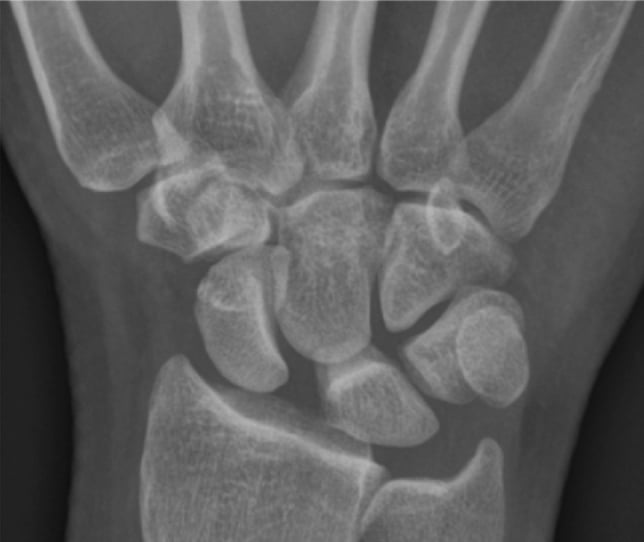
- SL interval, LT interval, Gilula arcs, cortical ring sign, fractures, ulnar variance and arthritis.
- Why You Request It
- Intercalated segment alignment.
- What To Check
- SL angle, capitolunate angle, radiolunate angle, DISI, VISI and perilunate alignment.
- Why You Request It
- Occult carpal fracture and joint overlap clarification.
- What To Check
- Scaphoid, triquetrum, hamate, capitate and distal radius articular injury.
- Why You Request It
- Loads the carpus to reveal dynamic SL widening.
- What To Check
- Side-to-side SL gap difference and dynamic dissociation. Can be normal in predynamic injury and can overcall laxity.
- Why You Request It
- Separates abnormal widening from constitutional laxity.
- What To Check
- Compare gap, angles and symptoms rather than treating an isolated number.
- Why You Request It
- Shows gap opening, clunk and reducibility in real time.
- What To Check
- Helpful when examination and static radiographs disagree. Operator-dependent and requires clinical correlation.
Measure translation and rotation. Alignment means DISI, VISI, carpal height and the capitolunate axis, and the gap alone does not fully describe the deformity: record both the translation and the rotation.
- How To Assess
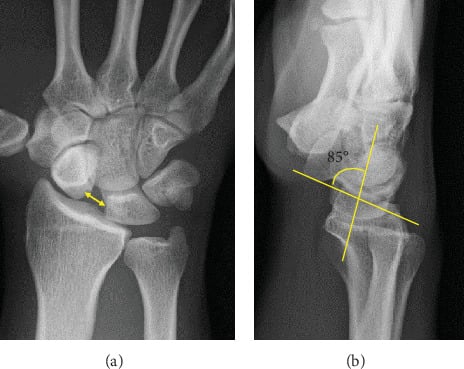
- Measure the interval between the scaphoid and lunate on PA and stress PA views. Greater than 3 mm is suspicious; around 5 mm or more is strongly abnormal when symptomatic.
- Meaning
- SL dissociation or dynamic SL instability.
- How To Assess
- Visible widening between scaphoid and lunate on neutral PA view.
- Meaning
- Static SL dissociation if present at rest.
- How To Assess
- Look for the distal scaphoid seen end-on because the scaphoid is flexed.
- Meaning
- Scaphoid flexion caused by loss of SL control.
- How To Assess
- On the true lateral, draw the scaphoid long axis and the lunate axis. Normal is roughly 30 to 60 degrees; greater than 70 degrees supports DISI.
- Meaning
- Dorsal lunate extension pattern after SL failure.
- How To Assess
- Draw the radial shaft axis and lunate axis on the lateral. The lunate should sit close to neutral relative to the radius.
- Meaning
- Dorsal or volar lunate tilt helps define DISI or VISI.
- How To Assess
- Draw the capitate axis and lunate axis. A small angle is expected; widening indicates carpal malalignment.
- Meaning
- Perilunate spectrum, DISI, VISI or midcarpal instability.
- How To Assess
- Smooth arcs across proximal and distal carpal rows on PA view.
- Meaning
- Broken arcs suggest carpal malalignment or fracture-dislocation.
- How To Assess
- Radioscaphoid narrowing, styloid arthritis, scaphocapitate/capitolunate involvement.
- Meaning
- Ligament reconstruction becomes inappropriate when cartilage is lost.
Advanced imaging
MRI shows ligament signal, occult fracture, cartilage, marrow oedema and associated pathology. It may miss partial tears or overcall incidental signal change, and it maps ligament and cartilage pathology without deciding whether a tear is mechanically unstable; stress imaging and arthroscopy determine that.
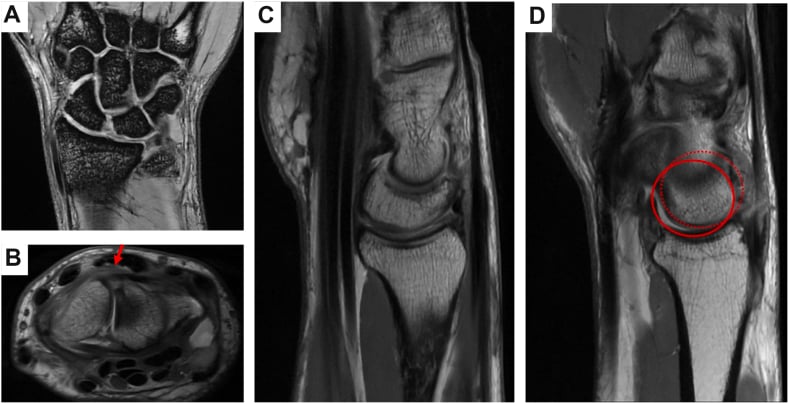
MR or CT arthrography shows contrast passage through the SL or LT interval and assesses cartilage. Contrast passing from the radiocarpal to the midcarpal joint proves an intercarpal communication through the SL and/or LT interval, but it does not by itself identify the symptomatic ligament or the instability grade. The test is invasive and still does not replace arthroscopy when treatment depends on the exact grade.
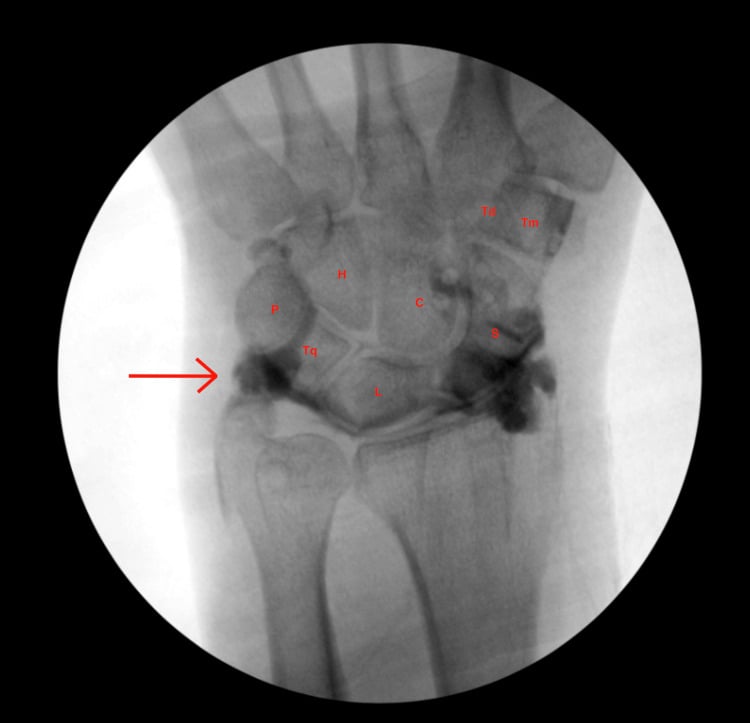
CT is for fracture, scaphoid nonunion, carpal alignment, arthritis and surgical planning. It is poor for ligament integrity unless arthrographic.
Arthroscopy assesses ligament integrity, step-off, reducibility and cartilage directly, so it stages as well as diagnoses. It is invasive, but often the reference standard for uncertain symptomatic instability, and especially useful when symptoms, stress radiographs and MRI do not agree.
Management
What decides the operation. Management is chosen by the ligament injured, stage, timing, reducibility, cartilage, associated fracture, ulnar-sided pathology and patient demand; age and occupation change the operation too. A repairable acute SL tear, a chronic reducible SL dissociation and an arthritic SLAC wrist are different problems.
Dynamic SL instability. Once stress views or arthroscopy confirm it, it is repaired acutely if early and repairable, and reconstructed if chronic and symptomatic. Do not reassure solely because neutral radiographs look normal.
Who. Non-operative management is appropriate only when the wrist is stable or when the patient's symptoms, demand, comorbidity or preference do not justify surgery. Do not reconstruct a stable wrist because MRI shows signal change; arthroscopic debridement is kept for persistent symptomatic synovitis or a partial tear.
- Treatment
- Short immobilisation, analgesia, oedema control, hand therapy and reassessment.
- Review Trigger
- Persistent dorsal or ulnar-sided pain, clicking or inability to load.
- Treatment
- Immobilisation, protected loading and therapy; arthroscopic debridement if persistent mechanical synovitis.
- Review Trigger
- Positive stress imaging or persistent mechanical symptoms.
- Treatment
- Splinting, activity modification, injections only as diagnostic or temporary tools, therapy.
- Review Trigger
- Progressive deformity, loss of function or degenerative change.
- Treatment
- Splint, analgesia, activity modification, corticosteroid injection and shared decision-making.
- Review Trigger
- Pain, function and radiographic progression.
Follow-up is part of the treatment. Do not call non-operative care complete unless follow-up is planned: dynamic instability can declare itself later.
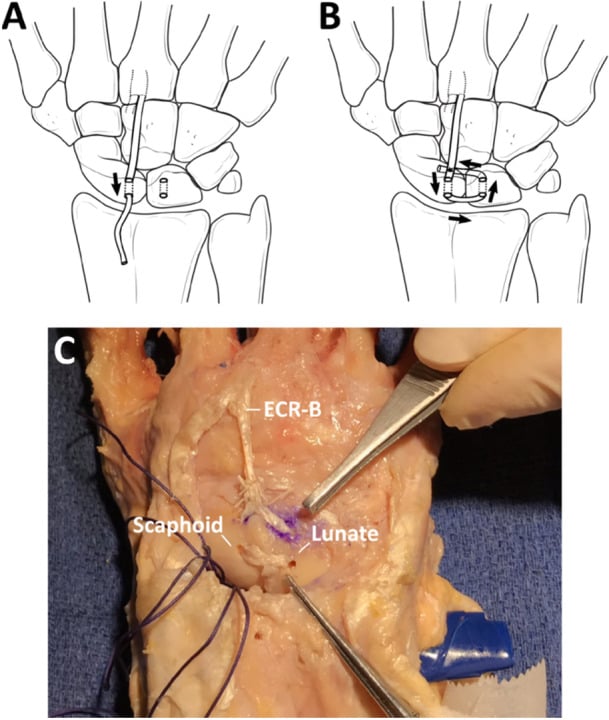
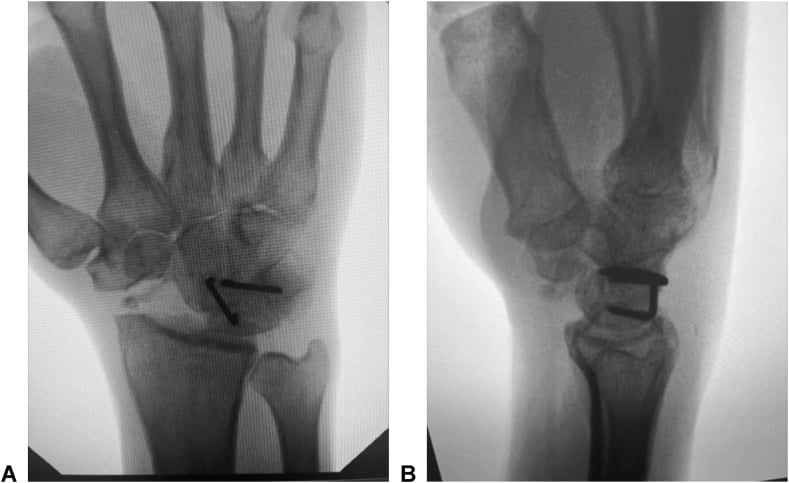
Delayed diagnosis can convert a repairable ligament injury into a reconstruction or salvage problem. Persistent wrist pain after trauma needs reassessment, not reassurance alone.
Surgical Technique Details
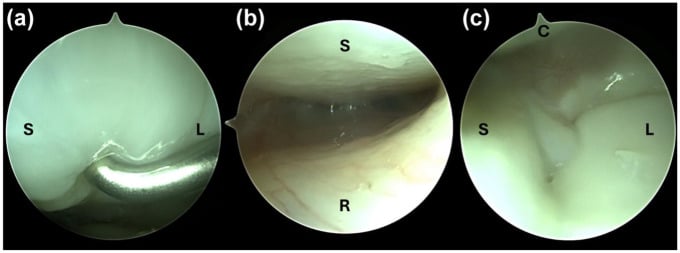
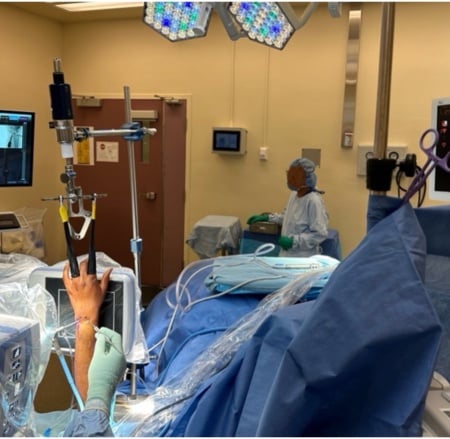
Purpose. Arthroscopy confirms the ligament grade, dynamic instability, cartilage condition and any associated TFCC or chondral injury.
Set-up. The patient lies supine with the arm on a hand table, the elbow at 90 degrees and finger-trap traction centred beneath the tower, or another wrist traction set-up. Position fluoroscopy and the monitor so that repeated true PA and lateral imaging does not contaminate the field.
Portals. Mark Lister's tubercle, EPL, and the 3-4, 4-5, 6R/6U and midcarpal portals before traction distorts the tendons and bony landmarks. The 3-4 portal lies just distal to Lister's tubercle and ulnar to EPL, the 6R portal radial to ECU, and the midcarpal radial and ulnar portals about 1 cm distal.
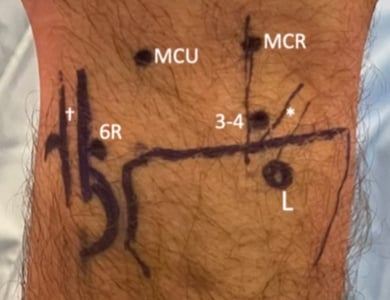
The examination. Work through the joint in order:
- Establish the 3-4 portal for radiocarpal viewing.
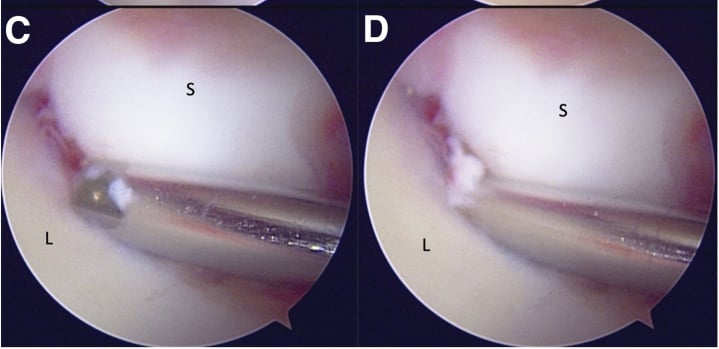
- Inspect the radius, scaphoid fossa, lunate fossa, proximal scaphoid, lunate, TFCC and SL interval.
- Probe the SL and LT ligaments; assess step-off and whether a probe or scope passes through the interval.
- Use the midcarpal portals to assess the SL and LT intervals from the opposite side, the capitolunate joint and the cartilage. Probe both intercarpal intervals before choosing repair, reconstruction or salvage.
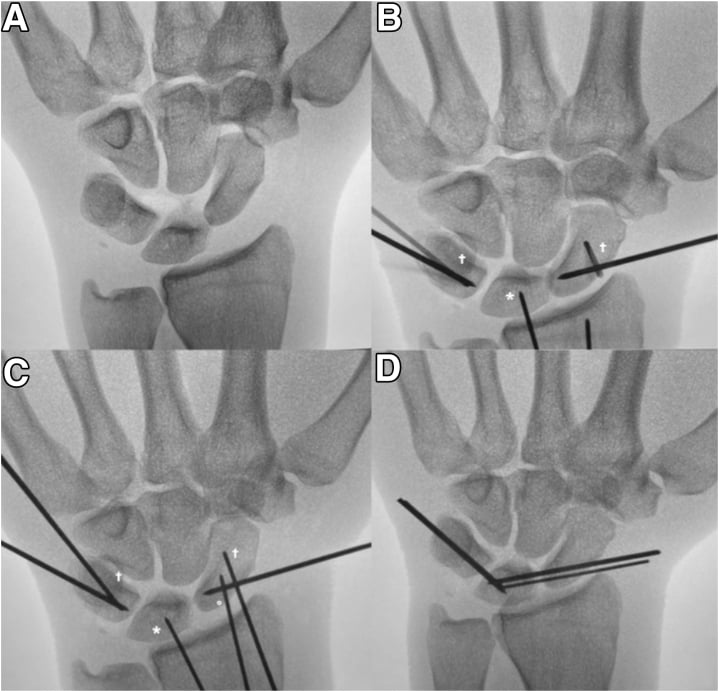
- Treat according to grade: debridement for stable partial tears, pinning or repair for unstable acute tears, reconstruction or salvage if chronic.
Hazards. The superficial radial nerve, dorsal sensory branches, the ECU subsheath and the extensor tendons are at risk, as is the cartilage from iatrogenic chondral injury.
PRC or four-corner fusion. Cartilage selects the operation (the salvage table above), and four-corner fusion is not chosen for a patient who cannot tolerate fusion protection. PRC has no fusion site and simpler rehabilitation when the cartilage is suitable, but risks radiocapitate arthritis and reduced grip strength if cartilage selection is poor. Four-corner fusion maintains carpal height better and may suit heavier demand in selected patients, at the cost of a risk of nonunion, hardware irritation and stiffness.
Complications
- Cause
- Normal neutral films interpreted as normal wrist.
- Prevention or Response
- Use stress views, reassessment and arthroscopy when symptoms persist.
- Cause
- Immobilisation, capsular surgery, tendon tethering or pain.
- Prevention or Response
- Counsel preoperatively, protect tendons and use staged hand therapy.
- Cause
- Chronic tissue attenuation, failed reconstruction or inadequate reduction.
- Prevention or Response
- Stage properly, reduce before fixation and counsel limitations.
- Cause
- Persistent malalignment and cartilage overload.
- Prevention or Response
- Recognise when reconstruction is too late; shift to salvage.
- Cause
- Trauma, swelling, portals or surgical exposure.
- Prevention or Response
- Document pre/post-op nerve status; decompress if acute carpal tunnel syndrome is present.
- Cause
- K-wire migration, infection, irritation, broken implants.
- Prevention or Response
- Appropriate pin care, removal timing and follow-up.
- Cause
- Poor preparation, fixation, smoking, biology or early loading.
- Prevention or Response
- Meticulous joint preparation, grafting, stable fixation and protected rehabilitation.
- Cause
- Adjacent joint disease, nonunion, expectations or residual impingement.
- Prevention or Response
- Match procedure to cartilage pattern and patient goals.
Guidelines, Registries & Global Practice
Carpal instability is a low-volume, high-complexity problem with no single randomised gold-standard operation, so practice is driven by expert society consensus, surgeon experience and resource setting rather than by registry-mandated implants.
Global epidemiology
- Scapholunate injury is the most frequent carpal instability and a common occult injury after fall-on-the-outstretched-hand trauma (Kitay & Wolfe, J Hand Surg Am 2012).
- Up to two-thirds of displaced intra-articular distal radius fractures carry an associated intracarpal ligament or TFCC injury (Geissler, JBJS Am 1996), so instability is frequently a missed companion of a common fracture.
- SLAC is the most common pattern of wrist osteoarthritis, accounting for around 57% of degenerative wrists in the original radiographic series (Watson & Ballet 1984).
Side-by-side society positions
- Emphasis
- Evidence-based management of distal radius fractures highlights screening for associated carpal/TFCC injury; instability itself has no dedicated high-level guideline.
- Practical Take-Home
- Have a low threshold to look for SL/LT injury when treating wrist trauma.
- Emphasis
- Specialist hand-surgery referral pathways for suspected carpal instability and ulnar-sided wrist pain; emphasis on staged assessment and arthroscopy.
- Practical Take-Home
- Refer persistent post-traumatic wrist pain to a hand unit rather than repeatedly reassuring.
- Emphasis
- Standardised arthroscopic staging of SL and LT tears and arthroscopic-assisted treatment algorithms.
- Practical Take-Home
- Arthroscopy is the reference standard when clinical and radiographic findings disagree.
- Emphasis
- Reduction-first principles for the perilunate spectrum and articular distal radius; carpal alignment must be restored before soft-tissue work.
- Practical Take-Home
- Reduce and align the carpus before judging or repairing ligaments.
- Emphasis
- Recognition that no single reconstruction is superior and that staged, cartilage-led decision-making prevails across Europe.
- Practical Take-Home
- Tailor the operation to stage, reducibility and cartilage, not to a fixed protocol.
Registry note
Unlike hip and knee arthroplasty, wrist ligament reconstruction is not tracked by national joint registries because it uses no standardised implant. Total wrist arthroplasty — a salvage option in selected low-demand wrists — is captured in some national registries (for example the Norwegian and Australian arthroplasty registries report wrist implant survival), and these data consistently show inferior longevity compared with hip and knee implants, reinforcing caution in high-demand patients.
High- versus limited-resource practice variation
- Typical Pathway
- Stress imaging, MR arthrography, diagnostic and therapeutic wrist arthroscopy, full salvage menu including arthroplasty.
- Reason
- Access to arthroscopy and advanced imaging allows precise staging and motion-preserving options.
- Typical Pathway
- Plain radiographs with contralateral comparison, clinical staging, immobilisation, open repair and fusion-based salvage.
- Reason
- Reliance on robust low-cost techniques; arthrodesis is durable and forgiving where arthroscopy and implants are scarce.
- Typical Pathway
- Reduction of perilunate injuries, recognition of acute carpal tunnel syndrome and avoidance of reconstructing an arthritic wrist.
- Reason
- These principles are universal and do not depend on resources.
Common Pitfalls
Persistent wrist pain after trauma needs reassessment. Dynamic SL instability can have normal neutral radiographs.
MRI signal does not equal clinically important instability. Correlate with stress imaging, arthroscopy and symptoms.
SLAC or fixed arthritic collapse is a salvage problem, not a ligament repair problem.
LT pain overlaps with TFCC injury, ECU pathology, ulnar impaction and midcarpal instability.
Controversies and Areas of Uncertainty
This is a field with strong opinions and weak comparative evidence, and naming the honest controversies is a fast way to demonstrate maturity in a viva.
The best operation for chronic reducible scapholunate instability. Capsulodesis, three-ligament tenodesis, bone-ligament-bone graft and screw-based constructs (RASL/SLAM) all have advocates. Comparative high-level data are lacking, and recurrent radiographic gap is common with every technique. Match the technique to tissue, demand and surgeon experience, and counsel that no method reliably restores normal kinematics.
Does fixing the ligament prevent SLAC? The assumption that early stabilisation prevents degenerative collapse is biologically plausible but not proven by long-term controlled data. Treat symptomatic, repairable, reducible injury early, but avoid over-promising arthritis prevention.
Predynamic and incidental MRI tears. High-resolution MRI and arthroscopy detect partial SL and LT tears whose natural history in asymptomatic wrists is unknown, and overtreatment is a real risk. Treat the patient, not the scan: reserve intervention for mechanical symptoms with corroborating examination and stress imaging.
PRC versus four-corner fusion. Meta-analysis now favours PRC for outcomes and complications, yet many surgeons still prefer fusion for younger, heavy-demand patients, citing carpal-height preservation. Let the cartilage pattern decide first (capitate head and lunate fossa for PRC, radiolunate joint for fusion) and use demand and age as tie-breakers.
Proprioceptive rehabilitation. Cadaver and clinical work suggests selective muscle retraining can dynamically stabilise ligament-deficient wrists, but robust trial evidence is limited. It is a reasonable adjunct for dynamic instability and low-demand patients, not a substitute for surgery in established static instability.
LT arthrodesis. Reported nonunion rates of up to 57% and persistent pain make LT fusion contentious. Use it only after exhaustively excluding TFCC, ulnar impaction and midcarpal drivers, and counsel the high failure rate.
MCQ Practice Points
Q: What does a normal PA wrist radiograph exclude? A: It excludes obvious static dissociation, but it does not exclude predynamic or dynamic scapholunate instability.
Q: What radiographic pattern is classically associated with scapholunate dissociation? A: DISI, with scaphoid flexion and lunate extension.
Q: What is the key contraindication to ligament reconstruction? A: Fixed irreducible deformity or established arthritis where salvage is required.
Viva Scenarios
Practise clinical reasoning and management decisions out loud
“A young manual worker has dorsal wrist pain three months after a fall. Neutral radiographs look normal.”
“A high-demand patient has an acute complete scapholunate ligament tear with reducible SL widening and no arthritis.”
“A patient has chronic scapholunate dissociation, DISI deformity and radioscaphoid arthritis.”
“A 35-year-old presents with chronic ulnar-sided wrist pain, a painful click and a positive lunotriquetral ballottement test. They want to know if they need a lunotriquetral fusion.”
Core diagnosis
- SL injury: dorsal pain, Watson shift, SL gap, DISI.
- LT injury: ulnar-sided pain, LT ballottement, possible VISI.
- Dynamic injury may need stress views or arthroscopy.
Measure
- SL gap on PA and stress views.
- Scapholunate angle and capitolunate angle on lateral.
- Gilula arcs, ring sign, DISI/VISI and arthritis pattern.
Stage
- Predynamic: symptoms, no radiographic instability.
- Dynamic: stress instability.
- Static reducible: visible malalignment that corrects.
- Irreducible or arthritic: salvage logic.
Treat
- Stable partial tear: immobilisation, therapy, selected arthroscopic debridement.
- Acute complete reducible SL: repair, pinning, possible capsulodesis.
- Chronic reducible SL: reconstruction or capsulodesis.
- Arthritic collapse: PRC, four-corner fusion, limited fusion or total wrist fusion.
Must not miss
- Perilunate spectrum injury in high-energy trauma.
- TFCC, ECU and ulnar impaction in LT-type symptoms.
- Cartilage loss before offering reconstruction.
- Median nerve symptoms after carpal trauma.
Evidence Base
The papers below are the ones most worth being able to cite by name in a viva.
Watson & Ballet — the SLAC pattern (landmark natural history)
- Review of 4,000 wrist radiographs identified 210 cases of degenerative arthritis after excluding other arthritides; the scapholunate advanced collapse (SLAC) sequence was the single most common pattern at 57%, beginning at the radioscaphoid joint.
- A further 27% involved the scaphotrapezium-trapezoid joint and 15% combined both patterns; 18 of 19 operated patients had less pain postoperatively.
Geissler — arthroscopic classification of carpal ligament tears
- Prospective arthroscopic study of 60 displaced intra-articular distal radius fractures: 41 patients (68%) had associated intracarpal soft-tissue injury, including 26 TFCC tears, 19 scapholunate and 9 lunotriquetral interosseous ligament tears.
- Intracarpal injuries clustered with fractures involving the lunate facet; the paper introduced the arthroscopic grading of interosseous ligament tears now known as the Geissler classification.
Kitay & Wolfe — scapholunate instability current concepts
- Comprehensive review establishing scapholunate injury as the most frequent cause of carpal instability and proposing a widely used treatment algorithm based on stage of injury, secondary ligament damage and arthritic change.
- An isolated SLIL tear may show normal static radiographs yet progress to abnormal kinematics, cartilage wear and degenerative collapse.