ACL Graft Choice: BTB vs Hamstring vs Quadriceps Tendon — Evidence and the Exam Answer
ACL graft choice for clinicians: what trials, meta-analyses and registries show for BTB, hamstring and quadriceps tendon autografts, and the viva answer.
By OrthoVellum Editorial TeamPublished 12 min read
Educational content for clinicians, not medical advice. Editorial policy
Key points
- In randomised trials BTB and hamstring autografts give similar function and re-rupture rates; BTB knees are more statically stable and have more anterior knee and kneeling problems (Cochrane, 19 trials, 1,597 patients).
- Registries show a small, consistent revision advantage for BTB: hazard rate ratio 0.63 in 45,998 Scandinavian reconstructions, and an adjusted hazard ratio of 2.3 for hamstring in Norway. Young age is a stronger risk factor than graft type.
- Hamstring grafts of 8 mm or less were revised more often in two Level III cohorts, most of all in patients under 20. Size the graft before committing to it.
- Quadriceps tendon matched BTB and hamstring in a meta-analysis and a 112-patient RCT, with less donor-site pain than BTB. Danish registry data show higher early revision in low-volume clinics, so the learning curve counts.
- The AAOS guideline makes autograft over allograft in young or active patients a strong recommendation. In STABILITY, adding a lateral extra-articular tenodesis to hamstring reconstruction cut graft rupture from 11% to 4%.
On this page8 sections
Every ACL reconstruction begins with a decision the patient lives with for decades: which tendon to take. ACL graft choice between bone–patellar tendon–bone (BTB), four-strand hamstring and quadriceps tendon autograft is a standard viva question, and the evidence answers it more clearly than the argument around it suggests. All three restore stability and function to a similar degree. BTB has a small, consistent revision advantage and the most kneeling pain. Hamstring has little anterior morbidity and a higher failure risk than BTB in young pivoting athletes. Quadriceps tendon looks comparable on shorter follow-up and has a learning curve. The background is on the ACL injuries topic page.
What does each autograft give, and what does it cost?
Each graft trades fixation and healing against donor-site morbidity. The table sets out the trade; the sections after it give the evidence.
| BTB (bone–patellar tendon–bone) | Four-strand hamstring | Quadriceps tendon | |
|---|---|---|---|
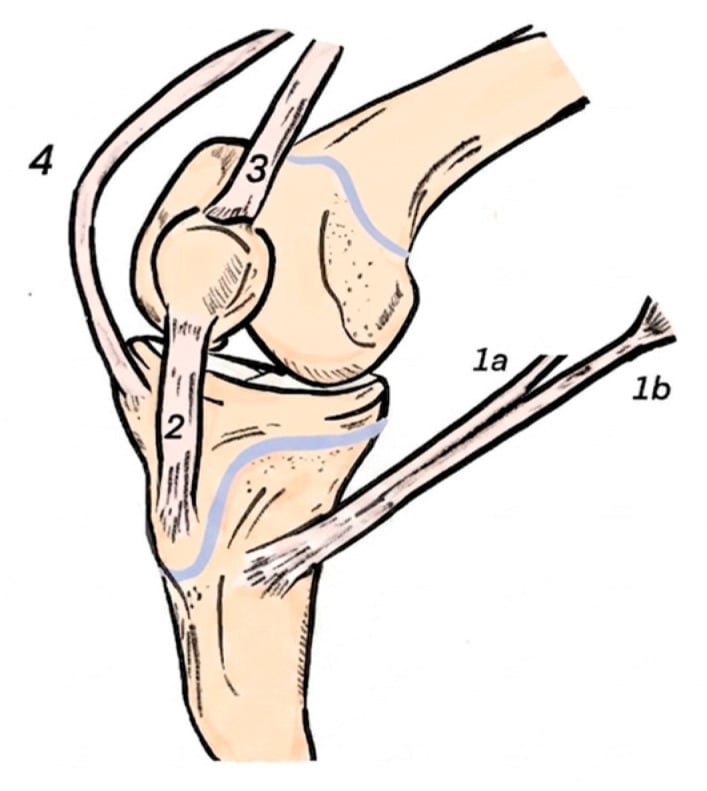
| Harvest | Central third (about 10 mm) of the patellar tendon with patellar and tibial bone blocks | Semitendinosus and gracilis, quadrupled | Central strip of quadriceps tendon, all soft tissue or with a patellar bone block |
| Healing in the tunnel | Bone to bone, classically 6–8 weeks | Soft tissue to bone, 12 weeks or more | Soft tissue, or bone to bone at the block end |
| Size | Fixed by the harvest | Variable; target at least 8 mm, ideally more | Large and adjustable |
| What it does well | Lowest revision rate in registries; aperture interference-screw fixation; most statically stable knee in trials | Less anterior knee and kneeling morbidity than BTB; small incision | Less donor-site pain than BTB; spares the hamstrings |
| What it costs | Anterior knee and kneeling pain; loss of extension; small risk of patellar fracture or tendon rupture | Flexion strength loss; small grafts fail more; higher revision in the young | Early quadriceps weakness; harvest learning curve; patellar fracture if a bone block is taken; less long-term data |
Allograft sits outside the table because, in a young patient, it is not an equal choice. That is covered below.
Does BTB fail less often than hamstring?
Slightly, and the answer depends on which kind of study you read.
Randomised trials see no difference in re-rupture. The Cochrane review by Mohtadi pooled 19 trials and 1,597 young to middle-aged adults. There was no significant difference in hop test, return to activity, Tegner, Lysholm, IKDC or re-rupture. Every static stability test (instrumented, Lachman and pivot shift) favoured patellar tendon. Patellar tendon patients had more anterior knee problems, especially with kneeling, and a significant loss of extension; hamstring patients had a significant loss of flexion strength. Many of the trials were at high risk of bias, and long-term data were too thin to judge osteoarthritis.
Registries see a small, consistent difference in revision. Gifstad combined the Scandinavian registries: 45,998 primary reconstructions, of which 84.1% used hamstring and 14.6% patellar tendon. The revision hazard rate ratio for patellar tendon against hamstring was 0.63 (95% CI 0.53–0.74), consistent across sex, age and cartilage-injury subgroups. The effect looked slightly stronger after soccer, handball and alpine injuries (0.57 against 0.81), but the test for interaction did not reach significance (P = .058). Persson, from the Norwegian registry (12,643 patients), found an adjusted hazard ratio for revision of 2.3 (95% CI 1.8–3.0) for hamstring against patellar tendon. In the same model, patients aged 15–19 had a hazard ratio of 4.0 against those aged 30 or over, and sex had no effect.
Pooled, the difference is real and small. Samuelsen's meta-analysis of 47,613 reconstructions (14 RCTs, 10 prospective cohorts and one registry) found ruptures in 2.80% of BTB and 2.84% of hamstring grafts, with an odds ratio of 0.83 (95% CI 0.72–0.96). The number needed to treat was 235: that many patients would need BTB rather than hamstring to prevent one rupture. Laxity, pivot shift and Lachman did not differ significantly.
Why trials and registries disagree is partly arithmetic. Revision is a rare outcome, and 1,597 patients cannot detect a hazard ratio near 0.6 that tens of thousands can. Registries pay for that size with confounding: they record revision rather than rupture, and they cannot separate the graft from the surgeon, the fixation and the patient who chose it. The quadriceps tendon operative guide puts it plainly: registry revision rates are useful signals, but they cannot establish that graft choice alone caused failure. Hold both findings together. BTB revises a little less, and age and activity matter more than the graft.
The guideline wording follows the evidence. The AAOS guideline (2022 update, summarised by Brophy and Lowry in 2023) says that for skeletally mature patients surgeons may favour BTB to reduce the risk of graft failure or infection, or hamstring to reduce the risk of anterior or kneeling pain. That is a moderate-strength recommendation, a clarification of the 2013 guideline, which had said on strong evidence that outcomes were similar.
Why does hamstring graft diameter matter?
Because small hamstring grafts fail more, and the effect concentrates in the patients most likely to fail anyway.
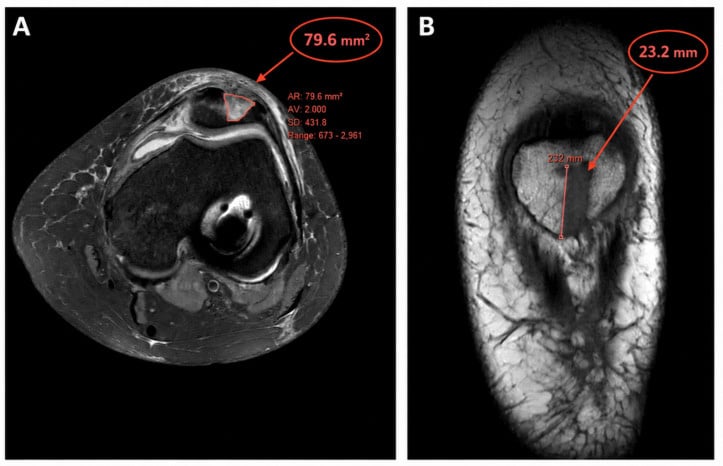
Magnussen followed 256 hamstring reconstructions. Revision was needed in 1 of 58 (1.7%) grafts over 8 mm, 9 of 139 (6.5%) at 7.5–8 mm and 8 of 59 (13.6%) at 7 mm or less (PubMed (opens in a new tab)). Sixteen of the 18 revisions were in patients under 20 with grafts of 8 mm or less. In the MOON cohort reported by Mariscalco, 14 of 199 (7.0%) grafts of 8 mm or less were revised within 2 years, against 0 of 64 larger grafts. In patients aged 18 or younger the figures were 13 of 71 (18.3%) against 0 of 14. Both are Level III cohorts with short follow-up, and Mariscalco's authors say a larger sample is needed to confirm the revision relationship. The direction is consistent enough to act on.
The practical rule is to size the graft before drilling. If a quadrupled hamstring falls short, the hamstring operative guide lists the options: add strands, or switch to quadriceps tendon or BTB. The same guide notes that small grafts are commonest in smaller patients, so the problem is better anticipated at consent than discovered on the back table.
Where does the quadriceps tendon fit?
Quadriceps tendon is used more and more because it offers a large soft-tissue graft without the kneeling cost of BTB. The comparative evidence supports it as an equal option. It does not show it to be better.
Mouarbes pooled 27 studies (2,856 patients). Against BTB (581 against 514 grafts) there was no significant difference in instrumented laxity, Lachman, pivot shift, Lysholm, subjective IKDC or graft failure, and donor-site pain was a quarter as common with quadriceps tendon (risk ratio 0.25, 95% CI 0.18–0.36). Against hamstring (181 against 176) the only difference was a slightly higher mean Lysholm score with quadriceps tendon (mean difference 3.81 points).
Ebert's randomised trial allocated 112 patients to quadriceps or hamstring autograft. At 24 months laxity and patient-reported outcomes did not differ, except that the ACL Return to Sport after Injury score was better in the hamstring group at 3, 6 and 12 months. Each graft left a weakness at its own donor site. The hamstring group had better quadriceps strength symmetry at 6 and 12 months and better hop symmetry, mainly at 6 months; the quadriceps group had better hamstring strength symmetry at 6, 12 and 24 months. One graft re-tore within 2 years, in the quadriceps group. Rehabilitation and return-to-sport testing should expect an extensor deficit after quadriceps harvest; the quadriceps tendon operative guide recommends serial strength testing rather than reading early weakness as failure.
The registry caution comes from Denmark. Lind compared 531 quadriceps, 14,213 hamstring and 1,835 patellar tendon reconstructions from 2005–2017. Two-year revision was 4.7% for quadriceps tendon against 2.3% for hamstring and 1.5% for patellar tendon, with slightly more laxity and positive pivot shift. The same group then split quadriceps cases by clinic routine. Clinics with 100 or fewer procedures over 2012–2019 had a revision rate of 6.4%, against 2.9% in higher-volume clinics (adjusted hazard ratio 2.3). Their conclusion was that quadriceps tendon is not associated with a high revision rate when performed routinely, and that the learning curve is an important factor. That is a registry inference, not a trial result. The useful message for a surgeon adopting the graft is to expect a learning curve and audit the early cases.
What about allograft?
In a young patient, allograft is the wrong answer in the exam and, on current evidence, usually in practice.
In a MOON prospective cohort, Kaeding found that the odds of graft rupture after allograft were about four times those after autograft, and that the odds rose 2.3-fold for each 10-year decrease in age (PubMed (opens in a new tab)). Patients aged 10–19 had the highest failure rate. The AAOS guideline recommends that surgeons consider autograft over allograft, particularly in young and/or active patients, and grades it strong; the 2013 version had treated the two as similar. At revision, the MARS cohort of 1,205 cases found autograft 2.78 times less likely to re-rupture than allograft at 2 years.
Allograft still has a place: no donor site and a shorter operation for the selected older, lower-demand patient or the multiligament knee that needs several grafts, after an informed discussion.
Does a lateral extra-articular tenodesis change the choice?
It changes what a hamstring graft can be asked to do. STABILITY randomised 618 patients aged 25 or under (mean 18.9 years) to hamstring reconstruction with or without a lateral extra-articular tenodesis (LET). All had at least two of three risk factors: a grade 2 or greater pivot shift, a plan to return to pivoting sport, or generalised ligamentous laxity. At 2 years graft rupture fell from 11% to 4% and the composite of clinical failure from 40% to 25%. The number needed to treat to prevent one rupture was 14.3. The price was early pain: patients without LET had less pain at 3 months, and KOOS pain still favoured them at 6 months; there were no clinically important differences in patient-reported outcomes at other time points. The detail of the tenodesis and its indications is on the anterolateral ligament and LET topic page.
Marmura used the STABILITY data to validate the MOON graft-rupture risk calculator. Age, high-grade preoperative laxity and graft type predicted rupture, and both BTB and hamstring plus LET were protective against hamstring alone. The authors concluded that isolated hamstring grafts should be avoided in young active patients. The AAOS guideline treats ALL reconstruction or LET with a hamstring graft as something that could be considered in selected patients, on moderate evidence, with long-term outcomes not yet known.
What STABILITY did not do is compare hamstring plus LET with BTB. Neither is proven better than the other for the high-risk young athlete; both are defensible, and both beat isolated hamstring in that group.
Which graft for which patient?
Put the evidence together and the decision follows the patient, not a house preference.
| Patient | Reasonable first choice | Why |
|---|---|---|
| Under about 25, pivoting or contact sport, high-grade pivot shift or hyperlaxity | BTB, or hamstring plus LET; quadriceps tendon in experienced hands | Registry revision advantage for BTB; STABILITY and the MOON calculator against isolated hamstring |
| Kneels for work or religion, anterior knee pain or patellar tendinopathy | Hamstring or quadriceps tendon | More kneeling problems after BTB (Cochrane); guideline allows hamstring to reduce kneeling pain |
| Small hamstrings sized 8 mm or less at surgery | Augment the graft, or change to quadriceps tendon or BTB | Revision rises in grafts of 8 mm or less, most of all under 20 |
| Sprinter, or hamstring-dependent sport | Quadriceps tendon or BTB | Hamstring harvest costs flexion strength; quadriceps harvest preserves it |
| Skeletally immature | Soft-tissue graft (hamstring or all-soft-tissue quadriceps); iliotibial band techniques when much growth remains | No bone block or hardware across an open physis |
| Revision | Autograft, usually contralateral BTB or quadriceps tendon | Autograft re-ruptured less than allograft in MARS |
| Older, lower demand, or multiligament knee | Autograft, or allograft after discussion | Rupture risk falls with age (MOON) |
Children are a separate decision. Over open physes the graft is usually soft tissue, and BTB is generally avoided while substantial growth remains because bone blocks can injure the physis. In a paediatric meta-analysis of 12 non-randomised studies (205 quadriceps, 454 hamstring), graft rupture was 3.5% with quadriceps tendon against 12.4% with hamstring (PubMed (opens in a new tab)). The confidence intervals were wide and the groups unmatched, so the paediatric ACL injury topic page treats it as promising rather than settled. Our post on physeal-safe paediatric ACL reconstruction covers the techniques.
The graft does not shorten rehabilitation. Whatever the tendon, return to pivoting sport should wait for objective criteria and, in most protocols, at least 9 months; the return to sport criteria page and our post on return-to-sport testing after ACL reconstruction give the battery.
In the exam
Examiners want a reasoned choice, not a favourite. Name the options, quote one trial-level and one registry-level finding, and match the graft to the patient in front of you. If the question opens with the examination, our post on the Lachman and pivot shift covers the grading that feeds the LET decision.
Frequently asked questions
Which ACL graft has the lowest failure rate?
In registries, BTB autograft. Scandinavian data on 45,998 reconstructions gave a revision hazard rate ratio of 0.63 against hamstring, and a meta-analysis of 47,613 patients found ruptures in 2.80% of BTB and 2.84% of hamstring grafts (odds ratio 0.83). The absolute difference is small: 235 patients would need BTB rather than hamstring to prevent one rupture. Patient age and activity predict failure more strongly than graft type.
Is quadriceps tendon better than hamstring for ACL reconstruction?
Not clearly. A 112-patient randomised trial found no difference in laxity or patient-reported outcomes at 2 years. Hamstring patients had better quadriceps strength and hop symmetry at 6–12 months; quadriceps patients had better hamstring strength symmetry. A meta-analysis found similar stability and graft failure, with slightly better Lysholm scores for quadriceps tendon. Long-term comparative data are still limited.
Why is allograft avoided in young athletes?
Because it fails more often. In a MOON cohort the odds of graft rupture after allograft reconstruction were about four times those after autograft, and the odds rose 2.3-fold for each 10-year decrease in age, so the two risks compound in teenagers. The AAOS guideline makes autograft over allograft, particularly in young or active patients, a strong recommendation. Allograft is kept for selected older, lower-demand or multiligament cases.
What is the minimum hamstring graft diameter for ACL reconstruction?
Aim for at least 8 mm, and ideally more: in a MOON cohort, 14 of 199 hamstring grafts of 8 mm or less were revised within 2 years, against 0 of 64 larger grafts. In patients aged 18 or younger the figures were 13 of 71 (18.3%) against 0 of 14. If the graft sizes small, add strands, add or swap to another tendon, or change graft.
Which ACL graft is best for someone who kneels at work?
Usually hamstring, with quadriceps tendon as an alternative. The Cochrane review found more anterior knee problems, especially with kneeling, after patellar tendon reconstruction, and the AAOS guideline says surgeons may favour hamstring to reduce anterior or kneeling pain. A quadriceps tendon graft also spares the patellar tendon; a meta-analysis found donor-site pain about a quarter as common as after BTB.
References
- Mohtadi NG, Chan DS, Dainty KN, Whelan DB. Patellar tendon versus hamstring tendon autograft for anterior cruciate ligament rupture in adults. Cochrane Database Syst Rev 2011;(9):CD005960. DOI (opens in a new tab)
- Samuelsen BT, Webster KE, Johnson NR, Hewett TE, Krych AJ. Hamstring autograft versus patellar tendon autograft for ACL reconstruction: is there a difference in graft failure rate? A meta-analysis of 47,613 patients. Clin Orthop Relat Res 2017;475(10):2459-2468. DOI (opens in a new tab)
- Gifstad T, Foss OA, Engebretsen L, et al. Lower risk of revision with patellar tendon autografts compared with hamstring autografts: a registry study based on 45,998 primary ACL reconstructions in Scandinavia. Am J Sports Med 2014;42(10):2319-2328. DOI (opens in a new tab)
- Persson A, Fjeldsgaard K, Gjertsen JE, et al. Increased risk of revision with hamstring tendon grafts compared with patellar tendon grafts after anterior cruciate ligament reconstruction: a study of 12,643 patients from the Norwegian Cruciate Ligament Registry, 2004-2012. Am J Sports Med 2014;42(2):285-291. DOI (opens in a new tab)
- Mariscalco MW, Flanigan DC, Mitchell J, et al. The influence of hamstring autograft size on patient-reported outcomes and risk of revision after anterior cruciate ligament reconstruction: a MOON cohort study. Arthroscopy 2013;29(12):1948-1953. DOI (opens in a new tab)
- Mouarbes D, Menetrey J, Marot V, et al. Anterior cruciate ligament reconstruction: a systematic review and meta-analysis of outcomes for quadriceps tendon autograft versus bone-patellar tendon-bone and hamstring-tendon autografts. Am J Sports Med 2019;47(14):3531-3540. DOI (opens in a new tab)
- Ebert JR, Calvert ND, Radic R. A prospective randomized controlled trial investigating quadriceps versus hamstring tendon autograft in anterior cruciate ligament reconstruction. Am J Sports Med 2024;52(3):660-669. DOI (opens in a new tab)
- Lind M, Strauss MJ, Nielsen T, Engebretsen L. Quadriceps tendon autograft for anterior cruciate ligament reconstruction is associated with high revision rates: results from the Danish Knee Ligament Registry. Knee Surg Sports Traumatol Arthrosc 2020;28(7):2163-2169. DOI (opens in a new tab)
- Lind M, Strauss MJ, Nielsen T, Engebretsen L. Low surgical routine increases revision rates after quadriceps tendon autograft for anterior cruciate ligament reconstruction: results from the Danish Knee Ligament Reconstruction Registry. Knee Surg Sports Traumatol Arthrosc 2021;29(6):1880-1886. DOI (opens in a new tab)
- Getgood AMJ, Bryant DM, Litchfield R, et al. Lateral extra-articular tenodesis reduces failure of hamstring tendon autograft anterior cruciate ligament reconstruction: 2-year outcomes from the STABILITY study randomized clinical trial. Am J Sports Med 2020;48(2):285-297. DOI (opens in a new tab)
- Marmura H, Getgood AMJ, Spindler KP, et al. Validation of a risk calculator to personalize graft choice and reduce rupture rates for anterior cruciate ligament reconstruction. Am J Sports Med 2021;49(7):1777-1785. DOI (opens in a new tab)
- Brophy RH, Lowry KJ. American Academy of Orthopaedic Surgeons clinical practice guideline summary: management of anterior cruciate ligament injuries. J Am Acad Orthop Surg 2023;31(11):531-537. DOI (opens in a new tab)
Study the full topic
Included in Pro
Go deeper with Pro
- Operative guide: ACL reconstruction with BTB autograft
- Operative guide: ACL reconstruction with 4-strand hamstring autograft
- Operative guide: ACL reconstruction with quadriceps tendon autograft
Share this article
Cite this article
OrthoVellum Editorial Team. ACL Graft Choice: BTB vs Hamstring vs Quadriceps Tendon — Evidence and the Exam Answer [Internet]. OrthoVellum; 2026 Oct 2 [cited 2026 Oct 2]. Available from: https://www.orthovellum.com/blog/acl-graft-choice
About this content
Prepared by the OrthoVellum Editorial Team from cited sources, under our editorial policy.
For education and exam preparation; not medical advice or a substitute for clinical judgement and local guidance.
Spotted an error? Tell us; every report is read.
Get new articles by email
New clinical explainers, landmark-trial summaries and exam guidance from the OrthoVellum blog. No account needed; unsubscribe from any email.