Achilles Avulsion | ORIF Required | Tension Band Wiring
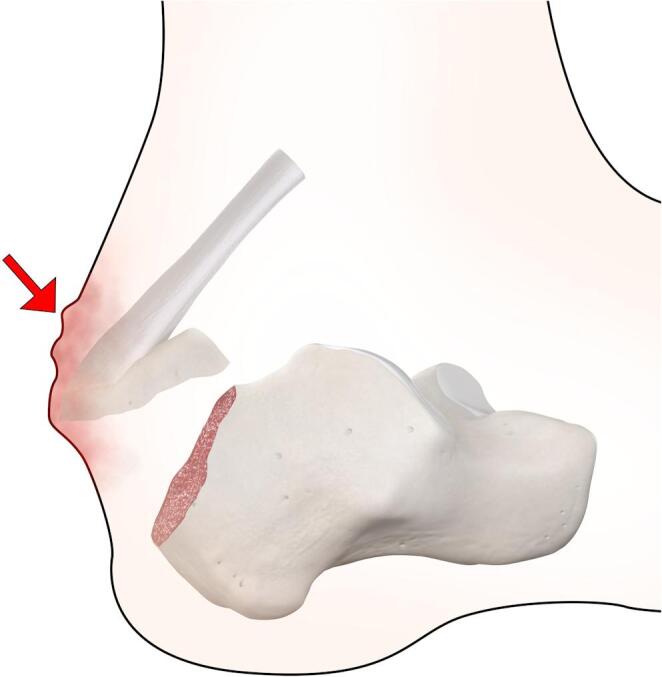
- Achilles avulsion injury - posterior tuberosity is the Achilles footprint; displacement causes loss of push-off and a tented heel
- Skin is the emergency, not the bone - the displaced fragment tents posterior heel skin; pressure necrosis can occur within hours, so urgent reduction is mandatory
- Displacement drives prognosis - Carnero-Martin showed displacement of 2cm or more raises complications from 30% to 91% and soft-tissue compromise from 0% to 45%
- Insufficiency / Charcot fracture - common in elderly osteoporotic women and diabetics; low-energy mechanism, poor bone quality complicates fixation
- Sural nerve at risk in the posterolateral approach; protect it during exposure
- “The skin over the heel is the time-critical issue - tenting demands urgent reduction
- “Lee classification has 4 types; Beavis classification is NOT prognostic (Carnero-Martin)
- “Displacement (not fracture type) predicts complications and soft-tissue compromise
- “Always check Achilles power and screen for diabetes / osteoporosis
Overview and Epidemiology
Calcaneal tuberosity fractures are rare but important injuries of the posterior tuberosity of the calcaneus, the insertion of the Achilles tendon. They are avulsion injuries, and a displaced fracture needs ORIF to prevent loss of plantarflexion power and equinus contracture.
Incidence. Approximately 1.3-2.7% of all calcaneal fractures. Lee found 20 among 764 calcaneal fractures, 2.6%.
Who. Typically older adults, and more often women: the Carnero-Martin series had a mean age of 57 and was around 62% female, a predominance that reflects post-menopausal osteoporosis. Roughly one patient in five was diabetic (19%), and many of these fractures are insufficiency or Charcot-related avulsions.
Mechanism. In Carnero-Martin 71% were low-energy, a trip or a fall. Less commonly the cause is a direct blow (Lee type II) or high energy. Ipsilateral foot and ankle fractures occur, so assess the whole hindfoot.
Anatomy and Pathophysiology
The tuberosity. The large, prominent posterior projection of the calcaneus, and the insertion of the Achilles tendon. Its blood supply comes from branches of the posterior tibial artery.
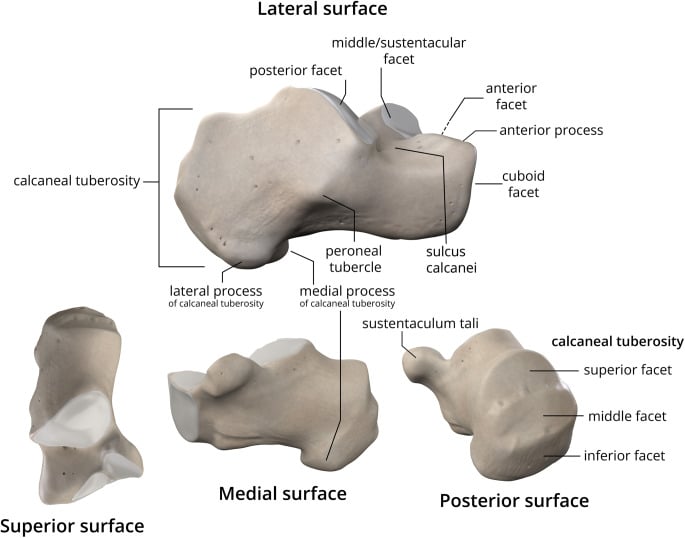
The Achilles insertion. The tendon is 1.5-2cm wide where it inserts on the posterior tuberosity, and it drives plantarflexion and push-off. The tuberosity is the Achilles footprint, so a tuberosity fracture is an Achilles tendon avulsion.
The sural nerve. Sensory to the lateral foot, it runs 1-2cm posterior to the lateral malleolus and is at risk in the posterior approach.
Mechanism of injury. Sudden plantarflexion with an eccentric contraction of the gastrocnemius-soleus puts the Achilles under excessive tension, and it avulses from the tuberosity with a bone fragment. In osteoporotic or diabetic (Charcot) bone the tuberosity is already weak, and a minor force is enough.
Why displacement matters. The tendon draws the fragment proximally. Plantarflexion power is lost, the patient cannot push off and gait suffers, and proximal migration leads to equinus contracture. Anatomic reduction restores plantarflexion, the Achilles lever arm and gastrocnemius-soleus tension, and prevents the contracture; stable fixation allows early motion.
Calcaneal Insufficiency Avulsion (CIA) and the Brodsky 3B Pattern
What CIA means. A posterior tuberosity avulsion through pathologically weak bone, with little or no trauma. Greenhagen notes that CIA fractures make up part of the 1.3-2.7% of calcaneal fractures attributed to reduced bone mineral density, and that in a person with diabetes the avulsion most likely represents a Charcot neuroarthropathy event rather than a simple mechanical failure.
Where Brodsky 3B fits. The Brodsky anatomic classification locates Charcot neuroarthropathy by region. The full classification and its reconstructive principles belong to the Charcot neuroarthropathy topic:
- Type 1 - midfoot, the commonest
- Type 2 - hindfoot
- Type 3A - ankle
- Type 3B - posterior calcaneus, a pathologic avulsion of the tuberosity (os calcis)
Labelling a tuberosity avulsion Brodsky 3B therefore signals a neuropathic, insufficiency mechanism, not a high-energy injury.
When to suspect it. A spontaneous avulsion, or one after trivial force, is a red flag, as is a diabetic or neuropathic patient. Check the sensory examination and blood glucose, screen for previously undiagnosed diabetes and peripheral neuropathy, and assess bone quality before planning fixation.
Why it changes management. Neuropathic or osteoporotic bone gives poor screw purchase, so conventional lag-screw ORIF frequently fails or loses reduction, and suture anchors, a tension band and gastrocnemius recession may be needed. Greenhagen described fragment excision, gastrocnemius recession and double-row suture-anchor Achilles reattachment rather than struggling to fix unfixable bone; the rearfoot AOFAS score improved from 27 to 88 at one year. Anticipate poor bone and be ready to abandon screws for anchors and tendon reattachment.
Classification Systems
Three schemes are in use. Lee's describes morphology and the Achilles fibres involved, Beavis's is historical, and Carnero-Martin's is built on displacement.
Lee (Clin Orthop Surg 2012) derived four types from 20 tuberosity fractures among 764 calcaneal fractures, correlating surgical and MRI findings.
- Description
- Simple extra-articular avulsion (sleeve)
- Achilles fibres / mechanism
- All fibres; accidental trip / fall
- Typical patient
- Elderly women (commonest, 8/20)
- Description
- Beak fracture
- Achilles fibres / mechanism
- All fibres; often direct blow
- Typical patient
- Younger male
- Description
- Infrabursal avulsion, middle-third
- Achilles fibres / mechanism
- Superficial fibres only; fall
- Typical patient
- Younger male
- Description
- Beak with small superior triangular fragment
- Achilles fibres / mechanism
- Deep fibres; fall
- Typical patient
- Younger male
In type II the skin over the apex of the beak is at risk. Types III and IV depend on which fibres are involved: diagnosis of type III often needs MRI to localise it, and MRI helps confirm the deep-fibre involvement of type IV. Morphology guides exposure but not prognosis.
Classify the morphology, but manage by displacement and skin status. Neither morphological scheme has been shown to predict outcome: Beavis failed when Carnero-Martin tested it, and Lee has not been tested against outcome.
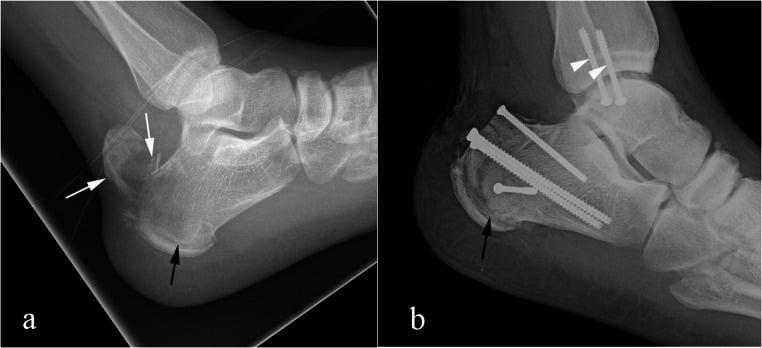
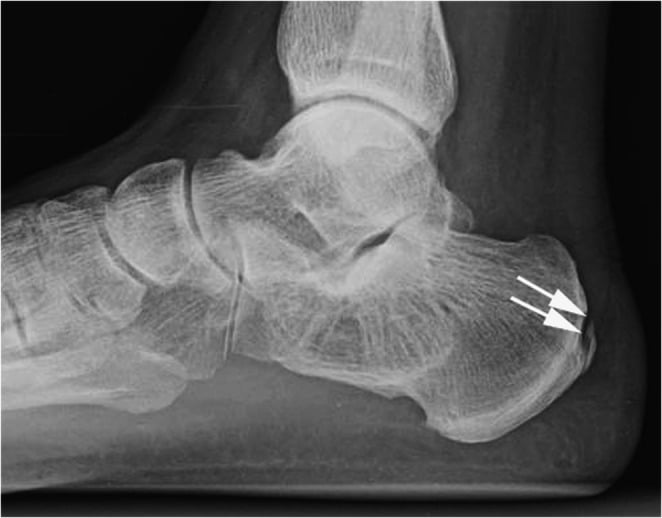
Clinical Assessment
History. Posterior heel pain and swelling after a sudden plantarflexion, a fall or direct trauma to the heel. Walking is difficult and weight bearing painful, and the patient cannot push off.
The skin comes first. Inspect the posterior heel for blanching or tenting before anything else. The displaced fragment tents the skin, and in thin, elderly or diabetic patients pressure necrosis can develop within hours; the skin, not the bone, is the time-critical issue.
Inspection and palpation. Swelling of the posterior heel, ecchymosis that may be delayed, and deformity from proximal migration of the fragment. The tuberosity is tender, a gap may be felt at the fracture if it is displaced, and Achilles continuity may be disrupted.
Function. Loss of active plantarflexion is the key finding: the patient cannot push off or perform a single-leg heel raise, which indicates Achilles dysfunction. Passive plantarflexion may be limited and a displaced fracture may produce an equinus deformity. The Thompson test may be positive, and a straight leg raise may be limited by pain.
- Key feature
- Posterior heel pain, weak push-off, tented skin
- Discriminator
- Bony fragment displaced proximally by Achilles
- Imaging
- Lateral radiograph shows avulsed fragment
- Key feature
- Sudden 'kick', palpable gap in tendon
- Discriminator
- Positive Thompson test, NO bony fragment
- Imaging
- Ultrasound/MRI show tendon gap, normal bone
- Key feature
- Chronic posterior heel pain, no trauma
- Discriminator
- Gradual onset, no avulsed fragment
- Imaging
- Enthesophyte, calcification, no acute fracture
- Key feature
- Higher-energy, hindfoot swelling
- Discriminator
- Fracture line enters posterior facet; skin at apex at risk
- Imaging
- CT shows joint involvement and Bohler angle loss
- Key feature
- Insidious heel pain, osteoporosis/diabetes
- Discriminator
- No discrete displaced fragment, positive squeeze
- Imaging
- MRI marrow oedema; subtle on radiograph
Investigations
Radiographs. A lateral, an axial and an AP view:
- Lateral - the best view: shows the tuberosity, the displacement and proximal migration of the fragment
- Axial (Harris) - shows the tuberosity from below and the displacement
- AP - may show the fracture, but is less reliable than the lateral
CT is recommended when displacement is unclear on the radiographs, when the pattern is complex, and when planning surgery, for which it is often needed. It shows the fracture pattern, fragment size and comminution, and measures displacement as step-off.
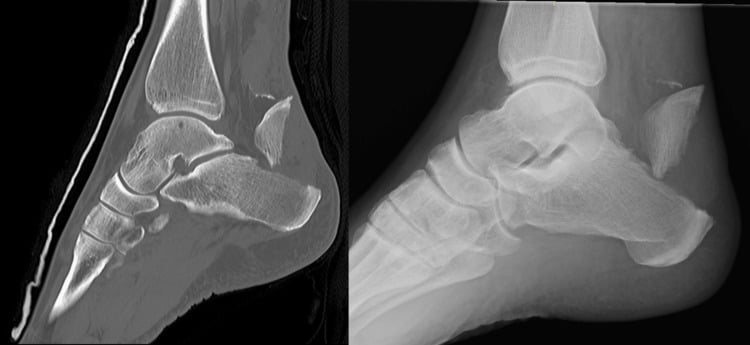
Emergency Closed Reduction of the Tented Heel
When the heel skin is threatened, urgent reduction, closed or open, is mandatory, and it is done within hours of recognising a tented, blanched heel. Closed reduction is a temporising measure to protect the soft-tissue envelope.
The manoeuvre. Unload the Achilles, reduce the fragment, then hold it:
- Relax the deforming force. Flex the knee and hold the ankle in plantarflexion (equinus) to slacken the gastrocnemius-soleus-Achilles complex that is pulling the fragment proximally.
- Reduce and decompress. With the muscle relaxed, press directly over the displaced fragment to push it back down onto the tuberosity bed, relieving the skin.
- Hold and reassess. Immobilise in a well-padded plantarflexion (equinus) splint or backslab, then confirm that skin colour, blanching and capillary refill improve.
When it is not enough. If plantarflexion and manual pressure fail to relieve the tenting or blanching, this becomes an emergency open reduction to decompress the skin directly; do not wait for an elective list when the heel skin is white. Even a successful closed reduction rarely gives a stable definitive result, because the strong Achilles pull re-displaces the fragment, so definitive fixation still follows once the soft tissues allow.
Management Algorithm
The decision. Displacement and the extensor mechanism decide it. Most fractures are displaced and are fixed; the rare non-displaced fracture with an intact extensor mechanism can be treated in a cast.
Timing. Definitive fixation within 2 weeks if possible, before healing. Threatened skin cannot wait for that: it is reduced first, as above.
The absolute indications for ORIF are displacement greater than 2mm, loss of active plantarflexion and proximal migration of the fragment. Patient preference and a high-demand patient are relative indications.
Surgical Technique
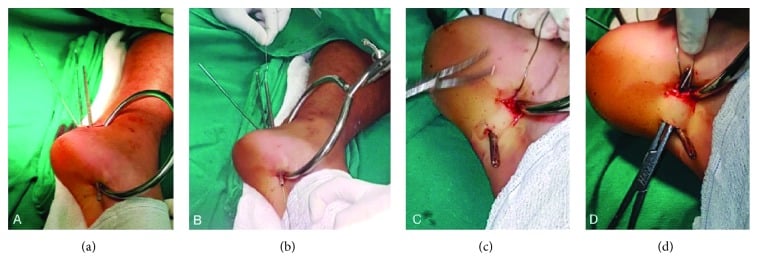
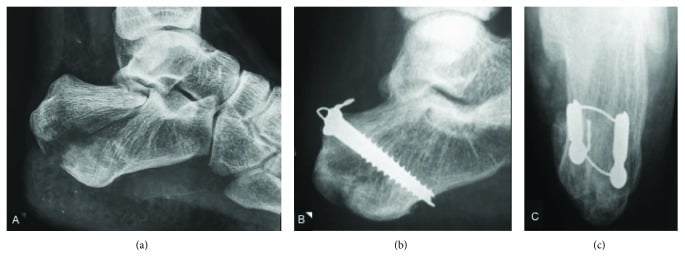
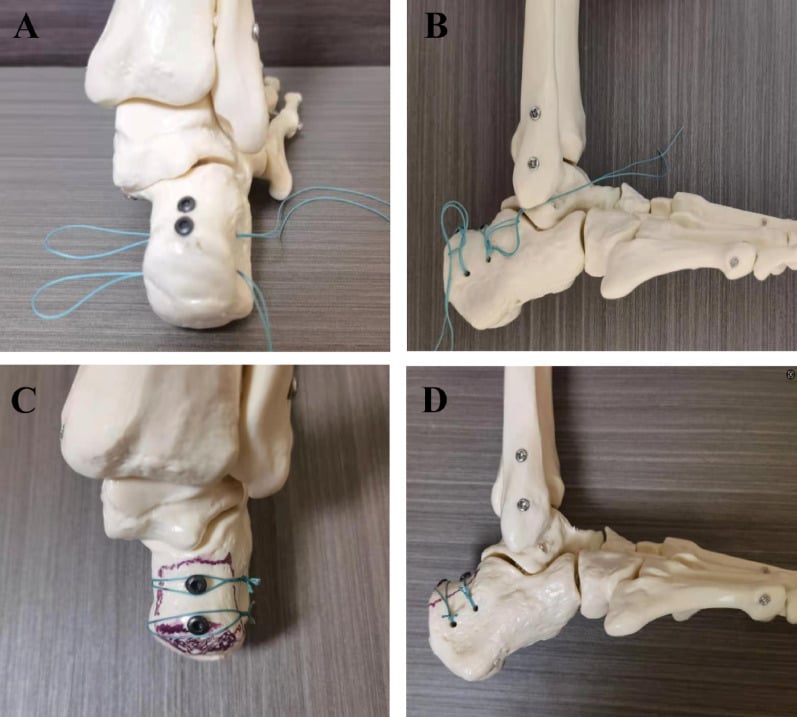
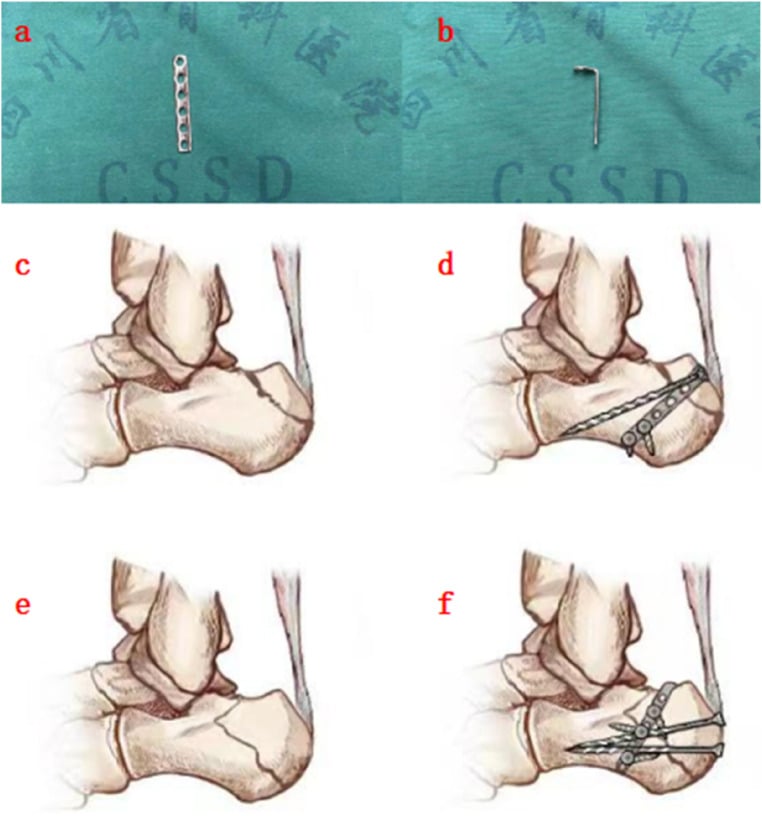
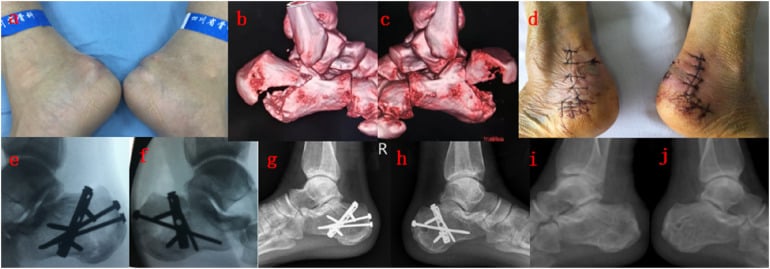
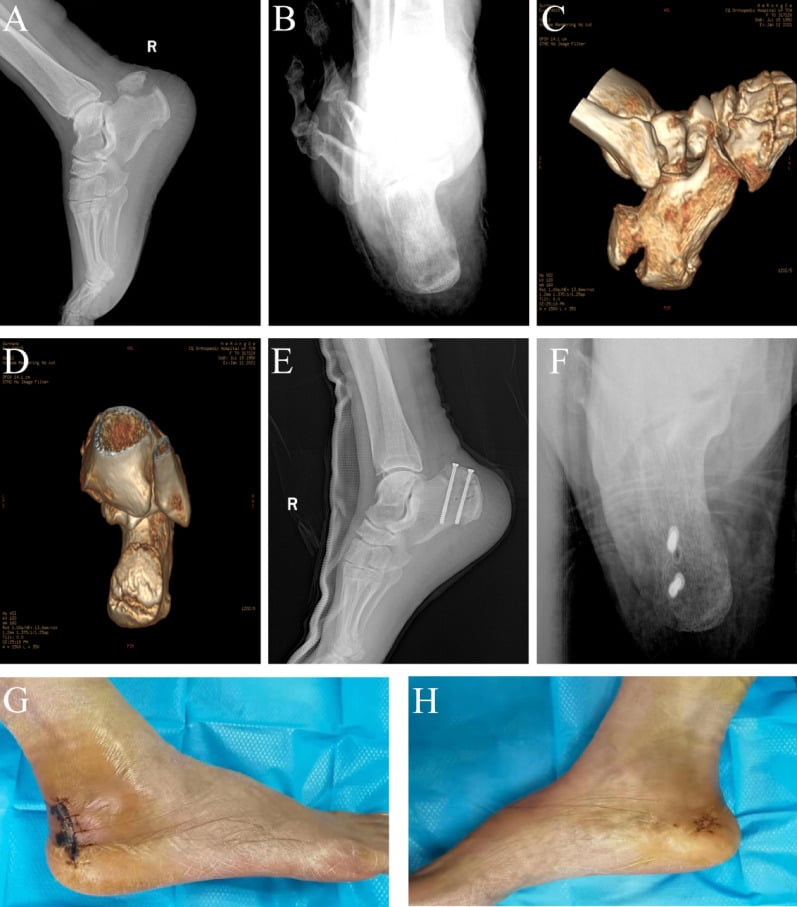
Choosing the construct. Tension band wiring is the preferred technique: it converts the tensile pull of the Achilles into compression at the fracture and allows early motion and weight bearing. Screws, combined constructs, plates and suture anchors are the alternatives, and the evidence does not settle the choice between them (see Controversies).
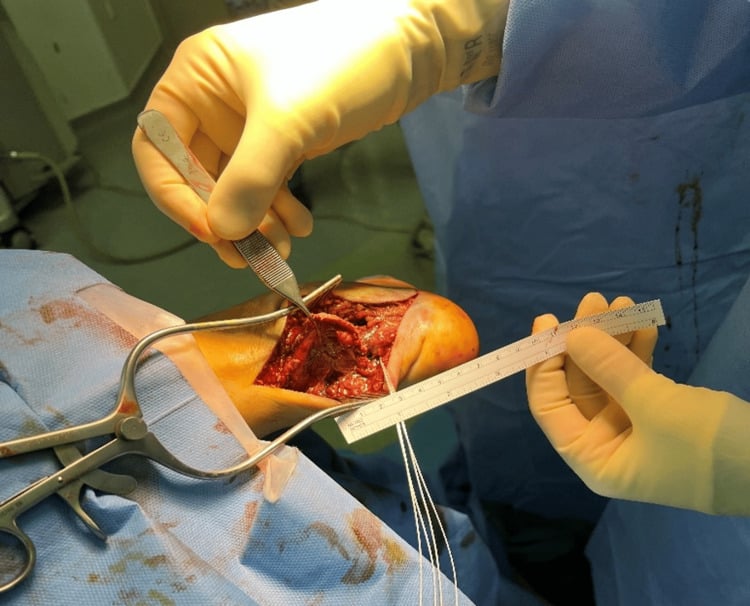
Approach. A posterior midline or posterolateral approach exposes the tuberosity. Identify and protect the sural nerve.
Used for most displaced fractures. The figure-of-8 wire can pass around K-wires or screws.
- Exposure through the posterior approach, protecting the sural nerve
- Reduction of the fragment anatomically to the calcaneus
- K-wires: two parallel K-wires (2.0-2.5mm) from the tuberosity into the calcaneus
- Tension band: a figure-of-8 wire (1.2-1.25mm) around the K-wires and through the Achilles
- Tensioning the wire
- Verification of reduction and hardware position on fluoroscopy
The construct is biomechanically favourable and has a high union rate.
Complications
- Incidence
- 5-10%
- Risk Factors
- Posterior approach
- Prevention/Management
- Protect nerve, identify early
- Incidence
- 10-15% if untreated
- Risk Factors
- Delayed treatment, inadequate fixation
- Prevention/Management
- Early ORIF, adequate fixation
- Incidence
- 10-15%
- Risk Factors
- Inadequate reduction, delayed treatment
- Prevention/Management
- Anatomic reduction, early treatment
- Incidence
- 5-10%
- Risk Factors
- Inadequate fixation, displacement
- Prevention/Management
- Rigid fixation, bone graft if needed
- Incidence
- 20-30%
- Risk Factors
- Tension band wires
- Prevention/Management
- Bury wires, remove if symptomatic
Sural nerve injury. The nerve lies in the path of the posterior approach. Identify and protect it; a symptomatic neuroma is excised.
Equinus contracture. It follows proximal migration of the fragment and delayed treatment. Established contracture is treated with stretching, serial casting or surgical release.
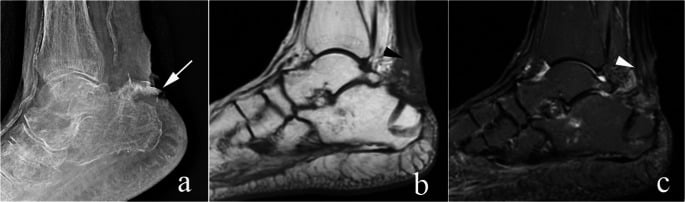
Soft-tissue failure and nonunion. Skin risk can dominate fracture management. The cases below show posterior soft-tissue failure, infection after delayed treatment, and nonunion after non-operative care.
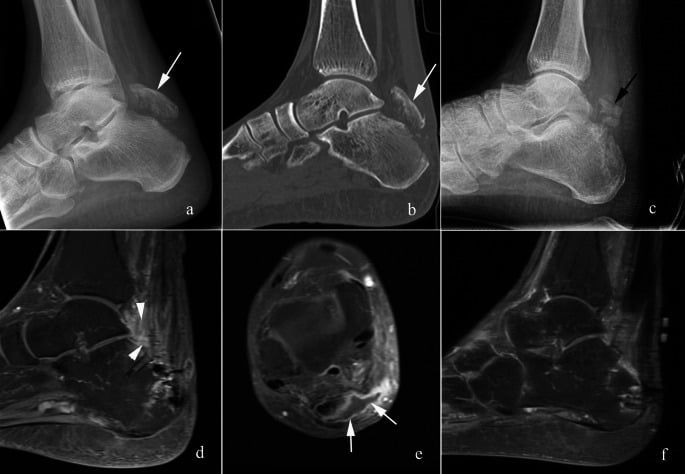
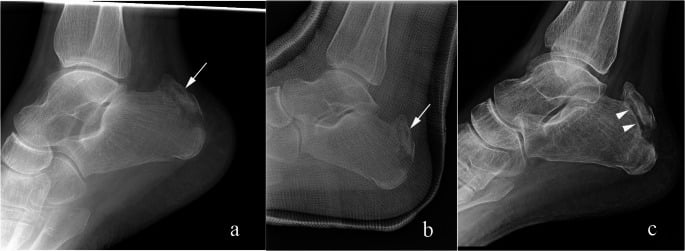
Postoperative Care
The ankle is protected in a short leg cast or boot, non-weight bearing initially (2-4 weeks). Ankle range-of-motion exercises start early if fixation is stable, and physiotherapy concentrates on plantarflexion strengthening.
- Short leg cast, non-weight bearing
- Elevation to reduce swelling
- Ankle ROM exercises (if stable)
- Transition to walking boot
- Progressive weight bearing (if stable)
- Plantarflexion strengthening
- Full weight bearing
- Progressive activity
- Return to sport at 3-4 months
Outcomes and Prognosis
The percentage ranges below are conventional teaching estimates commonly quoted for this injury; the published series are small and report results differently (e.g. Yu 2013 reported 90% excellent/good AOFAS outcomes after screw fixation in 10 followed patients), so treat these figures as approximate rather than measured.
- Success (union, pain relief)
- 80-90%
- Return to pre-injury level
- 75-85%
- Normal plantarflexion strength
- 80-90%
- Success (union, pain relief)
- 75-85%
- Return to pre-injury level
- 70-80%
- Normal plantarflexion strength
- 75-85%
- Success (union, pain relief)
- 85-90%
- Return to pre-injury level
- 80-85%
- Normal plantarflexion strength
- 85-90%
Long-term plantarflexion. With proper treatment 80-90% restore normal strength; without treatment 20-30% develop permanent weakness. Displacement, delayed treatment and inadequate fixation are the risk factors.
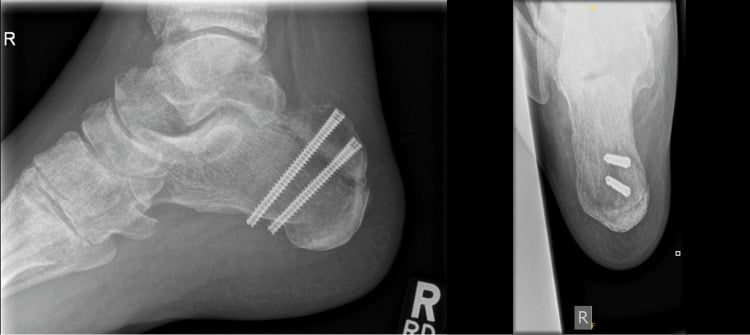
Guidelines, Registries & Global Practice
Global Epidemiology
- Rare injury: roughly 1.3-2.7% of all calcaneal fractures across published series
- Bimodal pattern: low-energy insufficiency avulsions in elderly osteoporotic women (Lee type I) and higher-energy or direct-blow patterns in younger men
- Strong association with osteoporosis and diabetes/Charcot neuroarthropathy; diabetic prevalence around 19% in surgical series
Society Guidance and Practice Points (Side by Side)
- Emphasis
- Soft-tissue and gastroc-soleus
- Take-home
- Early recognition; protect heel skin; address gastroc tightness
- Emphasis
- Tension-band biomechanics
- Take-home
- Convert Achilles tensile load to interfragmentary compression; stable fixation allows functional rehab
- Emphasis
- Limb-threatening soft tissue
- Take-home
- Treat threatened skin as urgent; early senior decision-making and combined ortho-plastic input
- Emphasis
- Displacement and imaging
- Take-home
- Classify morphology but manage by displacement; use CT for bone and MRI for soft tissue
Registry and Resource-Setting Notes
- No arthroplasty registry applies; evidence is from institutional series, so practice variation is wide and surgeon-dependent.
- High-resource settings: ready access to CT/MRI, multiple implant options (tension band, cannulated screws, suture anchors) and combined ortho-plastic cover for threatened skin.
- Limited-resource settings: reliance on radiographs alone, K-wire and cerclage-based tension band constructs (low cost, effective), and a lower threshold for fragment excision and Achilles reattachment when implants or soft-tissue cover are unavailable. Urgent reduction to save skin remains universal and equipment-independent.
A common foot and ankle viva. Lead with the skin emergency (urgent reduction of the tented heel), then the Achilles avulsion mechanism and loss of push-off. Quote the Lee classification (4 types) and the key point that displacement, not morphology, predicts outcome (Carnero-Martin: displacement greater than or equal to 2cm raises complications to around 91%). Flag the diabetic/osteoporotic insufficiency pattern and how poor bone changes fixation. Be ready to describe tension band wiring in detail and to protect the sural nerve.
Controversies and Areas of Uncertainty
The evidence base for these fractures is limited to small retrospective series and case reports, so several questions remain genuinely unsettled:
- Which classification to use - the displacement-based prognostic classification has not yet been validated in larger cohorts.
- Fixation construct - tension band wiring, large cannulated lag screws, plate fixation and suture anchors are all described, and no comparative trial establishes superiority. Fragment size, bone quality and surgeon preference drive the choice rather than high-level evidence.
- Fragment excision versus fixation - with small fragments or very poor (neuropathic or osteoporotic) bone, some advocate excision with Achilles reattachment plus gastrocnemius recession.
- Urgency threshold - there is consensus that threatened skin demands urgent reduction, but the exact displacement or skin-tenting threshold that mandates emergency surgery is not precisely defined.
- Gastrocnemius lengthening - routinely addressing gastrocnemius-soleus tightness at index surgery to reduce re-displacement is advocated by some (Banerjee) but not standardised.
- Hardware removal - tension band wires are frequently prominent in this subcutaneous location; rates and timing of elective removal vary widely.
MCQ Practice Points
Q: What is the relationship between calcaneal tuberosity fractures and Achilles tendon function? A: Calcaneal tuberosity is insertion site for Achilles tendon - Avulsion causes loss of plantarflexion power and inability to push off. ORIF required if displaced to restore function and prevent equinus contracture.
Q: When is ORIF required for calcaneal tuberosity fractures? A: Displacement greater than 2mm or loss of active plantarflexion - Prevents equinus contracture and loss of push-off strength. Tension band wiring preferred - converts tensile force to compression, allows early motion.
Q: Why is tension band wiring preferred for calcaneal tuberosity fractures? A: Converts tensile force from Achilles to compression at fracture site - Biomechanically superior to screw fixation alone. Allows early motion and weight bearing. High union rate (80-90% good results).
Q: What structure is at risk in the posterior approach for calcaneal tuberosity fractures? A: Sural nerve - Runs 1-2cm posterior to lateral malleolus. Injury causes lateral foot numbness and painful neuroma. Protect nerve during exposure (5-10% injury rate).
Q: What is the main complication of untreated calcaneal tuberosity fractures? A: Equinus contracture - Proximal migration of fragment causes contracture in 10-15% if untreated. Early ORIF prevents contracture. Adequate fixation essential to maintain reduction.
Exam Viva Scenarios
Practise clinical reasoning and management decisions out loud
“A 55-year-old woman presents with posterior heel pain and inability to push off after fall. Clinical examination shows loss of active plantarflexion and palpable gap at calcaneal tuberosity. X-rays show displaced calcaneal tuberosity fracture with 5mm proximal migration.”
“A 50-year-old patient has a displaced calcaneal tuberosity fracture requiring ORIF. The examiner asks you to describe the tension band wiring technique in detail.”
“A 68-year-old woman with type 2 diabetes and peripheral neuropathy presents 36 hours after a trip. There is a displaced calcaneal tuberosity (beak) fracture on the lateral radiograph, the fragment is migrating proximally, and the skin over the posterior heel is white and blanched. How do you manage her?”
Key Concepts
- Calcaneal tuberosity = Achilles tendon insertion site
- Achilles avulsion = loss of plantarflexion power
- ORIF required if displaced (greater than 2mm)
- Tension band wiring preferred (converts tensile to compression)
Classification (Lee 2012)
- Type I: Simple extra-articular avulsion (sleeve) - elderly women, all fibres
- Type II: Beak fracture - often direct blow, all fibres, skin risk
- Type III: Infrabursal mid-third - superficial fibres (MRI)
- Type IV: Beak + superior triangular fragment - deep fibres (MRI)
- Key point: displacement (not type) predicts outcome (Carnero-Martin)
Treatment
- Non-displaced (rare): Conservative (cast, NWB 6-8 weeks)
- Displaced (most): ORIF with tension band wiring (80-90% good results)
- Large fragment: Screw fixation alternative (75-85% good results)
- Loss of plantarflexion: Absolute indication for ORIF
Surgical Technique
- Posterior approach: Midline or posterolateral, protect sural nerve
- Tension band: K-wires (2.0-2.5mm) + figure-8 wire (1.2-1.25mm)
- Wire anterior to K-wire axis (on tension side)
- Converts tensile force to compression
- Verify reduction fluoroscopically
Complications
- Sural nerve injury: 5-10% (prevent by protecting nerve)
- Equinus contracture: 10-15% if untreated (prevent with early ORIF)
- Loss of plantarflexion: 10-15% (prevent with anatomic reduction)
- Nonunion: 5-10% (prevent with rigid fixation)
- Hardware prominence: 20-30% (remove if symptomatic)
Evidence Base
Lee Classification of Calcaneal Tuberosity Avulsion
- Tuberosity fractures = 2.6% of calcaneal fractures
- Type I commonest, in elderly women
- Achilles fibre involvement varies by type
- MRI required to confirm types III and IV
Displacement Predicts Outcome (Prognostic Classification)
- Displacement magnitude drives complications and skin compromise
- Displacement of 2cm or more: complications rise from 30% to 91%
- Beavis classification NOT prognostic
- 62% complication, 38% secondary surgery rate
JAAOS Review: Skin and Gastroc-Soleus Are Key
- Most common in elderly and diabetic patients
- Displacement threatens posterior heel skin
- Stable fixation of the displaced fragment required
- Address gastroc-soleus tightness to improve outcome
Surgical Series: Screw vs Plate Fixation Outcomes
- 90% excellent/good, mean AOFAS 91.1
- Large fragments into subtalar joint: plate fixation
- Skin necrosis can require flap coverage
- Emergency ORIF when soft tissues compromised
Diabetic Insufficiency Avulsion: Suture-Anchor Technique
- Diabetic avulsions are often a Charcot event
- Poor bone defeats conventional screw fixation
- Fragment excision + double-row anchor reattachment
- AOFAS improved from 27 to 88 at one year
Contemporary Review: Anatomy, Classification and Fixation
- Skin/tendon risk tracks with Lee and Carnero-Martin types
- CT for bony detail; MRI for soft tissue
- Fixation must resist strong Achilles pull
- Multiple modern fixation constructs available