Alumina | Zirconia | BIOLOX Delta | Wear Performance | Fracture Risk
- Ceramics are crystalline materials with ionic/covalent bonding (high hardness, brittle)
- Alumina (Al2O3): 99.7% purity, grain size under 2 microns, hot isostatic pressing
- BIOLOX Delta: alumina matrix (82%) with zirconia platelets (17%), chromium oxide (0.5%)
- Ceramic-on-ceramic wear rate: under 0.005mm/year (10x lower than XLPE)
- Fracture risk modern ceramics: 0.01-0.1% (edge loading, impingement, neck impaction main causes)
- “Ceramic hardness (Vickers 2000+) prevents scratching but causes brittleness
- “Squeaking: 1-8% incidence, multifactorial (edge loading, stripe wear, neck impingement)
- “The Delta improvement is a HEAD improvement - registry liner fracture is no better than Forte (0.126% vs 0.112%)
- “Zirconia discontinued: tetragonal to monoclinic phase transformation causes roughening in vivo
- “BIOLOX Delta: zirconia platelets stop crack propagation (higher fracture toughness)
Overview and Introduction
Ceramic bearings buy the lowest wear rates available in joint replacement and pay for them with brittleness. Alumina and zirconia are both extremely hard and wear-resistant, and modern alumina matrix composites such as BIOLOX Delta set out to keep that hardness while making the material tougher. Everything on this page follows from those two properties pulling in opposite directions.
Where this sits. Ceramic is one option among several, and the comparison that decides the case is made on THA bearing surfaces; the physics of why a smaller, harder particle matters at all is wear mechanisms, and the reason low wear is worth any fracture risk is that osteolysis is particle-driven.
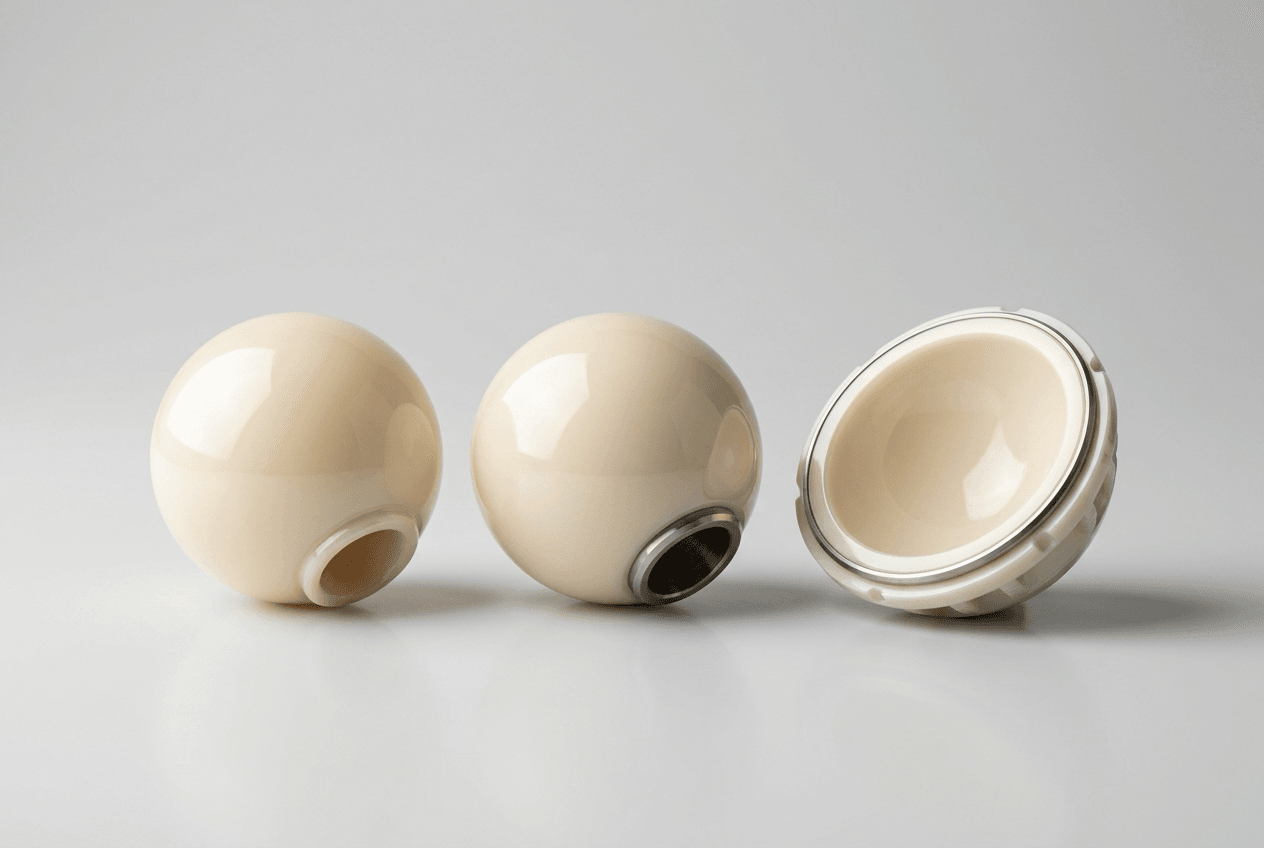

Material Science and Microstructure
The bonding. Ceramics are held together by ionic bonds - electrostatic attraction between Al3+ and O2- ions - with partial covalent character, the shared electrons adding to bond strength. Those bonds do not permit dislocation motion, so the material cannot deform plastically. That single fact makes it extremely hard, and makes it brittle.
The crystal. Alumina takes the corundum structure, the same lattice as ruby and sapphire, with oxygen ions in a face-centred cubic arrangement and aluminium ions filling two-thirds of the octahedral interstitial sites; pure Al2O3 is colourless.
Zirconia is polymorphic, and which phase it is in decides how it behaves.
- Monoclinic - stable at room temperature, brittle
- Tetragonal - metastable and tougher, stabilised by yttria (Y2O3)
- Cubic - high temperature only, less relevant here
Transformation from tetragonal to monoclinic carries a 3-5% volume expansion, which is both the reason zirconia can be toughened and the reason pure zirconia bearings failed.
The grains. A ceramic bearing is millions of individual crystalline grains, and the interfaces between them - grain boundaries - are the weak points where cracks start. Grain size is therefore a critical quality parameter, the one that determines the mechanical properties: pure alumina must be under 2 microns (ideally 1-1.5), and the alumina phase of BIOLOX Delta is under 0.5 microns. Components are rejected if the mean grain size exceeds those figures, and scanning electron microscopy is used to measure the distribution.
Why is grain size critical in a ceramic bearing? Because strength follows the Hall-Petch relationship, proportional to 1/√(grain size). Grain boundaries impede crack propagation, so more boundaries - smaller grains - mean a stronger component. A mean grain size above target is both a weaker component and a marker of poor manufacturing quality.
The composite. BIOLOX Delta is an alumina matrix with a second phase engineered into it rather than a new ceramic. The alumina carries the load and provides the hardness; the zirconia platelets exist to stop cracks; the two oxide additives do jobs that have nothing to do with bearing performance.
- Volume %
- 82%
- Grain Size
- less than 0.5 microns
- Function
- Primary load-bearing phase, provides hardness and wear resistance
- Mechanism
- Rigid ionic/covalent bonding resists deformation and wear
- Volume %
- 17%
- Grain Size
- 1-2 microns (elongated platelets)
- Function
- Crack deflection, increases fracture toughness 50%
- Mechanism
- Tetragonal to monoclinic transformation at crack tip absorbs energy, deflects crack path
- Volume %
- 0.5%
- Grain Size
- Nanoscale
- Function
- Grain growth inhibitor during sintering
- Mechanism
- Pins grain boundaries, prevents excessive grain growth, maintains small grain size
- Volume %
- 0.5%
- Grain Size
- Trace
- Function
- Radiographic marker for identification
- Mechanism
- Radiopaque, allows identification on X-ray if fracture occurs
How the platelets work. They are randomly oriented through the matrix, so an advancing crack must navigate around them along a longer, tortuous path, dissipating energy as it goes. The stress at the crack tip also triggers the tetragonal-to-monoclinic transformation locally, and the 3-5% expansion that follows puts the crack tip in compression and opposes its opening. Together these raise fracture toughness by about 50% over pure alumina without any bulk phase change.
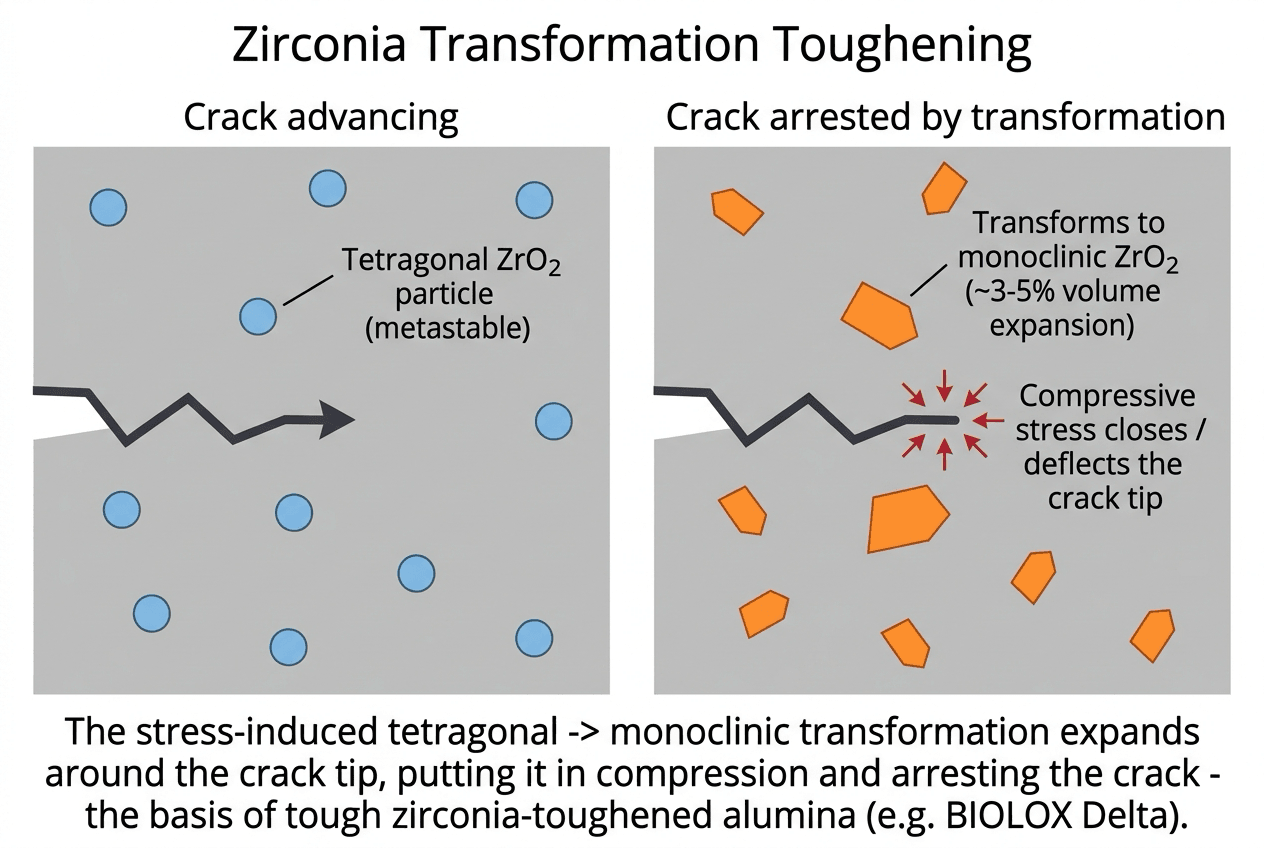
Manufacturing. The route from powder to implant is designed to remove the two things that start cracks, porosity and large grains. Ultra-pure alumina powder - quoted as 99.99% pure as raw material, with the finished ceramic at 99.7% - is wet-milled in ethanol for 24-48 hours with the Y-TZP, chromium oxide and strontium oxide so the phases are evenly distributed, then calcined at 1200C to drive off binders and volatiles.
- Cold isostatic pressing at 200-400 MPa forms a fragile "green body" of only 50-60% relative density, pre-sintered at 1000-1200C so it can be handled
- Sintering at 1600-1800C for 2-4 hours densifies it by diffusion; grains grow at this stage, which is what the chromium oxide is there to limit
- Hot isostatic pressing at 1400-1600C under 100-200 MPa of argon for 2-4 hours removes the residual porosity, reaching over 99.9% of theoretical density and eliminating every pore above 1 micron
- Diamond machining - the ceramic is harder than any metal tool - holds tolerances under 10 microns, and diamond-paste polishing takes the surface to Ra under 0.01 microns
That mirror finish is not cosmetic: a smooth surface minimises wear and gives a crack nowhere to start.
Defects and their control. Pores are stress concentrators, and they come in two kinds: closed pores are isolated voids within grains or at grain boundaries, and open pores are connected pathways that admit fluid and weaken the structure. Hot isostatic pressing takes final porosity below 0.1% by volume, and X-ray computed tomography detects any internal pore above 5 microns. The other failure of manufacture is abnormal grain growth, where a few grains reach ten to twenty times the normal size; chromium oxide pinning the grain boundaries is the control, and the specification is that 95% of grains lie within twice the mean.
Proof testing. Every component is deliberately stressed before it can be implanted, on the principle that a pre-existing flaw will declare itself by failing the test rather than failing in a patient. Burst pressure testing takes the component to 150% of anticipated in vivo stress and load-to-failure testing to three to five times peak physiological load, and over 99.5% of components pass.
Ceramics fail by brittle fracture with no warning. There is no plastic deformation to absorb energy, so once a crack reaches critical length it propagates catastrophically - which is why grain size, porosity and phase purity are controlled as tightly as they are.
The BIOLOX Delta improvement is a microstructural one: smaller grains, lower porosity and crack-deflecting zirconia platelets took the fracture rate from 0.1-0.2% for pure alumina to 0.01-0.1%, a ten-fold reduction.
Classification and Generations
Three materials are used in arthroplasty, and they follow one another as attempts on the same problem. Alumina (Al2O3) is hard but brittle. Yttria-stabilised zirconia (Y-TZP) is tougher but unstable in the body. The alumina matrix composite puts a little of the second inside the first.
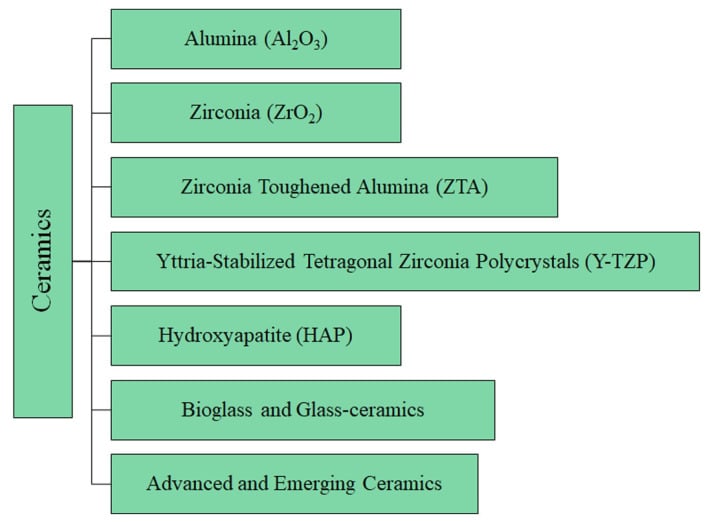
99% pure alumina with a grain size over 5 microns and significant porosity, both consequences of what manufacturing could then achieve. Wear was excellent and the fracture rate of 0.5-1% was not, so clinical adoption stayed limited.
Hot isostatic pressing eliminated porosity, grain size came down under 2 microns and purity rose to 99.7%. The fracture rate fell ten-fold to 0.1-0.2%, and use increased, particularly in young active patients.
Zirconia was adopted for its higher fracture toughness, on the expectation that a tougher ceramic would fracture less. What happened instead was in vivo aging: metastable tetragonal zirconia slowly transformed to monoclinic by hydrothermal degradation, the 3-5% volume expansion roughened the surface, and the roughened heads wore polyethylene rapidly. Zirconia femoral heads were withdrawn from the market.
The design move was to use zirconia as dispersed reinforcement rather than bulk material: 82% alumina matrix with 17% zirconia platelets, too little to transform in bulk but enough to deflect cracks. Fracture toughness rose to 5-6 MPa√m against 3-4 for pure alumina, the quoted fracture rate fell to 0.01-0.1%, and the ultra-low wear rate was unchanged. It is the current standard.
- 2nd Gen Alumina
- less than 2 microns
- 3rd Gen Zirconia (Y-TZP)
- less than 0.5 microns
- 4th Gen BIOLOX Delta
- less than 0.5 microns (alumina phase)
- Clinical Significance
- Smaller grain size increases strength (Hall-Petch relationship)
- 2nd Gen Alumina
- 2000-2200
- 3rd Gen Zirconia (Y-TZP)
- 1200-1400 (lower than alumina)
- 4th Gen BIOLOX Delta
- 2000-2200 (alumina matrix dominates)
- Clinical Significance
- Higher hardness provides better wear resistance, scratch resistance
- 2nd Gen Alumina
- 3-4 MPa√m (brittle)
- 3rd Gen Zirconia (Y-TZP)
- 5-7 MPa√m (toughest, but unstable)
- 4th Gen BIOLOX Delta
- 5-6 MPa√m (balanced)
- Clinical Significance
- Higher toughness reduces fracture risk from edge loading, impingement
- 2nd Gen Alumina
- Stable (no transformation)
- 3rd Gen Zirconia (Y-TZP)
- UNSTABLE (t to m transformation in vivo)
- 4th Gen BIOLOX Delta
- Stable (platelets constrained by matrix)
- Clinical Significance
- Phase transformation in zirconia causes roughening, product recall
- 2nd Gen Alumina
- less than 0.1% (HIP)
- 3rd Gen Zirconia (Y-TZP)
- less than 0.1% (HIP)
- 4th Gen BIOLOX Delta
- less than 0.05% (advanced HIP)
- Clinical Significance
- Lower porosity reduces crack initiation sites
Why zirconia aged. Body fluid drives the transformation: moisture-assisted hydrothermal degradation converts metastable tetragonal zirconia to the stable monoclinic phase over time, and the volume expansion lifts the surface into a roughened relief. A rough head abrades polyethylene, and measured wear rose to 0.1-0.3 mm/year. The transformation is detectable at two to five years and the roughening becomes significant at five to ten.
Why the composite does not. Zirconia is only 17% of the volume, against 100% in a pure zirconia head, and the alumina matrix physically constrains the platelets so they cannot expand in bulk; BIOLOX Delta has shown no phase transformation after more than twenty years of clinical use. Zirconia, in other words, is not a failed material - it is a failed bulk bearing that works as a dispersed reinforcement.
If zirconia is the tougher ceramic, why is it not used? Because pure yttria-stabilised zirconia heads were withdrawn from the market (recall 2001) for in vivo aging - tetragonal to monoclinic transformation, surface roughening, accelerated polyethylene wear. The trap is to conclude that zirconia is therefore out of arthroplasty: it is in every BIOLOX Delta component, as 17% dispersed platelets held stable by matrix constraint.
What is available now. First-generation alumina is historical, and second-generation alumina, although still approved, has largely been superseded. BIOLOX Delta received FDA approval in 2003, is TGA approved and widely used internationally, and accounts for over 90% of ceramic bearings, with an AOANJRR revision rate of 4-5% at ten years in use, with extensive post-market surveillance behind it.
Bearing Combinations and Selection
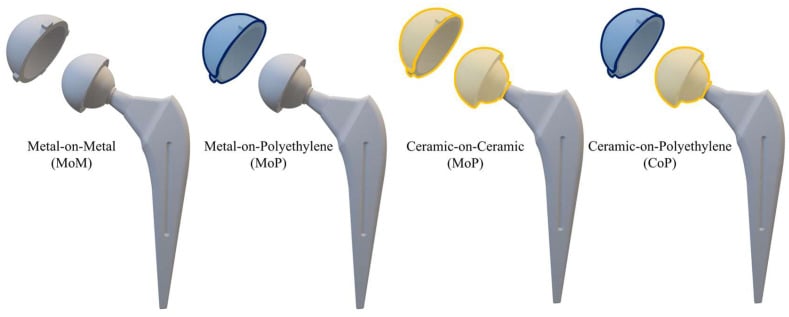
- Wear Rate
- Ultra-low: less than 0.005 mm/year (approaching zero wear)
- Fracture Risk
- 0.01-0.1% (head and liner both can fracture)
- Squeaking
- 1-8% incidence (usually benign, rarely requires revision)
- Indications
- Young active patients (less than 50-60 years), longest projected lifespan, desire lowest wear
- Wear Rate
- Low: 0.02-0.04 mm/year (lower than metal-on-XLPE)
- Fracture Risk
- Head fracture only (0.01-0.05%), liner cannot fracture
- Squeaking
- Rare (under 1%)
- Indications
- Compromise option: Lower fracture concern than CoC, lower wear than MoXLPE
- Wear Rate
- Moderate: 0.05-0.08 mm/year (similar to metal-on-PE)
- Fracture Risk
- Head fracture only
- Squeaking
- Rare
- Indications
- HISTORICAL ONLY (discontinued, no benefit over metal-on-XLPE, avoid)
- Wear Rate
- Variable (initially low, increases after phase transformation)
- Fracture Risk
- Head fracture risk, phase transformation causes roughening
- Squeaking
- Rare
- Indications
- DISCONTINUED (in vivo aging, product recall in 2001)
The case for ceramic-on-polyethylene. A ceramic head on crosslinked polyethylene wears less than a metal head does, because the ceramic surface resists the scratching that turns a metal head into an abrasive. Only the head can fracture, so liner fracture leaves the risk list altogether and squeaking becomes rare. The price is a wear rate several times that of ceramic-on-ceramic, and for many patients that is a price worth paying.
Who gets a ceramic-on-ceramic bearing. The argument is strongest in a young, active patient whose projected lifespan exceeds thirty years, where minimising lifetime wear and osteolysis is the whole point, and where normal anatomy and good bone quality allow the cup to be put where it should be. Metal sensitivity and revision for osteolysis are the other two clear indications, the second because the aim is to stop generating particles.
Who should not. Anything that raises fracture risk or makes the cup hard to position argues for polyethylene instead.
- BMI over 35 - higher joint reaction forces
- Very high-impact sport, where peak loads raise fracture risk
- Severe dysplasia, or revision bone loss, that forces a steep or medialised socket
- Anatomy that predisposes to impingement: coxa vara, a retroverted femur, a short femoral neck
- A high fall risk, or cognitive impairment that will prevent the patient reporting noise or pain
- The patient who does not want to accept a squeaking risk at all
Cost belongs in the conversation. Ceramic costs more than crosslinked polyethylene, and above 75 years, with a projected implant lifespan of ten to fifteen years, the wear advantage is largely irrelevant.
Age as a rough guide. Under 50-60 with high activity, ceramic-on-ceramic is the first choice, on a projected implant lifespan of 30-40 years, with ceramic-on-polyethylene the alternative if the patient declines the squeaking risk. Between 60 and 75 either is defensible and the decision is genuinely shared. Over 75 the bearing does not need to be ceramic at all.
- Recommended Bearing
- Ceramic-on-ceramic (BIOLOX Delta)
- Rationale
- Lowest wear rate, longest lifespan, optimal choice for young active patients
- Alternative
- Ceramic-on-XLPE if patient declines squeaking risk
- Recommended Bearing
- Ceramic-on-XLPE OR ceramic-on-ceramic (shared decision)
- Rationale
- Both provide acceptable longevity. CoXLPE avoids squeak, CoC lower wear.
- Alternative
- Metal-on-XLPE if cost consideration
- Recommended Bearing
- Ceramic-on-ceramic
- Rationale
- A safe cup position with good coverage can usually still be achieved
- Alternative
- Ceramic-on-XLPE if coverage is marginal
- Recommended Bearing
- Ceramic-on-XLPE
- Rationale
- Steep cup increases edge loading and fracture risk with CoC
- Alternative
- Metal-on-XLPE acceptable
- Recommended Bearing
- Ceramic-on-XLPE OR metal-on-XLPE
- Rationale
- Higher joint forces increase ceramic fracture risk
- Alternative
- Dual mobility if instability concern
- Recommended Bearing
- New ceramic head (larger where the cup allows) on a ceramic liner
- Rationale
- Ceramic resists third-body wear from residual particles better than PE
- Alternative
- Ceramic head on highly crosslinked polyethylene if the shell will not take a ceramic liner
- Recommended Bearing
- Ceramic-on-ceramic OR ceramic-on-XLPE
- Rationale
- Minimise future particle generation to prevent recurrent osteolysis
- Alternative
- Dual mobility if instability concern
- Recommended Bearing
- Ceramic-on-ceramic OR ceramic-on-XLPE
- Rationale
- Avoid metal bearing surface (metal shells unavoidable but lower debris than bearing)
- Alternative
- Oxinium (oxidized zirconium) on XLPE
What to say in clinic. The offer is the lowest wear rate available, no osteolysis because the particles are too small to provoke it, registry survivorship out beyond twenty years, and resistance to third-body scratching from cement or metal debris. In a young patient the point of all that is to minimise the lifetime revision burden, and possibly to avoid revision altogether.
The cost side is squeaking, a rare but catastrophic fracture, a more complex revision if that fracture happens, and a higher implant price the patient may bear themselves in private practice. Add the honest admission: crosslinked polyethylene also performs excellently, so whether ceramic adds anything beyond twenty to thirty years is not yet known.
Run the conversation in that order: lay out the three realistic couples, ask what the patient is optimising for - longevity, cost, or certainty about noise - give a recommendation based on their age, activity and anatomy, and let them make the final choice.
Biomechanics and Wear
How ceramics wear. What little wear occurs in a ceramic-on-ceramic bearing is mostly adhesive, and even that is minimal because the hardness prevents material transfer. The bearing does not fatigue under cyclic load and resists abrasion by third-body particles of cement or metal, which is why a ceramic head keeps its finish where a metal head would be scratched.
- Metal-on-XLPE
- Moderate
- Ceramic-on-Ceramic
- Very low
- Significance
- Ceramic hardness prevents material transfer
- Metal-on-XLPE
- High (third-body)
- Ceramic-on-Ceramic
- Very low
- Significance
- Ceramic resists scratching from PMMA/metal debris
- Metal-on-XLPE
- Moderate (XLPE)
- Ceramic-on-Ceramic
- None
- Significance
- Ceramic does not fatigue under cyclic loading
Microseparation. The head separates transiently from the centre of the cup during the swing phase of gait and relocates with rim (edge) contact at heel-strike. It is the dynamic mechanism underlying stripe wear and much ceramic squeaking, and it explains why these occur even with cups that are only mildly malpositioned. The factors that let the head lag behind the cup are:
- Cup malposition - steep inclination, or excessive or insufficient anteversion, brings the rim into the contact path
- Reduced femoral offset or soft-tissue laxity - abductor slack lets the head drift laterally in swing
- Impingement levering the head out of the cup
- Head-cup clearance and design - larger clearance permits more separation
What it does. At relocation the head strikes the liner rim rather than the dome, a small high-stress contact that produces a visible stripe wear band and roughens the surface. The roughening disrupts fluid-film lubrication, which generates squeaking and locally raises the wear rate from under 0.005 to around 0.01-0.02 mm/year within the stripe. Severe, repetitive edge loading is also the dominant mechanism of liner fracture.
Stripe wear itself is a gradual process, not a catastrophe: it is visible as a stripe on the head or at the liner equator, may remain asymptomatic for years, and is prevented rather than treated - by accurate cup position (40° inclination, 15° anteversion, avoiding inclination over 50°), by restored offset, by a larger head (36mm rather than 28mm), and by avoiding impingement.
Why the testing matters. Standard hip-wear simulators that keep the head concentric in the cup grossly underestimate ceramic wear. Only simulators that deliberately incorporate a microseparation protocol reproduce the clinical stripe-wear pattern and realistic wear rates, which is why pre-clinical ISO wear testing of hard bearings now includes microseparation. Generic adhesive, abrasive and fatigue wear modes are developed in the wear-mechanisms and tribology-wear topics.
Why the particles do not cause osteolysis. Ceramic wear particles are under 0.05 microns, too small for macrophage phagocytosis, and are cleared by the lymphatics without macrophage activation. Even when phagocytosed the cytokine response is minimal, and no osteolysis has been reported around a well-functioning ceramic bearing.
Investigations
Assessing the acetabulum before you promise a ceramic bearing. An AP pelvis answers the question that decides the bearing: can the cup be put at 40° inclination and 15° anteversion with secure fixation? Measure the lateral centre-edge angle and acetabular index, and read severe dysplasia as a warning that the socket may have to sit steeply, which is exactly the position that edge-loads a ceramic liner. Bone stock has to be adequate to hold the cup in that position rather than wherever it will grip.
And the femur. Neck-shaft angle, offset and version determine whether the neck will meet the liner: coxa vara, a retroverted femur and a short femoral neck raise impingement risk. If the anatomy forces a steep cup or carries a high impingement risk, consider ceramic-on-polyethylene instead and accept the wear rate.
Patient assessment adds three things to that anatomical judgement: activity level, which sets how much the wear advantage is worth; BMI over 35, which raises joint reaction forces and fracture risk; and expectations, meaning a documented discussion of squeaking tolerance against longevity priority.
Intraoperative inspection is an investigation, and the last one that can prevent a fracture. Three checks, in order, before any ceramic component goes anywhere near the patient.
- The component - cracks, edge chips, discolouration that suggests a manufacturing defect, any scratch, pit or rough area. Reject it if anything is visible
- The packaging - expiry date checked and seal intact, because a compromised package guarantees neither sterility nor quality
- The paperwork - lot numbers of head and liner recorded and entered in the registry, so that a recall can be traced to the patient
Even microscopic defects can propagate to catastrophic fracture. Components are proof-tested by the manufacturer, but handling in theatre creates new flaws: dropping a component on a hard surface, forceful impaction with metal instruments, or letting two ceramic surfaces contact each other.
Surgeon inspection is the last line of defence. If in doubt, reject the component and open a new one.
Reading the postoperative film. Stripe wear appears on the lateral as a linear radiolucency at the equator of the liner, the zone of concentrated contact from a steep cup, and the culprit is usually inclination over 50-55° or excessive anteversion or retroversion. It indicates suboptimal position rather than impending failure and rarely requires revision unless wear is severe or the hip is symptomatic.
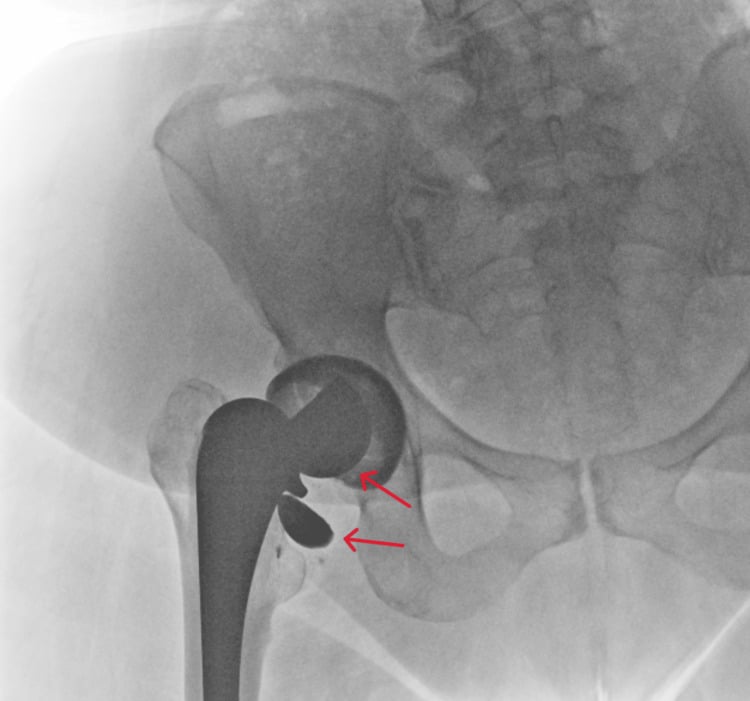
The signs of fracture are radio-dense ceramic fragments as small white particles in the joint space and surrounding soft tissues, a gap between head and neck taper or a liner separated from its shell, and - if the ceramic has gone completely - a metallic debris cloud from the head taper grinding against the metal shell.
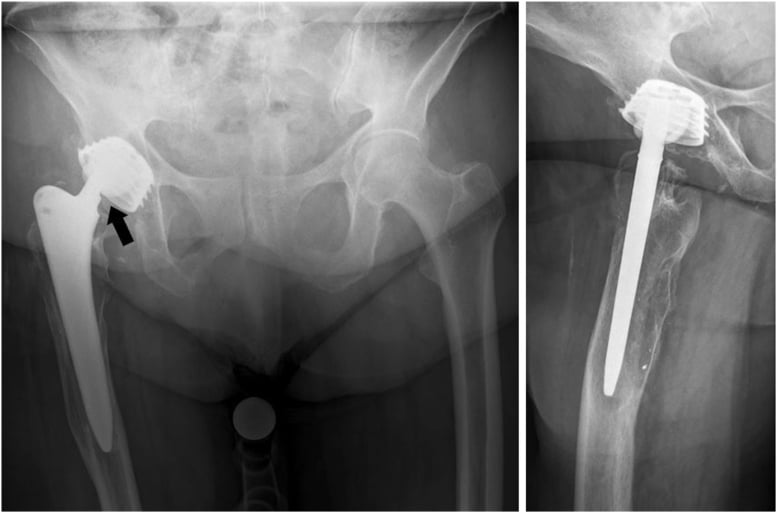
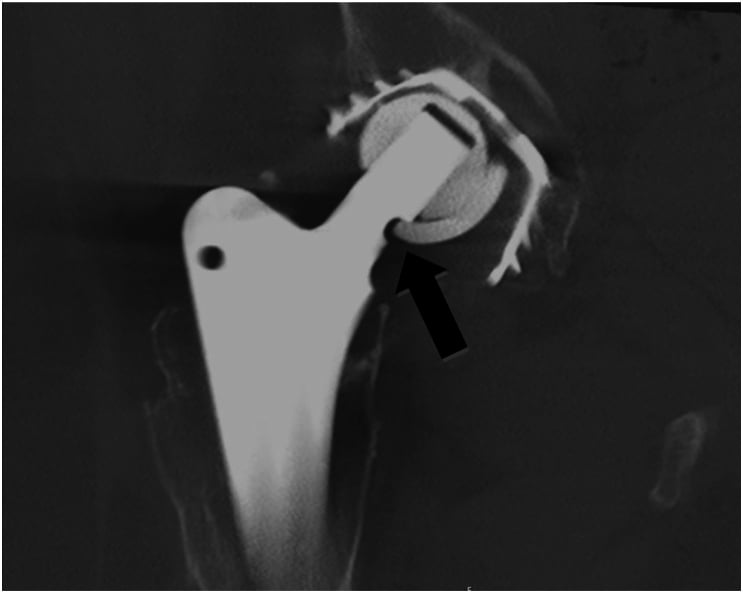
Working up the noisy or painful ceramic hip. Characterise the noise first, because the history does most of the work. Ask when it happens - stairs, standing from a chair, getting out of a car - whether it is constant or intermittent, whether others can hear it, whether it is embarrassing or limiting, and above all whether it hurts. Noise alone behaves very differently from noise with pain.
Then examine. Try to reproduce the noise in the impingement position of flexion, adduction and internal rotation, and assess range of motion for impingement, particularly flexion under 90° or painful terminal flexion.
Then the films. On an AP pelvis and lateral hip, four things are being looked for:
- Cup position - inclination (normal 30-50°) and anteversion (normal 5-25°)
- Stripe wear - at the liner equator
- Impingement - proximity of the femoral neck to the liner, anteriorly and posteriorly
- Loosening - radiolucent lines and migration, a rare cause of noise
If the films are inconclusive, CT measures version far more accurately than radiographic anteversion and allows three-dimensional impingement analysis.
Add blood tests when there is pain. Serum cobalt and chromium address trunnionosis, which produces metal debris from the taper despite a ceramic bearing, and ESR and CRP with aspiration address infection. Neither is needed for painless noise in a hip with a well-positioned cup.
Shown a postoperative radiograph and asked about cup position:
- Inclination (abduction) is the angle between the cup opening and the horizontal, referenced to the transverse acetabular ligament or the ischial tuberosities. Target 40°, range 30-50°.
- Anteversion is harder on an AP film alone; the ellipse method (the ratio of short to long axis of the opening ellipse) estimates it, and CT or a cross-table lateral measures it. Target 15°, range 5-25°.
- The Lewinnek safe zone is inclination 30-50° with anteversion 5-25°; for a ceramic bearing aim for the middle of it, 40° and 15°.
A cup over 50° increases edge loading, stripe wear, squeaking and fracture risk, and edge loading is more problematic with a larger head if the cup is malpositioned. Identified after the event in an asymptomatic patient, it buys closer surveillance and advice about activity, not an operation.
What retrievals have taught us. Components recovered at revision are the only direct measurement of what happened in the patient, and four techniques answer different questions.
- Information Obtained
- Surface wear patterns, stripe wear, fracture origin, edge loading zones
- Key Findings from Literature
- Stripe wear visible in 20-30% of retrievals (asymptomatic). Fracture usually initiates at rim (edge loading) or taper (impaction crack).
- Information Obtained
- Microstructural features, grain pullout, crack propagation paths
- Key Findings from Literature
- Crack propagation intergranular (along grain boundaries) or transgranular (through grains). BIOLOX Delta shows crack deflection by zirconia platelets.
- Information Obtained
- Quantitative wear measurement, surface roughness
- Key Findings from Literature
- Unworn regions: Ra less than 0.01 microns. Stripe wear regions: Ra 0.05-0.1 microns (roughened). Total linear wear typically less than 50 microns at 10+ years (ultra-low).
- Information Obtained
- Phase composition, detection of zirconia transformation
- Key Findings from Literature
- Pure zirconia heads show 10-20% monoclinic phase at surface (in vivo aging). BIOLOX Delta shows NO monoclinic phase (stable).
Management
A ceramic bearing generates two management problems after the bearing has been chosen: a hip that makes a noise, which almost never needs an operation, and a hip whose bearing has broken, which always does.
The squeaking hip. Observe, with confidence, when the noise comes alone: no pain, full range of motion, a cup inside the safe zone and no progressive stripe wear on serial films. Reassure the patient that revision for squeaking alone is needed in under 0.1% of cases, suggest avoiding the provocative movement where that is practical, and repeat radiographs at six to twelve months to confirm the wear is not progressing. Many hips settle as the surfaces conform.
Surgery for noise is reserved for severe functional impact, progressive pain, or cup malposition with stripe wear that is measurably advancing; severe psychological impact belongs on that list too, as a patient-driven decision. An incidental asymptomatic stripe on a film is managed the same way - annual radiographs, a warning that squeaking may follow, and advice to avoid high-impact activity, which may accelerate wear.
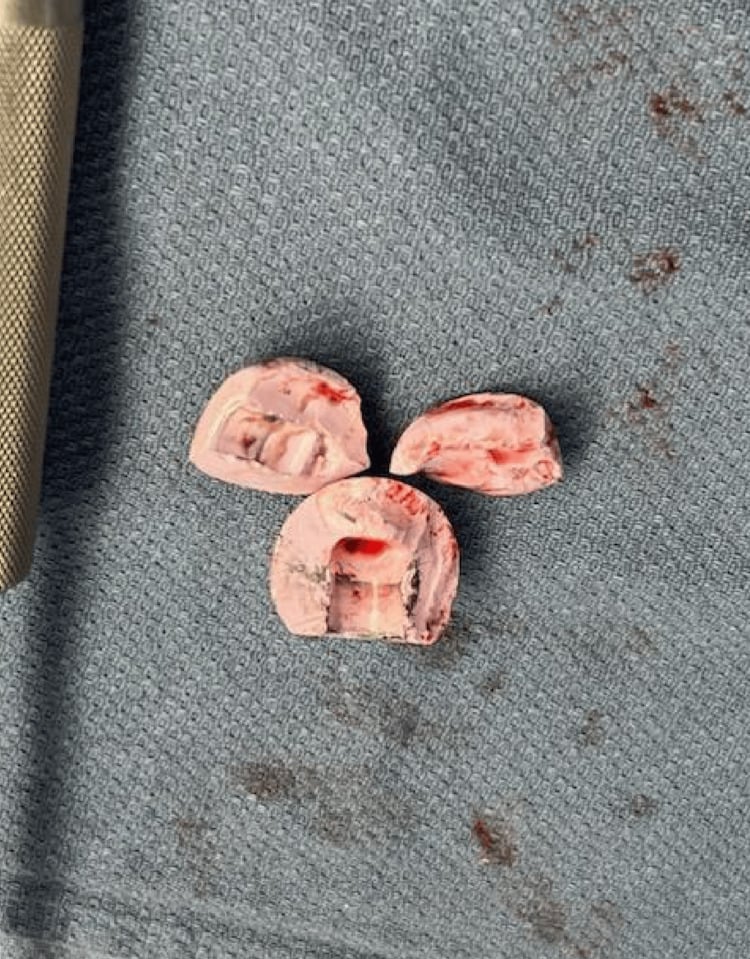
The fractured bearing. The typical presentation is a patient with a ceramic-on-ceramic hip who falls, or simply twists, and has sudden severe groin pain with grinding and an inability to weight-bear. Radiographs may show frank fragmentation, or may look deceptively normal when only a liner has cracked, so compare with prior films and obtain a CT if the film is unconvincing and the history is typical.
Image it before you plan it. CT with metal-artefact reduction is the study when the fragment distribution or the extent of osteolysis is unclear, and MARS MRI adds the soft-tissue picture, including synovitis.
Revision is urgent rather than emergent unless the pain or instability is severe: within two to four weeks, with the patient consented for a complete synovectomy, for exchange or retention of components as found, and for the fact that not every fragment can be recovered.
Retained ceramic is the whole problem. Ceramic is harder than any bearing material you can implant against it, so fragments left behind act as third-body abrasive and destroy the revision bearing. Every decision below follows from that.
- What to do
- Remove EVERY visible fragment and perform a TOTAL synovectomy — not a washout
- Why
- Ceramic embedded in synovium keeps grinding after the revision; incomplete synovectomy is one of the factors associated with worse survival
- What to do
- Inspect it directly. Undamaged → new ceramic head on a NEW titanium sleeve/adaptor. Damaged or deformed → revise the stem
- Why
- A ceramic head seated on a scored taper concentrates stress and risks re-fracture; the sleeve restores a true seating surface
- What to do
- A new ceramic head — 4th-generation alumina-matrix composite — against a ceramic liner where the shell allows, or a highly cross-linked polyethylene liner where it does not
- Why
- Ceramic resists abrasion from any microscopic ceramic left behind
- What to do
- Do NOT put a cobalt-chrome (or stainless-steel) head in
- Why
- Residual ceramic abrades metal rapidly, producing accelerated wear and metallosis — a second failure
This is the single most examined point, and the reasoning matters more than the rule. Ceramic third-body particles are harder than cobalt-chrome. Any that survive the debridement will cut the new metal head, generating metal debris and a rapidly failing hip. If a ceramic liner cannot be used, the head is still ceramic and the liner becomes highly cross-linked polyethylene.
Why polyethylene is the second choice, not the first. Residual ceramic accelerates polyethylene wear - reported at ten to a hundred times normal - and fragments embed in capsule, muscle, the shell and the trunnion, where no debridement will reach all of them. A ceramic liner is therefore used wherever the shell accepts one, and highly crosslinked polyethylene is the fallback when it does not.
The other two constructs. Where instability rather than the bearing alone is the problem, a constrained liner is the alternative. Metal-on-metal appears in older accounts of this revision as a historical option, and is avoided now for its metal-ion concerns.
- Action
- Posterior or lateral with capsulectomy
- Rationale
- Access all soft tissue for fragment removal
- Action
- Pulsed lavage, changing tips frequently
- Rationale
- Dilute and remove small fragments without reintroducing them
- Action
- Complete capsulectomy, debride abductor bed, inspect psoas and gluteus medius
- Rationale
- Fragments embed in synovium and muscle
- Action
- Remove all ceramic debris, assess corrosion
- Rationale
- Fragments at taper cause future fracture
- Action
- Inspect for ceramic embedded in rim
- Rationale
- May require shell revision if damaged
- Action
- Retain a well-fixed, well-positioned stem and shell; revise either if malpositioned
- Rationale
- Prevents recurrent edge loading; a stable shell may need only a liner exchange
- Action
- New liner AND new head, same size or larger
- Rationale
- NEVER reuse a component; a larger head gives more clearance
- Action
- Closed suction drain for 48 hours, postoperative radiographs
- Rationale
- Clears early particulate debris; documents position and residual fragments
- Action
- Record lot numbers, fracture pattern, debris location
- Rationale
- Medicolegal and quality purposes
Irrigation at revision for an established fracture is 12-15 litres of normal saline by pulsed lavage, changing tips frequently so that particles are not reintroduced.
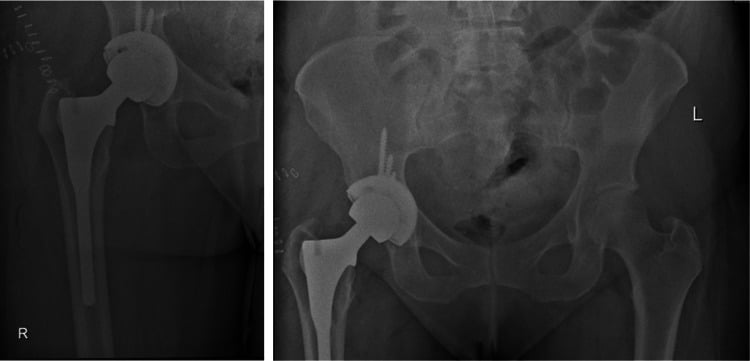
Re-heading a retained stem. When a well-fixed femoral stem is retained at any revision involving a ceramic head, a new ceramic head must never be impacted directly onto the used femoral taper. The original head burnishes and microscopically deforms the taper, so a fresh ceramic bore no longer mates congruently with the altered surface; the resulting point contact and uneven seating create radial tensile stress in the bore and risk early head fracture. Any retained ceramic debris on the taper is a further stress riser.
The solution is a dedicated titanium adaptor sleeve (for example BIOLOX OPTION) placed over the used taper, so that the new ceramic head seats onto a pristine sleeve rather than a damaged cone. It is the manufacturer-mandated way to put a ceramic head on a retained stem. If the taper is grossly damaged or corroded, or the stem is loose, revise the stem instead. Generic mechanically-assisted taper corrosion is developed in the trunnionosis-taper-corrosion topic; this is specifically the ceramic-head re-heading rule.
At revision, if you retain the stem and use a ceramic head, you must interpose a titanium taper sleeve (adaptor) - never impact a new ceramic head straight onto a previously-used taper. The old head deforms the taper, so a bare ceramic bore seats incongruently and can fracture under radial tensile stress; the sleeve gives the ceramic a fresh, congruent surface. (A new metal head may go directly onto a clean, undamaged taper, but the safest universal answer for a retained stem with a ceramic head is the sleeved head - and revise the stem if the taper is damaged.)
Counsel the patient honestly: this revision does not perform like a primary. The landmark multicentre survivorship series of revisions after fracture of an alumina ceramic head reported roughly 63% survival at five years — far below a primary hip — and identified the recurring reasons for failure: the cup was not exchanged, a stainless-steel head was used, total synovectomy was omitted, or the patient was under 50. Contemporary revisions using fourth-generation ceramic bearings do considerably better, with midterm registry survival around 90% at seven years, but the operation still carries the higher infection risk of a long procedure with extensive synovectomy, and audible squeaking may follow a ceramic-on-ceramic revision.
Revision total hip arthroplasty performed after fracture of a ceramic femoral head — a multicentre survivorship study
- 105 revisions after fracture of an alumina ceramic femoral head, multicentre
- Survival was approximately 63% at five years — substantially worse than primary arthroplasty
- Worse survival when the acetabular component was NOT exchanged, when a stainless-steel head was used, when total synovectomy was omitted, and in patients under 50
Asked what you would do for a fractured ceramic head: (1) urgent revision — this is not a wait-and-see; (2) remove every fragment and perform a total synovectomy; (3) assess the femoral taper — new ceramic head on a titanium sleeve if it is sound, revise the stem if it is not; (4) reimplant a ceramic head, never cobalt-chrome, with a ceramic or highly cross-linked polyethylene liner. Then counsel that revision survival is materially lower than a primary hip.
Surgical Technique
Ceramic is brittle, and most of what goes wrong in theatre is handling. Three rules govern the operation:
- Gentle impaction - controlled, gradual force, never forceful strikes
- Optimal positioning - cup at 40° inclination and 15° anteversion, to keep the contact off the rim
- No contamination and no metal on ceramic - surfaces clean and dry, dedicated impactors only
Preparing and seating the cup. Ream sequentially to size, typically under-reaming by 1-2mm for a press-fit shell, keeping the medial wall intact because excessive medialisation costs cup stability, and aiming the reamer at 40-45° of inclination so the final position follows. Trial the cup, check inclination and anteversion against an alignment guide, and correct anything approaching 50° of inclination before the shell goes in.
Impact the shell line-to-line or with a 1-2mm press-fit, with the impactor aligned to the intended position vector, using controlled sequential blows - excessive force here fractures the acetabulum rather than the ceramic. The shell should end flush with the prepared bone with no gaps. If bone quality is poor or this is a revision, one or two screws in the posterosuperior quadrant supplement fixation, placed in the posterior column away from the sciatic notch, or in the ilium above the dome.
The liner. Inspect it, then keep it dry and clean: blood, saline or cement on the taper prevents it seating fully. The ceramic liner has a metal backing whose Morse taper locks into the shell, and many designs have anti-rotation features, so check the orientation marks before anything is impacted.
- Press it in by hand first; it should seat partially
- Impact with the manufacturer's plastic or soft-metal impactor, controlled gentle blows - three to five taps, with a change in pitch as it seats
- Never a metal instrument directly on a ceramic surface
- Verify by eye that it is flush with the shell, run a finger round the rim for a smooth transition, and try gently to displace it; it should be rock-solid
A polyethylene liner is more forgiving throughout, which is what makes each of those rules a ceramic rule. It withstands more forceful impaction, accepts a standard metal impactor, is less sensitive to taper cleanliness, tolerates a suboptimal cup position better, and may be used with minor scratches.
Four errors fracture liners, and all four are avoidable:
- Trapped debris - blood or soft tissue on the shell taper prevents full seating and concentrates stress. Clean and dry both surfaces first.
- Forceful impaction - if the liner is not seating after five or six taps, take it out and look for debris rather than hitting it harder.
- Wrong impactor - a metal instrument directly on ceramic. Use only the manufacturer's plastic or soft-metal impactor.
- Incorrect orientation - anti-rotation features misaligned. Check the orientation marks before impaction.
The stem. Broach sequentially to size and insert the stem by standard cemented or cementless technique, aiming for 10-15° of anteversion, which with the cup gives a combined anteversion of 25-50°, and confirming version on the trial. Axial and rotational stability are what the rest of the construct depends on.
Trial before any ceramic goes on. Use a trial metal head on the real stem and a trial liner in the real cup, and assess stability, range of motion, the impingement-free arc, leg length and offset. Confirm the cup sits under 50° of inclination with appropriate anteversion. Anything unsatisfactory is corrected now - once the ceramic head is on the taper, the options narrow.
The ceramic head. Inspect it, and keep both the head bore and the femoral taper completely dry. Wipe the taper with a dry sponge, not saline, and remove any metal debris, cement or bone fragment that would hold the head off its seat.
Align the head, then impact with the manufacturer's plastic impactor - never a metal mallet on ceramic - using two to four gentle taps with force increasing gradually; a seated head rings at a higher pitch than the dull thud of an unseated one. If it has not seated after four or five taps, remove it and look for debris or damage.
Then prove it is on. Pull gently: it should not budge. Try to rotate it on the taper: it should not move. The gap between the base of the head and the neck shoulder should be minimal, typically under 1mm.
- Wet taper - fluid reduces friction, the head slides too far down the cone, and radial cracks form in the bore. Dry the taper completely.
- Forceful impaction - excessive force creates the same radial cracks. Controlled blows; investigate a head that will not seat.
- Contaminated taper - cement, metal debris or bone prevents full seating. Clean meticulously.
- Metal mallet directly on ceramic - instant fracture. Plastic impactor only.
Why must the femoral taper be dry before a ceramic head is impacted? A wet taper reduces friction between the ceramic bore and the metal cone, so the head slides down instead of seating gradually. That generates radial tensile stress in the bore, and ceramic is weak in tension: microscopic radial cracks form, propagate under cyclic loading, and the head fractures weeks to months later.
Prevention is a dry sponge on the taper and no saline immediately before head insertion. Every ceramic head manufacturer - CeramTec, Smith+Nephew, Stryker - specifies a dry taper in the instructions for use.
Head size. A larger head gives a better head-to-neck ratio, a greater range of motion and more jump distance, so it dislocates less; registry data also show fewer fractures with larger heads. The constraints run the other way: the cup has to be large enough for the liner wall thickness, so a 36mm head needs a shell of 52mm or more and a 40mm head one of 56mm or more, and the larger head brings more torque at the taper and more squeaking. 36mm is the usual compromise, and the head diameter must match the liner internal diameter exactly.
Reduction and closure. Reduce gently, supporting the head and guiding it into the liner rather than letting it clunk in, then take the hip through a full range to confirm a smooth reduction and test stability in flexion-adduction-internal rotation and extension-adduction-external rotation. During closure keep the hip near neutral, avoid extreme positions that risk dislocating the new bearing, and place any drain away from the joint.
Getting the cup where you said you would. A rod or laser guide on the impactor shows the orientation; the transverse acetabular ligament approximates anatomic version but not true version; and intraoperative fluoroscopy of the AP pelvis measures inclination directly. Avoid inclination over 50°, which edge-loads, and anteversion over 25°, which brings posterior impingement.
Navigation and robotics narrow the spread: cup position within ±2-3° against ±5-10° freehand, with real-time adjustment before final impaction, and outliers outside the safe zone falling from 20-30% to 5-10%. The costs are money, operative time, a learning curve, and registration errors that propagate straight into cup position. Reserve them for complex cases - dysplasia, revision - or for the surgeon early in the learning curve.
Pelvic tilt moves the target. Supine films show the anatomic position; standing films show the functional one, and in posterior pelvic tilt the functional cup is more vertical than the anatomic measurement suggests. Where sagittal alignment is abnormal, adjust the anatomic target: with a PI-LL over 10° (flat back, posterior tilt) aim for 35-38° anatomic inclination, which becomes 40-45° functional; with a PI-LL under -10° (hyperlordotic, anterior tilt) aim for 42-45° anatomic, which becomes 38-42° functional.
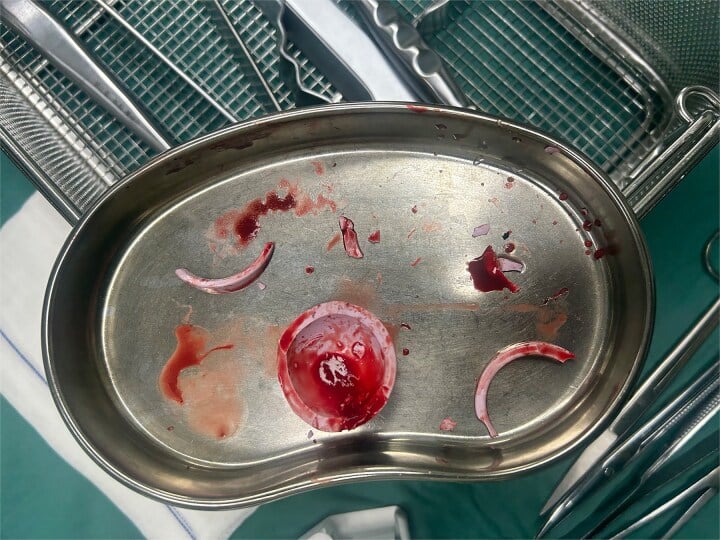
If a component fractures during insertion, stop. Do not proceed with a fractured component.
- Copious irrigation - 9-12 litres of normal saline by pulsed lavage
- Remove all fragments - inspect the joint, capsule and muscles
- Change gloves, gowns and drapes - so particles are not reintroduced
- Replace all ceramic components - new liner and new head, even if only one fractured
- Consider a larger head - more clearance, less risk of a repeat
- Abandon the ceramic bearing if contamination is extensive - switch to metal-on-crosslinked-polyethylene. That is the intraoperative option; after an established in-vivo fracture the head must still be ceramic
- Document - fracture, irrigation, component changes and lot numbers in the operative note
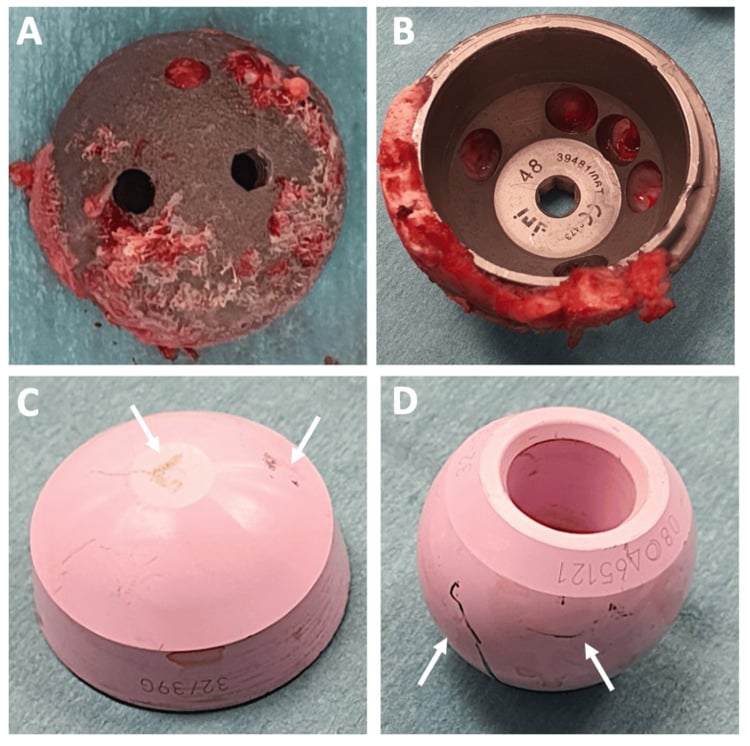
Complications
What is different about a ceramic hip. Four problems belong to the bearing: fracture of head or liner, squeaking, stripe wear, and trunnionosis where large heads are used. The general complications of hip replacement are all still possible, but their profile shifts - dislocation is similar or lower because larger heads are available, infection is unchanged, and osteolysis and late aseptic loosening are lower because there is almost no particulate debris to drive them.
The differential of the symptomatic ceramic hip is a standard exam scenario, and it is worked through the same way every time: is this noise or pain, is it acute or insidious, and does the film or the blood test explain it?
- Typical history
- Activity-related high-pitched noise (stairs, rising), usually painless
- Key examination / imaging
- Normal radiographs; cup may be steep; full range of motion
- Discriminating feature
- Noise without pain or progressive change; pooled incidence ~2.4% (Stanat 2012)
- Typical history
- Sudden severe pain, grinding or 'bag of glass' sensation, loss of function
- Key examination / imaging
- Radio-dense ceramic fragments, component asymmetry; CT to map debris
- Discriminating feature
- Acute grinding plus radiographic fragments; surgical emergency
- Typical history
- Insidious groin/thigh pain, larger heads or long necks
- Key examination / imaging
- Raised serum cobalt and chromium, MARS MRI pseudotumour
- Discriminating feature
- Elevated metal ions despite a ceramic bearing (debris from taper, not articulation)
- Typical history
- Rest pain, night pain, early or persistent symptoms, sinus/wound issues
- Key examination / imaging
- Raised CRP/ESR, aspiration (cell count, culture, alpha-defensin)
- Discriminating feature
- Inflammatory markers and positive aspirate regardless of bearing
- Typical history
- Start-up pain, progressive over time
- Key examination / imaging
- Progressive radiolucent lines, component migration on serial films
- Discriminating feature
- Radiographic loosening; osteolysis is uncommon with well-functioning ceramic
- Typical history
- Anterior groin pain on active hip flexion, or subluxation symptoms
- Key examination / imaging
- Prominent/oversized or uncovered anterior cup; dynamic imaging
- Discriminating feature
- Pain reproduced by resisted hip flexion; cup overhang on imaging
Sudden severe groin or hip pain, audible grinding or clicking, a "bag of glass" sensation, and loss of the ability to weight-bear; the patient may report an audible pop at the moment of fracture. It may present at once or after weeks to months of a crack quietly propagating.
Treat it as a surgical emergency until assessed: urgent revision, extensive debridement, and a ceramic head in the new construct.
Head and liner do not fracture for the same reasons, and that distinction drives both prevention and consent. A head fractures because of what happened at the taper; a liner fractures because of where the cup was put.
- Head Fracture
- Less common (0.005-0.01%)
- Liner Fracture
- More common (0.01-0.1%)
- Head Fracture
- Wet taper, forceful impaction, trauma
- Liner Fracture
- Edge loading (steep cup), impingement
- Head Fracture
- Dry taper, gentle impaction
- Liner Fracture
- Optimal cup positioning (40° inclination)
- Head Fracture
- Sudden onset, metallosis (from trunnion)
- Liner Fracture
- Gradual or sudden, grinding sensation
- Head Fracture
- New ceramic head, irrigate trunnion
- Liner Fracture
- New liner and head, extensive debridement
The sequence in a liner is worth rehearsing, because every step of it is a chance to intervene.
- A cup left over 50° of inclination loads the head onto the liner rim rather than the dome during stance
- The concentrated rim stress exceeds the fracture threshold of the ceramic
- A crack starts at the rim and propagates into the body of the liner
- The liner fails catastrophically, fragmenting into the joint
Component mismatch, impingement and trauma amplify it. Fracture can occur from days to years after implantation, typically within the first two years, and modern Delta components tolerate more edge-loading stress before they fail but fail just as catastrophically when they do.
Squeaking. Reported in 1-8% of ceramic-on-ceramic hips, with the range that wide because studies and implant designs differ, it is a high-pitched noise heard on specific movements - standing from a chair, climbing stairs - and arises when the fluid film between the surfaces is disrupted by edge loading and microseparation. Over 90% are self-limiting and under 0.1% are revised for noise alone; pain or functional loss is what turns a squeak into an investigation.
The risk factors depend on which literature you read, and a candidate should say so. Single-centre series implicate a steep cup over 50°, shorter patients, large heads of 40mm and above, and particular implant designs. The pooled meta-analysis found the reproducible associations to be rising BMI and one specific beta-titanium stem, and did not confirm cup position or a raised metallic lip.
The honest summary is that squeaking is multifactorial, that implant design and patient factors are the reproducible associations while the link with cup malposition is less consistent in pooled data than single-centre series suggest, and that optimal cup position remains worth achieving for every other reason.
Head size, dislocation and the taper. Dislocation falls as the head grows - from 3-4% at 28mm to 1-2% at 36mm and under 1% at 40mm - while squeaking rises and so does torque at the head-taper junction. That torque is the mechanism of trunnionosis: mechanically-assisted crevice corrosion at the trunnion, accelerated by large heads, long neck lengths and their longer moment arm, a Ti-6Al-4V taper (more susceptible than cobalt-chrome), and high activity.
Trunnionosis presents as groin or thigh pain with raised serum cobalt and chromium from the taper rather than the bearing, occasionally a pseudotumour, and visible taper wear at revision. Prevention is to use 36mm rather than 40mm where the choice is free, to keep neck lengths short or neutral where biomechanics allow, and to use the titanium sleeve adaptors available in some designs.
- Ceramic-on-Ceramic
- Under 0.005mm (10x lower)
- Metal-on-XLPE
- 0.05-0.1mm
- Ceramic-on-Ceramic
- Under 1% (essentially zero)
- Metal-on-XLPE
- 5-15%
- Ceramic-on-Ceramic
- 0.01-0.1% (ceramic specific)
- Metal-on-XLPE
- Not applicable
- Ceramic-on-Ceramic
- 1-8% (ceramic specific)
- Metal-on-XLPE
- Not applicable
- Ceramic-on-Ceramic
- Similar (depends on head size)
- Metal-on-XLPE
- Similar
- Ceramic-on-Ceramic
- Higher with larger heads
- Metal-on-XLPE
- Lower (smaller heads used)
- Ceramic-on-Ceramic
- Higher if fracture (debris removal)
- Metal-on-XLPE
- Standard
Postoperative Care
The first two days are the same as any hip replacement. Mobilise on day 0 or day 1, weight-bear as tolerated, give thromboprophylaxis per protocol, inspect the wound at 24 hours and use multimodal analgesia. Nothing about a ceramic bearing changes immediate care, including weight-bearing, which follows the fixation rather than the bearing.
Through the first six weeks the work is progressive mobilisation with aids, hip precautions for the approach used, wound care with sutures or staples out at 10-14 days, and physiotherapy for range and strength. The one ceramic-specific item is a conversation about noise: tell the patient it may happen, that it is usually benign and self-limiting, and what would make it worth reporting.
- Precautions
- Avoid flexion over 90°, adduction past midline, internal rotation
- Duration
- 6-12 weeks
- Precautions
- Avoid hip extension past neutral, external rotation
- Duration
- 2-6 weeks
- Precautions
- Avoid active abduction against resistance
- Duration
- 6 weeks
Ceramic does allow the larger heads, 36mm and 40mm, that reduce dislocation risk and may permit relaxed precautions, but that remains a matter of surgeon preference and approach rather than a property of the bearing.
- Immediate Postop
- Full weight-bearing
- 6 Weeks
- Full
- 3 Months
- Unrestricted
- Immediate Postop
- Weight-bearing as tolerated
- 6 Weeks
- Full
- 3 Months
- Unrestricted
- Immediate Postop
- Partial weight-bearing
- 6 Weeks
- Full
- 3 Months
- Unrestricted
Enhanced recovery applies unchanged, and the ceramic-specific element sits in theatre, not in the pathway: preoperative education that includes the squeaking discussion, optimisation of diabetes, anaemia and nutrition, smoking cessation six or more weeks before surgery, carbohydrate loading up to two hours preoperatively and minimal fasting (six hours for solids, two for clear fluids).
- Anaesthesia and surgery - spinal preferred for less blood loss, nausea and respiratory complication; multimodal analgesia with local infiltration or periarticular injection; tranexamic acid; normothermia; goal-directed fluid therapy
- Day 0 - oral intake at two to four hours, mobilisation the same day, early removal of any urinary catheter, oral multimodal analgesia to minimise opioids
- Day 1-2 - progressive mobilisation including stairs, discharge on functional criteria, same-day discharge for selected patients
- Target length of stay - 1-3 days, against a historical 5-7
- Timing
- 0-2 weeks
- Goals
- Wound healing, pain control, basic mobility
- Exercises
- Ankle pumps, quad sets, gluteal sets, bed mobility, transfers
- Timing
- 2-6 weeks
- Goals
- ROM recovery, gait normalization, early strength
- Exercises
- Hip flexor stretches, abductor strengthening, gait training without aids
- Timing
- 6-12 weeks
- Goals
- Full strength, endurance, functional activities
- Exercises
- Progressive resistance, balance training, stair endurance, return to daily activities
- Timing
- 3-6 months
- Goals
- Sport-specific, high-level function
- Exercises
- Activity-specific training, agility, impact tolerance (if appropriate)
- VTE Prophylaxis Regimen
- LMWH (enoxaparin 40mg daily) or rivaroxaban 10mg daily
- Duration
- 35 days
- VTE Prophylaxis Regimen
- LMWH (enoxaparin 40mg daily)
- Duration
- 35 days + consider extended
- VTE Prophylaxis Regimen
- Mechanical (IPC devices, TED stockings) + aspirin 100mg daily
- Duration
- 35 days
Aspirin 100mg twice daily is increasingly accepted for standard-risk patients, with equivalent prevention and a lower bleeding risk.
- Recommendation
- Encouraged, progressive distance
- Timing
- Immediate
- Recommendation
- As tolerated with handrail
- Timing
- 1-2 weeks
- Recommendation
- When off narcotics, safe reaction time
- Timing
- 4-6 weeks
- Recommendation
- After wound healed
- Timing
- 6 weeks
- Recommendation
- Low-impact, no twisting initially
- Timing
- 3-6 months
- Recommendation
- Higher impact activities
- Timing
- Discuss with surgeon (controversial)
Activity and the bearing. How much the bearing minds depends on the load, not the wear.
- Low impact (walking, swimming, golf) - minimal wear, excellent longevity, no restriction
- Moderate impact (hiking, cycling, doubles tennis) - low wear, generally permitted on patient preference
- High impact (running, singles tennis, skiing) - potential for edge loading and squeaking, so a discussion rather than a rule
- Very high impact (contact sports, jumping) - higher fracture and dislocation risk, generally discouraged
The point to make to the patient is that ultra-low wear means activity level matters less to a ceramic bearing than to polyethylene. The concerns that remain are mechanical - dislocation and fracture - not wear.
- Automatic Vehicle
- 2-4 weeks (when off narcotics)
- Manual Vehicle
- 4-6 weeks (clutch use)
- Automatic Vehicle
- 4-6 weeks (brake reaction time)
- Manual Vehicle
- 6-8 weeks
Driving resumes when the patient is off opioid analgesia, has a brake reaction time under 700ms, and can drive without violating hip precautions.
- Return Timing
- 2-4 weeks
- Modifications
- Frequent position changes
- Return Timing
- 4-6 weeks
- Modifications
- Avoid heavy lifting initially
- Return Timing
- 6-12 weeks
- Modifications
- Progressive return, modified duties
- Return Timing
- 3-6 months
- Modifications
- Full recovery, may need permanent restrictions
Tell the patient before surgery that the hip may become audible, that it can start weeks to years later, and that it is usually provoked by standing from a seated position or climbing stairs. Say plainly that noise alone is rarely a problem, and that the things to report are pain, grinding, or loss of function.
Document the discussion. A patient who has heard this in clinic behaves very differently from one who first reads about it online.
Wound drainage beyond day 3-5, fever over 38.5°C, new pain after an initial improvement, a patient-perceived leg length discrepancy over 2cm, or a neurological deficit all need urgent assessment.
Two are ceramic-specific. Early squeaking at one to four weeks is usually benign and needs reassurance; grinding is a different sound and needs radiographs at once to exclude fracture. Severe sudden pain means excluding dislocation and ceramic fracture, not one or the other.
Surveillance. A baseline immediately after surgery, then films timed to the complications that occur at each stage.
- Radiographs
- AP pelvis, lateral hip
- Purpose
- Document baseline component position, detect intraoperative fracture
- What to Look For
- Cup inclination (target 40°), anteversion (target 15°), leg length, offset. Look for ceramic fragments (white radio-dense particles)
- Radiographs
- Not routine
- Purpose
- Wound check and early complication screening
- What to Look For
- Clinical review only
- Radiographs
- AP pelvis, lateral hip
- Purpose
- Assess early integration, rule out early fracture or dislocation
- What to Look For
- Cup position stable, no radiolucent lines, no ceramic fragments, head-liner congruent
- Radiographs
- Optional
- Purpose
- Intermediate recovery and early squeaking assessment
- What to Look For
- Pain, function, noise on provocative movements
- Radiographs
- AP pelvis, lateral hip
- Purpose
- Assess fixation and early wear; establish the outcome baseline (HHS/OHS)
- What to Look For
- Radiolucent lines (concern for loosening), stripe wear (linear radiolucency at equator), osteolysis (rare with ceramic)
- Radiographs
- AP pelvis
- Purpose
- Critical period for late ceramic fracture
- What to Look For
- Head and liner contour, fragments, progressive stripe wear
- Radiographs
- AP pelvis (consider lateral only if symptomatic)
- Purpose
- Long-term surveillance for wear, loosening, osteolysis
- What to Look For
- Progressive radiolucent lines, component migration, osteolytic lesions (very rare with well-functioning ceramic bearings)
Outcomes
Survivorship at ten years does not separate the bearings. Registry and published series put ceramic-on-ceramic at 95-97% and metal-on-crosslinked-polyethylene at 95-96%, a difference of no significance, and the honest conclusion is that bearing choice is not what determines whether a hip is revised in its first decade.
Beyond fifteen years the data thin out. Ceramic-on-ceramic survivorship of 90-94% at 15-20 years is reported, and the theoretical argument - that lower wear should mean less late osteolysis - remains theoretical because BIOLOX Delta has only been available since 2003-2005 and the registry curves are still being drawn.
- 5-Year Revision
- 2.5-3.5%
- 10-Year Revision
- 4.5-6%
- 15-Year Revision
- 7-10%
- 5-Year Revision
- 2.5-3.5%
- 10-Year Revision
- 4.5-6%
- 15-Year Revision
- 7-10%
- 5-Year Revision
- 3-4%
- 10-Year Revision
- 6-8%
- 15-Year Revision
- 12-18%
- 5-Year Revision
- 5-8%
- 10-Year Revision
- 12-18%
- 15-Year Revision
- Not recommended
Patient-reported outcomes are equivalent between bearing surfaces at short-to-medium-term follow-up.
- Ceramic-on-Ceramic
- 42-44/48
- Metal-on-XLPE
- 42-44/48
- Significance
- No difference
- Ceramic-on-Ceramic
- 90-95/100
- Metal-on-XLPE
- 90-95/100
- Significance
- No difference
- Ceramic-on-Ceramic
- Improved
- Metal-on-XLPE
- Improved
- Significance
- No difference
- Ceramic-on-Ceramic
- 85-90%
- Metal-on-XLPE
- 85-90%
- Significance
- No difference
- Ceramic-on-Ceramic
- 92-95%
- Metal-on-XLPE
- 92-95%
- Significance
- No difference
Where ceramic does separate is wear, and therefore osteolysis. The ten-fold lower wear rate translates into a negligible osteolysis risk - an advantage that only matters if the patient lives long enough to need it.
- Annual Wear Rate
- Under 0.005 mm/year
- Particle Size
- Under 0.05 microns
- Osteolysis Risk
- Essentially zero
- Annual Wear Rate
- 0.05-0.1 mm/year
- Particle Size
- 0.1-1 microns
- Osteolysis Risk
- Low (5-10% at 15 years)
- Annual Wear Rate
- 0.1-0.2 mm/year
- Particle Size
- 0.1-1 microns
- Osteolysis Risk
- High (20-40% at 15 years)
Registry Evidence: Joint Replacement Registries
National joint replacement registries (AOANJRR, NJR, Swedish Arthroplasty Register and others) are the primary real-world evidence source for bearing-surface performance. National registries mandate lot-number traceability for implant recall and surveillance. The pooled, PubMed-indexed synthesis of these registries (Pentland 2026, DOI) reports an all-cause THA survivorship of 93.6% (95% CI 92.3-94.7) at 20 years across eight national registries, with modern bearings including third- and fourth-generation ceramics. Registry-level themes consistent across reports and the peer-reviewed literature:
- Equivalent broad survivorship: Ceramic-on-ceramic and ceramic/metal-on-highly-crosslinked-polyethylene show broadly comparable mid-term all-cause revision; bearing choice is not the dominant driver of revision in registry data.
- Mode of failure differs: Ceramic-on-ceramic essentially eliminates wear-driven osteolysis but adds the bearing-specific risks of ceramic fracture and squeaking; polyethylene bearings carry wear/osteolysis risk that scales with time and activity.
- Younger patients: Registries record higher ceramic-on-ceramic and ceramic-on-XLPE use in younger, higher-demand patients, where minimising lifetime wear and osteolysis is prioritised.
Exact year-on-year cumulative percent revision figures for a specific bearing differ between registries and editions and are not PubMed-indexed line by line. Quote the direction and magnitude of registry findings (for example "broadly equivalent mid-term survivorship; ceramic eliminates osteolysis but adds fracture/squeak risk") rather than reciting precise per-registry percentages you cannot source.
Almost every source quotes ONE "modern ceramic fracture rate". There is no such thing, because heads and liners behave completely differently.
The largest independent study is the National Joint Registry analysis of 223,362 bearings from 111,681 primary CoC hips with 182 linked revisions for bearing fracture (Howard et al, Bone Joint J 2017, PMID 28768777). Revision for fracture occurred in:
- Rate
- 0.009%
- n
- 7 of 79,442
- Rate
- 0.119%
- n
- 38 of 31,982
- Rate
- 0.126%
- n
- 101 of 80,170
- Rate
- 0.112%
- n
- 35 of 31,258
Read the fourth row against the third. The authors' conclusion is explicit: the latest generation of ceramic "has greatly reduced the odds of head fracture but not of liner fracture." A Delta liner fractures at essentially the same rate as a Forte liner - about 14 times more often than a Delta head. Quoting a single blended "0.004%" or "under 0.01%" for the construct hides that entirely, and the same paper states directly that previous studies have underestimated this risk - which is what manufacturer post-market surveillance figures do.
What is modifiable. Smaller heads carried significantly higher odds of fracture (p less than 0.001); the worst subgroup was the 28 mm Biolox Forte at 0.382%, and there were no fractures at all in the 40 mm head group for either ceramic. Liner thickness was not predictive (p = 0.67) - a common viva trap. BMI was independently associated with both head fracture (OR 1.09 per unit) and liner fracture (OR 1.06 per unit).
So the consent conversation is: head fracture is now genuinely rare, liner fracture is not rare in the same way, use the largest head the cup allows, and the risk rises with the patient's BMI.
The peer-reviewed cohorts of alumina matrix composite bearings that sit behind those registry figures are worth knowing individually.
- Bearing / cohort
- Delta CoC, 345 hips, prospective
- Follow-up
- Mean 5.3 yr
- Survivorship
- 96.9% at 6 yr
- Key findings
- Liner fracture 0.9%, squeaking 7.5% (more with 36mm)
- Bearing / cohort
- Delta CoC, 334 hips, age under 50
- Follow-up
- Mean 13.1 yr
- Survivorship
- High (no aseptic failures)
- Key findings
- No osteolysis, no ceramic fracture, squeaking 0.6%
- Bearing / cohort
- Alumina CoC, uncemented
- Follow-up
- Mean 18 yr
- Survivorship
- 95.6% plateau (16-24 yr)
- Key findings
- No osteolysis or loose components
- Bearing / cohort
- Registry meta-analysis (8 registries)
- Follow-up
- 20 yr (extrapolated 30 yr)
- Survivorship
- 93.6% at 20 yr; ~92% at 30 yr
- Key findings
- Modern bearings (incl. ceramic) improved durability
Modern fourth-generation Delta ceramic series consistently report no osteolysis and very low fracture rates, with the major real-world signal being patient-reported squeaking (Hamilton 2015, DOI; Kim 2016, DOI; Darwish 2024, DOI; Pentland 2026, DOI).
Trend: Delta ceramic shows excellent osteolysis-free midterm-to-long-term survivorship; head fracture is now rarer than with alumina (Massin 2014), while liner fracture under edge loading remains the dominant hard-on-hard failure mode.
- Good Prognosis
- 40-65 years
- Poor Prognosis
- Over 75 (selection usually polyethylene)
- Good Prognosis
- Under 35
- Poor Prognosis
- Over 40 (mechanical loading concerns)
- Good Prognosis
- Active (ceramic tolerates activity)
- Poor Prognosis
- Very high impact (fracture/dislocation risk)
- Good Prognosis
- 40° inclination, 15° anteversion
- Poor Prognosis
- Over 50° inclination (edge loading)
- Good Prognosis
- High volume (over 50/year)
- Poor Prognosis
- Low volume (technique critical)
- Good Prognosis
- BIOLOX Delta (4th gen)
- Poor Prognosis
- Pure alumina (higher fracture)
Cost. A ceramic bearing costs more up front and is cost-effective only where it prevents an operation.
- Ceramic-on-Ceramic
- $1,500-2,500 AUD
- Metal-on-XLPE
- $800-1,200 AUD
- Ceramic-on-Ceramic
- 7-10%
- Metal-on-XLPE
- 8-12%
- Ceramic-on-Ceramic
- $30,000-50,000 AUD
- Metal-on-XLPE
- $30,000-50,000 AUD
- Ceramic-on-Ceramic
- Favorable if 1+ revision avoided
- Metal-on-XLPE
- Lower upfront, higher revision risk
That arithmetic works in patients with a life expectancy over twenty years, where the lower revision rate offsets the implant price, and not in patients without one.
- Ceramic-on-Ceramic
- Under 0.005mm/year
- Ceramic-on-XLPE
- Under 0.05mm/year
- Ceramic-on-Ceramic
- Essentially zero
- Ceramic-on-XLPE
- Low (2-5% at 15 years)
- Ceramic-on-Ceramic
- 0.01-0.1% (head or liner)
- Ceramic-on-XLPE
- 0.01% (head only, liner not ceramic)
- Ceramic-on-Ceramic
- 1-8%
- Ceramic-on-XLPE
- Rare (under 1%)
- Ceramic-on-Ceramic
- 36mm, 40mm readily available
- Ceramic-on-XLPE
- 36mm, 40mm available
- Ceramic-on-Ceramic
- Higher (ceramic liner)
- Ceramic-on-XLPE
- Moderate
Ceramic-on-polyethylene combines the low wear of a ceramic articulation with the toughness of polyethylene, removes liner fracture and makes squeaking rare, and is an increasingly popular alternative for exactly those reasons.
- Dislocation
- 3-4%
- Squeaking
- Rare
- Trunnionosis
- Low
- Recommendation
- Historical, rarely used now
- Dislocation
- 2-3%
- Squeaking
- 1-3%
- Trunnionosis
- Low
- Recommendation
- Acceptable for smaller cups
- Dislocation
- 1-2%
- Squeaking
- 3-5%
- Trunnionosis
- Moderate
- Recommendation
- Optimal balance
- Dislocation
- Under 1%
- Squeaking
- 5-8%
- Trunnionosis
- Higher
- Recommendation
- Selected cases, 56mm+ cups
Guidelines, Registries & Global Practice
Global Epidemiology and Practice Variation
Total hip arthroplasty is performed in well over a million patients annually worldwide, and bearing-surface choice varies markedly by country and patient age. The largest contemporary synthesis of bearing performance pooled 1,904,237 THAs from 29 studies and eight national registries and reported 93.6% all-cause survivorship at 20 years for modern bearings, including third- and fourth-generation ceramics, with an extrapolated 92% at 30 years (Pentland 2026, DOI). Fourth-generation zirconia-toughened alumina (BIOLOX Delta, CeramTec) is the dominant ceramic worldwide.
Practice variation:
- Ceramic-on-ceramic use is comparatively high in parts of continental Europe and East Asia (notably South Korea and Japan), where young, high-demand cohorts are common.
- Ceramic-on-highly-crosslinked-polyethylene is increasingly the default "low-wear" couple in high-income settings including Australia, the UK and North America, balancing low wear against elimination of liner fracture and squeaking.
- Metal-on-highly-crosslinked-polyethylene remains the global volume leader, especially in older patients.
Side-by-Side Guidance and Standards
- Focus
- Bearing selection in THA
- Position / guidance
- No single bearing mandated; hard-on-hard and crosslinked-polyethylene couples each acceptable, individualised to age/activity. Ceramic favoured to minimise wear in younger patients.
- Evidence basis
- Registry and cohort evidence; consensus
- Focus
- Implant durability benchmark
- Position / guidance
- Primary THA implants should meet the ODEP benchmark (originally a 10-year revision rate at or below 5%, raised toward stricter thresholds). Bearing not prescribed; durability evidence is the gate.
- Evidence basis
- ODEP ratings, NJR data
- Focus
- Hard-on-hard counselling
- Position / guidance
- Counsel on ceramic-specific risks (fracture, squeaking) and on avoidance of metal-on-metal in most primaries; ceramic-on-polyethylene a pragmatic low-wear option.
- Evidence basis
- National guidance, registry
- Focus
- Education and technique
- Position / guidance
- Emphasise correct cup orientation, dry/clean taper, dedicated impactors and avoidance of edge loading to minimise fracture and squeaking with hard bearings.
- Evidence basis
- Expert consensus, biomechanics
- Focus
- Material and wear testing
- Position / guidance
- ISO 6474 (alumina/composite ceramics for surgical implants) and ISO 14242 (hip wear simulator method) define material and pre-clinical wear test requirements ceramic bearings must meet.
- Evidence basis
- International standards
Exam Viva Scenarios
Practise clinical reasoning and management decisions out loud
“Examiner shows an SEM micrograph of BIOLOX Delta and asks: Describe the microstructure of this ceramic composite. How does the microstructure provide both low wear and improved fracture toughness compared to pure alumina?”
“Examiner asks: How do you classify ceramic bearings used in total hip arthroplasty? What is the current gold standard and why?”
“Examiner presents case: 52-year-old active patient, ceramic-on-ceramic THA 2 years ago, now complains of squeaking with stairs and getting out of car. No pain. Examination shows full range of motion. How do you investigate and manage?”
“Examiner asks: 45-year-old active patient, primary osteoarthritis of hip, normal acetabular anatomy. What bearing surface would you recommend and why? The patient asks about risk of squeaking with ceramic. How do you counsel?”
“Examiner asks: You are performing primary THA with ceramic-on-ceramic bearing. Describe your technique for impacting the ceramic head onto the femoral taper. What are the key safety principles?”
“A 52-year-old active male presents 2 years after ceramic-on-ceramic THA with audible squeaking from his hip. He reports the squeaking occurs when standing from a seated position and climbing stairs. There is no associated pain, and he has full function. How do you investigate and manage this patient?”
“You are seeing a 48-year-old woman in clinic 6 weeks after ceramic-on-ceramic THA. She reports occasional squeaking from her hip when climbing stairs. She is anxious because she read online that squeaking means her hip is failing. How do you counsel this patient?”
“A 45-year-old active male marathon runner requires primary THA for osteoarthritis. He asks about ceramic-on-ceramic bearings. Discuss the evidence for ceramic bearings and how you would counsel this patient.”
Material Properties
- Alumina (Al2O3): ionic/covalent bonding, Vickers hardness over 2000
- Grain size under 2 microns, purity 99.7%, hot isostatic pressing
- Extremely hard (10x metal) but brittle (no plastic deformation)
- Manufacturing: sintering 1600-1800C, HIP eliminates porosity
Ceramic Types
- Pure alumina: first/second generation, fracture 0.1-0.2%
- Zirconia: discontinued (tetragonal to monoclinic transformation in vivo)
- BIOLOX Delta: 82% alumina, 17% zirconia, 0.5% chromium (current standard)
- Zirconia platelets: crack deflection, 50% higher toughness
Wear Performance
- Ceramic-on-ceramic: under 0.005mm/year (10x lower than XLPE)
- Particle size: under 0.05 microns (below osteolysis threshold)
- No osteolysis with well-functioning bearings (particles too small)
- Stripe wear: edge loading causes visible wear stripe and squeaking
Fracture Risk
- Modern ceramics (BIOLOX Delta): 0.01-0.1% fracture rate
- Causes: edge loading (steep cup), impingement, neck impaction, edge damage
- Prevention: optimal cup position (40° inclination, 15° anteversion)
- Technique: gentle head impaction, careful handling
Squeaking
- Incidence: 1-8%, usually benign, rarely requires revision (under 0.1%)
- Causes: edge loading, stripe wear, lubrication failure, impingement
- Most resolve spontaneously or remain asymptomatic
- Prevention: optimal cup positioning, avoid edge loading
Clinical Indications
- Ideal: young active patients (longest lifespan, ultra-low wear)
- Alternative: metal sensitivity, revision for osteolysis
- Contraindications: high fracture risk (obese, dysplasia requiring steep cup)
- Ceramic-on-XLPE option: lower fracture concern, no squeaking, moderate wear
MCQ Practice Points
Q: What is the composition of modern ceramic bearings and what determines their quality?
A: Alumina (Al₂O₃) is the main component. Quality determined by: grain size (smaller than 2 microns optimal), purity (greater than 99.7%), and manufacturing (hot isostatic pressing). Delta ceramics add zirconia for enhanced toughness while maintaining hardness.
Q: What is the annual wear rate of ceramic-on-ceramic bearings compared to metal-on-polyethylene?
A: Ceramic-on-ceramic: 0.004-0.04 mm/year. Metal-on-polyethylene: 0.1-0.2 mm/year. This is approximately 10-50 times less wear. This low wear makes ceramics ideal for young, active patients with greater than 20-year life expectancy.
Q: What causes squeaking in ceramic hip bearings and what are the risk factors?
A: Squeaking results from edge loading (stripe wear), microseparation, or dry running (lubrication failure). Risk factors: cup malposition (excessive inclination or anteversion), shorter patient height, larger head sizes, and specific implant designs. Incidence 1-10%, rarely functionally significant.
Q: What is the recommended approach when revising a fractured ceramic head?
A: Never use polyethylene - ceramic debris acts as third-body abrasive causing accelerated wear. Options: ceramic-on-ceramic (same or larger size), metal-on-metal (less common now), or complete liner exchange with meticulous synovectomy to remove all ceramic fragments. Fracture rate of a modern Delta head is less than 0.01%, but liner fracture is far commoner (0.126% in the NJR).
Evidence Base
BIOLOX Delta vs Alumina Component Fracture Rates
- Systematic review plus CeramTec manufacturer and French ANSM device-vigilance data
- BIOLOX Delta femoral head fracture rate 0.003% vs 0.021% for alumina (CeramTec data)
- Liner fracture rate remained roughly stable at approximately 0.03%
- Head fracture risk falls as head diameter increases; 36mm head reduces impingement
- Quality of taper impaction (clean, dry, axial) is a key determinant of head fracture
Delta Ceramic-on-Ceramic vs Ceramic-on-Polyethylene (Level I IDE Trial)
- Prospective randomised multicentre IDE trial: 264 hips (177 Delta CoC, 87 Delta CoP)
- Similar Harris hip scores, survivorship and complication rates between groups at minimum 2 years
- Four (2%) revisions in CoC group, two (2%) in CoP group
- Three intraoperative ceramic liner-related events plus one liner chipping requiring revision
- No patient reported squeaking in either group at early follow-up
Midterm Delta Ceramic-on-Ceramic: Squeaking and Liner Fracture
- Prospective multicentre Delta CoC cohort: 345 hips, 28mm (n=177) and 36mm (n=168)
- Three (0.9%) postoperative liner fractures at mean 5.3 years
- Kaplan-Meier survivorship 96.9% at 6 years (95% CI 94.0-98.4)
- Squeaking reported by 26 subjects (7.5%); none revised, only one reproducible in clinic
- Squeaking more frequent with 36mm than 28mm bearings (P=0.013)
Squeaking in Modern Ceramic-on-Ceramic THA (Meta-analysis)
- Meta-analysis and systematic review of 12 studies (6137 patients)
- Pooled squeaking incidence 2.4% (150 patients)
- Increasing body mass index was the only significant patient risk factor (P=0.03)
- A specific beta-titanium femoral stem (Stryker Accolade) significantly increased squeaking (P less than 0.0001)
- Acetabular cup position and a raised metallic lip were NOT significantly associated with squeak in this pooled analysis
Alumina Delta CoC in Patients Under 50 Years (Minimum 10-Year)
- 334 cementless Delta CoC hips in patients aged 50 years or younger, mean follow-up 13.1 years
- No hip showed osteolysis or ceramic head or liner fracture
- Squeaking in 2 hips (0.6%); clicking in 33 hips (10%)
- Mean UCLA activity score 8.6 (high-demand cohort)
- All acetabular and all but two femoral components well fixed
In Vivo Aging of Retrieved Zirconia Femoral Heads
- 47 retrieved yttria-stabilised tetragonal zirconia femoral heads (2-10 years in vivo)
- Monoclinic phase content strongly correlated with implantation time (r=0.97)
- Rising monoclinic content correlated with falling fracture toughness (r=-0.92)
- Rising monoclinic content correlated with increased surface roughness (r=0.88) and wear (r=0.89)
- Aging was a function of time in service, independent of patient age, weight or activity
Contemporary THA Survivorship to 30 Years (Global Registry Meta-analysis)
- Systematic review/meta-analysis of 1,904,237 THAs (29 studies, 8 national registries)
- Compared highly crosslinked polyethylene with third/fourth-generation ceramic and CoC bearings
- Registry-based survivorship 93.6% (95% CI 92.3-94.7) at 20 years
- Extrapolated survivorship 92.1% (90.1-93.7) at 30 years
- Modern bearing surfaces substantially improved long-term durability