Exercise-Induced | ICP Measurement | Fasciotomy | Athletes
- Aching pain during exercise that resolves with rest - distinguishes from acute compartment syndrome
- ICP measurement is gold standard - pre-exercise, 1 min post, 5 min post
- Diagnostic thresholds: over 15mmHg rest, over 30mmHg at 1 min, over 20mmHg at 5 min
- Fasciotomy is definitive treatment - excellent outcomes in most
- Rule out other causes: stress fracture, MTSS, popliteal entrapment, nerve entrapment
- “Anterior compartment most common (45%), often with lateral (35%)
- “Symptoms reproducible with specific exercise intensity and duration
- “Neurological symptoms (paresthesias, foot drop) often present
- “Bilateral in 85% - if unilateral, reconsider diagnosis
Overview and Epidemiology
Chronic exertional compartment syndrome is what happens when exercising muscle swells inside a fascial envelope that will not stretch. Intracompartmental pressure rises, blood flow through the compartment is impaired while the activity continues, and the patient develops symptoms at a predictable point in a specific exercise that resolve once they stop. Nothing is lost between episodes: there is no tissue necrosis.
Not acute compartment syndrome. CECS is reversible, chronic, causes no tissue necrosis and is not an emergency; acute compartment syndrome is progressive, irreversible without treatment, produces severe pain at rest with tissue death imminent, and is an emergency. An examiner who hears the words "compartment syndrome" will want that distinction stated before anything else.
Who. Young, active people aged 15-40: athletes in running sports and military personnel. Pooled series report a male-to-female ratio of roughly 7:4. The sports are the ones that load the leg repetitively:
- Running and athletics (most common)
- Soccer/football
- Field hockey
- Military training
- Any repetitive impact activity
Anatomy and Compartments
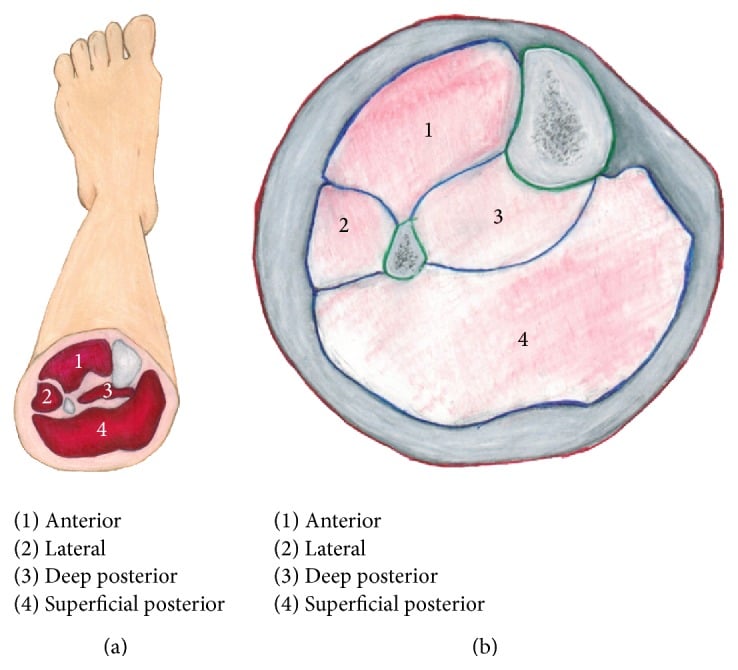
The compartments. Each compartment has its own muscles and its own nerve, so the function lost when it fails is its signature. The table is worth knowing cold, because it is also the map for the pressure needle and the fasciotomy.
- Contents
- TA, EHL, EDL, peroneus tertius
- Nerve
- Deep peroneal
- Function Lost if Affected
- Dorsiflexion, toe extension
- Contents
- Peroneus longus and brevis
- Nerve
- Superficial peroneal
- Function Lost if Affected
- Eversion, sensory first web
- Contents
- TP, FHL, FDL, popliteus
- Nerve
- Tibial nerve
- Function Lost if Affected
- Toe flexion, inversion
- Contents
- Gastrocnemius, soleus, plantaris
- Nerve
- Sural nerve (sensory)
- Function Lost if Affected
- Plantarflexion
The fascial boundaries. The crural fascia is the outer envelope around all four compartments. Inside it the anterior intermuscular septum separates anterior from lateral, the posterior intermuscular septum separates lateral from posterior, and the interosseous membrane separates deep posterior from anterior. For the surgeon, the anterior compartment is released through a longitudinal incision over it, the lateral through a parallel incision or an extension of the anterior one, and the deep posterior through a medial approach that releases the soleal bridge.
Why the anterior compartment. It has the smallest fascial envelope relative to its muscle mass and less fascial compliance than the other compartments, and it contains muscles with high activity during running, tibialis anterior among them. The result is the greatest percentage volume change with exercise and the highest exercise-induced pressure rise of any compartment, which is why it is the one most often affected.
Pathophysiology
Muscle expansion. Exercise increases muscle blood flow by up to 10-fold, and the hyperaemia increases the volume of active muscle by 20%. The metabolic demand of working muscle requires that increased perfusion.
Fascial constraint and pressure rise. The fascia around the leg compartments is non-compliant and cannot stretch to accommodate the larger muscle, so the compartment behaves as a closed space with rising pressure. Normal resting pressure is 8-10 mmHg; in CECS patients exercise drives it to 30-80+ mmHg. The critical threshold is the point at which compartment pressure exceeds capillary perfusion pressure.
Ischaemia. Elevated tissue pressure compresses the capillaries. Arterial inflow is maintained but venous outflow is impaired, a relative tissue ischaemia develops, and pain and neurological symptoms follow.
Recovery. Stopping exercise reduces metabolic demand, muscle volume falls back over 10-15 minutes, pressure normalises and the symptoms resolve. There is no permanent tissue damage, which is the whole difference from acute compartment syndrome.
Classification Systems
By compartment. The compartment tells you the symptoms, the nerve at risk and, as the outcomes section shows, the prognosis. Anterior disease is the most common and the one that produces dorsiflexion weakness and foot drop with exercise; lateral disease is often combined with it; deep posterior disease gives medial, deep pain and is harder to diagnose; superficial posterior disease is rare and presents as calf cramping. Over 60% of patients have more than one compartment involved, and the deep posterior is often overlooked.
- Frequency
- 45%
- Key Features
- Most common, dorsiflexion weakness, foot drop with exercise
- Nerve at Risk
- Deep peroneal
- Frequency
- 35%
- Key Features
- Often combined with anterior
- Nerve at Risk
- Superficial peroneal
- Frequency
- 15%
- Key Features
- Medial, deep pain; harder to diagnose
- Nerve at Risk
- Tibial nerve
- Frequency
- 5%
- Key Features
- Rare, calf cramping
- Nerve at Risk
- Sural nerve
- Frequency
- 60%+
- Key Features
- Multiple compartments involved
- Nerve at Risk
- Multiple nerves
By severity. Severity is read from how little exercise it takes to provoke symptoms, how long they take to settle and whether the nerve is involved, and it guides both treatment and counselling.
- Trigger
- High exercise intensity only
- Features
- Resolves immediately with rest; no neurological symptoms
- Treatment implication
- May respond to activity modification
- Trigger
- Moderate exercise levels
- Features
- Takes 5-10 minutes to resolve; occasional paraesthesias
- Treatment implication
- Usually requires surgery for return to sport
- Trigger
- Minimal exertion
- Features
- Persistent neurological symptoms during exercise; significant functional limitation
- Treatment implication
- Fasciotomy strongly indicated
Bilateral or unilateral. CECS is bilateral in 85% of cases, though the severity may be asymmetric, and a bilateral patient may need both legs measured and both released, staged or simultaneously. A truly unilateral presentation, the remaining 15%, should prompt you to reconsider the diagnosis and look for another cause, popliteal artery entrapment and stress fracture in particular, before any operation; if CECS is confirmed, a unilateral release is indicated.
Clinical Presentation and Assessment
History. The classic story is an aching, cramping pain that develops after a predictable duration or intensity of exercise, is the same every time, builds with continued activity and is relieved within minutes of stopping. Patients describe tightness or heaviness, the feeling of a swollen, tight compartment, and may report numbness, tingling or a foot drop during exercise. In anterior disease, foot drop with exercise indicates nerve involvement.
The questions that pin the pattern down:
- "How long into exercise does pain start?"
- "How quickly does it resolve with rest?"
- "Is it the same every time?"
- "Any numbness or tingling?"
- "Any weakness (foot drop)?"
Red flags that say this is not CECS. Any of these sends you to the differential rather than the pressure needle:
- Pain at rest
- Pain that does not resolve with rest
- Point tenderness (stress fracture)
- Night pain
Examination at rest. Usually normal: the compartments are soft, the neurology is normal and there is typically no tenderness, which is why the history does most of the work.
Examination immediately after exercise. This is where the signs live. The compartments are tight and firm, there may be a temporary neurological deficit, muscle may herniate through fascial defects, and the symptoms are reproducible. Test motor function compartment by compartment, sensation in the first web space for the deep peroneal nerve, and the pulses, which are usually normal but must be checked.
The provocation protocol. Examination and pressure measurement are built around the patient's own aggravating activity:
- Baseline examination and ICP measurement
- Have the patient perform their aggravating activity
- Continue until symptoms are reproduced or for 10-15 minutes
- Immediate post-exercise compartment examination
- ICP measurement at 1 minute and 5 minutes post-exercise
What you are looking for is reproduction of the symptoms, compartment firmness, neurological change and a rise in pressure.
Investigations
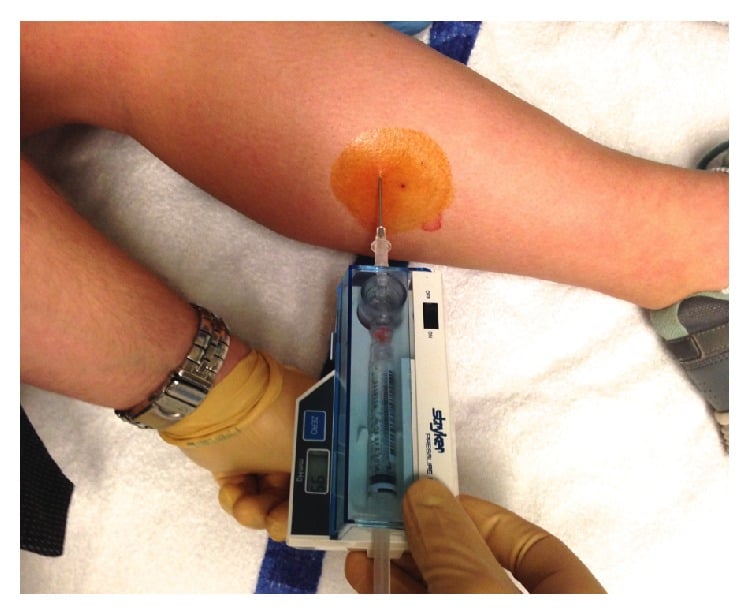
Intracompartmental pressure. ICP measurement is the gold standard for diagnosis. A slit catheter or Stryker needle is inserted perpendicular to the leg into the bulk of the compartment, and pressure is read at rest before exercise, at 1 minute and at 5 minutes after it.
- Threshold
- Over 15 mmHg
- Interpretation
- Positive
- Threshold
- Over 30 mmHg
- Interpretation
- Positive
- Threshold
- Over 20 mmHg
- Interpretation
- Positive
Reading the numbers. Any one criterion positive is diagnostic. The most helpful reading is the 1-minute post-exercise value, which should be elevated significantly above baseline.
The limits of static thresholds. The Pedowitz numbers are the ones to quote, but a substantial proportion of asymptomatic athletes have post-exercise pressures above the classic cut-offs, especially the 30 mmHg at one minute, so a positive static pressure in isolation over-diagnoses CECS. Interpret pressures alongside a consistent clinical picture, and do not diagnose CECS on a single static reading alone.
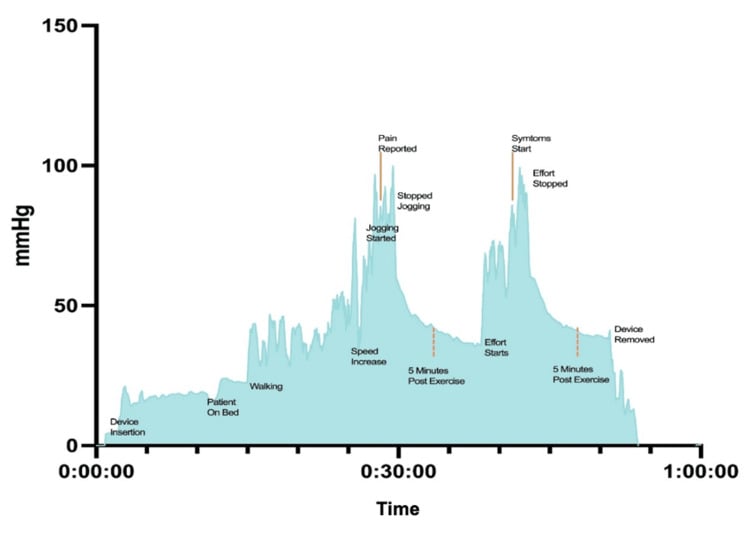
Dynamic pressure. Rather than three discrete readings, a transducer left in situ during the provoking exercise records the rise in pressure and, crucially, the post-exercise decay or recovery time. A prolonged time for pressure to fall back to baseline is more discriminating than a single peak value, and it is physiologically the more logical test.
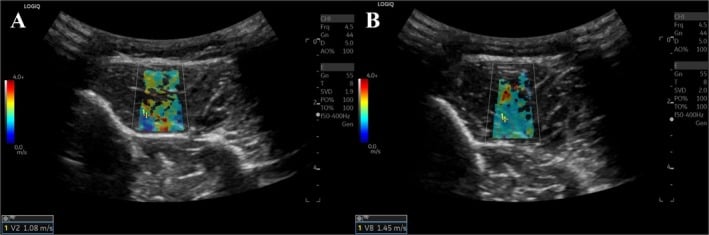
Near-infrared spectroscopy. NIRS is a non-invasive alternative that measures muscle deoxygenation and oxygenation during exercise. Delayed reoxygenation after exercise reflects the ischaemia of CECS without a needle, and it is an emerging adjunct and screening tool. The principle behind all of these is that the diagnosis is a clinical pattern plus a confirmatory ischaemia test: needle pressure remains the reference standard, but its thresholds are imperfect, which is why dynamic monitoring and NIRS are gaining ground.
Deep posterior measurement is a different problem. The reassuring figures for CECS all come from the anterior and lateral compartments; the anterior compartment is superficial and easily landmarked, and measurement there is straightforward. In 24 patients with suspected deep posterior disease a catheter was inserted freehand by anatomical landmarks into what was intended to be tibialis posterior, and MRI then showed where the tip actually lay: placement was accurate in only 10 of 24 (42%), suboptimal, within the deep posterior compartment but outside tibialis posterior, in 9 (38%), and frankly outside the compartment in 5. Haematoma was seen in 38%, though without clinical symptoms (DOI, level IV). A pressure reading is only as good as the compartment it came from, so a normal freehand deep posterior measurement does not exclude the diagnosis.
Both directions of harm are live, and they land on different patients. Under-diagnosis is accepting a normal freehand deep posterior reading and telling a symptomatic athlete there is nothing wrong. Over-treatment is the graver error because it is irreversible: operating on a deep posterior compartment on the strength of a misplaced reading. Use image guidance rather than palpation for deep posterior catheter placement, and treat a negative deep posterior study in a convincing history as unresolved rather than negative.
Imaging. Radiographs are usually normal; their job is to exclude a stress fracture, and a tibial stress fracture may show periosteal reaction. MRI may show muscle oedema after exercise, with T2 signal change in the affected compartment, and helps to differentiate CECS from medial tibial stress syndrome, but it is not diagnostic on its own. A bone scan separates the two bony mimics: focal uptake is a stress fracture, diffuse uptake is MTSS.
Vascular assessment. The ankle-brachial index is measured at rest and after exercise to rule out popliteal artery entrapment; a fall with exercise should make you consider PAES. If entrapment is suspected, duplex or CT angiography follows, and active plantarflexion may show the occlusion.
Differential Diagnosis
The discriminator. CECS is predictable, reproducible, exercise-induced and resolves with rest. The mimics may hurt at rest, follow variable patterns, or fail to track exercise intensity reliably, and each has its own investigation.
- Key Feature
- Point tenderness
- Investigation
- MRI or bone scan
- Distinguishing Factor
- Focal pain, positive imaging
- Key Feature
- Diffuse medial tibial pain
- Investigation
- Bone scan (diffuse)
- Distinguishing Factor
- Longer recovery, not exercise-limited
- Key Feature
- Claudication with exercise
- Investigation
- ABI post-exercise, angio
- Distinguishing Factor
- Reduced pulses, vascular symptoms
- Key Feature
- Calf swelling, tenderness
- Investigation
- Duplex ultrasound
- Distinguishing Factor
- Constant symptoms, swelling
- Key Feature
- Neurological symptoms dominant
- Investigation
- EMG/NCS
- Distinguishing Factor
- Specific nerve distribution
- Key Feature
- Acute onset
- Investigation
- Clinical, possibly MRI
- Distinguishing Factor
- History of specific injury
STAMPSDifferential Diagnosis
Hook:STAMPS out the differential diagnosis for exercise leg pain!
Management
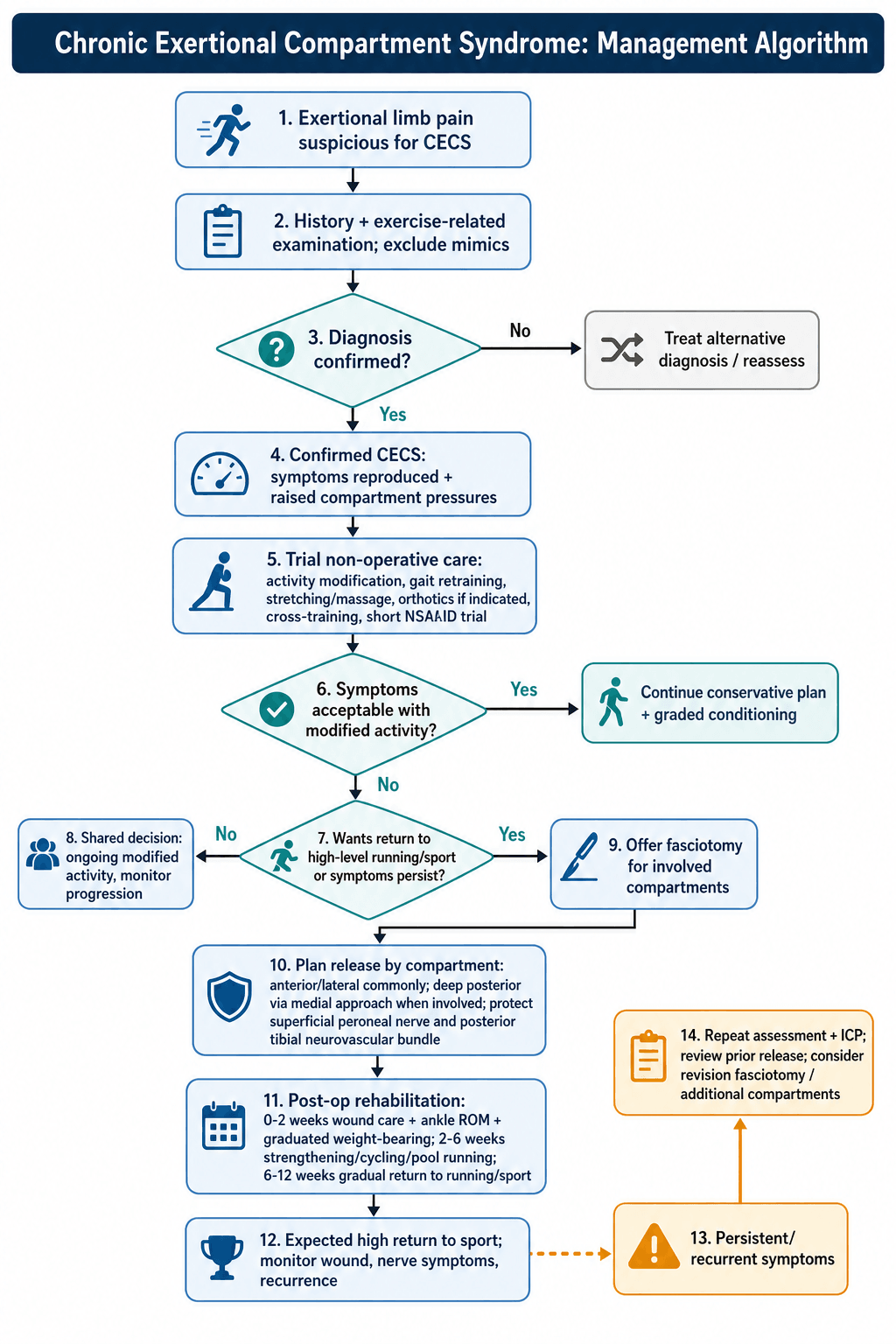
The decision. Conservative management is tried first, and it is a real option for the patient willing to change how they exercise. In dedicated athletes with confirmed CECS it usually fails, and fasciotomy is the definitive treatment.
Non-operative options. Each may help, and each often fails:
- Activity modification (reduce intensity or duration)
- Gait retraining (forefoot rather than heel strike)
- Stretching and massage
- Orthotics (theoretical benefit)
- Cross-training (swimming, cycling)
- NSAIDs (limited evidence)
Success for return to full activity is low, under 50%, though conservative care may be adequate for a patient willing to modify their sport. Botulinum toxin injection into the affected compartment muscles is an emerging option on lower-grade evidence.
Gait retraining. A habitual rearfoot striker needs strong eccentric tibialis anterior activity to control foot slap, and that drives anterior compartment loading; converting to a forefoot or midfoot landing markedly reduces tibialis anterior demand and anterior intracompartmental pressure. A supervised programme can resolve symptoms and return runners and soldiers to activity without fasciotomy, and in some military cohorts gait retraining has matched or exceeded surgery, the army study flagged in the systematic review below. It is most applicable to anterior disease, not deep posterior.
The programme is graded, often over weeks: cadence is increased with shorter, quicker steps, forefoot or midfoot landing is cued, and mileage is rebuilt gradually. Gait-laboratory or physiotherapy supervision embeds the new pattern and guards against metatarsal and Achilles overload during the transition. Before fasciotomy for anterior CECS, this programme should have been offered.
Indications for fasciotomy.
- Confirmed CECS with positive ICP measurements
- Failed conservative treatment
- Desire to return to sport
- Foot drop with exercise, which indicates nerve involvement and needs release
Surgical Technique
Positioning for the anterolateral release. Supine with the leg externally rotated and the bony prominences padded. A tourniquet is optional, and many prefer to do without one.
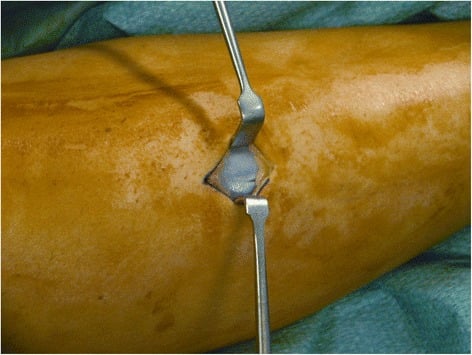
Anterior compartment release. The exposure is a single lateral incision, and the release must run the length of the compartment:
- Single lateral incision 2-3cm anterior to the fibula, 10-15cm long for an adequate release
- Identify the subcutaneous fat and the crural fascia
- Incise the anterior compartment fascia longitudinally
- Extend proximally and distally with scissors: the release must be complete from tibial plateau to ankle
- Confirm the muscle bulging through the fasciotomy
- Identify the anterior intermuscular septum, and check the lateral compartment if it is symptomatic
Lateral compartment release. This can be done through the same incision, extended distally to visualise the lateral compartment, or through a separate lateral incision if needed. Identify the intermuscular septum between the compartments, incise the lateral compartment fascia, and release from fibular head to ankle. The superficial peroneal nerve must be identified and protected, and marking nerve locations preoperatively, where possible, is part of the plan.
The superficial peroneal nerve pierces the lateral compartment fascia in the distal third of the leg, exiting the lateral compartment 10-12cm above the lateral malleolus. Identify and protect it during release. Injury causes numbness over the dorsum of the foot.
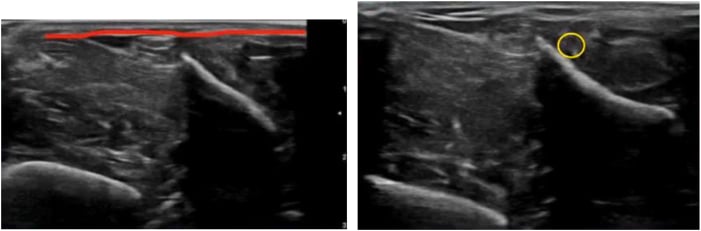
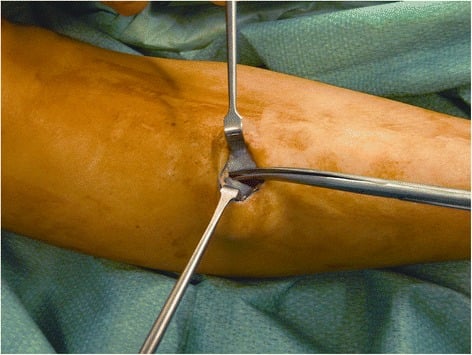
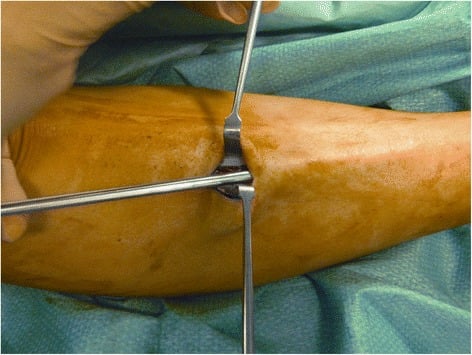
Deep posterior compartment release. Position supine with the hip flexed and externally rotated, the frog-leg position, or in lateral decubitus. The approach is medial:
- Medial incision 2cm posterior to the medial tibial border
- Incise the crural fascia
- Identify and release the soleal bridge to reach the deep posterior compartment
- Release the fascia over FDL and tibialis posterior
- Identify and protect the posterior tibial neurovascular bundle
- Extend the release proximally and distally
The soleal bridge must be released for adequate deep posterior decompression. This is the attachment of soleus to the posteromedial tibia that crosses over the deep posterior compartment.
Principles that decide the result. Complete release is essential, because a partial release leads to failure: release at least 90% of the compartment length, have a low threshold for releasing adjacent compartments, and operate on both legs if the symptoms are bilateral. Haemostasis is meticulous before closure, and closure is of skin only; the fascia is never closed. Do not ignore neurological symptoms, and do not miss bilateral involvement.
Endoscopic or open. Open release is the gold standard and gives the better visualisation; endoscopic release is less invasive and has a learning curve. Outcomes are similar when either is properly performed.
Complications
- Risk
- Most common nerve injury
- Prevention
- Identify and protect
- Management
- Observation if neuropraxia
- Risk
- Commonest cause of failure
- Prevention
- Full visualisation
- Management
- Revision surgery
- Risk
- Rare
- Prevention
- Know anatomy
- Management
- Direct repair or ligation
- Risk
- Rare
- Prevention
- Confirm anatomy
- Management
- Release correct compartment
Nerve injury. Superficial peroneal nerve injury during lateral release is the most common nerve complication. It costs sensation over the dorsum of the foot and nothing in motor function, and most are neuropraxias that recover: observe for 3-6 months, obtain EMG and nerve conduction studies if there is no improvement, and explore only rarely.
Wound problems. Haematoma occurs in 2-5% and wound infection in 1-2%; dehiscence and delayed healing also occur. Prevention is meticulous haemostasis, a compression dressing and early mobilisation. A large haematoma is drained and a small one compressed; infection is managed with antibiotics and wound care and rarely needs debridement; delayed healing calls for optimised nutrition and offloading of the wound.
Functional problems. Persistent symptoms affect 5-10%, recurrence can follow scarring over the fasciotomy, muscle weakness is usually temporary, and the scars can be sensitive and a cosmetic concern.
Lower limb surgery with restricted mobility increases DVT risk. Consider chemical prophylaxis and early mobilisation. Encourage ankle pumps immediately postoperatively.
Recurrence. Symptoms recur in 5-10%. The causes:
- Incomplete original release (most common)
- Scar formation over the fasciotomy
- Missed additional compartment
- Wrong diagnosis initially
Before calling it a recurrence, allow time, since some patients take 16 weeks or more to settle. Then confirm the diagnosis with repeat ICP measurement, review the original operative note, assess all compartments after exercise and reconsider the alternative diagnoses. Revision is a more extensile approach with complete release and scar excision, considering every compartment; the success rate is slightly lower than for a primary release but still worthwhile.
- Incidence
- 5-10%
- Risk Factor
- Incomplete release
- Incidence
- 3-5%
- Risk Factor
- Haematoma, poor technique
- Incidence
- 1-3%
- Risk Factor
- Superficial peroneal at risk
- Incidence
- Under 1%
- Risk Factor
- Immobility
- Incidence
- 1-2%
- Risk Factor
- Standard surgical risk
Postoperative Care
The first two weeks. A compression dressing and elevation from the day of surgery, ankle range-of-movement exercises the same day, and weight-bearing as tolerated. The wound is checked at 5-7 days and sutures come out at 10-14 days; in between, active ankle dorsiflexion and plantarflexion, ice for swelling and gentle calf stretches. The goals are wound healing, a maintained ankle range, controlled swelling and DVT prevention, and early mobilisation is the key to recovery.
Weeks 2 to 6. Full weight-bearing, progressive stretching and light resistance exercise from week 2, moving to progressive strengthening, elliptical training and sport-specific warm-up exercises from week 4. Cardiovascular fitness is preserved with non-impact work throughout, stationary cycling at low resistance from 2 weeks and pool running or aqua jogging from 3-4 weeks, and light jogging on a treadmill begins at 4-6 weeks. By week 6 the patient is running outdoors and starting sport drills, with progress individualised to their response.
Weeks 6 to 12. The running programme starts at 50% of previous intensity and duration and increases by 10-15% per session, with sport-specific drills from 6-8 weeks. Agility work, plyometrics and full training with the team come at 8-10 weeks, and full return to competition at 10-12 weeks, monitoring for recurrence as the load builds. Most athletes are back in full sport by 12 weeks.
Outcomes and Prognosis
Anterior and lateral release. Return to sport is 90-95%, most to their pre-injury level, with satisfaction of 85-95% and a complication rate under 5%. The pooled figures in the evidence base below are lower, 85% satisfaction and 80% return to activity across all compartments and populations, with a wide range between series, and outcomes are population-dependent: civilian athletes do considerably better than military and high-demand cohorts.
Deep posterior release. Reported success is only 30-65%, markedly inferior to anterior and lateral release. It is a different operation with different expectations, and it is consented separately with its own success figure. Quoting a deep posterior patient the 90-95% that belongs to a different compartment is a consent failure as much as a surgical one.
Prognostic factors. The favourable ones:
- Clear diagnosis with positive ICP
- Anterior or lateral compartment
- Complete surgical release
- Younger patient
- Single-sport athlete
The less favourable:
- Atypical presentation
- Deep posterior involvement
- Previous failed surgery
- Military personnel, whose demands are higher
- Coexisting conditions
Guidelines, Registries & Global Practice
Global Epidemiology
CECS is a major cause of exercise-induced leg pain in young athletes and military recruits. In military and recreational-runner cohorts, exercise-induced lower leg pain accounts for an estimated 27 to 33 percent of all lower-leg pain presentations, with CECS a leading diagnosis after medial tibial stress syndrome (Breen et al. 2015, PMID 25709867). Pooled systematic-review data show a male-to-female ratio of roughly 7:4 and an age range spanning 12 to 70 years, with most patients in the second-to-fourth decades (Vogels et al. 2020, PMID 32526086). The anterior (and combined anterolateral) compartment is the most frequently affected subtype across populations (de Bruijn/Winkes 2020, PMID 30980096).
Guidance and Evidence Across Bodies
No single national college (AAOS, NICE, BOA, AO, EFORT) publishes a dedicated CECS clinical practice guideline; management is instead driven by sports-medicine consensus and systematic reviews. There is broad international agreement on the principles below.
- Consensus Position
- Clinical pattern plus intracompartmental pressure (Pedowitz criteria); dynamic testing physiologically preferred but underused
- Evidence Level
- Level III (Pedowitz, PMID 2301689)
- Consensus Position
- Trial of conservative care including gait/running-technique retraining, especially in military and runners
- Evidence Level
- Level IV SR (PMID 32526086)
- Consensus Position
- Fasciotomy of all symptomatic compartments when conservative care fails
- Evidence Level
- Level IV SR (PMID 37778507)
- Consensus Position
- Lower, less predictable surgical success; counsel accordingly
- Evidence Level
- Level III SR (PMID 24065078)
Registry and Population Evidence
There is no dedicated CECS registry; the evidence base is systematic reviews and cohort series rather than arthroplasty-style national registries. The largest pooled lower-leg dataset (68 studies, n=3783) reports fasciotomy satisfaction of 85 percent and return to activity of 80 percent, versus roughly 47 to 50 percent for conservative care (Vogels 2020, PMID 32526086).
Practice Variation
Most published series use static rather than dynamic intracompartmental pressure measurement, and ICP cut-offs vary widely between centres, contributing to heterogeneous reported outcomes (Dean 2024, PMID 37778507).
Civilian athletes do considerably better than military/high-demand cohorts, in whom only about half achieve complete resolution and at least 25 percent cannot return to full duty (Dunn and Waterman 2014, PMID 25280617).
MCQ Practice Points
Q: What are the Pedowitz criteria for diagnosing CECS?
A: 15-30-20: Pre-exercise over 15mmHg, 1 min post over 30mmHg, 5 min post over 20mmHg. Any ONE positive is diagnostic.
Q: Which compartment is most commonly affected in CECS?
A: Anterior compartment (45%), followed by lateral (35%), deep posterior (15%), and superficial posterior (5%). Anterior and lateral are often affected together.
Q: What percentage of CECS cases are bilateral?
A: 85% are bilateral. If truly unilateral, strongly reconsider the diagnosis and investigate other causes such as popliteal artery entrapment or stress fracture.
Q: What nerve is at risk during lateral compartment release for CECS?
A: The superficial peroneal nerve emerges through the lateral compartment and is at risk during fasciotomy. It must be identified and protected.
Q: What is the expected return to sport rate after fasciotomy for CECS?
A: 90-95% of patients return to their previous level of sport after fasciotomy. Success is highest for anterior and lateral compartment releases.
Exam Viva Scenarios
Practise clinical reasoning and management decisions out loud
“A 22-year-old long-distance runner presents with bilateral anterior leg pain that starts 20 minutes into running and forces her to stop. Pain resolves within 5-10 minutes of rest. She describes tightness and occasional numbness on the dorsum of her foot. Examination at rest is normal.”
“A 28-year-old male soccer player presents with unilateral right leg pain with exercise. He describes cramping in the calf that starts after 30 minutes of training. He has no numbness. His pain sometimes persists for hours after stopping.”
“A 25-year-old triathlete had anterior compartment fasciotomy for CECS 6 months ago. She has returned to training but symptoms have recurred. ICP measurement shows elevated pressures in the anterior compartment.”
Definition
- Exercise-induced elevated intracompartmental pressure
- Symptoms with exercise, resolve with rest
- Reversible, no tissue necrosis (unlike acute CS)
- 85% bilateral
Pedowitz Criteria (15-30-20)
- Resting (pre-exercise) over 15mmHg
- 1 minute post-exercise over 30mmHg
- 5 minutes post-exercise over 20mmHg
- Any ONE positive = diagnostic
Compartment Frequency
- Anterior: 45% (most common)
- Lateral: 35% (often with anterior)
- Deep posterior: 15%
- Superficial posterior: 5% (rare)
Treatment
- Conservative: Usually fails in athletes
- Fasciotomy: Definitive treatment
- 95% return to sport post-op
- Complete release essential
Differential (STAMPS)
- Stress fracture - point tenderness
- Tibial nerve entrapment
- Artery entrapment (popliteal)
- MTSS (shin splints)
- Peroneal nerve entrapment
Surgical Pearls
- Protect superficial peroneal nerve
- Complete release proximal to distal
- Consider releasing lateral with anterior
- Soleal bridge for deep posterior
Evidence Base
Pedowitz Modified Diagnostic Criteria (Landmark)
- Derived the still-used intramuscular pressure thresholds from slit-catheter recordings in 210 compartments: a pre-exercise pressure of 15 mmHg or more, a 1-minute post-exercise pressure of 30 mmHg or more, or a 5-minute post-exercise pressure of 20 mmHg or more is diagnostic when clinical findings fit. Muscle herniation was the only history/examination feature that differed between groups (45.9 percent vs 12.9 percent).
Treatment Outcomes in Lower-Leg CECS (Systematic Review)
- Fasciotomy significantly reduced intracompartmental pressure (mean 76 mmHg to 24 mmHg) and achieved 85 percent (plus or minus 13) satisfaction and 80 percent (plus or minus 17) return to activity. Conservative interventions (gait retraining, botulinum toxin) gave roughly 47 percent satisfaction and 50 percent return to activity. Return to activity was significantly more likely after surgery (P less than 0.01), except in one army-personnel study favouring gait retraining.
Deep Posterior CECS: Is Surgery Effective? (Systematic Review)
- Success after fasciotomy for deep posterior CECS was modest, ranging 30 to 65 percent, markedly inferior to anterior/lateral release. No single surgical technique was superior, ICP cut-offs varied widely, and prolonged high post-provocation ICP was associated with surgical success.
Diagnosis and Treatment Patterns in CECS (Systematic Review)
- Most published series (24 of 29) diagnose CECS with static rather than dynamic pressure measurement, and fasciotomy (single-incision most common) is the dominant treatment. Reported post-fasciotomy satisfaction ranged 42 to 94 percent and return to sport 26 to 100 percent; conservative return to sport was 25 to 35 percent, underscoring wide practice variation and heterogeneous outcome reporting.
CECS in Military Populations (Practice Variation)
- In military service members, surgical results are far less reliable than in civilian athletes: only about half achieve complete symptom resolution and at least 25 percent are unable to return to full duty. The five cardinal symptoms are pain, tightness, cramps, weakness and diminished sensation.
Management of Anterolateral-Leg CECS (Review)
- Anterior tibial muscle CECS is the most common subtype; dynamic intracompartmental pressure measurement is the gold-standard diagnostic test. Duplex and imaging exclude popliteal artery entrapment and nerve entrapment. Conservative measures including running-technique modification can succeed; recalcitrant cases warrant fasciotomy, and residual or recurrent disease may need partial fasciectomy.