Iodinated and Gadolinium Contrast in Orthopaedic Practice
- Iodinated contrast (CT): reactions are anaphylactoid (NOT IgE-mediated), cannot be predicted by skin testing, and require immediate treatment if severe.
- Gadolinium contrast (MRI): associated with nephrogenic systemic fibrosis (NSF) in patients with severe renal impairment (eGFR less than 30).
- Contrast-induced nephropathy (CIN) is a transient decline in renal function after iodinated contrast — risk is highest with pre-existing renal impairment.
- Adrenaline (epinephrine) 0.5mg IM is the FIRST-LINE treatment for anaphylaxis from contrast media — not antihistamines or steroids.
- Premedication with steroids and antihistamines does NOT prevent all reactions but reduces their severity.
- “Iodinated contrast reactions are NOT true allergies — they are anaphylactoid (direct mast cell degranulation, not IgE-mediated).
- “A previous iodinated contrast reaction increases the risk of future reaction 5-6 fold but does NOT predict the severity of the next reaction.
- “Metformin should be withheld for 48 hours after iodinated contrast in patients with eGFR less than 30 due to the risk of lactic acidosis if AKI develops.
- “Gadolinium-based contrast agents are classified by the ACR into Group I (linear agents, greatest NSF risk), Group II (macrocyclic agents and the stable linear gadobenate, lowest NSF risk), and Group III (gadoxetate, limited data).
- “Breastfeeding does NOT need to be interrupted after iodinated or gadolinium contrast — less than 0.04% of dose enters breast milk.
Overview
Contrast agents are used in orthopaedic imaging to enhance tissue differentiation and improve diagnostic accuracy. Iodinated contrast is used for CT, fluoroscopy and conventional arthrography; gadolinium-based contrast agents (GBCAs) are used for MRI. Contrast-enhanced imaging is not routinely required for most musculoskeletal conditions, but it plays a critical role in tumour staging, infection assessment, vascular evaluation, arthrography and post-operative assessment.
Why the surgeon needs this. Orthopaedic patients frequently require contrast-enhanced imaging, and the operating surgeon may need to manage a contrast reaction in the perioperative setting. Contrast pharmacology, reaction management and renal safety are therefore essential knowledge for all orthopaedic surgeons, not just radiologists.
Iodinated contrast. Iodinated contrast works by absorbing X-rays, a consequence of the high atomic number of iodine (Z=53). Modern agents are non-ionic and low-osmolar (iohexol, iopamidol), which significantly reduced reaction rates compared with the older ionic high-osmolar agents. Iodinated contrast is excreted renally and is the agent associated with contrast-induced nephropathy (CIN). Its orthopaedic applications:
- CT angiography
- Contrast-enhanced tumour assessment
- CT arthrography
Gadolinium contrast. Gadolinium is a paramagnetic metal that shortens the T1 relaxation time of nearby water molecules, so the tissue where it accumulates becomes T1-bright. GBCAs are chelated, the ion bound inside a molecular cage, to reduce toxicity. The key safety concern is nephrogenic systemic fibrosis (NSF) in severe renal impairment (eGFR less than 30), and modern macrocyclic agents (gadobutrol, gadoterate) have the lowest NSF risk because their chelate structure is more stable. Its orthopaedic applications:
- MR arthrography
- Tumour enhancement
- Infection assessment
- Post-operative evaluation
Pre-Contrast Safety Assessment
Six questions, asked before any contrast is administered.
- Assessment
- Ask about any prior reaction to contrast media and its severity
- Action Required
- If prior reaction: consider premedication, alternative imaging, or radiology consultation
- Assessment
- Check eGFR within the last 3 months for iodinated contrast; within 6 months for gadolinium
- Action Required
- eGFR less than 30: high CIN risk (iodinated) and NSF risk (gadolinium). Hydrate and use minimum contrast volume
- Assessment
- History of asthma, atopy, or other drug allergies
- Action Required
- Asthma increases contrast reaction risk 5-10x. Ensure bronchodilator available. Consider premedication
- Assessment
- Metformin, NSAIDs, aminoglycosides, diuretics
- Action Required
- Avoid nephrotoxins and withhold metformin as set out under Contrast-Induced Nephropathy. Ensure adequate hydration
- Assessment
- Pregnancy status and breastfeeding
- Action Required
- Iodinated contrast: avoid in pregnancy unless essential. Gadolinium: avoid in pregnancy (crosses placenta). Breastfeeding: can continue after both agents
- Assessment
- Resuscitation equipment must be immediately available
- Action Required
- Adrenaline, oxygen, IV access, suction, monitoring equipment must be on-site whenever contrast is administered
Iodinated Contrast Reactions
What the reaction is. Iodinated contrast reactions are anaphylactoid: direct mast cell degranulation, not a true IgE-mediated allergy. Two things follow. They can occur on first exposure, and they cannot be predicted by skin testing.
- Symptoms
- Limited urticaria, pruritus, nausea, warmth, metallic taste, sneezing, mild headache
- Incidence
- About 3% (the great majority of all reactions)
- Management
- Observation only. Most resolve spontaneously. May give oral antihistamine if symptoms are bothersome
- Symptoms
- Diffuse urticaria, facial/laryngeal oedema (mild), bronchospasm (responsive), hypotension (transient, responds to fluids)
- Incidence
- Well under 1%
- Management
- Medical treatment required: adrenaline 0.3-0.5mg IM if progressing, IV fluids, salbutamol nebuliser for bronchospasm, antihistamine IV, observation minimum 4 hours
- Symptoms
- Cardiovascular collapse, severe bronchospasm, laryngeal oedema with stridor, loss of consciousness, seizures, respiratory arrest
- Incidence
- 0.04%
- Management
- ADRENALINE 0.5mg IM IMMEDIATELY (1:1000, anterolateral thigh). Repeat every 5 min. High-flow oxygen. Large-bore IV saline. Call arrest team. Transfer to resuscitation area
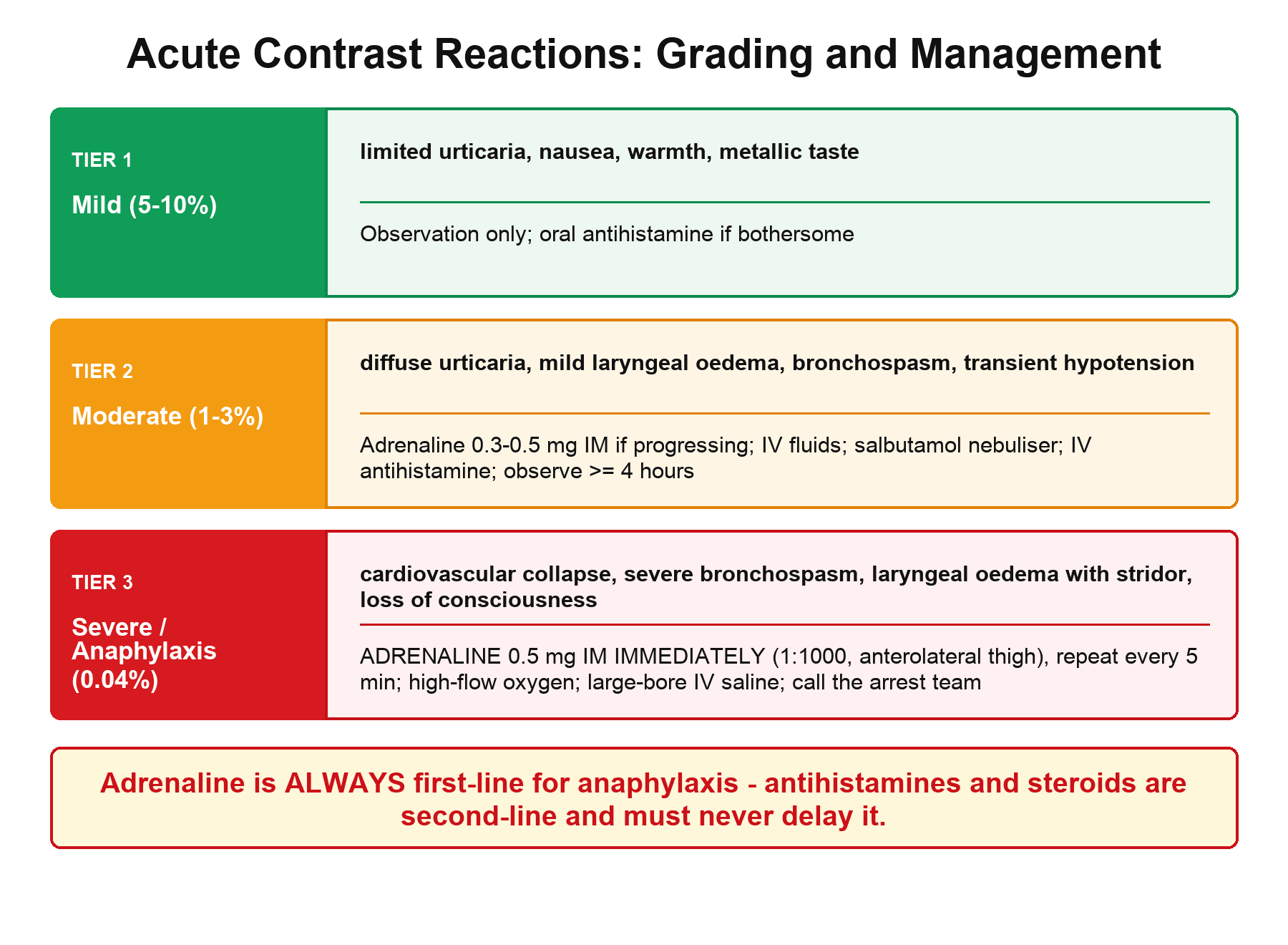
Quote the rate for the agent you are actually using. The "5 to 10 percent" mild-reaction figure that circulates in vivas belongs to the high-osmolar ionic era, when the total adverse reaction rate was 12.66 percent. With the non-ionic low-osmolar agents that are now standard, the total rate across 168,363 examinations was 3.13 percent, of which 0.04 percent were severe, so the modern figures are roughly a quarter of the old ones, and an examiner quoting 10 percent is quoting an obsolete agent class.
Adrenaline first. Adrenaline is always the first-line treatment for anaphylaxis: it reverses bronchospasm, supports the blood pressure and reduces oedema. Antihistamines and corticosteroids are second-line adjuncts and should never delay it. All moderate and severe reactions require a minimum observation period and documentation for future reference.
The rest of the resuscitation. Stop the contrast infusion and call for help early. Give high-flow oxygen via mask and a salbutamol nebuliser for bronchospasm, and consider intubation if the airway is compromised. Secure large-bore IV access, give a rapid IV saline bolus of 500 mL to 1 L, and position the hypotensive patient supine with the legs elevated (Trendelenburg). The second-line drugs are promethazine 25 mg IV or chlorpheniramine 10 mg IV, and hydrocortisone 200 mg IV. Monitor continuously throughout: ECG, SpO2 and blood pressure.
Adrenaline dosing is weight- and age-banded, and 0.5 mg is the adult dose only. A paediatric patient having a contrast-enhanced CT is not rare in orthopaedics, and the wrong dose in either direction is dangerous. All doses below are 1:1000 intramuscular into the anterolateral thigh, repeated after 5 minutes if there is no improvement:
- Dose
- 500 micrograms
- Volume of 1:1000
- 0.5 mL
- Dose
- 300 micrograms
- Volume of 1:1000
- 0.3 mL
- Dose
- 150 micrograms
- Volume of 1:1000
- 0.15 mL
- Dose
- 100 to 150 micrograms
- Volume of 1:1000
- 0.1 to 0.15 mL
By weight the equivalent is 10 micrograms/kg IM. Intravenous adrenaline is a different drug in practice. It is given only by those trained to use it, with continuous cardiac monitoring, in 50 microgram boluses of the 1:10,000 dilution. Giving the 1:1000 intramuscular dose intravenously is a recognised cause of fatal arrhythmia and myocardial ischaemia, which is why the ampoule strength should be stated out loud when it is drawn up.
Confirming it was anaphylaxis afterwards: mast cell tryptase. Take three timed samples: immediately once resuscitation allows, at 1 to 2 hours, and a baseline at 24 hours or later once the patient has recovered. A rise and fall across the series supports mast cell degranulation and is what an allergy clinic needs; a single sample is close to uninterpretable because the baseline varies between people. Never delay resuscitation to take blood, and note that a normal tryptase does not exclude anaphylaxis, since it is commonly normal in reactions without hypotension.
ABCDAContrast Reaction Management
Hook:ABCDA: Adrenaline first, then Breathing, Circulation, Drugs, and Arrest team. Remember: ADRENALINE saves lives, not antihistamines.
Premedication for the patient with a prior reaction. A history of contrast reaction raises the risk of a future reaction 5-6 times. Premedication reduces the incidence and severity of subsequent reactions but does not eliminate the risk entirely, and it is most effective when the full protocol, all three steroid doses, is completed. The standard protocol, widely used internationally in the ACR/ESUR style:
- Prednisolone 50mg orally at 13h, 7h, and 1h before contrast administration
- Promethazine 25mg orally 1h before contrast, OR cetirizine 10mg orally 1h before
- Alternative: hydrocortisone 200mg IV 1h before, for emergency or urgent cases where oral dosing is not feasible
What premedication does not do. Even with premedication, breakthrough reactions occur, so emergency equipment must always be available, and every radiology department should have a documented protocol for managing contrast reactions. If the previous reaction was severe anaphylaxis, consider whether the imaging is truly essential and whether a non-contrast alternative could provide the needed information.
Seafood allergy and iodine. There is no cross-reactivity between iodinated contrast and shellfish allergy. The myth of "iodine allergy" is unfounded: iodine is an essential element, not an allergen, and shellfish allergy is to tropomyosin protein, not iodine.
Biphasic Reactions and Post-Reaction Observation
A biphasic reaction is the recurrence of anaphylaxis after it has apparently resolved, without any further exposure to the trigger. It is the entire reason a patient is kept under observation once a severe reaction has settled, and it is why a discharge decision is a clinical judgement rather than a fixed number of hours.
- Time course
- A single episode that resolves with treatment and does not recur
- Implication
- Standard observation, then discharge with documentation
- Time course
- Symptoms resolve, then RECUR without any re-exposure; the timing is set out below
- Implication
- The reason for a minimum observation period; the second phase can be as severe as the first and is re-treated as new anaphylaxis (adrenaline first)
- Time course
- Anaphylaxis persists for hours despite treatment
- Implication
- Needs ongoing resuscitation and critical-care support
How common. The figure most often quoted in vivas, "up to 20 percent", comes from small early case series and is a substantial overestimate. Pooling 27 observational studies and 4,114 patients with anaphylaxis gives 192 biphasic reactions, 4.7 percent, with a median onset at 11 hours and a range from 12 minutes to 72 hours. That single figure explains why a fixed observation period cannot be right for everyone: a median of 11 hours sits well beyond the 4 to 6 hours most departments use.
Who is at risk. The same pooled data identify who is actually at risk, which is what should drive the decision, and a contrast reaction does not sit in the low-risk category. This is level 3 evidence, a systematic review and meta-analysis of observational studies with substantial heterogeneity for the hypotension estimate.
- Presenting with hypotension roughly doubles the risk (pooled odds ratio 2.18, 95% CI 1.14 to 4.15). A patient who collapsed after contrast is therefore in the higher-risk group, not the reassuring one
- An unknown or unidentified trigger raises risk (odds ratio 1.72, 95% CI 1.0 to 2.95), while a food trigger lowers it (odds ratio 0.62)
After a moderate or severe contrast anaphylaxis, observe for a minimum of 4 to 6 hours, and extend that to 12 hours or more, with a monitored bed, where the reaction involved hypotension, required more than one dose of adrenaline, or the patient lives far from emergency care or is poorly supported at home. Corticosteroids are given as an adjunct but do NOT reliably prevent the biphasic phase, so the protection that actually matters is adequate first-line adrenaline plus a sufficient monitored observation window, with immediate re-treatment if symptoms recur.
Contrast-Induced Nephropathy
Definition. CIN is an acute decline in renal function, a rise in serum creatinine of 25% or more, or 44 micromol/L or more above baseline, occurring within 48-72 hours of iodinated contrast administration, in the absence of another cause. It is detected by checking the creatinine 48-72 hours after contrast.
- Risk Factor
- eGFR less than 30 (highest risk), eGFR 30-60 (moderate risk)
- Management
- IV hydration: N/S 1mL/kg/hr for 12h pre and 12h post. Use lowest contrast volume
- Risk Factor
- Diabetic nephropathy compounds the risk, especially with metformin
- Management
- Withhold metformin for 48h post-contrast if eGFR less than 30 (risk of lactic acidosis if AKI develops). Check creatinine before restarting
- Risk Factor
- Hypovolaemia reduces renal perfusion and concentrates contrast in tubules
- Management
- Ensure adequate hydration; correct volume depletion before contrast
- Risk Factor
- NSAIDs, aminoglycosides, ACE inhibitors, diuretics
- Management
- Withhold nephrotoxins if clinically safe. Ensure volume status is optimised
- Risk Factor
- Larger volumes increase the osmotic and direct toxic load on the kidneys
- Management
- Use the minimum effective dose. Avoid repeated contrast studies within 48-72 hours
- Risk Factor
- High-osmolar ionic contrast has the highest CIN risk
- Management
- Use low-osmolar or iso-osmolar non-ionic contrast for all patients
Hydration, and its limits. Isotonic saline is the only prophylaxis still endorsed, and the endorsement is for eGFR below 30, not above it. In randomised data on patients with eGFR 30-59 receiving intravenous contrast, withholding prophylactic hydration was non-inferior to giving it (AMACING), and neither sodium bicarbonate nor N-acetylcysteine is any better than plain saline (PRESERVE). Below eGFR 30 the evidence is thinner, because that group was excluded from those trials, so the regimen in the table stands for that group. Renal anxiety should not delay a clinically essential scan.
Natural history. CIN is typically transient: creatinine peaks at 3-5 days and returns to baseline within 7-14 days in the majority of cases. A small proportion of patients, particularly those with severely impaired baseline renal function, may develop persistent renal impairment or require temporary dialysis. The risk of permanent dialysis-dependent renal failure from CIN is very low in the general population but clinically significant in high-risk patients (eGFR less than 15, diabetic nephropathy, heart failure).
Extravasation and Thyroid Effects
Two iodinated-contrast hazards fall to the orthopaedic team more often than anaphylaxis does, and neither is a renal problem.
Extravasation. Extravasation of iodinated contrast into the soft tissues of the arm complicates roughly 0.1 to 1 percent of power-injected CT studies. It matters here because the feared endpoint is compartment syndrome, and the referral usually lands with orthopaedics.
Most extravasations are benign and are managed conservatively. Stop the injection, elevate the limb above the heart to encourage reabsorption, and apply a cold compress. Hyaluronidase and steroid injection are not routinely indicated. Document the estimated volume, since larger volumes carry more risk, though volume alone is a poor predictor and a small extravasation in a tight compartment can be worse than a large one in a lax forearm.
Escalate urgently, do not simply observe, if any of the following appear, because these are the features of a developing compartment syndrome rather than of ordinary swelling: pain out of proportion or increasing despite elevation, pain on passive stretch of the digits, altered sensation or paraesthesia in the hand, skin blistering or ulceration, decreased capillary refill or absent pulses, or a progressively tense compartment. The decision to perform fasciotomy is clinical and must not wait for the swelling to settle; a limb lost to a missed compartment syndrome after a routine staging CT is a catastrophic and avoidable outcome. Mark the extent of swelling on the skin and re-examine at defined intervals rather than leaving the review open-ended.
The thyroid. A standard contrast dose delivers an enormous iodine load, orders of magnitude above the daily dietary requirement, and two consequences follow.
It can precipitate thyrotoxicosis in a patient with Graves' disease or an autonomously functioning nodule (the Jod-Basedow phenomenon), typically appearing weeks after the study rather than immediately. Ask about thyroid disease before elective contrast in an at-risk patient, and warn them what to look out for.
It blocks radioiodine uptake. A patient who may need a radioiodine scan or radioiodine therapy should not receive iodinated contrast beforehand, because the thyroid will be saturated and the study or treatment is wasted; typically a delay of about 6 weeks to 2 months is needed. This is a scheduling error that is easy to make and expensive to correct, so it is worth asking about planned nuclear medicine studies when contrast is requested. Neither effect applies to gadolinium.
Gadolinium Agent Classification: ACR Groups and NSF Risk
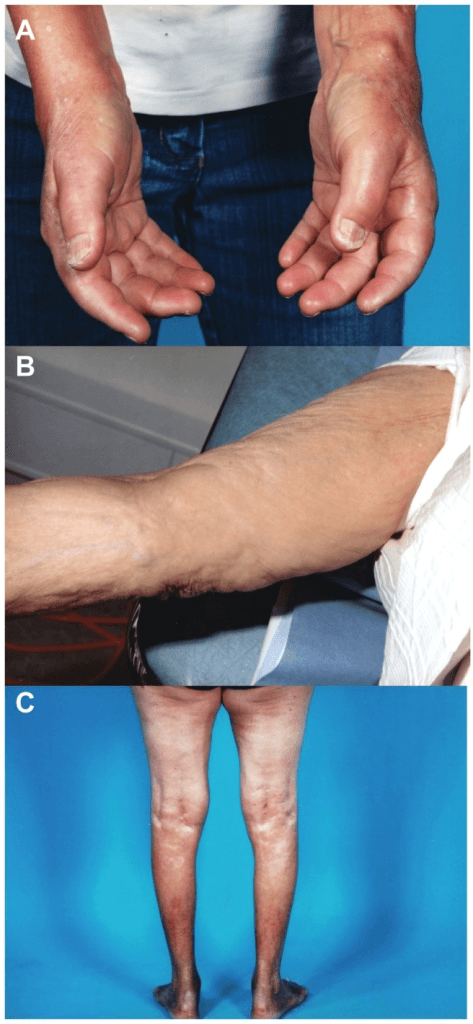
Nephrogenic systemic fibrosis. NSF is a potentially fatal fibrosing condition affecting the skin, joints and internal organs, caused by gadolinium in severe renal impairment. The risk is almost exclusively in patients with an eGFR less than 30, and the culprit is free, unchelated gadolinium released from the contrast agent. That risk is what drives the avoidance of the high-risk linear agents and the eGFR-based screening before any gadolinium is given.
Why the chelate structure drives the risk. Linear (open-chain) chelates hold the gadolinium ion less tightly, so during prolonged retention in severe renal impairment they release more free (toxic) gadolinium, which triggers NSF. Macrocyclic chelates fully encage the ion in a rigid ring and release almost none. This is why the Group II macrocyclics are preferred whenever gadolinium is essential, and why the European regulator suspended most Group I linear agents in 2017.
The ACR groups. The ACR classifies gadolinium-based contrast agents into three groups by their association with NSF. The numbering is counter-intuitive and is a standing trap: Group I is the HIGHEST-risk (linear) group, not the safest. Say "macrocyclic" out loud before saying a group number, and the error becomes hard to make.
- Agents
- Linear agents: gadodiamide, gadopentetate, gadoversetamide
- NSF risk and use
- Associated with the GREATEST number of NSF cases; avoid in eGFR under 30 (most have been suspended or withdrawn in Europe)
- Agents
- Macrocyclic agents (gadobutrol, gadoterate, gadoteridol) plus the more stable linear gadobenate
- NSF risk and use
- Few or NO unconfounded NSF cases - the LOWEST risk and the standard choice, usable with caution even in chronic kidney disease
- Agents
- Gadoxetate disodium (a liver-specific agent)
- NSF risk and use
- Limited NSF data available; used for specific hepatobiliary indications
Guidelines, Registries & Global Practice
Contrast media safety is governed by broadly convergent international guidance, with non-ionic low-osmolar iodinated agents and macrocyclic gadolinium agents now standard worldwide. The main areas of genuine divergence are the eGFR thresholds for renal precautions and the role of premedication.
Global Epidemiology
- Iodinated contrast acute reactions: mild 0.5-3% and severe approximately 0.04% with low-osmolar agents (down from approximately 0.22% with the older high-osmolar agents).
- Gadolinium acute reactions are rarer (roughly 0.04-0.07% overall); confirmed NSF is now exceedingly rare since linear agents were restricted, with virtually no unconfounded cases reported after macrocyclic-only exposure.
- Contrast-associated AKI: historically reported in 2-25% of at-risk patients, but contemporary controlled data (propensity-matched and RCT) suggest the true attributable risk from modern IV contrast is much lower than once believed, especially above eGFR 30.
Side-by-Side Guideline Comparison
- Renal / CIN threshold
- Prophylactic hydration for eGFR under 30 (or AKI); routine renal screening targeted by risk
- Gadolinium / NSF
- Group II macrocyclic agents considered very low NSF risk even in CKD; group-based classification
- Premedication stance
- Recognises premedication value but highlights breakthrough reactions and high number needed to treat
- Renal / CIN threshold
- Volume expansion advised for eGFR under 30 (IV contrast) / under 45 (intra-arterial first-pass)
- Gadolinium / NSF
- Avoid high-risk linear agents in severe CKD; macrocyclic preferred
- Premedication stance
- Steroid premedication for prior moderate/severe reaction; emphasises shared decision-making
- Renal / CIN threshold
- Risk-stratified hydration; pragmatic thresholds around eGFR 30
- Gadolinium / NSF
- Restricts linear GBCAs; macrocyclic standard
- Premedication stance
- Premedication for prior reaction; resuscitation readiness mandatory
- Renal / CIN threshold
- Labelling-based renal cautions
- Gadolinium / NSF
- EMA suspended most linear GBCAs (2017); FDA retained with boxed warning and patient medication guide
- Premedication stance
- Class labelling on reaction risk
High- vs Limited-Resource Practice Variation
- Well-resourced settings: macrocyclic gadolinium exclusively, point-of-care creatinine, structured premedication and anaphylaxis pathways, and routine post-contrast monitoring.
- Limited-resource settings: high-osmolar ionic agents may still be used for cost reasons (higher reaction rates), eGFR may be unavailable before urgent imaging, and adrenaline or resuscitation equipment may not be immediately at the contrast injection site — the single most important safety gap to close.
- Universal minimum standard everywhere: adrenaline, oxygen, IV access and trained staff must be immediately available wherever contrast is injected, regardless of setting.
Controversies and Areas of Uncertainty
Much historical "contrast-induced nephropathy" reflected the natural creatinine fluctuation of sick patients rather than contrast toxicity. Propensity-matched studies and the AMACING trial suggest the attributable risk of modern intravenous low-osmolar contrast is small, especially above eGFR 30. The preferred term is now "contrast-associated AKI" (temporal association) versus "contrast-induced AKI" (proven causation). Renal anxiety should not delay a clinically essential scan.
Premedication reduces but does not abolish reactions, and the number needed to treat to prevent one severe reaction is very high (over 500 in the Mervak data). Mandatory 13-hour steroid regimens can delay urgent imaging and cause hyperglycaemia. Many centres now reserve full premedication for prior moderate/severe reactions and favour switching the contrast agent plus close observation.
Macrocyclic agents deposit far less gadolinium than linear agents, but trace deposition still occurs in the dentate nucleus and globus pallidus with repeated dosing. No clinical harm has been proven, yet the principle of lowest effective cumulative dose and macrocyclic-only use is now standard.
Once widely used for renal protection, both were shown to be no better than plain saline in the large PRESERVE trial and should no longer be used routinely. Isotonic saline volume expansion in the highest-risk patients remains the only consistently endorsed pharmacological measure.
Iodinated vs Gadolinium Contrast
- Iodinated (CT/fluoroscopy)
- High atomic number iodine absorbs X-rays (radiodensity)
- Gadolinium (MRI)
- Paramagnetic gadolinium shortens T1, producing T1-bright signal
- Iodinated (CT/fluoroscopy)
- Anaphylactoid reaction (approximately 0.04% severe); higher than gadolinium
- Gadolinium (MRI)
- Acute reactions rarer than iodinated contrast
- Iodinated (CT/fluoroscopy)
- Contrast-associated AKI (attributable risk small with modern agents)
- Gadolinium (MRI)
- Nephrogenic systemic fibrosis with high-risk agents in eGFR under 30
- Iodinated (CT/fluoroscopy)
- Non-ionic low-osmolar (e.g. iohexol, iopamidol)
- Gadolinium (MRI)
- Macrocyclic (e.g. gadobutrol, gadoterate, gadoteridol)
- Iodinated (CT/fluoroscopy)
- Withhold if eGFR under 30 (lactic acidosis risk if AKI develops)
- Gadolinium (MRI)
- No metformin interaction
- Iodinated (CT/fluoroscopy)
- Use only if essential
- Gadolinium (MRI)
- Avoid — crosses placenta; reserve for compelling indication
Clinical Decision Scenarios
Practise clinical reasoning and management decisions out loud
“A patient collapses with severe bronchospasm, hypotension, and urticaria immediately after receiving iodinated contrast for a CT scan.”
“A 72-year-old patient with an eGFR of 25 requires a contrast-enhanced CT scan for staging of a suspected bone tumour.”
“An examiner asks you about nephrogenic systemic fibrosis (NSF) — what it is, who is at risk, and how to minimise the risk.”
Anaphylaxis Management (ABCDA)
- A: Adrenaline 0.5mg IM (1:1000) — FIRST LINE, anterolateral thigh, repeat every 5 min
- Paediatric IM: over 12y 500mcg; 6-12y 300mcg; 6mo-6y 150mcg; or 10 mcg/kg. IV only by trained staff, 50 mcg boluses of 1:10,000
- B: Breathing — high-flow O2, salbutamol nebuliser for bronchospasm
- C: Circulation — large-bore IV access, rapid saline bolus
- D: Drugs — antihistamine and hydrocortisone are SECOND LINE only, and do NOT prevent the biphasic phase
- A: Arrest team — observe 4-6h minimum, 12h+ if hypotension, repeated adrenaline, or poor home support
- Tryptase x3: immediately, 1-2h, and baseline at 24h+
Contrast-Induced Nephropathy
- Definition: 25% or 44 micromol/L creatinine rise within 48-72 hours
- Threshold for precautions: eGFR less than 30 (ACR and ESUR)
- Prevention: isotonic saline is the only endorsed measure — but no benefit shown in the eGFR 30-59 band, and it caused complications in 5.5%
- Bicarbonate and N-acetylcysteine are NOT better than plain saline (PRESERVE, n=5,177)
- Withhold metformin 48h post-contrast if eGFR less than 30; no need to stop above that without AKI
- Usually self-limiting: peaks at 3-5 days, resolves within 7-14 days
Extravasation and Thyroid
- Extravasation: stop injection, elevate, cold compress — most are benign
- Surgical review for pain out of proportion, pain on passive stretch, paraesthesia, blistering, tense compartment or vascular compromise
- Iodine load can precipitate thyrotoxicosis (Jod-Basedow) weeks later in Graves' or an autonomous nodule
- Iodinated contrast blocks radioiodine uptake — delay any radioiodine scan or therapy by about 6 weeks to 2 months
- Neither applies to gadolinium
Gadolinium Safety
- NSF risk in severe renal impairment (eGFR less than 30) — potentially fatal fibrosis
- Group II (macrocyclic): lowest NSF risk — use these if gadolinium essential
- Group I (linear): highest NSF risk — AVOID in renal impairment
- Check eGFR before ALL gadolinium studies
- Gadolinium brain deposition: clinical significance unclear; macrocyclic agents deposit less
Key Myths Debunked
- Shellfish allergy ≠ iodine allergy (tropomyosin protein allergy, not iodine)
- Reactions are anaphylactoid (not IgE-mediated) — can occur on first exposure
- Breastfeeding does NOT need to stop after contrast (less than 0.04% enters milk)
- Premedication reduces but does NOT eliminate reaction risk
Evidence Base
Adverse Reactions to Ionic vs Non-Ionic Contrast (Katayama / Japanese Committee)
- Nationwide prospective study of 337,647 examinations (169,284 ionic, 168,363 non-ionic).
- Overall adverse reaction rate was 12.66% for ionic high-osmolar contrast vs 3.13% for non-ionic low-osmolar contrast.
- Severe reactions occurred in 0.22% (ionic) vs 0.04% (non-ionic); one death occurred in each group, with no proven causal relationship to contrast.
Breakthrough Reactions Despite Premedication
- Among 1,051 inpatients completing 13-hour corticosteroid and diphenhydramine premedication before contrast-enhanced CT, the overall breakthrough reaction rate was 1.2%.
- Patients premedicated because of a previous contrast reaction had a breakthrough rate of 2.1% (3-4 times the 0.6% ordinary rate in the general population); those premedicated for other reasons had a 0% breakthrough rate.
- There were NO severe breakthrough reactions; the number needed to treat was 69 to prevent any reaction and 569 to prevent a severe reaction.
Biphasic Anaphylaxis: Incidence, Timing and Predictors
- 27 observational studies pooling 4,114 patients with anaphylaxis, of whom 192 had a biphasic reaction - 4.7%, far below the often-quoted 'up to 20%'.
- Median time to onset of the second phase was 11 hours, with a range from 0.2 to 72 hours.
- Presentation with hypotension more than doubled the risk (pooled OR 2.18, 95% CI 1.14-4.15); an unknown trigger raised it (OR 1.72, 95% CI 1.0-2.95) and a food trigger lowered it (OR 0.62, 95% CI 0.4-0.94).
Non-ionic contrast and premedication reduce but do not eliminate reaction risk.