IMN Gold Standard | Early Fixation | Rotation Check | Screen for Neck Fx
- Intramedullary nailing is gold standard (reamed, locked)
- Screen for ipsilateral neck fracture - 5% incidence, easily missed
- Early fixation (under 24h) reduces pulmonary complications in polytrauma
- 1-1.5L blood loss expected - resuscitate before and during surgery
- Rotation alignment - check clinically, compare to contralateral side
- “Antegrade for most; retrograde for floating knee, bilateral, pregnancy, obesity
- “Piriformis entry: risk of AVN in young - trochanteric entry safer
- “Damage control: external fixation if physiologically unstable
- “Check rotation intraoperatively - ER malrotation is most common error
Overview and Epidemiology
Who. The age distribution is bimodal. Young adults aged 15-44 break the femoral shaft in high-energy trauma, with a 2:1 male predominance; the elderly over 65 break it in low-energy falls or through pathological bone. Incidence is 10-20 per 100,000 per year.
Mechanism. High-energy mechanisms predominate in the young, low-energy falls in the elderly:
- Motor vehicle accidents (most common)
- Motorcycle crashes
- Falls from height
- Gunshot wounds
- Pedestrian versus vehicle
What comes with it. Associated injuries are common in polytrauma (50%), and a complete ATLS assessment is essential after any high-energy mechanism. Head injury is common, chest trauma raises the fat embolism risk, and abdominal injuries and other long-bone fractures travel with the femur. The injuries to screen for in the limb itself:
- Ipsilateral femoral neck fracture (5%) - easily missed
- Floating knee (ipsilateral tibia fracture)
- Knee ligament injuries (10-30%)
- Hip dislocation
- Vascular injury (rare but devastating)
Blood loss. A closed fracture loses 1-1.5 litres into the thigh, an open fracture more and less predictably, and the loss can be occult, declared only by thigh swelling. Anticipate it and resuscitate accordingly: early blood products, with the massive transfusion protocol if indicated; avoid crystalloid over-resuscitation; monitor haemoglobin perioperatively; and consider tranexamic acid.
Anatomy and Biomechanics
The shaft. The femoral shaft runs from 5cm below the lesser trochanter to the supracondylar metaphyseal flare, about 40-50cm of cortical bone. It has an anterior bow (apex anterior, radius approximately 120cm), which matters for nail insertion, and its narrowest point is the isthmus, 9-12mm in diameter. The linea aspera is the posterior ridge to which the muscles attach.
The muscles. Three compartments surround the shaft: the quadriceps anteriorly, encasing the anterior femur; the adductors medially; the hamstrings posteriorly. Their attachments predict the deformity a fracture takes at each level, set out in the location table under Classification.
Blood supply. Perforating branches of the profunda femoris form the periosteal supply to the outer third of the cortex, and are preserved with careful technique. The nutrient artery, also a branch of the profunda, enters the posterior cortex at mid-shaft and supplies the inner two-thirds; this endosteal supply is disrupted by the fracture and by reaming.
Why reaming still wins. Reaming disrupts the endosteal supply only temporarily, and the reaming debris is a local autograft. The net effect promotes healing, and the biological benefit outweighs the temporary disruption.
Load and the nail. The femur is the primary weight-bearing bone of the lower limb and sees bending, torsion and axial load. A nail is an intramedullary splint that shares that load; its length and diameter affect its stiffness, and it is locked statically or dynamically. Nail design must match the fracture pattern and the patient.
Classification
Winquist and Hansen grade comminution, and the grade guides the locking strategy. AO/OTA 32 describes the pattern. Location tells you the deformity to expect and which way to nail.
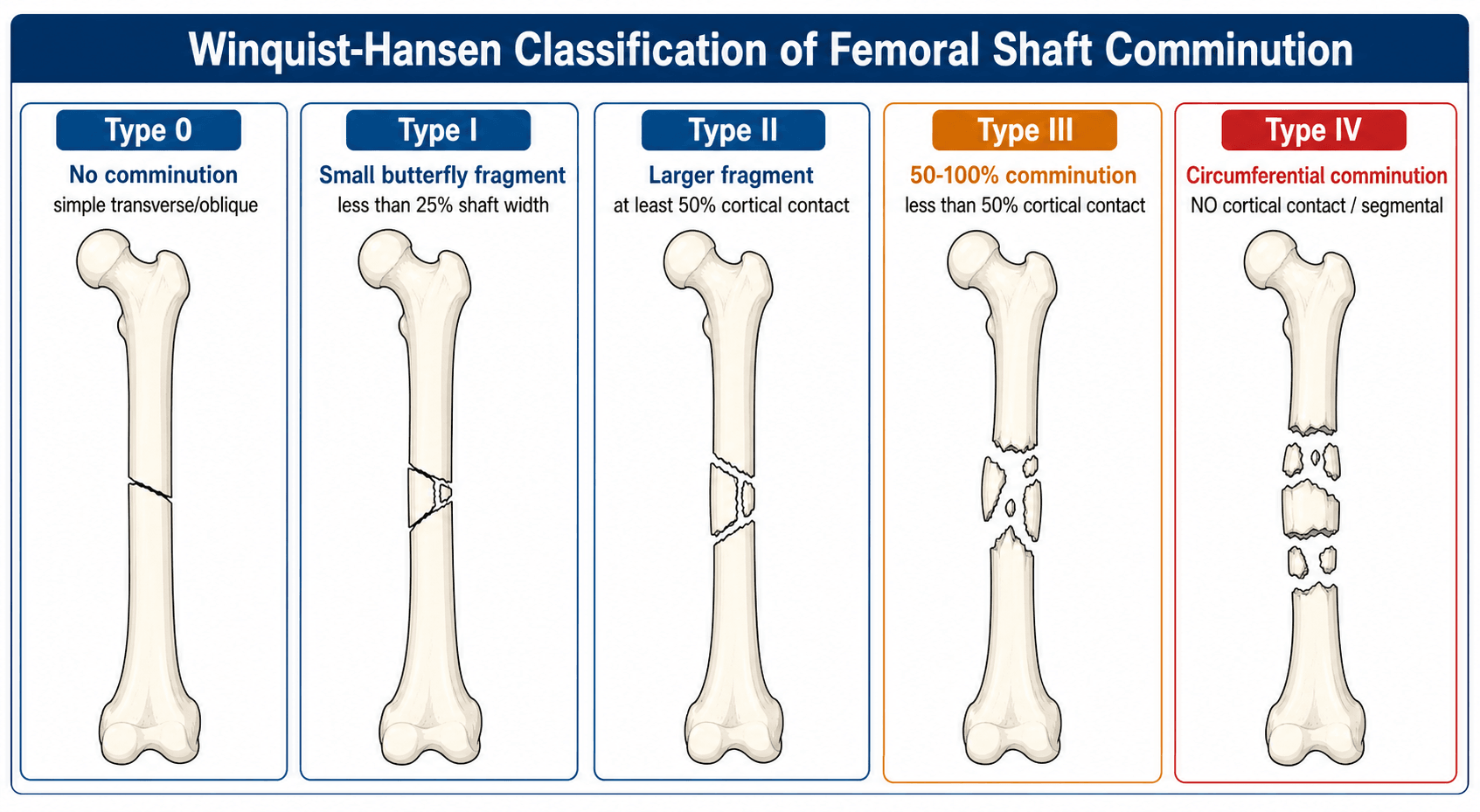
- Description
- No comminution
- Stability
- Stable
- Locking
- Dynamic possible
- Description
- Small butterfly (under 25%)
- Stability
- Stable
- Locking
- Dynamic possible
- Description
- Butterfly 25-50%, at least 50% cortical contact
- Stability
- Moderate
- Locking
- Static preferred
- Description
- Butterfly over 50%, under 50% cortical contact
- Stability
- Unstable
- Locking
- Static required
- Description
- Circumferential loss, segmental
- Stability
- Very unstable
- Locking
- Static, may need graft
Static or dynamic. Dynamic locking leaves one end unlocked so that weight-bearing compresses the fracture axially, and is an option for the stable patterns, Grades 0-I. Static locking fixes both ends and is the choice for the unstable Grades II-IV. Most femoral shaft fractures should be statically locked initially.
History
The mechanism. High or low energy, the direction of force, the position at the time of injury, and what associated injuries that mechanism makes likely.
The patient. Age and baseline function, comorbidities, anticoagulation status, previous surgery on this limb, and the social circumstances the recovery will have to fit into. A thorough history guides treatment decisions and expectations.
Examination
The limb. The thigh is swollen, and the degree of swelling is an indicator of blood loss; the leg is shortened and rotated, the deformity visible. Look at the skin and decide whether the fracture is open or closed. Screen the joints on either side: hip pain, and range of movement if it can be tested; a knee effusion and ligament stability, although an examination under anaesthesia is often needed for the ligaments.
Neurovascular status. Document it carefully before any intervention:
- Distal pulses (dorsalis pedis, posterior tibial)
- Motor: dorsiflexion, plantarflexion, toe movements
- Sensory: all dermatomes of the foot
- Compartments: the thigh has three
The rest of the patient. ATLS for polytrauma. The ipsilateral femoral neck is screened by imaging in every femoral shaft fracture, set out under Investigations.
Investigations
Radiographs. The films must include the joint above and the joint below:
- Full-length femur, AP and lateral, including hip and knee
- AP pelvis, to screen the hip and compare the sides
- AP and lateral knee, for extension of the fracture and ligament injury
CT is for suspicion of an ipsilateral neck fracture, for assessing a complex fracture pattern, and for pre-operative planning in difficult cases. MRI is rarely needed acutely but is valuable for occult injuries: an occult neck fracture when CT is inconclusive, and knee ligament injury, usually delayed rather than acute.
The ipsilateral neck. About 5% of femoral shaft fractures carry a femoral neck fracture on the same side (Tornetta's series puts the range at 1-9%), and it is often non-displaced and subtle. A missed neck fracture is a disaster, ending in AVN or nonunion, with significant medicolegal implications. It must be excluded before nailing and reaming, because a neck fracture changes the entry point and the approach, and if it is present the neck is fixed first, then the shaft.
- Dedicated AP hip view
- Internal rotation view if possible
- CT scan if any suspicion
- Intraoperative screening if not done pre-operatively
Bloods. A trauma panel: full blood count for baseline haemoglobin and platelets, coagulation studies (INR, PTT), group and screen or crossmatch of 2-4 units, renal function, and a blood gas in polytrauma. Blood products must be available before surgery starts; haemoglobin is checked serially through the operation, and a cell saver is worth considering for bilateral or complex cases.
Planning. Measure femoral length against the contralateral side, the canal diameter at the isthmus, and the neck-shaft angle for proximal fractures. Then decide, before entering the operating room: antegrade or retrograde; piriformis or trochanteric entry; nail length and diameter; static or dynamic locking; immediate or delayed.
Management
The standard. Reamed, locked intramedullary nailing is the treatment for virtually all femoral shaft fractures, with a long nail preferred for most. The goals are to restore length, alignment and rotation, to fix the bone stably enough for early mobilisation, and to preserve the biology where possible.
Timing. In the physiologically stable patient the nail goes in within 24 hours. Early fixation reduces pulmonary complications, ARDS and fat embolism, in polytrauma, and early stabilisation is both safe and beneficial in the appropriately resuscitated patient. The unstable patient gets damage control instead: an external fixator now, and a nail when the physiology allows.
Damage control orthopaedics. The indications are physiological instability (hypothermia, coagulopathy, acidosis), ongoing massive transfusion, a head injury with raised intracranial pressure, and polytrauma with multiple competing priorities. A spanning external fixator, hip to knee or a simple femoral frame, stabilises the fracture, reduces the bleeding and lets the other surgical priorities proceed. Conversion to a nail comes when the patient is physiologically stable, typically at 24-72 hours: remove the fixator, prepare widely, then nail, planning carefully for the pin-site infection risk, since the timing balances physiology against soft tissue and infection.
The classic exam framing is "early total care (ETC) versus damage control orthopaedics (DCO)," but modern practice has moved to Early Appropriate Care (EAC): rather than a fixed binary, the timing of definitive nailing is driven by how well the patient has been resuscitated, judged on physiological markers - lactate, pH and base excess (e.g. nailing is considered safe once lactate and base deficit are trending to normal, pH is corrected, and the patient is warm and not coagulopathic).
The key concept is Pape's "borderline" patient - not clearly stable, not clearly in extremis - in whom reamed nailing imposes a "second hit" (the embolic/inflammatory load of reaming on top of the injury), which can tip a marginally-resuscitated polytrauma or chest-injured patient into ARDS/SIRS. For these patients, temporise with an external fixator (DCO) and convert when the markers normalise; for the genuinely stable patient, early definitive nailing within 24 hours reduces pulmonary complications and mortality. Decide nailing timing by resuscitation status, not the clock alone: stable, early definitive nail; in extremis, DCO; borderline, resuscitate to physiological endpoints, then convert.
Entry point. Piriformis entry sits in line with the canal and suits a narrow canal, but it crosses the blood supply of the femoral neck, and it is difficult in the obese. Trochanteric entry has a low AVN risk and easier access and positioning, at the cost of a nail that may need a slight valgus bend; most modern nails are designed for it, and it is now preferred for most cases. The historic AVN concern relates chiefly to piriformis entry in skeletally immature patients (Ricci), which is why piriformis entry is avoided in the young.
- Advantages
- In line with canal, good for narrow canals
- Disadvantages
- AVN risk in young, difficult in obese
- Advantages
- Low AVN risk, easier access
- Disadvantages
- May need slight valgus bend in nail, better for modern nails
Antegrade or retrograde. Antegrade is the default, for its excellent biomechanical properties, and the proximal third in particular is nailed antegrade, where it gives better control and retrograde proximal locking is difficult. Retrograde is preferred in a defined set of situations: the floating knee, where the tibia is nailed separately; bilateral fractures, done supine; pregnancy, where it reduces radiation to the pelvis; obesity, for access; and the distal third, where it gives better distal control (or antegrade with blocking screws). Knee pathology or a knee replacement contraindicates the retrograde nail.
- Antegrade
- Preferred (trochanteric entry), long nail; check for neck fracture
- Retrograde
- Alternative
- Antegrade
- Possible
- Retrograde
- Preferred - easier; nail tibia separately
- Antegrade
- Possible
- Retrograde
- Preferred - supine positioning, easier access
- Antegrade
- Higher pelvic radiation
- Retrograde
- Preferred - less pelvic radiation
- Antegrade
- Difficult access
- Retrograde
- Preferred - easier access
- Antegrade
- Preferred - better control; piriformis or trochanteric entry
- Retrograde
- Difficult proximal locking
- Antegrade
- Possible, with blocking screws
- Retrograde
- Better distal control
- Antegrade
- Preferred
- Retrograde
- Contraindicated
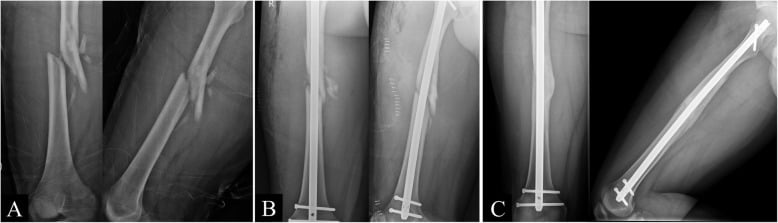
Surgical Technique
Positioning. For an antegrade nail, a fracture table with traction, supine, is most common; the alternative is lateral decubitus on a radiolucent table. Either way, make sure the C-arm can reach. A retrograde nail is done supine with the knee flexed over a radiolucent triangle.
Entry. The piriformis fossa lies medial to the tip of the greater trochanter, in line with the femoral canal: the true anatomic axis. Trochanteric entry uses the greater trochanter itself, for the nails designed for it, and avoids damage to the piriformis tendon. Whichever is chosen, avoid a varus start, which breaches the medial wall.
The steps. Antegrade nailing, in order:
- Position, prepare and drape the whole leg
- A 3-5cm incision proximal to the greater trochanter
- Split gluteus medius in line with its fibres
- Identify the entry point with an awl under fluoroscopy, pass a guidewire into the canal and open it with the opening reamer or awl
- Pass the ball-tipped guidewire across the fracture
- Ream sequentially in 0.5mm increments to 1-1.5mm above the nail diameter
- Insert the nail over the exchange guidewire to the correct depth
- Lock proximally through the targeting jig, under fluoroscopy
- Verify length and rotation
- Lock distally, freehand by the perfect-circles technique or with a jig
- Final imaging in all planes
Reduction. Closed reduction with traction and manipulation is the norm. Blocking (Poller) screws are used where the fracture extends into the metaphysis, percutaneous reduction clamps help a simple pattern, and open reduction is for the irreducible fracture only.
Rotation. Malrotation is the most common technical error, and it is external rotation that is usually got wrong. Use several checks and let them agree:
- Match the cortical diameters of the proximal and distal fragments on fluoroscopy
- Compare the lesser trochanter profile with the contralateral side on intraoperative films of both sides
- Check the trochanter-patella relationship, and patella-to-tubercle alignment, clinically
- Compare hip internal and external rotation and the foot progression angle with the other leg
- Intraoperative CT if uncertain
Length. Pre-operative templating is essential. Compare with the contralateral femur under traction, using the overlay technique on the AP views, and accept 1cm of shortening in the elderly if needed.
Retrograde nailing. Indicated for an ipsilateral knee injury, pregnancy and the obese patient. The entry is in the intercondylar notch, anterior to the PCL. It cannot be used for proximal-third fractures.
When not to nail. Plating is indicated for a narrow canal (below 8mm), existing hardware, periarticular extension, and a vascular repair that needs stability. External fixation is for damage control in polytrauma, contaminated open fractures, and temporary stabilisation.
Children. Avoid piriformis entry for its AVN risk; use a lateral trochanteric entry or flexible nails, and submuscular plating for school-age children. Technique selection depends on the fracture pattern, the patient and the implants available.
Complications
On the table. Malrotation is the most common error, especially external rotation, and the prevention is the careful intraoperative assessment described under Surgical Technique. A guidewire or reamer breaks when it is forced or when the wire kinks in the canal; avoid both, and retrieve any broken hardware. The fracture can displace as the nail goes in, so hold the reduction through reaming and insertion, with the fracture table's traction. Iatrogenic fracture comes as comminution at the entry point or a fracture at the nail tip distally, and an oversized nail in a narrow canal invites it.
The first days. Fat embolism syndrome is the classic early complication of this fracture, and the pearl below sets out its timing, criteria and management. ARDS in polytrauma is the other pulmonary complication, and the timing argument under Management is its prevention. The thigh compartments can develop compartment syndrome, so watch for increasing pain and swelling, and perform a fasciotomy if it is diagnosed. Infection runs under 1% for closed nailing and higher in open fractures; it is treated with antibiotics and debridement, and may need a nail exchange.
The femoral shaft (and long-bone/pelvic) fracture is the classic cause of fat embolism syndrome (FES), so examiners expect the diagnostic framework, not just "rash and hypoxia." FES typically declares itself after a lucid interval of about 24-72 hours and is a clinical diagnosis by the Gurd & Wilson criteria (one major + several minor, with supporting features):
- Major: respiratory insufficiency/hypoxia (PaO2 low), cerebral involvement (confusion, drowsiness unexplained by head injury), and a petechial rash (characteristically over the conjunctivae, axillae, neck and upper trunk - the most specific sign).
- Minor/laboratory: tachycardia, pyrexia, retinal changes (fat/petechiae), jaundice, renal changes, anaemia, thrombocytopenia, raised ESR, and fat macroglobulinaemia.
Pathophysiology is dual - a mechanical theory (marrow fat embolises to the lungs/systemic circulation, including paradoxically via a PFO) and a biochemical theory (free fatty acids from mobilised fat cause a toxic pneumonitis) - which is why it differs from a simple pulmonary thromboembolism (FES has the petechiae, CNS signs and a fracture source rather than a DVT, and a slightly later, more gradual onset).
Management is supportive (oxygen/ventilation, resuscitation); the key intervention is prevention by early fracture stabilisation (and limiting the reaming second hit in the at-risk patient). Steroids are not routine.
Nonunion. Occurs in 2-5% with modern techniques, with open fracture, comminution and infection the risk factors. Treatment is exchange nailing, bone graft, or plate augmentation.
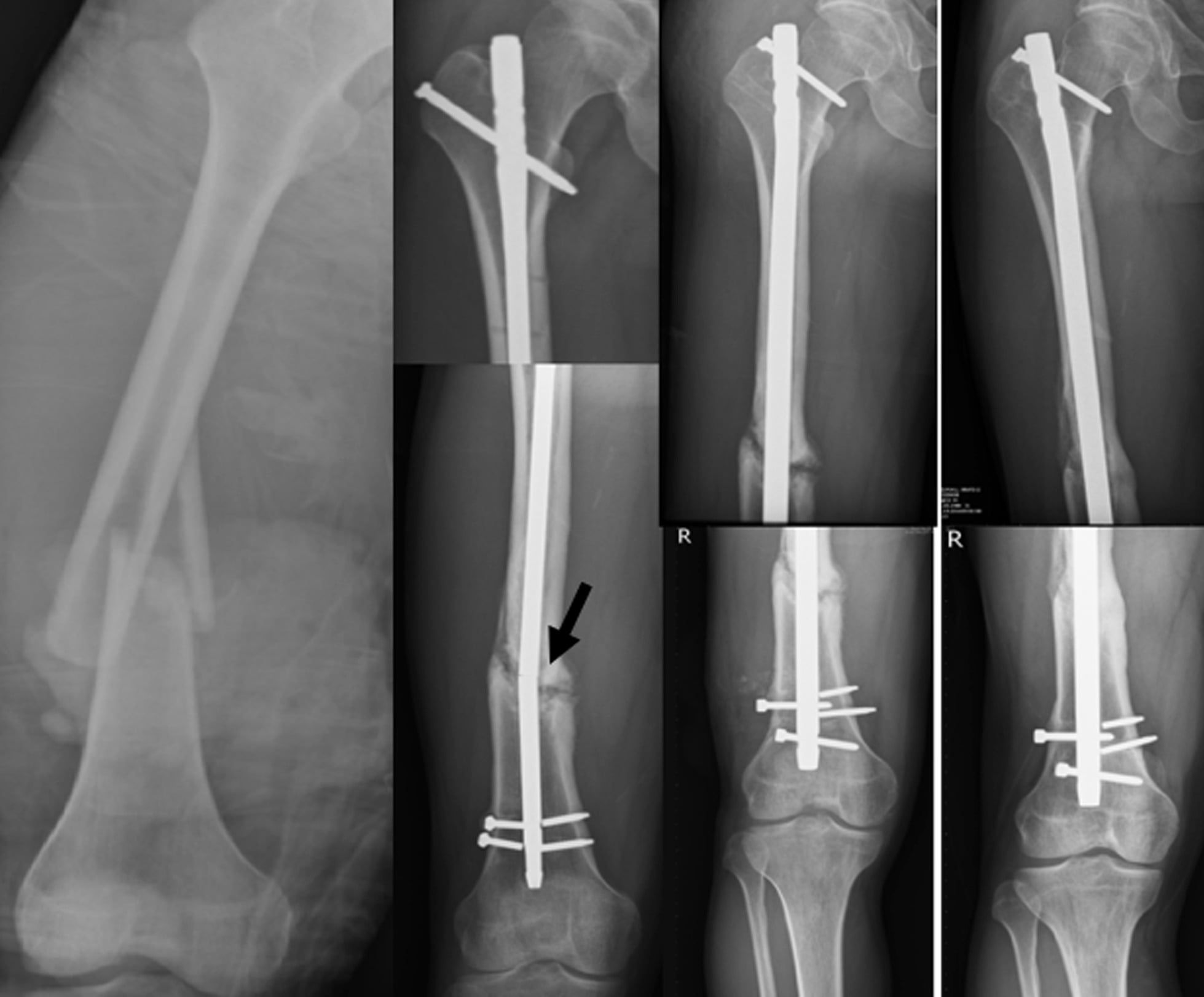
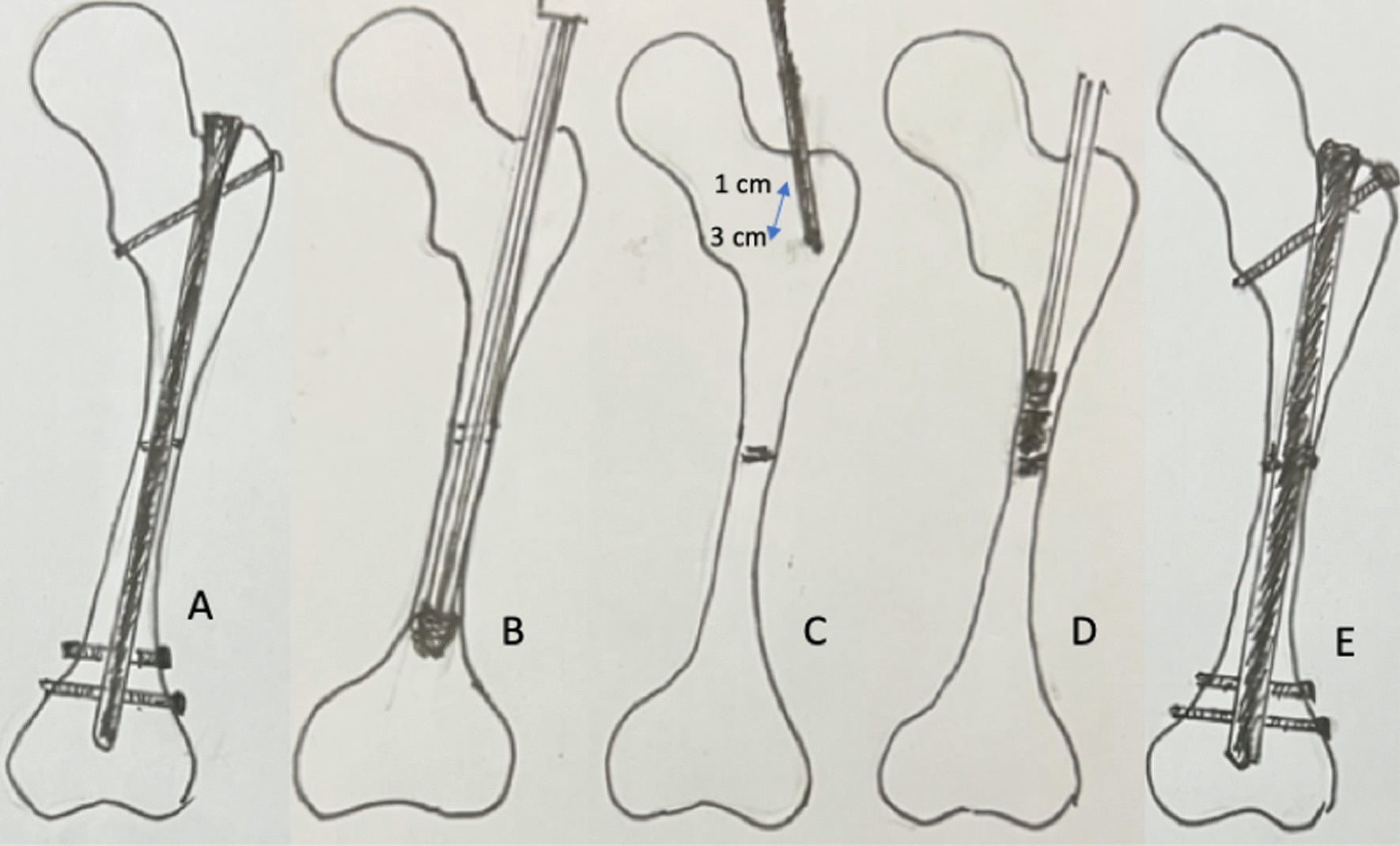
Malunion. Rotation is the most common malunion, and it is usually external rotation; shortening follows comminution; angular deformity is rare with a nail. Malrotation may need a derotation osteotomy.
Hardware and length. Proximal screws cause trochanteric pain and a retrograde nail causes knee pain; symptomatic hardware is removed after union. Limb length discrepancy comes from shortening at the fracture site: a shoe lift if under 2cm, lengthening if significant. Careful intraoperative restoration of length is the prevention.
Postoperative Care
Weight-bearing. Most nailed fractures with adequate fixation bear weight as tolerated from the start; comminuted patterns (Winquist III-IV) are protected, and progression follows the healing. Early mobilisation is critical to preventing complications.
Thromboprophylaxis. Low-molecular-weight heparin, started 6-12 hours after surgery and continued for 4-6 weeks in total, with mechanical prophylaxis alongside.
The first two weeks. The early protocol:
- Day of surgery: neurovascular checks hourly for 4 hours, multimodal analgesia, and post-operative radiographs to check implant position
- Day 1: sit out of bed with the physiotherapist and commence range of movement exercises
- Wound check at 2 weeks, with sutures out at 10-14 days; progress mobility under physiotherapy supervision and watch the wound
Weeks 2-12. Weight-bearing progresses on the surgeon's guidance, with active hip and knee range of movement, gait training from walker to crutches, and pool exercises once the wound has healed. Radiographs at 6 weeks assess callus; from there, advance to a single crutch and then a cane, strengthen the hip abductors and quadriceps, and address any stiffness that is developing. Regular clinical and radiographic review is what catches problems early. The red flags to monitor:
- Increasing pain, which may indicate hardware failure
- New deformity
- Wound drainage beyond 2 weeks
- Persistent thigh swelling
Months 3-6. Radiographs at 3 months assess union; with bridging callus, activities advance, walking aids are weaned as strength permits, and light gym work or cycling begins. Expect radiographic union by 4 months, and at 6 months confirm it, considering dynamisation if union is delayed. Driving resumes when the patient is off analgesia and able to brake, return to work is gradual with desk work earlier, and athletes get sport-specific rehabilitation; most patients are back to normal activity by 4-6 months.
Hardware removal and the long term. Removal is not routine and is only for symptomatic hardware, a minimum of 18-24 months after union, with counselling about the risk of refracture through the screw holes. Review annually until 2 years, address any limb length discrepancy, and remember that malrotation is usually well tolerated under 15 degrees.
Outcomes and Prognosis
Modern reamed locked nailing unites the great majority of femoral shaft fractures, and most patients achieve excellent functional outcomes.
- Result
- 95-98%
- Notes
- Excellent with reamed locked nailing
- Result
- 3-4 months
- Notes
- Simple patterns faster
- Result
- 4-6 months
- Notes
- Depends on occupation
- Result
- 5-15%
- Notes
- Often under 10 degrees, well tolerated
- Result
- 2-5%
- Notes
- Higher in open, comminuted
Prognosis. A simple, closed fracture, fixed early and reduced well in a compliant patient, does best. The prognosis is worse with an open fracture (especially Gustilo III), a segmental or highly comminuted pattern, infection, delayed fixation, and smoking.
Differential diagnosis. The diagnosis of a displaced femoral shaft fracture is usually obvious, but the key clinical task is distinguishing it from injuries that change the surgical plan, and identifying the underlying cause in low-energy or atypical presentations.
- Distinguishing Features
- Often non-displaced, subtle; groin pain; seen on fine-cut CT not always on plain film
- Why It Matters
- Occurs in 1-9% (Tornetta); must fix neck first to avoid osteonecrosis
- Distinguishing Features
- Proximal location; flexed-abducted-ER proximal fragment; needs cephalomedullary device
- Why It Matters
- Different implant and reduction strategy than mid-shaft
- Distinguishing Features
- Apex-posterior gastrocnemius pull; intra-articular extension on CT
- Why It Matters
- May favour retrograde nail or distal locking plate
- Distinguishing Features
- Low-energy mechanism, prodromal pain, lytic/blastic lesion, abnormal bone
- Why It Matters
- Requires staging, biopsy considerations, possible stabilisation of whole bone
- Distinguishing Features
- Lateral cortical beaking, transverse subtrochanteric/diaphyseal line, thigh prodrome, often bilateral
- Why It Matters
- Stop antiresorptive, image contralateral femur, full-length nail
- Distinguishing Features
- Fracture around hip/knee implant; Vancouver/Su classification applies
- Why It Matters
- Implant stability dictates revision vs fixation
- Distinguishing Features
- Knee swelling between two diaphyseal fractures; high vascular/ligament injury rate
- Why It Matters
- Sequenced fixation; screen vascular status
Guidelines, Registries & Global Practice
Global Epidemiology
Femoral shaft fractures follow a bimodal age and mechanism pattern that is consistent across high-income settings: high-energy trauma in young men (road traffic and motorcycle crashes, falls from height) and low-energy fragility or atypical fractures in older, predominantly female patients. In low- and middle-income countries the burden is dominated by road-traffic trauma in young adults, where access to timely intramedullary fixation and image intensification is the principal determinant of outcome.
- Position on Femoral Shaft Fractures
- Reamed locked intramedullary nailing is the reference standard; AO/OTA 32 classification used for description and research
- Evidence Basis
- Expert consensus + RCT data (COTS, Bone)
- Position on Femoral Shaft Fractures
- Early definitive fixation of the diaphyseal femur once resuscitated; lactate/base-deficit-guided 'Early Appropriate Care'
- Evidence Basis
- Level I-III (Bone; Vallier)
- Position on Femoral Shaft Fractures
- Stabilisation by an appropriate team within agreed trauma-network timelines; damage control for the physiologically deranged
- Evidence Basis
- BOAST standards + trauma-network audit
- Position on Femoral Shaft Fractures
- Fix long-bone fractures to allow early mobilisation; manage within a major trauma network; VTE prophylaxis per NG89
- Evidence Basis
- Guideline (GRADE-appraised)
- Position on Femoral Shaft Fractures
- IM nailing standard; trochanteric entry increasingly favoured; retrograde for defined indications
- Evidence Basis
- Cohort + registry data
Registry and Trial Evidence on Timing
The early-fixation paradigm rests on Bone's 1989 randomised trial and has since been refined by the damage-control vs early-total-care debate. The John Hunter Hospital Level-1 trauma centre series (Balogh group) found that a predominantly early-total-care strategy in stable and borderline femoral shaft fracture patients produced fewer ICU and ventilator days and fewer septic complications than the comparator randomised cohort, supporting individualised, resuscitation-driven decision-making rather than reflex damage control.
Thromboprophylaxis and Access to Care
VTE prophylaxis after major lower-limb trauma uses LMWH (e.g. enoxaparin) as the standard agent, typically continued for several weeks, with mechanical prophylaxis as an adjunct and early mobilisation as the cornerstone; precise duration follows regional trauma and thromboprophylaxis guidance. Across well-resourced systems, modern reamed locked nailing achieves union in roughly 95-98% of closed fractures with most patients returning to pre-injury function within about six months; outcome disparities globally are driven chiefly by access to fluoroscopy, sterile implants, and timely surgery rather than by technique selection.
MCQ Practice Points
Q: What is the recommended timing for femoral shaft fracture fixation in a polytrauma patient?
A: Within 24 hours if the patient is physiologically stable. Early fixation reduces pulmonary complications (ARDS, fat embolism). If unstable, damage control with external fixation.
Q: What is the main concern with piriformis entry for antegrade femoral nailing in a young patient?
A: Risk of AVN (avascular necrosis) of the femoral head. The entry violates the blood supply to the femoral head. Trochanteric entry is preferred to avoid this risk.
Q: What associated injury must be screened for in all femoral shaft fractures?
A: Ipsilateral femoral neck fracture - occurs in 5% of cases and is easily missed. Get dedicated hip views or CT before nailing. If present, fix neck first.
Q: What is the most common rotational malalignment error in femoral nailing?
A: External rotation. Up to 5-15% of cases have some malrotation. ER is more common than IR. Check rotation intraoperatively using cortical diameter matching and comparison to contralateral side.
Q: When is retrograde femoral nailing preferred over antegrade?
A: Floating knee (ipsilateral tibia fracture), bilateral femur fractures (easier positioning), pregnancy (less pelvic radiation), morbid obesity (easier access), and some distal third fractures.
Exam Viva Scenarios
Practise clinical reasoning and management decisions out loud
“A 25-year-old male presents after motorcycle accident with closed femoral shaft fracture, pelvic fracture, and moderate head injury (GCS 13). BP 110/70 after resuscitation. How do you manage the femoral shaft?”
“A 32-year-old female has femoral shaft fracture and ipsilateral tibial shaft fracture after being hit by a car. What is your approach?”
“You are about to nail a femoral shaft fracture when your registrar shows you the CT scan that was done for abdominal trauma - there is a non-displaced femoral neck fracture on the same side. What is your plan?”
Gold Standard Treatment
- Reamed locked intramedullary nailing
- Early fixation (under 24h) in polytrauma
- Long nail preferred for most cases
- Static locking for comminuted patterns
Screen for Neck Fracture
- 5% have ipsilateral neck fracture
- Easily missed if non-displaced
- CT scan if X-ray unclear
- If present: fix neck FIRST
Entry Point Selection
- Trochanteric: Preferred for most (less AVN risk)
- Piriformis: Avoid in young (AVN risk)
- Retrograde: Floating knee, bilateral, pregnancy, obesity
Rotation Check
- Cortical diameter matching on fluoro
- Opposite limb comparison
- Trochanter-patella relationship
- ER malrotation most common error
Damage Control Indications
- Hypothermia, coagulopathy, acidosis
- Massive transfusion ongoing
- Apply external fixator temporarily
- Convert to IMN when stable (24-72h)
Evidence Base
Bone (1989): Early vs Delayed Fixation in Polytrauma
- Prospective randomised study of 178 adults comparing early (under 24h) vs delayed reduction and stabilisation of acute femoral fractures.
- In multiply injured patients, delayed stabilisation increased pulmonary complications (ARDS, fat embolism, pneumonia), ICU days, and hospital stay.
- Hospital costs were significantly higher with delayed treatment across all patients.
Vallier (2013): Early Appropriate Care Protocol
- 1443 adults with pelvis, acetabulum, spine, or femur fractures; definitive fixation within 24-48h after resuscitation reduced pulmonary complications.
- Lactate was the most specific predictor of complications; correction of pH to greater than 7.25 within 8 hours reduced pulmonary morbidity.
- Chest injury, number of fractures, and timing of fixation were the key independent variables.
Nicholas/Balogh (2011): Damage Control vs Early Total Care
- Level-1 trauma centre series from John Hunter Hospital of 66 femoral shaft fracture patients categorised by Pape physiology into stable and borderline groups.
- A predominantly early-total-care strategy (used in 98% of stable and 86% of borderline patients) was associated with fewer ICU and ventilator hours and fewer septic complications than the comparator randomised cohort.
- Borderline patients managed with early total care showed a tendency to lower ARDS and multiple-organ-failure rates.