Non-Operative Success Rate High | Radial Nerve at Risk | Functional Bracing Gold Standard
- Functional bracing achieves over 90% union with acceptable alignment in most cases
- Radial nerve spirals around posterior humerus - vulnerable at junction of middle and distal thirds
- Holstein-Lewis fracture: Distal third spiral fracture with high radial nerve palsy risk
- Acceptable alignment: under 20° anterior angulation, under 30° varus/valgus, less than 3cm shortening, under 15° rotation
- Primary radial nerve palsy (at injury): observe 3-4 months before exploration
- “70% of radial nerve palsies recover spontaneously without exploration
- “Secondary palsy after manipulation = urgent exploration
- “Pendulum exercises begin immediately with functional brace
- “Antegrade IMN avoids radial nerve but risks rotator cuff injury
Overview and Epidemiology
Humeral shaft fractures are unusual among long-bone fractures in that non-operative management achieves excellent outcomes in the majority of cases. The shoulder and elbow compensate well for residual angulation and shortening, which is why functional bracing is the gold standard.
Who. The distribution is bimodal: young men from high-energy injuries (sport, motor vehicle accidents) and older women from low-energy osteoporotic falls. The mean age is 45-55 years; the Swedish Fracture Register population is older, with a mean of 66.8 years and most fractures from low-energy falls in patients over 50, so contemporary population data show a predominantly low-energy injury in older adults.
Mechanism. Falls are the most common mechanism overall, with motor vehicle accidents and sport (throwing, arm wrestling) making up the rest of the list. A direct blow produces a transverse fracture (50%); an indirect torsional load produces a spiral or oblique fracture (50%).
Where. The middle third takes most of the fractures and the distal third carries the highest nerve risk:
- Proximal third - 30%. Spiral or oblique; the axillary nerve is at risk, rarely
- Middle third - 60%. Transverse or spiral; the radial nerve is at risk in the spiral groove
- Distal third - 10%. Spiral (Holstein-Lewis); the highest radial nerve risk
Anatomy and Pathophysiology
The radial nerve. It is the nerve most commonly injured in humeral shaft fractures. It enters the arm in the axilla from the posterior cord and supplies triceps proximally, then enters the posterior compartment from medial to lateral and wraps around the posterior humerus in the spiral groove, 14-20cm from the lateral epicondyle, at the junction of the middle and distal thirds. Here it is tethered by the lateral intermuscular septum, which it pierces in the distal third, before dividing into the posterior interosseous and superficial radial nerves at the elbow.
Why triceps is spared. The branches to triceps leave before the spiral groove, so a nerve injured at the groove may still extend the elbow. Wrist and finger extension are the findings that reveal the palsy, and they are what must always be tested.
Landmarks. The levels that organise the shaft:
- Surgical neck - the transition to the shaft (axillary nerve)
- Deltoid insertion - V-shaped, on the lateral mid-shaft
- Spiral groove - posterior, at the middle-distal junction
- Supracondylar ridge - the transition to the distal humerus
Deforming forces. The muscles inserting above and below the fracture pull the fragments in predictable directions, so the level of the fracture predicts the deformity:
- Proximal Fragment
- Abduction, ER (rotator cuff)
- Distal Fragment
- Adduction (pec major, deltoid)
- Resulting Deformity
- Apex lateral angulation
- Proximal Fragment
- Adduction (pec major)
- Distal Fragment
- Abduction (deltoid)
- Resulting Deformity
- Apex medial angulation
- Proximal Fragment
- Abduction (deltoid)
- Distal Fragment
- Proximal pull (biceps, triceps)
- Resulting Deformity
- Shortening, variable angulation
Classification Systems
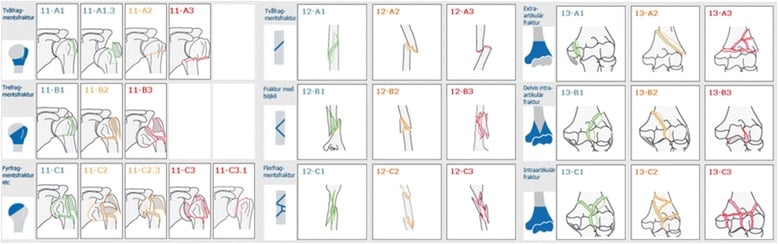
The AO/OTA system grades complexity and comminution, which is what sets the treatment tendency: simple (A) fractures have excellent outcomes with functional bracing, and complex (C) fractures often require surgical stabilisation. The descriptive and location-based classifications add the pattern and the level, which between them predict stability in a brace and the nerve at risk.
- Description
- Two fragments, over 90% cortical contact
- Subgroups
- A1: Spiral, A2: Oblique (over 30°), A3: Transverse (under 30°)
- Treatment Tendency
- Functional bracing
- Description
- Three fragments, contact between main fragments possible
- Subgroups
- B1: Spiral wedge, B2: Bending wedge, B3: Fragmentary wedge
- Treatment Tendency
- Bracing or surgery
- Description
- Multiple fragments, no contact between main fragments
- Subgroups
- C1: Spiral, C2: Segmental, C3: Irregular comminuted
- Treatment Tendency
- Usually surgical
Clinical Assessment
History. The mechanism (direct blow, torsion or fall) predicts the pattern. The other answers that change management:
- Hand dominance and occupation - manual or sedentary work
- Comorbidities - diabetes, smoking, osteoporosis
- Previous injury - the pathological fracture concern
Examination. Look for deformity, swelling, bruising and the condition of the skin; feel for point tenderness and crepitus; movement is limited by pain, but the shoulder and elbow are still tested. The neurovascular examination is the part that matters, and the two structures in question are the radial nerve and the brachial artery.
Document radial nerve function before and after any intervention: wrist extension against gravity, finger MCP extension, thumb extension (hitchhiker), sensation in the first dorsal web space. Record it in the notes clearly.
- Technique
- Extend wrist against resistance
- Finding
- Wrist drop if absent
- Interpretation
- Radial nerve palsy - most reliable sign
- Technique
- Extend fingers at MCP against resistance
- Finding
- Cannot extend MCPs
- Interpretation
- PIN involvement
- Technique
- Extend thumb (hitchhiker sign)
- Finding
- Cannot extend thumb
- Interpretation
- EPL - PIN involvement
- Technique
- Light touch dorsal first web
- Finding
- Numbness/decreased
- Interpretation
- Superficial radial nerve
- Technique
- Extend elbow against resistance
- Finding
- Usually preserved
- Interpretation
- Branches given before spiral groove
Reading the examination. Wrist drop is the classic finding. Wrist extension (ECRL, ECRB) is carried by the radial nerve proper, while thumb and finger extension (EPL, EDC) and supination (supinator) are posterior interosseous nerve functions. A palsy found at this first examination is a primary palsy; one that appears after a manipulation is secondary, and the two are managed differently (see Radial Nerve Palsy Management).
- Distinguishing Features
- Mid-arm deformity, crepitus, abnormal mobility; possible wrist drop
- Key Investigation
- AP/lateral humerus including shoulder and elbow
- Pitfall to Avoid
- Missing associated radial nerve palsy by not testing wrist extension
- Distinguishing Features
- Low-energy mechanism, antecedent arm pain, known malignancy, lytic lesion
- Key Investigation
- Radiographs +/- CT/MRI, bloods, staging if primary unknown
- Pitfall to Avoid
- Treating as simple trauma and missing underlying tumour or myeloma
- Distinguishing Features
- Pain and deformity localised to shoulder, not mid-arm; axillary nerve at risk
- Key Investigation
- Shoulder AP and axillary/scapular-Y views
- Pitfall to Avoid
- Mislabelling a surgical-neck fracture as a shaft fracture
- Distinguishing Features
- Elbow-centred pain, articular involvement, possible ulnar nerve signs
- Key Investigation
- CT for articular extension
- Pitfall to Avoid
- Underestimating articular involvement on plain films
- Distinguishing Features
- Wrist drop without bony injury (e.g. Saturday-night palsy, penetrating wound)
- Key Investigation
- Nerve conduction studies, ultrasound/MRI of nerve
- Pitfall to Avoid
- Attributing wrist drop to a fracture that is not present
- Distinguishing Features
- Fever, systemic upset, atraumatic or trivial trauma, raised inflammatory markers
- Key Investigation
- Bloods (CRP, WCC), MRI, aspiration
- Pitfall to Avoid
- Plating through occult infection
Investigations
Radiographs. AP and lateral views of the entire humerus, which must include the shoulder and elbow joints; if either joint is not fully visualised, add separate views of it. The films are read for fracture pattern, displacement, angulation and any articular involvement, and for the associated injuries that change the plan, a floating elbow or a shoulder dislocation.
What to measure. The pattern first, simple or comminuted, because simple fractures brace well and comminuted fractures may need surgery. Then coronal (varus/valgus) angulation on the AP view, sagittal (anterior/posterior) angulation on the lateral, shortening against the normal side, and joint involvement, which prompts a CT if suspected. The thresholds that make alignment acceptable, and the reduction that follows if they are exceeded, are given under Management.
Further imaging. CT is indicated for articular extension, for preoperative planning of comminuted fractures and for the pathological fracture work-up. MRI evaluates a suspected pathological fracture and soft-tissue injury. Angiography is for suspected vascular injury, which is rare.
Management Algorithm
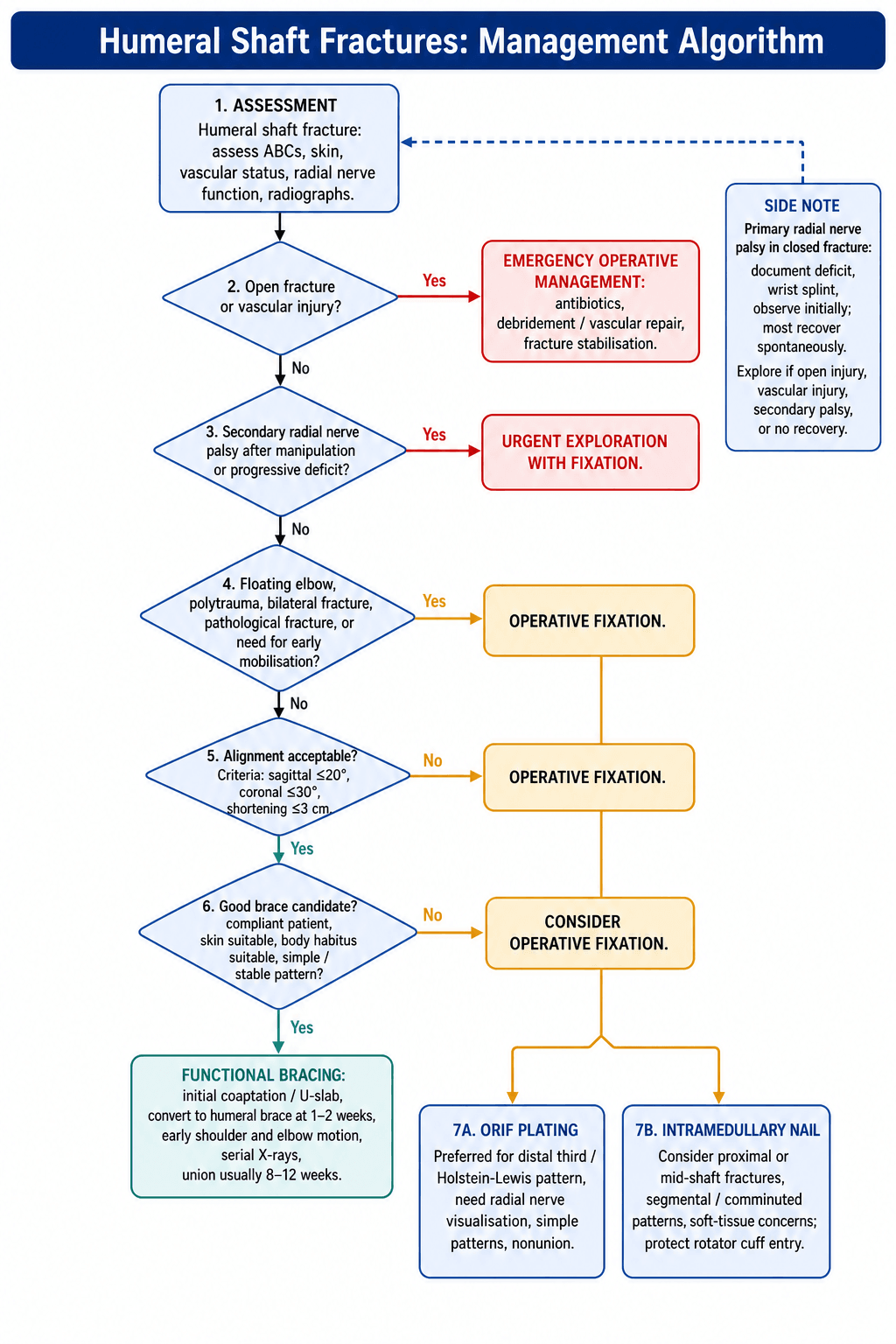
The decision. Radial nerve function is documented before anything else happens. An open fracture or a vascular injury goes to emergency surgery; a secondary palsy after manipulation, or a progressive deficit, is explored; a floating elbow, polytrauma, a bilateral or pathological fracture, or unacceptable alignment is fixed. Everyone else is a candidate for a brace, provided they are compliant, their skin and body habitus suit it, and the pattern is simple and stable.
Functional bracing. Pioneered by Sarmiento, and the gold standard for most humeral shaft fractures. The brace works by hydraulic compression: circumferential soft-tissue containment through adjustable straps, combined with gravity, aligns the fracture, and early motion matters because muscle contraction maintains that alignment and promotes healing. The elbow and shoulder are left free to move.
The union rate. Over 90% union is the figure usually quoted, and it comes from Sarmiento's series, where nonunion in closed fractures was under 2%, but among only the two-thirds who returned for follow-up. The randomised comparison on this page (Matsunaga) followed every patient and found 15% nonunion in the braced arm. Bracing works; quote the trial figure when discussing risk.
Acceptable alignment (20-30-3-15). The shoulder hides angulation well, which is what makes the shaft forgiving:
- under 20° sagittal (anterior/posterior) angulation
- under 30° coronal (varus/valgus) angulation
- less than 3cm shortening
- under 15° rotation
Angulation beyond these limits needs reduction, and unacceptable alignment is an elective indication for fixation.
Who braces well. A compliant patient, a simple fracture pattern, acceptable initial alignment, early active motion and weekly radiographs at first. Poor brace candidates:
- Obesity - poor soft-tissue compression
- Skin problems - burns, dermatitis
- Non-compliance
- Transverse fractures at the narrow isthmus
- Segmental fractures
Functional Bracing Protocol
Coaptation splint (sugar tong) or U-slab. Sling for comfort. Ice, elevation. Begin pendulum exercises immediately if pain allows.
Convert to prefabricated humeral brace once swelling subsides. Circumferential compression with adjustable straps. Allows elbow and shoulder motion.
Active shoulder and elbow ROM. Pendulum exercises 4-6 times daily. Gravity alignment maintains reduction. Wean sling.
Weekly X-rays initially to ensure maintained alignment. Then every 2-4 weeks until union (usually 8-12 weeks).
Wean brace once clinical and radiographic union. Progressive strengthening. Full activity by 4-6 months.
The humerus is the second most common long bone for skeletal metastases (after the femur), so "pathological fracture" appears in the indication list - but the examinable decision-making behind it is distinct from a normal trauma fracture.
The impending fracture (still intact bone with a destructive lesion) is scored with the Mirels score, 1 to 3 points each for site, pain, lesion type (lytic, blastic or mixed) and size as a fraction of cortical diameter:
- Score 9 or more = prophylactic fixation before it breaks (a fixed bone is far easier than a pathological fracture, and avoids the morbidity of a sudden break).
- Score 7 or less = radiotherapy and surveillance; 8 is borderline and individualised.
- Functional bracing's usual forgiveness does not apply: tumour bone will not unite, so the goal is durable mechanical stability for the patient's remaining life, not union.
The implant for diaphyseal disease differs from trauma. A long intramedullary nail spanning the whole bone is often preferred for diaphyseal metastases, because it protects the entire humerus against further lesions and allows immediate load-bearing, unlike a plate that protects only the fracture; plate plus cement (PMMA) is the alternative where a nail is unsuitable or for periarticular lesions, filling the defect for immediate stability. Always biopsy or otherwise confirm the diagnosis before fixing an unknown solitary lesion (it may be a primary sarcoma, where a nail would contaminate the whole bone), and give postoperative radiotherapy to the construct to control local tumour.
Exam point: for a humeral lesion, score the impending fracture with Mirels (fix if 9 or more, irradiate if 7 or less); for diaphyseal metastatic disease favour a long IMN spanning the whole bone plus postoperative radiotherapy, and biopsy an unknown solitary lesion before fixation to avoid seeding a primary sarcoma.
Radial Nerve Palsy Management
Primary palsy is present at the time of injury and is usually a neurapraxia from stretch or contusion. About 70% recover spontaneously within 3-4 months (in Shao's pooled data, 70.7% spontaneous recovery among conservatively managed patients and 88.1% overall recovery including those explored), and early exploration confers no benefit, so the palsy is observed with a wrist splint and clinical and EMG monitoring. If there is no recovery by 4 months, explore.
Secondary palsy develops after manipulation or surgery and suggests the nerve is entrapped in the fracture site. Spontaneous recovery is unlikely without exploration, so it is explored urgently.
Management of Primary Radial Nerve Palsy
Document findings clearly. Wrist cock-up splint to maintain function. Proceed with non-operative management if otherwise indicated.
Baseline EMG/NCS to confirm nerve injury type and level. Monitor clinically for Tinel sign progression (sign of regeneration).
Repeat EMG if no clinical recovery. Look for reinnervation potentials. Continue monitoring.
If no clinical or EMG recovery, plan surgical exploration. Nerve grafting may be required if gap identified.
If nerve recovery is incomplete, consider tendon transfers: PT to ECRB (wrist extension), FCR to EDC (finger extension), PL to EPL (thumb extension). These restore functional wrist and finger extension.
Surgical Technique
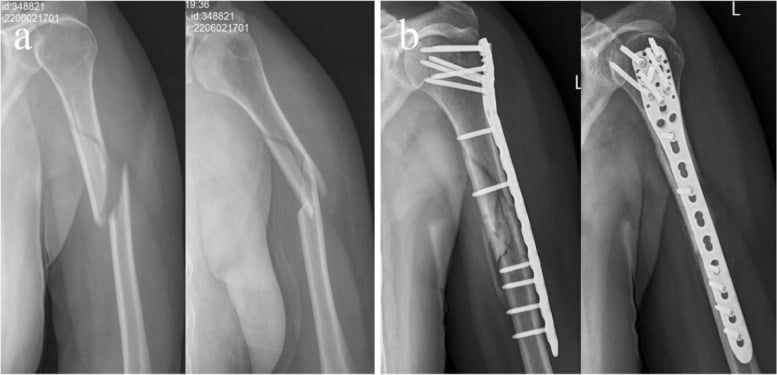
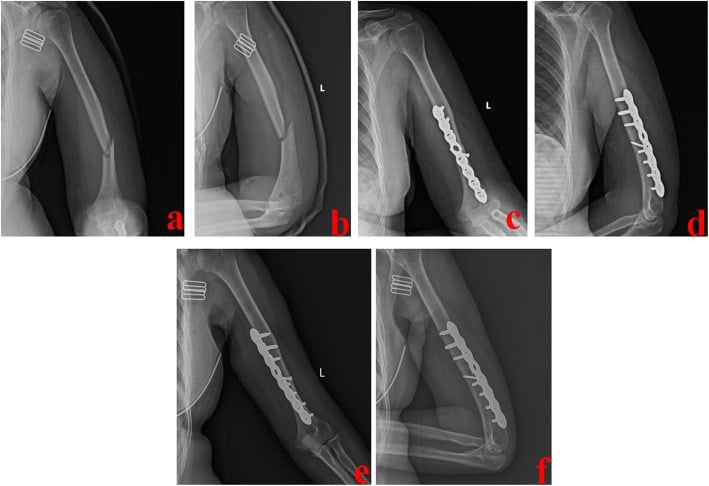
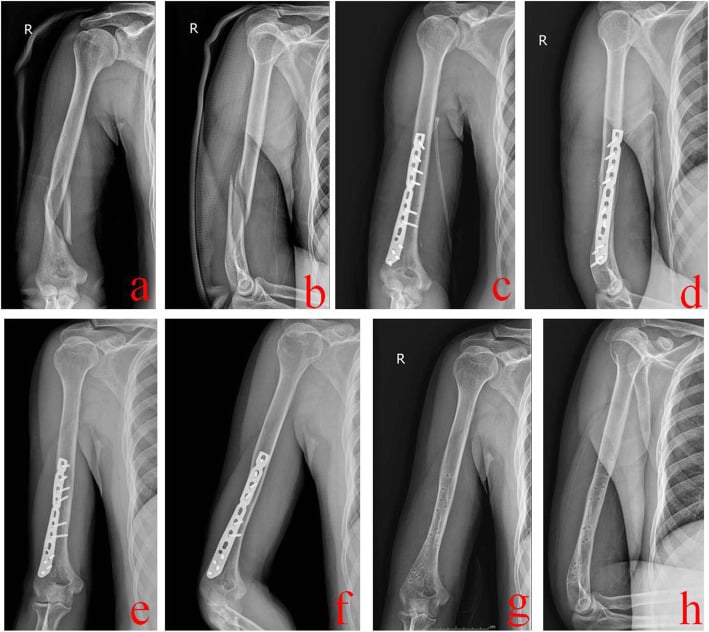
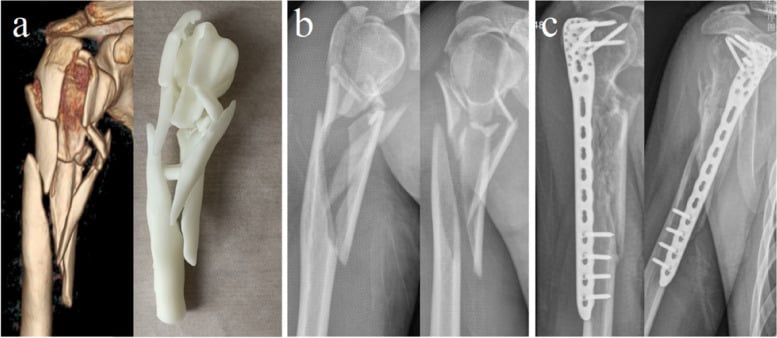
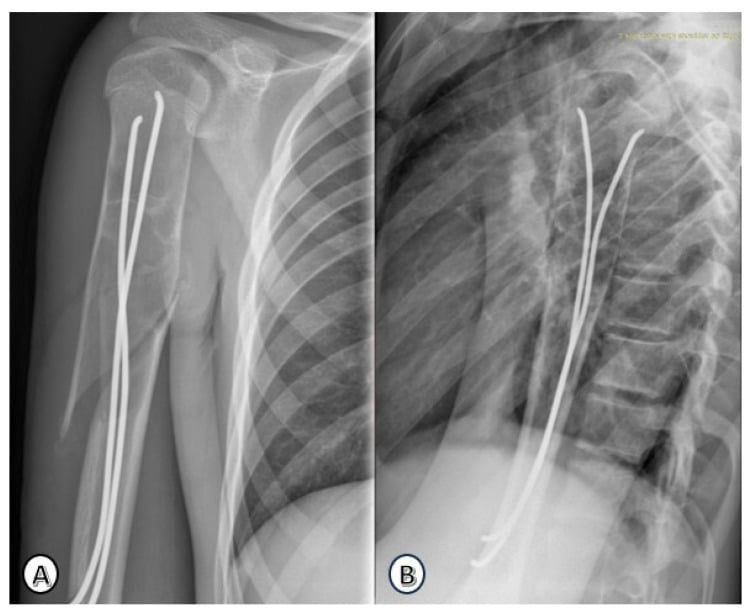
Choosing the implant. Plating is preferred for distal-third and Holstein-Lewis patterns, simple fractures and nonunions, because it allows the radial nerve to be seen and protected. A nail suits proximal and mid-shaft, segmental, comminuted or pathological fractures and cases with soft-tissue concerns; the antegrade nail avoids the radial nerve but risks the rotator cuff at its entry point.
Positioning. Supine with the arm on an arm board for the anterolateral approach; lateral decubitus or prone for the posterior approach; beach chair for proximal fractures.
Anterolateral approach. The incision follows the lateral border of biceps and the interval is developed between brachialis (musculocutaneous nerve) and brachioradialis (radial nerve). The radial nerve runs between these two muscles: identify it and protect it. The plate is applied to the flat anterolateral surface of the humerus.
Posterior approach. A midline posterior incision, with triceps split in the midline or its medial and lateral heads elevated. The radial nerve is identified in the spiral groove and protected, and the plate goes on the flat posterior surface.
The plate. A 4.5mm narrow or broad LCP, with a minimum of 3-4 screws (6-8 cortices) on each side of the fracture. Simple patterns are compressed; comminution is bridged.
MIPO. Minimally invasive plate osteosynthesis passes the plate submuscularly through small proximal and distal incisions, which reduces soft-tissue stripping and the theoretical risk of nerve injury. It requires fluoroscopy.
Complications
- Incidence
- 12-18% (primary)
- Risk Factors
- Distal third, spiral, Holstein-Lewis
- Management
- Observe primary, explore secondary
- Incidence
- 2-10%
- Risk Factors
- Transverse pattern, distraction, non-compliance
- Management
- ORIF + bone graft
- Incidence
- Variable
- Risk Factors
- Non-operative with poor follow-up
- Management
- Usually well tolerated, osteotomy if symptomatic
- Incidence
- Common initially
- Risk Factors
- Prolonged immobilization, poor compliance
- Management
- Early motion, physiotherapy
- Incidence
- 1-3%
- Risk Factors
- Open fractures, poor soft tissues
- Management
- Debridement, antibiotics, revision
- Incidence
- 2-5%
- Risk Factors
- Early loading, inadequate fixation
- Management
- Revision fixation
- Incidence
- 2-5% (surgical)
- Risk Factors
- Posterior approach, ORIF
- Management
- Careful dissection, MIPO technique
The palsy figure. The table's 12-18% is the incidence of primary palsy; Shao's pooled prevalence across 4,517 fractures was 11.8%. Say which figure you are quoting.
Nonunion. Transverse fractures fail to unite in a brace more often (2-10%, against 5% or less for oblique and spiral patterns): the narrow isthmus and the transverse orientation provide poor cortical contact. Consider primary ORIF for a transverse fracture at the narrow diaphyseal portion.
Validated risk factors for humeral shaft nonunion (cluster these mentally):
- Fracture features: transverse pattern, a fracture gap or distraction (often from an over-heavy cast/brace or interposed soft tissue), proximal-third location, and high comminution.
- Biology/host: smoking, diabetes, obesity, advanced age, alcohol, NSAID use, and any over-distraction.
Early radiographic and clinical warning signs at the 6 to 12 week reviews:
- Absence of bridging callus by about 6 to 8 weeks in a fracture that should be forming it.
- Persistent fracture-site motion or pain on clinical stressing once early union would be expected.
- A visible or widening fracture gap on serial films - distraction is the single most correctable cause, addressed by adjusting the brace to allow gravity to close the gap.
Acting on it: the at-risk fracture is recognised early and managed by correcting distraction first; if there is still no callus and ongoing motion by around 12 weeks, early conversion to compression plating (with bone graft for atrophic patterns) gives better, faster results than waiting many months for an established nonunion. This is also the practical message of the operative-versus-bracing trials (e.g. the FISH and Matsunaga RCTs): early fixation does not improve final function much but markedly reduces nonunion and secondary reintervention.
Exam point: nonunion is predicted, not just diagnosed - transverse pattern, a distraction gap, proximal-third location and poor host biology flag the at-risk fracture; absent callus plus persistent motion by 6 to 12 weeks should trigger correction of distraction and, if it persists, early conversion to compression plating rather than prolonged bracing.
Shoulder stiffness. Common at first and preventable. The key to successful functional bracing is early motion, so pendulum exercises begin on day one, and the stiff shoulder is treated with physiotherapy.
Postoperative Care and Rehabilitation
Post-ORIF Rehabilitation
Sling for comfort. Wound care. Gentle pendulum exercises. No active shoulder elevation against gravity.
Active-assisted shoulder ROM. Active elbow ROM. Gentle strengthening begins at 4 weeks if stable fixation.
Progressive resistive exercises. Wean sling. Radiographic union usually evident by 8-12 weeks.
Full activity when clinically and radiographically healed. Sport-specific training as appropriate.
Outcomes and Prognosis
What decides the result. The prognostic factors are the ones already met. Fracture pattern is significant: simple patterns do well with bracing and transverse fractures are at risk. Patient compliance is critical for bracing, since non-compliance leads to malunion or nonunion. Radial nerve status matters, a primary palsy usually recovering and a secondary one needing surgery; associated injuries have a variable effect, with polytrauma patients possibly needing fixation; and smoking and diabetes are both negative, the first through higher nonunion rates and the second through delayed healing and more complications.
Plate or nail. Meta-analyses show similar union rates, both over 95%. Bhandari's pooling of three trials found plating reduced reoperation and shoulder problems; Heineman's later and larger pooling of four trials found no significant difference in complications, nonunion, infection, nerve palsy or reoperation, and neither was powered to settle the question. Nailing is faster but is associated with more shoulder pain (antegrade) or elbow issues (retrograde), so the implant is chosen on fracture pattern, bone quality and surgeon familiarity rather than a proven superiority.
Guidelines, Registries & Global Practice
Global Epidemiology
- Population
- Sweden, adults
- Humeral Shaft Incidence
- 13.4
- Key Pattern
- 13% of all humeral fractures; F:M 2.4:1; mean age 66.8
- Population
- Western Europe
- Humeral Shaft Incidence
- Approximately 13-20
- Key Pattern
- Bimodal: young males high-energy, elderly females low-energy falls
- Population
- Global
- Humeral Shaft Incidence
- Approximately 1-3% of all fractures
- Key Pattern
- Most are closed, low-energy, isolated injuries
The Swedish Fracture Register (Bergdahl et al, BMC Musculoskelet Disord 2016) provides the cleanest contemporary denominator: humeral shaft fractures occur at 13.4 per 100,000 person-years, are predominantly low-energy falls in older women (F:M 2.4:1), and make up about 13% of all humeral fractures. Only ~1% are open.
Guideline & Registry Landscape
- Position on Humeral Shaft Fractures
- Functional bracing remains a reasonable default for most closed isolated fractures; surgery for absolute indications and selected relative ones. AO principles guide implant choice (plate for distal/articular, nail or plate for mid-shaft)
- Evidence Basis
- Synthesis of RCTs and meta-analyses (Level I-II)
- Position on Humeral Shaft Fractures
- Emphasis on documented neurovascular assessment, early senior decision-making, and shared decision-making between bracing and fixation; no mandate for routine surgery
- Evidence Basis
- Consensus standards informed by RCT evidence
- Position on Humeral Shaft Fractures
- Bracing and operative fixation both endorsed; growing interest in primary fixation to reduce nonunion and shorten disability in selected adults
- Evidence Basis
- Level I RCT and meta-analysis data
- Position on Humeral Shaft Fractures
- Competency expected in both non-operative and operative management; mandatory documentation of radial nerve status; informed consent must include nerve-injury discussion
- Evidence Basis
- Training and examination standards
There is genuine international practice variation: the historical Sarmiento data and Shao systematic review underpin a non-operative-first culture in many UK/European and Australian units, whereas the Matsunaga RCT and lower nonunion rates with fixation have driven a trend toward earlier operative management in some centres. No registry or guideline currently mandates routine surgery for the typical closed isolated fracture.
Key documentation requirements:
- Document radial nerve function before AND after any manipulation
- Record complete motor (wrist, finger, thumb extension) and sensory (dorsal first web) exam
- Document discussion of treatment options including functional bracing vs surgery
- Informed consent for surgery must include: infection, nonunion, nerve injury (especially iatrogenic), shoulder stiffness (IMN), need for hardware removal
- If radial palsy present: document as primary vs secondary and management plan
Specific risks to discuss: Radial nerve injury (iatrogenic 2-5%), infection, nonunion, hardware failure/irritation, need for bone grafting, shoulder stiffness. For IMN: add rotator cuff injury and shoulder pain (15-30%).
MCQ Practice Points
Q: At what level does the radial nerve cross the posterior humerus in the spiral groove? A: The junction of the middle and distal thirds, approximately 14-20cm from the lateral epicondyle. Here it is tethered by the lateral intermuscular septum.
Q: What is a Holstein-Lewis fracture? A: A distal third spiral oblique fracture of the humerus with high radial nerve palsy rate (22-32%). The sharp proximal spike can trap or lacerate the radial nerve at the lateral intermuscular septum.
Q: What are the acceptable angulation limits for humeral shaft fractures treated non-operatively? A: Less than 20° sagittal (AP) angulation, less than 30° coronal (varus/valgus), less than 3cm shortening, less than 15° rotation. The shoulder compensates well for these deformities.
Q: A patient develops wrist drop after manipulation of a humeral shaft fracture. What is your management? A: This is secondary radial nerve palsy - the nerve is likely trapped in the fracture. Urgent exploration is required. Do not observe as you would for primary palsy.
Q: What is the expected spontaneous recovery rate for primary radial nerve palsy in closed humeral shaft fractures? A: 70% recover spontaneously within 3-4 months. Observe with wrist splint and EMG monitoring. Explore if no recovery by 4 months.
Exam Viva Scenarios
Practise clinical reasoning and management decisions out loud
“A 35-year-old man presents after falling off a ladder onto his outstretched arm. He has obvious deformity of his right upper arm and cannot extend his wrist or fingers. X-rays show a spiral fracture of the distal third of the humerus. How would you assess and manage this patient?”
“A 55-year-old woman sustains a closed transverse humeral shaft fracture at the mid-diaphysis in a motorcycle accident. She also has a closed tibial shaft fracture. Her radial nerve is intact. How would you manage this patient?”
“You are called to see a 40-year-old man in ED who had a closed humeral shaft fracture reduced in a backslab by the junior doctor. He now cannot extend his wrist or fingers - he had normal function before the reduction. What is your management?”
Key Anatomy
- Radial nerve in spiral groove at middle-distal third junction
- Nerve tethered by lateral intermuscular septum
- Triceps branches given BEFORE spiral groove (usually spared)
- Muscular deforming forces vary by fracture level
Classification
- AO/OTA: 12-A (simple), B (wedge), C (complex)
- Holstein-Lewis: distal third spiral = high radial palsy risk
- Location: proximal (30%), middle (60%), distal (10%)
- Pattern: transverse (direct blow), spiral (torsion)
Acceptable Alignment (20-30-3-15)
- under 20° sagittal (AP) angulation
- under 30° coronal (varus/valgus) angulation
- less than 3cm shortening
- under 15° rotation
Treatment Algorithm
- Most fractures: Functional bracing (over 90% union)
- STOP BRACE indications: Segmental, Transverse isthmus, Open, Polytrauma, Bilateral, Radial 2° palsy, Arterial injury, Cannot tolerate, Extended joints (floating elbow)
- Plate preferred over nail (less shoulder pain, lower reop rate)
- MIPO technique reduces iatrogenic nerve injury
Radial Nerve Palsy
- Primary palsy: observe 3-4 months, 70% recover
- Secondary palsy (post-manipulation): URGENT exploration
- Test: wrist extension, finger MCP extension, thumb extension
- Tendon transfers if no recovery: PT-ECRB, FCR-EDC, PL-EPL
Evidence Base
Sarmiento Functional Bracing Series
- 922 humeral diaphyseal fractures treated with a prefabricated functional brace; 620 (67%) available for follow-up
- Nonunion in 16 of 620 followed patients - 9 of 155 open fractures (6%) versus 7 of 465 closed fractures (less than 2%)
- Coronal angulation healed at less than 16° varus in 87% and anterior angulation less than 16° in 81%
- 98% retained shoulder motion loss of 25° or less at brace removal
Plate vs Nail Meta-Analysis (Heineman)
- Meta-analysis of 4 RCTs (203 patients) comparing intramedullary nails and plates
- No statistically significant difference in total complication rate, non-union, infection, nerve palsy, or reoperation
- Included trials were small with methodological limitations
- Authors called for a definitive large RCT
Plate vs Nail Meta-Analysis (Bhandari)
- Meta-analysis of 3 RCTs (155 patients) of compression plating versus intramedullary nailing
- Plating reduced relative risk of reoperation versus nailing (RR 0.26, 95% CI 0.007-0.9, p=0.03)
- Plating reduced shoulder problems versus nailing (RR 0.10, 95% CI 0.03-0.4, p=0.002)
- Roughly one reoperation prevented for every 10 patients treated with a plate
Radial Nerve Palsy Natural History (Shao Systematic Review)
- Systematic review of 35 studies; overall palsy prevalence 11.8% (532 palsies in 4517 fractures)
- Overall recovery 88.1%; spontaneous recovery 70.7% in conservatively managed patients
- Middle and middle-distal shaft fractures had the highest association with palsy
- No significant difference in final outcome between early exploration and expectant management
Holstein-Lewis Fracture (Original Description)
- Original description of the distal-third spiral oblique humeral fracture associated with radial-nerve paralysis
- Sharp proximal fragment displaces the radial nerve where it pierces the lateral intermuscular septum
- Established the pattern as a recognised cause of fracture-associated radial nerve injury
Bridge Plate vs Functional Brace RCT (Matsunaga)
- RCT of 110 patients - minimally invasive bridge-plate osteosynthesis versus functional brace
- DASH score modestly better with surgery at 6 months only (10.9 vs 16.9, p=0.046)
- Lower nonunion rate with surgery (0% vs 15%)
- No difference in SF-36, pain, or Constant-Murley score; coronal angulation lower with plating (2.0° vs 10.5°)
Population Epidemiology - Swedish Fracture Register
- 2,011 adult humeral fractures from the Swedish Fracture Register (2011-2013); 13% were shaft fractures
- Humeral shaft fracture incidence 13.4 per 100,000 person-years
- Female:male ratio 2.4:1; mean age 66.8 years, with most fractures from low-energy falls in patients over 50
- Only 1.2% open and 1.3% pathological