Intra-Articular | Nonunion Risk | ORIF Often Required
- INTRA-ARTICULAR fracture (elbow and wrist joint)
- Greater than 2mm displacement = surgical indication
- High risk of nonunion due to synovial fluid bathing fracture
- Late complications: nonunion, malunion, cubitus valgus, tardy ulnar nerve palsy
- Lateral approach - do NOT dissect posterior (blood supply)
- “Milch Type I = Salter-Harris IV (lateral to trochlear ridge)
- “Milch Type II = Salter-Harris II (through trochlear ridge, unstable)
- “Nonunion causes lateral spur and cubitus valgus
- “Tardy ulnar nerve palsy occurs years later due to valgus
Overview and Epidemiology
The lateral condyle is the second most common paediatric elbow fracture after the supracondylar fracture, about 15% of them, and it carries the higher complication rate of the two. It is intra-articular and prone to nonunion, and it can lead to progressive cubitus valgus and a tardy ulnar nerve palsy years after the injury.
Who and how. Peak age is 5-7 years, with a slight male predominance, and the mechanism is usually a fall onto the outstretched hand.
Why it matters. Unlike the supracondylar fracture, this one crosses the articular surface. It needs an anatomic reduction to prevent degenerative change and angular deformity, and because it is intra-articular the fracture lies bathed in synovial fluid from the elbow joint; with the pull of the extensor origin added, the risk of nonunion is high, which is why surgery is often needed.
Anatomy and Biomechanics
The fragment. The lateral condyle is the capitellum, which articulates with the radial head, a variable lateral portion of the trochlea, and the lateral epicondyle, where the common extensor origin attaches. The lateral collateral ligament attaches to the fragment as well, and the physis is involved, so the injury follows a Salter-Harris pattern.
The fracture line. It runs through the lateral metaphysis, across the physis, usually posterolaterally, and into the articular surface of the trochlea or capitellum.
Blood supply. It enters the lateral condyle posteriorly. Once the condyle has fractured the fragment has no anterior blood supply at all, so the posterior soft tissues are protected at surgery.
Deforming forces. The extensor muscles attached to the lateral epicondyle pull the fragment distally and rotate it, and that is what displaces it.
Classification Systems
Two systems are in use. Milch describes where the fracture line exits and is the one most commonly cited; Weiss (with Jakob) grades displacement and articular congruity and is the one that guides treatment.
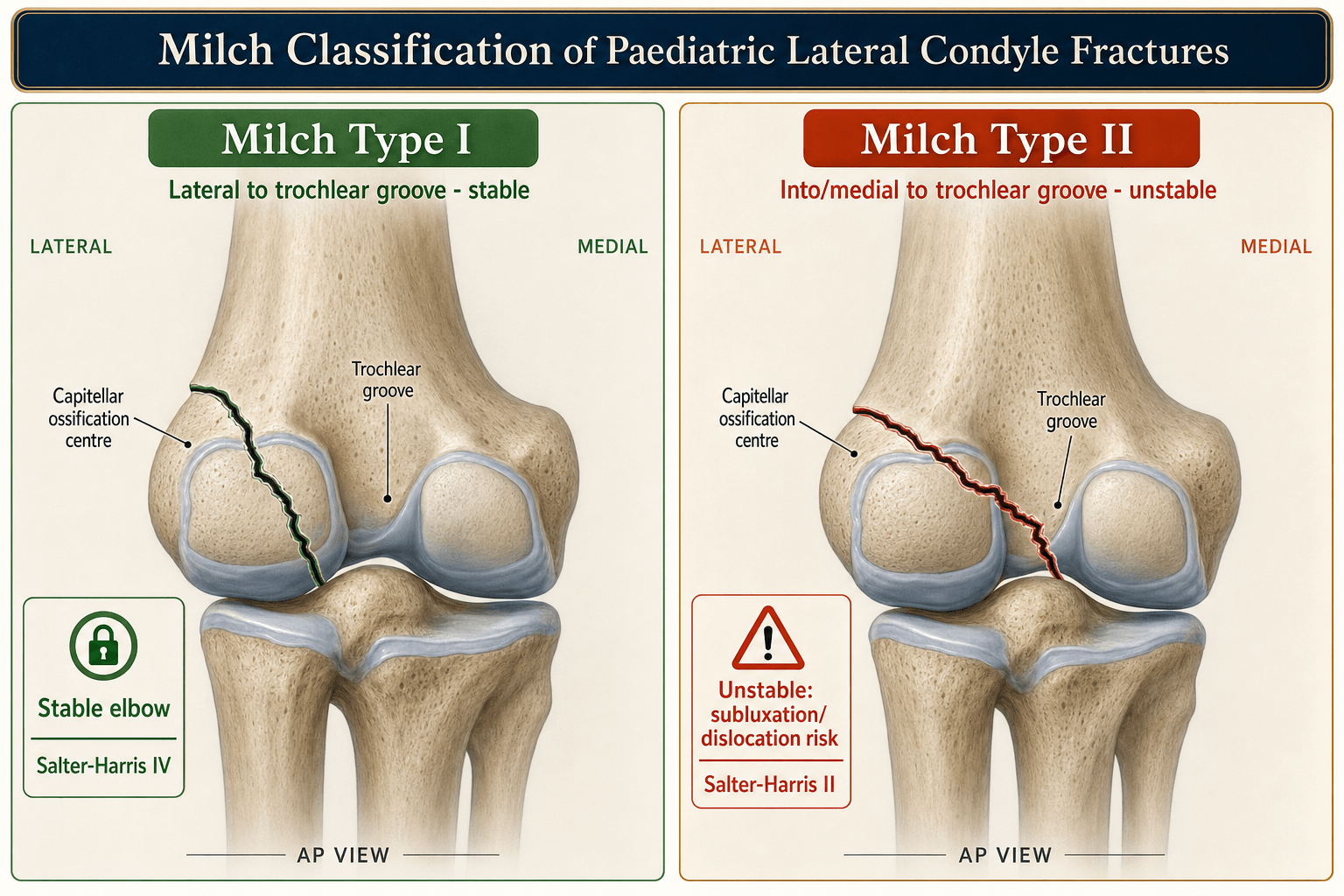
Milch. The trochlear ridge is the landmark. A line that exits lateral to it leaves the elbow stable; a line that exits through it means the ulnohumeral articulation may be unstable. Type II is more common.
- Fracture Exit
- Lateral to trochlear ridge
- Equivalent
- Salter-Harris IV
- Stability
- Elbow stable
- Fracture Exit
- Through trochlear ridge
- Equivalent
- Salter-Harris II
- Stability
- Elbow potentially unstable
Know its weakness, because the examiners do. Weiss and colleagues opened their 158-patient series by stating that Milch, though the most commonly cited system, "has not been shown to be predictive of outcome or recommend treatment", which is precisely why they built a classification on displacement and articular congruity instead. Milch describes where the fracture line exits; it does not tell you whether the cartilage hinge is intact, and that is the thing that governs both stability and complications. Use Milch for anatomical description and Weiss for decisions.
- Displacement
- Less than 2mm
- Articular Surface
- Minimally displaced, cartilage hinge intact
- Treatment
- Long arm cast, close follow-up
- Displacement
- At least 2mm (in Weiss's series all were under 4mm)
- Articular Surface
- Cartilage INTACT - the hinge still holds, confirmed on arthrogram, not assumed from the plain film
- Treatment
- CRPP or ORIF with K-wires
- Displacement
- At least 2mm (all were 4mm or more)
- Articular Surface
- Cartilage DISRUPTED
- Treatment
- ORIF with K-wires
What separates Type II from Type III is the cartilage, not the millimetres. Weiss's 4 mm figure is a useful radiographic surrogate: every Type II in that series measured under 4 mm and every Type III measured 4 mm or more, which is why a fracture under 4 mm can reasonably be pinned closed before committing to an arthrogram. The surrogate is not the definition. A fracture displaced 3 mm with a disrupted articular surface is a Type III and carries Type III's risk, a complication rate of 34% against 11% for Type II.
Clinical Assessment
History. A fall onto the outstretched hand with a varus stress. Ask about the time since injury, any swelling or deformity, neurovascular symptoms and previous elbow injury.
Examination. Lateral elbow swelling and tenderness, with ecchymosis that may be extensive, and a range of motion likely limited by pain. Do a full neurovascular examination, and check elbow stability against the opposite side.
In young children, the lateral condyle ossific nucleus may not yet be visible (capitellum ossifies around age 1-2). An effusion (positive fat pad sign) with lateral tenderness but no obvious fracture line suggests an occult lateral condyle fracture. Obtain an internal oblique view, consider ultrasound/MRI or arthrogram, or treat as a fracture and follow closely with repeat films.
Use the CRITOE ossification sequence (Capitellum, Radial head, Internal/medial epicondyle, Trochlea, Olecranon, External/lateral epicondyle) to interpret the immature elbow. Comparison views of the contralateral elbow are invaluable - a displaced ossific fragment lateral to the metaphysis confirms the diagnosis when the cartilaginous fracture itself is radiolucent.
The differential. The painful, swollen paediatric elbow has several causes; the table gives the feature that separates each from a lateral condyle fracture and the pitfall each carries.
- Mechanism / Age
- FOOSH, varus stress; peak 5-7y
- Key Distinguishing Feature
- Lateral metaphyseal fragment, intra-articular, displaces in cast
- Pitfall to Avoid
- Underestimating displacement on AP/lateral only
- Mechanism / Age
- FOOSH, hyperextension; peak 5-7y
- Key Distinguishing Feature
- Transverse metaphyseal line, anterior humeral line abnormal, extra-articular
- Pitfall to Avoid
- Missing concurrent NV injury (AIN/median)
- Mechanism / Age
- Valgus/throwing; older child 9-14y
- Key Distinguishing Feature
- Medial fragment, may be incarcerated in joint
- Pitfall to Avoid
- Forgetting to count ossification centres (CRITOE)
- Mechanism / Age
- Birth/NAI in infants under 3y
- Key Distinguishing Feature
- Whole epiphysis displaced medially, radiocapitellar line maintained to capitellum
- Pitfall to Avoid
- Mistaking for elbow dislocation; consider non-accidental injury
- Mechanism / Age
- FOOSH valgus
- Key Distinguishing Feature
- Radial head angulation, point tenderness over radial neck
- Pitfall to Avoid
- Attributing all lateral pain to the condyle
- Mechanism / Age
- Axial pull; toddler 1-4y
- Key Distinguishing Feature
- No swelling, refusal to use arm, normal radiographs
- Pitfall to Avoid
- Over-imaging; reduces with supination-flexion
Investigations
Radiographs. AP and lateral views alone can underestimate displacement, so add an internal oblique, and compare with the opposite elbow in a young child:
- AP elbow - fragment size and displacement; measure the gap here
- Lateral elbow - rotation of the fragment, which often rotates posteriorly
- Internal oblique - 45° of internal rotation places the fracture line in profile, for better visualisation of the fracture
- Comparison views of the opposite elbow, which help in young children
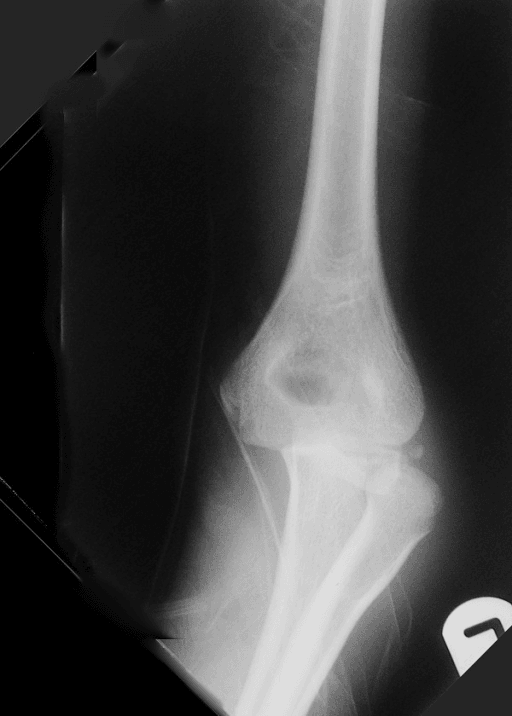
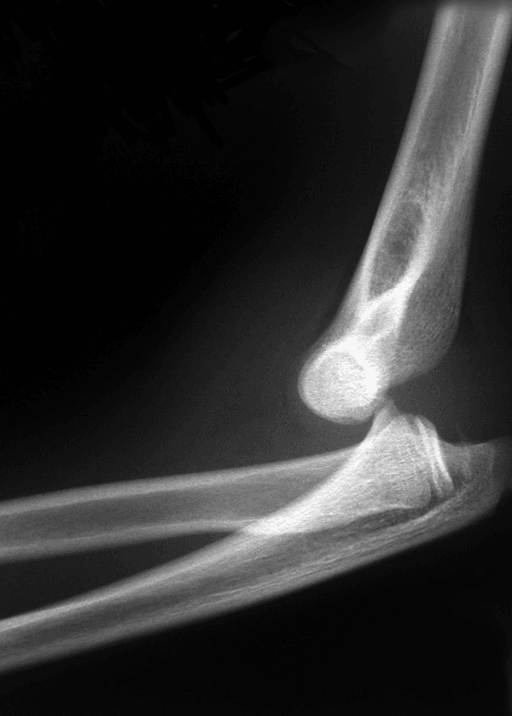
MRI and arthrography. Consider them when an occult fracture is suspected (an effusion but no visible fracture), when the cartilaginous extent of the fracture is unclear, or to assess articular congruity. An arthrogram, contrast injected into the elbow joint, outlines the cartilaginous extent of the fragment, and is useful intraoperatively or to clarify displacement.
Management
The threshold. Displacement greater than 2 mm, or any rotation of the fragment, is the indication for surgery. Some authors are more aggressive and operate on any fracture displaced more than 2 mm on any view. Below 2 mm the fracture can be treated in a cast, but only with close follow-up, because it can displace in the cast.
The 2 mm versus 4 mm debate. The operative threshold is contested. Many use over 2 mm on the maximally displaced view; others reserve open surgery for at least 4 mm (articular disruption) and treat 2-4 mm fractures with closed pinning after an arthrogram. Weiss's data link the 4 mm point to articular incongruity and higher complications.
Non-operative (Weiss Type I). Less than 2 mm of displacement with an intact cartilage hinge. A long arm cast at 90° of elbow flexion for 4-6 weeks until union is confirmed, with X-rays weekly for the first 3 weeks; if any displacement occurs, convert to ORIF. Close follow-up is mandatory, because up to 20% of initially undisplaced fractures may displace.
Operative (Weiss Types II and III). Displacement greater than 2 mm or any rotation of the fragment. Open reduction through a lateral (Kocher) approach, the articular surface reduced anatomically under direct vision and held with two divergent smooth K-wires, the reduction checked on fluoroscopy; a Type II fracture with intact cartilage may be pinned closed instead. Afterwards, a long arm cast for 4-6 weeks, with the pins removed at 4 weeks if union is proceeding.
Surgical Technique Considerations
The blood supply to the lateral condyle enters posteriorly. During ORIF, do NOT dissect or strip the soft tissues from the posterior aspect of the fragment. Use an anterior/lateral approach and visualise the articular surface from the front.
Set-up and approach. Supine, with the arm on a hand table, through the lateral (Kocher) interval between anconeus and extensor carpi ulnaris. The critical step is to see the articular surface from anterior and to leave the posterior soft tissues on the fragment alone.
Reduction. Reduce the articular surface anatomically; the metaphyseal reduction usually follows.
Fixation. Two smooth K-wires, usually 1.6 mm, in a divergent configuration, crossing the fracture site but avoiding the olecranon fossa.
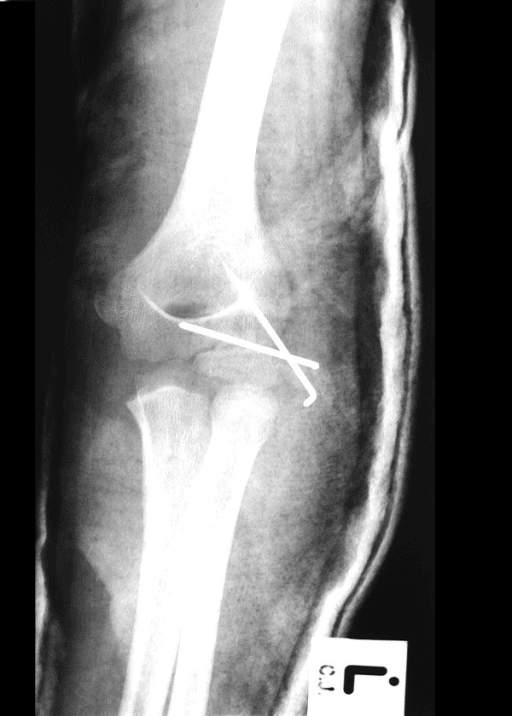
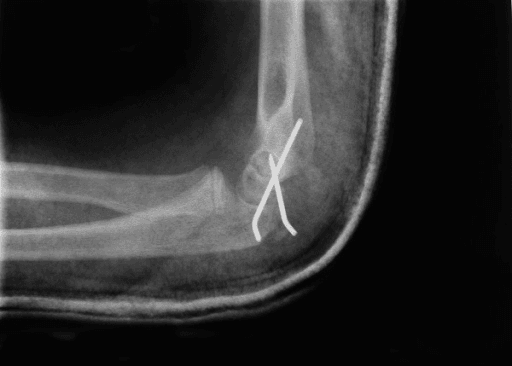
Implant choice. Smooth K-wires are the traditional and standard fixation because they spare the open physis; screws should not cross the physis in a young child. Some surgeons use a cannulated screw in an older child near skeletal maturity for more stable fixation, and cannulated or headless screws are increasingly used near maturity for compression and earlier motion. Comparative data show no clear outcome superiority of one implant over the other.
Percutaneous (in situ) pinning. For the minimally displaced fracture where the reduction is adequate but the surgeon is concerned it will displace. Under fluoroscopy, two pins from the lateral epicondyle are directed proximally and medially. Its limitation is that the articular reduction cannot be seen directly, so it is best reserved for near-anatomic alignment.
Complications
The table lists the recognised complications; the three that need explaining follow it.
- Incidence
- Most serious
- Cause
- Synovial fluid, inadequate fixation
- Management
- ORIF if early, osteotomy if late
- Incidence
- Common with nonunion
- Cause
- Lateral physeal arrest
- Management
- Osteotomy if symptomatic
- Incidence
- Delayed (years)
- Cause
- Progressive valgus stretches nerve
- Management
- Ulnar nerve transposition
- Incidence
- Common
- Cause
- Prolonged immobilisation or malunion
- Management
- Physiotherapy, rarely need release
- Incidence
- Rare
- Cause
- Posterior soft tissue stripping
- Management
- Prevention - protect blood supply
- Incidence
- With late reduction
- Cause
- Missed or delayed diagnosis
- Management
- Osteotomy if functional limitation
Cubitus valgus and tardy ulnar nerve palsy. Nonunion leads to lateral physeal arrest while medial growth continues, so the elbow drifts into progressive valgus with a lateral spur. The valgus stretches the ulnar nerve around the medial epicondyle over years, which is why the palsy is "tardy": it may present years after the original injury as an ulnar neuropathy. Treatment is ulnar nerve transposition, often anterior subcutaneous, and may require a supracondylar or distal humeral osteotomy to correct the carrying angle.
Lateral spur and overgrowth. A lateral bony prominence with mild lateral condylar overgrowth is extremely common after healing, even of well-reduced fractures, and is almost always benign and cosmetic: periosteal healing new bone over a united fracture, which usually remodels and becomes less prominent with growth. The clinical task is to reassure the family that it is not a nonunion. Surgery for the spur alone is rarely needed.
Fishtail deformity. A late V-shaped notch of the central distal humerus between the capitellum and trochlea, caused by osteonecrosis or growth arrest of the lateral trochlea after a lateral condyle (or supracondylar or T-condylar) fracture, and aggravated by posterior soft-tissue stripping at surgery. It is often an incidental radiographic finding years later, but it can cause pain, clicking, restricted motion or progressive deformity. It is the reason preservation of the posterior blood supply is critical during ORIF.
Postoperative Care
The protocol after fixation is a cast, a wound and pin-site check, a radiograph before the pins come out, and a radiograph before the cast does.
Post-Operative Protocol
Long arm backslab in 90 degrees elbow flexion. Neurovascular checks. Elevate and ice.
Check wound and pin sites. X-ray to confirm maintained reduction. Convert to long arm cast.
X-ray to assess healing. If good callus, may remove pins (in clinic). Continue cast.
X-ray confirms union. Remove cast. Begin active ROM exercises. Avoid passive stretching.
Full return to activities. Final check of motion, alignment, carrying angle. Follow long-term if any concern.
Outcomes and Prognosis
Prognosis depends on prompt diagnosis and treatment. Outcomes are good when:
- The fracture is recognised early
- Displacement greater than 2 mm is treated surgically
- An anatomic articular reduction is achieved
- Union is confirmed before discharge from follow-up
They are poor when the diagnosis is delayed, when the fracture displaces in the cast and the displacement is missed, and when a nonunion develops.
Guidelines, Registries & Global Practice
- 15-20% of paediatric elbow fractures; second only to supracondylar
- Peak age 5-7 years; slight male predominance
- Mechanism: fall on outstretched hand with varus (pull-off) or push-off load
- Roughly 40-60% are displaced enough to warrant surgery across published series
- National arthroplasty registries (NJR, AJRR, AOANJRR, SHAR) do not capture paediatric trauma
- Evidence base is observational cohorts and society position statements, not registry survival data
- No randomized trial defines the exact displacement threshold
Side-by-Side Society Guidance
- Operative Threshold
- Over 2mm or articular incongruity
- Fixation Emphasis
- Smooth K-wires; arthrogram to confirm reduction
- Distinct Point
- CRPP acceptable for many displaced fractures
- Operative Threshold
- Over 2mm; close cast surveillance under 2mm
- Fixation Emphasis
- K-wires standard; structured follow-up
- Distinct Point
- Emphasis on early review to detect late displacement
- Operative Threshold
- Displacement / rotation or articular step
- Fixation Emphasis
- Anatomic articular reduction, lag screw near maturity
- Distinct Point
- Protect posterior blood supply, anterolateral exposure
- Operative Threshold
- Over 2mm on maximal-displacement view
- Fixation Emphasis
- K-wires; selective screws
- Distinct Point
- Internal oblique view to grade displacement
- Routine internal oblique views, fluoroscopy and intraoperative arthrogram
- Increasing use of closed reduction and percutaneous pinning
- MRI/CT available for occult or complex fractures
- Day-case surgery with structured pin-site care and early clinic review
- Higher proportion of late presentation, nonunion and cubitus valgus
- Reliance on plain radiographs and comparison views; arthrogram less available
- Open reduction more common where image intensifiers are scarce
- Reconstruction (osteosynthesis +/- osteotomy +/- ulnar transposition) forms a larger share of workload
Across every major society the core principles are identical: this is an intra-articular, nonunion-prone fracture; over 2mm displacement or articular incongruity is operative; reduction must be anatomic; the posterior blood supply must be preserved; and close radiographic follow-up is mandatory because non-displaced fractures can displace in cast. The main variation is the closed-versus-open debate and the precise 2mm-versus-4mm threshold.
Special Considerations
Early nonunion (less than 3-6 months). ORIF with bone grafting is still possible, and gives better outcomes than late reconstruction.
Established nonunion (greater than 6 months). In situ fixation with bone grafting, or a corrective osteotomy. The nonunion may be too sclerotic for direct healing without an osteotomy. Late nonunion with cubitus valgus may require a supracondylar osteotomy for angular correction plus ulnar nerve transposition.
Late presentation. The challenge is a fragment that may be fibrosed in its displaced position. Under 3 weeks it is still reasonable to attempt ORIF. Beyond 3-4 weeks, in situ fixation may be considered if there is functional limitation, but the outcomes are less predictable. Much later, it is better to accept the position and address the deformity if it develops.
Controversies and Areas of Uncertainty
Closed versus open reduction. Traditional teaching mandated open reduction for displacement over 2-4 mm to confirm articular congruity. Song's prospective series and later cohorts show that closed reduction with percutaneous pinning can succeed even in fully displaced or rotated fractures, with an intraoperative arthrogram to confirm the joint reduction. The trade-off is the inability to inspect the articular surface directly.
Buried versus exposed pins. Leaving the pins percutaneous allows removal in clinic but carries a risk of pin-site infection; burying them reduces infection but needs a second anaesthetic for removal. Practice varies. Pin-site infection is usually superficial and resolves with oral antibiotics and pin removal.
Whether to repair an established, minimally symptomatic nonunion is contested. Historic concern about osteonecrosis and stiffness favoured observation, but contemporary series (e.g. Eamsobhana 2015) report high union rates and good Mayo scores even with mild symptoms, supporting earlier osteosynthesis - ideally before the nonunion is neglected beyond ~28 months. Aggressive dissection of a fibrosed, displaced fragment still risks avascular necrosis, so meticulous posterior soft-tissue preservation is essential.
MCQ Practice Points
Q: What is the displacement threshold for ORIF of pediatric lateral condyle fractures? A: 2mm. Greater than 2mm displacement, or any rotation of the fragment, requires ORIF. Less than 2mm can be treated non-operatively with close follow-up.
Q: In the Milch classification, what distinguishes Type I from Type II lateral condyle fractures? A: Exit point relative to trochlear ridge. Type I exits LATERAL to the trochlear ridge (elbow stable). Type II exits THROUGH the trochlear ridge (elbow potentially unstable). Type II is more common.
Q: Why should posterior soft tissue stripping be avoided during ORIF of lateral condyle fractures? A: Blood supply enters posteriorly. The blood supply to the lateral condyle fragment comes from posterior. Stripping posterior soft tissues risks avascular necrosis.
Q: Why is lateral condyle fracture at high risk of nonunion? A: Synovial fluid bathes the fracture. The intra-articular location means synovial fluid prevents hematoma formation and bone healing. This is compounded by the deforming force of the extensor muscles.
Q: What is tardy ulnar nerve palsy and how does it relate to lateral condyle fractures? A: Delayed ulnar neuropathy due to progressive cubitus valgus. Nonunion leads to lateral physeal arrest and valgus deformity, which stretches the ulnar nerve over years. Treatment is transposition.
Q: What is the standard fixation for pediatric lateral condyle fractures? A: 2 divergent smooth K-wires. This avoids physeal damage. Screws may be considered in older children near skeletal maturity.
Exam Viva Scenarios
Practise clinical reasoning and management decisions out loud
“A 6-year-old child presents after a fall with lateral elbow pain and swelling. X-rays show a lateral condyle fracture with 3mm displacement. How would you manage this?”
“A 10-year-old presents 4 months after a fall. He was treated at another hospital with casting. He now has an established nonunion of the lateral condyle with 15 degrees of cubitus valgus. There is no ulnar nerve dysfunction. How would you manage this?”
“A 5-year-old child presents with a lateral condyle fracture with 1.5mm displacement on the AP view and no displacement on the lateral view. How would you manage this?”
Key Facts
- 15% of pediatric elbow fractures (2nd most common)
- INTRA-ARTICULAR fracture
- High nonunion risk (synovial fluid)
- Blood supply from posterior - do NOT strip
Management
- Less than 2mm: cast with weekly XR
- Greater than 2mm: ORIF
- Fix with 2 divergent K-wires
- Lateral approach, stay ANTERIOR
Classification
- Weiss I: less than 2mm - non-op
- Weiss II: 2-4mm - ORIF
- Weiss III: greater than 4mm - ORIF
- Milch I: lateral to trochlear ridge
Complications
- Nonunion (most common serious)
- Ulnar nerve palsy (tardy - years later)
- Tilted (cubitus valgus)
- Stiffness
Key Surgical Points
- Lateral approach, stay ANTERIOR
- Visualize articular surface
- 2 divergent smooth K-wires
- Do NOT strip posterior soft tissues
Evidence Base and Key Studies
Weiss et al. - Displacement-Based Classification Predicts Complications
- 158 operatively treated fractures - the largest operative series at the time
- THE PAPER'S OPENING PREMISE IS A CRITICISM OF MILCH: the most commonly cited classification 'has not been shown to be predictive of outcome or recommend treatment', which is why this displacement-and-congruity system was built
- Type I less than 2mm; Type II at least 2mm with intact cartilage (arthrogram); Type III at least 2mm with disrupted articular surface
- Complication rate 11% (Type II) versus 34% (Type III) - more than 3-fold higher (P less than 0.03), with major complications 1.5% against 10%
- Every Type II fracture had under 4mm displacement and every Type III had at least 4mm on plain radiographs - which may let you predict which fractures can be closed-pinned before committing to an operative arthrogram
- No correlation between complications and patient age, days from injury to surgery (all operated within 16 days) or duration of casting
Song et al. - Five-Stage Classification and Treatment Algorithm
- Prospective study of 63 unstable fractures graded on four radiographic views
- Closed reduction and internal fixation succeeded in 13 of 17 stage-3 and 30 of 40 stage-4 fractures
- Open reduction reserved for residual displacement over 2mm after closed attempt
- No osteonecrosis, nonunion, malunion, or physeal arrest
Song et al. - Internal Oblique Radiograph for Assessment
- Prospective study of 54 fractures with AP, lateral, and oblique views
- 70% showed different displacement on AP versus internal oblique view
- Internal oblique view demonstrated more displacement in 30 cases and more instability in 20
- Classification should use the greatest displacement across at least three views
Song et al. - CRIF for Completely Displaced/Rotated Fractures
- Prospective, three Level I centres, 24 completely displaced and rotated (Jakob 3) fractures
- 18 of 24 (75%) reduced to within 2mm by closed technique with percutaneous fixation
- Closed reduction failed in 3 - converted to open reduction
- No osteonecrosis, nonunion, malunion, or physeal arrest