Sports Medicine | Isolated Usually Non-Operative | Combined Injuries Need Surgery | PLC Assessment Critical
- LCL is primary varus stabiliser - especially at 30° flexion when cruciate contribution minimal
- Isolated LCL injuries are RARE - always assess for PLC injury (popliteus, popliteofibular ligament)
- Varus stress test at 0° and 30° - opening at 0° indicates combined cruciate injury
- Peroneal nerve at risk - courses around fibular neck, assess with every lateral knee injury
- Combined injuries require surgery - isolated Grade III may heal non-operatively, combined do not
- “LCL injury with varus opening at 0° = combined PCL/ACL injury until proven otherwise
- “Always document peroneal nerve function BEFORE any intervention
- “MRI essential to assess PLC structures - isolated LCL rare, combined common
- “Fibular STYLOID avulsion (arcuate sign) means a torn posterolateral corner - but it appears in only a minority, so a clean X-ray excludes nothing
Overview and Epidemiology
The lateral collateral ligament is the primary static stabiliser of the knee against varus stress, and it works in concert with the structures of the posterolateral corner. Injury to it is uncommon in isolation but frequently occurs as part of a complex multi-ligament knee injury.
Who and how. The typical patient is a male aged 20-40 hurt in a contact sport (rugby, AFL, American football) or skiing. The mechanism is a varus force to the weight-bearing knee, often with rotation.
Why the corner matters. The LCL cannot be considered in isolation. Truly isolated injuries are rare; injury to the lateral structures almost always involves the posterolateral corner, and most lateral-sided injuries occur with PLC and/or cruciate damage. Failing to identify and treat the PLC leads to residual instability, and untreated posterolateral corner injury is the most common cause of ACL and PCL reconstruction failure.
Pathophysiology and Mechanisms
The ligament. The LCL runs from the lateral femoral epicondyle, where its origin lies anterior and distal to that of popliteus, to the lateral aspect of the fibular head, where its insertion is conjoint with the biceps femoris tendon. It is a round, cord-like structure roughly 60mm long and 5-8mm wide.
Extra-articular. Unlike the MCL, the LCL is not attached to the capsule or the meniscus: the popliteus tendon separates it from the joint, and the lateral meniscus has popliteomeniscal fascicles instead. This is why an isolated LCL injury does not cause meniscal damage, whereas the MCL is intimately related to the medial meniscus.
Neighbours at risk. The common peroneal nerve wraps around the fibular neck, directly adjacent to the LCL insertion, and passes 10mm posterior to the biceps tendon insertion. The lateral inferior genicular artery runs beneath the ligament.
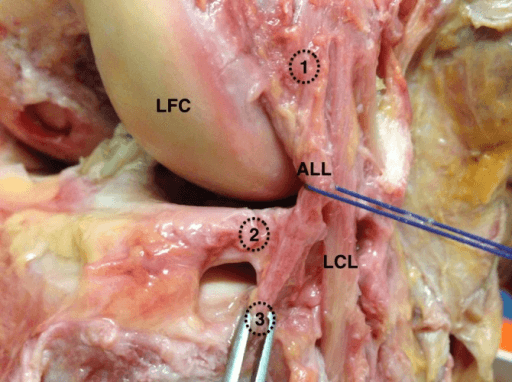
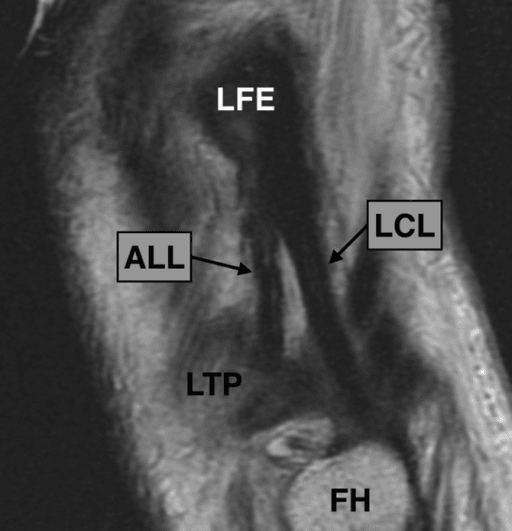
The posterolateral corner. The PLC is described in three layers:
- Layer 1, superficial: iliotibial band and biceps femoris tendon
- Layer 2, middle: lateral retinaculum and patellofemoral ligaments
- Layer 3, deep: LCL (fibular collateral ligament), popliteus muscle and tendon, popliteofibular ligament, arcuate ligament complex, fabellofibular ligament (when a fabella is present) and the lateral capsule
The triad. The core of the corner is the LCL, popliteus and the popliteofibular ligament. The LCL is the static varus restraint; popliteus is a dynamic stabiliser that resists external rotation and anchors the corner; the popliteofibular ligament connects popliteus to the fibular styloid and is critical to PLC stability. Injury to all three produces significant posterolateral rotatory instability.
Biomechanics. The LCL is the primary varus stabiliser at all flexion angles, providing 55% of varus restraint at 5° and 69% at 25°, with its maximum constraint at 30°, where the cruciates relax. The secondary stabilisers are the cruciates (especially the PCL) at full extension, the popliteus complex, the ITB and biceps femoris.
Why the test is done at two angles. At 0° the ACL and PCL are taut and provide secondary varus restraint; at 30° they relax and the LCL becomes the isolated primary restraint. Opening at 0° therefore indicates a combined LCL plus cruciate injury, usually involving the PCL, while opening only at 30° suggests an isolated LCL injury.
Classification Systems
Grading is based on varus stress testing at 30° of flexion, the angle that isolates the LCL.
- Pathology
- Microscopic fibre damage, ligament intact
- Varus Stress at 30°
- Under 5mm opening, firm endpoint
- Clinical Features
- Tenderness, no instability, full ROM
- Pathology
- Partial macroscopic tear, some fibres intact
- Varus Stress at 30°
- 5-10mm opening, endpoint present
- Clinical Features
- Pain with varus stress, mild laxity
- Pathology
- Complete tear (midsubstance or avulsion)
- Varus Stress at 30°
- Over 10mm opening, no endpoint
- Clinical Features
- Gross laxity, may be painless (complete disruption)
History
Mechanism. Ask what direction the force came from and whether there was contact. The patterns that tear the lateral side:
- Varus force to the weight-bearing knee (a tackle from the medial side)
- Non-contact hyperextension with a varus moment
- Dashboard injury with the knee flexed and externally rotated
- Twisting injury with the foot planted
Symptoms. Lateral knee pain that is worse with varus stress, a feeling of instability especially on pivoting or cutting, and the knee giving way in combined injuries. A pop or snap at the time of injury is reported, though less commonly than with an ACL tear.
Questions that change management. Was there immediate swelling, which suggests cruciate involvement? Could the patient weight-bear afterwards? Any previous knee injury, and what are the sport and activity demands?
Examination
Inspection. Look for lateral ecchymosis; bruising that is posterolateral suggests the corner. An effusion is an intra-articular sign and indicates cruciate involvement. Watch the patient walk.
Palpation. Work along the structures in turn:
- The LCL along its course from epicondyle to fibular head
- The fibular head, where tenderness suggests avulsion
- The lateral joint line
- The peroneal nerve at the fibular neck
- The popliteal fossa for popliteus
Special tests.
- Varus stress test, the most important. Stabilise the femur, apply a varus force at the ankle and test at 0° and 30° of flexion, comparing with the other knee. Grade the opening as I (under 5mm), II (5-10mm) or III (over 10mm) and note the endpoint: firm means a partial tear, soft or absent means a complete one.
- Dial test. Test external rotation at 30° and 90° of flexion and read the asymmetry against the contralateral side; performing it prone as well as supine (the heel-height / prone versus supine nuance) makes the foot-thigh angle easier to read. Over 10° of asymmetry at 30° only indicates an isolated PLC injury; over 10° at both 30° and 90° indicates a combined PLC plus PCL injury.
- Posterolateral drawer. At 90° of flexion, apply a posterior force with external rotation. A positive test indicates PLC injury.
- Reverse pivot shift. Extend the knee from flexion with valgus and external rotation. A reduction clunk indicates PLC laxity and posterolateral rotatory instability.
- External rotation recurvatum test (Hughston). With the patient supine and the knees extended, lift both feet off the bed by the great toes. In a PLC-deficient knee the tibia drops into hyperextension, varus and external rotation relative to the other side. It is most positive when the PLC injury is combined with an ACL injury and is a useful screening sign for significant posterolateral and combined instability.
- Varus thrust on gait. A dynamic sign of functional PLC deficiency: the knee thrusts laterally into varus at heel-strike and stance. Its presence, especially in chronic injury, signals that ligament reconstruction alone will fail without addressing alignment, and it flags the chronic, malaligned knee that needs an osteotomy.
Neurovascular examination. Peroneal nerve assessment is mandatory in every lateral knee injury. Test and record:
- Motor: ankle dorsiflexion (tibialis anterior, deep peroneal), great toe extension (EHL, deep peroneal) and ankle eversion (peronei, superficial peroneal)
- Sensory: the first web space (deep peroneal) and the dorsolateral foot (superficial peroneal)
- Vascular: dorsalis pedis and posterior tibial pulses, capillary refill, and an ABI if there is any concern about vascular injury
Peroneal nerve injury complicates around 25% of knee dislocations with posterolateral disruption (Niall et al, 2005), and recovery is frequently incomplete.
Always document peroneal nerve function (dorsiflexion power, first web space sensation) BEFORE any intervention including bracing, examination under anaesthesia, or surgery. Medicolegal significance is high.
Differential Diagnosis of Lateral Knee Instability/Pain
- Distinguishing Features
- Varus laxity at 30° only, normal rotation, varus stable at 0°
- Key Test/Investigation
- Varus stress at 0° and 30°; MRI confirms isolated FCL
- Distinguishing Features
- Varus laxity plus increased external rotation; posterolateral rotatory instability
- Key Test/Investigation
- Dial test (over 10° asymmetry at 30°), posterolateral drawer, reverse pivot shift
- Distinguishing Features
- Posterior sag, increased ER at BOTH 30° and 90°
- Key Test/Investigation
- Dial test at 30° and 90°; posterior drawer; MRI
- Distinguishing Features
- Gross multidirectional instability, high-energy mechanism, neurovascular risk
- Key Test/Investigation
- ABI, CT angiography, peroneal nerve exam, MRI
- Distinguishing Features
- Lateral pain with activity, no instability, tender over lateral epicondyle
- Key Test/Investigation
- Noble/Ober tests; no varus laxity
- Distinguishing Features
- Joint-line pain, mechanical catching/locking, no varus laxity
- Key Test/Investigation
- McMurray/Thessaly; MRI
- Distinguishing Features
- Focal fibular tenderness, possible peroneal nerve signs
- Key Test/Investigation
- AP/lateral X-ray; assess associated LCL avulsion (arcuate sign)
Investigations
Radiographs. Start with AP, lateral and skyline views; add bilateral weight-bearing views if the injury is chronic and stress views if the diagnosis is uncertain. The findings to look for:
- Arcuate sign - avulsion of the fibular styloid. It is highly specific for posterolateral corner injury (if you see it, the corner is torn) but not sensitive, and most PLC injuries show no avulsion at all. A normal radiograph is not reassurance: Pacheco's series missed 72% of these injuries at first presentation.
- Segond fracture - a lateral tibial avulsion of the anterolateral capsule that suggests ACL injury
- Lateral capsular avulsion
- Fibular head fracture
- Varus alignment in chronic deficiency
Stress radiographs. A varus stress view at 20° of flexion with side-to-side comparison is the objective measure of lateral compartment gapping, and the one investigation that separates an isolated ligament tear from a whole corner. There are two thresholds, not one (LaPrade 2008, clinician-applied stress): an increase of about 2.7mm indicates an isolated fibular collateral ligament tear, and about 4.0mm a complete grade III posterolateral corner injury. Quote only the 4mm figure and a complete isolated FCL rupture gets reported as normal. Under a standardised 12-Nm moment rather than a clinician's hand the increases are smaller, 2.1mm and 3.4mm, so record which method produced the number.
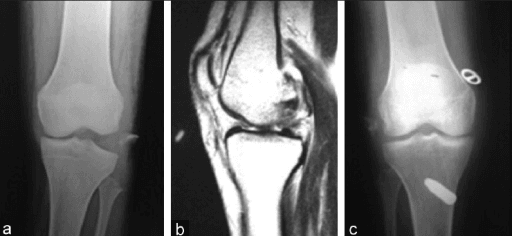
MRI. The gold standard for soft-tissue assessment, with a sensitivity of 90-95% for complete LCL tears and somewhat lower for partial tears. The LCL itself shows increased T2 signal (oedema or tear), discontinuity in a complete tear, a bony avulsion at the fibula or epicondyle, or a wavy appearance in chronic elongation. Read the rest of the scan for the company the ligament keeps:
- PLC structures: popliteus tendon and muscle, popliteofibular ligament, arcuate ligament and lateral capsule, and the bone bruise pattern (lateral femoral condyle and medial tibial plateau = a PLC mechanism)
- Associated injuries: PCL and ACL status, the menisci, cartilage, and signal change in the peroneal nerve
Vascular and nerve studies. Where there is concern about the circulation, an ankle-brachial index under 0.9 is abnormal, CT angiography follows any suspicion of vascular injury, and duplex ultrasound is the alternative. EMG and nerve conduction studies are indicated if peroneal nerve injury is suspected, timed at 3 weeks after injury to allow for wallerian degeneration.
Examination under anaesthesia. Indicated when pain precludes an adequate examination, and often combined with arthroscopy for intra-articular assessment. Document every stability finding carefully while the patient is asleep.
Non-Operative Management
Who. Non-operative treatment suits all grade I injuries, most grade II injuries, selected isolated grade III injuries, elderly or low-demand patients, and those with significant medical comorbidities.
A grade I sprain is treated functionally and recovers fully, typically in 2-4 weeks.
Acute phase, week 0-1. PRICE (protection, rest, ice, compression, elevation), an optional functional hinged brace for the first week or two, weight-bearing as tolerated, and NSAIDs for pain and inflammation.
Recovery phase, weeks 1-3. Range-of-motion exercises aiming for full movement by 2 weeks, quadriceps and hamstring strengthening, proprioception work and stationary cycling.
Return to sport, weeks 3-6. Sport-specific drills, with a functional brace for contact sports initially. Full return when strength is 90% and there is no pain with stress.
Management Algorithm
Treatment decisions rest on injury severity, the associated structures and the patient's demands. A knee that opens at 0° has a combined LCL and cruciate injury and cannot be managed non-operatively.
- Initial Assessment
- Under 5mm varus, firm endpoint
- Management
- Functional treatment, early ROM
- Timeline
- Return 2-4 weeks
- Initial Assessment
- 5-10mm varus, endpoint present
- Management
- Hinged brace 4-6 weeks, PT
- Timeline
- Return 6-12 weeks
- Initial Assessment
- Over 10mm varus at 30° only
- Management
- Trial bracing 6-8 weeks, reassess
- Timeline
- Surgery if persistent laxity
- Initial Assessment
- Varus + external rotation asymmetry
- Management
- Surgical reconstruction (LCL + PLC)
- Timeline
- Surgery within 2-3 weeks ideal
- Initial Assessment
- Varus at 0° AND 30°, + cruciate tests
- Management
- Multi-ligament reconstruction
- Timeline
- Staged or single-stage, surgeon preference
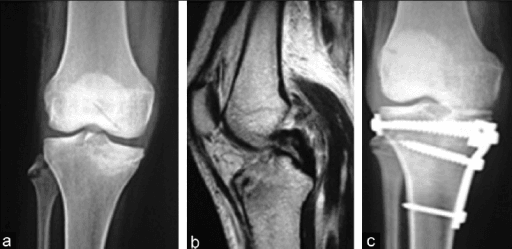
Surgical Management
Absolute
- Combined LCL + PLC injury (Fanelli B/C)
- Combined LCL + cruciate injury
- Multi-ligament knee injury
- Bony avulsion with displacement (repair/fixation)
- Peroneal nerve injury requiring exploration
- Failed non-operative treatment of isolated Grade III
Relative
- High-demand athlete with isolated Grade III
- Persistent symptomatic instability
- Varus thrust gait in chronic injury
- Primary varus: varus due to tibiofemoral bony/articular alignment alone (constitutional varus +/- lateral compartment cartilage/meniscus loss). The lateral soft tissues are competent.
- Double varus: primary (bony) varus plus separation of the lateral tibiofemoral compartment from deficiency/laxity of the lateral soft-tissue restraints (LCL/PLC stretch) - the limb is more varus on weight-bearing than the bony alignment alone predicts.
- Triple varus: double varus plus posterolateral rotatory instability and varus recurvatum (frank PLC incompetence with hyperextension/external rotation) - this is the knee with a visible varus thrust.
Why it matters: in double and especially triple varus, a ligament reconstruction performed on a malaligned limb is loaded by the uncorrected varus mechanical axis and stretches out/fails. The principle is therefore to correct alignment first (or concurrently) with a valgus-producing high tibial osteotomy, which shifts the weight-bearing axis laterally, abolishes the varus thrust and protects the subsequent (or staged) PLC reconstruction. Some triple-varus knees become asymptomatic after osteotomy alone, deferring or avoiding ligament surgery.
Complications
- Risk Factors
- Grade III injury, posterolateral trauma, fibular fracture
- Prevention/Management
- Document pre-op function, careful dissection, explore if no recovery by 3 months
- Risk Factors
- Missed PLC injury, inadequate reconstruction, non-anatomic repair
- Prevention/Management
- Complete assessment pre-op, anatomic reconstruction technique
- Risk Factors
- Prolonged immobilisation, associated intra-articular injury
- Prevention/Management
- Early ROM, avoid over-tensioning graft
- Risk Factors
- Chronic instability, failed treatment
- Prevention/Management
- Correct with reconstruction, may need HTO for varus malalignment
- Risk Factors
- Untreated posterolateral instability
- Prevention/Management
- Always address PLC with cruciate reconstruction
Postoperative Care
Hinged brace locked at 0°, toe-touch weight-bearing, ice and elevation, gentle quad sets, ankle pumps. No active hamstring exercises (protects PLC repair).
Progress ROM in brace (0-90° by week 4, full by week 6), progress to 50% weight-bearing by week 4, stationary cycling, pool exercises, continue quad strengthening.
Full weight-bearing, wean from brace by week 8, closed chain exercises, proprioception training, progress strengthening, avoid pivoting/cutting.
Sport-specific training progression, agility drills (straight-line first, then cutting), plyometrics, functional testing at 6 months.
Full return when passing functional tests (hop tests over 90%, isokinetic strength over 85%), sport-specific brace recommended for first season, ongoing maintenance program.
Avoid active hamstring exercises in the early postoperative period: the biceps femoris inserts with the LCL and can stress the reconstruction. Rehabilitation is quad-dominant initially.
Outcomes and Prognosis
Non-operative. Grade I injuries return to sport in 100% of cases with no residual laxity, and grade II in 95% or more with minimal residual laxity. Isolated grade III injuries do satisfactorily with bracing in 70-80%, and the remaining 20-30% need delayed surgery.
Surgical. By procedure:
- Return to Sport
- 85-90%
- Stability Restoration
- 90%+
- Complications
- Under 5%
- Return to Sport
- 75-85%
- Stability Restoration
- 80-90%
- Complications
- 5-10%
- Return to Sport
- 70-80%
- Stability Restoration
- 75-85%
- Complications
- 10-15%
- Return to Sport
- 60-75%
- Stability Restoration
- 70-85%
- Complications
- 15-20%
What shifts the result. Acute surgery, an isolated injury, a young patient and anatomic technique favour a good outcome; chronic injury, multi-ligament involvement, varus alignment and nerve injury work against it.
Guidelines, Registries & Global Practice
Global epidemiology. Isolated LCL injury is rare; lateral-sided injuries usually involve the posterolateral corner and are frequently part of multiligament injury or frank knee dislocation. PLC injury is commonly missed at first presentation - Pacheco et al found it was unrecognised in 72% of referred cases, with a mean diagnostic delay of 30 months (J Bone Joint Surg Br, 2011). In knee dislocation, common peroneal nerve palsy complicates around 25% and is associated with posterolateral disruption (Niall et al, 2005). Sport-related cohorts confirm that lateral and bicruciate patterns carry a worse return-to-play prognosis than medial-sided injuries (Bakshi et al, Sports Health, 2018).
Guidance across major bodies. No society has published a high-level (Level I) standalone guideline for isolated LCL/PLC injury; recommendations are consensus-based and consistent internationally.
- Region
- USA
- Core guidance
- Reconstruct (not repair) complete PLC tears; address PLC with concomitant cruciate reconstruction
- Evidence level
- Expert consensus / Level III-V
- Region
- UK
- Core guidance
- Early specialist referral and MRI for suspected PLC; anatomic reconstruction for complete injury
- Evidence level
- Consensus
- Region
- UK
- Core guidance
- No condition-specific guideline; general acute knee soft-tissue injury pathways apply
- Evidence level
- n/a
- Region
- Europe
- Core guidance
- Anatomic reconstruction preferred over repair for chronic/complete PLC; treat associated cruciate injury
- Evidence level
- Consensus / Level III-V
- Region
- Global
- Core guidance
- Fix displaced fibular/arcuate avulsions; reconstruct chronic ligamentous deficiency
- Evidence level
- Expert opinion
Registry evidence. Joint-replacement registries (AOANJRR, NJR, AJRR) do not capture isolated ligament reconstruction, so there is no national LCL/PLC implant-survival dataset; the evidence base remains cohort studies and biomechanical work. Multiligament and dislocation cohorts (including military and professional-sport series) provide the best available outcome data.
Practice variation. Surgeons increasingly favour anatomic two-graft reconstruction (after LaPrade) over older single-graft (Larson) techniques and over primary repair, reflecting Stannard's finding of higher failure with repair. Timing is convergent internationally: acute injuries are best addressed within roughly 2-3 weeks while primary repair/augmented repair remains feasible, with reconstruction reserved for chronic deficiency.
MCQ Practice Points
Q: What is the primary restraint to varus stress at 30 degrees knee flexion? A: The lateral collateral ligament (LCL) is the primary varus stabilizer, providing 69% of varus restraint at 25-30 degrees flexion. At this angle, the cruciates relax making the LCL the isolated primary restraint.
Q: What does varus opening at both 0 and 30 degrees indicate? A: Combined injury to both the LCL AND the cruciate ligaments (particularly PCL). Opening only at 30 degrees suggests isolated LCL injury since the cruciates are taut at 0 degrees and contribute to varus restraint.
Q: What is the dial test and what does asymmetry at 30 degrees only indicate? A: The dial test assesses external rotation of the tibia relative to the femur. Asymmetry greater than 10 degrees at 30 degrees ONLY indicates isolated PLC injury. Asymmetry at BOTH 30 and 90 degrees indicates combined PLC plus PCL injury.
Q: What is the arcuate sign? A: A small avulsion fracture of the fibular STYLOID, best seen on the AP knee radiograph. It represents avulsion of the arcuate complex - principally the popliteofibular ligament, whose anterior and posterior divisions attach at the styloid tip - and it is highly specific for posterolateral corner injury. Do not confuse it with avulsion of the conjoint tendon of biceps femoris and the fibular collateral ligament, which attaches to the fibular HEAD more anterolaterally and gives a larger fragment. The catch is sensitivity: most PLC injuries produce no avulsion at all, so a clean radiograph excludes nothing.
Q: Why is untreated PLC injury important in ACL reconstruction? A: Untreated posterolateral corner instability is the NUMBER ONE cause of ACL graft failure. The abnormal tibial external rotation places excessive stress on the ACL graft, leading to elongation or rupture.
Q: What is the relationship between the common peroneal nerve and the LCL? A: The common peroneal nerve passes approximately 10mm posterior to the biceps femoris tendon at the fibular head level. Peroneal nerve injury complicates around 25% of knee dislocations with posterolateral disruption (Niall et al, 2005).
Clinical Decision Scenarios
Practise clinical reasoning and management decisions out loud
“25-year-old rugby player presents after a tackle from the medial side. Has lateral knee pain and weakness of ankle dorsiflexion. X-ray shows fibular styloid avulsion (arcuate sign). Varus stress at 30° shows over 10mm opening. Varus at 0° is normal.”
“30-year-old AFL player has lateral knee injury. Varus stress positive at 30° (Grade III). Dial test shows 15° external rotation asymmetry at 30° but not at 90°. What is your diagnosis and management?”
“A 28-year-old presents 18 months after ACL reconstruction with recurrent instability. Original MRI showed isolated ACL tear. Examination shows 2+ Lachman and Grade II varus laxity. What happened?”
“45-year-old presents with lateral knee pain and 'knee bowing outward' when walking. History of knee injury 5 years ago, managed conservatively. Standing alignment shows 8° varus. Stress testing shows Grade II varus laxity.”
Key Numbers
- 30° flexion - optimal angle for varus stress testing (isolates LCL)
- Under 5mm opening = Grade I, 5-10mm = Grade II, over 10mm = Grade III
- Dial test: over 10° asymmetry at 30° = PLC injury; both 30° and 90° = PLC + PCL
- Isolated LCL injury is uncommon - most lateral injuries involve the PLC
- Peroneal nerve injury ~25% in knee dislocation with PLC disruption (Niall 2005)
Critical Concepts
- Isolated LCL injury is RARE - always assess PLC
- Varus opening at 0° = combined LCL + cruciate injury
- Peroneal nerve documentation BEFORE any intervention is mandatory
- Untreated PLC is #1 cause of ACL/PCL reconstruction failure
- Acute repair/reconstruction (under 3 weeks) has better outcomes
Must-Know Anatomy
- LCL: Lateral epicondyle to fibular head (extra-articular)
- PLC triad: LCL + popliteus + popliteofibular ligament
- Peroneal nerve: 10mm posterior to biceps tendon at fibular neck
- Arcuate sign: Fibular styloid avulsion = PLC injury
Management Principles
- Grade I-II isolated: Non-operative (brace, PT)
- Grade III isolated: Trial bracing, surgery if fails
- Combined LCL + PLC: Surgical reconstruction required
- Combined + cruciate: Address all structures, PLC protects graft
- Chronic instability + varus: HTO before or with reconstruction
Viva Pearls
- Always examine BOTH 0° and 30° for varus stress
- Dial test at 30° AND 90° differentiates PLC vs PLC+PCL
- Check peroneal nerve before doing ANYTHING
- Failed cruciate reconstruction - think missed PLC injury
- Chronic varus thrust needs alignment correction first
Evidence Base
LaPrade Anatomic Two-Graft PLC Reconstruction (Landmark Technique)
- Cadaveric study (10 specimens): two-graft technique anatomically reconstructs FCL, popliteus tendon and popliteofibular ligament
- Reconstruction significantly improved varus stability versus the cut (Grade III) state at 0°, 30°, 60° and 90° of flexion
- No significant difference in external rotation between intact and reconstructed knees at any flexion angle
- Provided the biomechanical basis for the modern anatomic PLC reconstruction
PLC Repair versus Reconstruction (Stannard)
- Prospective cohort of 64 PLC tears (39 repairs, 25 reconstructions; minimum 24-month follow-up)
- Acute primary repair failed in 13 of 35 (37%) versus 2 of 22 (9%) for reconstruction (statistically significant)
- Reconstruction using the modified two-tailed technique gave significantly better stability than repair
- Authors now favour reconstruction over repair for most high-energy PLC tears
PLC Injuries: A Serious Injury Commonly Missed (Pacheco)
- Retrospective review of 68 referred PLC injuries; injury was not identified at initial presentation in 49 of 68 patients (72%)
- Mean delay to correct diagnosis was 30 months from time of injury
- MRI correctly identified 14 of 15 injuries when performed within 12 weeks, but only 4 of 15 when performed later
- PLC injury was usually recognised only when severe multiligament injury was present
Untreated Grade III PLC Injury Increases ACL Graft Force (LaPrade)
- Cadaveric biomechanical study of ACL-reconstructed knees with sequential sectioning of the FCL, popliteofibular ligament and popliteus tendon
- ACL graft force was significantly higher after FCL sectioning during varus loading at both 0° and 30° of flexion
- Coupled varus and internal rotation moments increased graft force further beyond varus alone
- Supports the clinical observation that untreated Grade III PLC injury contributes to ACL graft failure
Common Peroneal Nerve Palsy After Knee Dislocation (Niall)
- Common peroneal nerve injury in 14 of 55 patients (25%) with knee dislocation; all had posterolateral structure disruption
- Palsy occurred in 14 of 34 (41%) of those with combined bicruciate and posterolateral injury
- Complete recovery in only 3 (21%) and partial useful motor recovery in 4 (29%); no useful recovery in 7 (50%)
- Lesions in continuity under 7 cm long recovered within 6 to 18 months
Posterolateral Attachments of the Knee: Surgical Anatomy (LaPrade)
- Cadaveric morphologic study (10 knees) quantifying attachments of the FCL, popliteus tendon and popliteofibular ligament
- FCL femoral attachment averaged 1.4 mm proximal and 3.1 mm posterior to the lateral epicondyle; fibular attachment 8.2 mm posterior to the anterior fibular head
- Popliteus tendon femoral attachment was consistently anterior to the FCL (mean separation 18.5 mm)
- Popliteofibular ligament had constant anterior and posterior divisions at the fibular styloid
Varus Stress Radiographs for Isolated FCL and Grade-III Posterolateral Injuries (LaPrade)
- Ten cadaveric limbs, sequentially sectioned, radiographed under both a standardised 12-Nm moment and a clinician-applied varus stress
- Intact lateral compartment gapping was 8.9 mm under the 12-Nm moment and 9.7 mm under clinician-applied stress - the ABSOLUTE number is meaningless without the uninjured side
- Sectioning the fibular collateral ligament alone increased gapping by 2.1 mm (12-Nm) and 2.7 mm (clinician-applied)
- Complete posterolateral corner sectioning increased it by 3.4 mm and 4.0 mm respectively - so the two diagnoses are separated by barely a millimetre
- Reliability was excellent: intraobserver ICC 0.99, interobserver ICC 0.97
Return to Play After Multiligament Knee Injury in NFL Athletes (Bakshi)
- Retrospective cohort of 50 NFL athletes; overall return-to-play rate 64%
- Athletes with ACL and PCL/LCL injury had a lower RTP rate (55.6%) and longer recovery than ACL/MCL injuries (70.8%)
- Mean time to RTP was 459 days for combined ACL and PCL/LCL injury versus 305 days for ACL/MCL injury
- Lateral-sided and bicruciate injury patterns carry a worse prognosis than medial-sided patterns